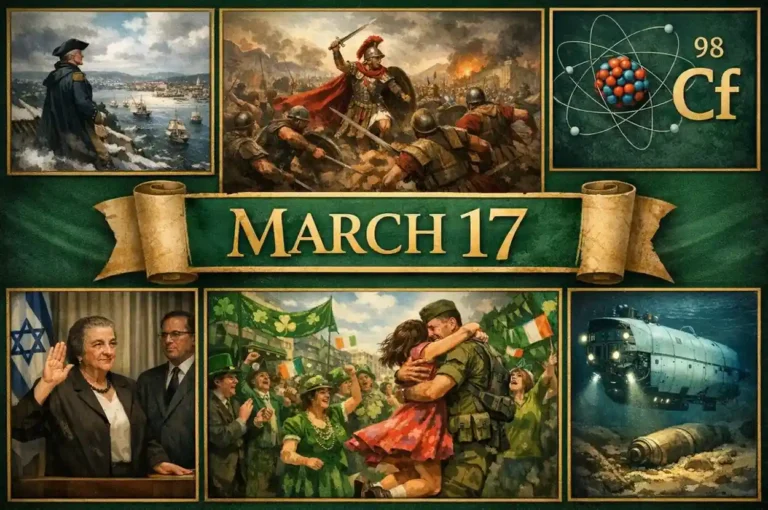

A few dates stand out for the way human creativity and resolve reshape the world. This day in history March 14, celebrates breakthroughs that transformed lives—from Eli Whitney’s cotton gin patent to the first life saved by penicillin—while also marking Pi Day’s scientific spirit and major turning points like the recapture of Seoul and Slovakia’s declaration of independence.
Important Events That Happened On March 14 In History
1074 – Battle of Mogyoród
In a significant struggle for the Hungarian throne, Dukes Géza and Ladislaus faced their cousin, King Solomon. The brothers achieved a decisive victory, forcing Solomon to flee toward the western borders of Hungary. This battle effectively shifted the balance of power, leading to Géza’s ascension and later the legendary reign of Saint Ladislaus.
1590 – Battle of Ivry
During the French Wars of Religion, Henry of Navarre led the Huguenot forces to a stunning victory over the Catholic League. Commanded by the Duke of Mayenne, the League’s forces were soundly defeated. Henry’s success at Ivry was a major stepping stone in his path to the French throne, famously marked by his white plume used as a rallying point for his troops.
1647 – The Truce of Ulm
As the Thirty Years’ War ravaged Europe, a significant diplomatic breakthrough occurred with the signing of the Truce of Ulm. Bavaria, Cologne, France, and Sweden agreed to a cessation of hostilities. This agreement forced the Elector of Bavaria to abandon his alliance with the Holy Roman Emperor, significantly weakening the Imperial position in the final stages of the war.
1663 – Otto von Guericke Completes Experimenta Nova
The scientist and inventor Otto von Guericke completed his seminal work detailing his groundbreaking research into the nature of the vacuum. In this book, he described his famous Magdeburg hemispheres experiment and his discovery of electrostatic repulsion. His work laid the foundational physics for atmospheric pressure and the development of the vacuum pump.
1674 – Battle of Ronas Voe
During the Third Anglo-Dutch War, a fierce naval engagement took place at Ronas Voe in the Shetland Islands. British forces successfully captured the Dutch East India Company ship Wapen van Rotterdam. The encounter resulted in a heavy toll for the Dutch, with up to 300 crew members and soldiers losing their lives during the capture.
1757 – Execution of Admiral Sir John Byng
In a rare and controversial application of the Articles of War, Admiral Sir John Byng was executed by firing squad aboard the HMS Monarch. He was convicted of “failing to do his utmost” during the Battle of Minorca. His execution served as a stark warning to the British naval command and was famously satirized by Voltaire as being done “to encourage the others.”
1780 – Capture of Fort Charlotte
Spanish forces achieved a strategic victory in the American Revolutionary War by capturing Fort Charlotte in Mobile, Alabama. This was the last British frontier post capable of threatening New Orleans. The fall of the fort secured Spanish control over the Gulf Coast and significantly hindered British operations in the southern theater of the war.
1794 – Eli Whitney Patents the Cotton Gin
Eli Whitney was officially granted a patent for the cotton gin, a machine that revolutionized the processing of short-staple cotton. By automating the removal of seeds from cotton fiber, the invention exponentially increased productivity. However, it also inadvertently strengthened the institution of slavery in the American South by making cotton a massively profitable global commodity.
1864 – Premiere of Rossini’s Petite messe solennelle
Gioachino Rossini’s “little” solemn mass was first performed in a private mansion in Paris. Despite the title, the work was a profound musical statement featuring twelve singers, two pianists, and a harmonium player. It was one of the last major compositions by the legendary opera composer, written years after his retirement from the stage.
1885 – Premiere of The Mikado
The Savoy Theatre in London hosted the first public performance of The Mikado, the celebrated light opera by W.S. Gilbert and Arthur Sullivan. With its satirical take on British politics disguised in a Japanese setting, it became one of the most successful and enduring pieces of musical theater in history, running for 672 consecutive performances in its initial London run.
1900 – The Gold Standard Act
The United States officially ratified the Gold Standard Act, which placed the nation’s currency on a fixed gold basis. This act ended the long-standing debate between the “gold bugs” and those favoring silver, establishing gold as the sole standard for redeeming paper money. The move brought stability to the U.S. financial system at the dawn of the 20th century.
1901 – Utah’s Anti-Polygamy Veto
Governor Heber Manning Wells took a firm stance by vetoing a bill that would have eased restrictions on polygamy in Utah. The governor feared that passing such legislation would jeopardize Utah’s hard-won statehood and reignite tensions with the federal government. His veto signaled a definitive move toward mainstream American legal standards regarding marriage.
1903 – Pelican Island National Wildlife Refuge
President Theodore Roosevelt established the Pelican Island National Wildlife Refuge in Florida, marking the birth of the National Wildlife Refuge System. This was the first time the federal government set aside land specifically for the protection of wildlife. Roosevelt’s executive order paved the way for a massive expansion of environmental conservation efforts in the United States.
1916 – Capture of Côte 265 at Verdun
During the brutal Battle of Verdun, German forces successfully captured Côte 265 on the west end of the Mort-Homme ridge. Despite this loss, the French 75th Infantry Brigade managed to hold Côte 295 on the east end. The ridge remained a scene of intense, bloody fighting as both sides struggled for the high ground overlooking the Meuse River.
1920 – Second Schleswig Plebiscite
In a vote to determine national borders following WWI, approximately 80% of the population in Zone II voted to remain part of Weimar Germany. This plebiscite was part of a series of democratic votes to resolve the long-standing Schleswig-Holstein question between Germany and Denmark, resulting in the current border that exists today.
1921 – Execution of the “Forgotten Ten”
In the midst of the Irish War of Independence, six members of the Irish Republican Army were hanged at Dublin’s Mountjoy Prison. Known as part of the “Forgotten Ten,” these activists were executed for their roles in the conflict against British rule. Their deaths became a rallying point for the republican movement during a period of escalating violence.
1923 – Execution of Charlie Daly
In the later stages of the Irish Civil War, Free State forces executed Charlie Daly and three other members of the Irish Republican Army. These executions were part of a series of controversial state-sanctioned killings intended to suppress anti-treaty resistance. The events deepened the bitterness and divisions that defined the early years of the Irish Free State.
1926 – El Virilla Train Accident
One of the deadliest rail disasters in history occurred in Costa Rica when a train fell off a bridge over the Río Virilla. The accident, taking place between Heredia and Tibás, resulted in the deaths of 248 people and left nearly 100 others wounded. The tragedy led to a national period of mourning and a massive investigation into the country’s rail safety.
1931 – Release of Alam Ara
India’s cinematic history was forever changed with the release of Alam Ara, the country’s first “talkie” or sound film. Directed by Ardeshir Irani, the movie premiered at the Majestic Cinema in Mumbai. The introduction of sound and music in Alam Ara laid the foundation for the massive, song-and-dance-driven film industry that India is known for today.
1939 – Slovakia Declares Independence
Under intense pressure from Nazi Germany, Slovakia declared itself an independent state. The move was a precursor to the complete dismemberment of Czechoslovakia by Adolf Hitler. This new Slovak Republic became a puppet state of the Third Reich, marking a dark turning point in the lead-up to the official start of World War II.
1942 – First Patient Treated with Penicillin
In a landmark moment for modern medicine, Anne Miller became the first American patient to be successfully treated with penicillin. Suffering from a life-threatening streptococcal infection, her recovery under the care of doctors Orvan Hess and John Bumstead proved the miraculous potential of antibiotics. This event ushered in the antibiotic era, saving millions of lives globally.
1943 – Liquidation of the Kraków Ghetto Completed
The final stage of the liquidation of the Kraków Ghetto was completed by German forces. Over the course of this brutal operation, the remaining Jewish residents were either murdered on-site or deported to concentration camps like Płaszów and Auschwitz. The liquidation effectively destroyed one of the oldest and most vibrant Jewish communities in Europe.
1945 – First Use of the “Grand Slam” Bomb
The Royal Air Force deployed the massive 22,000-pound “Grand Slam” earthquake bomb for the first time in combat. Dropped by a Lancaster bomber, the weapon targeted the Bielefeld railway viaduct in Germany. The bomb’s immense power was designed to penetrate deep into the ground before exploding, creating shockwaves that collapsed heavy infrastructure.
1951 – UN Forces Recapture Seoul
For the second time during the Korean War, United Nations troops successfully recaptured the city of Seoul from communist forces. The city had been devastated by months of urban warfare and had changed hands several times. This recapture was a major strategic and psychological victory for the UN and South Korean forces, though the conflict continued for two more years.
1961 – Yuba City B-52 Crash
A United States Air Force B-52 bomber carrying two nuclear weapons crashed near Yuba City, California, following a fuel leak and cabin depressurization. While the aircraft was destroyed, the safety mechanisms on the nuclear weapons prevented a nuclear detonation. The crew successfully bailed out, and the incident remains one of the most famous “Broken Arrow” events of the Cold War.
1964 – Conviction of Jack Ruby
In a televised legal event, Jack Ruby was convicted of the murder of Lee Harvey Oswald, the man accused of assassinating President John F. Kennedy. Ruby had shot Oswald in the basement of the Dallas Police Headquarters two days after the JFK assassination. The conviction added another layer of complexity and conspiracy to the events surrounding the president’s death.
1967 – JFK’s Permanent Burial
The body of President John F. Kennedy was moved from a temporary grave to a permanent burial site at Arlington National Cemetery. The ceremony was attended by members of the Kennedy family and President Lyndon B. Johnson. The site, marked by the Eternal Flame, became a permanent place of pilgrimage and remembrance for the fallen leader.
1972 – Sterling Airways Flight 296 Crash
A Sterling Airways flight crashed into a mountain ridge near Kalba, United Arab Emirates, while on its final approach to Dubai. All 112 people on board were killed in what remains the deadliest aviation accident in the history of the UAE. The investigation pointed to navigational errors as the primary cause of the tragic disaster.
1978 – Operation Litani
The Israel Defense Forces launched Operation Litani, a major military invasion of southern Lebanon. The seven-day campaign was aimed at pushing Palestinian militant groups back from the Israeli border following a series of deadly cross-border attacks. The operation resulted in the occupation of southern Lebanon and the creation of a UN-monitored buffer zone.
1979 – Alia Royal Jordanian Flight 600 Crash
During a severe thunderstorm, an Alia Royal Jordanian aircraft crashed at Doha International Airport in Qatar. The accident claimed the lives of 45 people. The crash was attributed to wind shear, which caused the pilot to lose control of the aircraft during an attempted go-around, highlighting the dangers of extreme weather in aviation.
1980 – LOT Polish Airlines Flight 007 Crash
A LOT Polish Airlines flight crashed near Warsaw after the pilot lost control due to an engine failure. All 87 people on board perished, including 14 members of a US amateur boxing team. The tragedy led to a massive investigation into the Soviet-built Ilyushin II-62 aircraft and deep mourning in both Poland and the United States.
1982 – ANC Headquarters Bombing
The South African apartheid government was responsible for a bomb attack on the headquarters of the African National Congress (ANC) in London. The blast caused significant structural damage but resulted in no fatalities. The incident was a stark example of the apartheid regime’s willingness to conduct clandestine operations against its political opponents on international soil.
1988 – Johnson South Reef Skirmish
Chinese and Vietnamese naval forces engaged in a brief but violent skirmish over control of the Johnson South Reef in the Spratly Islands. Chinese forces successfully defeated the Vietnamese, sinking two ships and resulting in dozens of Vietnamese casualties. The battle underscored the ongoing territorial disputes and geopolitical tensions in the South China Sea.
1991 – Inauguration of the Escondida Mine
The Escondida copper mine, located in Chile’s Atacama Desert, was officially inaugurated. Over the following decades, it would grow to become the most productive copper mine in the world. The mine’s massive output has played a central role in the Chilean economy and the global supply of copper for the electronics and construction industries.
1995 – First American on a Russian Launch Vehicle
Astronaut Norman Thagard made history by becoming the first American to ride into space on board a Russian Soyuz spacecraft. Launched from the Baikonur Cosmodrome, the mission was a landmark in post-Cold War space cooperation, eventually leading Thagard to a 115-day stay on the Russian Mir space station.
2006 – Chadian Coup Attempt Fails
A military coup attempt intended to overthrow Chadian President Idriss Déby ended in failure. Rebel forces, who had been advancing toward the capital, N’Djamena, were repelled by government troops. The event highlighted the persistent political instability in Chad and the frequent armed challenges to Déby’s long-standing rule.
2006 – Raid on Jericho Prison
In an operation known as “Bringing Home the Goods,” Israeli troops launched a raid on a Palestinian prison in Jericho. The objective was to capture Ahmad Sa’adat, the chief of the PFLP, and five other prisoners. The raid took place after American and British monitors withdrew from the site, leading to a ten-hour standoff before the prisoners surrendered.
2007 – Nandigram Violence
Violent clashes broke out in Nandigram, West Bengal, between police and villagers protesting the state government’s plan to acquire land for a Special Economic Zone. At least 14 people were killed in the police firing. The tragedy sparked national outrage and became a turning point in West Bengal politics, eventually leading to a change in the state government.
2008 – Unrest in Lhasa and Tibet
A series of riots and protests erupted in Lhasa, Tibet, on the anniversary of the 1959 uprising. The demonstrations quickly spread to other parts of the Tibetan plateau, leading to clashes between protesters and Chinese security forces. The unrest drew significant international attention to the human rights situation and cultural tensions in Tibet.
2017 – Nihonium Naming Ceremony
A formal naming ceremony for the chemical element 113, Nihonium, was held in Tokyo. With Crown Prince Naruhito in attendance, the event celebrated the first element discovered by scientists in Asia (at the RIKEN Nishina Center). The name “Nihonium” is derived from “Nihon,” one of the two Japanese words for Japan.
2019 – Cyclone Idai Landfall
One of the worst tropical cyclones on record to affect Africa, Cyclone Idai, made landfall near Beira, Mozambique. The storm brought catastrophic winds and flooding to Mozambique, Zimbabwe, and Malawi, resulting in over 1,000 deaths and affecting millions. The disaster prompted a massive international humanitarian response to address the widespread destruction.
2021 – Hlaingthaya Massacre
During the ongoing protests against the military coup in Myanmar, security forces killed at least 65 civilians in the Hlaingthaya township of Yangon. The massacre was one of the deadliest days since the coup began, as the military used lethal force to suppress anti-junta demonstrations. The event led to a surge in international condemnation of the Myanmar military’s actions.
Read Here: What Happened This day in history March 13: Powerful Tales
Famous People Born on March 14
| Name | Description | Date |
|---|---|---|
| Diane Arbus | Influential portrait photographer | March 14, 1923 – July 26, 1971 |
| Casey Jones | Folk hero engineer | March 14, 1864 – April 30, 1900 |
| Martin Dempsey | Chairman, Joint Chiefs of Staff | March 14, 1952 – Present |
| Maurice Merleau-Ponty | Phenomenology pioneer | March 14, 1908 – May 4, 1961 |
| Georg Philipp Telemann | Baroque music master | March 14, 1681 – June 25, 1767 |
| Johann Strauss I | Viennese waltz composer | March 14, 1804 – September 24, 1849 |
| Frank Borman | Apollo 8 commander | March 14, 1928 – November 7, 2023 |
| Umberto I | Italian monarch | March 14, 1844 – July 29, 1900 |
| Algernon Blackwood | Supernatural fiction writer | March 14, 1869 – December 10, 1951 |
| Thomas R. Marshall | VP under Woodrow Wilson | March 14, 1854 – June 1, 1925 |
| Raymond Aron | Political thinker | March 14, 1905 – October 17, 1983 |
| Ferdinand Hodler | Symbolist artist | March 14, 1853 – May 20, 1918 |
| Mustafa al-Barzani | Kurdish nationalist figure | March 14, 1903 – March 1, 1979 |
| Horton Foote | Pulitzer-winning writer | March 14, 1916 – March 4, 2009 |
| Mátyás Rákosi | Communist ruler | March 14, 1892 – February 5, 1971 |
| Giovanni Schiaparelli | Studied Mars “canals” | March 14, 1835 – July 4, 1910 |
| James Nachtwey | War photographer | March 14, 1948 – Present |
| Sylvia Beach | Founder of Shakespeare & Company | March 14, 1887 – October 5, 1962 |
| Wacław Sierpiński | Topology pioneer | March 14, 1882 – October 21, 1969 |
| Pedro Duque | First Spaniard in space | March 14, 1963 – Present |
| Adolph Gottlieb | Abstract Expressionist | March 14, 1903 – March 4, 1974 |
| Thomas Hart Benton | U.S. senator & expansionist | March 14, 1782 – April 10, 1858 |
| Lee Petty | NASCAR champion | March 14, 1914 – April 5, 2000 |
| Józef Bem | Hero of 1848 revolutions | March 14, 1794 – December 10, 1850 |
| Álvaro Arzú | President (1996–2000) | March 14, 1946 – April 27, 2018 |
| Pan Tianshou | Traditional art master | March 14, 1897 – September 5, 1971 |
| Antônio de Castro Alves | “Poet of the slaves” | March 14, 1847 – July 6, 1871 |
| Ada Louise Huxtable | Architecture critic | March 14, 1921 – January 7, 2013 |
| Vilhelm Bjerknes | Weather forecasting pioneer | March 14, 1862 – April 9, 1951 |
| Giuseppe Maria Crespi | Baroque artist | March 14, 1665 – March 25, 1747 |
Famous People Who Died on March 14
| Name | Description | Date |
|---|---|---|
| Nikolay Bukharin | Bolshevik theorist | October 9, 1888 – March 14, 1938 |
| Edward Abbey | Environmental writer | January 29, 1927 – March 14, 1989 |
| Fannie Lou Hamer | Civil rights leader | October 6, 1917 – March 14, 1977 |
| Aleksey Rykov | Bolshevik leader | February 25, 1881 – March 14, 1938 |
| Frederick Jackson Turner | Frontier thesis creator | November 14, 1861 – March 14, 1932 |
| Busby Berkeley | Musical film choreographer | November 29, 1895 – March 14, 1976 |
| Juan Manuel de Rosas | Dictatorial governor | March 30, 1793 – March 14, 1877 |
| Erwin Panofsky | Iconography pioneer | March 30, 1892 – March 14, 1968 |
| John Byng | Executed naval officer | 1704 – March 14, 1757 |
| Mohammad Hatta | Vice president of Indonesia | August 12, 1902 – March 14, 1980 |
| Ben Shahn | Social realist painter | September 12, 1898 – March 14, 1969 |
| Doc Pomus | Rock & pop writer | January 27, 1925 – March 14, 1991 |
| Peter Maxwell Davies | Modern classical composer | September 8, 1934 – March 14, 2016 |
| Frederick Henry, Prince of Orange | Stadtholder | January 29, 1584 – March 14, 1647 |
| Klement Gottwald | Communist leader | November 23, 1896 – March 14, 1953 |
| Einhard | Biographer of Charlemagne | c.770 – March 14, 840 |
| William Fowler | Nobel Prize physicist | August 9, 1911 – March 14, 1995 |
| Howard Aiken | Inventor of Harvard Mark I | March 9, 1900 – March 14, 1973 |
| Augustus FitzRoy | PM during American Revolution | October 1, 1735 – March 14, 1811 |
| Lennart Meri | Post-Soviet leader | March 29, 1929 – March 14, 2006 |
| Chic Young | Creator of Blondie | January 9, 1901 – March 14, 1973 |
| Friedrich Klopstock | Epic poet | July 2, 1724 – March 14, 1803 |
| Ignacy Krasicki | Enlightenment writer | February 3, 1735 – March 14, 1801 |
| Stephen D. Bechtel | Construction executive | September 24, 1900 – March 14, 1989 |
| Janis Čakste | First president of Latvia | September 14, 1859 – March 14, 1927 |
| Ludwig Windthorst | Catholic political leader | January 17, 1812 – March 14, 1891 |
| Johann von Mädler | Lunar cartographer | May 29, 1794 – March 14, 1874 |
| Spinello Aretino | Gothic artist | c.1346 – March 14, 1410 |
| Antoine Furetière | Lexicographer & satirist | December 28, 1619 – March 14, 1688 |
| Pierre‑Claude Nivelle de La Chaussée | Creator of “tearful comedy” | 1692 – March 14, 1754 |
Observances & Institutional Dates
- Pi Day: Celebrated globally to honor the mathematical constant $\pi$ (3.14).
- White Day (Japan & Asia): A day where men give gifts to women in return for Valentine’s Day chocolates.
- Mother Tongue Day (Estonia): Celebrating the Estonian language and its literary heritage.
- National Elephant Day (Thailand): Honoring the cultural and historical importance of elephants.
- Heroes’ Day (Saint Vincent and the Grenadines): Honoring those who have contributed to the nation’s history.
- Nanakshahi New Year: The first day of the month of Chet in the Sikh calendar.
Frequently Asked Questions
- What is Pi Day? Celebrated on March 14 (3/14), it honors the mathematical constant $\pi$ (3.14).
- When was the cotton gin patented? Eli Whitney received the patent on March 14, 1794.
- Who was the first person saved by penicillin? Anne Miller became the first American to be successfully treated on March 14, 1942.
- When did UN forces recapture Seoul? They captured the city for the second time on March 14, 1951.