Some days are remembered for the power of ideas to change the course of history. This day in history March 15, reflects human ingenuity at its finest—from the cotton gin’s industrial impact to penicillin’s lifesaving promise—while also honoring Pi Day and pivotal events such as the recapture of Seoul and Slovakia’s independence.
Important Events That Happened On March 15 In History
474 BC – Truce with Veii
Roman consul Aulus Manlius Vulso celebrated an ovation to mark the conclusion of the war against the city-state of Veii. The victory secured a forty-year truce, providing the Roman Republic with a much-needed period of stability and peace on its northern frontier after years of conflict.
200 BC – Second Macedonian War Declared
Under the leadership of new consuls Publius Sulpicius Galba and Gaius Aurelius Cotta, the Roman Republic officially declared war on Philip V of Macedon. This declaration signaled the start of the Second Macedonian War, a conflict that would eventually establish Roman hegemony over the Greek world.
44 BC – Assassination of Julius Caesar
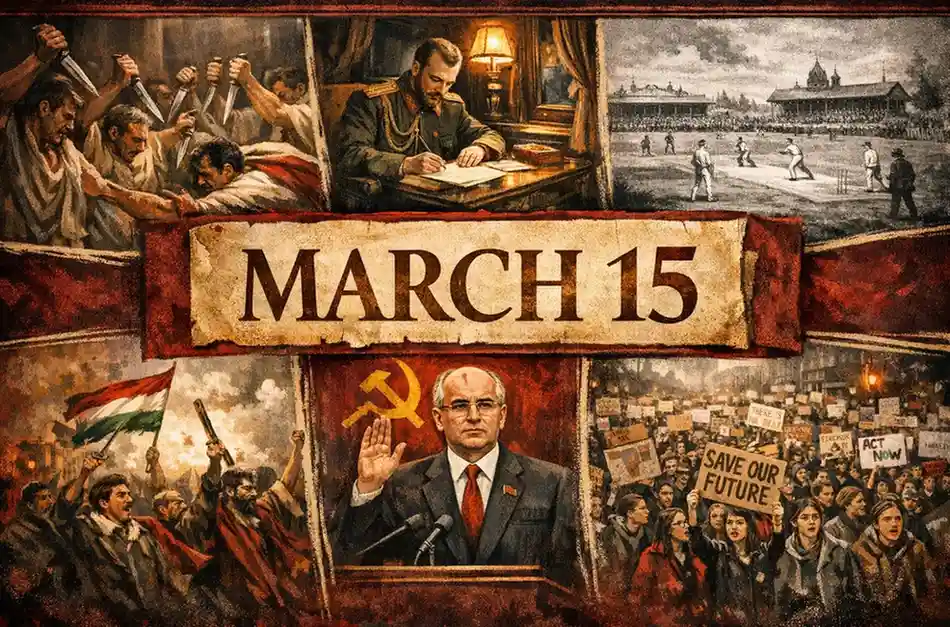
On the Ides of March, Julius Caesar, the dictator of the Roman Republic, was assassinated by a group of senators led by Brutus and Cassius. The conspirators stabbed Caesar to death during a meeting of the Senate, an act intended to restore the Republic but which instead triggered a series of civil wars leading to the birth of the Roman Empire.
351 – Elevation of Constantius Gallus
Constantius Gallus was elevated to the rank of Caesar by his cousin, Emperor Constantius II. Following his appointment, he was dispatched to Antioch to govern the Roman East, tasked with stabilizing the frontier and maintaining imperial authority in the region.
493 – Death of Odoacer
Odoacer, who became the first barbarian King of Italy after the fall of the Western Roman Empire, was slain by Theoderic the Great. The king of the Ostrogoths killed his rival while the two were feasting together, a brutal act that consolidated Theoderic’s control over the Italian peninsula.
856 – Michael III Takes Control
Byzantine Emperor Michael III successfully overthrew the regency of his mother, Empress Theodora. With the critical support of the Byzantine nobility, Michael seized personal control of the empire, ending the long-standing influence of his mother’s administration.
897 – Zaydi Imamate Founded in Yemen
Al-Hadi ila’l-Haqq Yahya entered the city of Sa’dah, where he established the Zaydi Imamate. This event marked the beginning of a long religious and political dynasty in Yemen, with the Zaydi school of thought playing a central role in the region’s history for centuries to follow.
933 – Battle of Riade
After a ten-year truce expired, the German King Henry the Fowler met a Hungarian army at the Battle of Riade near the Unstrut River. Henry’s forces achieved a significant victory, marking a major success in his efforts to protect German territories from Hungarian raids.
1311 – Battle of Halmyros
The Catalan Company, a band of mercenaries, defeated Walter V, Count of Brienne, at the Battle of Halmyros. This victory allowed the company to seize control of the Duchy of Athens, a Crusader state, fundamentally altering the political landscape of medieval Greece.
1412 – Treaty of Lublowa and Grand Tournament
Following the Peace of Thorn, Grand Master Heinrich von Plauen sought economic aid from Sigismund of Hungary. Sigismund agreed to mediate border disputes and financial installments, organizing a massive tournament and lavish feasts to mark the occasion. The event drew 40,000 nobles and 2,000 knights from 17 different countries, including England, Poland, and Bosnia.
1564 – Akbar Abolishes Jizya
In a landmark move of religious tolerance, the Mughal Emperor Akbar abolished the jizya tax, which was traditionally levied on non-Muslim subjects. This decree was a central part of Akbar’s policy to integrate his diverse subjects and build a more inclusive empire.
1626 – Potosí Dam Failure
A catastrophic dam failure caused a sudden and violent flood in the mining city of Potosí, located in modern-day Bolivia. The disaster resulted in the deaths of thousands of residents and caused a massive environmental crisis through the release of toxic mercury, which was used extensively in local silver mining.
1672 – Royal Declaration of Indulgence
King Charles II of England issued the Royal Declaration of Indulgence. This decree granted a limited degree of religious freedom to all Christians in England, including Protestant nonconformists and Roman Catholics, suspending the penal laws that punished those who did not adhere to the Church of England.
1783 – Washington Defuses Newburgh Conspiracy
George Washington delivered an emotional speech in Newburgh, New York, pleading with his officers not to support a threatened coup d’état against the Continental Congress. His heartfelt address was successful, the conspiracy was abandoned, and the principle of civilian control over the military was preserved.
1820 – Maine Becomes a State
As part of the Missouri Compromise, Maine was admitted to the Union as the twenty-third U.S. state. Its admission as a free state was paired with the admission of Missouri as a slave state to maintain the balance of power in the U.S. Senate.
1823 – Report of New South Greenland
Sailor Benjamin Morrell reported the existence of an island he called “New South Greenland” near Antarctica. This report was later proven to be erroneous, as no such landmass existed, leading to the island becoming one of the most famous “phantom islands” in maritime history.
1848 – Hungarian Revolution Begins
A revolution broke out in Hungary against the rule of the Austrian Habsburgs. The reform party’s demands were so widespread and intense that the Habsburg rulers were compelled to meet them, initiating a major struggle for Hungarian national independence.
1874 – Second Treaty of Saigon
France and Vietnam signed the Second Treaty of Saigon. This diplomatic agreement further solidified French colonial ambitions by formally recognizing the full sovereignty of France over the region of Cochinchina.
1875 – First American Cardinal
Archbishop John McCloskey of New York was named a cardinal by the Pope. He became the first person in the history of the United States to be elevated to the College of Cardinals, marking a significant milestone for the Catholic Church in America.
1877 – First Official Cricket Test Match
The first ever official cricket test match began between Australia and England at the Melbourne Cricket Ground (MCG). This historic event marked the birth of international test cricket, with Australia eventually winning the inaugural match.
1888 – Anglo-Tibetan War Begins
The Anglo-Tibetan War of 1888 commenced as British forces clashed with Tibetan troops. The conflict arose primarily due to disputes over the border between Tibet and the British protectorate of Sikkim.
1892 – Lobau Bombing
A bomb exploded at the Lobau barracks in France, marking one of the first major attacks of the Ère des attentats (Era of Attacks). This period was characterized by a wave of anarchist bombings that targeted state institutions and public figures in France.
1894 – Madeleine Bombing
Désiré Pauwels carried out a bombing at the Church of the Madeleine in Paris. This attack was another significant incident during the Ère des attentats, reflecting the ongoing political violence and anarchist unrest in late 19th-century France.
1907 – First Finnish Parliamentary Elections
The Grand Duchy of Finland held its first parliamentary elections. These were notable for being the first elections in Europe where women had the right to both vote and run for office, resulting in the election of the world’s first female members of parliament.
1917 – Abdication of Tsar Nicholas II
Facing the pressures of the Russian Revolution and military failure in WWI, Tsar Nicholas II abdicated the throne. His resignation ended the 304-year Romanov dynasty and set the stage for the eventual rise of the Soviet Union.
1918 – Battle of Tampere Begins
During the Finnish Civil War, the pivotal Battle of Tampere began. It was the largest and bloodiest engagement of the war, fought between the “Reds” (socialists) and the “Whites” (conservatives) for control of the industrial city of Tampere.
1919 – Establishment of the Kontrrazvedka
The Kontrrazvedka was established as the counterintelligence division of the Revolutionary Insurgent Army of Ukraine. Operating during the Ukrainian War of Independence, the unit was tasked with protecting the insurgent movement from internal and external threats.
1919 – Founding of the American Legion
A group of World War I veterans met in Paris to found the American Legion. The organization was created to provide support for veterans, promote patriotism, and advocate for strong national security, eventually becoming the largest veterans’ organization in the U.S.
1921 – Assassination of Talaat Pasha
Talaat Pasha, the former Grand Vizier of the Ottoman Empire and a primary architect of the Armenian Genocide, was assassinated in Berlin. The shooter was Soghomon Tehlirian, a 23-year-old Armenian who survived the genocide and carried out the killing as part of Operation Nemesis.
1922 – Fuad I Becomes King of Egypt
Following the United Kingdom’s declaration of nominal independence for Egypt, Sultan Fuad I changed his title and became the King of Egypt. This marked a new chapter in Egypt’s modern history as it moved toward greater self-governance.
1927 – First Women’s Boat Race
The first official Women’s Boat Race between the University of Oxford and the University of Cambridge took place on The Isis in Oxford. While the race was judged on “time and style” rather than a side-by-side sprint, it established a historic tradition in collegiate athletics.
1939 – Germany Occupies Czechoslovakia
Violating the Munich Agreement, German troops marched into the remaining Czech territories, occupying the country. This move effectively ended the existence of Czechoslovakia as an independent state and signaled Hitler’s intent to continue his expansion across Europe.
1939 – Independence and Annexation of Carpatho-Ukraine
Carpatho-Ukraine declared itself an independent republic as Czechoslovakia collapsed. However, its independence was extremely short-lived, as the territory was annexed by Hungary the very next day.
1943 – Third Battle of Kharkiv
During World War II, German forces successfully retook the city of Kharkiv from the Soviet Red Army. The battle was a major tactical victory for the Germans on the Eastern Front, demonstrating their continued ability to launch effective counter-offensives.
1951 – Nationalization of Iranian Oil
The Iranian parliament voted to nationalize the country’s oil industry, which had been controlled by the British-owned Anglo-Iranian Oil Company. This move, led by Prime Minister Mohammad Mosaddegh, was a major assertion of national sovereignty over natural resources.
1961 – South Africa Withdraws from the Commonwealth
At a conference of Commonwealth Prime Ministers, South Africa announced its intention to withdraw from the organization. The decision was driven by the international criticism of South Africa’s apartheid policies and the country’s transition to a republic.
1965 – “We Shall Overcome” Speech
In response to the civil rights crisis in Selma, Alabama, President Lyndon B. Johnson addressed a joint session of Congress. In his speech, he used the civil rights anthem’s lyrics, “We shall overcome,” while advocating for the passage of the Voting Rights Act to ensure African Americans could exercise their right to vote.
1974 – Sterling Airways Flight 901 Fire
A Sud Aviation Caravelle operated by Sterling Airways caught fire following a landing gear collapse at Mehrabad International Airport in Tehran. The fire resulted in the deaths of fifteen people, marking a tragic incident in Danish aviation history.
1978 – Ethio-Somali War Truce
Somalia and Ethiopia signed a truce to end the Ethio-Somali War, also known as the Ogaden War. The conflict had seen intense fighting over the disputed Ogaden region, and the truce brought a temporary halt to the hostilities.
1986 – Collapse of Hotel New World
The Hotel New World in Singapore catastrophically collapsed, killing thirty-three people. The disaster was caused by structural failures and led to a massive rescue operation and a complete revision of building safety regulations in Singapore.
1990 – Mikhail Gorbachev Elected President
Mikhail Gorbachev was elected as the first and only President of the Soviet Union. The new executive office was created as part of Gorbachev’s efforts to reform the Soviet political system, though the union would dissolve less than two years later.
1991 – Full Sovereignty for Germany
The Treaty on the Final Settlement with Respect to Germany officially came into effect. This “Two Plus Four” treaty granted full sovereignty to the Federal Republic of Germany, ending the special rights held by the four occupying powers since the end of WWII.
2008 – Gërdec Ammunition Explosion
A massive explosion occurred at a former military ammunition depot in the village of Gërdec, Albania, as workers were disposing of obsolete shells. The blast killed 26 people, destroyed hundreds of homes, and triggered a major political scandal regarding the handling of munitions.
2011 – Beginning of the Syrian Revolution
Protests broke out in various cities across Syria, demanding political reforms and the release of political prisoners. These demonstrations are considered the beginning of the Syrian revolution, which eventually escalated into a prolonged and devastating civil war.
2019 – Christchurch Mosque Shootings
A lone gunman attacked two mosques in Christchurch, New Zealand, during Friday prayers, killing fifty-one people. The terrorist attack was the deadliest mass shooting in New Zealand’s modern history and led to immediate national changes in gun laws.
2019 – 2019–20 Hong Kong Protests Begin
A large-scale protest occurred in Hong Kong against a proposed extradition bill that would allow suspects to be sent to mainland China. This event marked the start of the 2019–20 Hong Kong protests, which grew into a broader movement for democratic reforms.
2019 – Global Climate Strike
Approximately 1.4 million young people in 123 countries participated in a coordinated strike to protest a lack of action on climate change. Inspired by activist Greta Thunberg, the “Fridays for Future” movement became one of the largest environmental protests in history.
2022 – Sri Lankan Economic Protests Begin
Massive protests erupted in Sri Lanka as the country faced its worst economic crisis since independence. Citizens took to the streets to demonstrate against severe shortages of fuel, food, and medicine, as well as record-high inflation and rolling power cuts.
2026 – Tammun Shooting Incident (March 15)
On March 15, reports emerged from Tammun stating that four members of a Palestinian family were shot and killed by the Israeli military. The incident added to the ongoing tensions in the region, drawing significant attention from international human rights observers.
Never Forgot to Check March 14 Facts
Famous People Born on March 15
| Name | Description | Date |
|---|---|---|
| John Snow | Pioneer of modern epidemiology | March 15, 1813 – June 16, 1858 |
| Ry Cooder | Influential blues & roots musician | March 15, 1947 – Present |
| Harry James | Big band trumpet star | March 15, 1916 – July 5, 1983 |
| Cecil Taylor | Free-jazz pioneer | March 15, 1929 – April 5, 2018 |
| Joseph Jenkins Roberts | First Liberian president | March 15, 1809 – February 24, 1876 |
| Lord Melbourne | Advisor to Queen Victoria | March 15, 1779 – November 24, 1848 |
| Shunzhi Emperor | First Qing ruler of China | March 15, 1638 – February 5, 1661 |
| Zhores Alferov | Nobel Prize laureate | March 15, 1930 – March 1, 2019 |
| Ben Okri | Booker Prize–winning novelist | March 15, 1959 – Present |
| Augusta, Lady Gregory | Irish Literary Revival figure | March 15, 1852 – May 22, 1932 |
| Harold L. Ickes | New Deal administrator | March 15, 1874 – February 3, 1952 |
| Rosabeth Moss Kanter | Management expert | March 15, 1943 – Present |
| Martin Karplus | Nobel Prize chemist | March 15, 1930 – December 28, 2024 |
| George Perkins Marsh | Early environmental thinker | March 15, 1801 – July 23, 1882 |
| Emil von Behring | First Medicine Nobel laureate | March 15, 1854 – March 31, 1917 |
| Alexandre de Rhodes | Pioneer in Vietnam missions | March 15, 1591 – March 5, 1660 |
| Hara Takashi | Party politics pioneer | March 15, 1856 – November 4, 1921 |
| Anne de Montmorency | Constable of France | March 15, 1493 – November 12, 1567 |
| Paul Heyse | Nobel Prize in Literature | March 15, 1830 – April 2, 1914 |
| Philippe de Broca | Comedy film specialist | March 15, 1933 – November 25, 2004 |
| Élisée Reclus | Anarchist scholar | March 15, 1830 – July 4, 1905 |
| Gilberto Freyre | Pioneer of Brazilian sociology | March 15, 1900 – July 18, 1987 |
| E. Donnall Thomas | Bone marrow transplant pioneer | March 15, 1920 – October 20, 2012 |
| Richard Ellmann | Biographer of James Joyce | March 15, 1918 – May 13, 1987 |
| Lionel Johnson | “Tragic generation” writer | March 15, 1867 – October 4, 1902 |
| Franciscus Sylvius | Founder of iatrochemistry | March 15, 1614 – November 15, 1672 |
| Liberty Hyde Bailey | Founder of modern horticulture | March 15, 1858 – December 25, 1954 |
| Stanisław Wojciechowski | Polish independence leader | March 15, 1869 – April 9, 1953 |
| Jim Lightbody | Olympic champion | March 15, 1882 – March 2, 1953 |
| Sir Charles Vernon Boys | Precision instruments inventor | March 15, 1855 – March 30, 1944 |
Famous People Who Died on March 15
| Name | Description | Date |
|---|---|---|
| Tom Harmon | Heisman Trophy winner | September 28, 1919 – March 15, 1990 |
| Lester Young | Jazz legend | August 27, 1909 – March 15, 1959 |
| Genrikh Yagoda | NKVD chief under Stalin | 1891 – March 15, 1938 |
| Mai Zetterling | Actress & director | May 24, 1925 – March 15, 1994 |
| Henry Bessemer | Steel manufacturing pioneer | January 19, 1813 – March 15, 1898 |
| Victor Vasarely | Op art pioneer | April 9, 1908 – March 15, 1997 |
| Rebecca West | Journalist & novelist | December 21, 1892 – March 15, 1983 |
| Talat Pasha | Young Turk leader | 1874 – March 15, 1921 |
| Joseph Bazalgette | Designed London sewer system | March 28, 1819 – March 15, 1891 |
| Arthur Holly Compton | Nobel Prize physicist | September 10, 1892 – March 15, 1962 |
| Tokugawa Hidetada | Second Tokugawa ruler | May 2, 1579 – March 15, 1632 |
| W. S. Merwin | Pulitzer Prize poet | September 30, 1927 – March 15, 2019 |
| Luigi Cherubini | Classical composer | September 14, 1760 – March 15, 1842 |
| René Clair | Pioneer filmmaker | November 11, 1898 – March 15, 1981 |
| James Joseph Sylvester | Invariant theory founder | September 3, 1814 – March 15, 1897 |
| Alexander Zemlinsky | Romantic composer | October 14, 1871 – March 15, 1942 |
| Mario Castelnuovo‑Tedesco | Film & classical composer | April 3, 1895 – March 15, 1968 |
| Meyer Guggenheim | Mining magnate | February 1, 1828 – March 15, 1905 |
| John A. Pople | Nobel Prize chemist | October 31, 1925 – March 15, 2004 |
| Salvator Rosa | Baroque artist | June 20, 1615 – March 15, 1673 |
| Eusebio Kino | Explorer & cartographer | August 10, 1645 – March 15, 1711 |
| Alexey von Jawlensky | Expressionist artist | March 13, 1864 – March 15, 1941 |
| Harry Callahan | Modern photography pioneer | October 22, 1912 – March 15, 1999 |
| Léonide Massine | Ballet choreographer | August 9, 1896 – March 15, 1979 |
| John Endecott | Massachusetts leader | c.1588 – March 15, 1665 |
| St. Louise de Marillac | Cofounder, Daughters of Charity | August 12, 1591 – March 15, 1660 |
| Stuart Rosenberg | Director of Cool Hand Luke | August 11, 1927 – March 15, 2007 |
| Mouloud Feraoun | Berber life writer | March 8, 1913 – March 15, 1962 |
| Okwui Enwezor | Global art figure | October 23, 1963 – March 15, 2019 |
| Peter Bichsel | Modern short-story author | March 24, 1935 – March 15, 2025 |
Observances & Institutional Dates
- National Day (Hungary): Celebrating the start of the Hungarian Revolution of 1848 against Habsburg rule.
- International Day To Combat Islamophobia: Designated by the UN to promote a culture of tolerance and peace.
- Constitution Day (Belarus): Commemorating the adoption of the nation’s constitution.
- World Consumer Rights Day: An international day to promote the basic rights of all consumers.
- Joseph Jenkins Roberts’ Birthday (Liberia): Honoring the first president of Liberia.
- Youth Day (Palau): Dedicated to the potential and contributions of young people in Palau.
Frequently Asked Questions
- What happened to Julius Caesar on March 15? He was assassinated by a group of senators in 44 BC, an event known as the Ides of March.
- Who was the last Tsar of Russia? Tsar Nicholas II, who abdicated the throne on March 15, 1917.
- When was the first cricket test match? It began on March 15, 1877, between Australia and England.
- What is the significance of March 15 in Hungary? It is a National Day commemorating the start of the 1848 Revolution.