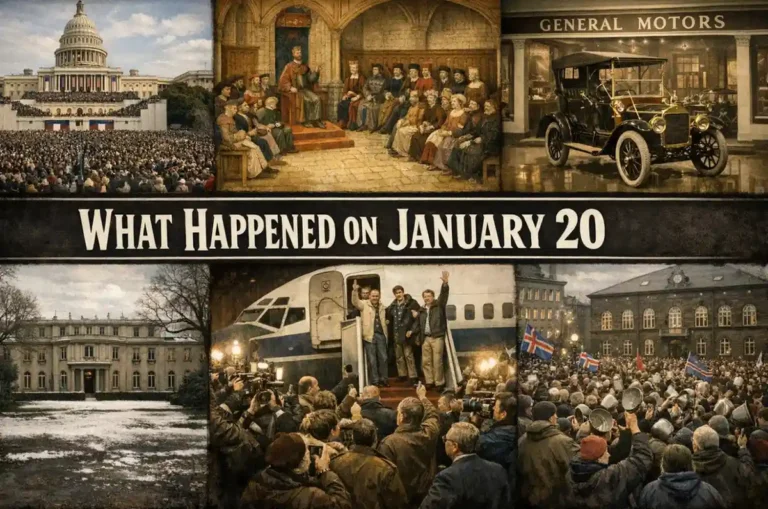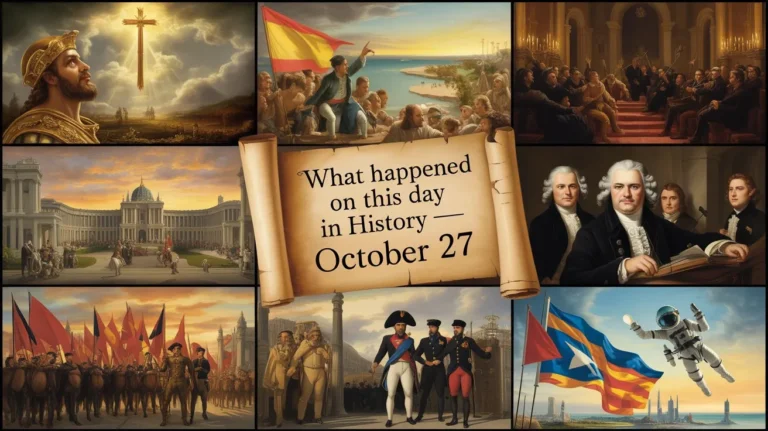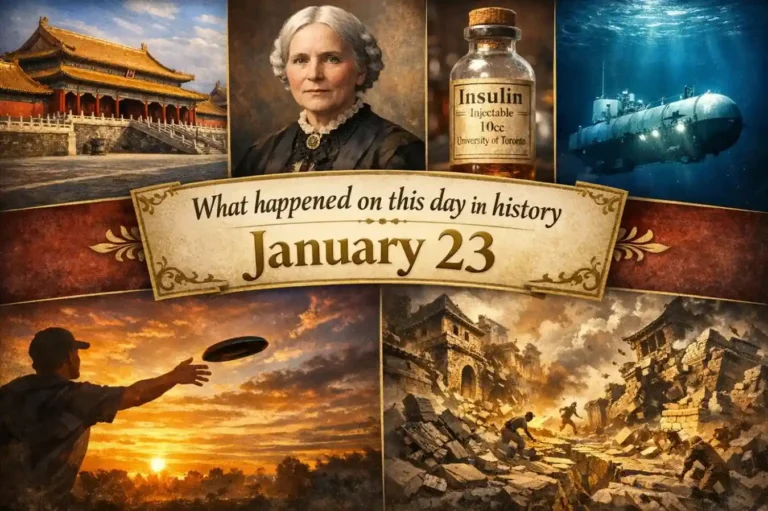
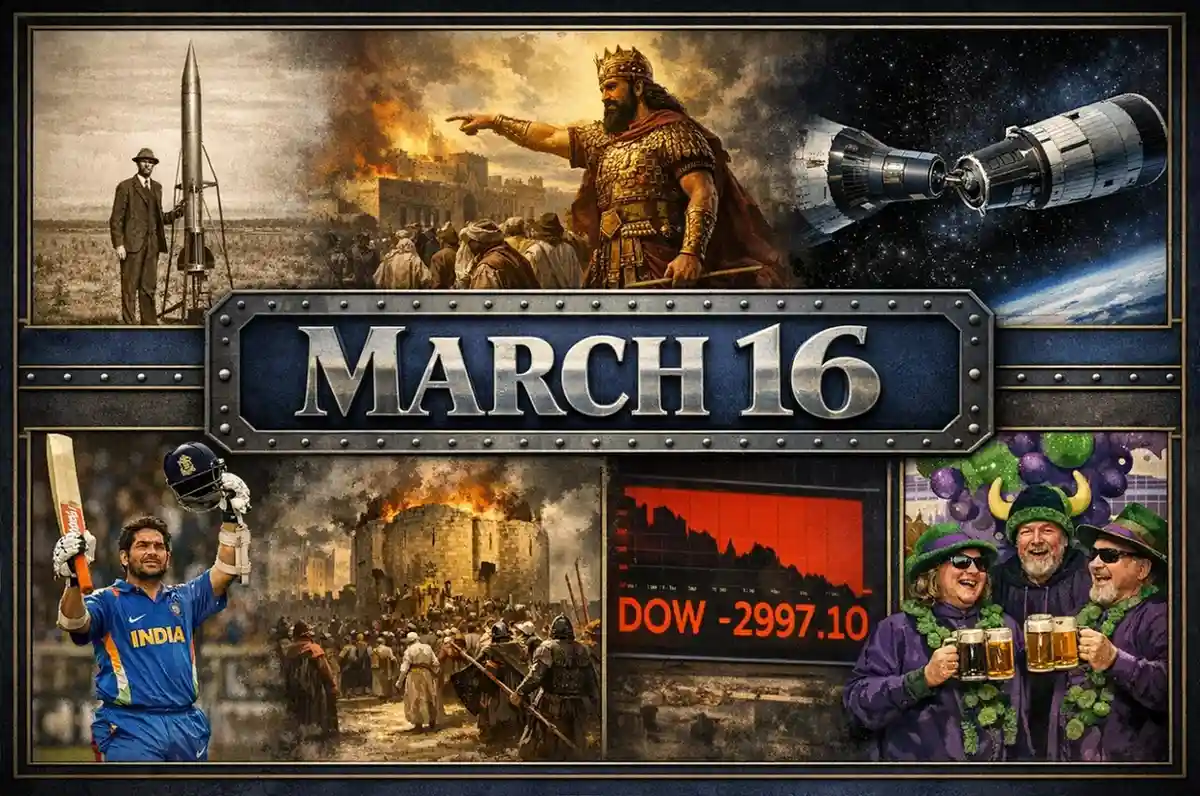
Looking at what happened on this day in history March 16, we see a landscape of monumental firsts and harrowing conflicts. It is a day defined by the launch of the first liquid-fueled rocket by Robert Goddard and the first orbital docking of spacecraft during the Gemini 8 mission. Yet, the date is also heavy with the memory of significant human tragedies, from the ancient siege of Jerusalem to the modern-day chemical attack on Halabja and the record-breaking volatility of the global stock market.
Important Events That Happened On March 16 In History
597 BC – First Siege of Jerusalem Ends
The Neo-Babylonian Empire, led by King Nebuchadnezzar II, successfully concluded its first siege of the city of Jerusalem. Facing overwhelming force, the city surrendered to the Babylonian king. This event resulted in the deportation of the Judean elite to Babylon and marked a pivotal moment in the history of the ancient Near East.
445 – Assassination of Valentinian III
Western Roman Emperor Valentinian III was assassinated while practicing his archery skills on the Campus Martius in Rome. The act was carried out by followers of Petronius Maximus, a powerful senator. Valentinian’s death removed one of the last stable links to the Theodosian dynasty during the final decline of the Western Empire.
1190 – Massacre at York
In a dark chapter of medieval English history, a wave of anti-Semitic violence culminated in the massacre of the Jewish community at Clifford’s Tower in York. Trapped inside the royal castle by a rioting mob, many Jews chose to take their own lives rather than face the crowd outside, while those who remained were killed.
1244 – Fall of Montségur
Following the surrender of the mountain fortress of Montségur, over 200 Cathar believers who refused to recant their faith were burned to death by French royal and crusading forces. This mass execution effectively signaled the end of organized Cathar resistance in Languedoc during the Albigensian Crusade.
1355 – Restoration of the Song Dynasty
Amidst the chaos of the Red Turban Rebellions against the Mongol-led Yuan dynasty, Han Lin’er was proclaimed emperor in Bozhou. Claiming to be a descendant of Emperor Huizong, he stood as the figurehead of a restored Song dynasty, representing a significant challenge to Mongol authority in China.
1621 – Samoset Greets the Plymouth Settlers
Samoset, a leader of the Abenaki people, walked into the Plymouth Colony and famously greeted the English settlers in their own language, saying, “Welcome, Englishmen!” He was the first Native American to make contact with the Pilgrims, eventually facilitating the vital relationship between the settlers and Tisquantum (Squanto).
1660 – Dissolution of the Long Parliament
The Long Parliament of England, which had sat intermittently since 1640, was finally dissolved. This move was made to clear the way for the Convention Parliament, which would ultimately facilitate the restoration of the monarchy under King Charles II later that year.
1696 – Bombardment of Givet
During the Nine Years’ War, Dutch forces conducted a heavy bombardment of the French town of Givet. The attack was part of the wider conflict between the League of Augsburg and the forces of King Louis XIV of France as they struggled for territorial control in Europe.
1792 – Assassination Attempt on King Gustav III
King Gustav III of Sweden was shot by Jacob Johan Anckarström during a masked ball at the Royal Opera House in Stockholm. The king was wounded in the back and succumbed to his injuries thirteen days later. The assassination was the result of a conspiracy among disgruntled aristocrats.
1802 – Establishment of the Army Corps of Engineers
The United States Military Academy at West Point was founded and placed under the operation of the newly established Army Corps of Engineers. This act by the U.S. government created a permanent institution dedicated to training officers in engineering and military science.
1815 – Willem Proclaims Himself King
Prince Willem of Orange-Nassau proclaimed himself King of the United Kingdom of the Netherlands. This marked the establishment of the first constitutional monarchy in the Netherlands, uniting the northern and southern provinces (modern-day Netherlands and Belgium) under a single sovereign.
1872 – The First FA Cup Final
Wanderers F.C. defeated Royal Engineers A.F.C. with a score of 1–0 at The Oval in London to win the inaugural FA Cup. This victory made them the first winners of the oldest national football competition in the world, a landmark event in the history of association football.
1898 – Adoption of the Australian Constitution
In Melbourne, representatives from five Australian colonies formally adopted a draft constitution. This document would serve as the foundational legal framework for the Commonwealth of Australia, which was officially established three years later in 1901.
1916 – Hunt for Pancho Villa
U.S. cavalry regiments under the command of John J. Pershing crossed the border into Mexico. The mission, known as the Punitive Expedition, was launched to capture the Mexican revolutionary Pancho Villa following his raid on the town of Columbus, New Mexico.
1918 – Battle of Länkipohja
During the Finnish Civil War, the “Whites” achieved a victory at the Battle of Länkipohja. The engagement is remembered for its brutal aftermath, in which White forces executed between 70 and 100 captured “Red” soldiers who had already surrendered.
1924 – Fiume Annexed by Italy
Under the terms of the Treaty of Rome, the Free State of Fiume was formally annexed by the Kingdom of Italy. This ended a long-standing territorial dispute and fulfilled a major goal of Italian nationalists who viewed the Adriatic port as vital to their national interests.
1925 – Dali Earthquake
A powerful earthquake, estimated at a magnitude of 7.0, struck the city of Dali in southwestern China. The disaster caused widespread destruction across the region and resulted in the deaths of approximately 5,000 people.
1926 – First Liquid-Fueled Rocket Launch
Robert Goddard successfully launched the world’s first liquid-fueled rocket in Auburn, Massachusetts. Although it only reached an altitude of 41 feet during its 2.5-second flight, the event proved the viability of liquid-propellant rocketry and changed the course of space exploration.
1935 – Hitler Violates Treaty of Versailles
Adolf Hitler officially ordered the rearmament of Germany, openly violating the military restrictions set by the Treaty of Versailles. This move included the reintroduction of military conscription to build the Wehrmacht, signaling a major escalation in German militarism.
1936 – St. Patrick’s Day Flood in Pittsburgh
Unusually warm temperatures led to a rapid melting of snow and ice, causing the Allegheny and Monongahela rivers to overflow. The resulting flood submerged much of downtown Pittsburgh, leading to significant property damage and loss of life in one of the city’s worst natural disasters.
1939 – Protectorate of Bohemia and Moravia
Following the German occupation of Czechoslovakia, Hitler proclaimed the Czech lands as the Protectorate of Bohemia and Moravia from Prague Castle. The territory was placed under German administrative and military control, effectively ending Czech independence.
1941 – Operation Appearance
British forces launched Operation Appearance to recapture British Somaliland from Italian occupation during World War II. The successful amphibious landing and subsequent military actions allowed the British to re-establish their colonial administration in the region.
1945 – Battle of Iwo Jima Officially Ends
The brutal Battle of Iwo Jima was declared officially over by U.S. forces. While the island was secured, small pockets of Japanese resistance remained in caves and tunnels, continuing to fight for weeks after the official end of the campaign.
1945 – Destruction of Würzburg
In one of the most intense bombing raids of World War II, British bombers destroyed 90 percent of the German city of Würzburg in just 20 minutes. The incendiary attack killed at least 4,000 people and reduced the historic city center to rubble.
1962 – Disappearance of Flight 739
A Flying Tiger Line aircraft, chartered by the U.S. military to transport troops to South Vietnam, disappeared over the western Pacific Ocean. All 107 people on board were presumed dead. Despite a massive search effort, no wreckage or remains were ever found.
1966 – Launch of Gemini 8
NASA launched the Gemini 8 mission, carrying astronauts Neil Armstrong and David Scott. During the flight, the crew achieved the first-ever docking of two spacecraft in orbit by connecting with an Agena target vehicle. However, a thruster malfunction forced an emergency early return to Earth.
1968 – My Lai Massacre
During the Vietnam War, U.S. Army troops killed between 347 and 500 unarmed Vietnamese civilians in the hamlet of My Lai. The massacre of men, women, and children became one of the most infamous atrocities of the war when it was revealed to the public a year later.
1969 – Viasa Flight 892 Crash
A McDonnell Douglas DC-9 crashed shortly after takeoff in Maracaibo, Venezuela. The aircraft struck power lines and buildings, resulting in the deaths of all 84 people on board and another 71 people on the ground, making it the deadliest aviation accident in Venezuelan history at the time.
1977 – Assassination of Kamal Jumblatt
Kamal Jumblatt, a prominent Lebanese politician and the leader of the anti-government forces during the Lebanese Civil War, was assassinated. His death removed a central figure of the Lebanese Left and further intensified the sectarian conflict in the country.
1978 – Kidnapping of Aldo Moro
Former Italian Prime Minister Aldo Moro was kidnapped in Rome by members of the Red Brigades, a far-left militant group. Five of his bodyguards were killed during the ambush. Moro was held captive for 54 days before he was eventually murdered by his captors.
1978 – Amoco Cadiz Oil Spill
The supertanker Amoco Cadiz ran aground and split in two off the coast of Brittany, France. The disaster released nearly 69 million gallons of crude oil into the Atlantic, resulting in what was the largest oil spill in history at that time and causing massive ecological damage to the French coastline.
1979 – End of the Sino-Vietnamese War
Following a month of intense border fighting, the Chinese People’s Liberation Army completed its withdrawal back across the border into China. Both sides claimed victory in the brief but bloody conflict, which was sparked by Vietnam’s invasion of Cambodia.
1984 – Kidnapping of William Buckley
The CIA’s station chief in Beirut, William Buckley, was kidnapped by the militant group Hezbollah. Despite efforts to secure his release, Buckley was held for over a year and eventually died in captivity due to medical neglect and torture.
1985 – Terry Anderson Taken Hostage
Associated Press journalist Terry Anderson was kidnapped in Beirut by Islamic Jihad militants. He would become the longest-held American hostage in Lebanon, spending 2,454 days in captivity before his final release in December 1991.
1988 – Indictments in the Iran–Contra Affair
Lieutenant Colonel Oliver North and Vice Admiral John Poindexter were formally indicted on charges including conspiracy to defraud the United States. The charges stemmed from their roles in the secret sale of weapons to Iran to fund the Contra rebels in Nicaragua.
1988 – Halabja Chemical Attack
On the orders of Saddam Hussein, the Iraqi military attacked the Kurdish town of Halabja with a mixture of mustard gas and nerve agents. The chemical strike killed an estimated 5,000 people and injured 10,000 more, primarily civilians, in an act of genocide against the Kurdish population.
1988 – Milltown Cemetery Attack
During a funeral for IRA members in Belfast, loyalist militant Michael Stone attacked the crowd with pistols and grenades. The attack killed three people and wounded more than 60 others, further inflaming the tensions of The Troubles in Northern Ireland.
1995 – Mississippi Ratifies 13th Amendment
In a delayed symbolic move, the state of Mississippi formally ratified the 13th Amendment to the U.S. Constitution, which abolished slavery. While the amendment had been the law of the land since its original ratification in 1865, Mississippi remained the final state to officially record its approval.
2001 – Shijiazhuang Bombings
A series of four bomb blasts struck apartment buildings for factory workers in Shijiazhuang, China. The explosions killed 108 people and injured dozens more. A disgruntled former employee was later convicted of the attacks, which remain the deadliest mass murder in modern Chinese history.
2003 – Death of Rachel Corrie
American peace activist Rachel Corrie was killed in Rafah, Gaza, after being run over by an armored Israel Defense Forces bulldozer. She had been acting as a human shield to prevent the demolition of a Palestinian home. Her death became a major flashpoint for international debate regarding the Israeli-Palestinian conflict.
2005 – Israel Hands Over Jericho
In a move intended to bolster peace negotiations, Israeli military forces officially handed over security control of the West Bank city of Jericho to the Palestinian Authority. The handover was seen as a key step in implementing the “road map” for peace.
2010 – Kasubi Tombs Fire
The Kasubi Tombs in Uganda, the burial site of four kings of Buganda and a UNESCO World Heritage site, were almost entirely destroyed by a major fire. The incident caused a deep sense of loss for the Baganda people and led to civil unrest in the capital, Kampala.
2012 – Sachin Tendulkar’s 100th Century
In an unprecedented feat in the history of cricket, Indian batter Sachin Tendulkar scored his 100th international century during an Asia Cup match against Bangladesh. He became the first and only player to reach this milestone, cementing his legacy as one of the greatest athletes in the sport.
2014 – Crimean Referendum
Voters in Crimea participated in a controversial referendum to secede from Ukraine and join the Russian Federation. While local authorities reported an overwhelming majority in favor, the vote was condemned as illegal and unconstitutional by the Ukrainian government and much of the international community.
2020 – Record Dow Jones Drop
The Dow Jones Industrial Average suffered a historic loss, falling by 2,997.10 points in a single day. Driven by fears of the economic impact of the COVID-19 pandemic, the 12.93% drop was the second-largest percentage decrease in history, exceeding the crash of Black Monday in 1929.
2021 – Atlanta Spa Shootings
A gunman opened fire at three different spas in the Atlanta, Georgia area, killing eight people, six of whom were women of Asian descent. The tragedy prompted a national conversation regarding anti-Asian sentiment and the safety of immigrant workers in the United States.
2022 – Fukushima Earthquake
A magnitude 7.4 earthquake struck off the coast of Fukushima, Japan, causing violent shaking across the northern and eastern parts of the country. The quake killed four people, injured over 200, and caused temporary power outages and transport disruptions in the region.
2022 – Mariupol Theatre Airstrike
During the intense siege of Mariupol, a Russian airstrike destroyed the Donetsk Regional Drama Theatre. The building was being used as a designated bomb shelter by hundreds of civilians, including many children. The attack remains one of the most widely condemned incidents of the conflict.
2025 – Kočani Nightclub Fire
A devastating fire broke out in a nightclub in the town of Kočani, North Macedonia. The blaze trapped many patrons inside, resulting in the deaths of at least 59 people and leaving 155 others injured. The tragedy led to a national review of building safety and fire codes.
2026 – Maiduguri Bombings (March 16)
On March 16, a coordinated series of bombings attributed to Boko Haram struck the city of Maiduguri, Nigeria. The attacks left 26 people dead and 146 others injured, marking another violent chapter for the region and drawing widespread condemnation from international aid organizations.
After reading the March 16 stories, check also the March 15 Tales
Famous People Born on March 16
| Name | Description | Date |
|---|---|---|
| Pat Nixon | American first lady (1969–74) | March 16, 1912 – June 22, 1993 |
| Jens Stoltenberg | Prime minister of Norway and secretary-general of NATO | March 16, 1959 – Present |
| Daniel Patrick Moynihan | United States senator and sociologist | March 16, 1927 – March 26, 2003 |
| Jorge Ramos | Mexican-American journalist and author | March 16, 1958 – Present |
| Rosa Bonheur | French painter and sculptor | March 16, 1822 – May 25, 1899 |
| Alice Hoffman | American novelist | March 16, 1952 – Present |
| Sanford I. Weill | American financier and philanthropist | March 16, 1933 – Present |
| Michael Mansfield | U.S. senator and longest-serving majority leader | March 16, 1903 – October 5, 2001 |
| Anna Atkins | English photographer and botanist | March 16, 1799 – June 9, 1871 |
| Sir Mark Sykes, 6th Baronet | British diplomat (Sykes-Picot Agreement) | March 16, 1879 – February 16, 1919 |
| Blessed Clemens August, Graf von Galen | German bishop, opponent of Nazism | March 16, 1878 – March 22, 1946 |
| César Vallejo | Peruvian poet | March 16, 1892 – April 15, 1938 |
| Sully Prudhomme | French poet, first Nobel Prize in Literature | March 16, 1839 – September 7, 1907 |
| Frederick Reines | American physicist, Nobel Prize winner (neutrino) | March 16, 1918 – August 26, 1998 |
| Robert Rossen | American writer and director (The Hustler) | March 16, 1908 – February 18, 1966 |
| Dame Lucie Rie | Austrian-born British studio potter | March 16, 1902 – April 1, 1995 |
| Jean-Baptiste Carrier | French revolutionary | March 16, 1756 – December 16, 1794 |
| Kodaira Kunihiko | Japanese mathematician, Fields Medal winner | March 16, 1915 – July 26, 1997 |
| Teresa Berganza | Spanish mezzo-soprano | March 16, 1933 – May 13, 2022 |
| Camilo Castelo Branco | Portuguese novelist | March 16, 1825 – June 1, 1890 |
| Magnus Gösta Mittag-Leffler | Swedish mathematician | March 16, 1846 – July 7, 1927 |
| Zhu Chen | Chinese chess player, women’s world champion | March 16, 1976 – Present |
| Juan Martínez Montañés | Spanish sculptor | March 16, 1568 – June 18, 1649 |
| Pieter Corneliszoon Hooft | Dutch dramatist and poet | March 16, 1581 – May 21, 1647 |
| Francisco Ayala | Spanish novelist and sociologist | March 16, 1906 – November 3, 2009 |
| Heinrich Kayser | German physicist (discovered helium in Earth’s atmosphere) | March 16, 1853 – October 14, 1940 |
| Karl Brugmann | German linguist | March 16, 1849 – June 29, 1919 |
| Matthew Flinders | English navigator who charted Australia | March 16, 1774 – July 19, 1814 |
| Bernardo Bertolucci | Italian film director (Last Tango in Paris) | March 16, 1941 – November 26, 2018 |
| Mark Carney | Canadian economist, prime minister of Canada | March 16, 1965 – Present |
Famous People Died on March 16
| Name | Description | Date |
|---|---|---|
| Aubrey Beardsley | English illustrator, leading figure in Aestheticism | August 21, 1872 – March 16, 1898 |
| Thomas E. Dewey | Governor of New York, Republican presidential nominee | March 24, 1902 – March 16, 1971 |
| Arthur Godfrey | American radio and television entertainer | August 31, 1903 – March 16, 1983 |
| Constantin Brancusi | Romanian-French pioneer of modern abstract sculpture | February 19, 1876 – March 16, 1957 |
| T-Bone Walker | American musician, pioneer of the electric guitar in blues | May 28, 1910 – March 16, 1975 |
| Jean Monnet | French political economist, architect of European integration | November 9, 1888 – March 16, 1979 |
| Selma Lagerlöf | Swedish author, first woman to win Nobel Prize in Literature | November 20, 1858 – March 16, 1940 |
| Roy Bean | American justice of the peace, “law west of the Pecos” | 1825? – March 16, 1903 |
| François VI, duc de La Rochefoucauld | French classical author | September 15, 1613 – March 16, 1680 |
| Giovanni Battista Pergolesi | Italian composer (La serva padrona) | January 4, 1710 – March 16, 1736 |
| Valentinian III | Roman emperor (425–455) | July 2, 419 – March 16, 455 |
| Yakov Mikhaylovich Sverdlov | Soviet Communist Party leader | June 3, 1885 – March 16, 1919 |
| Sir Austen Chamberlain | British statesman, foreign secretary, Nobel Peace Prize winner | October 16, 1863 – March 16, 1937 |
| Sir John Hawkwood | Anglo-Italian mercenary captain | c.1320 – March 16, 1394 |
| Aron Nimzowitsch | Latvian chess master and theoretician | November 7, 1886 – March 16, 1935 |
| Nathaniel Bowditch | American navigator and mathematician | March 26, 1773 – March 16, 1838 |
| Pierre Drieu La Rochelle | French novelist and political essayist | January 3, 1893 – March 16, 1945 |
| J.J.R. Macleod | Scottish physiologist, co-discoverer of insulin | September 6, 1876 – March 16, 1935 |
| Robert Smith Surtees | English novelist, creator of Mr. Jorrocks | May 17, 1805 – March 16, 1864 |
| Roger Sessions | American composer | December 28, 1896 – March 16, 1985 |
| Perle Mesta | American socialite and diplomat | October 12, 1889 – March 16, 1975 |
| Charles-Albert Gobat | Swiss politician, Nobel Prize for Peace winner | May 21, 1834 – March 16, 1914 |
| Sir John Murray | Scottish Canadian oceanographer | March 3, 1841 – March 16, 1914 |
| Arthur Adamov | French playwright, founder of Theatre of the Absurd | August 23, 1908 – March 16, 1970 |
| Joseph Medill | American editor and publisher (Chicago Tribune) | April 6, 1823 – March 16, 1899 |
| Charles Yanofsky | American geneticist | April 17, 1925 – March 16, 2018 |
| Sir Derek H.R. Barton | British chemist, Nobel Prize winner | September 8, 1918 – March 16, 1998 |
| William Henry Beveridge, 1st Baron Beveridge | British economist, architect of the welfare state | March 5, 1879 – March 16, 1963 |
| Miguel Primo de Rivera | Spanish dictator (1923–1930) | January 8, 1870 – March 16, 1930 |
| Dick Dale | American rock guitarist, “King of the Surf Guitar” | May 4, 1937 – March 16, 2019 |
Observances & Institutional Dates
- Saint Urho’s Day: A tongue-in-cheek holiday celebrated by Finnish Americans and Canadians, honoring the legendary saint who drove the grasshoppers out of Finland.
- Day of the Book Smugglers (Lithuania): Commemorating the secret distribution of Lithuanian language books during the 19th-century ban by the Russian Empire.
- Remembrance Day of the Latvian Legionnaires: A day of observance in Latvia for those who served in the Latvian Legion during World War II.
Frequently Asked Questions
- What was the first liquid-fueled rocket? It was launched by Robert Goddard on March 16, 1926.
- Who was Samoset? He was the first Native American to greet the Plymouth Pilgrims on March 16, 1621.
- What happened at My Lai? A mass murder of hundreds of unarmed Vietnamese civilians by U.S. troops occurred on March 16, 1968.
- When did Sachin Tendulkar score his 100th century? He reached this historic cricket milestone on March 16, 2012.