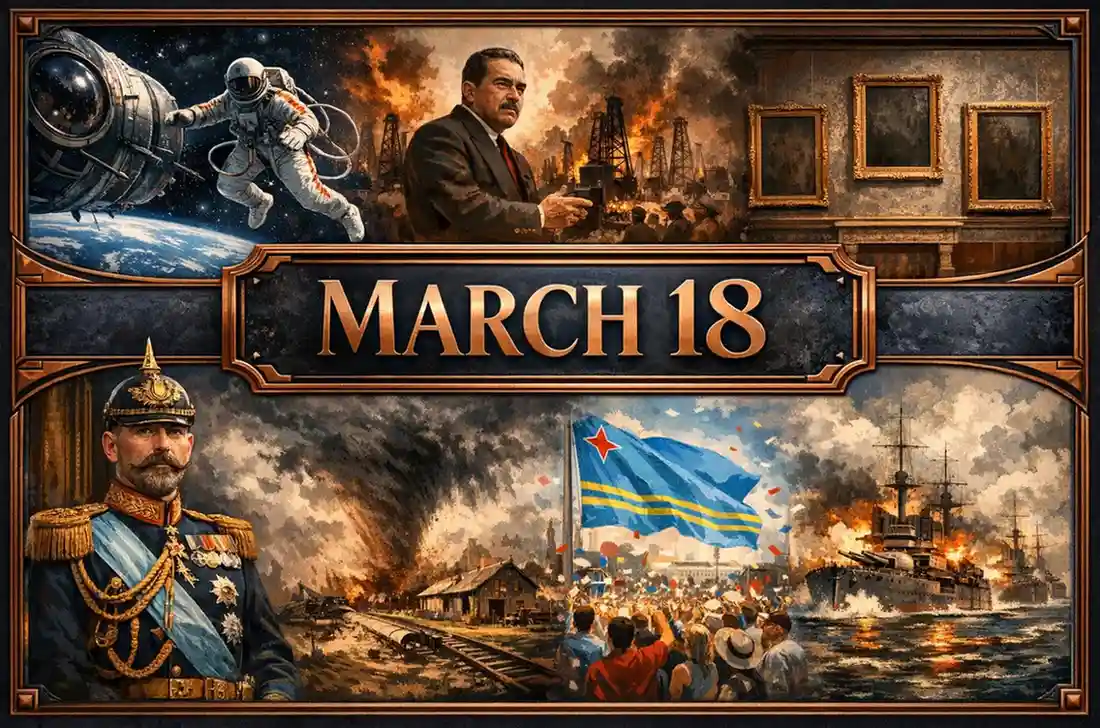
The events of this day in history March 18 capture a dramatic spectrum of human ambition and institutional change. From the Roman Senate’s elevation of Caligula to Alexei Leonov’s pioneering walk in the vacuum of space, the date marks extraordinary milestones. It also stands as a symbol of national defiance, seen in both the repeal of the Stamp Act and Mexico’s historic seizure of its oil industry.
Important Events That Happened On March 18 In History
37 – Caligula Becomes Emperor
The Roman Senate officially annulled the will of the late Emperor Tiberius and proclaimed Gaius Julius Caesar Augustus Germanicus, better known by his childhood nickname “Caligula,” as the new emperor. His reign began with great popularity and hope, though it would eventually become synonymous with eccentricity and authoritarianism.
417 – Election of Pope Zosimus
Following the death of Pope Innocent I, Zosimus was elected as the Bishop of Rome. His brief papacy was marked by his involvement in the Pelagian controversy and his efforts to assert the jurisdictional authority of the Roman See over the churches in Gaul.
1068 – Near East Earthquake
A massive earthquake struck the Levant and the Arabian Peninsula, causing catastrophic destruction across a vast region. Historical records suggest the death toll reached as many as 20,000 people, with significant damage reported in cities like Ayla (modern-day Aqaba) and Ramla.
1229 – Frederick II Named King of Jerusalem
During the Sixth Crusade, Holy Roman Emperor Frederick II declared himself the King of Jerusalem. Unlike previous crusades, Frederick achieved this through a negotiated treaty with the Ayyubid Sultan al-Kamil rather than through military conquest, returning the Holy City to Christian control for a brief period.
1241 – Battle of Chmielnik
During the first Mongol invasion of Poland, the Mongol forces overwhelmed the Polish provincial armies in Kraków. Following their victory at the Battle of Chmielnik, the Mongols plundered and burned the city of Kraków, forcing the local population to flee.
1314 – Execution of Jacques de Molay
Jacques de Molay, the 23rd and final Grand Master of the Knights Templar, was burned at the stake in Paris. His execution followed years of persecution by King Philip IV of France and the dissolution of the order by the Pope. Legend claims he cursed the King and the Pope from the flames.
1571 – Valletta Becomes Malta’s Capital
Valletta was officially designated as the capital city of Malta. Built by the Knights of St. John following the Great Siege of 1565, the city was designed as a “modern” fortified stronghold, named after Grand Master Jean Parisot de Valette.
1673 – Quakers Purchase West Jersey
English lord John Berkeley sold his proprietary half of the province of New Jersey to a group of Quakers led by John Fenwick and Edward Byllynge. This sale led to the division of the colony into East and West Jersey and established a significant Quaker presence in the American colonies.
1766 – Repeal of the Stamp Act
The British Parliament officially repealed the Stamp Act, which had imposed a direct tax on the American colonies. While the repeal was a victory for colonial protesters who argued “no taxation without representation,” it was accompanied by the Declaratory Act, asserting Parliament’s absolute authority over the colonies.
1834 – Sentencing of the Tolpuddle Martyrs
Six farm laborers from the village of Tolpuddle in Dorset, England, were sentenced to seven years of transportation to a penal colony in Australia. Their “crime” was forming a friendly society (a trade union) to protest declining wages, sparking a massive national outcry and becoming a landmark moment in the labor movement.
1848 – Five Days of Milan
A major rebellion broke out in Milan against Austrian rule, part of the wider Revolutions of 1848. After five days of intense street fighting, known as the Cinque Giornate, the local insurgents successfully drove the veteran Austrian Marshal Radetzky and his soldiers out of the city.
1871 – Declaration of the Paris Commune
Following the French defeat in the Franco-Prussian War, an insurrectionary government known as the Paris Commune was declared. President Adolphe Thiers ordered the evacuation of the French government and regular army from Paris to Versailles, leaving the city under the control of radical revolutionaries.
1899 – Discovery of Phoebe
Phoebe, a small satellite of Saturn, became the first celestial body to be discovered using photography. Astronomer William Henry Pickering identified the moon on photographic plates taken in August 1898 at the Boyden Station in Peru.
1913 – Assassination of King George I of Greece
King George I was assassinated while walking in the city of Thessaloniki, which had recently been liberated during the First Balkan War. The assassin, Alexandros Schinas, shot the king at close range. George I had reigned for nearly 50 years, overseeing a period of significant Greek expansion.
1915 – Naval Attack on the Dardanelles
During the Gallipoli Campaign of World War I, a combined British and French naval fleet launched a massive attack to force the Dardanelles strait. The operation failed disastrously when three battleships—the Bouvet, Irresistible, and Ocean—were sunk by naval mines, leading to a shift toward a land-based invasion.
1922 – Gandhi Sentenced to Prison
In India, Mohandas Gandhi was sentenced to six years in prison for civil disobedience following his “Non-Cooperation Movement.” Though the judge expressed regret at sentencing such a prominent figure, Gandhi was held responsible for the unrest. He eventually served only two years before being released for medical reasons.
1925 – The Tri-State Tornado
The deadliest tornado in United States history struck the states of Missouri, Illinois, and Indiana. The “Tri-State Tornado” stayed on the ground for a record 219 miles, killing 695 people and destroying several towns in its path.
1937 – New London School Explosion
A massive natural gas explosion destroyed the London School in New London, Texas. The blast killed approximately 300 people, the vast majority of whom were children. The tragedy led to the requirement that thiols (odorants) be added to natural gas so that leaks could be detected by smell.
1938 – Mexican Oil Expropriation
President Lázaro Cárdenas signed a decree expropriating the assets of almost all foreign oil companies operating in Mexico. This led to the creation of Pemex, a state-owned petroleum company, and is celebrated in Mexico as a major act of national economic sovereignty.
1944 – Eruption of Mount Vesuvius
Mount Vesuvius began a major eruption that lasted for nearly two weeks. The eruption killed 26 people and caused thousands to flee. It also resulted in the destruction of dozens of Allied B-25 bombers stationed at a nearby airfield during the Italian Campaign of WWII.
1962 – Évian Accords Signed
Representatives of the French government and the Algerian National Liberation Front (FLN) signed the Évian Accords. The agreement established a ceasefire and a path to a referendum on independence, effectively ending the eight-year-long Algerian War of Independence.
1965 – First Human Spacewalk
Soviet cosmonaut Alexei Leonov made history by becoming the first person to walk in space. Leaving the Voskhod 2 spacecraft for 12 minutes, Leonov floated in the vacuum of space tethered to his ship. The mission nearly ended in disaster when his spacesuit ballooned, making it difficult to re-enter the airlock.
1968 – Gold Reserve Requirement Repealed
The United States Congress officially repealed the requirement for a gold reserve to back the U.S. currency. This move was a significant step in the transition of the U.S. dollar away from the gold standard, providing more flexibility in monetary policy.
1990 – Isabella Stewart Gardner Museum Theft
In the largest art theft in American history, two thieves disguised as police officers gained entry to the Isabella Stewart Gardner Museum in Boston. They stole 12 world-renowned paintings, including works by Rembrandt and Vermeer, collectively worth an estimated $500 million. The frames remain empty in the museum to this day.
1994 – Washington Agreement Signed
Leaders of Bosnia’s Bosniaks and Croats signed the Washington Agreement, ending the war between the Croatian Republic of Herzeg-Bosnia and the Republic of Bosnia and Herzegovina. The pact established the Federation of Bosnia and Herzegovina and simplified the complex conflict into a unified front against Bosnian Serb forces.
2015 – Bardo National Museum Attack
Gunmen attacked the Bardo National Museum in Tunis, Tunisia, targeting tourists visiting the historic site. The attack resulted in the deaths of 24 people and wounded 50 others. It was a major blow to Tunisia’s tourism industry and was part of a wave of extremist violence in the region.
2025 – Gaza Strip Bombardments (March 18)
On March 18, a series of widespread aerial bombardments and military attacks were launched on the Gaza Strip. The strikes resulted in the deaths of at least 591 people, including many children. The scale of the loss of life drew urgent calls for intervention from international humanitarian organizations.
Famous People Born on March 18
| Name | Description | Date |
|---|---|---|
| John Updike | American author, Pulitzer Prize winner | March 18, 1932 – January 27, 2009 |
| Nikolay Rimsky-Korsakov | Russian composer | March 18, 1844 – June 21, 1908 |
| Rudolf Diesel | French-German engineer, inventor of the diesel engine | March 18, 1858 – September 29, 1913 |
| Chiang Ching-kuo | President of Taiwan (1978–1988) | March 18, 1910 – January 13, 1988 |
| Stéphane Mallarmé | French poet, leader of the Symbolist movement | March 18, 1842 – September 9, 1898 |
| Galeazzo Ciano, conte di Cortellazzo | Italian diplomat and Fascist leader | March 18, 1903 – January 11, 1944 |
| François, duc d’Anjou | French prince, son of Henry II of France | March 18, 1554 – June 10, 1584 |
| John IV | King of Portugal (1640–1656), founder of the Bragança dynasty | March 18, 1604 – November 6, 1656 |
| Fred Shuttlesworth | American minister and civil rights activist, co-founder of SCLC | March 18, 1922 – October 5, 2011 |
| Seymour Martin Lipset | American sociologist and political scientist | March 18, 1922 – December 31, 2006 |
| Christa Wolf | German novelist and essayist | March 18, 1929 – December 1, 2011 |
| Christer Fuglesang | Swedish physicist and astronaut, first Swede in space | March 18, 1957 – Present |
| Kurt Koffka | German psychologist, co-founder of Gestalt psychology | March 18, 1886 – November 22, 1941 |
| Miloš | Prince of Serbia (1815–1839, 1858–1860), founder of Obrenović dynasty | March 18, 1780 – September 26, 1860 |
| Christian Goldbach | Russian mathematician (Goldbach’s conjecture) | March 18, 1690 – November 20, 1764 |
| Jakob Steiner | Swiss mathematician, founder of synthetic geometry | March 18, 1796 – April 1, 1863 |
| Sir Randal Cremer | British labor leader and pacifist, Nobel Peace Prize winner | March 18, 1838 – July 22, 1908 |
| Friedrich Hebbel | German dramatist | March 18, 1813 – December 13, 1863 |
| Lennart Carleson | Swedish mathematician, Abel Prize winner | March 18, 1928 – Present |
| Benny Friedman | American football quarterback, early passing pioneer | March 18, 1905 – November 23, 1982 |
| Nathanael Greene Herreshoff | American naval architect and yacht designer | March 18, 1848 – June 2, 1938 |
| Adam Levine | American musician, lead singer of Maroon 5 | March 18, 1979 – Present |
| Sutton Foster | American actress and singer, Tony Award winner | March 18, 1975 – Present |
| Queen Latifah | American musician and actress | March 18, 1970 – Present |
| Bonnie Blair | American speed skater, five-time Olympic gold medalist | March 18, 1964 – Present |
| Irene Cara | American singer-songwriter and actress (Fame) | March 18, 1959 – November 25, 2022 |
| Ingemar Stenmark | Swedish Alpine skier, Olympic and World Cup champion | March 18, 1956 – Present |
| Wilson Pickett | American soul singer-songwriter | March 18, 1941 – January 19, 2006 |
| Dick Smith | Australian aviator, explorer, and businessman | March 18, 1944 – Present |
| Gian Francesco Malipiero | Italian composer | March 18, 1882 – August 1, 1973 |
Famous People Died on March 18
| Name | Description | Date |
|---|---|---|
| Farouk I | King of Egypt (1936–1952) | February 11, 1920 – March 18, 1965 |
| Erich Fromm | German-born American psychoanalyst and social philosopher | March 23, 1900 – March 18, 1980 |
| Robert Walpole, 1st earl of Orford | First British prime minister (in power 1721–1742) | August 26, 1676 – March 18, 1745 |
| Umberto II | King of Italy (1946) | September 15, 1904 – March 18, 1983 |
| Norbert Wiener | American mathematician, founder of cybernetics | November 26, 1894 – March 18, 1964 |
| Edward the Martyr | King of England (975–978) | c.963 – March 18, 978 |
| William Crapo Durant | American industrialist, founder of General Motors | December 8, 1861 – March 18, 1947 |
| Laurence Sterne | Irish-born English novelist (Tristram Shandy) | November 24, 1713 – March 18, 1768 |
| Vasily Chuikov | Soviet general, defender of Stalingrad | February 12, 1900 – March 18, 1982 |
| Eleuthérios Venizélos | Prime minister of Greece (multiple terms) | August 23, 1864 – March 18, 1936 |
| Bernard Malamud | American novelist and short-story writer | April 26, 1914 – March 18, 1986 |
| Augustus De Morgan | English mathematician and logician | June 27, 1806 – March 18, 1871 |
| Anne-Robert-Jacques Turgot, baron de l’Aulne | French economist and statesman | May 10, 1727 – March 18, 1781 |
| Odysseus Elytis | Greek poet, Nobel Prize in Literature | November 2, 1911 – March 18, 1996 |
| Othniel Charles Marsh | American paleontologist, pioneer in vertebrate paleontology | October 29, 1831 – March 18, 1899 |
| Chuck Berry | American singer, songwriter, and guitarist, rock-and-roll pioneer | October 18, 1926 – March 18, 2017 |
| Natasha Richardson | British actress | May 11, 1963 – March 18, 2009 |
| Sir Harold Jeffreys | British astronomer and geophysicist | April 22, 1891 – March 18, 1989 |
| Ludwig Guttmann | German-born English neurosurgeon, founder of the Paralympic Games | July 3, 1899 – March 18, 1980 |
| Tamara de Lempicka | Polish artist, pioneer of Art Deco painting | May 16, 1898? – March 18, 1980 |
| Matilda Joslyn Gage | American suffragist and women’s rights advocate | March 25, 1826 – March 18, 1898 |
| Valentin Haüy | French educator, pioneer of education for the blind | November 13, 1745 – March 18, 1822 |
| Anna Leopoldovna | Regent of Russia (1740–1741) | December 18, 1718 – March 18, 1746 |
| Sir Edward Belcher | British admiral and explorer | 1799 – March 18, 1877 |
| Alexandre, count de Lameth | French nobleman, early leader of the French Revolution | October 28, 1760 – March 18, 1829 |
| Otto Weddigen | German submarine commander, World War I U-boat ace | September 15, 1882 – March 18, 1915 |
| John Horne Tooke | British radical politician and philologist | June 25, 1736 – March 18, 1812 |
| Thomas Stafford | American astronaut, commander of Apollo 10 | September 17, 1930 – March 18, 2024 |
| John Phillips | American musician, founder of The Mamas and the Papas | August 30, 1935 – March 18, 2001 |
| Grace Ogot | Kenyan author and politician | May 15, 1930 – March 18, 2015 |
Observances & Institutional Dates
- Anniversary of the Oil Expropriation (Mexico): A national holiday celebrating the 1938 nationalization of the oil industry.
- Gallipoli Memorial Day (Turkey): Commemorating the naval victory and the fallen soldiers of the 1915 campaign.
- Flag Day (Aruba): Celebrating the adoption of the national flag and anthem in 1976.
- Men’s and Soldiers’ Day (Mongolia): Honoring the military and the 1921 victory of the People’s Army.
- Ordnance Factories’ Day (India): Recognizing the history and contributions of the Indian Ordnance Factories.
Frequently Asked Questions
- Who was the first person to walk in space? Alexei Leonov achieved the first spacewalk on March 18, 1965.
- What was the Tri-State Tornado? It was the deadliest tornado in U.S. history, striking three states on March 18, 1925.
- When did Mexico nationalize its oil? President Cárdenas signed the expropriation decree on March 18, 1938.
- What was stolen from the Gardner Museum? Twelve masterpieces worth $500 million were stolen on March 18, 1990.