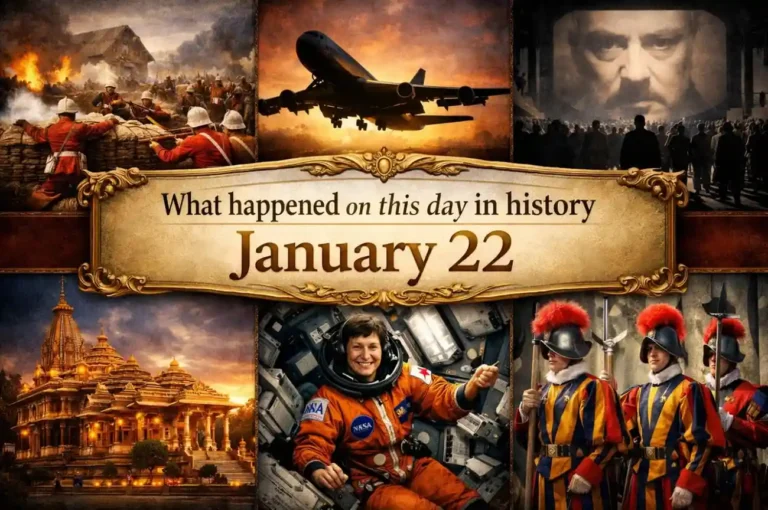
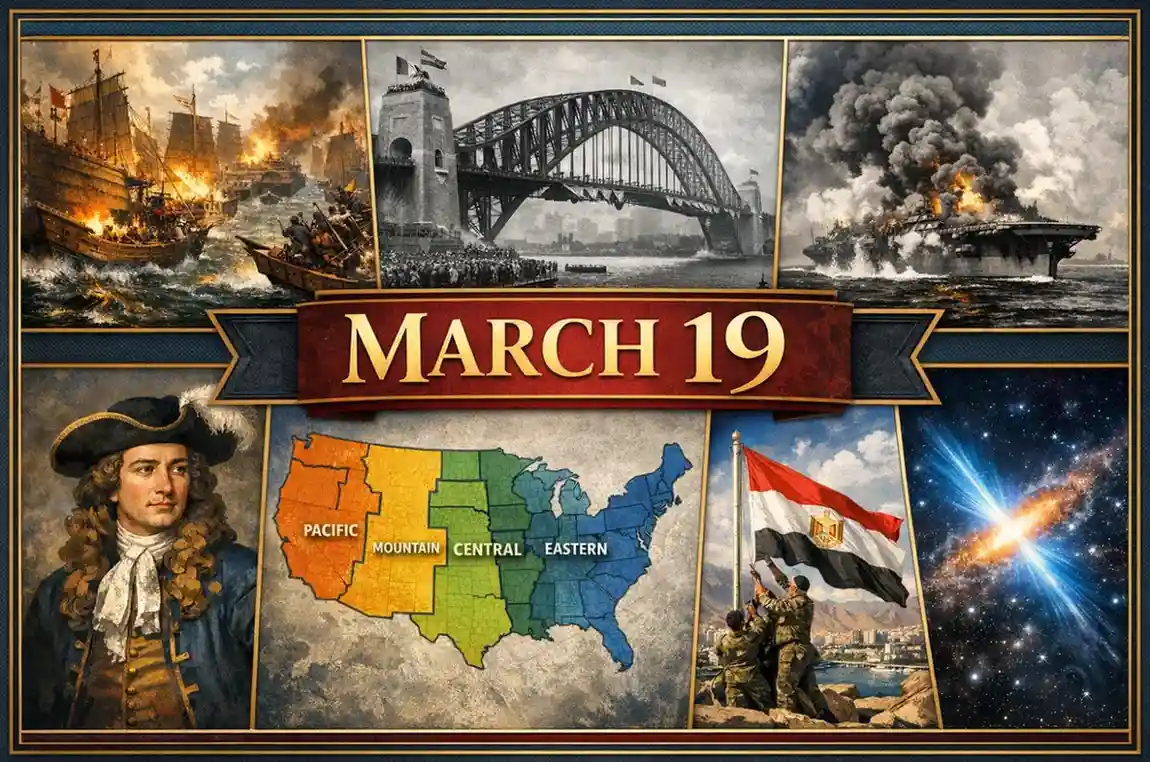
When we look at the events of this day in history March 19, we see a moment where the old world gave way to the new. From the final collapse of the Song Dynasty at the Battle of Yamen to the U.S. Congress finally putting the country on the same clock with official time zones, it’s a date that redefined how societies are organized. It also marks the hard-won end of the Algerian War of Independence and the eventual discovery of the shipwrecked SS Georgiana, proving that this day is as much about finding closure as it is about making history.
Important Events That Happened On March 18 In History
1205 – Battle of Adramyttion
Latin forces under Henry of Flanders achieved a decisive victory over a Nicaean army commanded by Constantine Laskaris. This engagement was a significant clash during the aftermath of the Fourth Crusade, as the Latin Empire sought to solidify its hold over former Byzantine territories in Asia Minor.
1227 – Election of Pope Gregory IX
Following the death of Pope Honorius III, Ugolino di Conti was elected to the papacy, taking the name Gregory IX. His reign became notable for his fierce struggles with Holy Roman Emperor Frederick II and his formal establishment of the Papal Inquisition to combat heresy.
1279 – Battle of Yamen
A massive naval engagement between the Yuan dynasty (Mongols) and the Song dynasty took place off the coast of Guangdong. The Mongol victory resulted in the annihilation of the Song fleet and the death of the young Emperor Bing, effectively ending the Song dynasty and bringing all of China under Mongol rule.
1284 – Statute of Rhuddlan
King Edward I of England issued the Statute of Rhuddlan, which formally incorporated the Principality of Wales into the Kingdom of England. This administrative change established English common law in Wales and divided the territory into counties, ending Welsh independence following the death of Llywelyn ap Gruffudd.
1452 – Coronation of Frederick III
Frederick III of Habsburg was crowned Holy Roman Emperor by Pope Nicholas V in Rome. This event was historically significant as it marked the final time a Holy Roman Emperor was crowned in Rome according to the traditional medieval ceremony.
1563 – Edict of Amboise
The Edict of Amboise was signed to end the first phase of the French Wars of Religion. The treaty provided a temporary peace by granting the Huguenots (French Protestants) specific legal rights and limited freedoms to practice their religion, though tensions remained high in the kingdom.
1649 – House of Lords Abolished
In the wake of the English Civil War and the execution of King Charles I, the House of Commons passed an act to abolish the House of Lords. The Commons declared the upper house “useless and dangerous to the people of England,” centralizing power in a single legislative body during the Commonwealth period.
1687 – Murder of Robert Cavelier de La Salle
The French explorer Robert Cavelier de La Salle, who had claimed the entire Mississippi River basin for France, was murdered by his own men in present-day Texas. The mutiny occurred during an increasingly desperate and failed expedition to find the mouth of the Mississippi by sea.
1808 – Abdication of Charles IV
Following a popular revolt and riots at the winter palace in Aranjuez, King Charles IV of Spain was forced to abdicate his throne. His son, Ferdinand VII, took the crown, though the political instability paved the way for Napoleon’s intervention in Spanish affairs.
1812 – Spanish Constitution of 1812
The Cortes of Cádiz, the national assembly of Spain, promulgated a new liberal constitution. It established the principles of universal male suffrage, national sovereignty, and freedom of the press, serving as a landmark document for 19th-century European liberalism.
1831 – First U.S. Bank Heist
In the first documented bank robbery in United States history, burglars stole $245,000 from the City Bank on Wall Street. Although a massive sum for the time, the perpetrators were eventually caught, and the majority of the stolen funds were recovered.
1885 – North-West Rebellion Begins
Louis Riel declared a provisional government in Batoche, Saskatchewan, marking the start of the North-West Rebellion. The uprising involved Métis and First Nations peoples who felt their land rights and culture were being ignored by the Canadian government.
1918 – U.S. Establishes Time Zones
The United States Congress passed the Standard Time Act, which formally established time zones across the country. The act also approved the first use of daylight saving time in the U.S. to conserve energy during World War I.
1932 – Opening of the Sydney Harbour Bridge
One of Australia’s most iconic landmarks, the Sydney Harbour Bridge, was officially opened to the public. Known as “The Coathanger,” the massive steel arch bridge became a vital transport link and a symbol of modern engineering for the city of Sydney.
1944 – German Occupation of Hungary
During World War II, the German army launched Operation Margarethe, the occupation of its former ally, Hungary. Nazi leadership took control of the country to prevent it from negotiating a separate peace with the Allies and to accelerate the deportation of the Hungarian Jewish population.
1945 – Attack on the USS Franklin
While operating off the coast of Japan, the aircraft carrier USS Franklin was struck by two bombs from a Japanese dive bomber. The resulting explosions killed 724 crew members. Despite catastrophic damage, the crew managed to save the ship, which eventually returned to the U.S. under its own power.
1945 – Hitler’s Nero Decree
As Allied forces closed in on Germany, Adolf Hitler issued the “Nero Decree.” The order commanded the destruction of all German infrastructure—including industries, shops, and communications—to prevent them from falling into enemy hands, effectively adopting a “scorched earth” policy against his own people.
1962 – End of the Algerian War
The Algerian War of Independence officially ended following the signing of the Évian Accords. This brought an end to eight years of brutal conflict between France and the Algerian National Liberation Front, leading to Algeria’s emergence as a sovereign nation.
1965 – Discovery of the SS Georgiana
Underwater archaeologist E. Lee Spence discovered the wreck of the SS Georgiana off the coast of South Carolina. Found exactly 102 years after it was sunk, the vessel was considered the most powerful Confederate cruiser and its cargo was valued at over $50,000,000.
1979 – C-SPAN Begins Broadcasting
The United States House of Representatives began broadcasting its floor proceedings via the cable network C-SPAN. This provided the American public with unprecedented direct access to the day-to-day legislative business of their elected officials.
1982 – Argentinians Land on South Georgia
Argentine forces landed on South Georgia Island in the South Atlantic, raising their national flag. This incident escalated the territorial dispute over the islands and served as the immediate trigger for the Falklands War between Argentina and the United Kingdom.
2003 – Invasion of Iraq Announced
U.S. President George W. Bush addressed the nation from the Oval Office, announcing that American and coalition forces had begun military operations in Iraq. The invasion was launched with the stated goal of disarming Iraq of weapons of mass reconnaissance and removing Saddam Hussein from power.
2008 – Most Distant Naked-Eye Object
Astronomers observed a gamma-ray burst known as GRB 080319B. The cosmic explosion was so powerful that it was briefly visible to the naked eye from Earth, despite being 7.5 billion light-years away, making it the farthest object ever seen without technical aid.
2011 – Intervention in Libya Begins
Following the failure of Libyan leader Muammar Gaddafi’s forces to capture Benghazi, the French Air Force launched Opération Harmattan. This marked the start of a multi-national military intervention in Libya intended to protect civilians during the country’s civil war.
2023 – UBS Acquires Credit Suisse
In a historic move to prevent a wider international banking collapse, the Swiss government brokered a deal for UBS to acquire its struggling rival, Credit Suisse. The takeover was a major attempt to stabilize the global financial system during the 2023 banking crisis.
Famous People Born on March 19
| Name | Description | Date |
|---|---|---|
| Sir Richard Burton | British scholar-explorer and Orientalist | March 19, 1821 – October 20, 1890 |
| Josef Albers | German-born American painter (Color Field, Op art) | March 19, 1888 – March 25, 1976 |
| Alexis | Tsar of Russia (1645–1676) | March 19, 1629 – February 8, 1676 |
| Joseph W. Stilwell | United States general in World War II | March 19, 1883 – October 12, 1946 |
| Moms Mabley | American comedian and vaudeville performer | March 19, 1897 – May 23, 1975 |
| Max Reger | German composer and organist | March 19, 1873 – May 11, 1916 |
| Zhang Zuolin | Chinese warlord, ruler of Manchuria | March 19, 1875 – June 4, 1928 |
| Lennie Tristano | American jazz pianist and influential teacher | March 19, 1919 – November 18, 1978 |
| Allen Newell | American computer scientist, AI pioneer, Turing Award winner | March 19, 1927 – July 19, 1992 |
| Kang Youwei | Chinese scholar, leader of the Reform Movement of 1898 | March 19, 1858 – March 31, 1927 |
| John Sirica | U.S. district court judge, central figure in Watergate | March 19, 1904 – August 14, 1992 |
| Philip Roth | American novelist, Pulitzer Prize winner | March 19, 1933 – May 22, 2018 |
| Glenn Close | American actress | March 19, 1947 – Present |
| Mario Molina | Mexican-American chemist, Nobel Prize winner (ozone layer) | March 19, 1943 – October 7, 2020 |
| Bruce Willis | American actor (Die Hard) | March 19, 1955 – Present |
| Hans Küng | Swiss Roman Catholic theologian | March 19, 1928 – April 6, 2021 |
| Clayton Kershaw | American baseball pitcher, three-time Cy Young Award winner | March 19, 1988 – Present |
| Andy Reid | American football coach, Super Bowl champion | March 19, 1958 – Present |
| Albert Pinkham Ryder | American painter | March 19, 1847 – March 28, 1917 |
| Sir John Hubert Marshall | British archaeologist, excavated Harappā and Mohenjo-daro | March 19, 1876 – August 17, 1958 |
| Jan Zamoyski | Polish politician and military commander | March 19, 1542 – June 3, 1605 |
| Roque Sáenz Peña | President of Argentina (1910–1914), electoral reformer | March 19, 1851 – August 9, 1914 |
| John Henry Taylor | English golfer, member of the “Great Triumvirate” | March 19, 1871 – February 10, 1963 |
| Alonso Cano | Spanish painter, sculptor, and architect | March 19, 1601 – September 3, 1667 |
| Jeanne Gang | American architect | March 19, 1964 – Present |
| Edith Nourse Rogers | American U.S. congresswoman, veterans’ advocate | March 19, 1881 – September 10, 1960 |
| Mario Monti | Prime minister of Italy (2011–2013) | March 19, 1943 – Present |
| Jill Abramson | American journalist, executive editor of The New York Times | March 19, 1954 – Present |
| Norman Haworth | British chemist, Nobel Prize winner | March 19, 1883 – March 19, 1950 |
| Gaston Lachaise | French-born American sculptor | March 19, 1882 – October 18, 1935 |
Famous People Died on March 19
| Name | Description | Date |
|---|---|---|
| René-Robert Cavelier, sieur de La Salle | French explorer, claimed Mississippi River basin for France | November 22, 1643 – March 19, 1687 |
| Louis de Broglie | French physicist, Nobel Prize winner (wave–particle duality) | August 15, 1892 – March 19, 1987 |
| Arthur James Balfour, 1st earl of Balfour | British prime minister (1902–1905), author of Balfour Declaration | July 25, 1848 – March 19, 1930 |
| Paul Scofield | British actor, Academy Award winner | January 21, 1922 – March 19, 2008 |
| Willem de Kooning | Dutch-born American Abstract Expressionist painter | April 24, 1904 – March 19, 1997 |
| Edgar Rice Burroughs | American novelist, creator of Tarzan | September 1, 1875 – March 19, 1950 |
| Arthur C. Clarke | British author and scientist (2001: A Space Odyssey) | December 16, 1917 – March 19, 2008 |
| Frank Nitti | American gangster, Al Capone’s enforcer and successor | 1896? – March 19, 1943 |
| Gheorghe Gheorghiu-Dej | Romanian communist leader, prime minister (1952–1955) | November 8, 1901 – March 19, 1965 |
| Clement XI | Pope (1700–1721) | July 23, 1649 – March 19, 1721 |
| Edmund Plantagenet, 1st earl of Kent | English noble, brother of King Edward II | August 5, 1301 – March 19, 1330 |
| Elias Lönnrot | Finnish folklorist, compiler of the Kalevala | April 9, 1802 – March 19, 1884 |
| Gaston Maurice Julia | French mathematician, pioneer of fractal theory | February 3, 1893 – March 19, 1978 |
| Sir Norman Haworth | British chemist, Nobel Prize winner | March 19, 1883 – March 19, 1950 |
| Vasily Ivanovich Surikov | Russian historical painter | January 24, 1848 – March 19, 1916 |
| Jimmy Breslin | American columnist and novelist | October 17, 1928 – March 19, 2017 |
| Thomas Killigrew | English dramatist and playhouse manager | February 7, 1612 – March 19, 1683 |
| Frederick Edgeworth Morgan | British officer, original planner of Operation Overlord | February 5, 1894 – March 19, 1967 |
| Clinton Hart Merriam | American biologist and ethnologist, co-founder of National Geographic | December 5, 1855 – March 19, 1942 |
| John Henry Lloyd | American baseball player and manager in the Negro leagues | April 15, 1884 – March 19, 1964 |
| Józef Ignacy Kraszewski | Polish novelist and historian | July 28, 1812 – March 19, 1887 |
| Thomas Ken | Anglican bishop, hymn writer | July 1637 – March 19, 1711 |
| John Zachary DeLorean | American automobile manufacturer (DeLorean DMC-12) | January 6, 1925 – March 19, 2005 |
| E.M.S. Namboodiripad | Indian communist leader, chief minister of Kerala | June 13, 1909 – March 19, 1998 |
| Garry Winogrand | American street photographer | January 14, 1928 – March 19, 1984 |
| Philip Mazzei | Italian physician, supporter of the American Revolution | December 25, 1730 – March 19, 1816 |
| Jivatram Bhagwandas Kripalani | Indian educator and politician, associate of Gandhi | November 11, 1888 – March 19, 1982 |
| Hugo Claus | Belgian poet, novelist, and playwright | April 5, 1929 – March 19, 2008 |
| Nora Bayes | American singer, star of the Ziegfeld Follies | 1880 – March 19, 1928 |
| Spencer Compton, 2nd earl of Northampton | Royalist commander in the English Civil Wars | May 1601 – March 19, 1643 |
Observances & Institutional Dates
- Day of Equality (Finland): Commemorating the birthday of Minna Canth, a pioneer for women’s rights and social justice.
- Kashubian Unity Day (Poland): Celebrating the culture and heritage of the Kashubian people.
- C-SPAN Anniversary: Marking the start of televised sessions of the U.S. House of Representatives.
Frequently Asked Questions
- What happened at the Battle of Yamen? On March 19, 1279, the Mongol fleet defeated the Song dynasty, ending their rule in China.
- When did the Sydney Harbour Bridge open? The bridge was officially opened on March 19, 1932.
- What is Hitler’s Nero Decree? Issued on March 19, 1945, it ordered the total destruction of German infrastructure to deny it to the Allies.
- Who was Robert Cavelier de La Salle? A French explorer murdered by his men on March 19, 1687, while searching for the Mississippi River.