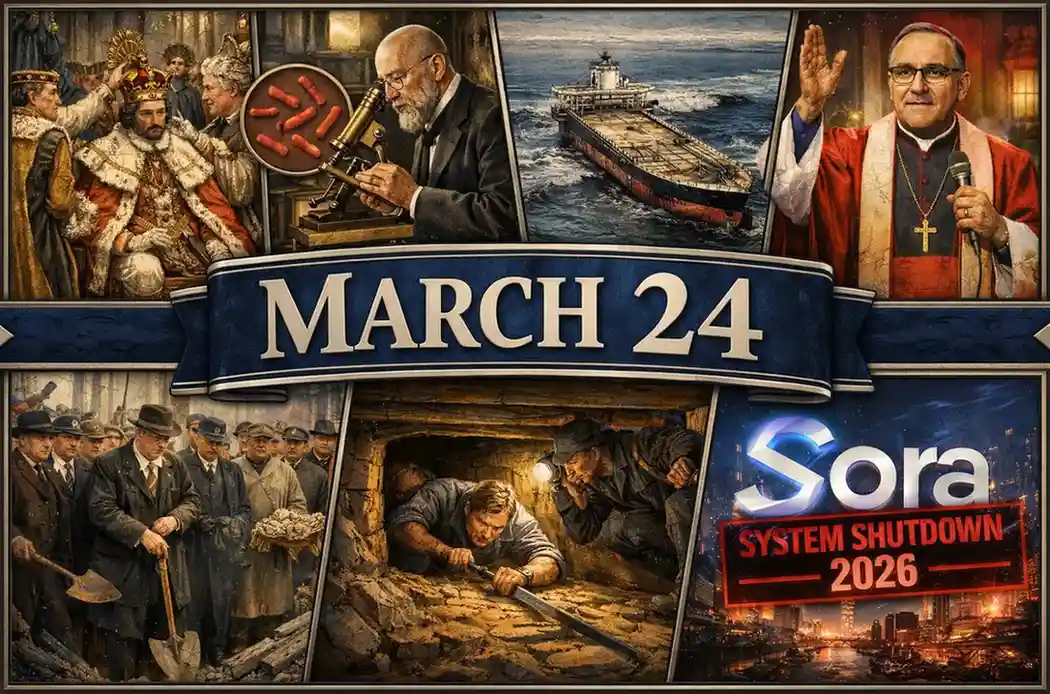
Looking back at what happened on this day in history March 24, we find a date heavy with the transition of power and the evolution of modern rights. It spans from the moment James VI of Scotland united the English and Scottish crowns to the somber anniversary of the Exxon Valdez oil spill. The day is also defined by pivotal scientific achievements, such as Robert Koch’s identification of the cause of tuberculosis, and modern shifts like Bhutan’s first democratic elections.
Important Events That Happened On March 24 In History
1199 – The Wounding of King Richard I
While fighting in France, King Richard I of England—known as “the Lionheart”—was struck by a crossbow bolt. The wound itself was not immediately fatal, but it led to a severe infection. This injury ultimately resulted in his death on April 6, changing the line of succession for the English throne.
1387 – Battle of Margate
In a significant naval engagement off the coast of Margate, English forces secured a victory over a combined Franco-Castilian-Flemish fleet. The battle was a notable clash during the Hundred Years’ War, demonstrating English naval strength and securing the surrounding coastal waters from continental threats.
1401 – Sack of Damascus
The Turco-Mongol emperor Timur, also known as Tamerlane, successfully besieged and sacked the ancient city of Damascus. The conquest was marked by widespread destruction, as Timur’s forces dismantled one of the most important cultural and economic centers of the Islamic world at the time.
1603 – Union of the Crowns
Following the death of Queen Elizabeth I, James VI of Scotland was proclaimed King James I of England and Ireland. This historic proclamation united the crowns of the three kingdoms under a single monarch for the first time, laying the groundwork for the future United Kingdom.
1603 – Establishment of the Tokugawa Shogunate
In Japan, Emperor Go-Yōzei granted the title of shōgun to Tokugawa Ieyasu. This official appointment allowed Ieyasu to establish the Tokugawa shogunate in Edo (modern-day Tokyo), beginning an era of peace and isolation that would last for over two and a half centuries.
1663 – Charter of the Province of Carolina
King Charles II of England granted a charter for the Province of Carolina to eight “Lords Proprietor.” This land grant was a reward for their loyal assistance in restoring the king to the throne. The province would eventually be divided into the states of North and South Carolina.
1720 – Frederick of Hesse-Kassel Elected King
The Riksdag of the Estates elected Count Frederick of Hesse-Kassel as the King of Sweden. His election followed the abdication of his consort, Queen Ulrika Eleonora, on February 29. His reign marked a shift in Swedish governance toward a period known as the Age of Liberty.
1721 – Dedication of the Brandenburg Concertos
Johann Sebastian Bach dedicated a collection of six instrumental works to Margrave Christian Ludwig of Brandenburg-Schwedt. Now known universally as the Brandenburg Concertos, these pieces are considered some of the finest examples of Baroque orchestral music ever composed.
1765 – The Quartering Act
The British Parliament passed the Quartering Act, a controversial law that required the Thirteen Colonies to provide housing and supplies for British troops stationed in America. This act became a major point of contention and helped fuel the fires of the American Revolution.
1794 – Kościuszko Uprising Begins
In Kraków, Tadeusz Kościuszko announced a general uprising against the forces of Imperial Russia and the Kingdom of Prussia. Assuming the role of Commander in Chief, Kościuszko sought to defend Polish sovereignty and territorial integrity against foreign partition.
1829 – Roman Catholic Relief Act
The Parliament of the United Kingdom passed the Roman Catholic Relief Act 1829. This landmark legislation removed many of the legal restrictions on Roman Catholics, finally allowing them to sit and serve as members of Parliament.
1832 – Attack on Joseph Smith
In Hiram, Ohio, a violent mob targeted the Mormon leader Joseph Smith. The group pulled him from his home, beat him, and then covered him in hot tar and feathers. Despite the brutal attack, Smith survived and continued to lead the Latter Day Saint movement.
1854 – Abolition of Slavery in Venezuela
President José Gregorio Monagas officially signed the decree that abolished slavery throughout Venezuela. This act ended centuries of institutionalized bondage in the country and granted full legal freedom to thousands of formerly enslaved people.
1860 – The Sakuradamon Incident
Japanese chief minister Ii Naosuke was assassinated outside the Sakurada Gate of Edo Castle. The attack was carried out by a group of rōnin samurai who were angered by his policies toward foreign powers. The event was a major blow to the authority of the Tokugawa shogunate.
1869 – Tītokowaru’s Uprising Ends
The final forces belonging to the Māori leader Tītokowaru surrendered to the New Zealand government. This marked the official end of his military campaign against colonial forces, concluding one of the most successful resistance efforts during the New Zealand Wars.
1870 – Discovery of Caracoles Silver
A Chilean prospecting party led by José Díaz Gana discovered massive silver deposits at Caracoles in the Atacama Desert. This discovery sparked the last of the major Chilean silver rushes but also created a diplomatic rift between Chile and Bolivia over mining taxes.
1878 – Sinking of HMS Eurydice
The British training frigate HMS Eurydice sank during a sudden snowstorm off the Isle of Wight. More than 300 crew members and trainees lost their lives in the disaster, making it one of the deadliest peace-time shipwrecks in the history of the Royal Navy.
1882 – Discovery of the Tuberculosis Bacterium
Robert Koch announced to the Berlin Physiological Society that he had identified Mycobacterium tuberculosis, the bacterium responsible for the “white plague.” This monumental discovery revolutionized medical science and paved the way for diagnosing and treating tuberculosis.
Getty Images
1900 – NYC Subway Groundbreaking
Mayor Robert Anderson Van Wyck officially broke ground for a new underground “Rapid Transit Railroad” in New York City. The project was designed to create a vital transport link between Manhattan and Brooklyn, forming the basis of the modern New York City Subway.
1900 – Formation of Carnegie Steel
The Carnegie Steel Company was formally organized in New Jersey. With a capitalization of $160 million—the largest corporate value recorded to date—it solidified Andrew Carnegie’s dominance over the American steel industry before its eventual merger into U.S. Steel.
1921 – First Women’s Olympiad
The 1921 Women’s Olympiad began in Monte Carlo. This historic event was the first international multi-sport competition specifically for women, providing a platform for female athletes at a time when they were largely excluded from the traditional Olympic Games.
1922 – The McMahon Killings
In a dark episode of the conflict in Northern Ireland, six Catholic civilians were shot dead in Belfast by gunmen. While police were heavily suspected of involvement, no one was ever prosecuted for the murders, which became a symbol of the sectarian violence of the era.
1927 – The Nanking Incident
During the Northern Expedition, foreign warships in the Yangtze River bombarded Nanjing, China. The military action was taken to protect foreign nationals and diplomatic residents within the city as Chinese revolutionary forces moved to seize control.
1934 – Tydings–McDuffie Act
The United States Congress passed the Tydings–McDuffie Act, which outlined a path for Philippine independence. The law established the Philippines as a self-governing commonwealth and set a ten-year transition period toward full sovereignty from the U.S.
1939 – The Liechtenstein Putsch
A group of approximately 40 members of the VBDL (a Nazi-sympathizing party) attempted a coup in Liechtenstein. They marched toward Vaduz with the intent of overthrowing the government and forcing annexation into Germany, but the attempt was quickly suppressed.
1944 – Ardeatine Massacre
In German-occupied Rome, Nazi troops executed 335 Italian civilians in the Ardeatine Caves. The massacre was a retaliatory act for a partisan attack on German police and remains one of the most notorious war crimes committed in Italy during World War II.
1944 – The “Great Escape” Begins
At the German prisoner-of-war camp Stalag Luft III, 76 Allied airmen began their daring breakout through a tunnel nicknamed “Harry.” The escape was later immortalized in the film The Great Escape, though most of the men were eventually recaptured.
1946 – British Cabinet Mission to India
A high-level British Cabinet Mission arrived in India to meet with local leaders. The goal of the mission was to discuss and plan the formal transfer of power from the British Raj to Indian leadership, a critical step toward Indian independence.
1949 – Execution of Hanns Albin Rauter
Hanns Albin Rauter, the highest-ranking SS and police leader in the occupied Netherlands, was executed by firing squad. He had been convicted of numerous crimes against humanity, including the deportation of Dutch Jews and the execution of political prisoners.
1972 – Direct Rule in Northern Ireland
The United Kingdom government, led by Prime Minister Edward Heath, suspended the Northern Ireland Parliament and imposed direct rule from London. The move was a response to the escalating violence and political instability of “The Troubles.”
1976 – Argentine Coup d’État
The Argentine armed forces overthrew the constitutional government of President Isabel Perón. This military coup marked the beginning of a seven-year dictatorship known as the National Reorganization Process, a period characterized by widespread human rights abuses.
1977 – Morarji Desai Becomes Prime Minister
Morarji Desai was sworn in as the Prime Minister of India. He was the first person to hold the office who did not belong to the Indian National Congress party, representing a major shift in the country’s democratic landscape following the end of “The Emergency.”
1980 – Assassination of Óscar Romero
Archbishop Óscar Romero, a vocal critic of social injustice and human rights violations in El Salvador, was assassinated while celebrating Mass. He was shot by a sniper, an act that helped ignite the Salvadoran Civil War and turned Romero into a global symbol of liberation theology.
1982 – Coup in Bangladesh
Army Chief Lieutenant General Hussain Muhammad Ershad led a bloodless coup that deposed President Abdus Sattar. Ershad suspended the national constitution and imposed martial law, initiating a period of military rule in Bangladesh that lasted until 1990.
1986 – Loscoe Gas Explosion
A methane gas explosion destroyed a house in Loscoe, England, after landfill gas migrated through the ground. The incident resulted in significant injuries and led directly to new UK laws regarding landfill gas protection and environmental monitoring.
1989 – Exxon Valdez Oil Spill
The oil tanker Exxon Valdez ran aground on Bligh Reef in Alaska’s Prince William Sound. The resulting spill of 240,000 barrels of crude oil devastated the local ecosystem and remains one of the most significant environmental disasters in maritime history.
1990 – IPKF Withdrawal from Sri Lanka
The last ship of the Indian Peace Keeping Force (IPKF) departed from Sri Lanka, marking the end of India’s direct military intervention in the Sri Lankan Civil War. The three-year mission had sought to enforce a peace accord but faced heavy resistance from various factions.
1992 – Launch of STS-45
The Space Shuttle Atlantis launched from Kennedy Space Center on mission STS-45. The mission focused on the “Atmospheric Laboratory for Applications and Science” (ATLAS-1), which provided crucial data on the Earth’s atmosphere and solar radiation.
1998 – Westside Middle School Shooting
Two students, aged 11 and 13, opened fire on their classmates and teachers at Westside Middle School in Jonesboro, Arkansas. Five people were killed and ten others were wounded in what was then one of the deadliest school shootings in U.S. history.
1998 – Dantan Tornado
A massive tornado swept through the Dantan region of India, causing widespread devastation. The storm killed approximately 250 people and left 3,000 others injured, highlighting the severe vulnerability of the region to extreme weather events.
1998 – First Computer-Assisted Bone Navigation
Dr. Rüdiger Marmulla performed the world’s first computer-assisted Bone Segment Navigation at the University of Regensburg in Germany. This technological breakthrough allowed for unprecedented precision in complex reconstructive surgeries.
1999 – NATO Bombing of Yugoslavia
NATO launched Operation Allied Force, a series of airstrikes against the Federal Republic of Yugoslavia during the Kosovo War. The campaign began without the approval of the UN Security Council, marking the first time NATO attacked a sovereign nation to halt a humanitarian crisis.
1999 – Mont Blanc Tunnel Fire
A transport truck carrying margarine and flour caught fire inside the Mont Blanc Tunnel between France and Italy. The fire created a massive inferno with temperatures reaching 1,000°C, resulting in the deaths of 39 people and leading to a major overhaul of tunnel safety laws.
2008 – Bhutan Becomes a Democracy
Bhutan officially transitioned from an absolute monarchy to a constitutional democracy. The nation held its first-ever general election for the National Assembly, following the guidance of the Fourth King to modernize the country’s political system.
2015 – Germanwings Flight 9525
A Germanwings Airbus A320 crashed into the French Alps, killing all 150 people on board. Investigation revealed that the co-pilot had intentionally crashed the plane in a mass murder-suicide, prompting global changes in airline cockpit security and pilot mental health monitoring.
2018 – End of the Afrin Offensive
The Turkish Armed Forces and the Syrian National Army captured the city of Afrin, taking full control of the district from Kurdish YPG forces. This marked the conclusion of Operation Olive Branch, a major phase in the multi-faceted Syrian Civil War.
2018 – March for Our Lives
Students across the United States organized the “March for Our Lives” to demand stricter gun control legislation. The massive nationwide protest was a direct response to the shooting at Marjory Stoneman Douglas High School and became one of the largest youth-led protests in history.
2023 – Mississippi Tornado Outbreak
A violent EF4 tornado tore through the towns of Rolling Fork and Silver City, Mississippi. The storm caused total destruction in many neighborhoods, resulting in multiple fatalities and drawing national attention to the increasing intensity of tornado seasons.
2024 – Senegalese Presidential Election
Senegal held its presidential election following a period of intense anti-government protests and political uncertainty. The vote was seen as a critical test for one of West Africa’s most stable democracies after attempts to delay the electoral process.
2026 – Sora Shutdown
In a surprise move for the tech industry, OpenAI announced that their flagship video-generation app and API, Sora, would be shutting down. The decision followed nearly two years of industry-shifting AI development, marking a significant pivot in the company’s generative media strategy.
Famous People Born on March 24
| Name | Description | Date |
|---|---|---|
| Thomas E. Dewey | Governor of New York, Republican presidential nominee | March 24, 1902 – March 16, 1971 |
| Andrew Mellon | American financier, secretary of the treasury (1921–1932) | March 24, 1855 – August 26, 1937 |
| Edward Weston | American photographer, major 20th-century artist | March 24, 1886 – January 1, 1958 |
| Michiel de Ruyter | Dutch admiral, hero of the Anglo-Dutch wars | March 24, 1607 – April 29, 1676 |
| Lawrence Ferlinghetti | American Beat poet and publisher | March 24, 1919 – February 22, 2021 |
| Peter Debye | Dutch-American physical chemist, Nobel Prize winner | March 24, 1884 – November 2, 1966 |
| John Wesley Powell | American explorer, geologist, and ethnologist (Grand Canyon) | March 24, 1834 – September 23, 1902 |
| Rufus King | American Founding Father, senator, and diplomat | March 24, 1755 – April 29, 1827 |
| Fanny Crosby | American hymn writer, author of over 8,000 hymns | March 24, 1820 – February 12, 1915 |
| Dorothy Height | American civil rights and women’s rights activist | March 24, 1912 – April 20, 2010 |
| Ub Iwerks | American animator, co-creator of Mickey Mouse | March 24, 1901 – July 7, 1971 |
| Vasily Vasilyevich Smyslov | Russian chess grandmaster, world champion (1957–58) | March 24, 1921 – March 27, 2010 |
| Olive Schreiner | South African writer, feminist, and liberal activist | March 24, 1855 – December 11, 1920 |
| Malcolm Muggeridge | British journalist and social critic | March 24, 1903 – November 24, 1990 |
| Sidney Reilly | Russian spy, “Ace of Spies” | March 24, 1874 – November 25, 1925 |
| David Dacko | President of the Central African Republic (1960–65, 1979–81) | March 24, 1930 – November 20, 2003 |
| Agnes Campbell Macphail | Canadian politician, first woman elected to Canadian Parliament | March 24, 1890 – February 13, 1954 |
| Adolf Butenandt | German biochemist, Nobel Prize winner (sex hormones) | March 24, 1903 – January 18, 1995 |
| George Sisler | American baseball player, Hall of Fame first baseman | March 24, 1893 – March 26, 1973 |
| Joseph Liouville | French mathematician, discovered transcendental numbers | March 24, 1809 – September 8, 1882 |
| Sir John Cowdery Kendrew | British biochemist, Nobel Prize winner (myoglobin) | March 24, 1917 – August 23, 1997 |
| Luigi Einaudi | President of Italy (1948–1955) | March 24, 1874 – October 30, 1961 |
| Joel Barlow | American poet and diplomat | March 24, 1754 – December 24, 1812 |
| Josef Stefan | Austrian physicist (Stefan–Boltzmann law) | March 24, 1835 – January 7, 1893 |
| Georgius Agricola | German scholar, “father of mineralogy” | March 24, 1494 – November 21, 1555 |
| Joseph H. Taylor, Jr. | American astrophysicist, Nobel Prize winner (binary pulsar) | March 24, 1941 – Present |
| Vojislav Koštunica | President of Yugoslavia (2000–2003), prime minister of Serbia | March 24, 1944 – Present |
| Antonio Rosmini-Serbati | Italian philosopher and theologian | March 24, 1797 – July 1, 1855 |
| Horace Gray | Associate justice of the U.S. Supreme Court | March 24, 1828 – September 15, 1902 |
| Charles Daniels | American swimmer, Olympic gold medalist | March 24, 1885 – August 8, 1973 |
Famous People Died on March 24
| Name | Description | Date |
|---|---|---|
| Gordon Moore | American engineer, co-founder of Intel (Moore’s Law) | January 3, 1929 – March 24, 2023 |
| Alexander Alekhine | Russian-French chess grandmaster, world champion (1927–35, 1937–46) | October 31, 1892 – March 24, 1946 |
| Orde Charles Wingate | British military officer, commander of Chindits in WWII | February 26, 1903 – March 24, 1944 |
| Joseph Needham | British biochemist and historian of Chinese science | December 9, 1900 – March 24, 1995 |
| Enrique Granados | Spanish composer and pianist | July 27, 1867 – March 24, 1916 |
| Nicholas V | Pope (1447–1455), founder of the Vatican Library | November 15, 1397 – March 24, 1455 |
| Bertel Thorvaldsen | Danish Neoclassical sculptor | November 19, 1770 – March 24, 1844 |
| J.M. Synge | Irish playwright, leading figure in Irish literary renaissance | April 16, 1871 – March 24, 1909 |
| Walter Bagehot | British economist and journalist, editor of The Economist | February 3, 1826 – March 24, 1877 |
| César Milstein | Argentine-British immunologist, Nobel Prize winner (monoclonal antibodies) | October 8, 1927 – March 24, 2002 |
| Arne Jacobsen | Danish architect and designer | February 11, 1902 – March 24, 1971 |
| Auguste Piccard | Swiss-Belgian physicist, explorer of stratosphere and deep sea | January 28, 1884 – March 24, 1962 |
| John Hersey | American novelist and journalist (Hiroshima) | June 17, 1914 – March 24, 1993 |
| An Wang | Chinese-American engineer, founder of Wang Laboratories | February 7, 1920 – March 24, 1990 |
| Terrence McNally | American dramatist and librettist | November 3, 1939 – March 24, 2020 |
| Harold Joseph Laski | British political scientist and Labour Party leader | June 30, 1893 – March 24, 1950 |
| César Cui | Russian composer, member of “The Five” | January 18, 1835 – March 24, 1918 |
| Henri, baron de Jomini | French general and military theorist | March 6, 1779 – March 24, 1869 |
| John W. Davis | American politician, Democratic presidential nominee (1924) | April 13, 1873 – March 24, 1955 |
| Jacques Hébert | French revolutionary journalist and radical leader | November 15, 1757 – March 24, 1794 |
| Manu Dibango | Cameroonian saxophonist and composer (Soul Makossa) | December 12, 1933 – March 24, 2020 |
| Henry, 1st duke and 4th earl of Lancaster | English soldier, trusted adviser of King Edward III | c.1300 – March 24, 1361 |
| Alice Guy-Blaché | French film director, first woman to direct a narrative film | July 1, 1873 – March 24, 1968 |
| Johann Wolfgang Döbereiner | German chemist, discovered triads (periodic law precursor) | December 13, 1780 – March 24, 1849 |
| Spencer Compton Cavendish, 8th duke of Devonshire | British statesman, leader of Liberal Unionists | July 23, 1833 – March 24, 1908 |
| Jacques Callot | French printmaker, documented horrors of war | 1592 – March 24, 1635 |
| Ii Naosuke | Japanese feudal lord, signed first treaty with the U.S. | November 29, 1815 – March 24, 1860 |
| Humphry Repton | English landscape designer, successor to Lancelot Brown | April 21, 1752 – March 24, 1818 |
| Joseph ben Ephraim Karo | Jewish scholar, author of the Shulḥan ʿarukh | 1488 – March 24, 1575 |
| Lanford Wilson | American playwright, pioneer of Off-Off-Broadway | April 13, 1937 – March 24, 2011 |
Observances & Institutional Dates
- World Tuberculosis Day: Commemorating Robert Koch’s discovery of the TB bacterium in 1882 and raising awareness for the global epidemic.
- Day of Remembrance for Truth and Justice (Argentina): A public holiday marking the anniversary of the 1976 coup and honoring the victims of the “Dirty War.”
- National Tree Planting Day (Uganda): An annual event focused on reforestation and environmental conservation.
- International Day for the Right to the Truth: A UN observance honoring victims of gross human rights violations and the importance of public memory.
Frequently Asked Questions
- What happened on March 24, 1603? James VI of Scotland became King James I of England, and Tokugawa Ieyasu became Shōgun of Japan.
- Who discovered the cause of tuberculosis? Robert Koch announced the discovery of Mycobacterium tuberculosis on March 24, 1882.
- What was the Exxon Valdez disaster? It was a massive oil spill in Alaska that occurred on March 24, 1989, after a tanker ran aground.
- Why does Argentina observe March 24? It is a day of remembrance for the victims of the 1976 military coup and the subsequent dictatorship.