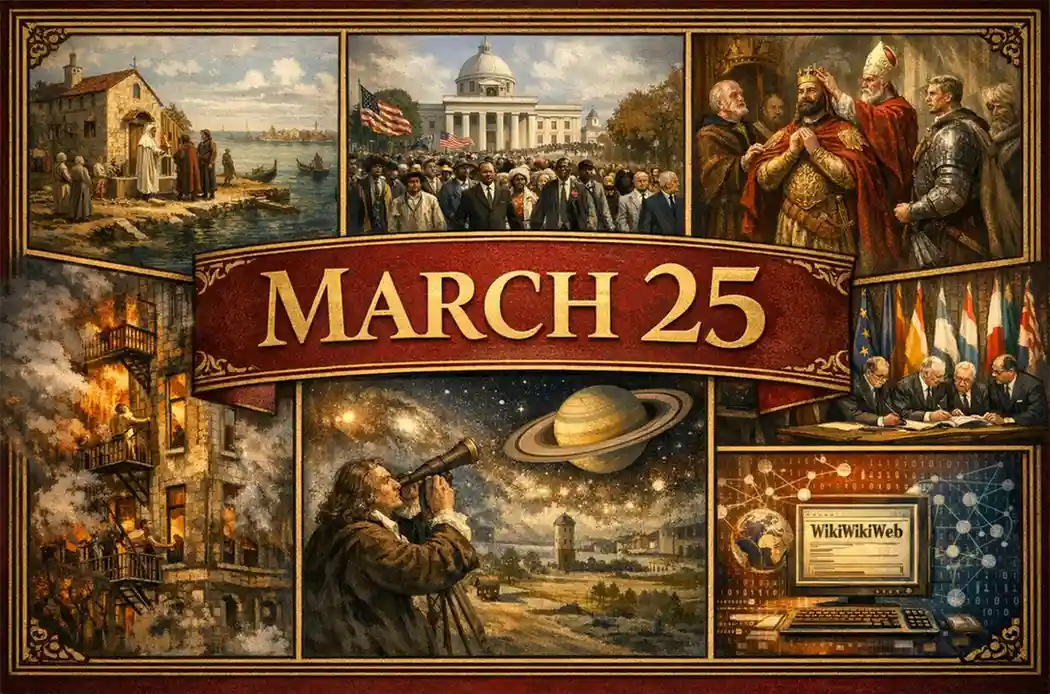
Thinking about this day in history March 25, it’s clear that this date serves as a perennial launchpad for the “new.” It captures the spirit of beginning, from the legendary founding of Venice in 421 to Robert the Bruce being crowned King of Scots in 1306. These milestones of governance paved the way for modern shifts, like the 1957 establishment of the European Economic Community and even the birth of the very first “wiki” software.
Important Events That Happened On March 25 In History
410 – Fall of Guanggu
General Liu Yu of the Jin dynasty captured Guanggu, the capital of the Southern Yan. This military success effectively brought the Southern Yan dynasty to an end, marking a significant consolidation of power during the turbulent Era of the Sixteen Kingdoms in China.
421 – Founding of Venice
According to tradition, the city of Venice was founded with the dedication of its first church, San Giacomo di Rialto, on the islet of Rialto. This humble beginning on a marshy lagoon eventually evolved into one of the most powerful maritime republics in world history.
708 – Election of Pope Constantine
Following the death of Pope Sisinnius, Constantine was elected as the new Bishop of Rome. His papacy was notable for his efforts to maintain relations with the East; he was the last pope to visit Constantinople until 1967.
717 – Resignation of Theodosius III
Byzantine Emperor Theodosius III resigned his throne to enter a monastery, clearing the way for Leo III to take power. This transition marked the beginning of the Isaurian dynasty, which would lead the empire through a period of intense military and religious reform.
919 – Romanos Lekapenos Seizes Power
In Constantinople, Romanos Lekapenos seized the Boukoleon Palace. By doing so, he established himself as the regent for the young Byzantine emperor Constantine VII, effectively taking control of the empire’s administration.
1000 – Assassination of Barjawan
The Fatimid caliph al-Hakim bi-Amr Allah successfully orchestrated the assassination of his powerful eunuch chief minister, Barjawan. By removing his mentor and rival, the Caliph assumed full personal control over the government at the age of 15.
1065 – Great German Pilgrimage Attacked
On Good Friday, a large group of German pilgrims traveling to Jerusalem was ambushed by Beduin bandits. The pilgrims suffered heavy losses during the attack, highlighting the extreme dangers faced by European travelers in the Levant during the 11th century.
1221 – Coronation of Robert of Courtenay
Robert of Courtenay was crowned as the Emperor of the Latin Empire in Constantinople. His reign was characterized by the struggle to maintain the fragile crusader state against surrounding Byzantine and Bulgarian forces.
1306 – Robert the Bruce Becomes King
In a bold move during the Wars of Scottish Independence, Robert the Bruce was crowned King of Scots at Scone. His coronation defied the English crown and initiated a long military campaign to secure Scotland’s sovereignty.
1409 – Council of Pisa Convenes
The Council of Pisa opened in an attempt to resolve the Western Schism, a period where multiple rival popes claimed authority over the Catholic Church. While the council sought to heal the divide, it initially resulted in the election of a third competing pope.
1410 – Ming Campaigns Against Mongols
The Yongle Emperor of Ming China launched the first of five major military expeditions into the Mongolian Steppe. The campaign was a success, leading to the defeat and fall of the Mongol khan Bunyashiri.
1519 – Hernán Cortés Defeats Tabascans
Entering the province of Tabasco, Spanish conquistador Hernán Cortés defeated the local Tabascan Indians in battle. This victory led to the natives providing the Spaniards with food, gold, and twenty women, including La Malinche, who became a key interpreter.
1576 – Newington Butts Theatre Sub-Lease
Jerome Savage took out a sub-lease to start the Newington Butts Theatre just outside London. It was one of the earliest purpose-built playhouses in the London area, predating the more famous Globe Theatre.
1584 – Raleigh Granted Patent for Virginia
Sir Walter Raleigh was granted a royal patent by Queen Elizabeth I to explore, colonize, and rule “remote, heathen and barbarous lands” in North America. This patent eventually led to the establishment of the Roanoke Colony in Virginia.
1655 – Discovery of Titan
Dutch astronomer Christiaan Huygens discovered Saturn’s largest moon, Titan. Using a telescope of his own design, Huygens became the first person to identify a satellite orbiting a planet other than Earth or Jupiter.
1708 – French Fleet at Fife Ness
A French fleet carrying troops for a planned invasion of Britain anchored near Fife Ness in Scotland. The invasion, intended to restore the Jacobite claimant to the throne, was ultimately abandoned due to the presence of the British Royal Navy.
1725 – Premiere of “Wie schön leuchtet der Morgenstern”
Johann Sebastian Bach’s chorale cantata Wie schön leuchtet der Morgenstern (BWV 1) was performed for the first time in Leipzig. The performance coincided with both the Feast of the Annunciation and Palm Sunday.
1770 – Daskalogiannis Uprising
Daskalogiannis led the people of Sfakia, Crete, in the first major Greek uprising against Ottoman rule. Although the revolt was eventually suppressed, it is remembered as a foundational moment of resistance in the Greek struggle for independence.
1776 – Raid on Tybee Island
During the American Revolutionary War, Patriot forces conducted a raid on Tybee Island, Georgia. Their primary objective was to capture runaway slaves who had sought refuge and protection with British forces stationed there.
1802 – Treaty of Amiens Signed
France and the United Kingdom signed the Treaty of Amiens, establishing a “Definitive Treaty of Peace.” This brought a temporary end to hostilities between the two powers during the Revolutionary Wars, though peace would only last for about a year.
1807 – First Passenger Railway
The Swansea and Mumbles Railway in Wales became the first passenger-carrying railway in the world. Originally designed for industrial use, it began a regular service using horse-drawn carriages to transport fare-paying passengers.
1811 – Percy Bysshe Shelley Expelled
The University of Oxford expelled poet Percy Bysshe Shelley after he refused to acknowledge his authorship of the controversial pamphlet The Necessity of Atheism. The event became a famous example of the conflict between intellectual freedom and institutional religious authority.
1821 – Traditional Start of Greek Independence
This date is traditionally celebrated as the start of the Greek War of Independence against the Ottoman Empire. While fighting had actually begun in late February, March 25 remains the national holiday, coinciding with the Annunciation.
1845 – First New Zealand Militia Act
The New Zealand Legislative Council passed the first Militia Act. This legislation provided the legal framework for the constitution of the New Zealand Army, allowing for the mobilization of citizens for territorial defense.
1865 – Battle of Fort Stedman
During the Siege of Petersburg in the American Civil War, Confederate forces under General John B. Gordon launched a surprise attack and captured Fort Stedman. However, the Union army quickly counterattacked, repulsing the Confederates and inflicting heavy casualties.
1894 – Coxey’s Army Departs
Coxey’s Army, the first significant protest march in the United States, departed Massillon, Ohio. Led by Jacob Coxey, the group of unemployed workers planned to march to Washington, D.C., to demand government job creation following the Panic of 1893.
1911 – Triangle Shirtwaist Factory Fire
A fire broke out at the Triangle Shirtwaist Factory in New York City, killing 146 garment workers, most of whom were young immigrant women. The tragedy led to massive public outcry and resulted in the overhaul of factory safety standards and labor laws in the U.S.
1911 – Murder of Andrey Yushchinsky
The body of 13-year-old Andrey Yushchinsky was found in Kiev. His death led to the “Beilis affair,” a notorious trial in which a Jewish man was falsely accused of ritual murder, fueling antisemitism in the Russian Empire.
1917 – Georgian Church Autocephaly
The Georgian Orthodox Church successfully restored its autocephaly (self-governance). The status had been abolished by Imperial Russia more than a century earlier in 1811, and its restoration was a key moment for Georgian national identity.
1918 – Belarusian People’s Republic Established
The Belarusian People’s Republic was proclaimed as an independent state following the collapse of the Russian Empire. Although its independence was short-lived, it remains a significant symbol in the history of Belarusian sovereignty.
1919 – Tetiev Pogrom
A devastating pogrom occurred in the Ukrainian town of Tetiev. The scale and systematic nature of the violence against the Jewish population have led historians to describe it as a prototype for the mass murders that occurred during the Holocaust.
1924 – Second Hellenic Republic Proclaimed
On the anniversary of Greek independence, Alexandros Papanastasiou proclaimed the establishment of the Second Hellenic Republic. This followed the abolition of the monarchy in the wake of the Greco-Turkish War.
1931 – Arrest of the Scottsboro Boys
In Alabama, nine Black teenagers, known as the “Scottsboro Boys,” were arrested and falsely charged with the rape of two white women. Their subsequent trials became a landmark in the American civil rights movement and highlighted racial injustice in the legal system.
1932 – Tomb of the Unknown Soldier Unveiled
The Tomb of the Unknown Soldier was officially unveiled in Syntagma Square, Athens. The monument serves as a national memorial to all Greek soldiers killed in war whose remains were never identified.
1941 – Yugoslavia Joins the Axis
The Kingdom of Yugoslavia signed the Tripartite Pact, officially joining the Axis powers. The decision was highly unpopular among the public and the military, leading to a coup d’état just two days later.
1947 – Centralia Mine Explosion
A massive coal mine explosion in Centralia, Illinois, resulted in the deaths of 111 miners. The disaster led to renewed scrutiny of mine safety regulations and the eventual passage of stricter federal safety laws.
1948 – First Successful Tornado Forecast
Meteorologists at Tinker Air Force Base in Oklahoma issued the first successful tornado forecast in history. Their warning allowed personnel to take cover before a tornado struck the base, proving that these destructive storms could be predicted.
1949 – Mass Deportations from Baltic States
In a sudden Soviet operation, more than 92,000 “kulaks” and their families were forcibly deported from the Baltic states (Estonia, Latvia, and Lithuania) to Siberia. The operation was designed to break resistance to the forced collectivization of agriculture.
1957 – Seizure of “Howl”
U.S. Customs officials in San Francisco seized copies of Allen Ginsberg’s poem Howl on the grounds that it was obscene. The seizure led to a famous First Amendment trial that ultimately protected the publication of controversial literary works.
1957 – Establishment of the EEC
The Treaty of Rome was signed, establishing the European Economic Community (EEC). The founding members—West Germany, France, Italy, Belgium, the Netherlands, and Luxembourg—created a framework for economic integration that eventually became the European Union.
1959 – Sale of Chain Island
The State of California sold Chain Island to Sacramento businessman Russell Gallaway III for $5,258.20. Gallaway intended to use the island as a private hunting and fishing retreat, a price that would be equivalent to over $58,000 today.
1965 – Completion of the Selma March
Led by Martin Luther King Jr., thousands of civil rights activists successfully completed their 50-mile march from Selma to the state capitol in Montgomery, Alabama. The march was a turning point in the movement, building the political momentum needed to pass the Voting Rights Act of 1965.
1971 – ARVN Abandons Laos Mission
The Army of the Republic of Vietnam (ARVN) was forced to abandon Operation Lam Son 719, an attempt to cut off the Ho Chi Minh trail in Laos. The retreat followed heavy North Vietnamese counterattacks and marked a significant failure for the “Vietnamization” policy.
1975 – Assassination of King Faisal
King Faisal of Saudi Arabia was shot and killed by his nephew, Prince Faisal bin Musaid, during a royal reception. The motives for the assassination remain a subject of debate, though the king was immediately succeeded by his brother, Khalid.
1979 – Columbia Delivered to Kennedy Space Center
The first fully functional Space Shuttle orbiter, Columbia, was delivered to the John F. Kennedy Space Center. After years of development, the orbiter began final preparations for the historic first launch of the Space Shuttle program.
1988 – Candle Demonstration in Bratislava
A peaceful gathering known as the “Candle Demonstration” took place in Bratislava, Czechoslovakia. It was the first mass protest of the 1980s against the communist regime, with participants calling for religious freedom and civil rights.
1995 – WikiWikiWeb Goes Public
Ward Cunningham made the WikiWikiWeb public, creating the world’s first “wiki.” As part of the Portland Pattern Repository, this technology allowed users to collaboratively create and edit web pages, a concept that would later make sites like Wikipedia possible.
1996 – EU Bans British Beef
The European Union’s Veterinarian Committee issued a global ban on the export of British beef and its by-products. The measure was taken to prevent the spread of “mad cow disease” (Bovine spongiform encephalopathy) to other countries.
2006 – Capitol Hill Massacre
In Seattle, a gunman opened fire at a party in the Capitol Hill neighborhood, killing six people before taking his own life. It was one of the deadliest shootings in the city’s history and prompted renewed debates over gun laws and mental health.
2006 – Unrest in Belarus
Protesters in Minsk clashed with riot police while demanding a new election following the widely condemned 2006 Belarusian presidential election. Several opposition figures, including leader Aleksander Kozulin, were arrested during the crackdown.
2018 – SDF Insurgency in Afrin
Following the Turkish capture of the region, the Syrian Democratic Forces (SDF) announced the beginning of an insurgency against the Turkish occupation of the Afrin District. This marked a new phase of guerrilla warfare within the broader Syrian Civil War.
After reading the March 24 stories, check also the March 25 Facts
Famous People Born on March 25
| Name | Description | Date |
|---|---|---|
| David Lean | British film director (Lawrence of Arabia, Doctor Zhivago) | March 25, 1908 – April 16, 1991 |
| Arturo Toscanini | Italian conductor, one of the great virtuoso conductors | March 25, 1867 – January 16, 1957 |
| Joachim Murat | French marshal, king of Naples (1808–1815) | March 25, 1767 – October 13, 1815 |
| Thomas-Alexandre Dumas | French general, father of Alexandre Dumas | March 25, 1762 – February 26, 1806 |
| A.J.P. Taylor | British historian and journalist | March 25, 1906 – September 7, 1990 |
| Simone Signoret | French actress, Academy Award winner | March 25, 1921 – September 30, 1985 |
| Gutzon Borglum | American sculptor, creator of Mount Rushmore | March 25, 1867 – March 6, 1941 |
| Sheryl Swoopes | American basketball player, WNBA legend | March 25, 1971 – Present |
| Tom Glavine | American baseball pitcher, Cy Young Award winner | March 25, 1966 – Present |
| Matilda Joslyn Gage | American suffragist and women’s rights activist | March 25, 1826 – March 18, 1898 |
| Caroline Bonaparte | Queen of Naples, sister of Napoleon Bonaparte | March 25, 1782 – May 18, 1839 |
| Toni Cade Bambara | American author and civil rights activist | March 25, 1939 – December 9, 1995 |
| Gabrielle Roy | Canadian novelist, important figure in French-Canadian literature | March 25, 1909 – July 13, 1983 |
| Stephen Edelston Toulmin | British philosopher, historian of ideas | March 25, 1922 – December 4, 2009 |
| Andronicus III Palaeologus | Byzantine emperor (1328–1341) | March 25, 1297 – June 15, 1341 |
| Francis | Grand duke of Tuscany (1574–1587) | March 25, 1541 – October 19, 1587 |
| Kate DiCamillo | American children’s author | March 25, 1964 – Present |
| Conradin | Duke of Swabia, last of the Hohenstaufen dynasty | March 25, 1252 – October 29, 1268 |
| Michael Davitt | Irish political leader, founder of the Irish Land League | March 25, 1846 – May 31, 1906 |
| Johann Adolph Hasse | German Baroque opera composer | March 25, 1699 – December 16, 1783 |
| Albrecht Ritschl | German Lutheran theologian | March 25, 1822 – March 20, 1889 |
| Paul Scott | British novelist (The Raj Quartet) | March 25, 1920 – March 1, 1978 |
| George Sutherland | Associate justice of the U.S. Supreme Court | March 25, 1862 – July 18, 1942 |
| William S. Knudsen | American industrialist, president of General Motors | March 25, 1879 – April 27, 1948 |
| László Papp | Hungarian boxer, first three-time Olympic boxing champion | March 25, 1926 – October 16, 2003 |
| Matthew Barney | American sculptor and video artist (Cremaster cycle) | March 25, 1967 – Present |
| Athenagoras I | Ecumenical patriarch of Constantinople (1948–1972) | March 25, 1886 – July 7, 1972 |
| José de Espronceda y Delgado | Spanish Romantic poet, “Spanish Lord Byron” | March 25, 1808 – May 23, 1842 |
| Adolf Engler | German botanist, famous for his plant classification system | March 25, 1844 – October 10, 1930 |
| Simon Flexner | American pathologist, isolated dysentery bacillus | March 25, 1863 – May 2, 1946 |
Famous People Died on March 25
| Name | Description | Date |
|---|---|---|
| Josef Albers | German-born American painter (Color Field, Op art) | March 19, 1888 – March 25, 1976 |
| Edward Steichen | American photographer, influential modernist | March 27, 1879 – March 25, 1973 |
| Novalis | German Romantic poet and theorist | May 2, 1772 – March 25, 1801 |
| Oscar Micheaux | African American filmmaker, pioneer of independent cinema | January 2, 1884 – March 25, 1951 |
| Henry Lee | American cavalry officer, father of Robert E. Lee | January 29, 1756 – March 25, 1818 |
| Frédéric Mistral | French poet, Nobel Prize in Literature (1904) | September 8, 1830 – March 25, 1914 |
| Frederick | King of Sweden (1720–1751) | April 17, 1676 – March 25, 1751 |
| John Hope Franklin | American historian, scholar of African American history | January 2, 1915 – March 25, 2009 |
| Marcel Lefebvre | French archbishop, traditionalist Catholic leader | November 29, 1905 – March 25, 1991 |
| James S. Coleman | American sociologist, pioneer of mathematical sociology | May 12, 1926 – March 25, 1995 |
| James Wright | American poet, Pulitzer Prize winner | December 13, 1927 – March 25, 1980 |
| Max Eastman | American poet, editor, and radical activist | January 12, 1883 – March 25, 1969 |
| Eddie Collins | American baseball player, Hall of Fame second baseman | May 2, 1887 – March 25, 1951 |
| Nunnally Johnson | American screenwriter, producer, and director | December 5, 1897 – March 25, 1977 |
| James Braid | British surgeon, pioneer of hypnosis | 1795 – March 25, 1860 |
| Stephen (II) | Unconsecrated pope (elected, died before consecration) | unknown – March 25, 752 |
| Wenceslaus Hollar | Bohemian etcher, topographical artist | July 23, 1607 – March 25, 1677 |
| Taira Masakado | Japanese rebel leader of the Heian period | unknown – March 25, 940 |
| Afonso II | King of Portugal (1211–1223) | c.1185 – March 25, 1223 |
| Sir Hector Macdonald | British soldier, rose from private to major general | April 13, 1853 – March 25, 1903 |
| Marcos de Niza | Spanish Franciscan explorer, sought “Seven Golden Cities” | c.1495 – March 25, 1558 |
| Robert Joffrey | American dancer and choreographer, founder of Joffrey Ballet | December 24, 1930 – March 25, 1988 |
| Wilhelm Lehmbruck | German sculptor, Expressionist | January 4, 1881 – March 25, 1919 |
| Gabriel Okara | Nigerian poet and novelist | April 21, 1921 – March 25, 2019 |
| Caroline Chisholm | British-born Australian philanthropist | May 1808? – March 25, 1877 |
| John Drinkwater | English poet, playwright, and critic | June 1, 1882 – March 25, 1937 |
| Giambattista Marino | Italian poet, founder of Marinism | October 18, 1569 – March 25, 1625 |
| Goodman Ace | American radio writer and performer | January 15, 1899 – March 25, 1982 |
| Arnulf Øverland | Norwegian poet, inspired resistance during WWII | April 27, 1889 – March 25, 1968 |
| Giuseppe Maria Crespi | Italian Baroque painter | March 14, 1665 – March 25, 1747 |
Observances & Institutional Dates
- Independence Day (Greece): Commemorating the start of the 1821 revolution against Ottoman rule.
- International Day of Remembrance of the Victims of Slavery: A UN-sanctioned day to honor those who suffered under the transatlantic slave trade.
- Medal of Honor Day (USA): Dedicated to the recipients of the United States’ highest military decoration for valor.
- Freedom Day (Belarus): An unofficial holiday marking the 1918 establishment of the Belarusian People’s Republic.
- Commemoration Day for the Victims of Communist Genocide (Latvia): Remembering the thousands deported to Siberia in 1949.
Frequently Asked Questions
- When was Venice founded? Tradition holds that Venice was founded on March 25, 421, with the dedication of the San Giacomo di Rialto church.
- What is the significance of March 25 in Greek history? It is Greek Independence Day, marking the start of the war against the Ottoman Empire in 1821.
- When did the first wiki start? Ward Cunningham launched the world’s first wiki, WikiWikiWeb, on March 25, 1995.
- What happened on the Selma march on this day? In 1965, activists led by Martin Luther King Jr. completed their 50-mile journey at the capitol in Montgomery.