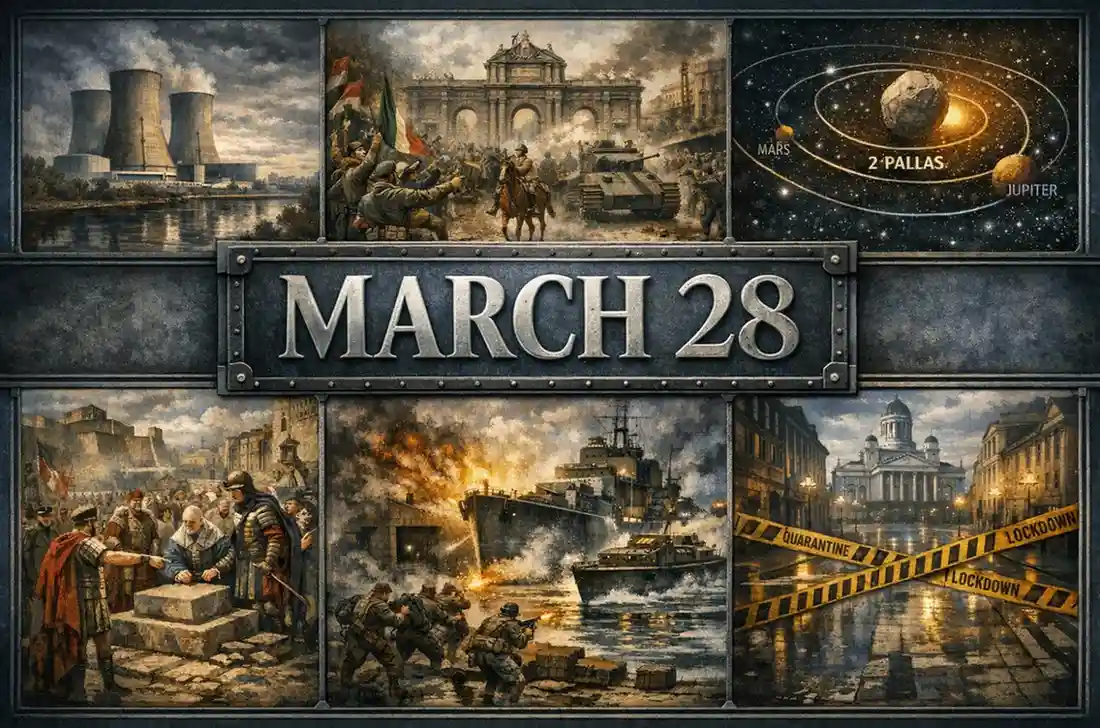
Reviewing what happened on this day in history March 28, we find a date defined by the rise and fall of regimes and significant scientific and environmental turning points. The timeline stretches from the Roman Senate bestowing titles upon Caligula in AD 37 to the 1979 Three Mile Island accident, which remains a landmark event in nuclear energy history. The day also marks the foundation of modern capitals like Valletta and pivotal moments in global conflicts, including the end of the Siege of Madrid in 1939.
Important Events That Happened On March 28 In History
AD 37 – Caligula Becomes Emperor
The Roman Senate officially bestowed the titles of the Principate upon Caligula. This act confirmed him as the successor to Tiberius, beginning a reign that started with great public hope but would eventually become synonymous with autocracy and excess.
193 – The Roman Throne is Auctioned
Following the assassination of Emperor Pertinax, the Praetorian Guard took the unprecedented step of auctioning off the Roman Empire to the highest bidder. Didius Julianus won the “auction” by promising a massive bounty to the guards, a move that severely undermined the legitimacy of the imperial office.
364 – Valentinian I Appoints Valens
Roman Emperor Valentinian I appointed his brother, Flavius Valens, as his co-emperor. This division of power allowed Valentinian to focus on the Western provinces while Valens managed the Eastern half of the empire from Constantinople.
1065 – Rescue of the Great German Pilgrimage
After enduring three days of attacks by Bedouin bandits, the participants of the Great German Pilgrimage were rescued. The intervention was led by the Fatimid governor of Ramla, who arrived in time to save the surviving travelers near the end of their journey to Jerusalem.
1566 – Foundation of Valletta
Jean Parisot de Valette, the Grand Master of the Sovereign Military Order of Malta, laid the foundation stone for Valletta. The new capital city was designed as a fortified stronghold following the Great Siege of Malta, eventually becoming a masterpiece of Baroque architecture.
1745 – Battle of Vilshofen
During the War of the Austrian Succession, Austrian forces engaged and defeated French troops at the Battle of Vilshofen. This victory was part of a broader campaign that eventually forced Bavaria out of the war against the Habsburg Monarchy.
1776 – Site for the Presidio of San Francisco
Spanish explorer Juan Bautista de Anza identified the specific site for the Presidio of San Francisco. This military outpost was established to secure Spain’s claim to the San Francisco Bay and protect the nearby missions from foreign encroachment.
1795 – End of the Duchy of Courland
As part of the ongoing Partitions of Poland, the Duchy of Courland and Semigallia ceased to exist as an independent entity. The territory, formerly a northern fief of the Polish–Lithuanian Commonwealth, was formally annexed into the Russian Empire.
1801 – Treaty of Florence
The French Republic and the Kingdom of Naples signed the Treaty of Florence, effectively ending the war between them. The treaty forced Naples to close its ports to British ships and cede several strategic territories to French control.
1802 – Discovery of 2 Pallas
Astronomer Heinrich Wilhelm Matthäus Olbers discovered 2 Pallas, the second asteroid ever to be identified. At the time, it was considered a new planet, and its discovery helped lead to the realization that a belt of small bodies existed between Mars and Jupiter.
1809 – Battle of Medellín
In a major engagement of the Peninsular War, French forces under Marshal Victor decisively defeated a Spanish army at Medellín. The French victory secured their control over the Extremadura region, though the war across the peninsula continued to rage.
1814 – Battle of Valparaíso
During the War of 1812, two American naval vessels, the USS Essex and the Essex Junior, were captured by two Royal Navy ships off the coast of Chile. The loss of the Essex ended a successful American commerce-raiding campaign in the Pacific.
1842 – First Concert of the Vienna Philharmonic
The Vienna Philharmonic Orchestra performed its very first concert, conducted by Otto Nicolai. This event marked the beginning of one of the world’s most celebrated musical institutions, established as a professional ensemble where members made all artistic decisions.
1854 – France and Britain Enter Crimean War
France and Great Britain officially declared war on Russia, joining the Ottoman Empire in the Crimean War. The intervention was designed to halt Russian expansion into the Balkans and protect Mediterranean trade routes.
1860 – Battle of Waireka
The Battle of Waireka began during the First Taranaki War in New Zealand. It was a significant clash between British colonial forces and Māori warriors, occurring as tensions over land ownership escalated into open warfare.
1862 – Battle of Glorieta Pass
Union forces successfully halted the Confederate invasion of the New Mexico Territory at the Battle of Glorieta Pass. Often called the “Gettysburg of the West,” the Union victory destroyed the Confederate supply train, forcing them to retreat to Texas.
1910 – First Seaplane Flight
Henri Fabre became the first person to successfully fly a seaplane, the Fabre Hydravion. He took off from a water runway at Étang le Barre near Marseille, France, proving that aircraft could operate effectively from the water.
1918 – General Pershing Diverts the ‘Rainbow’ Division
During World War I, General John J. Pershing cancelled the training orders for the 42nd ‘Rainbow’ Division and moved them to the Baccarat sector. The division became the first American unit to occupy an entire sector on its own, a position it held for three months.
1918 – “Bloody Maundy Thursday” in Tampere
The Finnish Civil War saw fierce urban combat in Tampere, known as “Bloody Maundy Thursday.” The White Guards forced the Red Guards into the city center, resulting in heavy casualties. During the battle, an explosion at the Red headquarters killed several commanders.
1920 – Palm Sunday Tornado Outbreak
A series of devastating tornadoes swept across the Great Lakes region and the Deep South. The outbreak resulted in hundreds of deaths and massive property destruction, remaining one of the most violent tornado events in U.S. history.
1933 – First Sabotage of an Airliner
The Imperial Airways biplane City of Liverpool crashed in Belgium after a passenger reportedly set a fire on board. It is believed to be the first instance of an airliner being lost due to a deliberate act of sabotage.
1939 – Franco Conquers Madrid
Nationalist forces led by Generalissimo Francisco Franco entered Madrid, ending a brutal three-year siege. The fall of the capital marked the effective end of the Spanish Civil War and the beginning of Franco’s long dictatorship.
1941 – Battle of Cape Matapan Begins
A major naval engagement began in the Mediterranean between the Royal Navy and the Royal Australian Navy against the Italian Regia Marina. The British used radar and decrypted intelligence to gain a decisive advantage over the Italian fleet.
1942 – St. Nazaire Raid
British commando and naval forces launched a daring raid to disable the Louis Joubert Lock in Saint-Nazaire, France. By destroying the only dry dock on the Atlantic coast capable of holding the German battleship Tirpitz, they protected vital Allied convoy lanes.
1946 – Acheson–Lilienthal Report
The United States Department of State released the Acheson–Lilienthal Report. The document proposed a plan for the international control of nuclear energy and the prevention of atomic warfare by placing nuclear materials under a global authority.
1959 – Dissolution of the Tibetan Government
The State Council of the People’s Republic of China officially dissolved the local government of Tibet. This action followed the 1959 uprising and led to the installment of a new administrative structure controlled by Beijing.
1961 – Crash of ČSA Flight 511
A ČSA (Czechoslovak Airlines) Flight 511 crashed in Igensdorf, West Germany, during a flight from Prague to Zurich. All 52 people on board were killed, and the cause of the high-altitude disintegration remains a subject of investigation.
1963 – Rome, Georgia Sit-In
Over one hundred high school students conducted a sit-in protest in Rome, Georgia, as part of the American civil rights movement. The demonstration was a direct challenge to racial segregation in public facilities and led to numerous arrests.
1965 – El Cobre Dam Failure
A powerful magnitude 7.4 earthquake in Chile caused the failure of several mining tailings dams. The resulting flow of toxic waste buried the town of El Cobre, killing at least 500 people in one of the country’s worst industrial-natural disasters.
1968 – Death of Edson Luís de Lima Souto
Military police in Brazil killed high school student Edson Luís de Lima Souto during a protest against rising food prices at a student restaurant. His death sparked a massive wave of anti-government demonstrations across the country.
1969 – Giorgos Seferis Opposes the Junta
Nobel Prize-winning poet Giorgos Seferis made a famous broadcast on the BBC World Service. He issued a powerful statement against the military junta ruling Greece, calling for an end to the “state of obligation” and the return of democracy.
1970 – Gediz Earthquake
A strong earthquake struck western Turkey near the town of Gediz. The disaster killed 1,086 people and injured over 1,200, destroying thousands of homes and leaving tens of thousands of people displaced.
1978 – Stump v. Sparkman Decision
The U.S. Supreme Court handed down a 5–3 decision in Stump v. Sparkman. The case involved a judge who had ordered the involuntary sterilization of a minor; the Court ruled that the judge was protected by judicial immunity from being sued for the act.
1979 – Three Mile Island Accident
A coolant leak at the Three Mile Island nuclear plant in Pennsylvania led to a partial meltdown of the Unit 2 reactor core. It remains the most significant accident in U.S. commercial nuclear power history, leading to major changes in safety regulations.
1979 – Vote of No Confidence in UK
The British House of Commons passed a vote of no confidence against the government of James Callaghan by a single vote (311 to 310). The defeat forced a general election, which would eventually lead to Margaret Thatcher becoming Prime Minister.
1990 – Jesse Owens Awarded Gold Medal
U.S. President George H. W. Bush posthumously awarded Olympic legend Jesse Owens the Congressional Gold Medal. The honor recognized his athletic achievements and his role in challenging racial ideology during the 1936 Berlin Olympics.
1994 – Shell House Massacre
In Johannesburg, South Africa, security guards at the African National Congress (ANC) headquarters opened fire on Inkatha Freedom Party protesters. Dozens of people were killed, heightening political tensions just before the country’s first democratic elections.
1999 – Izbica Massacre
During the Kosovo War, Serbian military and paramilitary forces killed at least 130 Kosovo Albanians in the village of Izbica. The event was one of the largest mass killings of the conflict and was later documented through satellite imagery and survivor testimony.
2001 – Opening of Athens International Airport
The “Eleftherios Venizelos” International Airport officially began operations in Athens, Greece. Replacing the old Ellinikon International Airport, it was a major infrastructure project completed in preparation for the 2004 Summer Olympics.
2003 – Friendly Fire Incident in Iraq
During the invasion of Iraq, two American A-10 Thunderbolt II aircraft mistakenly attacked a convoy of British tanks. The “blue-on-blue” incident resulted in the death of one British soldier and several injuries, sparking a significant military inquiry.
2005 – Nias–Simeulue Earthquake
A massive magnitude 8.6 earthquake struck off the coast of Sumatra, Indonesia. The powerful tremors killed over 1,000 people, primarily on the island of Nias, and triggered fears of a repeat of the devastating 2004 tsunami.
2006 – Mass Protests in France
At least one million people, including students and union members, took to the streets across France. The nationwide protests were directed at the government’s proposed “First Employment Contract” law, which critics argued made young workers too easy to fire.
2020 – Isolation of Uusimaa
Due to a surge in COVID-19 infections, the Finnish government temporarily isolated the region of Uusimaa—which includes the capital, Helsinki—from the rest of the country. It was an unprecedented move in modern Finnish history to curb the spread of the virus.
2025 – Mandalay Earthquake
A catastrophic magnitude 7.7 earthquake struck near Mandalay, Myanmar. The disaster resulted in over 5,400 fatalities and caused immense damage to historical sites and modern infrastructure across the central part of the country.
Famous People Born on March 28
| Name | Description | Date |
|---|---|---|
| Rick Barry | American basketball player, Hall of Fame forward | March 28, 1944 – Present |
| Alexandre Grothendieck | German-French mathematician, Fields Medal winner | March 28, 1928 – November 13, 2014 |
| Edmund Muskie | American politician, secretary of state, senator, governor | March 28, 1914 – March 26, 1996 |
| John Amos Comenius | Czech educational reformer, father of modern education | March 28, 1592 – November 14, 1670 |
| Paul Whiteman | American bandleader, “King of Jazz” | March 28, 1890 – December 29, 1967 |
| Jerome Isaac Friedman | American physicist, Nobel Prize winner | March 28, 1930 – Present |
| Jerry Sloan | American basketball player and coach, NBA legend | March 28, 1942 – May 22, 2020 |
| Aristide Briand | French prime minister (11 times), Nobel Peace Prize winner | March 28, 1862 – March 7, 1932 |
| Francisco de Miranda | Venezuelan revolutionary, precursor to Latin American independence | March 28, 1750 – July 14, 1816 |
| Sir Joseph William Bazalgette | British engineer, designed London’s main drainage system | March 28, 1819 – March 15, 1891 |
| Dame Flora Robson | British actress | March 28, 1902 – July 7, 1984 |
| Thomas Clarkson | English abolitionist, leader against slave trade | March 28, 1760 – September 26, 1846 |
| Nelson Algren | American writer | March 28, 1909 – May 9, 1981 |
| Rudolf Serkin | Austrian-born American pianist | March 28, 1903 – May 8, 1991 |
| Laura Chinchilla | President of Costa Rica (2010–2014), first female president | March 28, 1959 – Present |
| Bohumil Hrabal | Czech author | March 28, 1914 – February 3, 1997 |
| Freddie Bartholomew | British-born American child actor | March 28, 1924 – January 23, 1992 |
| August Anheuser Busch, Jr. | American brewer, president of Anheuser-Busch | March 28, 1899 – September 29, 1989 |
| Russell Banks | American novelist | March 28, 1940 – January 8, 2023 |
| Willem Mengelberg | Dutch conductor, led Concertgebouw Orchestra | March 28, 1871 – March 21, 1951 |
| William Byrd of Westover | American colonial diarist, founder of Richmond, Virginia | March 28, 1674 – August 26, 1744 |
| Samuel Sewall | British-American colonial judge, Salem witch trials diarist | March 28, 1652 – January 1, 1730 |
| Henry Rowe Schoolcraft | American explorer and ethnologist, discovered source of Mississippi | March 28, 1793 – December 10, 1864 |
| Corneille Heymans | Belgian physiologist, Nobel Prize winner | March 28, 1892 – July 18, 1968 |
| Mehmed Emin Pasha | German explorer and physician, governor of Equatorial Sudan | March 28, 1840 – October 23, 1892 |
| Maximilian III Joseph | Elector of Bavaria (1745–1777) | March 28, 1727 – December 30, 1777 |
| Yekaterina Romanovna Vorontsova, Princess Dashkova | Russian princess, associate of Catherine the Great | March 28, 1743 – January 16, 1810 |
| Angelos Sikelianós | Greek lyric poet | March 28, 1884 – June 19, 1951 |
| Grace Hartigan | American Abstract Expressionist painter | March 28, 1922 – November 15, 2008 |
| Martin Sheridan | Irish-born American athlete, Olympic gold medalist | March 28, 1881 – March 27, 1918 |
Famous People Died on March 28
| Name | Description | Date |
|---|---|---|
| Modest Mussorgsky | Russian composer (Boris Godunov, Pictures from an Exhibition) | March 21, 1839 – March 28, 1881 |
| Eugène Ionesco | Romanian-born French dramatist, founder of Theatre of the Absurd | November 26, 1909 – March 28, 1994 |
| W.C. Handy | American composer, “Father of the Blues” | November 16, 1873 – March 28, 1958 |
| Robert-François Damiens | French regicide, attempted assassin of Louis XV | January 9, 1715 – March 28, 1757 |
| E. Kirby-Smith | Confederate general in the American Civil War | May 16, 1824 – March 28, 1893 |
| Stephen Leacock | Canadian humorist and educator | December 30, 1869 – March 28, 1944 |
| George H. Thomas | Union general, “Rock of Chickamauga” | July 31, 1816 – March 28, 1870 |
| Anthony Powell | English novelist (A Dance to the Music of Time) | December 21, 1905 – March 28, 2000 |
| Valdemar II | King of Denmark (1202–1241), extended Danish Baltic empire | 1170 – March 28, 1241 |
| Edward M. House | American diplomat, adviser to President Woodrow Wilson | July 26, 1858 – March 28, 1938 |
| Christopher Morley | American writer | May 5, 1890 – March 28, 1957 |
| Jack Butler Yeats | Irish painter, most important Irish painter of 20th century | August 23, 1871 – March 28, 1957 |
| Dorothy Fields | American songwriter | July 15, 1905 – March 28, 1974 |
| Arthur Crudup | American blues singer-songwriter (“That’s All Right”) | August 24, 1905 – March 28, 1974 |
| Katharine Lee Bates | American poet, wrote “America the Beautiful” | August 12, 1859 – March 28, 1929 |
| Martin IV | Pope (1281–1285) | c.1210/1220 – March 28, 1285 |
| Janet Jagan | American-born Guyanese president, first female president in South America | October 20, 1920 – March 28, 2009 |
| Albert Pinkham Ryder | American painter | March 19, 1847 – March 28, 1917 |
| Sir Ralph Abercromby | British general, restored discipline to British army | October 7, 1734 – March 28, 1801 |
| Ban Johnson | American baseball executive, first president of American League | January 5, 1864 – March 28, 1931 |
| Go-Toba | Emperor of Japan (1183–1198), attempted imperial restoration | August 6, 1180 – March 28, 1239 |
| Miguel Hernández | Spanish poet and dramatist | October 30, 1910 – March 28, 1942 |
| Guntram | Merovingian king of Burgundy | c.532 – March 28, 592 |
| William Thornton | British-born American architect, designed the U.S. Capitol | May 20, 1759 – March 28, 1828 |
| Constantijn Huygens | Dutch diplomat, poet, and scholar | September 4, 1596 – March 28, 1687 |
| David J. Brewer | Associate justice of the U.S. Supreme Court | June 20, 1837 – March 28, 1910 |
| Peg Woffington | Irish actress, outstanding theatrical personality of her time | c.1714 – March 28, 1760 |
| Jean-Maurice-Émile Baudot | French engineer, invented Baudot telegraph code | 1845 – March 28, 1903 |
| William Francis Giauque | Canadian-born American chemist, Nobel Prize winner | May 12, 1895 – March 28, 1982 |
| John Arden | British playwright | October 26, 1930 – March 28, 2012 |
Observances & Institutional Dates
- Teachers’ Day (Czech Republic & Slovakia): Observed on the birthday of John Amos Comenius, a pioneer of modern education.
- Serfs Emancipation Day (Tibet): An official holiday in the Tibet Autonomous Region marking the 1959 dissolution of the Tibetan government.
- National Teachers’ Day (Vietnam): While often in November, March 28 is cited in specific regional educational contexts.
Frequently Asked Questions
- What happened at Three Mile Island? On March 28, 1979, a partial nuclear meltdown occurred at the plant in Pennsylvania due to a coolant leak.
- When did Madrid fall to Franco? General Francisco Franco’s forces conquered Madrid on March 28, 1939, ending the Spanish Civil War.
- Who discovered the asteroid Pallas? Heinrich Wilhelm Matthäus Olbers discovered 2 Pallas on March 28, 1802.
- What was the “Bloody Maundy Thursday”? It refers to the fierce urban battles in Tampere during the Finnish Civil War on March 28, 1918.