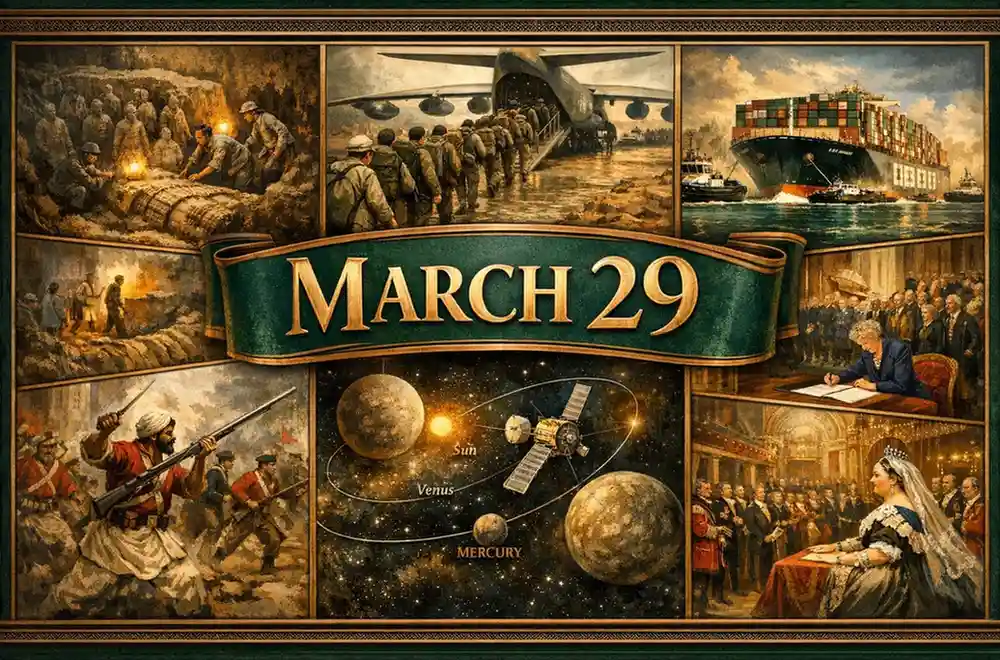
Whether we look at the redrawing of empire borders or the shifting of modern alliances, this day in history March 29 is a recurring catalyst for global change. It marks the 1849 British annexation of the Punjab and the 2017 start of the Brexit process, showing how this date has repeatedly reshaped national identities. Beyond politics, it is a day of incredible reveals, from the 1974 discovery of China’s Terracotta Army to the moment Taipei 101 was officially crowned the world’s tallest building in 2004, proving that this date is as much about human ingenuity as it is about geopolitical upheaval.
Important Events That Happened On March 29 In History
1139 – Endorsement of the Knights Templar
Pope Innocent II issued the papal bull Omne datum optimum. This document officially endorsed the Knights Templar, granting the order special privileges and approving the Templar Rule, which solidified their status as a powerful military and religious force.
1430 – Ottoman Capture of Thessalonica
The Ottoman Empire, led by Murad II, captured the city of Thessalonica from the Republic of Venice. The conquest followed a lengthy siege and marked a significant expansion of Ottoman control in the Balkans.
1461 – Battle of Towton
In what is often cited as the largest and bloodiest battle ever fought on English soil, Edward of York defeated Queen Margaret’s Lancastrian forces. The victory allowed Edward to become King Edward IV, bringing a temporary halt to the Wars of the Roses.
1549 – Founding of Salvador, Bahia
The city of Salvador was founded in Bahia, serving as the first capital of Brazil. Established by the Portuguese, it became a central hub for the administration of the colony and a major port for the burgeoning sugar trade.
1632 – Treaty of Saint-Germain
France and England signed the Treaty of Saint-Germain. The agreement returned Quebec and other captured territories in New France to French control after the English had seized them three years earlier in 1629.
1792 – Death of Gustav III
King Gustav III of Sweden died from his wounds 13 days after being shot in the back at a midnight masquerade ball. The assassination took place at Stockholm’s Royal Opera and was the result of a conspiracy among disgruntled aristocrats.
1806 – Authorization of the Cumberland Road
The United States authorized the construction of the Great National Pike, commonly known as the Cumberland Road. It became the first federal highway in the U.S., designed to connect the Potomac and Ohio Rivers to facilitate westward expansion.
1809 – Abdication of Gustav IV Adolf
Following a military coup d’état, King Gustav IV Adolf of Sweden was forced to abdicate his throne. The coup was triggered by widespread dissatisfaction over Sweden’s losses in the Finnish War against Russia.
1809 – Diet of Porvoo
At the Diet of Porvoo, the four Estates of Finland pledged their allegiance to Alexander I of Russia. This event commenced the formal secession of the Grand Duchy of Finland from Sweden and its incorporation into the Russian Empire.
1847 – Siege of Veracruz
During the Mexican–American War, United States forces led by General Winfield Scott successfully captured the strategic port city of Veracruz. The victory followed a twenty-day siege and paved the way for the American march toward Mexico City.
1849 – Annexation of the Punjab
The United Kingdom officially annexed the Punjab region following the conclusion of the Second Anglo-Sikh War. This move brought the entire Indian subcontinent under varying degrees of British control or influence.
1857 – Mutiny of Mangal Pandey
Sepoy Mangal Pandey of the 34th Bengal Native Infantry mutinied against East India Company rule at Barrackpore. His actions and subsequent execution inspired the widespread Indian Rebellion of 1857, also known as the Sepoy Mutiny.
1867 – British North America Act
Queen Victoria gave Royal Assent to the British North America Act. This legislation established the Dominion of Canada, which would officially come into existence later that year on July 1.
1871 – Opening of Royal Albert Hall
Queen Victoria officially opened the Royal Albert Hall in London. Named in memory of her late husband, Prince Albert, the venue was designed to promote the arts and sciences and has since become one of the UK’s most iconic performance spaces.
1879 – Battle of Kambula
During the Anglo-Zulu War, British forces successfully repelled an attack by approximately 20,000 Zulu warriors. The Battle of Kambula was a turning point in the conflict, significantly weakening the Zulu military’s offensive capabilities.
1882 – Knights of Columbus Established
The Knights of Columbus was founded by Father Michael J. McGivney in New Haven, Connecticut. The organization was established as a fraternal benefit society for Catholic men, focusing on charity, unity, and patriotism.
1927 – Land Speed Record Broken
The Sunbeam 1000hp, driven by Henry Segrave, broke the land speed record at Daytona Beach, Florida. It became the first non-American car to set the record at Daytona and the first vehicle to exceed 200 mph (322 km/h).
1936 – German Referendum on the Rhineland
The Nazi government held a parliamentary election and referendum seeking public approval for the remilitarization of the Rhineland. The official results showed overwhelming support, though the vote was conducted under intense propaganda and pressure.
1941 – Battle of Cape Matapan
British and Australian naval forces achieved a decisive victory over the Italian Regia Marina off the coast of Greece. The Battle of Cape Matapan severely limited the Italian navy’s ability to interfere with Allied convoys in the Mediterranean.
1942 – Bombing of Lübeck
The Royal Air Force (RAF) Bomber Command launched a massive incendiary attack on the German city of Lübeck. It was the first major success for the RAF against a German city, destroying much of the historic center and signaling a shift in Allied bombing strategy.
1947 – Malagasy Uprising Begins
A major rebellion against French colonial rule began in Madagascar. The Malagasy Uprising was met with a violent crackdown by French forces, leading to a protracted conflict and heavy casualties among the Malagasy population.
1951 – Rosenberg Conviction
Julius and Ethel Rosenberg were convicted in the United States of conspiracy to commit espionage. They were accused of passing secret information regarding the atomic bomb to the Soviet Union during World War II.
1951 – Hypnosis Murders in Copenhagen
In a bizarre criminal case in Denmark, a man shot two people during a bank robbery, later claiming he had been compelled to do so under hypnosis by a former cellmate. The “hypnosis murders” became a famous subject of psychological and legal debate.
1957 – Abandonment of the NYO&W Railway
The New York, Ontario and Western Railway made its final run. It was the first major U.S. railroad to be abandoned in its entirety, marking the end of a line that had served the region since the late 19th century.
1961 – 23rd Amendment Ratified
The Twenty-third Amendment to the U.S. Constitution was officially ratified. This amendment granted residents of Washington, D.C., the right to vote in presidential elections by providing the district with electors in the Electoral College.
1962 – Overthrow of Arturo Frondizi
President Arturo Frondizi of Argentina was overthrown in a military coup. The intervention by the armed forces ended an 11-day constitutional crisis and began a period of political instability in the country.
1968 – Funeral of Yuri Gagarin
The state funeral for Yuri Gagarin, the first human to travel into space, was held in Moscow. Thousands of people attended the ceremony to honor the cosmonaut, who had died in a jet crash several days earlier.
1971 – Conviction of William Calley
Following the My Lai massacre during the Vietnam War, Lieutenant William Calley was convicted of premeditated murder. He was sentenced to life in prison for his role in the killing of South Vietnamese civilians.
1973 – U.S. Combat Troops Leave Vietnam
The last United States combat soldiers departed South Vietnam, marking the end of direct U.S. military involvement in the ground war. On the same day, Operation Barrel Roll—a covert bombing campaign in Laos—was also concluded.
1974 – Mariner 10 Flies by Mercury
NASA’s Mariner 10 became the first space probe to fly by the planet Mercury. It provided the first close-up images and scientific data of the planet’s surface, revealing a heavily cratered, moon-like landscape.
1974 – Discovery of the Terracotta Army
Farmers digging a well in Shaanxi province, China, accidentally discovered the Terracotta Army. The vast collection of life-sized sculptures was buried with the first Emperor of China, Qin Shi Huang, to protect him in the afterlife.
1979 – Quebecair Flight 255 Crash
A Quebecair Fairchild F-27 crashed shortly after takeoff from Québec City Jean Lesage International Airport. The accident, caused by engine failure, resulted in the deaths of 17 people on board.
1982 – Canada Act 1982
The Canada Act 1982 received Royal Assent from Queen Elizabeth II. This act “patriated” the Canadian constitution, ending the power of the British Parliament to amend it and establishing Canada as a fully sovereign nation.
1984 – Baltimore Colts Relocation
In the early morning hours, the Baltimore Colts professional football team loaded their possessions onto 15 Mayflower moving trucks. The team secretly transferred its operations to Indianapolis, leaving Baltimore fans stunned and ending an era of local sports history.
1990 – The “Hyphen War”
The Czechoslovak parliament failed to reach an agreement on the official name of the country following the fall of Communism. The disagreement over whether to include a hyphen in “Czecho-Slovakia” sparked a political debate known as the Hyphen War.
1999 – Dow Jones Passes 10,000
The Dow Jones Industrial Average closed above the 10,000 mark for the first time in history. This milestone occurred during the height of the dot-com bubble, reflecting the rapid growth of technology and internet-based companies.
1999 – Chamoli Earthquake
A magnitude 6.8 earthquake struck the Chamoli district in Uttar Pradesh, India. The tremors killed 103 people and caused extensive damage to thousands of homes in the Himalayan region.
2001 – Aspen Gulfstream III Crash
A Gulfstream III business jet crashed while on approach to the Aspen/Pitkin County Airport in Colorado. All 18 people on board were killed in the accident, which occurred during difficult weather conditions at the mountain airport.
2002 – Operation Defensive Shield
In response to a suicide bombing two days prior, Israel launched Operation Defensive Shield. It was the largest military operation in the West Bank since the 1967 Six-Day War, aimed at dismantling militant infrastructure.
2004 – NATO Expansion
Seven countries—Bulgaria, Estonia, Latvia, Lithuania, Romania, Slovakia, and Slovenia—officially joined NATO as full members. This was the largest single expansion in the history of the North Atlantic Treaty Organization.
2004 – Taipei 101 Certified as Tallest
The Council on Tall Buildings and Urban Habitat officially certified Taipei 101 as the world’s tallest building. Although not fully completed until the end of the year, its structural topping out in 2003 earned it the title.
2010 – Moscow Metro Bombings
Two female suicide bombers detonated explosives in the Moscow Metro during the morning rush hour. The attacks at the Lubyanka and Park Kultury stations killed 40 people and injured scores of others.
2013 – Dar es Salaam Building Collapse
A 16-floor building under construction in Dar es Salaam, Tanzania, collapsed. The disaster resulted in the deaths of at least 36 people, many of whom were workers or residents in the surrounding area.
2014 – First Same-Sex Marriages in England and Wales
Following the passage of the Marriage (Same Sex Couples) Act 2013, the first same-sex marriage ceremonies were performed in England and Wales. The law represented a major shift in the legal recognition of LGBTQ+ rights in the UK.
2015 – Air Canada Flight 624 Skids Off Runway
Air Canada Flight 624, traveling from Toronto, skidded off the runway upon landing at Halifax Stanfield International Airport. Despite the plane being severely damaged, all 138 people on board survived.
2017 – Invocation of Article 50
British Prime Minister Theresa May signed a letter formally invoking Article 50 of the Treaty on European Union. This act officially triggered the United Kingdom’s withdrawal process from the European Union, following the 2016 referendum.
2021 – Ever Given Dislodged
The massive container ship Ever Given was finally dislodged from the Suez Canal after being stuck for six days. The blockage had halted global trade through one of the world’s most vital maritime arteries, creating a massive backlog of ships.
Take A Look At March 28 Moments
Famous People Born on March 29
| Name | Description | Date |
|---|---|---|
| Eugene McCarthy | United States senator, 1968 presidential candidate | March 29, 1916 – December 10, 2005 |
| Sir Edwin Lutyens | English architect, planner of New Delhi | March 29, 1869 – January 1, 1944 |
| Pearl Bailey | American entertainer and singer | March 29, 1918 – August 17, 1990 |
| Cy Young | American baseball pitcher, winner of 511 games | March 29, 1867 – November 4, 1955 |
| Walt Frazier | American basketball player, New York Knicks legend | March 29, 1945 – Present |
| Robert J. Shiller | American economist, Nobel Prize winner | March 29, 1946 – Present |
| Hanna Reitsch | German aviator, leading female pilot of 20th century | March 29, 1912 – August 24, 1979 |
| Sir William Walton | English composer | March 29, 1902 – March 8, 1983 |
| Calouste Gulbenkian | Turkish-born British financier and philanthropist | March 29, 1869 – July 20, 1955 |
| Nicolas-Jean de Dieu Soult, duke de Dalmatie | French military leader, marshal of France | March 29, 1769 – November 26, 1851 |
| Carlo Maria Buonaparte | Father of Napoleon Bonaparte | March 29, 1746 – February 24, 1785 |
| Edward Stanley, 14th earl of Derby | Prime minister of Great Britain (three times) | March 29, 1799 – October 23, 1869 |
| Lou Hoover | American first lady (1929–1933), wife of Herbert Hoover | March 29, 1874 – January 7, 1944 |
| Teófilo Stevenson | Cuban heavyweight boxer, three-time Olympic gold medalist | March 29, 1952 – June 11, 2012 |
| József Mindszenty | Hungarian Roman Catholic cardinal, anti-communist leader | March 29, 1892 – May 6, 1975 |
| Sir John McEwen | Prime minister of Australia (1967–1968) | March 29, 1900 – November 21, 1980 |
| Tullio Levi-Civita | Italian mathematician, work on differential calculus | March 29, 1873 – December 29, 1941 |
| R.S. Thomas | Welsh poet and clergyman | March 29, 1913 – September 25, 2000 |
| Elihu Thomson | American electrical engineer and inventor | March 29, 1853 – March 13, 1937 |
| Lennart Meri | President of Estonia (1992–2001) | March 29, 1929 – March 14, 2006 |
| Sir Bartle Frere, 1st Baronet | British colonial administrator in India and South Africa | March 29, 1815 – May 29, 1884 |
| Wilhelm Liebknecht | German socialist, co-founder of German Social Democratic Party | March 29, 1826 – August 7, 1900 |
| Roger B. Myerson | American economist, Nobel Prize winner (mechanism design) | March 29, 1951 – Present |
| Sir John Robert Vane | English biochemist, Nobel Prize winner | March 29, 1927 – November 19, 2004 |
| Charles Elton | English biologist, founder of modern animal ecology | March 29, 1900 – May 1, 1991 |
| Raymond M. Hood | American architect, skyscraper designer | March 29, 1881 – August 14, 1934 |
| Isaac Mayer Wise | American rabbi, greatest organizer of Reform Judaism | March 29, 1819 – March 26, 1900 |
| Emlen Tunnell | American football player, first Black Pro Football Hall of Famer | March 29, 1924 – July 23, 1975 |
| Marcel Aymé | French novelist, essayist, and playwright | March 29, 1902 – October 14, 1967 |
| Santorio Santorio | Italian physician, pioneer of quantitative experimental medicine | March 29, 1561 – February 22, 1636 |
Famous People Died on March 29
| Name | Description | Date |
|---|---|---|
| Carl Orff | German composer (Carmina Burana) | July 10, 1895 – March 29, 1982 |
| Marie-Jean-Antoine-Nicolas de Caritat, marquis de Condorcet | French Enlightenment philosopher and mathematician | September 17, 1743 – March 29, 1794 |
| Charles Wesley | English clergyman, co-founder of Methodism, hymn writer | December 18, 1707 – March 29, 1788 |
| Philip W. Anderson | American physicist, Nobel Prize winner | December 13, 1923 – March 29, 2020 |
| Krzysztof Penderecki | Polish composer | November 23, 1933 – March 29, 2020 |
| Agnès Varda | French film director and photographer, pioneer of New Wave | May 30, 1928 – March 29, 2019 |
| Valentin Alkan | French pianist and composer | November 30, 1813 – March 29, 1888 |
| Eric Williams | Prime minister of Trinidad and Tobago (1962–1981) | September 25, 1911 – March 29, 1981 |
| Karol Szymanowski | Polish composer | October 6, 1882 – March 29, 1937 |
| Gerardo Machado y Morales | Cuban dictator and president (1925–1933) | September 29, 1871 – March 29, 1939 |
| Sir Charles Villiers Stanford | Anglo-Irish composer and teacher | September 30, 1852 – March 29, 1924 |
| Paul Henreid | Austrian-born actor (Casablanca) | January 10, 1908 – March 29, 1992 |
| John Burroughs | American essayist and naturalist | April 3, 1837 – March 29, 1921 |
| Alexey A. Abrikosov | Russian physicist, Nobel Prize winner (superconductivity) | June 25, 1928 – March 29, 2017 |
| Gustavus Swift | American businessman, founder of Swift & Company meatpacking | June 24, 1839 – March 29, 1903 |
| Joe Williams | American jazz singer, associated with Count Basie | December 12, 1918 – March 29, 1999 |
| Otto Hermann Kahn | German-born American banker and arts patron | February 21, 1867 – March 29, 1934 |
| Joyce Cary | English novelist | December 7, 1888 – March 29, 1957 |
| Lev Vladimirovich Kuleshov | Soviet film theorist and director (Kuleshov effect) | January 13, 1899 – March 29, 1970 |
| Alexandre Sabès Pétion | Haitian independence leader and president | April 2, 1770 – March 29, 1818 |
| Helen Levitt | American street photographer and filmmaker | August 31, 1913 – March 29, 2009 |
| Anna Louise Strong | American journalist and author on Soviet Union and China | November 24, 1885 – March 29, 1970 |
| Lina Bo Bardi | Italian-born Brazilian Modernist architect | December 5, 1914 – March 29, 1992 |
| Stephen IX (or X) | Pope (1057–1058), key figure in Gregorian Reform | c.1000 – March 29, 1058 |
| George P. Murdock | American anthropologist, creator of Standard Cross-Cultural Sample | May 11, 1897 – March 29, 1985 |
| Maria Fitzherbert | Secret wife of King George IV of Great Britain | July 1756 – March 29, 1837 |
| John Keble | Anglican priest, leader of the Oxford Movement | April 25, 1792 – March 29, 1866 |
| J. Arthur Rank, Baron Rank | British industrialist and motion picture producer | December 22, 1888 – March 29, 1972 |
| François-Athanase Charette de La Contrie | French royalist leader in the Wars of the Vendée | April 21, 1763 – March 29, 1796 |
| Sir Edward Albert Sharpey-Schafer | English physiologist, inventor of artificial respiration method | June 2, 1850 – March 29, 1935 |
Observances & Institutional Dates
- National Vietnam War Veterans Day (USA): A day to honor the men and women who served in the Vietnam War, marking the anniversary of the departure of the last combat troops.
- Commemoration of the 1947 Rebellion (Madagascar): A national holiday honoring those who fought for independence from French colonial rule.
- Youth Day (Taiwan): Commemorating the 72 martyrs of the Second Guangzhou Uprising in 1911.
- Boganda Day (Central African Republic): Honoring Barthélemy Boganda, the nationalist politician and founder of the republic.
Frequently Asked Questions
- When did the last U.S. combat troops leave Vietnam? They officially departed on March 29, 1973.
- What is the Terracotta Army? It is a collection of thousands of life-sized terracotta sculptures found on March 29, 1974, that were buried with the first Emperor of China.
- What was the “Hyphen War”? It was a 1990 political dispute in Czechoslovakia over whether to include a hyphen in the country’s new post-communist name.
- Why is March 29 significant for the Suez Canal? It marks the day in 2021 when the Ever Given was successfully freed, reopening the canal to global shipping.