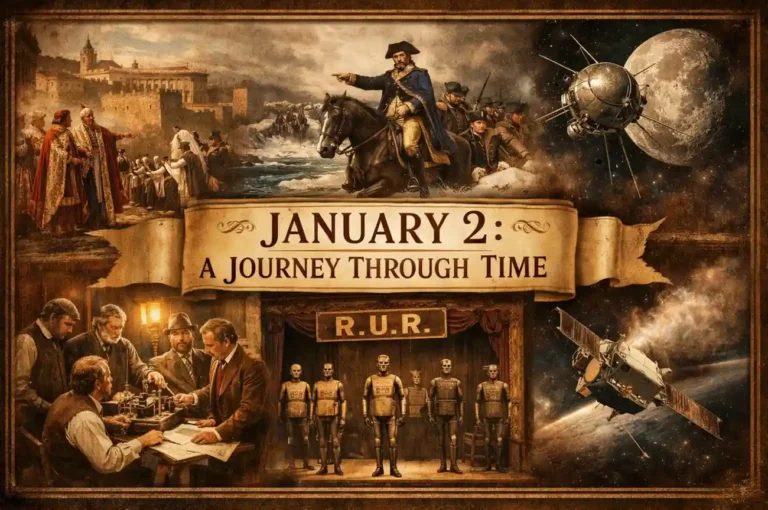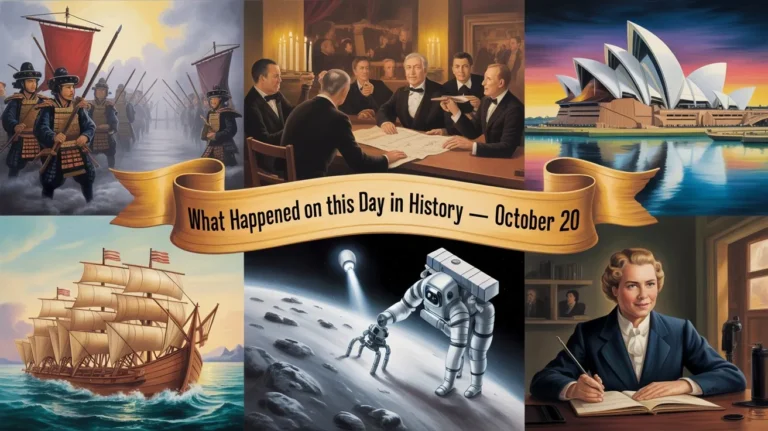
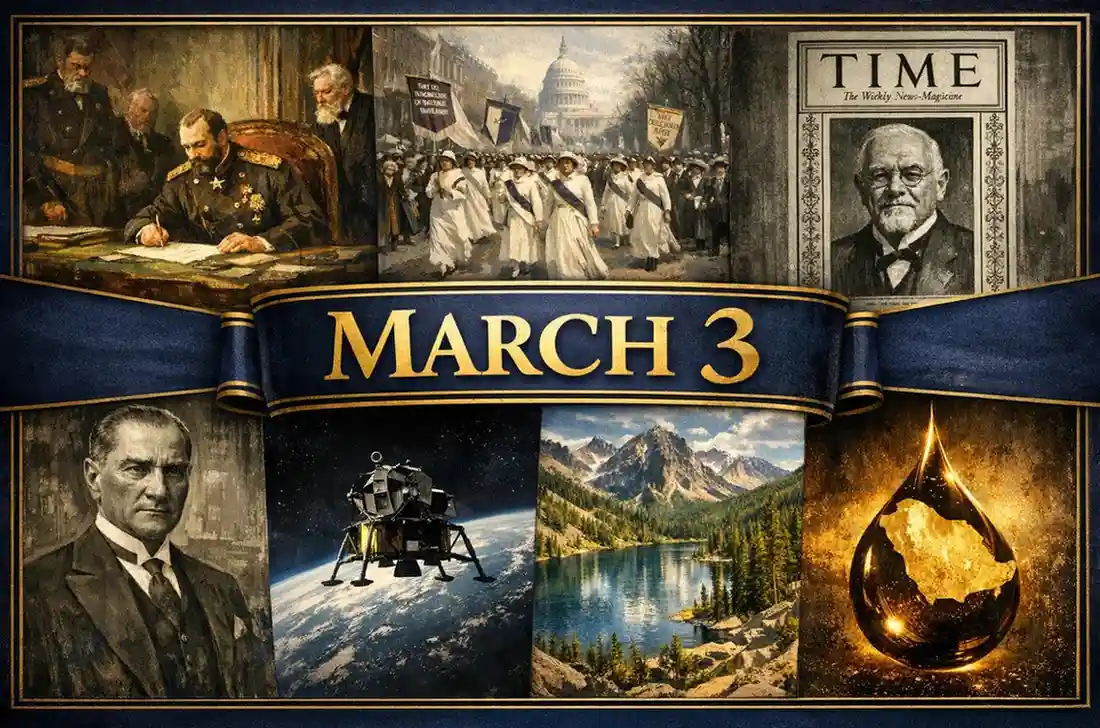
As the calendar turns to the third day of March, we encounter a date etched with the struggles and triumphs of human liberty. The chronicle of what happened on this day in history March 3 reveals a profound shift in the global social fabric, from the emancipation of millions of Russian serfs to the spirited march of thousands of women seeking the right to vote in Washington, D.C. It is a day of endings and beginnings—the fall of the centuries-old Ottoman Caliphate and the birth of iconic institutions like Time magazine—reminding us that the pursuit of a more equitable and informed world is a continuous, unfolding journey.
Important Events That Happened On March 3 In History
473 – Glycerius Nominated as Emperor
Gundobad, the powerful Burgundian prince and nephew of the late king-maker Ricimer, nominated Glycerius as the Emperor of the Western Roman Empire. This appointment occurred during a period of terminal decline for the West, where puppet emperors were frequently installed by Germanic generals. Glycerius’s reign would be brief and largely unrecognized by the Eastern Roman court, highlighting the fracturing authority of the ancient Roman world.
724 – Empress Genshō Abdicates
Empress Genshō, one of the few female monarchs in Japanese history, officially abdicated the throne in favor of her nephew, who became Emperor Shōmu. Her reign was noted for the completion of the Nihon Shoki, the first classical history of Japan, and the stabilization of the legal code. By stepping down, she ensured a smooth dynastic transition and paved the way for the flourishing of Buddhist culture during the Nara period.
880 – Ratification of the Fourth Council of Constantinople
Emperor Basil I officially ratified the decrees of the Fourth Council of Constantinople, confirming the reinstatement of Photios I as the Patriarch of Constantinople. This act was an attempt to heal the “Photian Schism” between the Eastern and Western Churches, which had centered on issues of papal primacy and theological disputes. While it brought temporary peace to the Byzantine Church, the underlying tensions would eventually contribute to the Great Schism centuries later.
1575 – Battle of Tukaroi
Mughal Emperor Akbar achieved a decisive victory over the army of Daud Khan Karrani, the Sultan of Bengal, at the Battle of Tukaroi. This military triumph was a turning point in Akbar’s campaign to expand his empire into eastern India, effectively bringing the wealthy region of Bengal under Mughal control. The defeat of the Karrani dynasty allowed Akbar to consolidate his administrative reforms and integrate Bengal into the vast Mughal economic network.
1585 – Inauguration of the Olympic Theatre
The Olympic Theatre (Teatro Olimpico), the final masterpiece designed by the renowned architect Andrea Palladio, was officially inaugurated in Vicenza, Italy. It was the first permanent indoor theater of the modern era, featuring a breathtaking trompe-l’œil stage set that created the illusion of long, receding streets. The theater remains a pinnacle of Renaissance architecture and continues to be used for performances, preserving the acoustic and visual brilliance of the 16th century.
1776 – First US Marine Corps Landing
During the American Revolutionary War, the United States Marine Corps conducted its first-ever amphibious landing at the Battle of Nassau in the Bahamas. Led by Captain Samuel Nicholas, the Marines successfully captured two British forts and seized a significant cache of gunpowder and cannons desperately needed by the Continental Army. this mission established the nascent Marine Corps as a vital component of American naval power and expeditionary capability.
1779 – Battle of Brier Creek
In a sharp blow to the American cause in the South, the Continental Army suffered a devastating rout at the hands of British forces at the Battle of Brier Creek in Georgia. The American troops were caught by surprise and suffered heavy casualties, with many soldiers drowning while attempting to escape across the Savannah River. This British victory secured their control over Georgia and allowed them to re-establish a loyalist colonial government in the region.
1795 – Outbreak of the Fédon Rebellion
The Fédon Rebellion erupted in Grenada as Julien Fédon, a free planter of mixed race, led an uprising against British colonial rule. Inspired by the French Revolution, the rebels quickly seized the towns of Grenville and Gouyave, gaining control over a significant portion of the island. The bloody conflict, which saw the execution of the British governor, highlighted the volatile intersection of racial inequality and revolutionary ideals in the Caribbean.
1799 – End of the Siege of Corfu
The Russo-Ottoman siege of the island of Corfu concluded with the surrender of the French garrison to the combined fleet of Admiral Fyodor Ushakov and the Ottoman Navy. The fall of the French-held island led to the creation of the Septinsular Republic, the first time Greeks had enjoyed limited self-government since the fall of the Byzantine Empire. This victory effectively checked Napoleonic expansion in the Ionian Islands and shifted the regional balance of power.
1845 – Florida Admitted as a State
Florida was officially admitted to the Union as the 27th U.S. state, concluding a long period of territorial status following its acquisition from Spain. The move was part of a political compromise to maintain the balance between free and slave states, as Florida entered alongside Iowa a year later. The state’s early years were shaped by the volatile Seminole Wars and the rapid expansion of the plantation economy across its northern panhandle.
1849 – Creation of Minnesota Territory
The United States Congress passed an act creating the Territory of Minnesota, encompassing a vast region that would later become the state of Minnesota and parts of the Dakotas. The establishment of the territory opened the area to formal settlement and the development of its rich timber and agricultural resources. St. Paul was designated as the capital, and the territory served as a critical gateway for the continued westward expansion of the American frontier.
1857 – Declaration of War on China
France and the United Kingdom officially declared war on the Qing Dynasty of China, marking the formal start of the Second Opium War. The conflict was triggered by the “Arrow Incident” and the execution of a French missionary, but the underlying cause was the European powers’ desire to force further trade concessions. The war would lead to the humiliating Treaty of Tientsin and the eventual sacking of the Old Summer Palace in Beijing.
1859 – Conclusion of the Great Slave Auction
The “Great Slave Auction” in Georgia, the largest single sale of enslaved human beings in U.S. history, concluded after two days of devastating transactions. To settle the debts of a wealthy planter, 436 men, women, and children were sold to various bidders, often resulting in the permanent separation of families. The scale and cruelty of the event became a rallying point for abolitionists, illustrating the inhumanity of the American chattel slavery system.
1861 – Emancipation Manifesto in Russia
Tsar Alexander II of Russia signed the Emancipation Manifesto, a monumental decree that legally abolished serfdom throughout the Russian Empire. This act granted over 20 million peasants their personal freedom and the right to own property, ending centuries of feudal bondage. While the implementation of the reform was complex and often left peasants in debt, it was a fundamental turning point that set Russia on a slow path toward modernization.
1873 – Enactment of the Comstock Law
The U.S. Congress passed the Comstock Law, a strict federal statute that criminalized the mailing of any “obscene, lewd, or lascivious” materials, including information about contraception. Named after anti-vice activist Anthony Comstock, the law led to widespread censorship and the prosecution of numerous writers and activists. It remained a powerful and controversial tool for regulating public morality and restricting reproductive health information for several decades.
1875 – First Organized Indoor Hockey Game
The first recorded organized indoor game of ice hockey took place at the Victoria Skating Rink in Montreal, Quebec. The game featured nine players per side, used a flat wooden disk instead of a ball to prevent it from flying into the crowd, and followed a set of basic rules published in the Montreal Gazette. This event is widely recognized by historians as the birth of the modern, structured sport of ice hockey.
1875 – Premiere of Carmen
Georges Bizet’s opera Carmen was performed for the first time at the Opéra-Comique in Paris, initially shocking the audience with its raw depiction of passion and crime. Although it received mixed reviews and was considered scandalous at its debut, the opera’s vibrant music and compelling characters eventually made it one of the most popular works in the repertoire. Tragically, Bizet died just three months later, never witnessing the global success his masterpiece would achieve.
1878 – Treaty of San Stefano
The Russo-Turkish War ended with the signing of the Treaty of San Stefano, which forced the Ottoman Empire to recognize the independence of Bulgaria, Serbia, Montenegro, and Romania. The treaty significantly expanded Bulgarian territory, creating a “Greater Bulgaria” that reached the Aegean Sea, though this would later be scaled back by the Congress of Berlin. This date remains a national holiday in Bulgaria, celebrating the restoration of its sovereignty after five centuries of Ottoman rule.
1891 – Shoshone National Forest Established
President Benjamin Harrison signed the act establishing the Shoshone National Forest in Wyoming as the first national forest in the United States. Originally created as the Yellowstone Park Timber Land Reserve, it was the first time the federal government set aside land specifically for forest conservation and sustainable resource management. This move was a critical early step in the development of the U.S. Forest Service and the broader American environmental movement.
1913 – Woman Suffrage Procession
On the day before President Woodrow Wilson’s inauguration, thousands of women marched down Pennsylvania Avenue in Washington, D.C., in the Woman Suffrage Procession. Organized by Alice Paul and Lucy Burns, the parade was designed to demand a constitutional amendment granting women the right to vote. The march was met with hostility and harassment from male onlookers, but the resulting publicity galvanized the suffrage movement and brought national attention to their cause.
1918 – Treaty of Brest-Litovsk
The newly formed Bolshevik government of Russia signed the Treaty of Brest-Litovsk with the Central Powers, officially ending Russia’s participation in World War I. To achieve peace, Russia was forced to concede vast territories, including the Baltic States, Belarus, and Ukraine, as well as several districts to the Ottoman Empire. This humiliating treaty allowed the Bolsheviks to focus on the internal Russian Civil War but cost the nation its most productive industrial and agricultural lands.
1923 – First Issue of Time Magazine
The first issue of Time magazine was published in New York City, co-founded by Briton Hadden and Henry Luce as the first weekly news magazine in the United States. The publication revolutionized the way Americans consumed news by organizing stories into concise departments like “National Affairs” and “Foreign News.” Its distinctive style and influential “Person of the Year” feature would eventually make it one of the most recognizable media brands in the world.
1924 – Abolition of the Ottoman Caliphate
The Grand National Assembly of Turkey, led by Mustafa Kemal Atatürk, officially abolished the Ottoman Caliphate and deposed the last Caliph, Abdülmecid II. This historic decision followed the abolition of the Sultanate and was a central part of Atatürk’s radical program to transform Turkey into a secular, modern nation-state. The end of the Caliphate sent shockwaves through the Islamic world, marking the final collapse of an institution that had existed for over 1,300 years.
1924 – Annexation of Fiume by Italy
The Free State of Fiume was officially annexed by the Kingdom of Italy following the signing of the Treaty of Rome between Italy and Yugoslavia. The city had been a source of intense diplomatic and military conflict after World War I, famously being occupied by the poet Gabriele D’Annunzio’s nationalist irregulars. The annexation was a significant victory for the rising fascist movement under Benito Mussolini, who sought to expand Italian territory and influence in the Adriatic.
1938 – Discovery of Oil in Saudi Arabia
American engineers discovered a massive oil field at Dammam Well No. 7 in Saudi Arabia, forever changing the course of the kingdom’s history and the global economy. After years of fruitless exploration, this discovery proved that the Arabian Peninsula held some of the largest petroleum reserves in the world. The resulting wealth transformed Saudi Arabia from a desert kingdom into a global energy superpower and a central player in international geopolitics.
1939 – Gandhi’s Hunger Strike in Bombay
Mohandas Gandhi began a hunger strike in Bombay to protest the autocratic and repressive rule of the local princely state of Rajkot within British India. He demanded that the ruler honor his promise of democratic reforms and allow greater participation of the people in their own governance. The fast drew immense public attention and forced the British viceroy to intervene, demonstrating the continuing power of Gandhi’s non-violent resistance in the struggle for independence.
1940 – Flamman Arson Attack
Five people, including two children, were killed in a deliberate arson attack on the offices of the communist newspaper Flamman in Luleå, Sweden. The attack was carried out by a group of anti-communist activists, including local military and police officers, during a period of intense domestic tension following the Soviet invasion of Finland. It remains one of the deadliest politically motivated terrorist acts in modern Swedish history, leading to a major national scandal and trial.
1942 – Japanese Air Raid on Broome
During World War II, a squadron of Japanese fighter planes launched a devastating surprise raid on the town of Broome in Western Australia. The attack targeted flying boats in the harbor that were carrying refugees from the Dutch East Indies, as well as the local airfield. Over 100 people were killed in the raid, many of them women and children, making it one of the deadliest enemy attacks on Australian soil during the conflict.
1943 – Bethnal Green Tube Station Disaster
In one of the most tragic civilian incidents of World War II in London, 173 people were killed in a suffocating crush at the entrance to the Bethnal Green tube station. The disaster occurred when a woman tripped on the stairs while hundreds of people were rushing into the station, which was being used as an air-raid shelter, after hearing the sound of nearby anti-aircraft rockets. The resulting pile-up happened in the dark, leading to a catastrophic loss of life through compressive asphyxia.
1944 – USSR Naval Awards Instituted
The Soviet Union officially instituted the Order of Nakhimov and the Order of Ushakov as the highest naval awards for officers of the Soviet Navy during World War II. Named after legendary Russian admirals, these honors were designed to recognize exceptional leadership and success in naval operations against the Axis powers. The creation of these awards reflected the growing importance of the Soviet Navy’s role in the conflict and the state’s desire to foster a strong military tradition.
1944 – Balvano Train Disaster
A tragic accident occurred in Italy when a freight train carrying hundreds of stowaway passengers stalled in the Armi tunnel near Balvano, leading to the deaths of 517 people. Because the train was using low-quality coal, it produced excessive amounts of carbon monoxide, which quickly filled the tunnel as the engine failed to pull the heavy load up the steep grade. Most of the victims died in their sleep, making it the deadliest railway disaster in Italian history and one of the worst in the world.
1945 – Accidental Bombing of The Hague
During World War II, Royal Air Force (RAF) bombers mistakenly dropped their payloads on the Bezuidenhout residential district of The Hague, Netherlands, instead of the intended V-2 rocket launch sites in a nearby park. Because of poor visibility and a navigational error, the 511 people were killed and thousands were left homeless as firestorms destroyed the neighborhood. The tragic error highlighted the dangers of precision bombing in densely populated areas during the final stages of the war.
1953 – De Havilland Comet Crash in Karachi
A De Havilland Comet, the world’s first commercial jetliner, crashed during its takeoff from Karachi, Pakistan, killing all 11 people on board. The aircraft, operated by Canadian Pacific Air Lines, failed to gain sufficient lift and struck an embankment beyond the runway. This was the first fatal accident involving a commercial jet, and it served as a sobering reminder of the technological challenges and safety risks associated with the dawn of the jet age.
1958 – Nuri al-Said Becomes PM Again
Nuri al-Said, a dominant figure in 20th-century Iraqi politics, was appointed Prime Minister of Iraq for the eighth and final time. A staunch pro-Western leader and a key architect of the Baghdad Pact, his final term was marked by his efforts to form a federation with Jordan to counter the rise of Arab nationalism led by Egypt. However, his long and controversial career would end tragically just months later when he was killed during the 14 July Revolution.
1969 – Launch of Apollo 9
NASA successfully launched the Apollo 9 mission from the Kennedy Space Center, a critical ten-day flight designed to test the lunar module in Earth orbit. Astronauts James McDivitt, David Scott, and Russell Schweickart performed the first docking and extraction maneuvers with the lunar module, proving the spacecraft was ready for the upcoming moon landing. The mission was a flawless success, clearing the way for the historic Apollo 11 mission later that year.
1972 – Mohawk Airlines Flight 405 Crash
A Mohawk Airlines Fairchild FH-227 crashed into a residential area while attempting to land in Albany, New York, killing 16 of the 48 people on board. The investigation by the NTSB determined that a control malfunction in the propeller system, combined with the pilots’ insufficient training in emergency procedures, led to the fatal descent. The crash highlighted the need for improved cockpit resource management and more rigorous training for regional airline crews.
1974 – Turkish Airlines Flight 981 Crash
Turkish Airlines Flight 981 crashed in the Ermenonville Forest near Paris shortly after takeoff, resulting in the deaths of all 346 people on board. The disaster was caused by a design flaw in the cargo door latching mechanism, which blew open at high altitude and caused a catastrophic loss of flight controls. At the time, it was the deadliest aviation accident in history, leading to major changes in aircraft safety standards and cargo door designs worldwide.
1980 – Decommissioning of the USS Nautilus
The USS Nautilus, the world’s first nuclear-powered submarine, was officially decommissioned and removed from the U.S. Naval Vessel Register. During its twenty-five years of service, the Nautilus broke numerous records, including being the first vessel to reach the geographic North Pole submerged. Following its retirement, the submarine was designated a National Historic Landmark and eventually became a popular museum ship in Groton, Connecticut.
1985 – Valparaíso Region Earthquake
A powerful 8.3 magnitude earthquake struck the Valparaíso Region of central Chile, causing widespread devastation across several cities, including the capital, Santiago. The quake killed 177 people, injured thousands, and left nearly a million people homeless as thousands of older adobe buildings collapsed. The disaster prompted major updates to Chile’s already strict building codes and led to the development of more sophisticated emergency response systems.
1986 – Commencement of the Australia Act
The Australia Act 1986 officially commenced, severing the final remaining legal and constitutional links between Australia and the United Kingdom. This act ensured that the British Parliament could no longer pass laws affecting Australia and ended all appeals from Australian courts to the Privy Council in London. While the British monarch remained the symbolic Head of State, the act effectively completed Australia’s journey to becoming a fully independent and sovereign nation.
1991 – Rodney King Beating Video
In Los Angeles, an amateur videographer captured the brutal beating of a Black man named Rodney King by several white police officers following a high-speed chase. The footage, which was broadcast globally, sparked a national conversation about police brutality and racial injustice in the United States. When the officers were acquitted of most charges a year later, the city of Los Angeles erupted in one of the deadliest and most destructive riots in American history.
1991 – United Airlines Flight 585 Crash
A United Airlines Boeing 737 crashed during its final approach to Colorado Springs, killing all 25 people on board. The cause of the crash remained a mystery for years until a similar incident in 1994 allowed investigators to identify a rare mechanical failure in the rudder power control unit. This discovery led to an unprecedented fleet-wide redesign of the Boeing 737’s rudder system, significantly improving the safety of the world’s most widely used passenger jet.
2005 – Rochfort Bridge RCMP Murders
In a tragic incident that shocked Canada, four constables of the Royal Canadian Mounted Police (RCMP) were murdered by James Roszko during a drug bust at his property in Rochfort Bridge, Alberta. Roszko, who had a long history of criminal activity, ambushed the officers before eventually taking his own life. It remains the deadliest peacetime incident for the RCMP since the late 19th century, leading to a national inquiry and changes in police safety equipment and procedures.
2005 – Steve Fossett’s Solo Non-Stop Flight
American adventurer Steve Fossett became the first person to fly an airplane non-stop and solo around the world without refueling. Flying the specialized “GlobalFlyer” aircraft, Fossett covered over 23,000 miles in 67 hours, landing back at Salina, Kansas, where he had begun his journey. The record-breaking flight was a testament to Fossett’s endurance and pushed the limits of modern aviation technology and fuel efficiency.
2005 – New Zealand’s Female Leadership Milestone
Margaret Wilson was elected as the Speaker of the New Zealand House of Representatives, marking a unique moment in global political history. For a period lasting over a year, all of the highest constitutional and political offices in New Zealand—including the Head of State (Elizabeth II), the Governor-General, the Prime Minister, and the Chief Justice—were occupied by women. This was the first time in history such a concentration of female leadership had occurred in any sovereign nation.
2013 – Karachi Bomb Blast
A powerful bomb blast struck a predominantly Shia Muslim residential area in Karachi, Pakistan, killing at least 48 people and injuring over 200 others. The explosion, which was planted in a vehicle, destroyed several apartment buildings and caused widespread devastation in the Abbas Town neighborhood. The attack was widely condemned as a sectarian atrocity and highlighted the ongoing challenges of religious violence and security in Pakistan’s largest city.
Famous People Born On March 3
| Name | Description | Date |
|---|---|---|
| Ira Glass | American radio and television host | March 3, 1959 – Present |
| William Godwin | British philosopher and political writer | March 3, 1756 – April 7, 1836 |
| Julius Malema | South African politician | March 3, 1981 – Present |
| Doc Watson | American folk and bluegrass musician | March 3, 1923 – May 29, 2012 |
| Matthew Bunker Ridgway | United States Army general | March 3, 1895 – July 26, 1993 |
| Reginald Pole | English cardinal and Archbishop of Canterbury | March 3, 1500 – November 17, 1558 |
| Arthur Machen | Welsh writer and mystic | March 3, 1863 – December 15, 1947 |
| Norman Bethune | Canadian surgeon and political activist | March 3, 1890 – November 12, 1939 |
| George M. Pullman | American industrialist and inventor | March 3, 1831 – October 19, 1897 |
| Arthur Kornberg | American biochemist, Nobel Prize winner | March 3, 1918 – October 26, 2007 |
| Ronald Searle | British cartoonist and satirist | March 3, 1920 – December 30, 2011 |
| James Merrill | American poet | March 3, 1926 – February 6, 1995 |
| Gyula Andrássy | Hungarian statesman and prime minister | March 3, 1823 – February 18, 1890 |
| Emil Artin | Austrian-German mathematician | March 3, 1898 – December 20, 1962 |
| Asger Jorn | Danish painter and sculptor | March 3, 1914 – May 1, 1973 |
| Sir Henry J. Wood | British conductor | March 3, 1869 – August 19, 1944 |
| Zheliu Zhelev | Bulgarian philosopher and president | March 3, 1935 – January 30, 2015 |
| Wee Willie Keeler | American baseball player | March 3, 1872 – January 1, 1923 |
| Edmund Waller | English poet | March 3, 1606 – October 21, 1687 |
| Damaskinos | Archbishop of Athens and Greek regent | March 3, 1891 – May 20, 1949 |
| Edward Herbert | English philosopher and diplomat | March 3, 1583 – August 5, 1648 |
| Sir James Fitzjames Stephen | British legal scholar | March 3, 1829 – March 11, 1894 |
| Hanya Holm | German-American choreographer | March 3, 1893 – November 3, 1992 |
| Sir John Murray | Scottish-Canadian oceanographer | March 3, 1841 – March 16, 1914 |
| George William Hill | American astronomer | March 3, 1838 – April 16, 1914 |
Famous People Died On March 3
| Name | Description | Date |
|---|---|---|
| Johann Pachelbel | German Baroque composer | September 1, 1653 – March 3, 1706 |
| Hergé | Belgian cartoonist, creator of Tintin | May 22, 1907 – March 3, 1983 |
| Michael Foot | British politician and Labour leader | July 23, 1913 – March 3, 2010 |
| Ōe Kenzaburō | Japanese Nobel Prize-winning writer | January 31, 1935 – March 3, 2023 |
| James J. Jeffries | American world heavyweight boxer | April 15, 1875 – March 3, 1953 |
| Rinus Michels | Dutch football player and coach | February 9, 1928 – March 3, 2005 |
| Albert Sabin | Polish-American medical researcher | August 26, 1906 – March 3, 1993 |
| Sewall Wright | American geneticist | December 21, 1889 – March 3, 1988 |
| Michael Thonet | Austrian furniture designer | July 2, 1796 – March 3, 1871 |
| William Kingdon Clifford | British mathematician and philosopher | May 4, 1845 – March 3, 1879 |
| Francisco J. Ayala | Spanish-American evolutionary biologist | March 12, 1934 – March 3, 2023 |
| Nicola Porpora | Italian composer and vocal teacher | August 17, 1686 – March 3, 1768 |
| John Frederick | Elector of Saxony | June 30, 1503 – March 3, 1554 |
| Pavel Milyukov | Russian historian and politician | January 27, 1859 – March 3, 1943 |
| Arthur Murray | American dance instructor | April 4, 1895 – March 3, 1991 |
| Gerhard Herzberg | German-Canadian Nobel Prize physicist | December 25, 1904 – March 3, 1999 |
| David Porter | United States naval officer | February 1, 1780 – March 3, 1843 |
| Johann Christian Fabricius | Danish entomologist | January 7, 1745 – March 3, 1808 |
| Giovanni Battista Viotti | Italian violinist and composer | May 12, 1755 – March 3, 1824 |
| Carlos Montoya | Spanish-American flamenco guitarist | December 13, 1903 – March 3, 1993 |
| Robert Mills | American architect | August 12, 1781 – March 3, 1855 |
| William Penney | British nuclear physicist | June 24, 1909 – March 3, 1991 |
| Eugen d’Albert | German pianist and composer | April 10, 1864 – March 3, 1932 |
| Henryk Szeryng | Polish-Mexican violinist | September 22, 1918 – March 3, 1988 |
| Fred W. Friendly | American journalist and producer | October 30, 1915 – March 3, 1998 |
Observances & Institutional Dates
- Liberation Day (Bulgaria): Celebrating the 1878 treaty that restored Bulgarian independence after Ottoman rule.
- World Wildlife Day: A UN-designated day to celebrate the world’s wild animals and plants and raise awareness of conservation.
- Hinamatsuri (Girl’s Day, Japan): A traditional festival where families display ornamental dolls and pray for the health and happiness of young girls.
- Martyrs’ Day (Malawi): A public holiday honoring those who gave their lives in the struggle for independence from British colonial rule.
- World Hearing Day: An annual event to raise awareness on how to prevent deafness and hearing loss and promote ear and hearing care.
Frequently Asked Questions
- When were the Russian serfs freed?
- Tsar Alexander II signed the Emancipation Manifesto on March 3, 1861, legally ending serfdom.
- What happened in Washington on March 3, 1913?
- Thousands of women marched in the Woman Suffrage Procession to demand the right to vote.
- What was the “Great Slave Auction”?
- It was a massive sale of 436 enslaved people in Georgia in 1859, concluding on March 3.
- Why did Turkey abolish the Caliphate?
- It was part of Mustafa Kemal Atatürk’s reforms to create a modern, secular Turkish republic in 1924.