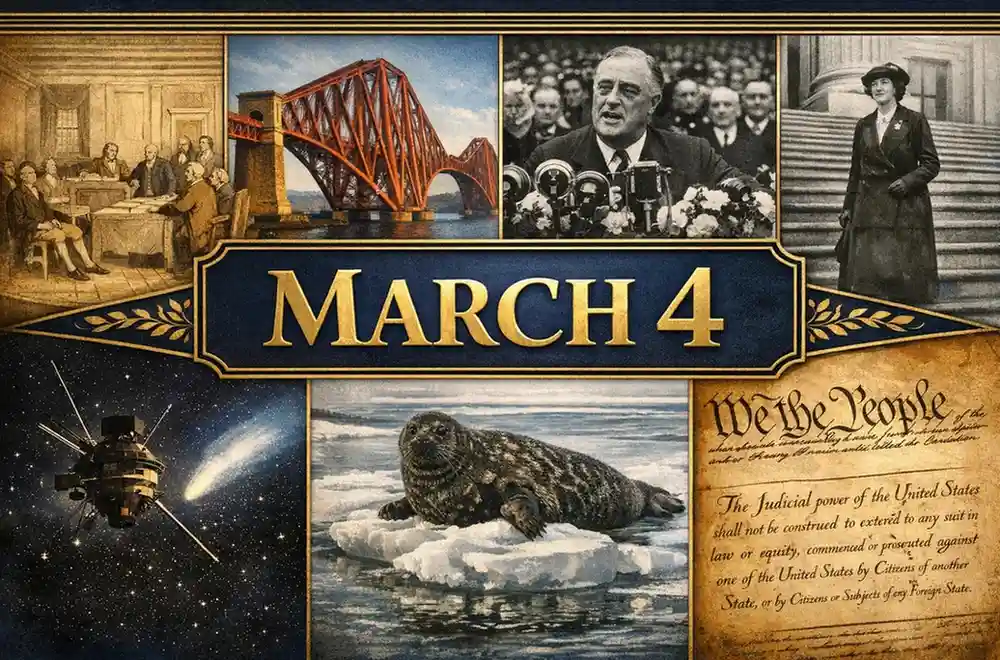
The arrival of early spring brings a sense of institutional renewal, and a look at what happened on this day in history March 4 reveals it as a cornerstone of modern governance and human rights. For over a century, this was the traditional day for American presidential inaugurations, marking the very first meeting of the U.S. Congress and the enactment of the Constitution. From the dawn of the Sui Dynasty in China to the historic election of Robert Mugabe in Zimbabwe and the first images of Halley’s Comet, March 4 stands as a testament to the cycles of power, the advancement of science, and the persistent push for social equality.
Important Events That Happened On March 4 In History
AD 51 – Nero Named Princeps Iuventutis
Nero, who would later become one of Rome’s most infamous emperors, was officially granted the title of princeps iuventutis, or “head of the youth.” This honor was a significant political step, signaling his status as the heir apparent to his adoptive father, Emperor Claudius. The title was designed to introduce the young Nero to the Roman public and military, solidifying his path toward the imperial throne amidst the complex web of Julio-Claudian dynastic politics.
306 – Martyrdom of Saint Adrian
Saint Adrian of Nicomedia, a member of the elite Praetorian Guard, was martyred for his refusal to renounce his Christian faith during the persecutions of Emperor Diocletian. Legend holds that Adrian was so moved by the courage of the Christians he was torturing that he converted on the spot and was subsequently imprisoned and executed. He remains one of the most venerated military saints, often depicted with an anvil to represent the brutal nature of his martyrdom.
581 – Foundation of the Sui Dynasty
Yang Jian officially declared himself Emperor Wen of Sui, effectively ending the Northern Zhou and establishing the Sui Dynasty. This pivotal moment brought an end to centuries of fragmentation and civil war, reuniting Northern and Southern China under a centralized imperial authority. Emperor Wen’s reign initiated significant administrative and economic reforms, including the construction of the Grand Canal, which would link the empire’s disparate regions for centuries.
852 – First Mention of the Croat Name
Knez Trpimir I, the Duke of the Croats, issued a royal statute that contains the first known written mention of the name “Croat” in a domestic historical source. This Latin charter, which confirmed a donation to the Archbishopric of Split, serves as a foundational document for Croatian national identity and statehood. It highlights the early organization of the Croatian principality and its complex relationship with the surrounding European powers of the 9th century.
938 – Relics of Wenceslaus I Translated
The relics of Wenceslaus I, the Duke of Bohemia and Prince of the Czechs, were “translated” or moved to the Cathedral of St. Vitus in Prague. Wenceslaus had been murdered by his brother three years earlier and was quickly elevated to the status of a martyr and the patron saint of the Czech people. This event solidified his cult as a symbol of Christian kingship and national unity, later inspiring the famous carol “Good King Wenceslas.”
1152 – Frederick I Barbarossa Elected King
Frederick I, better known as Barbarossa due to his red beard, was elected King of Germany in Frankfurt, setting the stage for his coronation as Holy Roman Emperor. His election was a strategic move to reconcile the rival Welf and Hohenstaufen families, as he held lineage from both houses. Barbarossa would go on to become one of the most powerful and legendary monarchs of the Middle Ages, spending much of his reign attempting to assert imperial authority over Italy.
1171 – Coronation of Alexios II Komnenos
At just two years of age, Alexios II Komnenos was crowned as the Byzantine co-emperor alongside his father, the formidable Manuel I Komnenos. This early coronation was intended to ensure a stable succession within the Komnenian dynasty during a period of increasing pressure from Western crusaders and Eastern Seljuk Turks. However, the move ultimately led to a tragic regency period following his father’s death, marked by palace intrigue and foreign intervention.
1238 – Battle of the Sit River
The Battle of the Sit River began, marking a catastrophic defeat for the forces of Prince Yuri II of Vladimir against the invading Mongol horde. The Mongol victory led to the death of the Prince and the total collapse of organized resistance in North-Eastern Rus. This battle initiated over two centuries of Mongol domination, often referred to as the “Mongol Yoke,” which profoundly influenced the political and cultural development of the Russian principalities.
1351 – Ramathibodi Becomes King of Siam
Ramathibodi I ascended to the throne as the first King of the Ayutthaya Kingdom in what is now modern-day Thailand. He is credited with establishing the city of Ayutthaya as a major center of power and drafting the first codified legal systems for his people. His reign marked the beginning of a powerful Siamese empire that would dominate mainland Southeast Asia for over four hundred years until the city’s eventual destruction in the 18th century.
1386 – Coronation of Władysław II Jagiełło
Jogaila, the Grand Duke of Lithuania, was crowned as Władysław II Jagiełło, King of Poland, following his conversion to Christianity and marriage to Queen Jadwiga. This event formed the Polish-Lithuanian Union, a massive and powerful political alliance that would reshape the map of Eastern Europe. His reign began the Jagiellonian dynasty, which oversaw a “Golden Age” for Poland and oversaw the defeat of the Teutonic Knights at the Battle of Grunwald.
1461 – Edward IV Deposes Henry VI
During the brutal Wars of the Roses, the Lancastrian King Henry VI was officially deposed by his Yorkist cousin, who then claimed the throne as King Edward IV. This shift in power followed the Yorkist victory at the Battle of Mortimer’s Cross and marked a major turning point in the dynastic struggle for the English crown. Edward IV’s accession brought a temporary measure of stability and strong leadership to a country that had been exhausted by years of civil strife.
1493 – Columbus Returns to Lisbon
Christopher Columbus arrived back in Lisbon, Portugal, aboard the ship Niña, marking the end of his historic first voyage across the Atlantic Ocean. Having landed in the Bahamas and the Caribbean, Columbus mistakenly believed he had found a new route to the East Indies. His return sparked intense diplomatic negotiations between Spain and Portugal, eventually leading to the Treaty of Tordesillas and the beginning of European colonization of the Americas.
1519 – Hernán Cortés Arrives in Mexico
The Spanish conquistador Hernán Cortés landed on the coast of Mexico with a small force of ships and soldiers in search of the rumored wealth of the Aztec Empire. This arrival marked the beginning of a campaign that would lead to the fall of the city of Tenochtitlan and the destruction of the Aztec civilization. Cortés utilized superior weaponry, local alliances, and the introduction of European diseases to conquer the region, forever altering the history of the Western Hemisphere.
1628 – Royal Charter for Massachusetts Bay
The Massachusetts Bay Colony was granted a Royal Charter by King Charles I of England, providing a legal foundation for the Puritan settlement in New England. Unlike other colonial charters, this document did not require the company’s management to remain in London, allowing the settlers to bring their government with them to America. This unique arrangement fostered a high degree of local autonomy and paved the way for the development of democratic institutions in the colonies.
1665 – Start of the Second Anglo-Dutch War
King Charles II of England officially declared war on the Netherlands, signaling the start of the Second Anglo-Dutch War over control of international trade routes. The conflict was largely fought at sea and featured some of the largest naval engagements of the age, as both nations sought to dominate the lucrative spice and textile trades. The war would eventually culminate in the humiliating Dutch raid on the Medway and the English acquisition of New Amsterdam, which was renamed New York.
1675 – First Astronomer Royal Appointed
John Flamsteed was appointed by King Charles II as the first “Astronomer Royal” of England, with the mission of improving navigational charts and observing the stars. Flamsteed was provided with an observatory at Greenwich, which would eventually become the Prime Meridian of the world. His meticulous star catalogs and observations laid the foundation for modern celestial navigation and established Britain as a leading power in the field of astronomical science.
1681 – Pennsylvania Land Charter Granted
King Charles II granted a massive land charter to William Penn in repayment of a debt the crown owed to Penn’s father. The charter allowed Penn to establish a colony in North America as a “holy experiment” based on religious tolerance and Quaker principles. Named Pennsylvania in honor of Penn’s father, the colony became a haven for various religious groups and was noted for its relatively fair dealings with indigenous peoples compared to other colonies.
1686 – Founding of Ilagan Mission
The Dominican mission of Ilagan was officially founded in the Philippines, having been unofficially settled as a Spanish outpost nearly a decade earlier. Located in the Cagayan Valley, the mission served as a center for the conversion of the local population and the expansion of Spanish colonial administration. Over time, Ilagan grew into a significant provincial capital, reflecting the deep and lasting influence of the Spanish religious orders on Philippine social and urban development.
1773 – Mozart Departs Italy
The teenage Wolfgang Amadeus Mozart departed Italy after completing the last of his three highly influential tours of the country with his father, Leopold. During these visits, Mozart had been exposed to the finest Italian opera and sacred music, which profoundly shaped his developing compositional style. Despite his immense talent and the success of his performances, he was unable to secure a permanent court position in Italy, prompting his return to Salzburg to continue his career.
1776 – Fortification of Dorchester Heights
During the American Revolutionary War, the Continental Army under George Washington successfully fortified Dorchester Heights with heavy cannons overlooking Boston. These guns, which had been hauled hundreds of miles from Fort Ticonderoga, placed the British fleet and garrison in a vulnerable position. The sudden and strategic placement of the artillery forced the British troops to abandon their Siege of Boston and evacuate the city just two weeks later.
1789 – First US Congress Meets
The first Congress of the United States met in New York City, officially putting the United States Constitution into effect and ending the era of the Articles of Confederation. Although many members were delayed in arriving, this gathering marked the beginning of the modern American federal government. One of the first major tasks of this inaugural Congress was to certify the electoral votes that made George Washington the first President of the United States.
1790 – France Divided into Départements
In a radical move by the National Constituent Assembly, France was officially divided into 83 départements, deliberately cutting across the borders of the ancient feudal provinces. This reform was intended to destroy regional loyalties to local nobility and create a more uniform, centralized administrative system. Each department was designed so that any citizen could reach the capital city on horseback within a single day, symbolizing the new revolutionary ideal of efficiency and equality.
1791 – Vermont Admitted to the Union
Vermont was officially admitted as the 14th state of the Union, becoming the first state to join the original thirteen colonies. Previously an independent republic known for its fierce self-reliance and the leadership of the “Green Mountain Boys,” Vermont’s entry was a significant expansion for the young nation. Its admission also served as a political counterweight to the slave state of Kentucky, which joined the Union shortly thereafter, maintaining a delicate regional balance.
1794 – 11th Amendment Passed
The United States Congress passed the 11th Amendment to the Constitution, which was designed to limit the power of federal courts to hear lawsuits brought against states by citizens of other states or foreign countries. The amendment was a direct response to the Supreme Court’s ruling in Chisholm v. Georgia, which many felt undermined state sovereignty. It was the first amendment passed after the Bill of Rights, demonstrating the early tensions between state and federal judicial authority.
1797 – Inauguration of John Adams
John Adams was inaugurated as the 2nd President of the United States, becoming the first president to take the oath of office on March 4. This peaceful transfer of power from George Washington to Adams was a critical moment for the young republic, proving that the American system of government could survive a change in leadership. Adams’s presidency would be defined by intense partisan conflict between the Federalists and the Democratic-Republicans as they navigated the nation’s early foreign policy.
1804 – Castle Hill Rebellion
Irish convicts in the Colony of New South Wales launched the Castle Hill Rebellion, the first major armed uprising against British colonial authority in Australia. The rebels, many of whom were political prisoners from the 1798 Irish Rebellion, sought to seize control of the colony and escape back to Ireland. The uprising was quickly and brutally suppressed by the New South Wales Corps, leading to multiple executions and the further tightening of convict discipline.
1813 – Cyril VI Elected Patriarch
Cyril VI of Constantinople was elected as the Ecumenical Patriarch, the spiritual leader of the Orthodox Christian world, during a period of intense political upheaval. His tenure was marked by his efforts to promote education and reform within the church despite the pressures of the Ottoman government. Tragically, he would later be executed by the Ottomans during the outbreak of the Greek War of Independence, becoming a martyr for both his faith and his nation.
1814 – Battle of Longwoods
During the War of 1812, American forces achieved a victory over British and Canadian troops at the Battle of Longwoods in Upper Canada. The American unit had established a strong defensive position on a snow-covered hill, using fallen logs and terrain to repel several British bayonet charges. While the battle was small in scale, it prevented further British incursions into the western theater of the war and boosted American morale during a difficult winter campaign.
1837 – Incorporation of Chicago
The city of Chicago was officially incorporated with a population of just over 4,000 people, located at a strategic portage point between the Great Lakes and the Mississippi River. Within decades, the small frontier settlement would explode into a massive industrial and transportation hub, fueled by the arrival of the railroads and the expansion of the western frontier. Chicago’s rapid growth transformed it into the “Second City” and a global center for architecture, finance, and trade.
1848 – Signing of the Statuto Albertino
King Carlo Alberto of Sardinia signed the Statuto Albertino, a foundational document that served as the first constitution for the Kingdom of Italy following the unification movement. The statute established a constitutional monarchy with a bicameral parliament and protected basic civil liberties, such as freedom of the press and assembly. It remained the primary governing document of Italy for a century, providing a legal framework during the nation’s transition into a modern European power.
1849 – The Atchison “One-Day President” Theory
A unique situation occurred when Zachary Taylor refused to be inaugurated on a Sunday, leading his swearing-in to be delayed until the following day. This gave rise to the popular, though legally erroneous, theory that Senator David Rice Atchison became the “acting president” for a single day as the President pro tempore of the Senate. However, constitutional experts clarify that Atchison’s own term had technically expired, and the nation simply functioned without a sworn-in president for 24 hours.
1861 – First Confederate Flag Adopted
The Confederate States of America officially adopted its first national flag, known as the “Stars and Bars,” which featured three horizontal stripes and a circle of stars. The design was intended to resemble the U.S. flag while still representing the distinct identity of the seceding Southern states. However, the flag proved to be confusing on the battlefield as it looked too similar to the “Stars and Stripes,” leading to the eventual adoption of the more recognizable Battle Flag.
1865 – Final Confederate Flag Adopted
In the waning months of the American Civil War, the Confederate Congress adopted its third and final national flag, often called the “Blood-Stained Banner.” This design added a vertical red bar to the previous “Stainless Banner” to prevent it from being mistaken for a white flag of surrender when limp. The change reflected the desperation of the Confederate government as its military forces collapsed and its territory was rapidly reclaimed by the Union.
1865 – Andrew Johnson’s Inaugural Address
During the second inauguration of Abraham Lincoln, Vice President-elect Andrew Johnson delivered a widely criticized and incoherent inaugural address while visibly intoxicated. Johnson had reportedly taken whiskey to settle a bout of typhoid fever, but the results were a rambling and embarrassing speech that shocked the assembled dignitaries. Despite this disastrous start, Johnson would become president just six weeks later following the assassination of President Lincoln.
1878 – Catholic Hierarchy Restored in Scotland
Pope Leo XIII officially reestablished the Roman Catholic hierarchy in Scotland, creating new dioceses and naming bishops for the first time since the Reformation in 1603. This move followed the Catholic Relief Acts and reflected the growing number of Catholics in Scotland due to Irish immigration and internal conversion. The restoration allowed the church to function as a formal institution once again, providing a structured religious home for thousands of Scottish citizens.
1882 – First Electric Trams in Britain
Britain’s very first electric trams began operation in East London, marking a major leap forward in urban public transportation. These early vehicles were powered by experimental batteries and provided a cleaner, quieter alternative to the horse-drawn and steam-powered trams of the era. While the technology was still in its infancy, the success of this trial led to the rapid electrification of tram systems across London and other major British cities.
1890 – Forth Bridge Opens
The Forth Bridge, an iconic cantilever railway bridge in Scotland, was officially opened by the Duke of Rothesay, the future King Edward VII. Measuring over 8,000 feet long, it was a marvel of Victorian engineering and the first major structure in the UK built primarily of steel. The bridge remains a vital transport link and a UNESCO World Heritage site, world-renowned for its distinctive red color and its enduring industrial beauty.
1899 – Cyclone Mahina Disaster
One of the deadliest storms in Australian history, Cyclone Mahina, struck the north of Queensland, producing a massive storm surge that reached up to 12 meters in height. The wave reached five kilometers inland, destroying entire communities and sinking nearly 100 vessels in the pearling fleet. Over 300 people were killed in the catastrophe, which remains a benchmark for weather disasters in the region and led to improved maritime safety protocols.
1901 – Second Inauguration of McKinley
William McKinley was inaugurated for his second term as President of the United States, with Theodore Roosevelt sworn in as his new Vice President. The ceremony was a celebration of the nation’s recent victory in the Spanish-American War and its growing status as a world power. Tragically, McKinley’s second term would be cut short just six months later by an assassin’s bullet, propelling the energetic Roosevelt into the presidency.
1908 – Collinwood School Fire
A devastating fire broke out at Lakeview Elementary School in Collinwood, Ohio, resulting in the deaths of 174 people, mostly young children. The tragedy was exacerbated by outward-swinging doors that were blocked by the crush of panicked students, a design flaw that proved fatal. In the aftermath of the disaster, school safety codes were drastically overhauled across the United States, leading to the mandatory installation of fire escapes and inward-swinging “panic bars.”
1909 – The “Saxbe Fix”
President William Howard Taft utilized a legal maneuver known as a “Saxbe fix” to appoint Philander C. Knox as the U.S. Secretary of State. The Constitution’s Ineligibility Clause prevents a member of Congress from being appointed to a position for which the salary was increased during their term. To bypass this, Congress passed a special law to lower the Secretary’s salary back to its previous level, establishing a precedent for future executive appointments.
1913 – Battle of Bizani
During the First Balkan War, the Greek army engaged Ottoman forces at the fortified position of Bizani, which guarded the approach to the city of Ioannina. The battle featured heavy artillery duels and intense infantry assaults against a series of formidable mountain forts. Two days later, the Greeks achieved a decisive victory, leading to the surrender of the Ottoman garrison and the liberation of the Epirus region after centuries of Ottoman rule.
1913 – Department of Labor Formed
The United States Department of Labor was officially established as a cabinet-level department, following years of advocacy by labor leaders and progressive reformers. The department was tasked with promoting the welfare of wage earners, improving working conditions, and overseeing the nation’s labor statistics. This creation represented a significant shift in the federal government’s role in balancing the interests of workers and industrial employers.
1917 – Jeannette Rankin Becomes First Congresswoman
Jeannette Rankin of Montana was sworn in as the first female member of the United States House of Representatives, three years before the national ratification of the 19th Amendment. A committed pacifist and suffragist, Rankin had benefited from Montana’s early grant of voting rights to women. Her historic presence in the halls of Congress paved the way for future generations of women in American politics, though she faced significant criticism for her vote against U.S. entry into World War I.
1918 – First Record of Spanish Flu
A soldier at Camp Funston, Kansas, was recorded with a case of influenza, an event traditionally cited as the beginning of the devastating 1918 flu pandemic. Fueled by the crowded conditions of military camps and the global movement of troops during World War I, the virus spread with unprecedented speed and lethality. Over the next two years, the “Spanish Flu” would infect one-third of the world’s population and result in an estimated 50 million deaths.
1933 – Inauguration of Franklin D. Roosevelt
In the midst of the Great Depression, Franklin D. Roosevelt was inaugurated as the 32nd President of the United States, famously declaring that “the only thing we have to fear is fear itself.” His address signaled a bold new direction for the country through his proposed “New Deal” of relief, recovery, and reform. This was the final presidential inauguration to take place on March 4, as the date was moved to January 20 by the 20th Amendment later that year.
1933 – Frances Perkins Becomes First Female Cabinet Member
Frances Perkins was confirmed and sworn in as the United States Secretary of Labor, making her the first woman in history to serve as a member of the U.S. Cabinet. A tireless advocate for workers’ rights, Perkins was the primary architect of the Social Security Act and the Fair Labor Standards Act. Her leadership during the New Deal era fundamentally reshaped the American social safety net and established a legacy of protection for millions of workers.
1933 – Suspension of Austrian Parliament
The Parliament of Austria was suspended following a procedural dispute, allowing Chancellor Engelbert Dollfuss to begin a period of authoritarian rule by decree. Dollfuss utilized the situation to dissolve political parties and suppress dissent, establishing a “Ständestaat” based on Catholic social principles and Italian fascism. This move marked the end of Austrian democracy and set the stage for the country’s eventual annexation by Nazi Germany.
1941 – Operation Claymore
British Commandos launched Operation Claymore, a successful large-scale raid on the Lofoten Islands in Nazi-occupied Norway. The mission resulted in the destruction of vital fish oil factories used for German munitions and the capture of hundreds of German prisoners and Norwegian collaborators. Crucially, the commandos also seized an Enigma machine and its rotors, providing British codebreakers with invaluable intelligence for the duration of the war.
1943 – Battle of the Bismarck Sea Ends
The Battle of the Bismarck Sea concluded with a crushing Allied air victory over a Japanese naval convoy attempting to reinforce their positions in New Guinea. Using the innovative tactic of “skip-bombing,” Allied pilots sank almost all the transport ships and several escorting destroyers. The defeat was so absolute that the Japanese military never again attempted to send large-scale convoys to New Guinea, significantly weakening their defensive capabilities in the Pacific.
1943 – Battle of Fardykambos Begins
The Battle of Fardykambos began in Greece, representing one of the first major engagements between the Greek Resistance (ELAS) and the occupying Royal Italian Army. The resistance fighters successfully ambushed an Italian battalion, leading to a multi-day struggle that ultimately resulted in the surrender of hundreds of Italian soldiers. This victory was a significant morale boost for the Greek people and led to the liberation of the town of Grevena from occupation.
1944 – USAAF Daylight Bombing of Berlin
Following the success of “Big Week,” the United States Army Air Forces (USAAF) launched its first major daylight bombing raid on the German capital of Berlin. Hundreds of B-17 and B-24 bombers, escorted by P-51 Mustangs, faced intense German fighter opposition and anti-aircraft fire. While the mission resulted in heavy losses for the Americans, it demonstrated that the Allied air forces could strike at the very heart of the Third Reich during the day.
1946 – Resignation of Mannerheim
The sixth President of Finland, Baron Gustaf Mannerheim, officially submitted his resignation due to his failing health and advanced age. Mannerheim had served as the nation’s military leader during the Winter War and the Continuation War and was seen as a unifying figure during Finland’s post-war transition. His resignation marked the end of an era for the Finnish people, who regarded him as the “Marshal of Finland” and the primary protector of their independence.
1955 – Protection for the Saimaa Ringed Seal
An official order was legalized in Finland to protect the Saimaa ringed seal, one of the rarest and most endangered seals in the world. Found only in Lake Saimaa, the species had been driven to the brink of extinction by hunting and habitat loss. This legislative move was a critical first step in a long-term conservation effort that has slowly helped the population recover, making the seal a national symbol of Finnish nature protection.
1957 – Introduction of the S&P 500
The S&P 500 stock market index was officially introduced by Standard & Poor’s, replacing the older S&P 90 to provide a more comprehensive measure of the U.S. stock market. The index tracks the performance of 500 large-cap companies across various industries, weighted by their market capitalization. Today, the S&P 500 is considered the definitive benchmark for the health of the American economy and is used by investors worldwide as a key indicator of market trends.
1960 – La Coubre Explosion
The French freighter La Coubre exploded in the harbor of Havana, Cuba, while unloading a cargo of Belgian munitions for the revolutionary government. The massive blast killed approximately 100 people and injured hundreds more, with Fidel Castro immediately blaming the United States and the CIA for the disaster. The event became a rallying point for the Cuban Revolution and was the occasion where the iconic “Guerrillero Heroico” photo of Che Guevara was taken.
1962 – Caledonian Airways DC-7 Crash
A Caledonian Airways Douglas DC-7 crashed shortly after taking off from Douala, Cameroon, resulting in the deaths of all 111 people on board. The aircraft had been attempting to climb into the night sky but struck a tropical swamp just miles from the runway. It remains the deadliest accident involving a DC-7 and led to a rigorous investigation into the airline’s maintenance and pilot training procedures during its long-haul operations.
1966 – Canadian Pacific Air Lines DC-8 Crash
A Canadian Pacific Air Lines DC-8 exploded and caught fire upon landing at Tokyo International Airport in heavy fog, killing 64 people. The aircraft struck a seawall and broke apart, with only eight passengers and crew members surviving the catastrophe. This was one of three major air disasters in Japan in a single month, leading to a national crisis of confidence in aviation safety and the implementation of much stricter landing protocols in poor visibility.
1966 – “More Popular Than Jesus” Interview
In an interview with the London Evening Standard, John Lennon of The Beatles sparked a global controversy by declaring that the band was “more popular than Jesus now.” While Lennon was making a point about the declining influence of Christianity among youth, the comment was widely misinterpreted as a claim of superiority. The quote led to mass protests, the burning of Beatles records in the United States, and death threats against the band members during their final tour.
1970 – Loss of the Submarine Eurydice
The French submarine Eurydice exploded while performing a deep-diving exercise in the Mediterranean Sea, resulting in the tragic loss of the entire 57-man crew. Seismic stations as far away as 1,000 kilometers recorded the underwater blast, though the exact cause of the hull failure remains unknown. The disaster was a profound blow to the French Navy and led to an extensive search and recovery operation that eventually located the wreckage months later.
1976 – Direct Rule Imposed on Northern Ireland
The Northern Ireland Constitutional Convention was formally dissolved after failing to reach an agreement on a power-sharing government between unionist and nationalist politicians. As a result, the British parliament imposed “direct rule” over Northern Ireland from London, taking over all administrative and legislative responsibilities. This period of direct rule would continue for decades as the region struggled through the violence of “The Troubles” before the eventually successful peace process.
1977 – Vrancea Earthquake
A massive earthquake with a magnitude of 7.2 struck the Vrancea region of Romania, causing widespread devastation across eastern and southern Europe. The quake was most destructive in the capital city of Bucharest, where dozens of historic buildings collapsed, killing more than 1,500 people. The disaster led to a massive reconstruction effort and a significant change in Romanian architectural policy, as many damaged historic structures were demolished in favor of modern socialist blocks.
1980 – Robert Mugabe Wins Election
Nationalist leader Robert Mugabe achieved a landslide victory in the first multiracial elections in the newly independent nation of Zimbabwe. Mugabe’s ZANU-PF party won a clear majority in the parliament, leading to his appointment as the country’s first Black prime minister. While his victory was initially seen as a triumph for liberation and reconciliation, his long rule would eventually become characterized by economic collapse and political suppression.
1985 – FDA Approves HIV Blood Test
The United States Food and Drug Administration (FDA) officially approved the first commercial blood test to detect the presence of HIV antibodies. This breakthrough allowed for the universal screening of all blood donations in the U.S., significantly reducing the risk of transmitting the virus through blood transfusions and medical products. The approval was a major milestone in the early response to the AIDS epidemic, providing a critical tool for public health monitoring and clinical diagnosis.
1986 – Vega 1 Returns Halley’s Comet Images
The Soviet space probe Vega 1 began transmitting the first-ever close-up images of Halley’s Comet as it approached the celestial body. These historic photos revealed the comet’s nucleus for the first time, showing a dark, peanut-shaped object emitting jets of gas and dust. The Vega mission was a remarkable international collaboration that provided scientists with unprecedented data about the composition and behavior of comets as they orbit the Sun.
1990 – Death of Hank Gathers
In one of the most tragic moments in college sports history, star basketball player Hank Gathers of Loyola Marymount collapsed during a game and died shortly after. Gathers, who had been diagnosed with a heart condition, was the leading scorer and rebounder in the nation at the time of his death. His passing shocked the sports world and led to increased awareness and screening for heart conditions in young athletes, as well as the widespread availability of defibrillators at sporting events.
1990 – Ousting of Lennox Sebe
Lennox Sebe, the self-proclaimed “President for life” of the South African Bantustan of Ciskei, was ousted in a bloodless military coup led by Brigadier Oupa Gqozo. Sebe’s regime had been noted for its corruption and human rights abuses under the apartheid-era system of “independent” homelands. The coup was a sign of the crumbling authority of the Bantustan system as South Africa moved toward the eventual end of apartheid and the reintegration of the homelands into a unified nation.
1994 – Launch of STS-62
The Space Shuttle Columbia was launched on mission STS-62 from the Kennedy Space Center, carrying a suite of scientific experiments known as the USMP-2 and OAST-2. During the 14-day flight, the crew conducted research on materials processing in microgravity and tested new technologies for future spacecraft. The mission provided valuable data for the development of the International Space Station and furthered our understanding of how various substances behave in the unique environment of space.
1996 – Weyauwega Train Derailment
A freight train carrying hazardous chemicals derailed in the town of Weyauwega, Wisconsin, sparking a massive fire and forcing the emergency evacuation of 2,300 residents. The risk of a catastrophic explosion was so high that people were kept away from their homes for 16 days as emergency crews worked to stabilize the situation and offload the dangerous materials. The incident highlighted the risks of transporting toxic chemicals through populated areas and led to improvements in rail safety and emergency planning.
1998 – Oncale v. Sundowner Decision
In a landmark ruling, the Supreme Court of the United States decided in the case of Oncale v. Sundowner Offshore Services, Inc. that federal laws against sexual harassment also apply when the parties are of the same sex. The court held that Title VII of the Civil Rights Act protects employees from harassment regardless of the gender of the perpetrator or the victim. This decision was a major victory for LGBTQ+ rights and workplace equality, ensuring broad protection against all forms of sexual discrimination.
2001 – BBC Television Centre Bombing
A massive car bomb exploded in front of the BBC Television Centre in London, causing significant damage to the building and injuring one person. The attack was attributed to the Real IRA, a dissident republican group opposed to the Northern Ireland peace process. Despite the blast, the BBC continued its broadcasts, with news presenters famously reporting from the scene of the explosion. The bombing led to a heightened security presence in London and a renewed focus on counter-terrorism efforts.
2002 – Battle of Roberts Ridge
During Operation Anaconda in Afghanistan, seven American Special Operations soldiers were killed during a fierce engagement known as the Battle of Roberts Ridge. The fight began when a helicopter was struck by enemy fire, leading to a series of rescue attempts on a high-altitude mountain peak held by Al-Qaeda fighters. The bravery of the soldiers involved led to several high-level military honors, and the battle became a case study in the challenges of high-altitude combat and medical evacuation.
2009 – ICC Issues Warrant for Omar al-Bashir
The International Criminal Court (ICC) issued an arrest warrant for Sudanese President Omar al-Bashir, accusing him of war crimes and crimes against humanity in the Darfur region. This was the first time in history that the ICC had indicted a sitting head of state, sparking a massive international debate over the balance of justice and peace. While al-Bashir remained in power for another decade, the warrant severely limited his international travel and drew global attention to the atrocities in Darfur.
2012 – Brazzaville Munitions Dump Explosion
A series of massive explosions occurred at a munitions dump in Brazzaville, the capital of the Republic of the Congo, resulting in the deaths of at least 250 people. The blasts were felt miles away and destroyed thousands of nearby homes and buildings, leaving a trail of devastation across the city. The tragedy was attributed to an electrical short circuit and led to calls for the relocation of military storage facilities away from densely populated urban centers.
2015 – Zasyadko Coal Mine Explosion
At least 34 miners were killed in a suspected gas explosion at the Zasyadko coal mine in the rebel-held Donetsk region of eastern Ukraine. The mine, which is one of the deepest and most dangerous in the country, had a long history of fatal accidents. The rescue efforts were complicated by the ongoing conflict in the region, highlighting the precarious conditions and lack of safety oversight for workers caught in war-torn industrial areas.
2018 – Poisoning of Sergei Skripal
Former Russian spy Sergei Skripal and his daughter Yulia were poisoned with a Novichok nerve agent in Salisbury, England, in a brazen assassination attempt. The British government identified the poison as a military-grade chemical weapon developed by Russia, leading to a major diplomatic crisis and the expulsion of hundreds of Russian diplomats worldwide. The incident was a chilling reminder of the ongoing “shadow war” of international espionage and the use of chemical agents on sovereign soil.
2020 – Nik Wallenda Volcano Walk
In a daring feat of endurance and skill, aerialist Nik Wallenda became the first person to walk across the active Masaya Volcano in Nicaragua on a high wire. Wearing a gas mask to protect himself from the toxic fumes and volcanic gases, Wallenda traversed the 1,800-foot cable suspended 1,800 feet above the bubbling lava lake. The event was broadcast live to a global audience, showcasing the incredible physical and mental discipline required for such a high-stakes performance.
Famous People Born On March 4
| Name | Description | Date |
|---|---|---|
| James Ellroy | American author | 1948 – |
| James Clark | British racing driver | 1936 – 1968 |
| George Gamow | Physicist & cosmologist | 1904 – 1968 |
| James Lankford | US Senator | 1968 – |
| Bernard Haitink | Dutch conductor | 1929 – 2021 |
| Pearl White | American actress | 1889 – 1938 |
| Richard C. Tolman | Physicist | 1881 – 1948 |
| Mihály, Count Károlyi | Hungarian statesman | 1875 – 1955 |
| John Henry Wigmore | Legal scholar | 1863 – 1943 |
| Dallas Seavey | Sled-dog racer | 1987 – |
| Irina Georgiyevna Ratushinskaya | Russian poet & dissident | 1954 – 2017 |
| Rebecca Gratz | American philanthropist | 1781 – 1869 |
| Jean-Joseph Jacotot | French educator | 1770 – 1840 |
| Benjamin Waterhouse | American physician | 1754 – 1846 |
| Giorgio Bassani | Italian author | 1916 – 2000 |
| Samuel Colman | American painter | 1832 – 1920 |
| Daniel Mannix | Australian archbishop | 1864 – 1963 |
| Arishima Takeo | Japanese novelist | 1878 – 1923 |
| Frederik Stang | Norwegian politician | 1808 – 1884 |
| Marguerite Taos Amrouche | Algerian singer & writer | 1913 – 1976 |
| Léon-Paul Fargue | French poet & essayist | 1876 – 1947 |
| David Watson Taylor | Naval architect | 1864 – 1940 |
| Bernhard Kellermann | German writer | 1879 – 1951 |
| Carlos Surinach | Composer | 1915 – 1997 |
| George Thomson | Scottish publisher | 1757 – 1851 |
| Johann Rudolf Wyss | Swiss writer | 1782 – 1830 |
| Arishima Takeo | Japanese writer | 1878 – 1923 |
| Kanō Tan’yū | Japanese painter | 1602 – 1674 |
| Jacob Kirkman | Harpsichord maker | 1710 – 1792 |
| Enrique Larreta | Argentine author | 1875 – 1961 |
Observances & Institutional Dates
- Constitution Day (USA): Commemorating the 1789 enactment of the United States Constitution.
- St. Casimir’s Day: A feast day celebrated in Poland and Lithuania honoring the patron saint of both nations.
- World Obesity Day: An international day established to raise awareness and promote practical solutions to end the global obesity crisis.
- World Engineering Day for Sustainable Development: A UNESCO-designated day to highlight the critical role of engineers in achieving sustainable development goals.
- Vermont Admission Day: Celebrating the state’s entry into the Union in 1791.
Frequently Asked Questions
- When did the U.S. Constitution go into effect?
- The Constitution officially took effect on March 4, 1789, when the first Congress met in New York City.
- Who was the first woman in the U.S. Congress?
- Jeannette Rankin of Montana was the first woman elected, taking her seat on March 4, 1917.
- What was the “Spanish Flu” and when did it start?
- It was a global pandemic that killed millions, with the first case recorded at Camp Funston on March 4, 1918.
- Why was March 4 the traditional Inauguration Day?
- It was originally chosen to give enough time for election results to be counted and for the new president to travel to the capital.