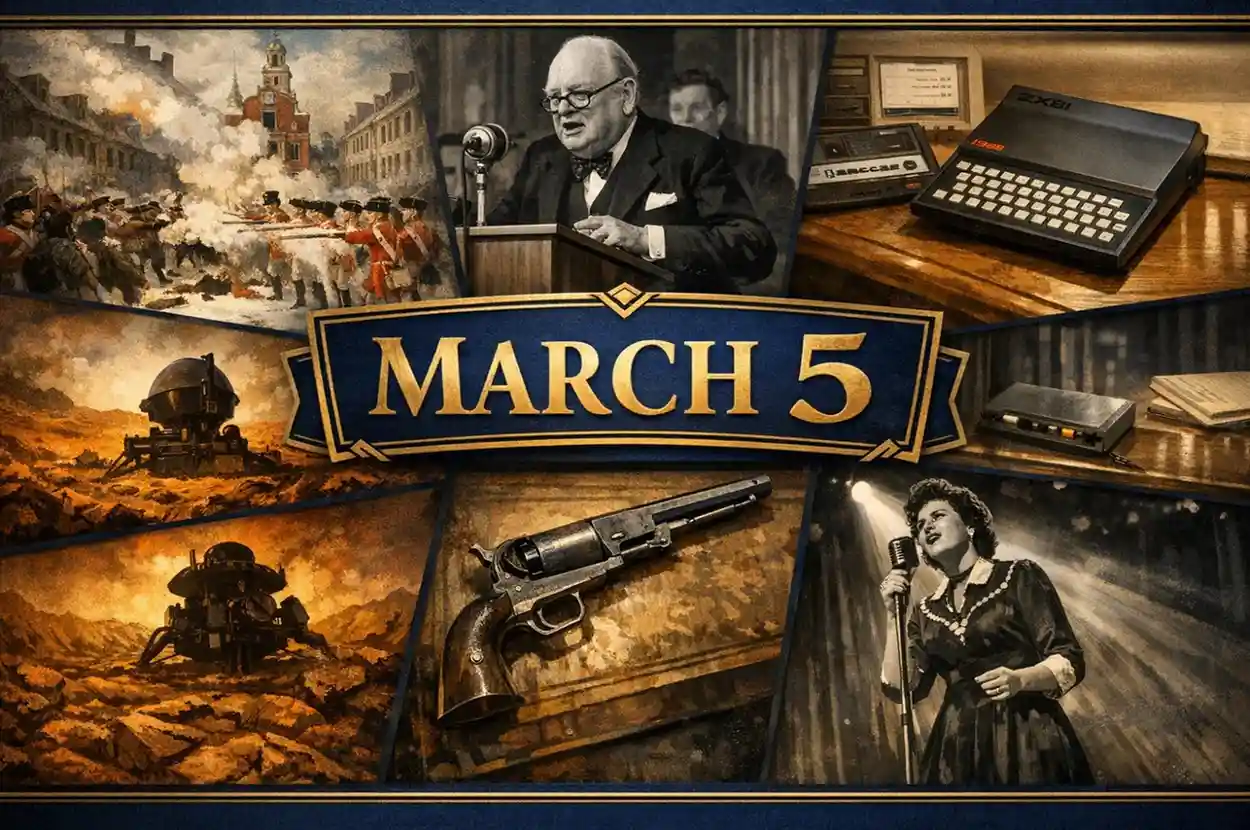
The pages of the past turn to a date marked by the heavy friction of empire and the sparked flames of revolution. Investigating what happened on this day in history March 5 brings us to the snowy streets of colonial Boston, where a fatal confrontation changed the course of American history forever. It is a day of somber transitions, from the passing of the iron-fisted Joseph Stalin to the silencing of legendary voices in country music.
Yet, it also reflects the tireless human drive for exploration and order, seen in the authorization of John Cabot’s voyages and the global commitment to nuclear non-proliferation.
Important Events That Happened On March 5 In History
363 – Julian’s Persian Campaign Begins
Roman Emperor Julian, known to history as “the Apostate,” departed Antioch with a massive army of 90,000 men to launch an ambitious invasion of the Sasanian Empire. His goal was to decisively defeat the Persians and secure the eastern borders of Rome while simultaneously attempting to restore traditional paganism. The campaign initially saw several tactical victories, but it would ultimately lead to a disastrous retreat and Julian’s own death on the battlefield just months later.
1046 – Nasir Khusraw Begins His Journey
The Persian poet, philosopher, and traveler Nasir Khusraw set out from Merv on a monumental seven-year journey across the Middle East and North Africa. Traveling as a pilgrim to Mecca and Cairo, he meticulously documented the cultures, politics, and geographies of the Islamic world in his famous book, the Safarnama. His vivid and detailed descriptions remain one of the most important primary sources for understanding the social landscape of the 11th-century Middle East.
1279 – Battle of Aizkraukle
The Livonian Order, a crusading military branch of the Teutonic Knights, suffered a crushing defeat at the hands of the Grand Duchy of Lithuania in the Battle of Aizkraukle. The Lithuanian forces, led by Grand Duke Traidenis, ambushed the retreating knights, killing their Grand Master and dozens of high-ranking commanders. This victory halted the crusaders’ northern expansion for a generation and solidified Lithuania’s status as a rising pagan power in Eastern Europe.
1496 – Letters Patent Issued to John Cabot
King Henry VII of England issued official letters patent to the Venetian explorer John Cabot and his sons, authorizing them to seek out and discover unknown lands in the west. This royal commission gave Cabot the legal right to claim any territory not already under Christian rule for the English crown. His subsequent voyage in 1497 would lead to the European “rediscovery” of mainland North America, laying the groundwork for future British colonial claims.
1616 – Copernicus’s Book Forbidden
Seventy-three years after its publication, Nicolaus Copernicus’s seminal work, On the Revolutions of the Heavenly Spheres, was officially added to the Catholic Church’s Index of Forbidden Books. The book proposed a heliocentric model where the Earth and planets orbit the Sun, a theory the Church eventually deemed contrary to Holy Scripture. The ban reflected the growing tension between emerging scientific observation and established theological doctrines during the Counter-Reformation.
Shutterstock
1766 – Antonio de Ulloa Arrives in New Orleans
The scientist and explorer Antonio de Ulloa arrived in New Orleans to serve as the first Spanish governor of Louisiana following its transfer from France. His arrival was met with suspicion and open hostility from the local French population, who resented the secret treaty that had handed them over to Spain. Ulloa’s struggle to assert authority without sufficient military support would eventually lead to the Rebellion of 1768 and his forced departure from the colony.
1770 – The Boston Massacre
In one of the most pivotal moments leading to the American Revolution, British soldiers fired into a crowd of colonists in Boston, killing five men, including Crispus Attucks. The incident began as a street scuffle between a lone sentry and a group of civilians but quickly escalated into a deadly confrontation that galvanized colonial opposition to British rule. The event was expertly used as propaganda by Paul Revere and Samuel Adams to fuel the fires of independence.
1811 – Battle of Barrosa
During the Peninsular War, an Anglo-Spanish-Portuguese force achieved a tactical victory over French troops under Marshal Victor at the Battle of Barrosa near Cádiz. Despite being heavily outnumbered and lacking coordination from the Spanish command, the British troops under General Graham successfully repelled the French assault. The victory temporarily lifted the siege of Cádiz but failed to result in a strategic shift due to continued friction between the Allied commanders.
1824 – First Anglo-Burmese War Declared
The British East India Company officially declared war on the Kingdom of Burma after years of border disputes and Burmese expansion toward British India. This conflict, the longest and most expensive war in the history of British India, involved grueling jungle warfare and a massive naval expedition up the Irrawaddy River. It would eventually result in the Treaty of Yandabo, forcing Burma to cede significant territory and pay a crippling indemnity to the British.
1825 – Capture of Pirate Roberto Cofresí
Roberto Cofresí, one of the last and most legendary pirates of the Caribbean, was finally defeated and captured by a combined force of Puerto Rican authorities and the U.S. Navy. Known as “El Pirata Cofresí,” he had become a folk hero in Puerto Rico for supposedly sharing his plunder with the poor while evading international capture. His execution shortly after his capture marked the effective end of the golden age of large-scale piracy in the West Indies.
1836 – Samuel Colt Opens Revolver Factory
Following the successful patenting of his revolutionary firearm design, Samuel Colt established his first manufacturing facility in Paterson, New Jersey. The factory produced the .34-caliber “Paterson” revolver, the first production-model firearm featuring a rotating cylinder capable of firing multiple shots without reloading. While this initial business venture eventually faced bankruptcy, it laid the technological and industrial foundation for the iconic Colt’s Manufacturing Company.
1850 – Opening of the Britannia Bridge
The Britannia Bridge, a magnificent tubular bridge designed by Robert Stephenson, was officially opened to carry railway traffic across the Menai Strait in Wales. Its innovative box-girder design allowed heavy trains to cross the high-wind channel between the island of Anglesey and the mainland for the first time. The bridge was a masterpiece of Victorian engineering, significantly improving the transport link between London and the port of Holyhead for Irish travel.
1860 – Italian Unification Referendums
The central Italian territories of Parma, Tuscany, Modena, and Romagna held popular referendums in which the overwhelming majority of citizens voted to join the Kingdom of Sardinia. These votes were a critical step in the Risorgimento, the movement for Italian unification led by King Victor Emmanuel II and Count Cavour. The results effectively dissolved the old ducal systems and paved the way for the formal proclamation of the Kingdom of Italy just one year later.
1868 – Premiere of Mefistofele
Arrigo Boito’s ambitious opera Mefistofele, based on Goethe’s Faust, received its world premiere performance at the legendary La Scala in Milan. The original version was nearly six hours long and was so poorly received by the audience that it led to riots in the theater and the opera’s immediate withdrawal. Boito later revised and shortened the work, and this second version eventually became a staple of the operatic repertoire, celebrated for its philosophical depth.
1872 – Air Brake Patented by Westinghouse
George Westinghouse was granted a patent for his automatic air brake system, a revolutionary invention that allowed train engineers to stop all cars simultaneously. Before this, brakemen had to manually apply brakes to each individual car, a process that was both slow and extremely dangerous. The air brake fundamentally improved the safety and efficiency of rail travel, allowing for longer, faster trains and paving the way for the modern global railroad industry.
1906 – First Battle of Bud Dajo
In a dark chapter of the Philippine-American War, United States Army troops used overwhelming artillery and gunfire against 800-1,000 Moro rebels and their families at the crater of Bud Dajo. The Moros, who were resisting American colonial taxes and authority, fought with traditional weapons against modern rifles, resulting in a near-total slaughter with only six survivors. The event sparked a significant political controversy in the United States over the ethics of imperial warfare.
1912 – First Military Use of Airships
During the Italo-Turkish War in Libya, Italian forces became the first in history to utilize airships for military purposes. These dirigibles were employed for reconnaissance missions behind Turkish lines, providing the Italian command with valuable aerial views of enemy positions. This milestone marked the beginning of a new era in warfare, where the “high ground” of the sky would become a critical theater for intelligence gathering and strategic maneuvering.
1931 – Signing of the Gandhi–Irwin Pact
In a major breakthrough for the Indian independence movement, Mahatma Gandhi and the British Viceroy Lord Irwin signed the Gandhi–Irwin Pact in Delhi. The agreement resulted in the release of political prisoners and allowed for the manufacture of salt by coastal communities in exchange for the suspension of the Civil Disobedience movement. This pact recognized Gandhi as a significant political force and paved the way for Indian participation in the Round Table Conferences in London.
1933 – Nazi Success in Reichstag Elections
In the final multi-party elections before the total consolidation of power, Adolf Hitler’s Nazi Party received 43.9% of the popular vote in Germany. Although they fell short of a majority, the results provided the Nazis with the momentum and political leverage needed to intimidate other parties. This electoral victory led directly to the passage of the Enabling Act later that month, which legally granted Hitler dictatorial powers and effectively ended German democracy.
1939 – Coup of the National Defence Council
In the final months of the Spanish Civil War, the National Defence Council led by Colonel Segismundo Casado seized control of the Republican government in a coup d’état. The council aimed to overthrow the pro-communist Prime Minister Juan Negrín and negotiate a peaceful “peace of honor” with Francisco Franco’s Nationalist forces. However, Franco refused to negotiate, demanding an unconditional surrender that led to the final collapse of the Second Spanish Republic.
1940 – Order for the Katyn Massacre
Six high-ranking members of the Soviet Politburo, including Joseph Stalin and Lavrentiy Beria, signed a formal order for the execution of over 25,000 members of the “Polish intelligentsia.” The victims included 14,700 Polish prisoners of war and thousands of priests, professors, and government officials. The subsequent mass executions, known as the Katyn massacre, were intended to eliminate the future leadership of Poland and were falsely blamed on Nazi Germany for decades.
1942 – Japanese Capture Batavia
Japanese imperial forces successfully captured Batavia (now Jakarta), the capital of the Dutch East Indies, during World War II. The city had been declared an “open city” and left largely undefended after the Allied garrison withdrew to more defensible positions in the mountains of Java. The fall of Batavia marked a major victory for Japan, providing them with a central administrative hub and control over the vast natural resources of the Indonesian archipelago.
1943 – Athens General Strike
A massive general strike and protest march erupted in Axis-occupied Athens as thousands of Greeks rallied against rumors of a decree for the forced mobilization of workers for labor in Germany. The protesters clashed violently with Italian and German occupation forces, resulting in several deaths, but the sheer scale of the defiance forced the collaborationist government to withdraw the decree the very next day. This was a rare and significant victory for civilian resistance in occupied Europe.
1944 – Uman–Botoșani Offensive Begins
The Soviet Red Army launched the Uman–Botoșani offensive, a massive military operation aimed at liberating the western Ukrainian SSR and driving German forces back toward the Romanian border. The offensive was conducted in the midst of “Rasputitsa” (the mud season), which famously bogged down German armor while the Soviets utilized superior numbers and local knowledge. The operation succeeded in cutting off major German supply lines and significantly accelerating the liberation of Ukraine.
1946 – The “Iron Curtain” Speech
In a speech at Westminster College in Missouri, former British Prime Minister Winston Churchill famously declared that “an iron curtain has descended across the Continent.” He used this imagery to describe the growing divide between the Western democracies and the Soviet-controlled nations of Eastern Europe. This historic address is widely considered the symbolic beginning of the Cold War, alerting the American public to the new reality of Soviet expansionism.
1953 – Death of Joseph Stalin
Joseph Stalin, the absolute dictator of the Soviet Union for nearly three decades, died at his Volynskoe dacha following a massive cerebral hemorrhage. His death sparked an immediate and intense power struggle within the Kremlin and triggered a period of mourning across the Communist world. Stalin’s passing marked the end of an era defined by industrialization, victory in World War II, and the brutal repression of millions through the Gulag system.
1957 – Sutton Wick Air Crash
A Blackburn Beverley transport aircraft of the Royal Air Force crashed into the village of Sutton Wick shortly after takeoff, resulting in the deaths of 15 people. The crash killed most of the crew and passengers on board as well as two local residents on the ground when the plane struck a row of houses. A subsequent investigation found that a non-return valve had been installed backward in the fuel system, causing a fatal engine failure at a critical altitude.
1960 – Sukarno Dismisses Indonesian Parliament
President Sukarno officially dismissed the democratically elected Indonesian parliament (DPR) that had been formed following the landmark 1955 elections. He replaced it with a new body known as the DPR-GR, composed entirely of members personally selected by him to support his concept of “Guided Democracy.” This move effectively consolidated Sukarno’s executive power and moved Indonesia away from Western-style parliamentary democracy toward a more authoritarian system.
1963 – Country Music Plane Crash
In a tragedy that devastated the country music world, a private plane crashed in Camden, Tennessee, killing stars Patsy Cline, Hawkshaw Hawkins, and Cowboy Copas. The group was returning from a benefit concert in Kansas City when their pilot, Randy Hughes, encountered severe weather and lost control of the aircraft. Patsy Cline, who was at the height of her career with hits like “Crazy,” became an immortal icon of the genre following the disaster.
1963 – Aeroflot Flight 191 Crash
An Aeroflot passenger aircraft crashed while attempting to land at Aşgabat International Airport in the Turkmen SSR, resulting in the deaths of 12 people. The flight encountered a severe dust storm that reduced visibility to near zero, leading the crew to lose their bearings during the final approach. The accident prompted a review of landing procedures and meteorological reporting at airports across the Soviet Union’s southern republics.
1965 – March Intifada in Bahrain
A major leftist uprising, known as the March Intifada, erupted in Bahrain as workers and students protested against the mass layoffs at the Bahrain Petroleum Company and the continued British colonial presence. The protests quickly spread across the island, leading to violent clashes with security forces and the declaration of a state of emergency. While the British eventually suppressed the uprising, it served as a catalyst for the eventual independence of Bahrain in 1971.
1966 – BOAC Flight 911 Disaster
A BOAC Boeing 707 disintegrated in mid-air shortly after takeoff from Tokyo, crashing into the slopes of Mount Fuji and killing all 124 people on board. The investigation revealed that the aircraft encountered extreme “clear-air turbulence” generated by the mountain, which imposed aerodynamic loads far beyond the plane’s structural limits. This disaster remains a landmark case study in aviation meteorology and the dangers of high-altitude mountain waves.
1967 – Lake Central Airlines Flight 527 Crash
A Lake Central Airlines Convair 580 crashed near Marseilles, Ohio, after a propeller blade failed and sliced through the aircraft’s fuselage. The catastrophic structural failure resulted in the loss of control and the deaths of all 38 people on board. The accident led to a mandatory redesign of the propeller pitch control system and stricter inspection protocols for turboprop aircraft to prevent similar fatigue-related failures.
1968 – Air France Flight 212 Crash
An Air France Boeing 707 crashed into the La Grande Soufrière volcano on the island of Guadeloupe during its night approach to the airport, killing all 63 people on board. The flight crew had reportedly initiated their descent too early and deviated from the prescribed approach path, striking the mountain in poor weather. It was the first of two nearly identical crashes at the same location by the same airline within two years.
1970 – Nuclear Non-Proliferation Treaty in Effect
The Treaty on the Non-Proliferation of Nuclear Weapons (NPT) officially went into effect after being ratified by 43 nations, including the United States, the United Kingdom, and the Soviet Union. The treaty aimed to prevent the spread of nuclear weapons and technology, promote cooperation in the peaceful uses of nuclear energy, and further the goal of achieving total disarmament. It remains the most widely adhered-to arms control agreement in human history.
1973 – Nantes Mid-Air Collision
An Iberia DC-9 and a Spantax Convair 990 collided in mid-air over Nantes, France, during a strike by French air traffic controllers. The DC-9 crashed, killing all 68 people on board, while the damaged Spantax aircraft miraculously managed to make an emergency landing at a nearby military base. Among the victims was Michael Jeffery, the influential manager of Jimi Hendrix, who was traveling on the scheduled Spanish flight.
1974 – Israeli Withdrawal from Suez
Following the disengagement agreements that ended the Yom Kippur War, Israeli forces completed their withdrawal from the west bank of the Suez Canal. The move allowed for the creation of a United Nations buffer zone between the Israeli and Egyptian armies and marked a significant step toward de-escalating the regional conflict. This withdrawal eventually paved the way for the reopening of the Suez Canal to international shipping for the first time since 1967.
1978 – Launch of Landsat 3
NASA successfully launched the Landsat 3 satellite from Vandenberg Air Force Base, continuing the groundbreaking mission of monitoring the Earth’s surface from space. The satellite provided vital data for agriculture, forestry, and geological mapping, offering a unique perspective on environmental changes and natural resource management. Landsat 3 was equipped with advanced thermal imaging sensors, significantly expanding the scientific capabilities of the Landsat program.
1979 – Discovery of Soft Gamma Repeaters
Three separate space probes—Venera 11, Venera 12, and Helios II—were struck by an intense, “off the scale” burst of gamma rays coming from a source in the sky. This event led to the historic discovery of “soft gamma repeaters” (SGRs), which were later identified as magnetars—highly magnetized neutron stars. This observation opened a new chapter in high-energy astrophysics, allowing scientists to study the most extreme magnetic environments in the universe.
1981 – Launch of the ZX81 Computer
Sinclair Research officially launched the ZX81, a pioneering and affordable home computer that helped spark the digital revolution in the United Kingdom and beyond. Sold for just £70 (or £50 as a kit), the tiny machine featured a touch-sensitive keyboard and 1KB of memory, connecting to a standard television set for display. It became a massive commercial success, selling over 1.5 million units and introducing a generation to the basics of computer programming.
1982 – Venera 14 Lands on Venus
The Soviet space probe Venera 14 successfully landed on the surface of Venus, surviving for approximately an hour in the planet’s crushing atmospheric pressure and 465°C heat. The probe managed to transmit high-resolution panoramic images of the landing site and conducted the first-ever on-site analysis of a Venusian soil sample. The data revealed a volcanic landscape composed largely of tholeiitic basalt, providing crucial insights into the geological history of Earth’s “twin” planet.
1991 – Aeropostal Flight 109 Crash
An Aeropostal Alas de Venezuela McDonnell Douglas DC-9 crashed into a mountainside in the Venezuelan Andes during a domestic flight, killing all 45 people on board. The investigation determined that the pilots had inadvertently entered the wrong coordinates into their navigation system, leading them to believe they were on a safe path when they were actually flying directly toward high terrain. The tragedy highlighted the critical need for improved pilot training and terrain awareness systems.
1993 – Palair Macedonian Flight 301 Crash
A Palair Macedonian Airlines Fokker 100 crashed shortly after taking off from Skopje Airport in North Macedonia, resulting in the deaths of 83 people. The crash was caused by severe atmospheric icing on the wings, which the crew had failed to notice or address before takeoff in the freezing conditions. This disaster remains the deadliest aviation accident in North Macedonian history and led to a global reinforcement of de-icing procedures for commercial aircraft.
2001 – Jamaraat Bridge Stampede
During the annual Hajj pilgrimage in Mina, Saudi Arabia, 35 pilgrims were killed in a tragic stampede on the Jamaraat Bridge. the crush occurred during the “Stoning of the Devil” ritual, as tens of thousands of people funneled through the bridge’s narrow walkways. The incident prompted the Saudi government to launch a multi-billion dollar project to completely redesign and expand the Jamaraat area to improve crowd control and pilgrim safety.
2002 – Mindanao Earthquake
A powerful 7.5 magnitude earthquake struck the island of Mindanao in the southern Philippines, causing widespread damage and killing at least 15 people. The quake triggered landslides and damaged hundreds of homes and schools across several provinces, leaving over 100 people injured. The disaster highlighted the high seismic vulnerability of the region and led to renewed efforts to strengthen local building codes and community disaster preparedness.
2003 – Haifa Bus 37 Bombing
A Palestinian suicide bomber detonated an explosive belt on a crowded Egged bus in Haifa, Israel, killing 17 civilians and wounding dozens more. Many of the victims were students from local high schools and the University of Haifa who were on their way home in the afternoon. The attack was one of the deadliest of the Second Intifada and was condemned globally as a senseless act of terrorism against innocent commuters.
2011 – Antonov An-148 Test Flight Crash
An Antonov An-148 regional jet crashed during a training and test flight in Russia’s Belgorod Oblast, resulting in the deaths of all seven people on board, including two pilots from Myanmar. The investigation revealed that the aircraft’s speed sensors had malfunctioned, providing the crew with incorrect data that led to a catastrophic mid-air breakup during a high-speed descent. The crash led to a temporary grounding of the An-148 fleet for safety inspections.
2012 – Tropical Storm Irina Hits Madagascar
Tropical Storm Irina made a devastating passage through Madagascar, bringing torrential rains and massive flooding that killed over 75 people. The storm destroyed thousands of homes and wiped out critical agricultural crops, leaving tens of thousands of people in need of emergency food and shelter. The disaster underscored the extreme vulnerability of Madagascar to climate-related events and the ongoing need for international humanitarian assistance in the region.
2012 – Bucharest Hair Salon Shooting
A police driver opened fire inside a hair salon in central Bucharest, Romania, killing two people—including his wife—and injuring six others. The shooter, who was reportedly motivated by a domestic dispute, surrendered to authorities shortly after the rampage. The rare act of public violence shocked the city and prompted a national debate in Romania regarding mental health checks for law enforcement personnel and stricter domestic violence laws.
2018 – SDF Pauses Deir ez-Zor Campaign
The Syrian Democratic Forces (SDF) officially announced a pause in their military operations against the Islamic State (ISIS) in Deir ez-Zor. This decision was a direct result of the Turkish-led invasion of the Afrin region, which forced the Kurdish-led SDF to redeploy thousands of its most experienced fighters to defend their home territory. The pause highlighted the complex and often contradictory alliances within the Syrian Civil War and briefly allowed ISIS remnants to regroup.
2021 – Historic Papal Visit to Iraq
Pope Francis began the first-ever papal visit to Iraq, a historic journey aimed at promoting interfaith dialogue and comforting the country’s persecuted Christian minority. Despite the ongoing COVID-19 pandemic and significant security concerns, the Pope traveled to Baghdad, Najaf, and the plains of Ur, the traditional birthplace of Abraham. The visit was hailed as a powerful message of peace and reconciliation for a nation scarred by decades of conflict and sectarian violence.
2021 – Mogadishu Suicide Bombing
A suicide car bomber detonated an explosive-laden vehicle outside a popular restaurant in the Somalian capital of Mogadishu, killing 20 people and injuring 30 others. The extremist group al-Shabaab claimed responsibility for the attack, which occurred during a busy evening hour. The bombing was part of a continued campaign of violence intended to destabilize the Somali government and disrupt the country’s fragile electoral process.
2023 – Estonian Parliamentary Elections
Estonia held its parliamentary elections, resulting in a historic victory for the center-right Reform Party led by Prime Minister Kaja Kallas. For the first time in the country’s modern history, two center-right liberal parties gained an absolute majority in the parliament, signaling strong public support for a pro-European and pro-Ukraine foreign policy. The election was also notable for the high level of digital voting, with over half of all ballots cast online.
2023 – Nouakchott Prison Escape
In a high-security failure that gripped the nation, four prisoners—including high-profile extremists—successfully escaped from the Nouakchott Civil Prison in Mauritania. The escape led to a massive nationwide manhunt and the temporary closure of several key roads and border crossings. All four fugitives were located and apprehended by security forces the following day in a remote desert area, though the incident prompted a major review of prison security protocols.
Read Also: This day in history March 4 Constitution, Crown, Commitment
Famous People Born On March 5
| Name | Description | Date |
|---|---|---|
| Louis I | King of Hungary & Poland | 1326 – 1382 |
| Étienne-Jules Marey | French physiologist | 1830 – 1904 |
| Howard Pyle | American author & illustrator | 1853 – 1911 |
| Karl Rahner | German theologian | 1904 – 1984 |
| James Tobin | American economist | 1918 – 2002 |
| Leslie Marmon Silko | American author | 1948 – |
| Charles Goodnight | American cattleman | 1836 – 1929 |
| Frank Norris | American novelist | 1870 – 1902 |
| Laurent Schwartz | French mathematician | 1915 – 2002 |
| Charles Fuller | American playwright | 1939 – 2022 |
| Randy Matson | American athlete | 1945 – |
| Ennio Flaiano | Italian author & critic | 1910 – 1972 |
| Sir C. Wyville Thomson | Scottish naturalist | 1830 – 1882 |
| Oh Eun-Sun | South Korean mountaineer | 1966 – |
| John George I of Saxony | Elector of Saxony | 1585 – 1656 |
| Sir John Ross Marshall | Prime Minister of New Zealand | 1912 – 1988 |
| Jan van der Heyden | Dutch painter | 1637 – 1712 |
| Constance Fenimore Woolson | American writer | 1840 – 1894 |
| Isaac Israel Hayes | American explorer | 1832 – 1881 |
| Subroto Mukerjee | Indian Air Force officer | 1911 – 1960 |
| Sutan Sjahrir | Prime Minister of Indonesia | 1909 – 1966 |
| Sir Hugh Charles Clifford | British colonial governor | 1866 – 1941 |
| Frederick IV | Elector Palatine | 1574 – 1610 |
| Michael von Faulhaber | German cardinal | 1869 – 1952 |
| Johann Michael Moscherosch | German satirist | 1601 – 1669 |
| Kurihara Harumi | Japanese chef & TV personality | 1947 – |
| Vasily Kirillovich Trediakovsky | Russian writer & poet | 1703 – 1768 |
| Julian Przyboś | Polish poet | 1901 – 1970 |
| Teodor Parnicki | Polish historical novelist | 1908 – 1988 |
| Édouard Belin | French engineer | 1876 – 1963 |
Famous People Died On March 5
| Name | Description | Date |
|---|---|---|
| Pierre-Simon, marquis de Laplace | French mathematician & scientist | 1749 – 1827 |
| Anna Akhmatova | Russian poet | 1889 – 1966 |
| Bohemond I | Prince of Antioch & Otranto | c.1050 – 1109 |
| Correggio | Italian Renaissance painter | 1489 – 1534 |
| Hippolyte Taine | French critic & historian | 1828 – 1893 |
| William Cameron Menzies | American set designer | 1896 – 1957 |
| Max Jacob | French poet | 1876 – 1944 |
| Flora Macdonald | Scottish Jacobite heroine | 1722 – 1790 |
| Mary Lyon | American educator | 1797 – 1849 |
| Thomas Arne | British composer | 1710 – 1778 |
| Edgar Lee Masters | American poet | 1868 – 1950 |
| Marie de Flavigny, countess d’Agoult | French author | 1805 – 1876 |
| Allan Nevins | American historian | 1890 – 1971 |
| St. Lucius I | Pope | – 254 |
| Luis de Requesens y Zúñiga | Spanish governor | 1528 – 1576 |
| Ernest von Koerber | Austrian prime minister | 1850 – 1919 |
| François de Callières | French diplomat & author | 1645 – 1717 |
| Mary Louise Booth | American journalist | 1831 – 1889 |
| Dan Takuma | Japanese industrialist | 1858 – 1932 |
| Richard Kuklinski | American criminal | 1935 – 2006 |
| Georges Arnaud | French writer & activist | 1917 – 1987 |
| Hugo Chávez | President of Venezuela | 1954 – 2013 |
| Joseph Weizenbaum | American computer scientist | 1923 – 2008 |
| Winifred Wagner | German cultural figure | 1897 – 1980 |
| E.Y. Harburg | American composer & lyricist | 1896 – 1981 |
| John Belushi | American actor & comedian | 1949 – 1982 |
| William Powell | American actor | 1892 – 1984 |
| Clément Ader | French inventor | 1841 – 1926 |
| Claude-Louis Mathieu | French astronomer & mathematician | 1783 – 1875 |
| Alfredo Casella | Italian composer | 1883 – 1947 |
Observances & Institutional Dates
- Learn from Lei Feng Day (China): A day dedicated to promoting selflessness and service to others, inspired by the legendary soldier Lei Feng.
- St. Piran’s Day (Cornwall): The national day of Cornwall, celebrating the patron saint of tin miners with parades and traditional “pasty” eating.
- National Read Across America Day: (Often observed near March 2, but frequently continues into the week of March 5).
- Cornish Heritage Day: A celebration of the unique Celtic culture and history of the Cornish people.
Frequently Asked Questions
- What was the “Boston Massacre”?
- It was an incident on March 5, 1770, where British soldiers killed five colonists, fueling the American Revolution.
- When did Joseph Stalin die?
- Stalin died on March 5, 1953, ending nearly 30 years of absolute rule in the Soviet Union.
- What is the significance of the “Iron Curtain” speech?
- Delivered by Winston Churchill in 1946, it described the divide between Western democracies and Eastern European communist states.
- Who was Patsy Cline?
- She was a legendary country music singer who tragically died in a plane crash on March 5, 1963.