When we examine what happened on this day in history March 7, we find a day that oscillates between the peaks of human ingenuity and the valleys of social conflict. It is the day the world was forever linked by the patenting of the telephone and the day the quest for the South Pole was finally shared with the masses. Yet, it is also a date marked by the violence of “Bloody Sunday” in Selma and the strategic gamble of the Rhineland’s re-militarization—moments where the cost of progress and the fight for justice collided in the streets and on the battlefield.
Important Events That Happened On March 7 In History
161 – Marcus Aurelius and Lucius Verus Become Co-Emperors
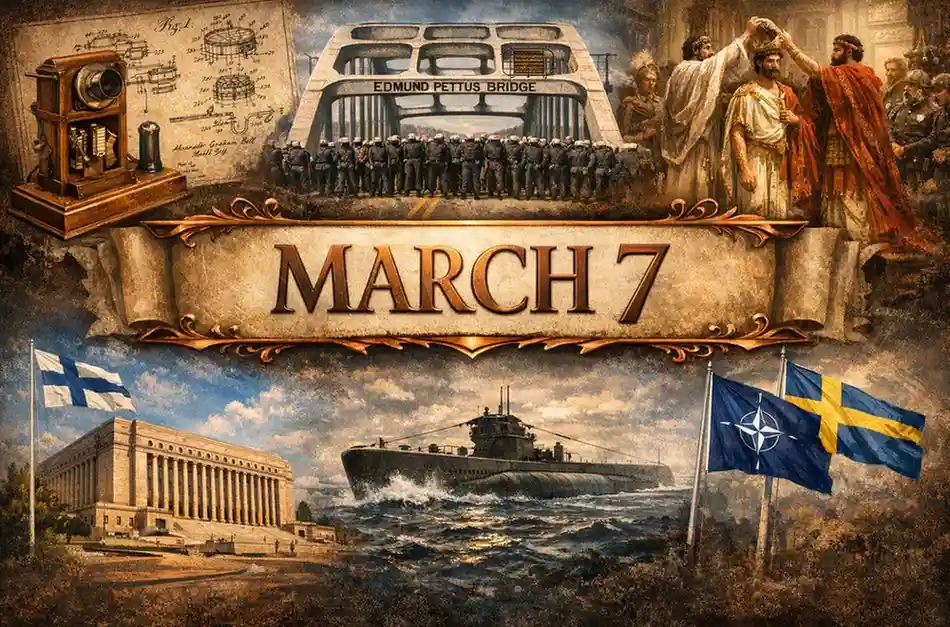
Following the death of Emperor Antoninus Pius, Marcus Aurelius and Lucius Verus (formerly L. Commodus) ascended to the throne as joint emperors of Rome. This was a landmark moment in Roman history, as it was the first time the Empire was ruled by two co-equal sovereigns simultaneously. While Marcus Aurelius is remembered for his Stoic philosophy, Verus took command of the military campaigns in the East, an arrangement that set a precedent for future divisions of imperial power.
681 – Deposition of Patriarch Macarius I
The Third Council of Constantinople took a major step toward resolving religious fractures by deposing Patriarch Macarius I of Antioch. He was removed for his adherence to Monothelitism, a doctrine that sought to reconcile different Christian views on the nature of Christ but was ultimately deemed heretical. His removal signaled the Council’s firm commitment to Dyothelitism, a core tenet of Orthodox and Catholic theology.
1138 – Election of Konrad III
Konrad III von Hohenstaufen was elected King of Germany at Coblenz in the presence of the influential papal legate Theodwin. His election marked the beginning of the Hohenstaufen dynasty’s long and often tumultuous rule over the Holy Roman Empire. However, his rise to power immediately sparked a fierce civil conflict with the House of Welf, initiating a rivalry that would dominate German and Italian politics for over a century.
1277 – Condemnation of Heretical Propositions
The University of Paris issued the last in a famous series of formal condemnations against various philosophical and theological theses. Issued by Bishop Étienne Tempier, these decrees targeted “radical Aristotelianism” and scientific ideas that were perceived to limit divine omnipotence. This event had a profound impact on the development of medieval thought, forcing scholars to find new ways to reconcile faith with the emerging logic of natural philosophy.
1573 – Peace Treaty Ends the Ottoman–Venetian War
The Republic of Venice signed a peace treaty with the Ottoman Empire, officially ending a three-year war that saw the loss of Cyprus to the Turks. Despite the Christian naval victory at Lepanto two years earlier, Venice was forced to recognize Ottoman control over the island and pay a heavy indemnity. The treaty secured Ottoman naval dominance in the Eastern Mediterranean and allowed Venice to resume its lucrative trade routes under much harsher conditions.
1799 – Napoleon Bonaparte Captures Jaffa
During his Egyptian campaign, Napoleon Bonaparte successfully captured the city of Jaffa in modern-day Israel. The victory was followed by a brutal massacre of more than 2,000 Albanian captives who had surrendered, an act that remains one of the darkest stains on Napoleon’s military career. Shortly after, the French army was struck by a devastating outbreak of the bubonic plague, significantly weakening their march toward Acre.
1814 – Battle of Craonne
In one of the bloodiest engagements of the Six Days’ Campaign, Emperor Napoleon I of France achieved a hard-fought victory over the Prussian and Russian forces at the Battle of Craonne. Although Napoleon successfully drove the Allies from the field, the win was pyrrhic, as the French suffered nearly 5,000 casualties they could not afford to replace. The battle was one of Napoleon’s final displays of tactical brilliance before his eventual abdication.
1826 – Shrigley Abduction of Ellen Turner
In a scandal that shocked the British public, 15-year-old heiress Ellen Turner was abducted from her boarding school by Edward Gibbon Wakefield. Wakefield tricked the girl into marriage in a bid to seize her family’s fortune, a scheme that ultimately led to his imprisonment. Interestingly, while in prison, Wakefield developed the theories of systematic colonization that he later applied to the establishment of colonies in South Australia and New Zealand.
1850 – Daniel Webster’s “Seventh of March” Speech
U.S. Senator Daniel Webster delivered one of the most famous and controversial speeches in American history, advocating for the Compromise of 1850. Webster argued that the preservation of the Union was more important than the immediate abolition of slavery, a stance that deeply angered his fellow Northern abolitionists. While the speech helped delay the Civil War for a decade, it effectively ended Webster’s political popularity in his home state of Massachusetts.
1876 – Alexander Graham Bell Patents the Telephone
The U.S. Patent Office granted Alexander Graham Bell patent number 174,465 for an invention he called the “telephone.” This historic document described the method of transmitting vocal sounds telegraphically through electrical wires. Just three days later, Bell would successfully transmit the first clear message to his assistant, Thomas Watson, laying the legal and technological foundation for the modern global telecommunications industry.
1902 – Battle of Tweebosch
During the Second Boer War, Boer forces led by General Koos de la Rey achieved a stunning victory over the British at the Battle of Tweebosch. The Boers captured a British column along with Lieutenant-General Lord Methuen, the highest-ranking British officer to be taken prisoner during the entire war. The defeat was a significant embarrassment for the British Empire and demonstrated the continued effectiveness of Boer guerrilla tactics late in the conflict.
1921 – Proclamation of the Labin Republic
In a bold act of defiance against fascist Italian administration, miners in the town of Labin, Istria, went on strike and proclaimed the short-lived socialist “Labin Republic.” This self-governing commune was established to protect workers’ rights and resist the growing influence of Italian Blackshirts. Although it lasted only 37 days before being crushed by the Italian military, it is remembered as one of the world’s first organized anti-fascist uprisings.
1931 – Inauguration of the Parliament House of Finland
The Parliament House (Eduskuntatalo) was officially inaugurated in Helsinki, serving as the new and permanent home for the Finnish legislature. Designed in the Stripped Classical style, the building became a powerful symbol of Finland’s sovereignty and democratic resilience following its independence from Russia. To this day, it remains the architectural and political heart of the nation, hosting the country’s most critical legislative debates.
1941 – Disappearance of U-47 and Günther Prien
Günther Prien and the crew of the German submarine U-47 disappeared without a trace during a patrol in the North Atlantic. Prien was one of the most celebrated U-boat commanders of World War II, famous for sinking the British battleship HMS Royal Oak at Scapa Flow. The exact cause of the submarine’s loss remains a mystery, though theories range from a depth charge attack to a malfunction of its own torpedoes.
1951 – Northwest Orient Flight 307 Crash
A Northwest Orient Airlines Douglas DC-4 crashed in the Lynnhurst neighborhood of Minneapolis during a blinding snowstorm, killing all 15 people on board. The aircraft struck a flagpole and then a house, narrowly avoiding a nearby school, though no one on the ground was killed. The tragedy led to renewed calls for improved airport safety and better navigational equipment for pilots landing in severe winter weather conditions.
1951 – Operation Ripper Begins
During the Korean War, United Nations troops led by General Matthew Ridgway launched Operation Ripper, a major offensive against Chinese and North Korean forces. The goal was to drive the enemy back across the Han River and liberate the capital city of Seoul. The operation was a strategic success, utilizing massive artillery support to clear out communist strongholds and eventually forcing the recapture of Seoul later that month.
1951 – Assassination of Ali Razmara
Iranian Prime Minister Ali Razmara was shot and killed while attending a funeral at a mosque in Tehran by a member of the fundamentalist group Fada’iyan-e Islam. Razmara had been a vocal opponent of the nationalization of the Anglo-Iranian Oil Company, a stance that made him many enemies among nationalists. His assassination paved the way for the rise of Mohammad Mosaddegh and the subsequent global crisis over Iranian oil.
1965 – “Bloody Sunday” in Selma, Alabama
A group of approximately 600 civil rights marchers was brutally attacked by state and local police as they attempted to cross the Edmund Pettus Bridge in Selma. The peaceful demonstrators, who were marching for voting rights, were met with tear gas and billy clubs, resulting in scores of injuries. The televised images of the violence shocked the nation and served as a major catalyst for the passage of the Voting Rights Act of 1965.
1965 – Aeroflot Flight 542 Crash
An Aeroflot passenger aircraft crashed in the remote Yermakovsky District of the Soviet Union, resulting in the deaths of all 31 people on board. The flight was en route to Krasnoyarsk when it encountered severe weather and structural failure, leading to a loss of control. The disaster highlighted the difficulties of managing air traffic across the vast and often treacherous Siberian wilderness during the height of the Soviet aviation expansion.
1986 – Crew Cabin of Challenger Located
Divers from the USS Preserver located the crew cabin of the Space Shuttle Challenger on the Atlantic ocean floor, several weeks after the vehicle exploded during takeoff. The discovery of the cabin, which remained largely intact despite the forces of the explosion, allowed for the recovery of the remains of the seven astronauts. This somber milestone provided crucial evidence for the investigation into the O-ring failure that caused the disaster.
1989 – UK and Iran Break Diplomatic Ties
Diplomatic relations between Iran and the United Kingdom were officially severed following the international firestorm over Salman Rushdie’s novel, The Satanic Verses. The Iranian leader Ayatollah Khomeini had issued a fatwa calling for Rushdie’s death, which the UK condemned as a violation of international law and free speech. The break in relations lasted for nearly a decade, symbolizing the deep cultural and political chasm between the two nations.
2006 – Varanasi Bombings
The terrorist organization Lashkar-e-Taiba coordinated a series of three synchronized bombings in the holy city of Varanasi, India, killing 28 people and injuring dozens more. The blasts targeted the Sankat Mochan Hanuman Temple and the main railway station during a crowded Tuesday evening. The attacks were condemned worldwide and led to a massive security crackdown across India to prevent further sectarian violence.
2007 – Reform of the House of Lords
In a historic move, the British House of Commons voted overwhelmingly in favor of making the House of Lords—the upper chamber of Parliament—a 100% elected body. This vote was intended to replace the system of hereditary peers and appointed life peers with a more democratic structure. While the vote was a significant statement of intent toward constitutional reform, the actual implementation of an elected upper house remains a subject of ongoing political debate in the UK.
2007 – Garuda Indonesia Flight 200 Crash
A Garuda Indonesia Boeing 737 crashed and burst into flames upon landing at Adisutjipto International Airport in Yogyakarta, killing 21 people. The investigation revealed that the pilot had landed the aircraft at twice the recommended speed and failed to go around despite warnings from the co-pilot. The tragedy led to a major overhaul of Indonesian aviation safety standards and a temporary ban on Indonesian airlines flying into European Union airspace.
2009 – Massereene Barracks Shooting
Two British soldiers were killed and four other people were injured in a shooting attack at the Massereene Barracks in Northern Ireland, claimed by the Real IRA. These were the first British military deaths in the region since the end of “The Troubles” in 1998, sparking fears of a return to sectarian violence. The attack was met with widespread condemnation from both republican and unionist leaders, who reaffirmed their commitment to the peace process.
2021 – Bata Explosions in Equatorial Guinea
A series of massive accidental explosions at a military barracks in the city of Bata, Equatorial Guinea, killed at least 108 people and injured more than 600. The blasts were caused by the negligent handling of dynamite and high-caliber ammunition during a field-clearing fire. The disaster leveled much of the surrounding neighborhood, leaving thousands homeless and prompting a massive international humanitarian response for the small Central African nation.
2024 – Sweden Joins NATO
Sweden officially became the 32nd member of NATO, ending over two centuries of military non-alignment. The decision was spurred by the geopolitical shift following the Russian invasion of Ukraine, as Sweden sought the collective security guarantees of the alliance. The accession was finalized in Washington, D.C., marking a historic expansion of NATO’s influence in the Baltic region and a major change in the security architecture of Northern Europe.
2024 – Rust Movie Set Conviction
In a landmark legal case, Hannah Gutierrez-Reed was found guilty of involuntary manslaughter for the fatal shooting of cinematographer Halyna Hutchins on the set of the movie Rust. This was the first time in history that a crew member was held criminally responsible for causing a death on a film set through negligence. The verdict underscored the critical importance of safety protocols in Hollywood and the legal liability of those responsible for handling real firearms.
Read Also: This day in history March 6 Compromise Conflict Constitution
Famous People Born On March 7
| Name | Dates | Role / Description |
|---|---|---|
| Anna Magnani | March 7, 1908 – September 26, 1973 | Italian Oscar-winning actress 🎭 |
| Luther Burbank | March 7, 1849 – April 11, 1926 | Pioneer of modern plant breeding 🌱 |
| Publius Septimius Geta | March 7, 189 – December 26, 211 | Roman emperor (209–211) 👑 |
| Kamehameha III | March 7, 1814 – December 15, 1854 | Long-reigning Hawaiian monarch 🌺 |
| Anthony Comstock | March 7, 1844 – September 21, 1915 | Anti-obscenity campaigner 📚 |
| Alessandro Manzoni | March 7, 1785 – May 22, 1873 | Author of The Betrothed ✍️ |
| Abe Kōbō | March 7, 1924 – January 22, 1993 | Surrealist novelist & playwright 📖 |
| Pope Clement XIII | March 7, 1693 – February 2, 1769 | Pope from 1758–1769 ⛪ |
| Julius Wagner-Jauregg | March 7, 1857 – September 27, 1940 | Nobel Prize–winning physician 🧠 |
| Joy Paul Guilford | March 7, 1897 – November 26, 1987 | Intelligence research pioneer 🧩 |
| Albert Fert | March 7, 1938 – — | Nobel laureate in physics ⚛️ |
| Milton Avery | March 7, 1893 – January 3, 1965 | Influential modern artist 🎨 |
| Mark Richards | March 7, 1957 – — | Four-time world surfing champion 🏄 |
| Champ Clark | March 7, 1850 – March 2, 1921 | U.S. House Speaker 🏛️ |
| Amanda Gorman | March 7, 1998 – — | Inaugural poet & activist ✨ |
Famous People Died On March 7
| Name | Dates | Role / Description |
|---|---|---|
| Gordon Parks | November 30, 1912 – March 7, 2006 | Photographer, filmmaker & author 📷 |
| Mikhail Bakhtin | November 17, 1895 – March 7, 1975 | Influential literary theorist 📚 |
| Harriet Jacobs | 1813 – March 7, 1897 | Former slave & memoirist ✊ |
| Domenico Montagnana | c.1687 – March 7, 1750 | Master violin & cello maker 🎻 |
| Theo van Doesburg | August 30, 1883 – March 7, 1931 | Leader of De Stijl movement 🖌️ |
| Hans Georg Dehmelt | September 9, 1922 – March 7, 2017 | Nobel Prize–winning physicist ⚛️ |
| Margaret Douglas | October 8, 1515 – March 7, 1578 | English noble & royal intriguer 👑 |
| Aristide Briand | March 28, 1862 – March 7, 1932 | Prime minister & Nobel laureate 🕊️ |
| W. D. Hamilton | August 1, 1936 – March 7, 2000 | Evolutionary theorist 🧬 |
| Will H. Hays | November 5, 1879 – March 7, 1954 | Hollywood censorship code leader 🎬 |
| William Longsword | — – March 7, 1226 | English noble & military leader ⚔️ |
| Pope Innocent XIII | May 13, 1655 – March 7, 1724 | Pope from 1721–1724 ⛪ |
| Cool Papa Bell | May 17, 1903 – March 7, 1991 | Legendary speedster in Negro Leagues ⚾ |
| Jean-Pierre Blanchard | July 4, 1753 – March 7, 1809 | Aviation pioneer 🎈 |
| Stanley Kubrick | July 26, 1928 – March 7, 1999 | Iconic filmmaker |
Observances & Institutional Dates
- Maritime Day in Slovenia: A day celebrating Slovenia’s connection to the sea and its naval history.
- Alexander Graham Bell Day: Commemorating the 1876 patent of the telephone.
- National Be Heard Day (USA): Encouraging small businesses to stand out and make their presence known.
- Eastern Orthodox Liturgics (March 7): Honoring various saints and martyrs of the church calendar.
Frequently Asked Questions
- Who was the first person to patent the telephone? Alexander Graham Bell received the first official patent for the telephone on March 7, 1876.
- What happened on “Bloody Sunday” in 1965? Civil rights marchers in Selma, Alabama, were brutally attacked by police on the Edmund Pettus Bridge.
- When did Sweden join NATO? Sweden officially became a member of NATO on March 7, 2024.
- What was the Shrigley abduction? It was the 1826 kidnapping of 15-year-old heiress Ellen Turner by Edward Gibbon Wakefield, which led to significant changes in British law.