Reflecting on what happened on this day in history March 8, we encounter a date that serves as a global stage for the struggle for identity and autonomy. It is the day the Persian soul was preserved through the completion of the Shahnameh and the day the “February Revolution” ignited in Russia, forever altering the 20th century.
From the tragic mystery of MH370 to the pioneering spirit of the first female pilot, this date reminds us that whether through the stroke of a pen, the vote of a parliament, or a march in the streets, the world is constantly being reshaped by those who demand to be heard.
Important Events That Happened On March 8 In History
1010 – Ferdowsi Completes the Shahnameh
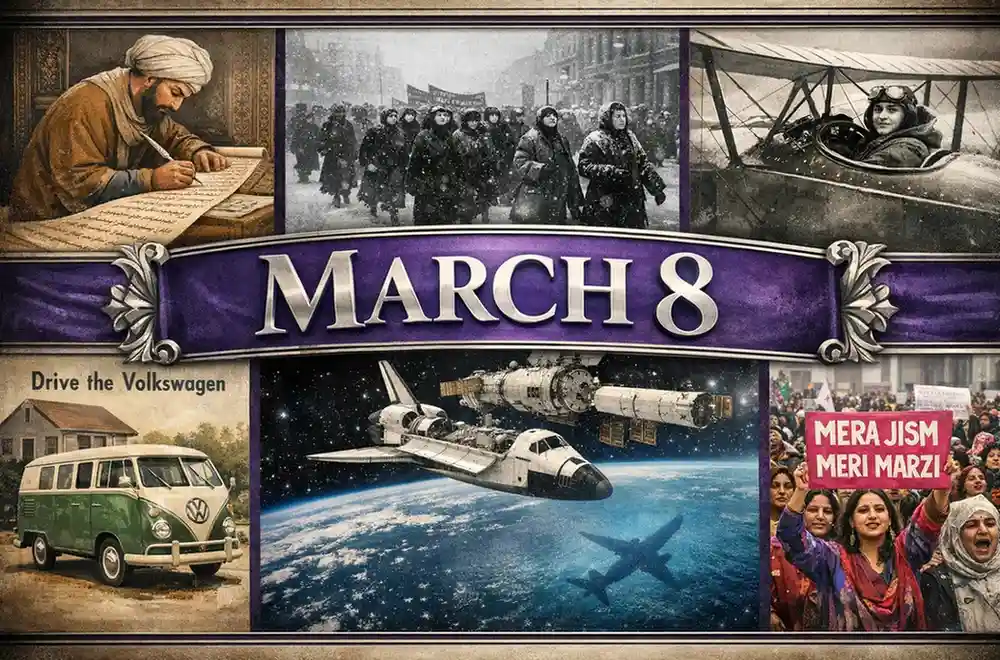
After thirty years of meticulous labor, the Persian poet Ferdowsi completed his magnum opus, the Shahnameh (Book of Kings). This massive epic poem, consisting of some 50,000 distichs, chronicles the mythical and historical past of the Persian Empire from the creation of the world until the Muslim conquest. It is credited with preserving the Persian language and cultural identity at a time when Arabic influence was dominant, remaining a cornerstone of literature in Iran, Afghanistan, and Tajikistan today.
1126 – Alfonso VII Proclaimed King of León
Following the death of his mother, Queen Urraca, Alfonso VII was officially proclaimed the King of León. Known as “The Emperor,” Alfonso VII spent much of his reign attempting to consolidate the various Christian kingdoms of the Iberian Peninsula under his hegemony. His rule was a pivotal period in the Reconquista, as he successfully campaigned against the Almoravids and sought to establish a unified front against Islamic rule in Spain.
1262 – Battle of Hausbergen
The Battle of Hausbergen took place between the bourgeois militias of the city of Strasbourg and the feudal army led by Bishop Walter von Geroldseck. The citizens of Strasbourg, weary of the Bishop’s heavy-handed rule and tax demands, scored a decisive victory that effectively ended the Bishop’s temporal power over the city. This triumph allowed Strasbourg to become a “Free Imperial City,” a status that granted it significant political and economic independence within the Holy Roman Empire.
1558 – Founding of the City of Pori
The city of Pori (known in Swedish as Björneborg) was founded by Duke John, who later became King John III of Sweden, on the shores of the Gulf of Bothnia. Established to facilitate trade and secure the northern coastline, Pori became an important industrial and maritime hub in Finland. Over the centuries, the city survived nine major fires, each time rebuilding and evolving into the cultural and economic center of the Satakunta region it is today.
1658 – Treaty of Roskilde Signed
Following a devastating defeat during the Northern Wars, King Frederick III of Denmark–Norway was forced to sign the Treaty of Roskilde, yielding nearly half of his territory to King Charles X Gustav of Sweden. This massive territorial shift saw Denmark lose its provinces in southern Sweden (Scania, Halland, and Blekinge), effectively ending Danish control over the Sound. The treaty remains a defining moment in Scandinavian history, establishing the modern borders between Denmark and Sweden.
1702 – Queen Anne Ascends the Throne
Queen Anne, the younger sister of Mary II, became the Queen regnant of England, Scotland, and Ireland following the death of William III. Her reign was one of the most transformative in British history, most notably overseen by the Acts of Union in 1707, which united England and Scotland into a single sovereign state called Great Britain. Despite personal tragedies and failing health, Anne presided over a period of significant military success and cultural flourishing known as the Augustan Age.
1722 – Battle of Gulnabad
The Safavid Empire of Iran suffered a catastrophic defeat at the hands of a numerically inferior Afghan army led by Mahmud Hotak at the Battle of Gulnabad. The loss exposed the deep-seated military and administrative decay within the Safavid state, leading to the eventual siege and fall of the capital, Isfahan. This battle effectively signaled the end of the Safavid dynasty’s two-century rule and ushered in a period of intense instability and foreign intervention in Persia.
1736 – Coronation of Nader Shah
Nader Shah, a brilliant military strategist often referred to as the “Napoleon of Persia,” was officially crowned the Shah of Iran, founding the Afsharid dynasty. He rose from humble beginnings to expel Afghan and Ottoman occupiers, eventually expanding the Persian Empire to its greatest extent since the Sassanids. His coronation marked the end of the Safavid interregnum and the beginning of a brief but powerful resurgence of Persian military might in Central Asia.
1775 – First Abolitionist Article in America
An anonymous writer, widely believed to be the revolutionary Thomas Paine, published “African Slavery in America” in the Pennsylvania Journal. The article was the first in the American colonies to call for the immediate emancipation of slaves and the total abolition of the institution of slavery. Paine’s moral arguments challenged the contradictions of a colony seeking liberty from Britain while denying it to others, lighting a spark for the abolitionist movement that would grow over the next century.
1782 – Gnadenhutten Massacre
In one of the most tragic episodes of the American Revolutionary War, ninety-six Christian Lenape (Delaware) Indians were murdered by Pennsylvania militiamen at the Gnadenhutten mission in Ohio. The victims, who had converted to Christianity and practiced non-violence, were killed in cold blood as “retaliation” for raids carried out by other, unrelated tribes. The massacre remains a haunting example of the indiscriminate violence faced by Native Americans during the struggle for control of the Ohio Country.
1801 – Battle of Abukir
A British force under the command of Sir Ralph Abercromby successfully landed at Abukir Bay in Egypt, initiating a campaign to expel Napoleon’s “Army of the East.” Despite heavy French resistance from the dunes, the British established a solid beachhead, which eventually led to the surrender of French forces in Egypt and Syria. The victory effectively ended Napoleon’s dreams of an Eastern empire and secured British dominance in the Mediterranean and the route to India.
1844 – Oscar I Becomes King of Sweden and Norway
Following the death of his father, Charles XIV John, Oscar I ascended to the joint thrones of Sweden and Norway. His reign was characterized by a shift toward more liberal domestic policies, including educational reform and the improvement of women’s rights. Oscar I sought to balance the interests of both his kingdoms and is remembered for his efforts to modernize the administration and foster a sense of Scandinavian unity during a period of rising nationalism.
1844 – Reopening of the Althing in Iceland
After being closed for 45 years by the Danish monarchy, the Althing—Iceland’s historic parliament—was officially reopened in Reykjavík. Although it initially functioned only as a consultative body to the Danish King, its restoration was a massive symbolic victory for the Icelandic independence movement led by Jón Sigurðsson. The reopening marked the beginning of Iceland’s long legislative journey back toward full sovereignty and self-determination.
1868 – The Sakai Incident
In a violent clash between cultures, Japanese samurai from the Tosa Domain killed 11 French sailors in the port of Sakai, near Osaka. The sailors had landed without permission, leading to a confrontation that ended in a massacre. To prevent a full-scale diplomatic war with France, the Japanese government ordered the samurai involved to commit ritual suicide (seppuku). The incident underscored the extreme tensions in Japan during the transition from the Shogunate to the Meiji Restoration.
1910 – Raymonde de Laroche Receives Pilot’s License
French aviatrix Raymonde de Laroche made history by becoming the first woman in the world to receive a pilot’s license. Awarded by the Aero-Club de France, her achievement shattered the gender barriers of early aviation and proved that women were equally capable of mastering the complex new technology of flight. Laroche’s pioneering spirit inspired a generation of female pilots and remains a landmark moment in the history of civil aviation.
1916 – Battle of Dujaila
During World War I, a British and Indian relief force launched an unsuccessful assault against Ottoman positions at the Battle of Dujaila in an attempt to reach the besieged city of Kut. The failure was a devastating blow to British morale, as the Ottoman defenders held their ground despite a night march intended to surprise them. The defeat eventually led to the surrender of the garrison at Kut, resulting in one of the largest captures of British troops in the history of the war.
1917 – Beginning of the February Revolution
International Women’s Day protests in Petrograd (St. Petersburg) escalated into mass strikes and riots, marking the start of the “February Revolution” in Russia. Women marching for “Bread and Peace” were joined by factory workers and, eventually, soldiers who refused to fire on the crowds. This spontaneous uprising led to the abdication of Tsar Nicholas II just days later, ending centuries of Romanov rule and setting the stage for the rise of the Soviet Union.
1917 – US Senate Adopts the Cloture Rule
In a move to increase legislative efficiency, the United States Senate voted to adopt the “cloture rule,” which allowed for the limitation of filibusters. The rule was established after a group of senators successfully blocked a bill to arm merchant ships during World War I, prompting President Woodrow Wilson to call for a change. For the first time, a two-thirds majority (later changed to three-fifths) could vote to end debate and move to a final vote on a bill.
1921 – Assassination of Eduardo Dato
Spanish Prime Minister Eduardo Dato Iradier was assassinated in Madrid while being driven home from a session of parliament. Three Catalan anarchists on a motorcycle pulled up alongside his car and fired multiple rounds, killing him instantly. Dato’s death was a symptom of the intense social unrest and labor conflict plaguing Spain in the early 1920s, a period of political instability that would eventually lead to the dictatorship of Primo de Rivera.
1924 – Castle Gate Mine Disaster
A series of coal dust explosions ripped through the Utah Fuel Company’s No. 2 mine near Castle Gate, Utah, killing all 172 miners inside. The disaster was so powerful that it blew a heavy mine car across a canyon and completely destroyed the ventilation system. It remains one of the deadliest industrial accidents in American history, leading to stricter safety regulations regarding the use of rock dust to prevent coal dust explosions in mines.
1936 – First Stock Car Race at Daytona
The legendary Daytona Beach and Road Course held its first organized oval stock car race, a precursor to the modern NASCAR era. The course utilized a stretch of the paved highway and the hard-packed sands of the beach, creating a unique and treacherous racing environment. While the event was plagued by logistical issues and cars getting stuck in the sand, it proved the massive public appetite for stock car racing and laid the foundation for Daytona’s status as the “World Center of Racing.”
1937 – Battle of Guadalajara Begins
During the Spanish Civil War, the Battle of Guadalajara began as Italian “volunteer” forces under Francisco Franco attempted to encircle Madrid from the northeast. The battle is famous for being a decisive Republican victory, as the Republican forces, supported by Soviet tanks and the International Brigades, successfully repelled the Italian advance in harsh winter conditions. The defeat was a significant embarrassment for Mussolini and a major morale boost for the Republican cause.
1942 – Dutch East Indies Surrender Java
Following the swift and overwhelming Japanese invasion of the Netherlands East Indies, Dutch commanders officially surrendered the island of Java to the Imperial Japanese Army. This capitulation ended three centuries of Dutch colonial rule in the region and secured vital oil and rubber resources for the Japanese war machine. The occupation that followed would last until 1945, profoundly influencing the eventual Indonesian struggle for independence.
1942 – Japanese Forces Capture Rangoon
In a critical blow to British defenses in Southeast Asia, Imperial Japanese forces captured Rangoon, the capital of Burma. The fall of the city severed the “Burma Road,” the primary supply route for Allied aid to China, forcing the British and their allies into a long and grueling retreat toward India. The loss of Rangoon was one of the lowest points for the Allies in the Pacific Theater, marking the start of a multi-year struggle to reclaim Burma.
1949 – Signing of the Élysée Accords
French President Vincent Auriol and the former Emperor of Vietnam, Bảo Đại, signed the Élysée Accords, which recognized Vietnam as an “Associated State” within the French Union. While the accords gave Vietnam more domestic autonomy, France maintained control over defense and foreign policy. The move was a French attempt to build a pro-Western government to oppose the communist Viet Minh, effectively setting the stage for the prolonged First Indochina War.
1950 – Production of the Volkswagen Type 2 Begins
The iconic Volkswagen Type 2, better known as the “Bus,” “Microbus,” or “Transporter,” officially entered mass production in Wolfsburg, Germany. Designed as a versatile commercial vehicle using the chassis of the VW Beetle, it quickly became a global symbol of utility and, later, a cultural icon for the 1960s counterculture movement. Its distinctive “boxy” design and air-cooled rear engine made it one of the most recognizable and beloved vehicles in automotive history.
1962 – Turkish Airlines Mount Medetsiz Crash
A Turkish Airlines Fokker F27 Friendship, en route from Istanbul to Adana, crashed into the snow-covered Mount Medetsiz in the Taurus Mountains. All 11 people on board were killed when the aircraft encountered severe turbulence and poor visibility during its descent. The recovery effort was hampered by the remote and rugged terrain, making it one of the most challenging salvage operations in the history of Turkish civil aviation at that time.
1963 – Ba’athist Coup in Syria
The military wing of the Ba’ath Party seized power in Syria in a coup d’état later known as the “8th of March Revolution.” Led by a committee of military officers, the coup overthrew the civilian government and established a Revolutionary Command Council. This event marked the beginning of decades of Ba’athist rule in Syria, fundamentally shifting the nation’s political landscape toward Arab nationalism and socialism.
1965 – US Marines Arrive at Da Nang
The first American combat troops, 3,500 U.S. Marines, landed on the beaches of Da Nang in South Vietnam. Their arrival marked a significant escalation of the Vietnam War, shifting the U.S. role from providing “advisors” to direct military engagement. The Marines were initially tasked with protecting the Da Nang airbase, but their mission quickly expanded into search-and-destroy operations as the conflict deepened into a full-scale war.
1965 – Aeroflot Flight 513 Crash
A Soviet Aeroflot passenger plane crashed during a failed takeoff attempt from Kuybyshev Airport, resulting in the deaths of 30 people on board. The investigation revealed that snow and ice accumulation on the wings had affected the aircraft’s lift, causing it to stall shortly after leaving the runway. The tragedy led to a review of de-icing procedures at Soviet airports, especially during the harsh winter months.
1966 – Destruction of Nelson’s Pillar
In the early hours of the morning, a powerful bomb destroyed the top half of Nelson’s Pillar, a large granite monument in the center of O’Connell Street in Dublin. The explosion, carried out by former IRA members, was intended to commemorate the 50th anniversary of the Easter Rising by removing a symbol of British imperialism. The remaining stump was later demolished by the Irish Army, leaving a gap in the Dublin skyline that was eventually filled by the Spire of Dublin.
1979 – First Public Demonstration of the Compact Disc
In Eindhoven, Netherlands, Philips publicly demonstrated the prototype of the “Compact Disc” (CD) for the first time. The digital audio technology, developed in collaboration with Sony, promised a revolution in music storage, offering crystal-clear sound quality and a durable, scratch-resistant format. The CD would go on to replace vinyl records and cassette tapes as the primary medium for recorded music, fundamentally changing how the world consumed audio for decades.
1979 – Discovery of Volcanoes on Io
NASA scientists analyzing images sent back by the Voyager 1 spacecraft confirmed the existence of active volcanoes on Io, one of Jupiter’s moons. This was a groundbreaking discovery, as it was the first time active volcanism had been observed on another celestial body in our solar system. The discovery proved that Io was the most geologically active object in the solar system, fueled by the intense tidal heating caused by Jupiter’s massive gravitational pull.
1983 – Reagan’s “Evil Empire” Speech
Addressing a convention of the National Association of Evangelicals in Orlando, Florida, U.S. President Ronald Reagan famously labeled the Soviet Union an “evil empire.” Reagan’s rhetoric was a sharp departure from the previous era of detente, framing the Cold War as a moral struggle between freedom and totalitarianism. The speech signaled a more assertive and confrontational U.S. foreign policy, which many historians credit with hastening the eventual collapse of the Soviet bloc.
1985 – Fadlallah Assassination Attempt
A massive car bomb exploded in Beirut, Lebanon, in an apparent attempt to assassinate the prominent Shiite cleric Sayyed Mohammad Hussein Fadlallah. While Fadlallah escaped unharmed, the blast destroyed several buildings and killed 80 people, most of whom were civilians. The attack was widely blamed on Western or regional intelligence agencies, further escalating the cycle of violence and suspicion during the Lebanese Civil War.
1988 – Hijacking of Aeroflot Flight 3379
The Ovechkin family, a popular jazz band of 11 members from Siberia, hijacked an Aeroflot flight in an attempt to defect to the West. Armed with sawed-off shotguns hidden in their musical instruments, they demanded to be flown to London. The plane eventually landed at a military base near the Finnish border, where Soviet special forces stormed the aircraft. The bungled rescue and the family’s suicide pact resulted in nine deaths, including five members of the Ovechkin family.
1994 – Indira Gandhi Airport Collision
In a tragic ground accident at Indira Gandhi International Airport in Delhi, a Sahara India Airlines Boeing 737 crashed into a stationary aircraft and airport buildings during a training flight. Nine people, including several workers on the ground, were killed in the resulting fire and explosion. The accident led to a major review of training protocols and ground safety measures at India’s busiest international airport.
2001 – Launch of STS-102 Discovery
The Space Shuttle Discovery launched on mission STS-102, heading for the International Space Station (ISS). The primary objective was to deliver the Expedition 2 crew and the Leonardo Multi-Purpose Logistics Module, which contained vital supplies and science racks. The mission was a success, marking the first time a shuttle had served as a “taxi” to rotate full crews on the station, a key step in the long-term habitation of space.
2004 – Signing of Iraq’s New Constitution
Iraq’s U.S.-appointed Governing Council signed a landmark interim constitution, known as the Transitional Administrative Law. The document was intended to serve as a bridge to a permanent government following the ousting of Saddam Hussein, establishing a federal system and a bill of rights. While the signing was hailed as a step toward democracy, it also exposed deep sectarian and ethnic divisions regarding the future structure of the Iraqi state.
2010 – TNA Wrestling Moves to Monday Nights
In a bold but ultimately unsuccessful attempt to challenge WWE’s dominance, TNA Wrestling moved its flagship program, Impact!, to Monday nights. Headlined by legendary figures Hulk Hogan and Ric Flair, the move was intended to recreate the “Monday Night Wars” of the 1990s. However, the show struggled in the ratings against Monday Night Raw and was eventually moved back to Thursday nights, a notable chapter in the history of professional wrestling television.
2014 – Disappearance of Malaysia Airlines Flight 370
Malaysia Airlines Flight 370, en route from Kuala Lumpur to Beijing with 239 people on board, vanished from radar screens over the South China Sea. Despite the most expensive search in aviation history, the main wreckage of the Boeing 777 has never been found. The disappearance remains one of the greatest mysteries in history, sparking countless theories and leading to significant changes in how aircraft are tracked globally during long-haul flights.
2017 – Collapse of the Azure Window
The Azure Window, a world-famous natural limestone arch on the Maltese island of Gozo, collapsed into the sea during a period of heavy storms. A popular destination for tourists and a frequent filming location for movies and TV shows like Game of Thrones, the arch had been slowly eroding for years. Its sudden disappearance was mourned by the people of Malta as a significant loss to the nation’s natural heritage and landscape.
2018 – First Aurat March in Pakistan
On International Women’s Day, the first “Aurat March” was held in Karachi, Pakistan, marking a new wave of feminist activism in the country. Organized by a collective of women, the march sought to highlight issues of gender-based violence, economic inequality, and bodily autonomy. The slogan “Mera Jism Meri Marzi” (My body, my choice) became a central and controversial rallying cry, sparking a nationwide conversation about women’s rights and social norms in Pakistan.
2021 – Violent Women’s Day Marches in Mexico City
International Women’s Day protests in Mexico City turned violent as demonstrators clashed with police outside the National Palace. Protesters, fueled by anger over the country’s high rates of femicide and domestic violence, used hammers and blowtorches to break through metal barriers. The confrontation left 62 police officers and 19 civilians injured, highlighting the deep frustration and the militant turn of the feminist movement in Latin America.
2021 – Formation of the National Unity Consultative Council
In response to the military coup in Myanmar, twenty-eight political and ethnic institutions established the National Unity Consultative Council (NUCC). This historic alliance brought together democratically elected leaders and ethnic armed organizations to coordinate the resistance against the ruling junta. The NUCC served as a critical platform for building a unified vision for a federal democratic union, representing the most diverse political coalition in Myanmar’s history.
Famous People Born On March 8
| Name | Description | Date |
|---|---|---|
| Otto Hahn | German chemist, nuclear fission pioneer | March 8, 1879 – July 28, 1968 |
| Carl Philipp Emanuel Bach | German composer | March 8, 1714 – December 14, 1788 |
| Ralph H. Baer | Video game pioneer | March 8, 1922 – December 6, 2014 |
| Anselm Kiefer | German painter | March 8, 1945 – Present |
| Vasundhara Raje | Indian politician | March 8, 1953 – Present |
| Neil Postman | Media theorist | March 8, 1931 – October 5, 2003 |
| Mississippi John Hurt | Blues musician | March 8, 1892 – November 2, 1966 |
| Louise Beavers | American actress | March 8, 1902 – October 26, 1962 |
| William V, Prince of Orange | Dutch ruler | March 8, 1748 – April 9, 1806 |
| Kenneth Grahame | Author, The Wind in the Willows | March 8, 1859 – July 6, 1932 |
| John McPhee | American journalist | March 8, 1931 – Present |
| Konstantinos Karamanlis | Greek statesman | March 8, 1907 – April 23, 1998 |
| Richard Howe | British admiral | March 8, 1726 – August 5, 1799 |
| Ruggero Leoncavallo | Italian composer | March 8, 1857 – August 9, 1919 |
| Alan Hovhaness | American composer | March 8, 1911 – June 21, 2000 |
| Simon Cameron | U.S. politician | March 8, 1799 – June 26, 1889 |
| Eric Linklater | British novelist | March 8, 1899 – November 7, 1974 |
| Leslie A. Fiedler | Literary critic | March 8, 1917 – January 29, 2003 |
| Rosso Fiorentino | Italian painter | March 8, 1494 – November 14, 1540 |
| Sir Anthony Caro | British sculptor | March 8, 1924 – October 23, 2013 |
| Mouloud Feraoun | Algerian novelist | March 8, 1913 – March 15, 1962 |
| Frederic W. Goudy | Typographer | March 8, 1865 – May 11, 1947 |
| Sir William Hamilton | Scottish philosopher | March 8, 1788 – May 6, 1856 |
| Edward C. Kendall | Nobel Prize chemist | March 8, 1886 – May 4, 1972 |
| Juana de Ibarbourou | Uruguayan poet | March 8, 1895 – July 1979 |
| Marie-Thérèse Nadig | Swiss Olympic skier | March 8, 1954 – Present |
| Jonathan Sacks | British rabbi & author | March 8, 1948 – November 7, 2020 |
| Lynn Redgrave | British actress | March 8, 1943 – May 2, 2010 |
| Cyd Charisse | American dancer & actress | March 8, 1922 – June 17, 2008 |
| Oliver Wendell Holmes Jr. | U.S. Supreme Court justice | March 8, 1841 – March 6, 1935 |
Famous People Died On March 8
| Name | Description | Date |
|---|---|---|
| Hector Berlioz | French composer | December 11, 1803 – March 8, 1869 |
| José Raúl Capablanca | World chess champion | November 19, 1888 – March 8, 1942 |
| Henry Ward Beecher | American minister | June 24, 1813 – March 8, 1887 |
| Sherwood Anderson | American author | September 13, 1876 – March 8, 1941 |
| Billy Eckstine | Jazz singer | July 8, 1914 – March 8, 1993 |
| Herbert Kroemer | Nobel Prize physicist | August 25, 1928 – March 8, 2024 |
| Sir William Walton | British composer | March 29, 1902 – March 8, 1983 |
| Ferdinand von Zeppelin | Airship pioneer | July 8, 1838 – March 8, 1917 |
| R. A. Butler | British statesman | December 9, 1902 – March 8, 1982 |
| Sir Thomas Beecham | Conductor | April 29, 1879 – March 8, 1961 |
| John Ericsson | Naval engineer | July 31, 1803 – March 8, 1889 |
| Athol Fugard | South African playwright | June 11, 1932 – March 8, 2025 |
| Francesco Sforza | Duke of Milan | July 23, 1401 – March 8, 1466 |
| Dame Ninette de Valois | Ballet pioneer | June 6, 1898 – March 8, 2001 |
| Adolfo Bioy Casares | Argentine writer | September 15, 1914 – March 8, 1999 |
| Jean-Jacques Cambacérès | French statesman | October 18, 1753 – March 8, 1824 |
| James B. Eads | American engineer | May 23, 1820 – March 8, 1887 |
| Tadd Dameron | Jazz composer | February 21, 1917 – March 8, 1965 |
| William Chambers | British architect | February 23, 1723 – March 8, 1796 |
| George A. Olah | Nobel Prize chemist | May 22, 1927 – March 8, 2017 |
| Robert W. Thomson | Inventor of pneumatic tire | June 29, 1822 – March 8, 1873 |
| Franz Alexander | Psychoanalyst | January 22, 1891 – March 8, 1964 |
| Wilson Harris | Guyanese writer | March 24, 1921 – March 8, 2018 |
| Paul Horgan | American author | August 1, 1903 – March 8, 1995 |
| Othmar Schoeck | Swiss composer | September 1, 1886 – March 8, 1957 |
| Anthony J. Leggett | Nobel Prize physicist | March 26, 1938 – March 8, 2026 |
| Max von Sydow | Swedish actor | April 10, 1929 – March 8, 2020 |
| George Martin | Beatles producer | January 3, 1926 – March 8, 2016 |
| Joe DiMaggio | Baseball legend | November 25, 1914 – March 8, 1999 |
| William Howard Taft | U.S. president | September 15, 1857 – March 8, 1930 |
Observances & Institutional Dates
- International Women’s Day: A global day celebrating the social, economic, cultural, and political achievements of women.
- International Women’s Collaboration Brew Day: A global event encouraging women in the brewing industry to brew a specific beer together.
- 8th of March Revolution Day (Syria): Commemorating the 1963 Ba’athist coup.
- Aurat March (Pakistan): An annual demonstration for women’s rights.
Frequently Asked Questions
- What was the Shahnameh? An epic Persian poem completed in 1010 that tells the history and myths of the Persian Empire.
- When did International Women’s Day start? While its roots go back to the early 1900s, it was formally recognized by the UN in 1977; the 1917 protests on this day sparked the Russian Revolution.
- What happened to MH370? The Malaysia Airlines flight disappeared on March 8, 2014, and remains one of aviation’s biggest unsolved mysteries.
- Who was the first woman to get a pilot’s license? Raymonde de Laroche of France received her license on March 8, 1910.