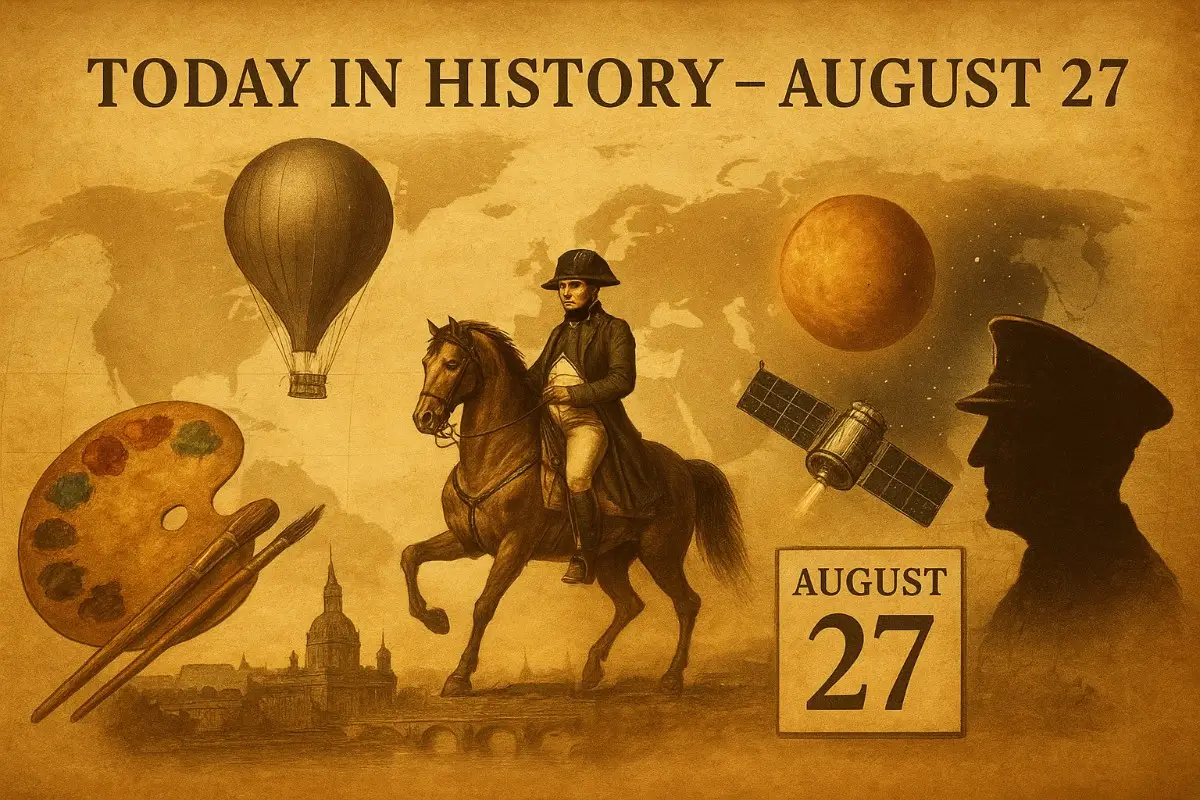
Today in History reminds us how a single date can carry centuries of drama, discovery, and change. August 27 stands out for bold experiments, political turning points, and cultural milestones. From the clash of empires to the invention of new technologies, the day captures humanity’s struggles for survival, freedom, and progress.
Major Historical Events on August 27
1576 – Death of Titian
The Venetian master painter Titian, one of the greatest figures of the Italian Renaissance, died on this day. Renowned for his rich use of color and groundbreaking techniques, his works influenced European art for centuries. From portraits of emperors to religious masterpieces, his brush gave depth and humanity to every subject. Even in death, Titian’s legacy shaped the course of Western art.
1660 – Books of John Milton Burned
In London, the works of poet and thinker John Milton were publicly burned for his sharp criticisms of King Charles II. Milton, author of Paradise Lost, had defended republican ideals and spoken out against monarchy. His punishment reflected the dangerous clash between free thought and royal authority. Yet instead of silencing him, history preserved his words as timeless defenses of liberty.
1776 – The Battle of Long Island
During the American Revolution, British General William Howe led forces against George Washington and the Continental Army in Brooklyn. Outnumbered and outmaneuvered, the Americans suffered a major defeat, forcing Washington into a risky retreat. Despite the setback, his army lived to fight another day, keeping hope for independence alive. The battle was a painful reminder of the uphill struggle the revolutionaries faced.
1783 – First Hydrogen Balloon Launched
French inventors Jacques Charles and the Robert brothers released the world’s first unmanned hydrogen balloon. Rising above Paris, it marked a daring leap in human fascination with flight. Crowds gathered to watch the strange sight, a mix of awe and fear. This small balloon was the first step toward the age of air travel and exploration of the skies.
1813 – Napoleon Wins the Battle of Dresden
In the heat of the Napoleonic Wars, French forces led by Napoleon crushed Austrian troops near Dresden. Though heavily outnumbered, Napoleon’s tactical brilliance secured a decisive victory. The triumph temporarily restored his prestige in Europe. But within a year, his empire would begin its final collapse, showing how fleeting battlefield success could be.
1863 – Edwin Drake Strikes Oil in Pennsylvania
In Titusville, Pennsylvania, Edwin Drake drilled the first successful commercial oil well in the United States. His discovery transformed the global energy landscape, sparking the birth of the petroleum industry. Small rural towns quickly became hubs of drilling, trade, and speculation. Drake’s well reshaped economies and powered the industrial age.
1928 – Kellogg-Briand Pact Signed
The United States and France signed the Kellogg-Briand Pact, a treaty that sought to ban war as a tool of national policy. Though over 60 nations would eventually join, the pact lacked enforcement power. Within a decade, the world would plunge into another global conflict. Still, the agreement remains a symbol of humanity’s recurring hope for peace.
1939 – First Jet Flight by the Heinkel He 178
German engineer Ernst Heinkel’s experimental aircraft, the He 178, became the first jet plane to take to the skies. Its brief but successful flight marked the dawn of the jet age. While largely unnoticed at the time, the breakthrough would transform both military aviation and civilian air travel. The future of speed and flight had arrived.
1962 – NASA Launches Mariner 2
NASA sent Mariner 2 into space, the first probe to successfully fly by another planet. Its target was Venus, and months later it sent back data revealing extreme temperatures and atmospheric pressure. The mission expanded human understanding of the solar system. Mariner 2 opened the door to planetary science and inspired a generation of space exploration.
1964 – Mary Poppins Premieres
The beloved Disney film Mary Poppins had its world premiere in Los Angeles. Based on the stories of P.L. Travers, the film became an instant classic. Julie Andrews, in her screen debut, captivated audiences with her performance as the magical nanny. Blending live-action and animation, Mary Poppins enchanted children and adults alike, securing its place in cinematic history.
1979 – Assassination of Lord Mountbatten
Louis Mountbatten, Earl of Burma and a senior British statesman, was assassinated in Ireland. The Provisional IRA planted a bomb on his boat in Donegal Bay, killing him and several companions. The attack shocked Britain and drew worldwide condemnation. Mountbatten’s death became one of the most infamous acts of the Troubles.
1985 – Military Coup in Nigeria
General Ibrahim Babangida seized power in Nigeria, overthrowing Muhammadu Buhari in a bloodless coup. The takeover reflected the political instability that plagued Nigeria in the postcolonial era. Babangida’s rule brought promises of reform but also repression and corruption. His coup marked another chapter in the nation’s turbulent military politics.
1991 – Moldova Declares Independence
Following the unraveling of the Soviet Union, Moldova proclaimed its independence. Once tied to Romania and later annexed into the USSR, the small republic sought to assert its sovereignty. Its path to independence was shaped by cultural, linguistic, and political struggles. August 27 became a national holiday, symbolizing Moldovan self-determination.
2003 – Mars at Closest Approach
On this day, Mars swung nearer to Earth than it had been in over 59,000 years. Stargazers around the globe looked up in wonder as the red planet shone brilliantly in the night sky. Telescopes captured stunning views, fueling public interest in space exploration. Scientists reminded the world that the next such close pass wouldn’t come until 2287.
2011 – Hurricane Irene Strikes the U.S.
After battering the Caribbean, Hurricane Irene made landfall in North Carolina before sweeping up the Eastern Seaboard. The storm disrupted travel, flooded cities, and left millions without power. Economic damages ran into billions, and dozens of lives were lost. Irene underscored how vulnerable modern societies remain to natural disasters.
2008 – Barack Obama Nominated for U.S. Presidency
Barack Obama made history as the first African American nominated for president by a major U.S. political party. His acceptance electrified audiences and symbolized profound change in American politics. Later that year, he won the election, defeating John McCain. Obama’s nomination was a defining moment in the story of U.S. democracy.
Famous Births on August 27
- 1770 – Georg Wilhelm Friedrich Hegel: German philosopher whose writings shaped modern philosophy, politics, and history.
- 1908 – Donald Bradman: Legendary Australian cricketer, often called the greatest batsman of all time.
- 1908 – Lyndon B. Johnson: 36th U.S. President, remembered for civil rights reforms and the Vietnam War escalation.
- 1910 – Mother Teresa: Catholic nun and Nobel Peace Prize laureate, known worldwide for her humanitarian work.
- 1952 – Paul Reubens: American actor and comedian, famous for creating the quirky character Pee-wee Herman.
- 1976 – Mark Webber: Australian Formula 1 race car driver with multiple Grand Prix wins.
Notable Deaths on August 27
- 1963 – W.E.B. Du Bois: Influential American sociologist, historian, and civil rights activist.
- 1967 – Brian Epstein: British music manager who guided The Beatles to international fame.
- 1975 – Haile Selassie I: Emperor of Ethiopia, revered as a reformer and a figure of Rastafarian faith.
- 1979 – Lord Louis Mountbatten: British statesman and naval officer, assassinated by the IRA.
- 1990 – Stevie Ray Vaughan: American blues guitarist and singer, admired for his electrifying style.
Read also August 26 Facts here
Final Thoughts on Today in History: August 27
That was Today in History: August 27—a date of bold experiments, tragic losses, and history-making firsts. From Napoleon’s triumphs to Obama’s nomination, from Titian’s final brushstroke to humanity’s first steps into space, the day reflects our creativity and our conflicts. Which of these moments do you think left the deepest mark?
FAQs About August 27 in History
Q1. What happened on August 27 during the American Revolution?
On this day in 1776, the Continental Army under George Washington was defeated at the Battle of Long Island, the first major battle after the Declaration of Independence.
Q2. Which famous artist died on August 27?
The Italian Renaissance painter Titian, celebrated for his mastery of color and influence on European art, died in 1576.
Q3. What space achievements are connected with August 27?
NASA’s Mariner 2 was launched on August 27, 1962, becoming the first probe to successfully fly by another planet. Also, in 2003, Mars made its closest approach to Earth in nearly 60,000 years.
Q4. Who was born on August 27?
Famous birthdays include philosopher Georg Hegel (1770), Australian cricket legend Don Bradman (1908), U.S. President Lyndon B. Johnson (1908), and humanitarian Mother Teresa (1910).
Q5. Which famous leader was assassinated on this day?
In 1979, Lord Mountbatten of Burma was killed by an IRA bomb in Donegal Bay, Ireland.