Introduction
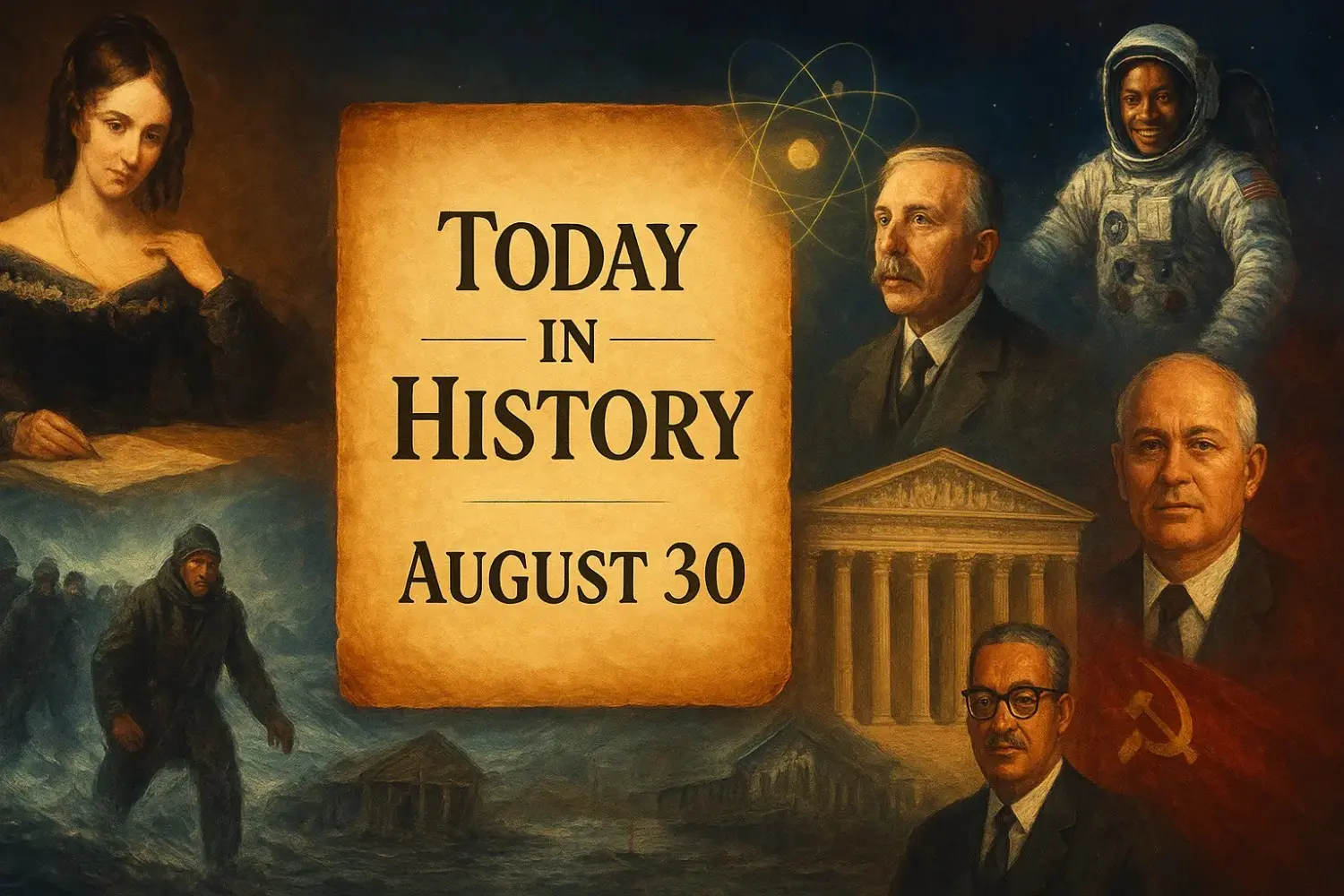
History keeps surprising us with how much can happen on a single date. When we look at Today in History – August 30, we find an odd blend of daring rescues, political betrayals, breakthroughs in science, and moments that reshaped nations. From Shackleton’s Antarctic heroics to Cold War diplomacy and the birth of literary icons, this day stitches together stories of courage, controversy, and change. Let’s walk through the most significant moments that belong to August 30.
Major Events on August 30
1780 — Benedict Arnold’s Secret Plot to Surrender West Point
On this day Benedict Arnold opened secret talks with the British to surrender the strategic fort at West Point in exchange for money and rank. Arnold’s plan threatened the American revolutionary cause because West Point guarded the Hudson River and could have split the colonies. The plot was exposed before it could be completed, and Major John André’s capture helped reveal the conspiracy. Arnold’s name became synonymous with treason, a cautionary tale about loyalty and ambition in wartime.
1797 — Birth of Mary Wollstonecraft Shelley
Mary Shelley was born in London on August 30, 1797; she would become the author of Frankenstein, a novel that fused Gothic horror with deep questions about science and responsibility. Composed as a young woman during a stormy summer at Geneva, her book examined what happens when human curiosity outruns ethics. Frankenstein has influenced literature, film, and scientific debate for two centuries. Today her birthday is remembered as Frankenstein Day, honoring her radical imagination.
1813 — Fort Mims Massacre and Frontier Violence
The Fort Mims massacre—part of the Creek War—saw Red Stick Creek warriors overwhelm a frontier stockade in Alabama, killing hundreds of settlers and militia members. The atrocity shocked American settlers and spurred a large-scale military response led in part by Andrew Jackson. The retaliation that followed further displaced Native communities and accelerated U.S. expansion into the Southeast. Fort Mims remains a grim reminder of frontier conflict and the human cost of territorial conflict.
1835 — Foundations of Melbourne’s First Permanent European Settlement
Around the banks of the Yarra River, the first permanent European settlement that would become Melbourne was established by arriving settlers. What began as a risky colonial outpost grew rapidly into a major port and later a booming city during the gold rush years. Melbourne’s rise transformed Australia’s economic and cultural map, drawing migrants from across the world. The settlement’s founding also marked the start of profound and often painful changes for local Indigenous peoples.
1871 — Birth of Ernest Rutherford, Pioneer of Nuclear Science
Ernest Rutherford was born on August 30, 1871; he later led discoveries about radioactive decay and nuclear structure that earned him the title “father of nuclear physics.” His experiments identified alpha, beta, and gamma radiation and laid the groundwork for splitting the atom and modern nuclear science. Rutherford’s work reshaped both pure physics and practical applications, from medicine to energy. His legacy lives on in the methods and concepts that underpin modern atomic theory.
1916 — Shackleton Rescues His Crew from Elephant Island
After months of impossible conditions, Sir Ernest Shackleton finally rescued the 22 men left behind on Elephant Island — all alive — in a feat of leadership that has become legendary. Shackleton’s refusal to abandon his crew, and his risky small-boat voyage across stormy Southern Ocean waters to fetch help, are studied in leadership courses worldwide. The survival story captures endurance, discipline, and luck under extreme stress. It remains a powerful saga of human resilience against nature’s worst.
1918 — Assassination Attempt on Vladimir Lenin
Revolutionary Fanny Kaplan shot Vladimir Lenin in Moscow on August 30, 1918, critically wounding him and increasing the Bolsheviks’ sense of existential threat. The attempt was followed by a harsh security crackdown and contributed to the violent climate of the Red Terror. Kaplan’s act and the government’s response deepened divisions inside revolutionary Russia and justified repressive measures against perceived enemies. This day underlined how fragile revolutionary governments can be when confronted by violence and dissent.
1945 — Liberation of Hong Kong and MacArthur Arrives in Japan
British forces formally reentered and liberated Hong Kong after nearly four years of Japanese occupation, a moment of relief and complicated recovery for the city. On the same day, General Douglas MacArthur landed in Japan to lead the Allied occupation and rebuilding efforts that would reshape postwar Japan. Both events marked the turning of a page in Asia — from brutal wartime occupation to reconstruction and geopolitical realignment. The aftermath set the stage for decades of political and economic change across the region.
1963 — Washington–Moscow “Hotline” Established
To prevent dangerous miscommunication after the Cuban Missile Crisis, a secure direct link—famously called the “Hotline”—was set up between U.S. and Soviet leaders on August 30. Though often imagined as a red telephone, the early system actually used secure teletype and later evolved with technology. The Hotline reduced the risk that misunderstandings could trigger nuclear escalation and stood as a pragmatic step toward crisis management. It remains a symbol of Cold War realism: even rivals must keep lines of communication open.
1967 — Thurgood Marshall Confirmed to the U.S. Supreme Court
Civil-rights lawyer and legal strategist Thurgood Marshall became the first African-American justice on the U.S. Supreme Court on this date. His path from courtroom lawyer in Brown v. Board of Education to the highest bench symbolized landmark progress in American civil rights. Marshall brought a profound commitment to equal protection and due process to the Court’s deliberations. His confirmation reshaped American jurisprudence and inspired generations of lawyers and activists.
1983 — Guion S. Bluford Jr. Becomes First African-American in Space
On August 30, 1983, Guion Bluford flew aboard the Space Shuttle Challenger, becoming the first African-American astronaut to go into orbit. The mission broke racial barriers in U.S. spaceflight and broadened the image of who could represent a nation in space. Bluford later flew on additional missions and contributed to scientific experiments in orbit. His flight remains an inspirational milestone in both space history and civil-rights progress.
1991 — Azerbaijan Declares Independence from the Soviet Union
As the USSR rapidly dissolved, Azerbaijan declared independence on August 30, 1991, joining other republics in the breakup of the Soviet federation. The declaration ushered in a turbulent era of state-building, regional conflict, and economic restructuring. Independence allowed Azerbaijan to assert national identity and pursue its own foreign policy, though it also meant confronting long-standing territorial disputes. The moment was pivotal for the geopolitics of the South Caucasus.
1993 — Hassan II Mosque Opens in Casablanca
On this date Morocco inaugurated the Hassan II Mosque in Casablanca — at the time one of the world’s largest mosques and a landmark of modern Islamic architecture. Built partly over the Atlantic and richly decorated, it signaled Morocco’s cultural ambitions and the country’s blend of tradition with contemporary engineering. The mosque became both a religious center and a major tourist and national symbol. Its opening represented investment in identity and global presence.
1999 — East Timor Votes for Independence
In a UN-backed referendum on August 30, 1999, the people of East Timor voted overwhelmingly for independence from Indonesia after decades of occupation. The vote triggered violent reprisals before international forces helped restore order and eventual sovereignty in 2002. East Timor’s path to nationhood was painful but ultimately a defining example of international intervention in self-determination processes. The referendum is now a key date in modern decolonization history.
2005 — New Orleans Flooded After Hurricane Katrina
On August 30, the day after Katrina made landfall, levee failures sent catastrophic flooding through New Orleans, submerging neighborhoods and displacing tens of thousands. The disaster exposed systemic failures in disaster planning, infrastructure, and social equity. It triggered national debates over emergency response, urban policy, and climate resilience that continue today. Katrina’s human toll and urban destruction remain a lasting tragedy on this date.
2021 — Final U.S. Troops Leave Afghanistan
August 30, 2021, marked the completion of the U.S. military withdrawal from Afghanistan, ending America’s longest war after nearly 20 years. The chaotic exit and swift Taliban return to power prompted intense global debate over foreign policy, state-building, and humanitarian consequences. For many Afghans, the date signaled uncertainty and the start of a difficult new chapter under different governance. The withdrawal remains a defining, contentious moment in 21st-century geopolitics.
2022 — Death of Mikhail Gorbachev
Mikhail Gorbachev, the last leader of the Soviet Union and architect of glasnost and perestroika, died on August 30, 2022. His reforms accelerated the end of the Cold War and opened a turbulent era of political transformation across Eastern Europe. Admired in the West for reducing East–West tensions, Gorbachev’s legacy in Russia is more contested because of the Soviet collapse that followed. His passing closed a major chapter in modern global history.
Notable Births on August 30
- 1797 — Mary Wollstonecraft Shelley, author of Frankenstein, whose work forever altered Gothic and science-fiction traditions.
- 1871 — Ernest Rutherford, a pioneering physicist whose experiments revealed the structure of the atom.
- 1930 — Warren Buffett, influential investor and philanthropist known for long-term value investing.
- 1954 — Alexander Lukashenko, long-serving president of Belarus.
- 1972 — Cameron Diaz, American actress and producer who rose to stardom in the 1990s and 2000s.
- 1982 — Andy Roddick, American tennis champion and former world No. 1.
Notable Deaths on August 30
- 2003 — Charles Bronson, actor best known for tough-guy roles, like in Death Wish.
- 2013 — Seamus Heaney, Irish poet and Nobel laureate, whose verse reshaped modern poetry.
- 2015 — Oliver Sacks, neurologist and writer, celebrated for humane case studies of the brain.
- 2022 — Mikhail Gorbachev, reformist Soviet leader who helped end the Cold War.
Today’s Observance
Frankenstein Day — Observed on Mary Shelley’s birthday, this day honors her influence on literature, science fiction, and ongoing debates about scientific responsibility.
Final Thoughts on Today in History: August 30
August 30 bundles stories of courage, betrayal, innovation, and political change. It’s a date that reminds us how fragile empires and institutions can be, how resilient human beings are in crisis, and how ideas — from Marshall’s jurisprudence to Mary Shelley’s imagination — can outlive their creators. Looking at this day’s events invites reflection on how the past shapes the possibilities and dangers of our present.
If you missed our other entries, check them here:
👉 [August 29 facts and events]
👉 [August 28 facts and events]
👉 [August 27 facts and events]
FAQs About August 30 in History
Q: Why is August 30 important in world history?
A: August 30 is significant because it hosts events that span exploration, political upheaval, scientific breakthroughs, and cultural milestones. Across centuries, this date has recorded acts that changed nations, shaped ideas, and altered people’s lives.
Q: Who are some famous people born on August 30?
A: Notables born on this date include Mary Shelley (author), Ernest Rutherford (physicist), Warren Buffett (investor), and Cameron Diaz (actress).
Q: What major political changes occurred on August 30?
A: Key political events include Azerbaijan’s 1991 declaration of independence, East Timor’s 1999 independence referendum, and the 2021 completion of U.S. troop withdrawal from Afghanistan — each reshaping their regions in different ways.
Q: Is August 30 linked to any commemorations or holidays?
A: Yes — Frankenstein Day commemorates Mary Shelley’s birthday and is celebrated by fans of literature and science fiction.