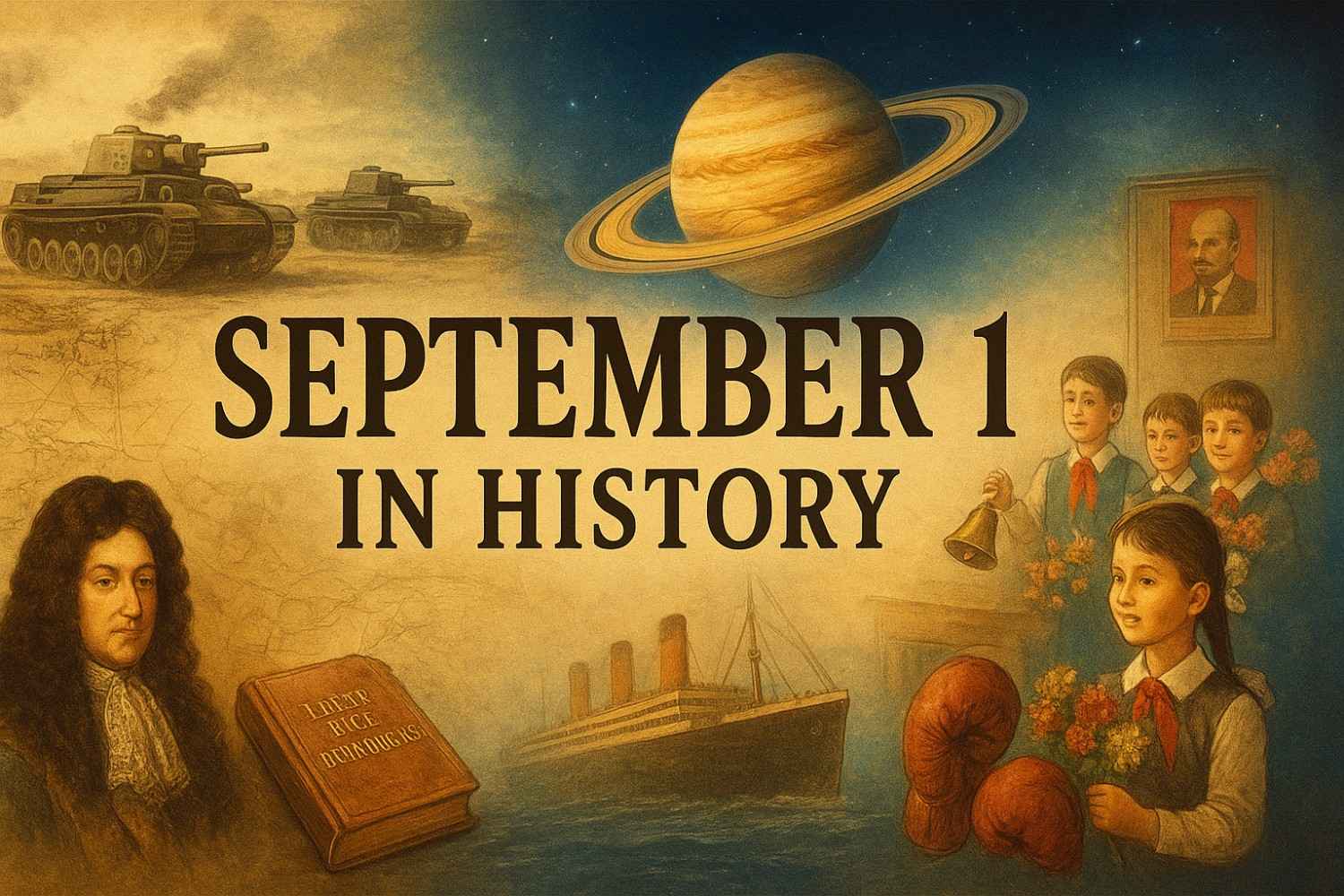
September 1 is a day where extremes meet: fires that remade cities, invasions that plunged the world into war, scientific breakthroughs that reshaped public health, and discoveries that revived old legends. In Today in History – September 1 you’ll find moments of catastrophe and courage, invention and political change.
From the Great Fire of London to the discovery of the Titanic’s wreck, this date stitches together stories that still matter. Here’s the cleaned, de-duplicated, and polished roundup.
Major Events on September 1
1715 — Louis XV Becomes King of France (Child Monarch)
When Louis XIV died, his great-grandson Louis XV ascended the throne at age five, inheriting a crown of immense pomp and heavy expectation. A child king’s reign thrust regents and courtiers into the real business of governance while leaving the monarchy’s prestige and finances exposed.
The early years of Louis XV’s rule foreshadowed the fiscal strains, court politics, and shifting international rivalries that would trouble France later. His accession is a classic example of how dynastic succession can shape a nation’s path for generations.
1752 — The Liberty Bell Arrives in Philadelphia
On this day the bell destined to become America’s most famous symbol of liberty reached Philadelphia, where it would hang in the Pennsylvania State House. Over time the bell’s symbolic value outgrew its physical role, becoming a rallying image for abolitionists, reformers, and patriotic ceremonies. Though its famous crack and legend grew in later years, the Liberty Bell’s arrival marked the beginning of a tangible icon for a new nation’s ideals. It’s a small shipment that grew into a big idea about freedom.
1798 — Notorious Bank Heist in Philadelphia (Patrick Lyon Case)
A dramatic theft in Philadelphia—one of the largest of its time—shocked the young United States when vaults were looted of cash and gold. Blacksmith Patrick Lyon was arrested and famously fought to clear his name, illustrating the rough-and-tumble justice system of the era. The episode exposed weaknesses in early American banking security and the social tensions around wealth and crime. The case is remembered today as part criminal caper, part legal drama in a country still inventing its institutions.
1807 — Aaron Burr Arrested (Alleged Conspiracy)
Former Vice President Aaron Burr was seized on charges stemming from an alleged plot to create an independent territory in the American Southwest and parts of Mexico. The arrest and subsequent trial turned into a major constitutional drama over the limits of executive ambition and federal authority. Burr’s legal saga highlighted how young republics wrestle with ambitious individuals and murky loyalties. Though acquitted, the affair tarnished Burr’s reputation and entered America’s political folklore.
1854 — John Snow Maps a Cholera Outbreak (Birth of Epidemiology)
On this date physician John Snow traced a London cholera outbreak to a contaminated pump on Broad Street, using careful case mapping and interviews. His work effectively linked contaminated water to disease transmission, challenging prevailing miasma theories and laying the groundwork for modern public-health practice. Snow’s investigation helped spur improvements in urban sanitation and water systems—measures that have saved countless lives since. Today, he’s widely seen as a pioneer of epidemiology and scientific detective work.
1864 — Charlottetown Conference Opens (Seeds of Canadian Confederation)
Delegates meeting in Charlottetown began discussions that grew from regional talks into a plan for uniting British North American colonies. What started as a maritime conference soon blossomed into constitutional conversation that, within a few years, produced the Dominion of Canada. The meetings reflected practical economic and defense concerns as well as a shared appetite for self-governance. Charlottetown is thus remembered as the birthplace of Canadian nationhood, where negotiation built a new polity.
1870 — Battle of Sedan Crushes France’s Second Empire
At Sedan, French forces suffered a humiliating defeat by the Prussian-led coalition—the blow that toppled Napoleon III and ended the Second Empire. The capture of the emperor and the military collapse accelerated political upheaval inside France and the proclamation of the Third Republic. Sedan’s reverberations were continental: German unification hardened while French politics were reshaped for decades. The battle illustrates how a single battlefield can redraw national destinies.
1897 — Boston Opens North America’s First Subway
In a quietly transformative step for urban life, Boston inaugurated the continent’s first subway system, easing street congestion and heralding a new era of public transit. The innovation reflected growing city populations and the need for efficient, mass transportation. Subways would become symbols of modernity for capitals worldwide, changing commuting patterns and city planning. Boston’s early rails set a standard for the 20th-century metropolis.
1914 — Martha, the Last Passenger Pigeon, Dies (Species Extinction)
Martha’s death at the Cincinnati Zoo marked the end of a species once so numerous its flocks darkened the sky—now gone because of overhunting and habitat destruction. Her passing became a wake-up call about human-driven extinction and has shaped conservation thinking ever since. The passenger pigeon’s fate underscores how even abundant wildlife can vanish in a single human lifetime without protections. Martha’s memory endures as a cautionary tale for biodiversity.
1923 — Great Kantō Earthquake Devastates Tokyo and Yokohama
A catastrophic quake near noon leveled neighborhoods across Tokyo and Yokohama, causing immense loss of life and urban ruin. The earthquake’s aftermath included fires, social chaos, and political consequences as Japan rebuilt on a new technical and civic foundation. The disaster spurred stricter building codes, disaster planning, and a long reconstruction that transformed Japan’s cities. Kantō remains a central reference in global disaster studies.
1939 — Germany Invades Poland (World War II Begins)
On September 1, 1939, German forces crossed into Poland in a Blitzkrieg that triggered declarations of war and the start of World War II. The invasion set in motion a conflict of unprecedented scale, reshaping borders, societies, and global power structures for decades. The date is one of modern history’s darkest inflection points—where regional aggression escalated into world war. Its legacy is a powerful reminder of how rapidly international order can unravel.
1942 — U.S. Courts Uphold Internment Measures (Wartime Ruling)
During World War II, U.S. courts upheld the detention of Japanese-Americans as a wartime measure—a decision that later generations have widely criticized. The ruling reflected wartime fears and the strain between national security and civil liberties. The episode prompted long-term legal and moral reckonings, including later redress for forcibly interned families. It remains a sobering chapter in democratic societies’ responses to perceived existential threats.
1951 — ANZUS Treaty Signed (Pacific Security Pact)
Australia, New Zealand, and the United States formalized a tripartite security agreement that shaped Pacific geopolitics during the Cold War and beyond. ANZUS committed partners to consult on Pacific security matters and helped anchor U.S. influence in the region. The pact has endured in modified form, guiding defense cooperation and crisis responses across decades. It shows how alliances born of a tense era can become lasting pillars of regional strategy.
1952 — Life Magazine Publishes “The Old Man and the Sea” Excerpt
Ernest Hemingway’s The Old Man and the Sea appeared in Life, instantly capturing readers with its spare, mythic tale of struggle and dignity. The publication helped the novella reach a mass audience and won Hemingway renewed critical acclaim, including the Nobel Prize in 1954. The episode illustrates how periodical culture could still propel literature into the popular imagination. It’s a moment where magazine publishing met literary fame.
1964 — Masanori Murakami Becomes First Japanese Major-Leaguer
Pitcher Masanori Murakami broke a cultural barrier when he debuted in Major League Baseball, becoming the first Japanese player to play in the MLB. His arrival foreshadowed later waves of international talent reshaping America’s pastime and globalizing the sport. Murakami’s stint highlighted cross-cultural exchange and the lure of top-level competition. Today’s international baseball stars trace part of their lineage to pioneers like him.
1969 — Muammar Gaddafi’s Coup Transforms Libya
A handful of young officers led by Colonel Muammar Gaddafi ousted King Idris I in a nearly bloodless coup, abolishing the monarchy and launching decades of revolutionary rule. Gaddafi’s regime would reshape Libya’s economy, diplomacy, and regional standing while courting controversy and confrontation. The coup shows how quickly a state’s political identity can be recast by ambitious military actors. Libya’s later history is inseparable from this turning point.
1972 — Bobby Fischer Wins the World Chess Championship
In Reykjavik, Bobby Fischer defeated Boris Spassky in a match that electrified global audiences and carried cultural weight far beyond chess—touching on Cold War rivalries and individual genius. Fischer’s triumph made him an American icon and brought mass interest to a cerebral sport. The match remains a landmark in sports diplomacy and individual achievement under pressure. It demonstrated how a board and sixty-four squares can capture worldwide attention.
1979 — Pioneer 11’s Historic Flyby of Saturn
NASA’s Pioneer 11 became the first spacecraft to fly past Saturn, delivering the first close-up data and images of the ringed giant and its environment. The mission expanded humanity’s reach into the outer solar system and informed subsequent, more advanced probes. Pioneer 11’s voyage exemplifies how small, early missions can open entire scientific frontiers. Its legacy paved the way for Cassini and other deep-space explorers.
1985 — Titanic Wreck Found by U.S.–French Expedition
After decades of speculation and myth, the wreck of the RMS Titanic was located in the North Atlantic at a depth of about 13,000 feet—an archaeological and human drama unveiled. The discovery rekindled interest in early-20th-century immigration, maritime technology, and the ship’s tragic human story. It also launched a new era of deep-sea exploration and ethical debate about salvaging human gravesites. Finding Titanic was both a technical triumph and a moment for reflection.
1980 — Terry Fox Forced to End Marathon of Hope (Cancer Returns)
Canadian runner Terry Fox, who had set out on a cross-country “Marathon of Hope” to raise money for cancer research, was forced to stop when his cancer returned. Fox’s courage and the symbolism of his single-legged run galvanized a nation and inspired fundraising that continues today. Although he died in 1981, his legacy endures through annual runs and ongoing research funds. The moment on September 1 is part heartbreak, part enduring inspiration.
2004 — Beslan School Siege Begins (Tragedy in North Ossetia)
Armed militants took over a school in Beslan, North Ossetia, taking more than 1,000 hostages—including many children—in a siege that ended after intense fighting and a devastating death toll. The assault and its chaotic aftermath left communities reeling and provoked global condemnation and soul-searching over tactics and prevention. Beslan exposed the brutal human toll of modern terrorism and the complexities of hostage rescue under fire. The event remains a painful benchmark in 21st-century violence.
Notable Births on September 1
- 1875 — Edgar Rice Burroughs, the imaginative author behind Tarzan, whose adventure tales helped define popular fiction in the 20th century.
- 1923 — Rocky Marciano, the undefeated heavyweight champion, still a legend in boxing lore for his power and perfect record.
- 1939 — Lily Tomlin, comedian and actress known for her incisive wit and long, versatile career in stage and screen.
- 1946 — Roh Moo-hyun, South Korea’s 16th president, remembered for his reformist policies and tumultuous political career.
- 1957 — Gloria Estefan, Cuban-American music star who brought Latin rhythms into global pop charts.
- 1970 — Padma Lakshmi, model, author, and TV host who blends culinary culture with activism and storytelling.
- 1975 — Natalie Bassingthwaighte, Australian entertainer who crossed music, television, and stage with commercial success.
Notable Deaths on September 1
- 1715 — Louis XIV of France, the Sun King whose 72-year reign shaped European art, court culture, and absolutism.
- 1947 — Frederick Russell Burnham, famed scout and adventurer whose exploits influenced youth scouting movements worldwide.
- 1981 — Albert Speer, architect and later Nazi official, a complex and controversial figure in 20th-century history.
- 1983 — Larry McDonald, U.S. congressman who died when Korean Air Lines Flight 007 was shot down in 1983.
- 2013 — Tommy Morrison, heavyweight boxer remembered both for powerful punching and a troubled later life.
Today’s Observances (September 1)
- Knowledge Day — The traditional start of the school year across Russia and many former Soviet republics, a day of flowers, school bells, and new beginnings.
- Uzbekistan Independence Day — Celebrating the country’s 1991 break from the Soviet Union.
- Kyrgyzstan Independence Day — Also marking 1991 independence and national sovereignty.
- Labor Day (U.S. & Canada — first Monday in September) — Rooted in 19th-century labor movements, the holiday is observed near this date.
Final Thoughts on Today in History: September 1
September 1 gathers stories of human ingenuity, catastrophic loss, political fracture, and enduring courage. Whether it’s a physician mapping a cholera outbreak, explorers finding Titanic’s wreck, or communities rebuilding after earthquakes and sieges, the date reminds us that history mixes progress with peril. Looking back at these events helps us appreciate how societies learn, fail, and sometimes heal. If you missed our other entries, check them here:
👉 [August 31 facts and events]
👉 [August 30 facts and events]
👉 [August 29 facts and events]
FAQs About September 1 in History
Why is September 1 remembered as a turning point in world history?
Because it has marked the start of global conflicts like WWII, the rise of new nations, and the fall of old empires. The date carries both tragedy and triumph in equal measure.
What are some surprising scientific or cultural milestones on September 1?
John Snow’s cholera investigation (1854) is a public-health landmark, Pioneer 11’s Saturn flyby (1979) advanced planetary science, and the discovery of the Titanic (1985) reshaped maritime archaeology and public imagination.
Which September 1 events shaped modern geopolitics?
Germany’s 1939 invasion of Poland launched World War II; Gaddafi’s 1969 coup remade Libya’s political order; and the ANZUS treaty of 1951 anchored postwar Pacific security arrangements.
Are there any September 1 observances tied to education?
Yes—Knowledge Day marks the traditional start of the academic year in Russia and many former Soviet republics, celebrated with ceremonies, flowers, and school bells.
Who are some notable people connected to September 1?
The date links a broad cast: Louis XIV’s death and Louis XV’s accession in 1715, literary figures like Edgar Rice Burroughs, cultural icons like Gloria Estefan, and sports legends like Rocky Marciano.