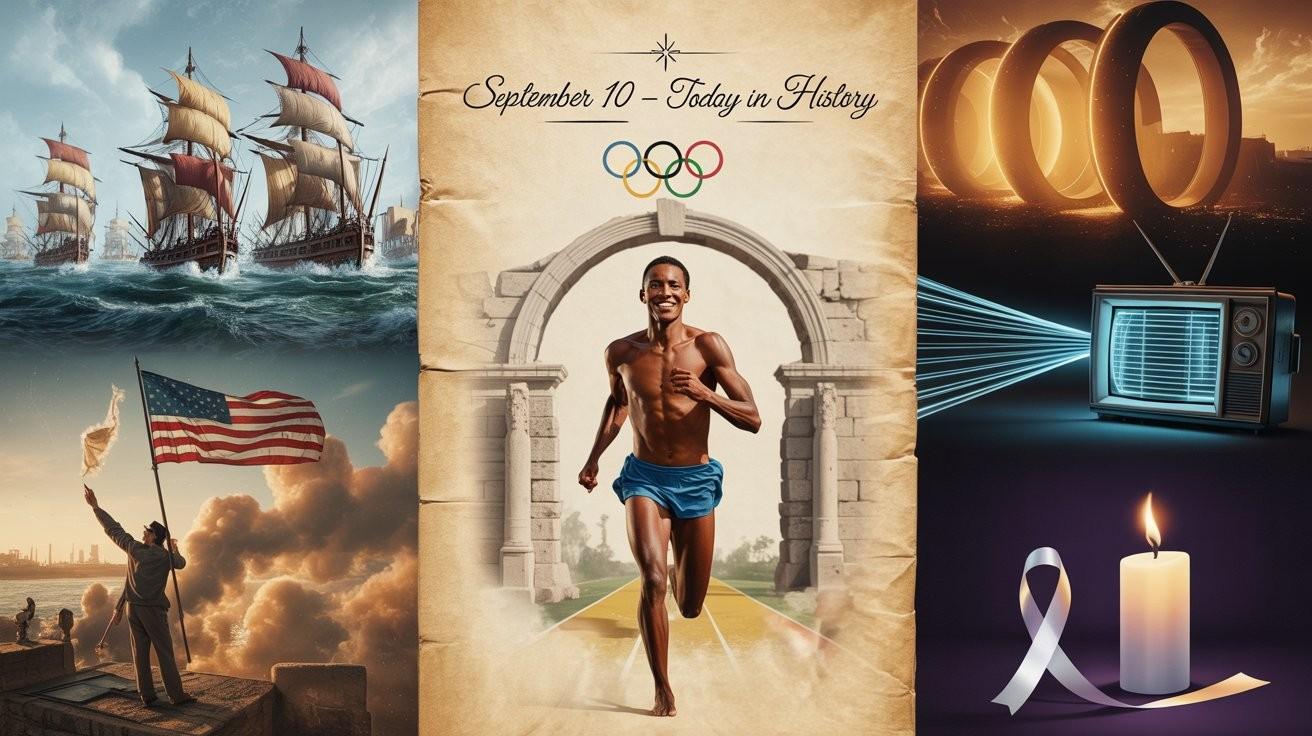
Today in History — September 10 knits together governance crises, scientific firsts, sporting feats, and cultural milestones. On this date you’ll find sudden violence and quiet institution-building, athletic triumphs and watershed media debuts — moments that changed politics, culture, and how people live and remember.
Major Events on September 10
1419 — John the Fearless killed at Montreuil
John the Fearless, Duke of Burgundy, was killed during a tense parley with the future King Charles VII at Montreuil, an assassination that intensified France’s internecine strife. His death deepened the Burgundian–Armagnac schism and reshaped French factional politics during the Hundred Years’ War.
The episode illustrates how personal violence among elites could alter dynastic trajectories and prolong civil conflict. In the longer view, the killing helped set the stage for shifting alliances that would influence France’s path to royal consolidation.
1608 — John Smith chosen president of Jamestown colony
On September 10, 1608 John Smith was selected president of the Jamestown council, a crucial step in stabilizing England’s first permanent North American settlement. Smith’s leadership helped impose order, organize supply expeditions, and negotiate with Powhatan-era Native American groups—actions that mattered for the colony’s survival.
His energetic style and practical rules shaped Jamestown’s early governance and colonial labor practices. The episode is part of the larger story of European colonization and the difficult, often violent encounters that accompanied settlement.
1651 — Yui Shōsetsu’s failed plot and su*icide (Japan)
In 1651 the would-be rebel Yui Shōsetsu committed suicide after a failed conspiracy aimed at challenging Tokugawa shogunate authority. The episode reflected simmering unrest in early-Edo Japan and demonstrated how the shogunate’s security apparatus responded to internal threats.
Yui’s plot and its suppression reinforced the Tokugawa regime’s emphasis on surveillance and control, helping consolidate the peace of the period at the cost of harsh repression. It’s a reminder that even seemingly stable political orders face moments of insurgent challenge.
1721 — Peace of Nystad ends the Second Northern War
The Peace of Nystad concluded the long Second Northern War in 1721, redrawing influence in the Baltic and signaling Sweden’s decline as a great power. The treaty reorganized territory and trade relationships in northeastern Europe and helped cement Russia’s rise under Peter the Great.
For merchants and statesmen it meant new commercial realignments and altered naval calculations in the Baltic Sea. The settlement was part of the slow reshuffling of European power after a century of dynastic warfare.
1813 — Battle of Lake Erie secures U.S. control of the lake
Oliver Hazard Perry’s naval victory on Lake Erie gave American forces strategic command of the lake during the War of 1812 and opened the way for subsequent operations in the Old Northwest. Perry’s dispatch—“We have met the enemy and they are ours”—became an iconic moment of American naval history and morale.
The victory improved U.S. supply lines, forced British retreats, and influenced border negotiations after the war. Militarily and symbolically, Lake Erie demonstrated how control of inland waters could determine regional outcomes.
1845 — King William II opens the Amsterdam Stock Exchange
A historic economic milestone for the Netherlands: the formal opening/modernization of Amsterdam’s financial marketplace in 1845 symbolized the city’s continuing role as a commercial and banking hub in Europe. Including this shows the economic-institution thread on the date.
1846 — Elias Howe patents the practical lockstitch sewing machine
Elias Howe secured a patent for a practical lockstitch sewing machine in 1846, a technological advance that accelerated mechanized garment production. Howe’s innovation reduced the labor intensity of sewing and initiated broader industrialization trends in textiles and apparel.
Over time sewing machines reshaped factory work, gendered labor patterns, and the availability of mass-produced clothing. The patent marks a key point in the 19th-century technology revolution that remade everyday life.
1897 — First drunk-driving fine (London taxi driver)
In 1897 a London taxi driver named George Smith became one of the first people publicly fined for drunk driving, reflecting early urban efforts to regulate increasingly motorized streets. The case signals how new technologies—automobiles—forced legal systems and social norms to adapt rapidly to fresh public-safety concerns.
As motoring spread, such early regulatory steps would multiply into modern traffic law, licensing, and enforcement. The incident is a small but telling example of how legal culture follows technological change.
1919 — Treaty of Saint-Germain ends Austria’s imperial status
The Treaty of Saint-Germain, signed on September 10, 1919, formally reorganized Austria after the collapse of the Habsburg monarchy and imposed new territorial and political constraints. The settlement helped redraw central Europe, set reparations and military limits, and attempted to stabilize a volatile postwar order.
For many, the treaty signaled both an end to imperial structures and the start of fraught national self-determination projects. Its consequences—economic hardship, political fragmentation—played into interwar tensions across the region.
1939 — Canada declares war on Germany (enters WWII)
On September 10, 1939 Canada declared war on Germany, joining Britain and France in a global conflict and marking the nation’s significant, autonomous entry onto the world stage. The decision reflected Canadian parliamentary sovereignty and set the country on a path of massive mobilization in industry, military service, and diplomacy.
Canada’s wartime contribution reshaped its international role and accelerated domestic social and economic change. The declaration exemplifies how dominions exercised increasing independence within the British Commonwealth.
1940 — Buckingham Palace hit during the Blitz
A German bomb struck near Buckingham Palace on September 10, 1940, injuring staff and symbolically testing Britain’s resilience during the Blitz. The attack on a royal residence became a potent image of civilian targeting and the war’s reach into national symbols.
The palace’s survival and the royal family’s visible stoicism were widely used to bolster public morale during sustained bombing. The event underscores how wartime violence reached beyond army lines into civic and symbolic spaces.
1960 — Abebe Bikila wins Olympic marathon (barefoot)
Ethiopian runner Abebe Bikila won the Rome Olympic marathon on September 10, 1960, famously running barefoot and setting a new world-record time. His victory was both an athletic triumph and a powerful symbol of postcolonial African pride on the global stage.
Bikila’s win elevated long-distance running’s international profile and inspired generations of African athletes. The moment fused sport with emerging narratives of national dignity and global visibility.
1962 — U.S. Supreme Court orders James Meredith admitted to Ole Miss
On September 10, 1962 the Supreme Court ordered that James Meredith be admitted to the University of Mississippi, enforcing desegregation against violent local opposition. The decision and the federal enforcement that followed were pivotal in the Civil Rights Movement, testing the limits of court rulings when faced with entrenched resistance.
Meredith’s enrollment reshaped higher-education access and highlighted the federal government’s role in protecting constitutional rights. The episode is a milestone in America’s long struggle over equality and the law.
1974 — Guinea-Bissau gains independence from Portugal
On this date Guinea-Bissau’s formal independence (declared in 1973, recognized in 1974 after the Carnation Revolution in Portugal) deserves mention as part of mid-20th-century decolonization movements in Africa. It’s an important national-foundation moment that fits the “nation-making” theme.
1977 — Last guillotine execution in France (Hamida Djandoubi)
On September 10, 1977 Hamida Djandoubi was executed by guillotine in France—the last execution by that method before France abolished the death penalty in 1981. The event marked the end of a grim chapter in European punitive history and fed debates about capital punishment, modernization, and human rights.
Public reaction and legal reform in subsequent years reflect shifting norms about state violence in Western Europe. The execution stands as a historical punctuation point for penal change.
1984 — Alex Trebek debuts as host of Jeopardy!
Alex Trebek’s first episode as host of Jeopardy! on September 10, 1984 launched an era-defining partnership between a calm, authoritative presenter and a quiz format beloved by millions. Trebek’s long tenure helped make the show a cultural mainstay and a template for televised knowledge competitions worldwide.
Jeopardy! became a reliable setting for civics, trivia, and friendly competition, shaping how audiences value factual knowledge on TV. Trebek’s debut is a media milestone in the long arc of game-show history.
1988 — Steffi Graf completes the Golden Slam at the U.S. Open
By winning the U.S. Open on September 10, 1988 Steffi Graf completed a calendar-year Grand Slam and added an Olympic gold—achieving a rare “Golden Slam.” Graf’s dominance combined technical precision, athleticism, and mental toughness, elevating women’s tennis on and off the court.
Her achievement changed expectations for elite performance and inspired a new generation of players. The moment stands as one of sport’s rare peaks, where personal excellence intersected with global attention.
1993 — The X-Files debuts, sparking a cult TV phenomenon
The X-Files premiered on September 10, 1993 and quickly built a devoted following with its mix of conspiracy, science fiction, and procedural drama. The series influenced television’s willingness to blend serialized myth arcs with episodic storytelling and helped launch a wave of genre programming.
Its aesthetic—alienation, government mistrust, and cinematic TV production—left a lasting imprint on 1990s pop culture. The X-Files became a cultural touchstone for questions about truth, secrecy, and the paranormal.
2007 — Nawaz Sharif’s return and swift deportation
On September 10, 2007 former Pakistani prime minister Nawaz Sharif returned to Islamabad after seven years in exile, aiming to re-enter Pakistan’s fractious political arena. His arrival set off immediate demonstrations and a tense standoff with the Musharraf government. Within hours officials detained and deported him back to Saudi Arabia, blocking his planned political comeback that day.
The episode was a high-drama moment in Pakistan’s struggle over civilian rule and military influence, and Sharif later returned to win office again in 2013.
2008 — Large Hadron Collider achieves first full circulating beam
CERN’s Large Hadron Collider routed its first full circulating proton beam on September 10, 2008, a major technical milestone for particle physics infrastructure. The achievement demonstrated complex engineering, international collaboration, and the machine’s readiness for experiments probing fundamental particles.
The LHC’s subsequent discoveries, including the Higgs-like signals years later, trace back to this successful commissioning. The event represents modern “big science” and the multinational scale of frontier research.
2009 — GM announces planned sale of Opel/Vauxhall stake to Magna/Sberbank
A key business/auto-industry story: General Motors’ 2009 plan to sell a majority stake in its European operations (Opel/Vauxhall) to Magna and partners reflected the auto industry’s post-crisis restructuring and global capital shifts. It’s relevant to economic-history and business timelines.
Earlier History
- 1419 — John the Fearless killed at Montreuil.
- 1651 — Yui Shōsetsu’s failed plot and suicide.
- 1721 — Peace of Nystad concludes the Second Northern War.
- 1813 — Battle of Lake Erie secures American control of the lake.
Exploration & Colonial Foundations
- 1608 — John Smith chosen president of Jamestown colony.
- 1791 — Washington, D.C., named as the national capital (contextual reference from the era).
- 1897 — Early motor regulation: first drunk-driving fine in London (George Smith).
Wars & Politics
- 1919 — Treaty of Saint-Germain reshapes post-WWI Austria.
- 1939 — Canada declares war on Germany.
- 1940 — Buckingham Palace struck during the Blitz.
- 1991 — Clarence Thomas hearings and other late-20th-century political flashpoints (contextual).
Arts & Culture
- 1955 — Gunsmoke debuts on CBS.
- 1984 — Alex Trebek begins hosting Jeopardy!.
- 1993 — The X-Files premieres.
- 2000 — Cats closes on Broadway after a record run.
Science, Technology & Media
- 1846 — Elias Howe patents the practical lockstitch sewing machine.
- 1926 (context) — NBC and the rise of national broadcasting (media context).
- 1960 — Abebe Bikila wins Olympic marathon barefoot.
- 2008 — LHC achieves first full circulating beam.
Notable Births on September 10
- 1487 — Julius III: Pope from 1550 to 1555.
- 1648 — Nicolas Desmarets: French finance minister under Louis XIV.
- 1697 — Alexander Monro, primus: Pioneering Scottish anatomy professor.
- 1713 — John Needham: British naturalist noted for spontaneous-generation debates.
- 1714 — Niccolò Jommelli: Composer influential in 18th-century opera.
- 1753 — Sir John Soane: Inventive British neoclassical architect.
- 1759 — Maximilian von Montgelas: Bavarian reforming statesman.
- 1771 — Mungo Park: Explorer of the Niger River.
- 1787 — John J. Crittenden: U.S. statesman linked to the Crittenden Compromise.
- 1789 — William Cranch Bond: American astronomer.
- 1797 — Carl Gustaf Mosander: Chemist who discovered rare earths.
- 1811 — Victor Duruy: French education reformer.
- 1835 — William Torrey Harris: American educator and philosopher.
- 1866 — Jeppe Aakjær: Danish author and poet.
- 1885 — Carl Van Doren: Literary critic and biographer.
- 1892 — Arthur Holly Compton: Physicist and Nobel laureate.
- 1910 — Jack Shea: Double Olympic gold medalist in speed skating.
- 1928 — Jean Vanier: Founder of L’Arche communities.
- 1934 — Roger Maris: Baseball star noted for 61 home runs in 1961.
- 1960 — Alison Bechdel: Cartoonist and graphic-novelist known for the Bechdel test.
Notable Deaths on September 10
- 0954 — Louis IV: King of France in a fractious feudal age.
- 1198 — Richard Fitzneale: Bishop of London and royal treasurer.
- 1419 — John, Duke of Burgundy: Powerful noble killed during a parley.
- 1604 — William Morgan: Welsh bishop noted for Bible translation work.
- 1651 — Yui Shōsetsu: Rebel whose failed coup affected Tokugawa security policy.
- 1669 — Henrietta Maria: Queen consort of England and mother of Charles II.
- 1784 — Ann Lee: Founder of the Shaker movement.
- 1827 — Ugo Foscolo: Italian poet and Napoleonic-era writer.
- 1845 — Joseph Story: U.S. Supreme Court justice and legal theorist.
- 1861 — Benjamin Caunt: Early notable English pugilist.
- 1898 — Empress Elisabeth of Austria (Sisi): Iconic European queen.
- 1931 — Salvatore Maranzano: Mafia boss instrumental in modern organized crime structures.
1932 — Ovide Decroly (death)
The Belgian educator and pioneer (died 1932) whose child-centered methods influenced modern pedagogy - 1947 — Ananda K. Coomaraswamy: Scholar of Indian art and culture.
- 1965 — Father Divine: Controversial religious leader and movement founder.
- 1983 — Felix Bloch: Nobel laureate in physics.
- 1999 — Catfish Hunter: Hall-of-Fame pitcher.
- 2019 — Robert Frank: Photographer who transformed documentary vision.
- 2023 — Mangosuthu Buthelezi: Zulu chief and South African political leader.
Observances & Institutional Dates
- World Suicide Prevention Day (annual): Observed on September 10 to raise awareness and prevention efforts globally.
- Cultural and media anniversaries: Several major TV premieres and long runs (e.g., Gunsmoke, Jeopardy!, The X-Files) anchor the date in broadcast history.
- Sporting anniversaries: Abebe Bikila’s barefoot marathon and later record-setting athletic moments.
Final Thoughts on Today in History: September 10
September 10 is a richly varied date: legal treaties and wartime choices sit next to cultural breakthroughs and scientific commissioning. From governance crises and battlefield decisions to television debuts and laboratory milestones, these events show how political, cultural, and technological forces often converge on the same calendar day. Remembering them helps us see patterns—how institutions form, how cultural forms spread, and how individual moments can ripple outward.
Check also: September 9 facts and evants
FAQs About September 10
What is the history today about?
September 10 mixes state-building and military turning points with cultural and scientific milestones—from Jamestown leadership and Lake Erie to the LHC, iconic TV debuts, and Olympic feats.
Did the Battle of Lake Erie really happen on September 10, 1813?
Yes — Oliver Hazard Perry’s victory on Lake Erie took place on September 10, securing American control of the lake during the War of 1812.
Was Abebe Bikila’s barefoot Olympic marathon victory on September 10, 1960?
Yes — Bikila won the Rome marathon barefoot on that date, setting a new world-record time and becoming a symbol of athletic pride for Africa.
Is September 10 World Suicide Prevention Day?
Yes — the World Health Organization and partners observe September 10 annually to raise awareness that suicide can be prevented and to promote prevention efforts.