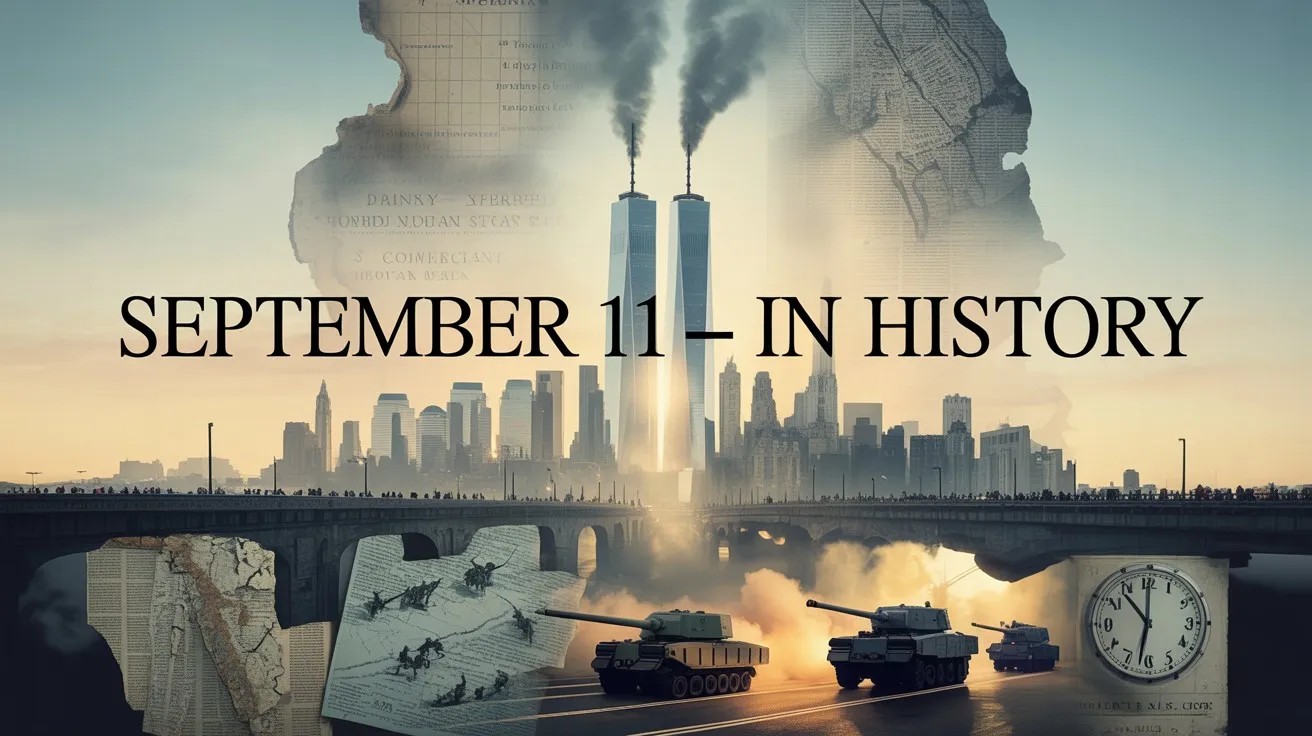
Today in History — September 11 brings battlefield shocks, political turning points, and modern tragedies with cultural and scientific landmarks. On this date, you’ll find medieval clashes and imperial contests, moments of exploration and institution-building, and modern media and technological milestones — plus an anniversary that reshaped global security and memory.
Major Events on September 11
1297 — Battle of Stirling Bridge (Scotland)
At Stirling Bridge, Scottish forces led by William Wallace and Andrew Moray routed an English army in a fight that helped ignite Scotland’s Wars of Independence. The victory demonstrated the tactical use of terrain and disciplined infantry against a larger feudal force and became a touchstone of Scottish resistance.
Stirling’s outcome raised Scottish morale and forced English commanders to rethink strategies in the north. In memory and myth the battle cemented Wallace’s reputation as a symbol of national defiance.
1609 — Henry Hudson sights Manhattan Island
Sailing for the Dutch East India Company, Henry Hudson entered the river that now bears his name and reached Manhattan Island, a step that opened the way for New Amsterdam and later New York. Hudson’s voyage set European interest in the region’s fur trade and strategic port sites, and it marked the beginning of sustained Dutch presence in the mid-Atlantic. The mapping and initial contacts that followed shaped colonial settlement patterns and later urban growth. Hudson’s name and route remain central to the story of North American colonization.
1697 — Battle of Zenta (Habsburg–Ottoman conflict)
At Zenta, Habsburg forces won a decisive victory over the Ottoman army, strengthening Habsburg influence in southeastern Europe and contributing to the Ottoman Empire’s gradual military retreat in the region.
The battle’s outcome influenced subsequent treaty negotiations and the shifting balance of power in the Balkans. It illustrated changing military technologies and alliance patterns at the turn of the 18th century. For contemporaries, the victory offered both relief and a reminder of how rapidly frontiers could move.
1709 — Battle of Malplaquet (War of the Spanish Succession)
Malplaquet was one of the bloodiest 18th-century battles: Allied forces under Marlborough and Prince Eugene defeated French troops but at staggering human cost. The high casualties tempered political enthusiasm for continued campaigning and helped shift European strategy from decisive open battles toward negotiation and attrition.
Malplaquet’s aftermath influenced how states weighed victory against the economic and social price of protracted war. The battle is thus a cautionary example of pyrrhic success in coalition warfare.
1777 — Battle of Brandywine (British victory near Philadelphia)
On September 11, 1777, British forces under General William Howe defeated General George Washington’s army at the Battle of Brandywine, opening the way for the occupation of Philadelphia. The engagement showed how maneuver, superior numbers in the right place, and well-timed flanking actions could decide a campaign, even when both sides fought fiercely.
Although a tactical loss for the Americans, the battle did not destroy Washington’s army, which retreated in good order and continued to fight in subsequent campaigns. Brandywine thus stands as a pivotal Revolutionary War encounter that shaped the contest for political and symbolic centers in the colonies.
1789 — Alexander Hamilton was named the first U.S. Treasury Secretary
President George Washington appointed Alexander Hamilton as the nation’s first Treasury Secretary, launching fiscal institutions that would shape American economic policy. Hamilton’s energetic proposals for federal assumption of state debts, a national bank, and sound public credit established core practices of modern fiscal governance.
His tenure set precedents for executive-led economic strategy and sparked lasting debates over federal power and finance. Hamilton’s appointment remains a founding moment in how the new republic organized money, markets, and state capacity.
1814 — Battle of Plattsburgh (War of 1812)
American naval and land forces repelled a larger British invasion on Lake Champlain, in a victory that helped secure U.S. borders in the north and influenced peace terms at Ghent. The battle showcased skillful coordination of naval and land defenses and provided a morale boost for the United States as the war wound down.
Strategically, Plattsburgh closed a potential British route into New York and preserved American negotiating strength. The victory also reinforced regional pride and military reputation in the young republic.
1855 — End of the Siege of Sevastopol (Crimean War)
The long, grinding Siege of Sevastopol ended in 1855 when British and French forces finally captured the Russian naval base, a climax to nearly a year of trench warfare and artillery duels. Taking Sevastopol struck at the heart of Russian Black Sea power and helped bring the Crimean War toward a negotiated settlement the following year.
The siege revealed the harsh human cost of modern siegecraft and prompted military and medical reforms in its aftermath, from tactical changes to improvements in battlefield medicine. Its fall reshaped naval calculations in the region and fed diplomatic momentum toward the Treaty of Paris.
1857 — Mountain Meadows Massacre (Utah Territory)
The Mountain Meadows Massacre was a grim and complex atrocity in which emigrant wagon trains were killed by a combination of militia and allied Native fighters—an event that stained regional and religious relations for decades. The massacre prompted intense investigations, legal and moral reckonings, and long-term debates about frontier violence, revenge, and authority.
For historians, it remains a painful case study in how rumor, fear, and local conflict can cascade into mass violence. The memory of Mountain Meadows continues to shape local and national conversations about justice and reconciliation.
1941 — Groundbreaking of the Pentagon (Arlington, Virginia)
Construction of the Pentagon began on September 11, 1941, marking a major expansion of U.S. military administration just months before America’s entry into World War II. The building’s scale and rapid construction reflected urgent wartime mobilization and the institutional consolidation of defense bureaucracy.
Over time, the Pentagon became both a practical nerve center of U.S. military planning and a powerful symbol of national defense. Its unveiling and later history are woven into broader stories of mid-20th-century state capacity and wartime organization.
1943 — German occupation of Corsica after Italy’s armistice
After Italy announced an armistice with the Allies in 1943, German forces moved quickly to seize strategic positions formerly under Italian control, including Corsica. The occupation was part of a wider German effort to plug gaps created by Italy’s switch and to secure Mediterranean lines of communication and airfields.
For the island’s population, it meant a new round of military governance, resistance activity, and civilian hardship as the fighting and occupation pressures intensified. Corsica’s change of hands illustrates the rapid rebalancing that can follow an ally’s political realignment in wartime.
1944 — Second Quebec Conference (Churchill & Roosevelt meet)
In 1944 Winston Churchill and Franklin D. Roosevelt met again on Canadian soil for the Second Quebec Conference to coordinate Allied strategy as the war in Europe moved toward its final phase. The talks brought top military and political planners together to align operations, logistics, and postwar priorities at a moment when momentum after Normandy demanded careful follow-through.
Discussions ranged from continued cross-Channel offensives to supply commitments and the shaping of postwar occupation policy, reflecting both urgency and a desire for an orderly peace. The conference underscored how close personal collaboration between allied leaders helped translate battlefield advantage into sustained political and administrative plans.
1944 — Allied wartime conferences and operations (Northwest Europe)
In 1944, Allied leaders held a series of strategic meetings and conducted operations as the war in Europe entered decisive phases, with U.S. troops pushing across the continent and political planning underway for postwar order. High-level conferences that year shaped military priorities, supply lines, and the diplomacy that would follow victory.
The momentum in late 1944 reflected both battlefield advances and the heavy costs of liberation campaigns. These months helped determine occupation zones, postwar institutions, and the Cold War’s early contours.
1951 — Florence Chadwick swims the English Channel both ways
Florence Chadwick became the first woman to swim the English Channel both directions, a feat that showed extraordinary endurance and helped popularize long-distance women’s athletics. Her swims tested human limits in cold, rough waters and brought public attention to open-water sports and women’s athletic achievement.
Chadwick’s success inspired other athletes and fed broader midcentury conversations about gender and physical possibility. The accomplishment endures as a landmark in competitive swimming history.
1967 — The Carol Burnett Show debuts on CBS
When The Carol Burnett Show premiered it combined sketch comedy, musical numbers, and character-driven satire, and it soon became a staple of American television and a showcase for ensemble comedy. The show influenced later variety and sketch programs with its blend of heart and broad comic invention.
Many of its bits and characters entered popular culture and set benchmarks for TV comedy’s warmth and craft. Its debut marks television’s mid-century maturation as a mass cultural medium.
1973 — Chilean coup d’état topples Salvador Allende
A military coup on September 11, 1973, led by General Augusto Pinochet, ousted President Salvador Allende and began a long, brutal authoritarian rule in Chile. The event triggered widespread repression, human-rights abuses, and deep social and political ruptures whose effects lasted decades.
Internationally, the coup became a focal point for Cold War debates over intervention, sovereignty, and human rights. Chile’s transition and memories of the coup continue to inform debates about democracy and accountability.
1985 — Pete Rose breaks the all-time hits record
On September 11, 1985, Pete Rose recorded his 4,192nd career hit, surpassing Ty Cobb’s long-standing Major League record and becoming one of baseball’s defining statistical figures. Rose’s achievement energized fan debate about consistency, longevity, and the narratives that drive sports lore.
Later controversies about rules and conduct complicated his legacy, but the record day remains a major milestone in baseball history. Sports historians treat the moment as an example of how records shape fandom and memory.
2001 — Terrorist attacks in the United States (9/11)
Coordinated terrorist hijackings struck the World Trade Center towers in New York City, damaged the Pentagon, and crashed a fourth airliner in Pennsylvania, killing nearly 3,000 people and transforming global politics, security, and daily life. The attacks triggered sweeping changes in intelligence, civil liberties debates, and international military interventions, and they created a persistent culture of memorialization and collective trauma.
The human toll, policy consequences, and long-term geopolitical reverberations make September 11 one of the defining turning points of the 21st century. Commemoration, inquiry, and the quest for resilience remain central to how societies remember that day.
2008 — Channel Tunnel fire disrupts cross-Channel service
A major fire in the Channel Tunnel on September 11, 2008, halted traffic and revealed the challenges of maintaining and securing large, international transport infrastructure. The incident prompted technical reviews, safety upgrades, and operational changes across one of Europe’s busiest transport links.
Beyond immediate disruption, the episode underlined how critical infrastructure requires constant attention to engineering, emergency response, and international coordination. The Chunnel recovery work that followed became a visible case in modern transport resilience.
2012 — Attack on U.S. diplomatic compound in Benghazi
Militant attackers assaulted the U.S. diplomatic post in Benghazi on September 11, 2012, killing Ambassador Christopher Stevens and three other Americans and prompting intense political and security reviews.
The assault highlighted vulnerabilities in diplomatic security in conflict zones and triggered an extended domestic debate about policy, preparedness, and congressional oversight. Benghazi’s political aftershocks reverberated through subsequent foreign-policy and electoral discourse. The event remains a cautionary episode about protecting civilians and diplomats in unstable regions.
Earlier History
- 1297 — Battle of Stirling Bridge.
- 1609 — Henry Hudson reaches Manhattan.
- 1697 — Battle of Zenta.
- 1709 — Battle of Malplaquet.
Exploration & Colonial Foundations
- 1609 — Dutch interest and subsequent New Amsterdam settlement.
- Colonial-era political names and early capital planning references appear in late-18th-century state-building.
Wars & Politics
- 1777 — Battle of Brandywine.
- 1814 — Battle of Plattsburgh (Lake Champlain).
- End of the Siege of Sevastopol (Crimean War).
- 1857 — Mountain Meadows Massacre.
- 1943 — German occupation of Corsica.
- 1944 — Second Quebec Conference (Churchill & Roosevelt meet)
- 1973 — Chilean coup d’état and long-term authoritarian rule.
- 2001 — Terrorist attacks in the U.S. and global security consequences.
Arts & Culture
- 1967 — The Carol Burnett Show premieres.
- 1985 — Pete Rose breaks Ty Cobb’s hits record.
- Mid- and late-20th-century cultural markers that shaped mass entertainment.
Science, Technology & Media
- 1846 (context) — Earlier technological milestones tied to industrialization and transport.
- 2008 — Channel Tunnel fire and transport resilience.
- 2008/2000s — Modern scientific and media infrastructure milestones intersect with public life.
🎂 Notable Births on September 11
- 1917 — Ferdinand Marcos: Longtime Philippine leader whose rule and exile reshaped the nation’s politics.
- 1944 — Serge Haroche: French physicist and Nobel laureate for quantum optics and single-photon work.
- 1935 — Gherman Titov: Soviet cosmonaut, among the earliest humans to orbit Earth for extended missions.
- 1937 — Robert Crippen: NASA astronaut and pilot of the first space shuttle mission.
- 1945 — Franz Beckenbauer: German football legend as player and manager.
- 1940 — Brian De Palma: Filmmaker influential in modern American cinema and suspense film.
- 1977 — Ludacris: Rapper and actor who helped popularize Southern hip-hop.
- 1970 — Taraji P. Henson: Actress known for breakout film and TV roles.
- 1967 — Harry Connick Jr.: Musician and actor blending jazz and popular song.
- 1965 — Bashar al-Assad: President of Syria; his rule has had major geopolitical consequences.
- 1935 — Arvo Pärt: Estonian composer noted for spare, spiritual minimalism.
- 1924 — Tom Landry: Iconic NFL coach who built the Dallas Cowboys into a powerhouse.
- 1895 — Vinoba Bhave: Indian social reformer and disciple of Gandhi, led land-gift movements.
- 1816 — Carl Zeiss: Founder of Carl Zeiss optics, transformed lenses and microscopes.
- 1917 — Jessica Mitford: Writer and investigative journalist known for moral wit and exposure.
- 1924 — Rudolf Vrba: Auschwitz escapee whose testimony helped expose the Holocaust.
- 1913 — Bear Bryant: Influential U.S. college football coach with an enduring legacy.
- 1885 — D. H. Lawrence: English novelist and poet, challenging social conventions.
- 1862 — O. Henry (William Sydney Porter): Master of short fiction and twist endings.
- 1903 — Theodor W. Adorno: Philosopher and critic central to 20th-century theory.
Notable Deaths on September 11
- 1772–1823 — David Ricardo: Pivotal classical economist whose work shaped modern economic theory.
- 1870–1950 — Jan Smuts: South African statesman, soldier, and internationalist leader.
- 1922–2002 — Kim Hunter: Oscar-winning actress best known for A Streetcar Named Desire.
- 1668–1733 — François Couperin: Major French Baroque composer and keyboard master.
- 1902–1982 — Wifredo Lam: Artist fusing modernism with Afro-Cuban imagery.
- 1902–1973 — E. E. Evans-Pritchard: Influential British anthropologist of African societies.
- 1874–1958 — Robert W. Service: Popular poet of the North, famed for frontier ballads.
- 1811–1888 — Domingo F. Sarmiento: Argentine president and education reformer.
- 1894–1917 — Georges-Marie Guynemer: French WWI flying ace and national icon.
- 1843–1915 — Sir William C. Van Horne: Railroad executive key to Canada’s transcontinental railway.
- 1933–2001 — Mychal Judge: FDNY chaplain, first officially identified casualty of the September 11 attacks.
- 1968–2001 — Mohammed Atta: Lead hijacker in the September 11 attacks (included for historical context).
- 1948–2003 — John Ritter: Beloved actor who died suddenly, prompting wide public mourning.
- 1933–2002 — Johnny Unitas: Legendary NFL quarterback and cultural sports figure.
- 1928–2019 — T. Boone Pickens: High-profile energy businessman and philanthropist.
- 1938–2024 — Alberto Fujimori: Former Peruvian president with a controversial legacy (recently deceased).
- 1908–1973 — Salvador Allende: Chilean president whose ouster and death were Cold War turning points.
- 1894–1971 — Nikita Khrushchev: Soviet leader who pursued de-Stalinization and Cold War policies.
- 1883–1972 — Max Fleischer: Animation pioneer behind Betty Boop and technical cartoon innovations.
- 1577–1599 — Beatrice Cenci: Historical figure whose trial and execution inspired literature and art.
Observances & Institutional Dates
- Patriot Day (U.S.) / National Day of Service and Remembrance: Commemorates the lives lost on September 11, 2001.
- Anniversaries of major cultural debuts and sports records anchor the date in broadcast and athletic history.
- Institutional milestones: Pentagon construction, wartime conferences, and transport incidents mark institutional change.
Check Also: September 10 facts and Events
Final Thoughts on Today in History: September 11
September 11 stitches together dramatic military encounters, state-making choices, cultural premieres, and a modern tragedy that continues to shape memory and policy. The date shows how public life mixes ritual, conflict, innovation, and grief, producing durable institutions and long debates about security, rights, and civic memory.
Looking across the entries helps us see continuity—how warfare, politics, media, and technology repeatedly reorder human landscapes.
FAQs About September 11
What is the history today about?
September 11 mixes state-building and military turning points with cultural and scientific milestones — from medieval battles and exploration to modern media debuts and the 2001 attacks.
Did the Battle of Stirling Bridge happen on September 11, 1297?
Yes — the Scots’ victory at Stirling Bridge occurred in early September 1297 and became a defining moment in Scotland’s Wars of Independence.
Was the Chilean coup on September 11, 1973?
Yes — a military coup led by General Pinochet on September 11, 1973 overthrew Salvador Allende and began decades of authoritarian rule.
Were the 9/11 terrorist attacks on September 11, 2001?
Yes — coordinated attacks on U.S. soil on September 11, 2001 killed nearly 3,000 people and reshaped international security and policy.
What is special about September 11th?
September 11 pairs longstanding historical events—battles, state-building, and cultural premieres—with a modern trauma (2001) that transformed global security, politics, and public memory. The date therefore carries both deep historical layers and intense contemporary significance.
What is the meaning of 9/11?
Colloquially, “9/11” refers to the terrorist attacks of September 11, 2001; it has become shorthand for that day’s violence, the resulting policy shifts, and the worldwide cultural and security impacts that followed.
How many died on 9/11 in total?
Nearly 3,000 victims were killed in the 2001 attacks—official counts list 2,977 victims (this figure excludes the hijackers). The toll includes civilians, first responders, and passengers across the four attacks.
Did anyone above the plane survive 9/11?
No passengers or crew survived any of the four hijacked flights. Inside the towers, virtually no occupants above the aircraft impact zones survived; a very small number of people on floors above the South Tower’s impact reached stairwells briefly, but survivors from above the impact zones were extremely rare.
Who was the youngest victim of 9/11?
The youngest victims were small children and toddlers; several victims were toddlers around two years old. Families and memorial records list children among those lost that day.
Why did the Twin Towers fall?
The combination of massive structural damage from the plane impacts and prolonged, intense fires weakened floor trusses and core columns; that loss of support initiated progressive collapse. In short: impact damage plus heat-weakened structure caused the towers’ catastrophic failures.
Who was the last person found alive on 9/11?
Most survivors were rescued within the first hours after the attacks; there are no widely confirmed reports of people being pulled alive from deep rubble many days later. Rescue efforts continued for weeks, but live extractions from the main collapse zone were concentrated in the immediate aftermath.
How long did it take to clean up 9/11?
Debris removal and site clearance at Ground Zero took several months; major wreckage removal was completed in May 2002 (roughly eight to nine months after the attacks), though related recovery and remediation work continued longer.
How much money did it take to clean up after 9/11?
Estimates vary by scope: the immediate Ground Zero cleanup and debris-removal costs were in the hundreds of millions to low billions of dollars, while total economic, health, rebuilding, and compensation costs associated with 9/11 rose into the tens of billions over subsequent years.
How many people got out of the Twin Towers alive?
Thousands of people evacuated the towers that morning—most occupants below the impact zones escaped. Exact survivor totals vary by source, but the majority of those who were below the crash floors left the buildings; those above the impact zones generally could not.
How many seconds did it take for the towers to collapse?
Each tower’s visible top-to-bottom collapse sequence occurred on the order of roughly 10–15 seconds once structural failure began, though the entire physical process and debris settling continued longer.
How many bodies were not recovered from the Twin Towers?
Hundreds of victims’ remains were never recovered or could not be individually identified; exact counts depend on definitions (full remains vs. fragments) and identification efforts, but many families never received complete recoverable remains.
What replaced the Twin Towers?
The rebuilt World Trade Center complex includes One World Trade Center (the primary office tower), the National September 11 Memorial & Museum, and several new office buildings and public spaces—designed both to restore commercial activity and to memorialize the lives lost.