September 13 threads art, warfare, invention, and vivid modern moments into a single date. In Today in History — September 13, you’ll find Michelangelo at his block of marble, decisive battles that redrew maps, scientific flashes that changed whole fields, and cultural products that went on to shape everyday life. These entries show how creativity, conflict, and technology repeatedly meet on the calendar—and why remembering them helps us understand long arcs of change.
Major Events on September 13
1501 — Michelangelo begins carving David
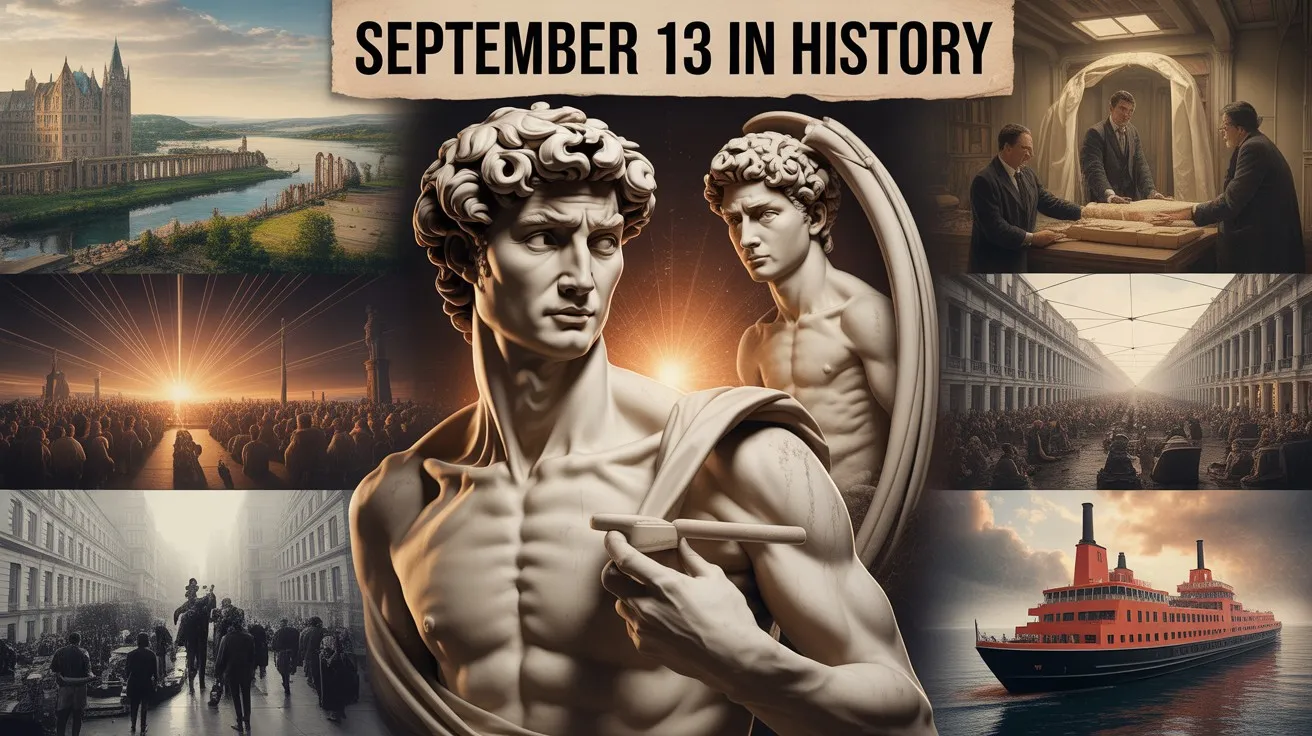
In the autumn of 1501, Michelangelo took up a massive block of Carrara marble and began the three-year labor that produced David, a sculpture that fused anatomical mastery with civic symbolism. The work’s scale and psychological intensity broke from medieval conventions and announced a new public role for the artist.
Florence embraced David as a statement of republican dignity and artistic pride; the statue’s stance and expression became models for Renaissance portraiture and heroic representation. Even centuries later David remains a touchstone for conversations about technique, politics, and the power of public art.
1515 — Swiss mercenaries and the Marignano campaign
Fighting near Marignano in 1515 tested the limits of pike formations against coordinated artillery and cavalry—an engagement that signaled changes in early modern warfare. In the campaign that followed, Swiss forces faced defeat that helped nudge Swiss politics toward the cautious neutrality the confederacy later pursued.
The episode illustrates how battlefield reversals can produce long-term diplomatic strategies as much as immediate territorial outcomes. Marignano is therefore not just a military footnote but a turning point in how small states managed great-power pressures.
1759 — Battle of the Plains of Abraham (Quebec)
A brief, brutal engagement outside Quebec City ended with British victory and the deaths of both commanders, James Wolfe and the Marquis de Montcalm. That clash effectively decided control of New France and set the stage for Britain’s dominant position in North America.
The battle’s aftermath reshaped law, language, and settlement patterns across a continent, showing how a single fight can pivot imperial trajectories. The Plains of Abraham remain a central reference for colonial-era change and contested memory.
1814 — Fort McHenry and the image that inspired a national song
During the War of 1812, the British bombardment of Fort McHenry failed to destroy the garrison’s spirit; Francis Scott Key’s sight of the flag still flying inspired a poem that became the U.S. national anthem. The episode demonstrates how wartime images can crystallize into national symbols with long cultural life.
Fort McHenry’s story is both a tactical episode in coastal defense and a case study in how narrative and symbol shape public identity. The flag’s endurance turned a night of shells into an anthem that generations have since invoked.
1845 — Michael Faraday discovers the Faraday effect
In laboratory experiments linking magnetism and light, Faraday showed that a magnetic field can rotate the plane of polarized light—a small, elegant finding with enormous theoretical consequences.
That result helped knit together electricity, magnetism, and optics in ways that later matured into electromagnetic theory. Faraday’s method—simple apparatus, relentless curiosity—became a model for experimental physics. The Faraday effect still appears in optics and materials science, a reminder that careful experiments can reveal deep structure.
1855 — Siege of Sevastopol ends (Crimean War)
The fall of Sevastopol closed a long, attritional campaign that exposed the stresses of industrialized warfare: logistics, disease, and heavy artillery. The siege’s end helped drive diplomatic settlements and stressed reform in armies and medical systems back home. Sevastopol’s months of trench lines and bombardment foreshadowed some features of later large-scale wars.
Its legacy is military and humanitarian—lessons about how modern conflict strains institutions and populations.
1898 — Hannibal Goodwin patents a flexible film base (celluloid film)
Goodwin’s patent for a transparent, flexible film base made practical motion pictures possible and helped convert early photographic experiments into an industry. That technical move underpinned cinema’s rise as a mass medium, enabling longer, more reliable recordings and projection.
Once film was portable and projectable, the language of visual storytelling expanded into news, documentary, and entertainment forms that reshaped public life. This patent is one of the small engineering steps behind a very large cultural revolution.
1899 — Henry Bliss becomes the first recorded automobile fatality in the U.S.
When Henry Bliss was struck and later died in New York City, it became the nation’s first widely reported auto fatality—an early signal of the social and regulatory challenges cars would bring. The tragedy prompted early debates about traffic rules, public space, and how cities would adapt to motor vehicles.
Over the following decades, licensing, road design, and traffic laws grew out of countless such incidents. Bliss’s death is a stark early marker of technological disruption in urban life.
1933 — Leó Szilárd conceives the idea of a nuclear chain reaction
While crossing a London street Szilárd had the flash of insight that a self-sustaining nuclear chain reaction might be possible—an idea that later carried enormous scientific, ethical, and political weight.
The concept moved quickly from thought to laboratory experiments, changing physics and eventually geopolitics. Szilárd’s intuition is an example of how theoretical leaps can become foundations for large-scale technological programs. The chain-reaction idea helped usher in the atomic age, with all its promise and peril.
1940 — Lascaux cave paintings discovered (Montignac, France)
Four local teenagers stumbled onto a chamber of Paleolithic paintings—horses, aurochs, and signs rendered with creative skill that stunned scholars. Lascaux transformed scholarly views of prehistoric symbolic life and showed that Paleolithic people produced sophisticated, sustained art.
The discovery prompted new archaeological and conservation methods and deepened interest in human cognitive and cultural origins. Lascaux is one of the planet’s richest windows into early human imagination.
1943 — Chiang Kai-shek’s wartime leadership (contextual note)
During 1943 Chiang Kai-shek continued to shape China’s wartime governance and international diplomacy amid a chaotic Asia-Pacific theater. His leadership during World War II tied China’s fate to Allied strategy and postwar negotiations.
The year is part of the larger arc where Chinese politics shifted under pressure from invasion, collaboration, and alliance. Chiang’s wartime role helped set the stage for later political contests on the mainland and across the Chinese world.
1959 — Luna 2 impacts the Moon (first human-made object to reach the Moon)
The Soviet probe Luna 2 struck the lunar surface, becoming the first human object to reach another celestial body and marking an early high point of the space age. That impact demonstrated robotic reach and intensified the space rivalry of the Cold War era
Public imagination and scientific programs both accelerated after Luna 2’s success. It’s a clear early milestone in humanity’s push beyond Earth.
1971 — Attica Prison uprising ends in deadly retaking
The Attica standoff over prison conditions and dignity ended when authorities stormed the facility; dozens of inmates and hostages died, and the episode sparked a national reckoning over incarceration, race, and state power. The violent suppression prompted investigations, litigation, and debate over prison reform that lasted for decades.
Attica’s legacy remains a focal point in discussions about criminal justice policy and the limits of force. The event highlighted systemic issues that reformers and policymakers have continued to wrestle with.
1985 — Super Mario Bros. released in Japan (gaming watershed)
Nintendo’s Super Mario Bros. launched a new template for game design: clear controls, imaginative level design, and a memorable character that became a global icon. The title revived an ailing video-game industry and proved how interactive entertainment could become a durable mass medium.
Mario’s success opened franchises, merchandising, and cross-media storytelling that persist today. The release marks a cultural and economic turning point in entertainment.
1993 — Oslo Accords signed (historic Middle East step)
Leaders from Israel and the Palestine Liberation Organization publicly shook hands and signed an agreement that launched a process of provisional recognition and negotiation. Oslo was not a final settlement, but it represented a rare diplomatic opening and created new institutional frameworks for peace efforts.
The accords reshaped regional diplomacy and set expectations that continue to influence Middle East politics. Oslo’s mixed legacy shows how hope, politics, and contested implementation can intertwine.
1995 — Military transport plane crash near Colombo, Sri Lanka
A military transport aircraft crashed near Colombo during severe weather and instrument problems, killing all aboard and marking a tragic aviation loss for the region. The accident underscored the dangers military and civilian aviators face in extreme weather and the continuing need for robust safety practices. For families and communities the crash was a painful episode; for aviation professionals it returned focus to training, maintenance, and instrument reliability. The loss remains a local and professional tragedy.
2009 — Ankoro ferry disaster (Congo River)
In darkness an overloaded ferry sank near Ankoro in the Democratic Republic of the Congo, leaving at least 15 dead and scores missing—one of many recurrent river tragedies in the region. The disaster highlighted chronic safety issues: overcrowding, poor maintenance, and weak enforcement of maritime rules.
For affected communities the wreck was a devastating human catastrophe; for policymakers it underscored the need for investment in transport safety and emergency response. Ankoro is a reminder that everyday infrastructure failures can produce sudden national grief.
Themed Short Roundups
Earlier History
1501 — Michelangelo begins David.
1515 — Marignano campaign and Swiss realignment.
1759 — Plains of Abraham changes North American control.
Exploration & Colonial Foundations
1609 links and regional voyages (context for Hudson’s era).
1501–1759 entries show art and conquest shaping civic life.
Wars & Politics
1814 — Fort McHenry inspires a national song.
1923 — Primo de Rivera coup (Spain).
1993 — Oslo Accords begin a fraught peace process.
Arts & Culture
1940 — Lascaux discovery expands our sense of prehistoric art.
1985 — Super Mario Bros. reshapes modern entertainment.
Goodwin’s film base leads to cinema’s growth.
🌐 Science, Technology & Media
1845 — Faraday effect links light and magnetism.
1933 — Szilárd conceives the chain reaction.
1959 — Luna 2 reaches the Moon.
Notable Births on September 13
- Roald Dahl (1916) — Beloved children’s author of Charlie and the Chocolate Factory.
- Tyler Perry (1969) — Filmmaker and media entrepreneur behind the Madea franchise.
- Milton S. Hershey (1857) — Chocolatier and philanthropist; founder of Hershey, PA.
- Clara Schumann (1819) — Pianist-composer and promoter of Romantic-era music.
- Tadao Andō (1941) — Architect known for refined concrete spaces and light.
- J. B. Priestley (1894) — Novelist and playwright who shaped 20th-century British drama.
- William Cecil, 1st Baron Burghley (1520) — Principal minister to Elizabeth I.
- Robert Indiana (1928) — Pop artist famous for the LOVE image.
- Alain Locke (1886) — Harlem Renaissance philosopher and cultural organizer.
- Óscar Arias Sánchez (1940) — Costa Rican president and Nobel Peace laureate.
- Oliver Evans (1755) — Early American inventor and industrialist.
- Daisuke Matsuzaka (1980) — Pitcher who rose to international baseball fame.
- Corneliu Codreanu (1899) — Founder of Romania’s Iron Guard (controversial historical figure).
- John II Comnenus (1087) — Byzantine emperor involved in 12th-century diplomacy.
- Fred Silverman (1937) — Television executive who greenlit many hit shows.
- Andrew Brimmer (1926) — Economist and the first Black governor of the U.S. Federal Reserve.
- Anthony J. Drexel (1826) — Financier and education philanthropist.
- Jens Jensen (1860) — Landscape architect and conservation advocate.
- Marjorie Jackson (1931) — Australian double Olympic sprint champion.
- Leopold Ružička (1887) — Nobel Prize–winning chemist.
Notable Deaths on September 13
- Tupac Shakur (1996) — Influential rapper and cultural figure.
- James Wolfe (1759) — British general killed at Quebec.
- Ken Starr (2022) — Independent counsel in high-profile U.S. investigations.
- Antony Hewish (2021) — Nobel-winning radio astronomer.
- Andrea Mantegna (1506) — Renaissance painter and engraver.
- Charles James Fox (1806) — British Whig statesman and orator.
- Richard Hamilton (2011) — British pop artist and influential critic.
- William Heath Robinson (1944) — Cartoonist known for whimsical machines.
- Julio César Turbay Ayala (2005) — President of Colombia (1978–82).
- Munakata Shikō (1975) — Japanese printmaker and modernist.
- Nogi Maresuke (1912) — Meiji-era general remembered in Japan.
- Mervyn LeRoy (1987) — Hollywood director/producer from the studio era.
- Italo Svevo (1928) — Italian novelist (author of Zeno’s Conscience).
- Emmanuel Chabrier (1894) — French composer of vibrant orchestral songs.
- Gregory Breit (1981) — Theoretical physicist involved in early nuclear studies.
- Alexandre Herculano (1877) — Portuguese novelist and historian.
- Olin J. Stephens II (2008) — Influential yacht designer.
- Joseph Furphy (1912) — Australian novelist and humorist.
- Robert Hope-Jones (1914) — Electric organ innovator.
- Samuel Alexander (1938) — Philosopher known for emergent evolution theory.
Observances & Institutional Dates
- Vermont largely abolished the death penalty (1848).
- Oslo Accords signed (1993).
- Attica uprising suppressed (1971).
- Super Mario Bros. was released (1985).
Final Thoughts on Today in History: September 13
September 13 stitches together human invention and human frailty: sculpture and science stand beside sieges and revolts, while media and technology reshape everyday life. The date shows how public symbols, technical breakthroughs, and violent conflicts each leave durable marks on collective memory. Remembering these events helps us see how art, power, and invention travel across centuries and continue to matter today.
“Want to see what happened on other days? Check out the key events from September 11 and September 12 to follow history day by day.”
FAQs About September 13
What is the history today about?
September 13 mixes art, science, and military turning points—from Michelangelo’s David and Faraday’s experiment to the Plains of Abraham and modern media milestones.
Did Michelangelo really begin David on September 13, 1501?
Yes—Michelangelo began work on David in 1501; the sculpture became a defining emblem of Renaissance Florence and public art.
Did the Battle of the Plains of Abraham happen on September 13, 1759?
Yes—the decisive clash near Quebec occurred in 1759 and profoundly shifted colonial control in North America.
What happened at Attica in 1971?
A prisoner uprising over conditions ended when state forces retook the prison; dozens died, and the event spurred long debates about incarceration, race, and state power.