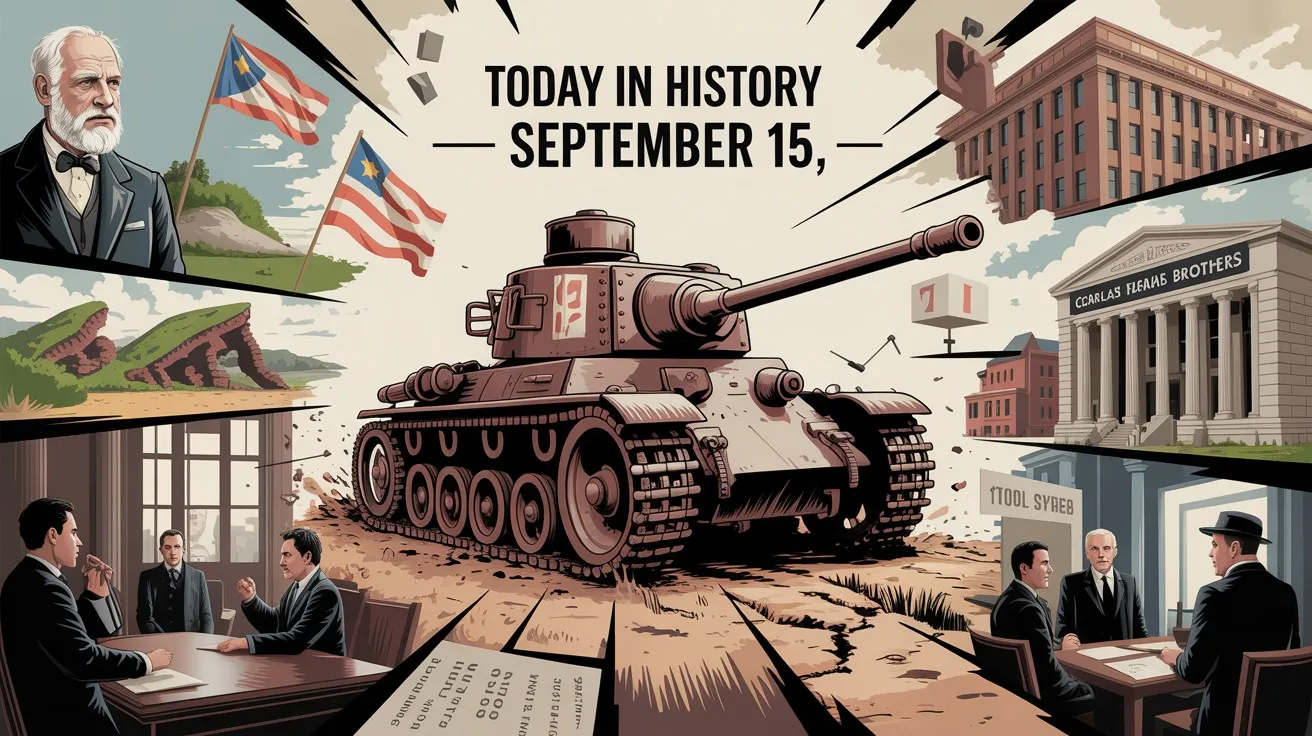
Today in History — September 15 threads together empire-making, battlefield firsts, political ruptures, scientific turning points, and cultural flashpoints. Across centuries, this date has hosted declarations of independence, the debut of new technologies on the battlefield, founding moments for institutions, and events that keep reappearing in public memory.
Major Events on September 15
994 — Fatimid victory at the Battle of the Orontes
A major Fatimid victory over Byzantine forces at the Orontes consolidated Fatimid influence in parts of the Levant. The engagement reinforced shifting frontiers between Islamic polities and the Byzantine Empire during the late tenth century.
For local rulers and merchants, the outcome altered patterns of allegiance and trade that shaped the eastern Mediterranean. Historians treat the battle as part of the protracted contest that defined borderlands in medieval Near Eastern politics.
1440 — Gilles de Rais taken into custody
On September 15, 1440, Gilles de Rais—once a celebrated military leader and companion of Joan of Arc—was arrested after accusations by Bishop Jean de Malestroit. The arrest opened a sensational trial combining charges of murder, occultism, and moral transgression that shocked late medieval France.
The case fused fears about magic with political rivalries and has remained a troubling example of how celebrity and atrocity intersected in early modern justice. For later cultural memory, de Rais’s downfall has fed enduring debates about guilt, punishment, and reputation.
1530 — Miraculous portrait of Saint Dominic appears in Soriano
The reported miraculous portrait of Saint Dominic appeared in Soriano Calabro on this date, an event later commemorated liturgically between 1644 and 1912. The image became a local focal point for devotion and pilgrimage, demonstrating how objects could shape communal piety in early modern Italy.
Such reputed miracles helped sustain popular religiosity and anchored local identities within wider Catholic practice. Over time, the Soriano portrait entered hagiographic narratives that linked image, miracle, and civic prestige.
1556 — Charles V departs Vlissingen for Spain
On September 15, the former emperor Charles V left Vlissingen to return to Spain, completing a symbolic stage in his abdication and retirement. His departure closed an era of intense Habsburg dynastic politics across Europe and the Atlantic.
The move to Spain signaled shifting responsibilities among Habsburg heirs and a reconfiguration of imperial leadership. Retiring rulers like Charles left administrative legacies and dynastic tensions that shaped 16th-century statecraft.
1762 — Battle of Signal Hill (Seven Years’ War)
The British recapture of Signal Hill on September 15, 1762, ended a brief French occupation of St. John’s in Newfoundland, closing one of the North American chapters of the Seven Years’ War. Though small in scale, the action reaffirmed British naval and colonial control in the region and helped tidy final settlement terms.
For local communities, the battle meant an end to disruption and the resumption of civil governance. Strategically, Signal Hill was a tidy coda to broader imperial rearrangements.
1776 — British landing at Kip’s Bay (New York Campaign)
British forces landed at Kip’s Bay on September 15, 1776, pressing the New York Campaign and exposing weaknesses in American defensive dispositions. The successful landing forced a disorderly Continental retreat across Manhattan, underscoring the perils of defending a seaport region against a professional navy and army.
Though a tactical win for Britain, the campaign’s larger political stakes—control of ports and supply lines—kept the struggle over New York fluid. The episode illustrates how geography and seamanship could decide early Revolutionary War operations.
1789 — Department of Foreign Affairs renamed Department of State (United States)
On September 15, 1789, the U.S. Department of Foreign Affairs was renamed the Department of State and given an expanded set of domestic duties. This change formalized an essential executive institution for the new republic and positioned it to handle both foreign correspondence and domestic administrative tasks.
The early Department of State’s broad remit reflected the practical needs of a government still working out specialized bureaucratic roles. Over time the department would hone its diplomatic focus, but its renaming remains a founding administrative milestone.
1794 — Arthur Wellesley’s first combat at Boxtel
The future Duke of Wellington saw his first combat at the Battle of Boxtel on September 15, 1794, during the Flanders Campaign. Although a relatively small engagement, the experience was formative for Wellesley’s professional development and tactical learning.
Military historians trace aspects of his later temperament—discipline, attention to logistics, and caution—to such early tests in the field. Boxtel therefore, appears in the long career arc of one of Britain’s defining commanders.
1795 — Britain seizes the Dutch Cape Colony
On September 15, 1795, Britain seized the Dutch Cape Colony to prevent its use by the French-aligned Batavian Republic, securing a strategic stopover on the route to India. The occupation reflected the global reach of European conflicts during the Revolutionary and Napoleonic eras.
For colonists, indigenous peoples, and enslaved populations, the transfer of control brought new laws, administrations, and economic priorities. The event exemplifies how metropolitan wars reshaped distant colonial governance.
1812 — Grande Armée reaches the Kremlin (Napoleon’s Moscow campaign)
Napoleon’s Grande Armée reached the Kremlin on September 15, 1812, entering a largely evacuated Moscow that soon suffered widespread fires. What initially looked like a strategic prize soon turned into a logistical catastrophe: scorched resources, freezing winter, and supply collapse forced the doomed retreat.
The campaign became a classic cautionary tale about overreach and the perils of occupying a hostile or abandoned capital. Moscow’s fate reshaped 19th-century European geopolitics and military thought.
1812 — Attack at the Narrows ambushes supply train to Fort Harrison (War of 1812)
A second supply train sent to relieve Fort Harrison was ambushed at the Narrows on September 15, highlighting frontier warfare’s dependence on secure logistics. The skirmish complicated U.S. efforts to sustain isolated garrisons and underlined how local engagements could shape theater-wide operations.
For soldiers on the frontier, such ambushes brought ongoing danger and operational uncertainty. The episode reminds readers that logistics and small actions often decide campaigns.
1813 — Eight Trigram Sect attacks the Forbidden City (Qing dynasty)
Followers of the Eight Trigram Sect mounted an assault on the Forbidden City on September 15, 1813, in a failed attempt to depose the Jiaqing Emperor. The uprising reflected the appeal of secret societies and millenarian movements amid social stress and economic grievance.
The Qing response was harsh and repressive, temporarily quelling the immediate threat but leaving unresolved tensions. This incident sits among a string of localized rebellions that would intermittently roil imperial China.
1820 — Constitutionalist revolution in Lisbon, Portugal
On September 15, 1820, a revolution in Lisbon by military officers and liberal elites set Portugal on the path toward constitutional monarchy and political reform. The movement curtailed absolutist tendencies and inaugurated a period of turbulent constitutional contest.
For Portuguese society, the events began a long debate about rights, representation, and modern governance. The revolution’s ripple effects influenced Iberian politics and colonial administration in the nineteenth century.
1821 — Central American declaration of independence from Spain
September 15, 1821, saw the Captaincy General of Guatemala declare independence from Spain—a date celebrated today by Costa Rica, El Salvador, Guatemala, Honduras, and Nicaragua. The declaration closed an era of colonial rule and initiated complex processes of state formation, regional federations, and contested sovereignty.
Independence did not instantly resolve internal divisions; the region would experience further conflicts and reorganizations. Nevertheless, the date remains a shared national milestone across multiple countries.
1830 — Liverpool–Manchester railway opens; William Huskisson fatally struck
The Liverpool–Manchester railway opened on September 15, 1830, marking a practical leap in transport and industrial mobility. The ceremony also produced tragedy: MP William Huskisson became the first widely reported railway passenger fatality after being struck during the opening events. Huskisson’s death was a shocking counterpoint to the progress symbolized by the new railway, underscoring how innovation and hazard often travel together.
The line itself revolutionized freight and passenger movement and catalyzed global railway construction.
1835 — HMS Beagle reaches the Galápagos (Darwin aboard)
On September 15, 1835, HMS Beagle reached the Galápagos Islands, where Charles Darwin observed species whose variation would later help shape his ideas on evolution. The stop contributed vital empirical material to what became evolutionary theory, linking field observation to conceptual breakthroughs.
The Galápagos visit is often presented as the hinge between exploratory natural history and a scientific revolution in biology. The date remains central to narratives about the origins of modern biological thought.
1847 — U.S. forces capture Mexico City (Mexican–American War)
General Winfield Scott’s forces captured Mexico City on September 15, 1847, a decisive event that effectively ended major Mexican resistance and led to territorial cessions. The fall of the capital precipitated negotiations that reshaped North America’s political map.
For both the United States and Mexico the campaign had deep political, social, and cultural consequences—triumph and expansion on one side, humiliation and internal debate on the other. The capture stands as a pivotal 19th-century episode in hemispheric history.
1862 — Confederate capture of Harpers Ferry (American Civil War)
Confederate forces captured Harpers Ferry on September 15, 1862, compelling the surrender of some 12,000 Union soldiers and temporarily securing a strategic position. The victory disrupted Union operations and underlined the town’s repeated strategic importance.
Harpers Ferry’s capture illustrates how key terrain and timing could produce dramatic local reversals during the Civil War. The episode added another chapter to a contested landscape of campaign maneuver.
1873 — Franco-Prussian War indemnity payment and German troop withdrawal
By September 15, 1873, German troops completed their withdrawal from France after the French government met indemnity payments, closing a painful chapter of occupation. The orderly exit marked a diplomatic and financial settlement that allowed both parties to begin reconstruction.
The episode highlighted how war termination often combines military occupation with fiscal imposition. The withdrawal helped create conditions for later Franco-German relations and the political economy of the Third Republic.
1894 — Battle of Pyongyang (First Sino-Japanese War)
On September 15, 1894, Japanese forces routed Qing troops at Pyongyang, compelling a Chinese retreat toward the border and tipping the regional balance in Japan’s favour. The defeat exposed Qing military weaknesses and presaged Japan’s emergence as a modern regional power.
For Korea and neighboring areas the battle signalled the start of shifting suzerainty and imperial competition. Historians see Pyongyang as a turning point in late nineteenth-century East Asian geopolitics.
1915 — Chen Duxiu founds New Youth (New Culture Movement)
Chen Duxiu launched New Youth in Shanghai on September 15, 1915, a journal that became central to the New Culture Movement and the intellectual ferment of Republican China. The magazine promoted vernacular language, science, and critique of traditional institutions, helping to incubate modern political and cultural ideas.
New Youth provided a forum for debate that influenced later revolutionary currents and modern Chinese thought. Its founding marks a key intellectual milestone in twentieth-century China.
1916 — First operational use of tanks at the Somme (World War I)
Tanks were used for the first time in combat on September 15, 1916, during the Battle of the Somme—experimental machines intended to breach trench lines and resist small-arms fire. Early tanks were mechanically fragile and tactically limited, but the debut foreshadowed the future centrality of armor in combined-arms warfare.
The Somme’s tank trials signaled the military’s pursuit of technological solutions to industrial stalemate. The event inaugurated a new category of battlefield technology that would evolve rapidly.
1935 — Nazi Germany adopts the swastika flag and enacts the Nuremberg Laws
In mid-September 1935, Nazi Germany formalized a new national flag and enacted the Nuremberg Laws, which stripped Jews of citizenship rights and forbade intermarriage with “German or related blood.” These measures codified racial exclusion into law and gave official status to antisemitic ideology.
The laws and symbols were foundational steps toward systematic persecution and the eventual horrors of the Holocaust. The date marks a sinister legal and symbolic consolidation of racial policy.
1940 — “Battle of Britain Day”: Luftwaffe’s intense assault; RAF holds
September 15, 1940, is remembered as a climactic day in the Battle of Britain when the Luftwaffe mounted a massive offensive intended to destroy the RAF; British air defenses held and the invasion threat receded. The day became a potent symbol of national resilience and the importance of air power in modern war.
Military historians treat it as a turning point that preserved Britain as a base for future Allied operations. The RAF’s success reshaped German strategic calculations and bolstered Allied morale.
1942 — USS Wasp sunk at Guadalcanal
Japanese torpedoes struck the U.S. carrier Wasp on September 15, 1942, leading to its loss and underscoring carrier vulnerability in the Solomon Islands campaign. The sinking cost lives and aircraft and compelled tactical and logistical re-evaluations by the U.S. Navy.
Losses like Wasp highlighted the grinding attrition of the Pacific war and the risks inherent in carrier operations. The incident remains a stark reminder of naval peril during World War II.
1944 — Battle of Peleliu begins (Pacific)
U.S. forces landed on Peleliu on September 15, 1944, beginning a campaign noted for ferocious fighting and heavy casualties against entrenched Japanese defenders. The battle’s necessity was later questioned by strategists, but at the time it was judged to secure flanks and airfields for Pacific operations.
Peleliu illustrated how rough terrain and prepared defenses could transform amphibious landings into costly sieges. The island’s capture entered debates about operational priorities and human cost in the Pacific theater.
1948 — Operation Polo: Indian Army captures towns in Hyderabad campaign
As part of Operation Polo, Indian forces took Jalna, Latur, Mominabad, Surriapet and Narkatpalli on September 15, 1948, consolidating control over Hyderabad State and ending the princely state’s bid for autonomy. The operation integrated Hyderabad into the Indian Union and reshaped regional governance after independence.
For local populations, the takeover brought swift administrative change and long-term debates about central authority and rights. The action is a decisive episode in India’s early nation-building.
1950 — Inchon landing (Korean War)
General MacArthur’s amphibious landing at Inchon on September 15, 1950, opened a dramatic counteroffensive that reversed North Korean advances and recaptured Seoul. The operation combined surprise, audacity, and complex tidal planning, demonstrating the power of amphibious maneuver.
Inchon’s success dramatically altered the war’s operational calculus and became a case study in operational risk-reward. The landing’s aftermath complicated later political and military choices in Korea.
1954 — Marilyn Monroe’s skirt scene filmed for The Seven Year Itch
On September 15, 1954, Marilyn Monroe’s iconic skirt-blowing scene was filmed—an image that would become one of Hollywood’s most enduring pop-culture moments. The shot crystallized Monroe’s star persona and fed debates about sexuality, celebrity, and the commercialization of image in midcentury media.
The sequence travelled far beyond its film origins to become a visual shorthand in advertising and fashion history. Its cultural staying power shows how a single cinematic moment can lodge in public imagination.
1958 — Newark Bay drawbridge disaster (Central Railroad of New Jersey)
A Central Railroad of New Jersey commuter train ran through an open drawbridge at Newark Bay on September 15, 1958, killing 48 people and prompting urgent safety reviews. The tragedy underscored the lethal consequences of signaling or procedural failure in transport systems.
Investigations led to improvements in drawbridge control, signaling redundancy, and commuter safety measures. The disaster occupies a sad place in American rail-safety history.
1959 — Nikita Khrushchev visits the United States (first Soviet leader to do so)
In 1959 Nikita Khrushchev made a landmark visit to the United States—the first Soviet premier to do so—mixing public diplomacy with sharp ideological contrast. The trip exposed Americans to Soviet leadership and fed both curiosity and Cold War anxieties.
Khrushchev’s visits to factories, farms, and political halls were heavily reported and colored public opinion on both sides. The exchange was a notable moment in superpower engagement before later crises hardened relations.
1962 — Soviet ship Poltava heads toward Cuba (Cuban Missile Crisis lead-up)
The Soviet ship Poltava’s movement toward Cuba in 1962 was one of a series of events that set into motion the Cuban Missile Crisis, raising superpower tensions to a new pitch. Ship movements, missile deployments, and diplomatic exchanges combined to produce a near-catastrophic standoff.
The episode is a reminder of how seemingly technical naval movements can escalate into geopolitical crises. The Cuban Missile Crisis would later test crisis management and back-channel diplomacy to the limit.
1963 — 16th Street Baptist Church bombing, Birmingham (civil rights atrocity)
The bombing of Birmingham’s 16th Street Baptist Church in September 1963 killed four young girls and injured many others, shocking the national conscience and galvanizing civil rights momentum. The atrocity became a moral fulcrum that helped push legislative action, including the Civil Rights Act of 1964.
The bombing remains a defining and tragic reminder of racial violence in mid-20th-century America. Memorials and public remembrances have kept the victims’ names in national memory.
1968 — Zond 5 launched and returned around the Moon (Soviet spaceflight milestone)
The Soviet Zond 5 mission, launched in 1968, became the first spacecraft to circle the Moon and re-enter Earth’s atmosphere with biological specimens, signaling key technical steps in lunar mission capability. While not a crewed flight, Zond 5 demonstrated re-entry and life-support tolerance that informed later missions.
The flight is one step in the broader lunar race that defined 1960s space competition. Its technical lessons fed both Soviet and global understanding of deep-space operations.
1971 — First Greenpeace ship departs Vancouver to protest nuclear testing
In 1971 the first Greenpeace voyage departed Vancouver to protest the planned Cannikin nuclear test in Alaska, launching an organization that would become a persistent voice in environmental activism. The voyage combined direct action, media spectacle, and grassroots organization, establishing tactics that would recur in environmental campaigns worldwide.
Greenpeace’s early voyages helped globalize concern about nuclear testing and marine protection. The organization’s founding actions transformed environmental protest into a transnational movement.
1972 (reported 2025 trial) — Bloody Sunday trial (Londonderry/Derry) developments brought to court
In 2025 a former British army paratrooper was put on trial for murder and attempted murder relating to demonstrator deaths during the Bloody Sunday events in Londonderry (Derry) in 1972. The legal proceedings underscore how contested episodes of state violence continue to generate demands for accountability decades later.
Trials and inquiries into Bloody Sunday have repeatedly reopened public debate about evidence, responsibility, and historical memory. The 2025 hearing is another chapter in long-running attempts to secure justice and closure for victims’ families.
1972–1978 — Hijackings, crashes and sport (various events)
Between the 1970s a range of episodes—from hijackings and aviation disasters to Muhammad Ali’s 1978 victory over Leon Spinks—show how the decade combined danger, political violence, and major sporting milestones. These events reflect the breadth of public life, where security challenges and mass entertainment often shared headlines.
Each story contributed to policy change—on aviation security, criminal justice, or sports governance. The decade’s mixture of risks and spectacles shaped later regulatory priorities.
1981 — Sandra Day O’Connor approved by the Senate Judiciary Committee
On September 15, 1981, the Senate Judiciary Committee unanimously approved Sandra Day O’Connor’s nomination to the U.S. Supreme Court, a crucial step toward her becoming the first woman to sit on the Court. Her confirmation broke a major gender barrier in American legal life and altered the Court’s long-term jurisprudential balance.
O’Connor’s pragmatic jurisprudence would make her a pivotal swing vote for decades. The committee’s backing signalled an institutional willingness to embrace greater representation on the bench.
1984 — Prince Harry born (British royal family)
Prince Harry was born on September 15, 1984, as the younger son of Charles, Prince of Wales, and Diana, Princess of Wales. His birth added to the public fascination with the modern British monarchy and would later shape public conversations about royal duties, privacy, and charity.
Over time Harry’s life—public and private—would become entangled with media, philanthropy, and political debate. His birth date enters popular timelines of contemporary royal history.
1995 — Malaysia Airlines Flight 2133 crashes at Tawau (killing 34)
The crash of Malaysia Airlines Flight 2133 at Tawau on September 15, 1995, killed 34 people and prompted inquiries into pilot procedures and airfield safety in the region. Aviation authorities used the accident to refine training, approach standards, and runway management.
Each air disaster sends safety ripples across regulators and carriers; this crash was no exception. The human cost remained the central concern in the aftermath reviews.
2001 — Alex Zanardi’s Lausitzring accident (racing career tragedy)
During a CART race at the Lausitzring in Germany on September 15, 2001, Alex Zanardi suffered a devastating accident that cost him both legs. The crash transformed a promising racing career into a story of resilience and reinvention; Zanardi later returned to competitive sport in adapted forms and became an inspirational figure.
The accident underscored both the perils of high-speed motorsport and the capacity for recovery after catastrophic injury. His subsequent advocacy and success in para-sport turned personal tragedy into public inspiration.
2004 — NHL lockout announced (season canceled)
On September 15, 2004, NHL commissioner Gary Bettman announced a lockout of the players’ union, setting the path for the cancellation of the entire 2004–05 NHL season. The labor breakdown stunned fans and business partners and forced leagues to re-evaluate revenue sharing, salary structures, and labor relations.
Rebuilding fan trust required years of negotiation and marketing work after the lost season. The lockout remains a cautionary example of how industrial disputes can interrupt cultural institutions.
2008 — Lehman Brothers files for Chapter 11 bankruptcy
Lehman Brothers filed for Chapter 11 on September 15, 2008, the largest bankruptcy in U.S. history and a seismic event in the global financial crisis. The collapse triggered market panic, forced policy interventions, and prompted sweeping regulatory reassessments of finance and risk.
Lehman’s failure illustrated the dangers of excessive leverage, opaque derivative exposures, and interconnected financial networks. The date is now a focal point in modern economic history.
2011 — Gleision Colliery mining accident (Wales)
On September 15, 2011, an accident at Gleision Colliery in the Swansea Valley killed four miners, highlighting ongoing hazards of underground coal work and the critical importance of safety regulation and emergency response. The tragedy prompted inquiries into mine safety practices, rescue preparedness, and company oversight.
Mining accidents like Gleision continue to remind policymakers and industry of the human stakes in extractive labour. Families and communities carried long-term grief and calls for accountability.
2017 — Parsons Green bombing (London)
The bombing at Parsons Green station in London on September 15, 2017, injured dozens and renewed debates about urban security, radicalization, and emergency preparedness. The incident formed part of a worrying pattern of low-cost, high-impact attacks on mass transit that have challenged metropolitan policing.
Public responses combined surveillance, targeted policing, and community outreach. The event underlined both the vulnerability of open transport systems and the resilience of civic response.
2020 — Bahrain–Israel normalization agreement signed in Washington (Abraham Accords)
On September 15, 2020, Bahrain joined the United Arab Emirates in signing a normalization agreement with Israel in Washington, part of the Abraham Accords that reshaped parts of Middle Eastern diplomacy. The pacts established formal relations, opened new economic and security channels, and shifted regional alignments.
Supporters argued the accords created new opportunities for cooperation; critics said they sidelined Palestinian statehood concerns. The date stands as a clear marker of diplomatic realignment in the early 21st century.
2025 — Trial of former British paratrooper over Bloody Sunday (Londonderry/Derry)
In 2025 a former British army paratrooper was brought to trial on charges of murder and attempted murder for actions during Bloody Sunday in 1972, when civilian demonstrators were shot in Londonderry (Derry). The proceedings illustrate how legal accountability for historic state violence can persist across decades and how historical wounds can remain politically active.
Families and campaigners have pursued justice through courts and inquiries over many years, and 2025’s trial is another phase in that long process. The case highlights the interplay of historical record, legal evidence, and public memory.
Earlier History
994 — Major Fatimid victory at the Battle of the Orontes.
1440 — Gilles de Rais arrested on charges of murder and witchcraft.
1530 — Miraculous portrait of Saint Dominic appears in Soriano.
1556 — Charles V departs Vlissingen to return to Spain.
Exploration & Colonial Foundations
1795 — Britain seizes the Dutch Cape Colony to block Batavian use.
1835 — HMS Beagle reaches the Galápagos with Charles Darwin aboard.
1821 — Central American nations declare independence from Spain (Guatemala/Captaincy General).
1858 — Overland Mail Company begins transcontinental service to San Francisco.
Wars & Politics
1762 — Battle of Signal Hill (Seven Years’ War).
1776 — British landing at Kip’s Bay (New York Campaign).
1812 — Grande Armée reaches the Kremlin in Moscow.
1862 — Confederate capture of Harpers Ferry (Civil War).
1916 — Tanks first used in battle (Battle of the Somme).
1940 — “Battle of Britain Day”: Luftwaffe launches massive assault; RAF holds.
1950 — U.S. X Corps lands at Inchon (Korean War).
1944 — Battle of Peleliu begins (Pacific).
1948 — Operation Polo: Indian Army captures towns in Hyderabad campaign.
2025 — Trial of former British paratrooper over Bloody Sunday (Londonderry/Derry).
Arts & Culture
1830 — Liverpool–Manchester railway opens; William Huskisson fatally struck.
1954 — Marilyn Monroe’s iconic skirt scene filmed for The Seven Year Itch.
1978 — Muhammad Ali regains heavyweight title (defeats Leon Spinks).
1984 — Birth of Prince Harry, public figure in modern royal history.
1915 — Chen Duxiu launches New Youth, key to China’s New Culture Movement.
Science, Technology & Media
1835 — Darwin’s Galápagos observations aid evolutionary thinking.
1958 — Newark Bay drawbridge disaster prompts rail-safety reforms.
1968 — Zond 5 lunar flyby and re-entry with biological specimens.
2008 — Lehman Brothers bankruptcy deepens global financial crisis.
1971 — First Greenpeace voyage departs Vancouver to protest nuclear testing.
1916 — Tanks’ battlefield debut at the Somme.
Notable Births on September 15
- Trajan (c. 53) — Roman emperor who expanded the empire to its greatest extent.
- François VI, duc de La Rochefoucauld (1613) — French moralist and aphorist.
- Titus Oates (1649) — Clergyman who fabricated the “Popish Plot.”
- Pierre-Simon Fournier (1712) — Influential French typefounder.
- Jean-Sylvain Bailly (1736) — Astronomer and early Revolutionary statesman.
- William Howard Taft (1857) — 27th U.S. President and later Chief Justice of the United States.
- Ettore Bugatti (1881) — Automobile designer and founder of Bugatti.
- Agatha Christie (1890) — Prolific mystery novelist.
- Murray Gell-Mann (1929) — Physicist; Nobel laureate.
- Dan Marino (1961) — NFL quarterback, one of the game’s leading passers.
- Tom Hardy (1977) — Acclaimed British actor.
- Prince Harry (1984) — Member of the British royal family.
Notable Deaths on September 15
- Constans II Pogonatus (d. 668) — Byzantine emperor.
- Robert the Strong (d. 866) — Frankish noble ancestor of the Capetians.
- St. Ludmila (d. 921) — Bohemian duchess and martyr.
- William Huskisson (d. 1830) — Statesman, first widely reported railway fatality.
- Isambard Kingdom Brunel (d. 1859) — Pioneering engineer.
- John Hanning Speke (d. 1864) — Explorer associated with Lake Victoria.
- Anton Webern (d. 1945) — Composer of the Second Viennese School.
- Bill Evans (d. 1980) — Influential jazz pianist.
- Ahmad Shah Massoud (d. 2001) — Afghan resistance leader.
- Saul Kripke (d. 2022) — Major analytic philosopher.
- Fernando Botero (d. 2023) — Colombian painter and sculptor.
Check Also September 14 Facts & Events
Observances & Institutional Dates
- Independence Day (Central America) — Costa Rica, El Salvador, Guatemala, Honduras and Nicaragua commemorate independence from Spain (1821).
- Liverpool–Manchester railway opening anniversary (1830) — milestone in transport history.
- Inchon landing anniversary (1950) — significant amphibious operation in the Korean War.
- Lehman Brothers bankruptcy anniversary (2008) — marker in modern financial history.
Final Thoughts on Today in History: September 15
September 15 gathers episodes of bold maneuver—military, diplomatic, and technological—alongside wrenching human tragedies and small cultural moments that became large symbols. From empire and independence to the first tanks on the Somme and the collapse of a global bank, the date highlights how innovation, violence, and institutional change often arrive together.
Whether through declarations of nationhood in Central America or through long-delayed trials for state violence, the day invites reflection on continuity, consequence, and the long arcs of justice and reform.
FAQs About September 15
When were tanks first used in combat?
Tanks first saw operational use on September 15, 1916, during the Battle of the Somme—fragile machines that nonetheless heralded a new era in land warfare.
Why do Central American countries celebrate September 15?
On September 15, 1821, the Captaincy General of Guatemala declared independence from Spain; Costa Rica, El Salvador, Guatemala, Honduras and Nicaragua mark this shared moment as their national independence day.
What was the significance of Lehman Brothers’ bankruptcy?
Lehman Brothers filed for Chapter 11 on September 15, 2008; its collapse was a catalytic event in the global financial crisis that triggered market panic and widespread policy responses.
What recent legal development related to Bloody Sunday occurred?
In 2025 a former British army paratrooper was tried for murder and attempted murder relating to the Bloody Sunday shootings in Londonderry (Derry) in 1972, underscoring ongoing legal and moral reckonings decades after the events.