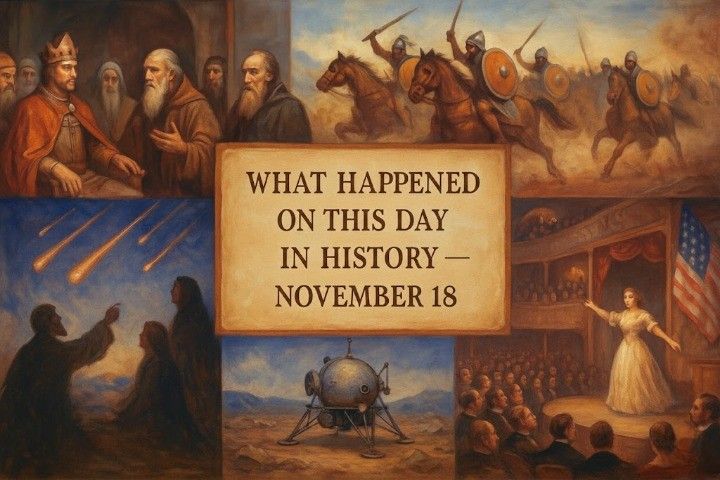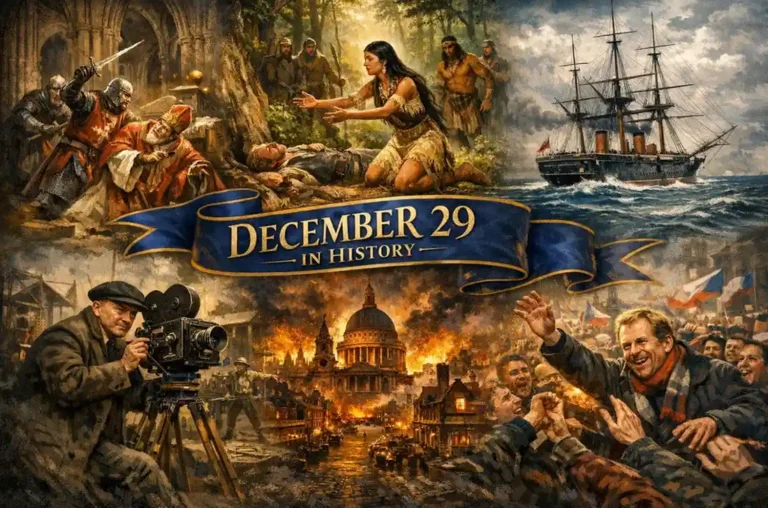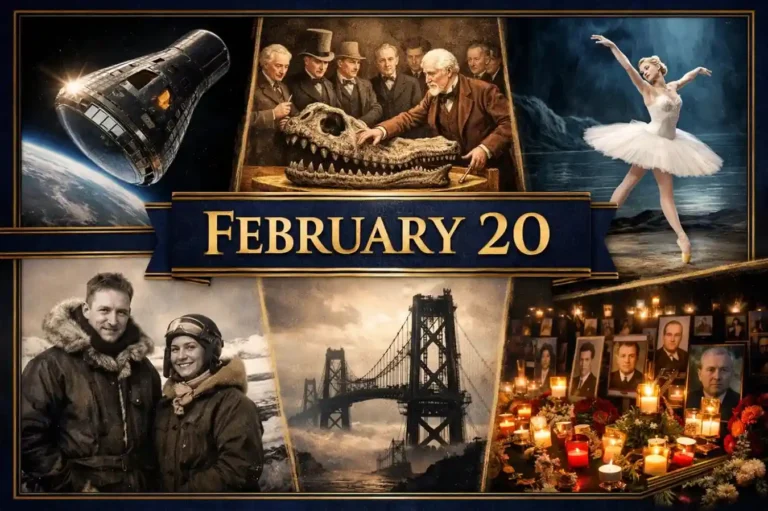

Today in History — September 19 threads together empire, invention, protest, and natural disaster. From Roman succession crises and medieval battlefields to modern earthquakes, viral discoveries, and civic uprisings, the date keeps resurfacing as a crossroads where politics, culture, and science collide.
Major Events on September 19
96 — Nerva declared emperor after Domitian’s death
On September 19, 96, the Roman Senate declared Nerva emperor after the assassination of Domitian and annulled laws passed under his rule. Statues and symbols of Domitian’s reign were ordered removed as a symbolic break with his tyranny.
Nerva’s elevation began a new phase in the Flavian succession and stabilized the imperial household—if only briefly—by restoring senatorial dignity and curbing autocratic excess.
634 — Siege of Damascus: Rashidun capture the city
The Rashidun forces under Khalid ibn al-Walid captured Damascus from the Byzantine Empire, consolidating early Islamic control in Syria. The fall of Damascus marked a key step in the rapid expansion of the Rashidun Caliphate across the Levant.
It reshaped regional administration and trade routes and signalled a major shift in Mediterranean power balances.
1356 — Battle of Poitiers: English victory and royal capture
At Poitiers an English army led by Edward the Black Prince defeated French forces and took King John II captive. The victory deepened France’s political crisis during the Hundred Years’ War and extracted a costly ransom that strained royal finances.
Poitiers reinforced English tactical strengths—longbowmen and maneuver—while producing long-term destabilizing effects for France’s monarchy.
1410 — End of the Siege of Marienburg (Malbork)
The Teutonic Order successfully repelled the Polish–Lithuanian siege of Marienburg, preserving its stronghold at a key moment in northern European conflict. The event underscored the Order’s military resilience and illustrated the contested border politics of the Baltic. The failed siege left both sides recalibrating strategies for influence in the region.
1676 — Bacon’s Rebellion: Jamestown burned
During Bacon’s Rebellion, Nathaniel Bacon’s forces burned Jamestown to the ground, signaling a violent episode of colonial unrest in Virginia. The uprising reflected deep grievances over frontier defense, government corruption and unequal access to land. Though ultimately suppressed, the rebellion forced colonial elites to reconsider frontier policies and labor systems.
1777 — First Battle of Saratoga (tactically costly British victory)
On September 19, 1777 British troops won a hard-fought tactical victory in the First Battle of Saratoga, though strategic momentum shifted toward the Americans in the Saratoga campaign. The fighting revealed the complexities of supply, terrain and militia coordination in the Revolutionary War. Saratoga’s broader campaign would still produce a major turning point for American diplomacy by helping secure French support.
1778 — Continental Congress passes the first federal budget
The Continental Congress approved the first American federal budget, an early step toward standardized national finance amid wartime exigencies. Establishing public accounts and funding commitments helped sustain the Continental Army and the new government’s administrative needs. The budget process marked an institutionalizing moment for federal fiscal practice.
1796 — Washington’s Farewell Address printed nationwide
George Washington’s Farewell Address was widely printed as an open letter on September 19, 1796, giving the public his parting counsel on neutrality, civic virtue, and the dangers of partisan rancor. The address shaped early American political culture and remains a touchstone in debates about foreign policy and national unity. Its publication made Washington’s warnings available to a broad citizenry at a pivotal constitutional moment.
1799 — Battle of Bergen (French-Dutch vs. Russian-British)
In the Battle of Bergen a French-Dutch force won against Russian and British elements, a contest in the chaotic closing phases of the Revolutionary wars. The engagement reflected shifting coalitions and the fluid military map of late-eighteenth-century Europe. Bergen’s outcome contributed to the realignments that preceded Napoleonic-era diplomacy.
1846 — La Salette Marian apparition reported
Two French shepherd children reported a Marian apparition near La Salette, an event later commemorated by the Church as Our Lady of La Salette. The apparition stimulated local devotion and became part of nineteenth-century Marian revival movements. Pilgrimage and devotional practices around La Salette shaped Catholic spiritual life in the region.
1852 — Discovery of asteroid Massalia
Italian astronomer Annibale de Gasparis discovered the asteroid Massalia on September 19, 1852 from Capodimonte Observatory, contributing to nineteenth-century planetary astronomy. Each new minor planet expanded knowledge of the solar system’s structure and encouraged systematic sky surveys. Massalia remains one of the principal asteroids in the main belt.
1862 — Rosecrans defeats Sterling Price (Civil War)
Union forces under William Rosecrans defeated a Confederate command led by Sterling Price on September 19, 1862, actions that were part of wider operations in the trans-Mississippi theater. The engagements interrupted Confederate plans and affected local control of key logistics routes. Such fights show how regional commanders shaped Civil War momentum outside the main eastern campaigns.
1863 — First day of the Battle of Chickamauga
September 19, 1863 saw the opening day of Chickamauga, a brutal encounter in northwestern Georgia that became the bloodiest two-day battle of the American Civil War and the Confederacy’s major victory in the Western Theater. Union and Confederate forces fought for control of critical rail and river lines, producing large casualties and chaotic retreats. The battle altered campaigns for Chattanooga and underscored the war’s high human cost.
1864 — Sheridan’s victories in the Shenandoah Valley
Union General Philip Sheridan defeated Confederate forces under Jubal Early in operations beginning around September 19, 1864, part of an offensive that neutralized Confederate threats to the North and Virginia. With more than 50,000 troops engaged over the campaign, the fighting demonstrated how coordinated maneuver and logistics could tip regional balances. Sheridan’s successes helped secure Union supply lines and pressure Confederate strategic options.
1868 — La Gloriosa begins (Spain)
La Gloriosa, the 1868 revolution in Spain, began on this date and would depose Queen Isabella II, ushering a turbulent period of political change and attempts at liberal reform. The uprising reflected social, military and political dissatisfaction with the Bourbon regime. Its aftermath reshaped Spanish institutions and set the stage for later constitutional experiments.
1870 — Siege of Paris begins (Franco-Prussian War)
Paris came under siege in September 1870 after French defeat in the Franco-Prussian War; the city held out for months before surrendering. The siege produced urban privation, political upheaval and the collapse of the Second Empire. The later Paris Commune and long-term Franco-German tensions grew from this traumatic wartime episode.
1893 — New Zealand grants women the vote
The Electoral Act of 1893, consented to on September 19, made New Zealand the first self-governing country to grant all women the right to vote. The law marked a landmark in global suffrage movements and influenced campaigns for women’s political rights worldwide. New Zealand’s reform became a model and rallying point for later activists.
1902 — Shiloh Baptist Church stampede kills 115
A tragic stampede at Shiloh Baptist Church in Birmingham, Alabama on September 19, 1902 killed 115 people during a crowded event, prompting community mourning and safety reconsiderations. The disaster exposed the dangers of overcrowded public gatherings and led to calls for better crowd control and venue management. Local memory preserved the story as a cautionary episode in civic life.
1916 — Tabora captured in the East African Campaign
Belgian colonial forces under Charles Tombeur captured Tabora on September 19, 1916 after hard fighting, an important Allied victory in the East African Campaign of World War I. The fall of Tabora disrupted German colonial control and supported Allied advances in the region. The campaign highlighted the global reach of the First World War and the involvement of African theaters.
1939 — Battle of Kępa Oksywska concludes (Poland)
The Battle of Kępa Oksywska, fought during the German invasion of Poland, concluded with heavy Polish losses around September 19, 1939 and illustrated the rapid collapse of organized defense in parts of the country. The fighting around Polish coastal positions underscored the multi-front intensity of the September campaign. The losses contributed to Poland’s early wartime displacement and exile government.
1940 — Witold Pilecki volunteers for Auschwitz reconnaissance
Polish resistance member Witold Pilecki deliberately allowed himself to be captured and sent to Auschwitz around this period to gather intelligence and establish resistance networks—an act of extraordinary courage and clandestine documentation. His reports from inside the camp were among the earliest eyewitness accounts of Nazi atrocities. Pilecki’s mission remains a powerful story of resistance under extreme conditions.
1944 — Battle of Hürtgen Forest begins
The Battle of Hürtgen Forest began on September 19, 1944, and became a long, grinding engagement in dense terrain that proved costly for U.S. forces. The fighting, marked by difficult weather and fortified German defenses, stretched into months and ranks among the U.S. Army’s longest single battles. Hürtgen would shape later tactical debates about terrain, attrition and offensive planning.
1944 — Moscow Armistice ends Continuation War (Finland)
Finland and the Soviet Union signed the Moscow Armistice, officially ending the Continuation War on September 19, 1944 and imposing territorial, economic and political terms on Finland. The agreement forced Finnish demobilization, reparations and realignment in Northern Europe. Its terms shaped Finland’s Cold War posture and domestic politics in the postwar decades.
1946 — Churchill’s Zurich speech urges European unity
Winston Churchill delivered his influential Zurich speech in September 1946, arguing for the creation of a “United States of Europe” and helping to catalyze postwar integration projects. The address galvanized thinkers and policymakers seeking institutions to anchor peace and cooperation. The speech fed a chain of ideas that later contributed to institutions such as the Council of Europe.
1950 — Battle of Nam River repelled (Korean War)
During the Korean War, defensive actions repelled North Korean attacks near Nam River around September 19, 1950, reflecting the ebb and flow of front-line engagements in the early months of the conflict. Local successes and failures on such axes affected supply lines and larger operational plans. The fighting illustrated how tactical victories sometimes presaged broader operational shifts.
1960 — Indus Waters Treaty signed by Nehru and Ayub Khan
India and Pakistan signed the Indus Waters Treaty on September 19, 1960, agreeing on the sharing and management of the Indus basin’s rivers and embedding a rare durable technical accord between rivals. The treaty established a commission and dispute-resolution mechanisms that have endured despite political tensions. It remains a foundational example of transboundary water cooperation.
1970 — First Glastonbury Festival hosted by Michael Eavis
Michael Eavis organized the first Glastonbury Festival on September 19, 1970 (then called the Pilton Pop, Folk & Blues Festival), launching what would become one of the world’s most famous music gatherings. The modest rural event grew into a major cultural institution blending music, politics and social causes. Glastonbury’s origin story is central to British festival culture.
1970 — Kostas Georgakis self-immolates in protest
Greek student Kostas Georgakis set himself on fire in Genoa as a political protest against the Papadopoulos junta, an extreme act of dissent that resonated among exiled opponents of the regime. His self-immolation highlighted the reach of authoritarian repression and the desperation of anti-dictatorship activism. Georgakis’s protest became a symbol of resistance for Greek dissidents abroad.
1976 — Turkish Airlines Flight 452 crashes into Taurus Mountains
Turkish Airlines Flight 452 struck the Taurus Mountains near Karatepe on September 19, 1976, killing all 154 on board in a tragic aviation accident. The crash prompted investigations into navigation, weather and air-traffic control procedures. It remains one of Turkey’s deadliest civil aviation disasters.
1976 — Imperial Iranian Air Force jets investigate UFO report
Two Imperial Iranian Air Force F-4 Phantom IIs reportedly intercepted and investigated an unidentified aerial phenomenon on this date—an episode that entered the UFO chronicles of the 1970s. While explanations vary, such events reflect the Cold War era’s high surveillance posture and public interest in unexplained aerial sightings.
1978 — Solomon Islands join the United Nations
The Solomon Islands were admitted to the United Nations on September 19, 1978, expanding international representation for newly independent Pacific states. UN membership marked a diplomatic milestone and provided the new state with global forums for development and security concerns. The accession highlighted decolonization’s continuing geographic sweep.
1982 — First emoticons posted by Scott Fahlman
Computer scientist Scott Fahlman posted the first documented emoticons ( 🙂 and 🙁 ) on a Carnegie Mellon bulletin board on September 19, 1982, a small technical note that would eventually shape online expression. Emoticons anticipated later emoji and changed how tone and humor are conveyed in text. This modest invention has had outsized cultural impact in digital communication.
1983 — Saint Kitts and Nevis gains independence
Saint Kitts and Nevis became independent on September 19, 1983, celebrating nationhood and entry into the community of sovereign states. Independence reshaped local governance and international relations for the twin-island federation. The day remains a national holiday marking self-determination.
1985 — Mexico City earthquake kills thousands
A powerful earthquake struck Mexico City on September 19, 1985, killing thousands and destroying hundreds of buildings; the disaster exposed construction vulnerabilities and spurred major changes in building codes and emergency response. The tragedy mobilized civil society and reshaped urban planning. Mexico’s recovery process became a long, politicized national effort.
1985 — Parents Music Resource Center hearings and cultural debate
In 1985 politicians’ spouses including Tipper Gore helped form the Parents Music Resource Center and testified before Congress, sparking heated hearings on music lyrics, obscenity and media regulation. Musicians such as Frank Zappa and John Denver testified in defense of creative freedom. The hearings produced the “Parental Advisory” sticker and a lasting debate about censorship and cultural politics.
1989 — UTA Flight 772 destroyed by a bomb over Niger
UTA Flight 772 was destroyed by an in-flight bomb over the Ténéré Desert on September 19, 1989, killing all 170 aboard and prompting international investigations into terrorism and aviation security. The attack intensified global efforts to harden passenger aviation against politically motivated violence. It also led to protracted legal and diplomatic responses.
1991 — Ötzi the Iceman discovered in the Alps
Hikers found a remarkably preserved mummified body—Ötzi the Iceman—on a glacier on September 19, 1991; scientific study of the find revolutionized knowledge of late Neolithic life, diet and technology in the Alps. Ötzi provided direct biological and material evidence for archaeologists and spurred multidisciplinary research. The discovery remains one of archaeology’s most remarkable human finds.
1995 — Unabomber manifesto published
The Unabomber’s manifesto, a long anti-technology tract by Ted Kaczynski, was published in major newspapers on September 19, 1995, a gambit that eventually led to his identification and arrest. The publication raised fraught questions about media responsibility and law-enforcement strategy. The case remains a study in criminal psychology and investigative tradecraft.
1997 — Guelb El-Kebir massacre (Algeria)
The Guelb El-Kebir massacre on September 19, 1997 claimed dozens of lives and was part of the violence that wracked Algeria during the 1990s. The attack illustrated the brutal toll of internal conflict and the human consequences of political instability. It remains a painful memory in Algeria’s modern history.
2006 — Thai military coup and martial law
On September 19, 2006 the Thai army staged a coup d’état, revoked the constitution and declared martial law, producing a major rupture in the country’s political order. The coup reflected chronic tensions between civilian governments and military institutions in Thailand. Its aftermath influenced political polarization and legal reform debates.
2008 — Learjet crash carrying Travis Barker and DJ AM
A Learjet 60 crashed during a rejected takeoff on September 19, 2008 carrying musicians including Travis Barker and Adam “DJ AM” Goldstein; four of the six aboard died while Barker and Goldstein survived with severe injuries. The accident prompted inquiries into aircraft maintenance and safety oversight. Survivors’ recoveries and media coverage highlighted the human toll of the crash.
2010 — Deepwater Horizon well sealed
BP announced on September 19, 2010 that the leaking Deepwater Horizon well had been successfully sealed, closing a catastrophic oil spill that had begun in April and devastated Gulf ecosystems. The capping marked an important milestone in cleanup and restoration efforts, even as legal and environmental consequences continued. The spill reshaped offshore drilling regulation and corporate accountability discussions.
2011 — Mariano Rivera sets MLB career saves record (602)
On September 19, 2011 Mariano Rivera recorded his 602nd career save, surpassing Trevor Hoffman and becoming Major League Baseball’s all-time saves leader at that time. Rivera’s achievement celebrated consistency and longevity in professional sports and enhanced his Hall of Fame credentials. His record highlighted the cultural place of elite athletes in contemporary life.
2016 — Suspect apprehended after NY/NJ bombings
Following a manhunt, law enforcement apprehended the suspect in a series of bombings in New York and New Jersey after a shootout on September 19, 2016, bringing the immediate threat to an end. The episode prompted intense local investigation and public debate about radicalization and urban security. The arrest offered some closure while catalyzing policy and intelligence reviews.
2017 — Puebla earthquake devastates central Mexico
A magnitude-7.1 earthquake struck central Mexico on September 19, 2017—tragically coinciding with the anniversary of the 1985 quake—causing hundreds of deaths, thousands of injuries and widespread building collapses. The disaster prompted massive rescue efforts and renewed scrutiny of building standards. Communities and governments faced long recovery and reconstruction tasks.
2021 — Cumbre Vieja eruption begins on La Palma
The eruption of Cumbre Vieja on La Palma began on September 19, 2021 and continued for nearly three months, forcing evacuations, destroying property and reshaping landscapes on the Canary Island. The volcanic event became a case study in hazard response, monitoring and community resilience. Its long duration tested emergency planning and recovery capacity.
2022 — State funeral for Queen Elizabeth II at Westminster Abbey
On September 19, 2022 the state funeral for Queen Elizabeth II was held at Westminster Abbey; the ceremony and lying-in-state attracted millions of mourners and international attention. The occasion marked the end of a 70-year reign and a moment of national and global reflection on monarchy, continuity and change. The funeral triggered discussions about constitutional succession and public memory.
2022 — Michoacán earthquake strikes Mexico
A strong quake in Michoacán on September 19, 2022 killed at least two people and injured dozens, adding to the country’s string of seismic shocks and underlining the ongoing vulnerability of many communities to earthquakes. The event prompted rapid emergency responses and localized damage assessments. Authorities and citizens faced renewed rebuilding needs and preparedness questions.
2023 — Azerbaijan launches offensive in Nagorno-Karabakh (Artsakh)
On September 19, 2023 Azerbaijan began a military offensive against the de facto Republic of Artsakh, precipitating the flight of most of the Armenian population and a rapid political reordering in the region. The offensive brought renewed international concern over human rights, displacement and regional stability. The episode closed a long chapter of frozen conflict and raised urgent humanitarian questions.
Earlier History
96 — Nerva declared emperor after Domitian’s death.
634 — Siege of Damascus captured by Rashidun forces.
1356 — Battle of Poitiers; English capture of King John II.
1410 — Siege of Marienburg ends.
1676 — Jamestown burned during Bacon’s Rebellion.
Exploration & Colonial Foundations
1759 — Articles of Capitulation of Quebec (British control).
1796 — Washington’s Farewell Address printed nationwide.
1837 — Tiffany & Co. founded in New York.
1916 — Tabora captured (East African Campaign).
Wars & Politics
1777 — First Battle of Saratoga.
1863 — Battle of Chickamauga begins.
1870 — Siege of Paris opens (Franco-Prussian War).
1944 — Moscow Armistice ends Continuation War (Finland).
2006 — Thai military coup and martial law.
Arts & Culture
1852 — Discovery of asteroid Massalia (science culture).
1927 — CBS goes on air (broadcast media).
1970 — First Glastonbury Festival.
1982 — First emoticons posted (digital culture).
1995 — Unabomber manifesto sparks media debate.
Science, Technology & Media
1868 — La Gloriosa (political science context).
1928 — First autogyro channel crossing (aviation).
1991 — Ötzi discovered (archaeology & paleo-science).
2010 — Deepwater Horizon capped (environmental tech & policy).
2021 — Cumbre Vieja eruption (volcanology & hazard response).
Disasters & Human Rights
1902 — Shiloh Baptist Church stampede.
1928/1879—(context) natural disasters in records.
1985 — Mexico City earthquake.
1989 — UTA Flight 772 bombing.
2017 — Puebla earthquake.
2022 — Michoacán earthquake.
2023 — Artsakh offensive and displacement.
Notable Births on September 19 (selection)
- 866 — Leo VI, Byzantine emperor.
- 1737 — Charles Carroll, signer of the U.S. Declaration.
- 1819 — Léon Foucault, physicist (Foucault pendulum).
- 1843 — Charles Valentine Riley, entomologist.
- 1907 — Lewis F. Powell Jr., U.S. Supreme Court Justice.
- 1911 — William Golding, novelist, Nobel laureate.
- 1922 — Emil Zátopek, Olympic long-distance runner.
- 1936 — Al Oerter, U.S. Olympic discus champion.
- 1973 — Mark Shuttleworth, entrepreneur and space tourist.
Notable Deaths on September 19 (selection)
- AD 96 — Domitian, Roman emperor (assassinated).
- 1668 — Sir William Waller, Parliamentary commander.
- 1761 — Pieter van Musschenbroek, physicist (Leyden jar).
- 1819 — John Langdon, American Founding-Era leader.
- 1961 — Dag Hammarskjöld, UN Secretary-General (air crash).
- 1970 — Jimi Hendrix, influential guitarist.
- 2020 — Ruth Bader Ginsburg, U.S. Supreme Court Justice.
Observances & Institutional Dates
- Armed Forces Day (Chile) — national observance.
- Second day of Fiestas Patrias (Chile) — public holiday.
- Feast of San Gennaro and various Christian liturgical commemorations.
- Day of the First Public Appearance of the Slovak National Council; Island Language Day (Okinawa); World Water Monitoring Day.
- International Talk Like a Pirate Day — cultural/novelty observance.
Read here about September 18 facts & events
Final Thoughts on Today in History: September 19
September 19 repeatedly surfaces at the intersection of sudden rupture and institutional response: emperors fall and new rulers are proclaimed, towns burn and are rebuilt, inventions and discoveries expand human understanding, and communities are tested by natural and human-made disasters.
Reading these events together helps us see patterns—how power is exercised, how societies repair, and how memory attaches to particular calendar dates. That mixture of continuity and contingency is why “Today in History — September 19” still matters.
FAQs About September 19
When did the Battle of Chickamauga begin?
The Battle of Chickamauga opened on September 19, 1863; it was a major, bloody engagement in northwestern Georgia and the Confederacy’s principal victory in the Western Theater.
When was Washington’s Farewell Address published?
George Washington’s Farewell Address was printed and widely distributed on September 19, 1796 as an open letter offering guidance on foreign policy and civic virtue.
When was Ötzi the Iceman discovered?
Hikers discovered Ötzi the Iceman in the Alps on September 19, 1991; subsequent scientific study transformed knowledge of Copper Age Europe.
What happened on September 19, 1985 in Mexico City?
A catastrophic earthquake struck Mexico City on September 19, 1985, killing thousands and causing massive urban destruction that prompted major changes in building codes and disaster response.