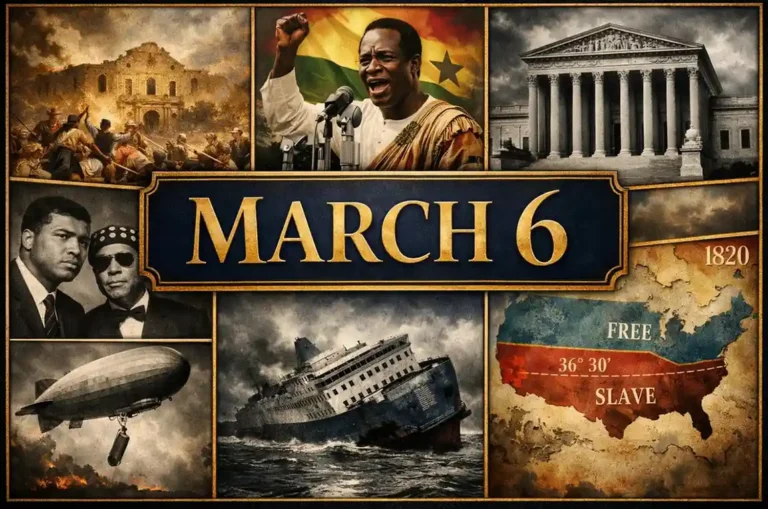
Today in History — September 20 gathers rebellions, voyages, legal firsts, and modern crises into a single, surprising line of continuity. From Magellan’s great departure and medieval battles to civil rights milestones and recent natural disasters, the date keeps returning as a hinge where exploration, politics, and popular action meet.
Major Events on September 20
1058 — Negotiations over Burgenland border territory
Agnes of Poitou and Andrew I of Hungary met to negotiate the border territory later known as Burgenland, an early example of medieval territorial diplomacy that foreshadowed many later Central European border settlements.
1066 — Battle of Fulford: Harald Hardrada defeats local earls
At Fulford, invading Norwegian king Harald Hardrada routed earls Morcar and Edwin, a prelude to the famous Norman Conquest later that year. The victory demonstrated the volatility of northern English politics and set in motion a chain of events culminating in the struggle for the English crown.
1187 — Saladin begins the Siege of Jerusalem
Saladin’s siege of Jerusalem marked a decisive moment in the Crusader era, leading to the city’s surrender and reshaping Christian–Muslim relations in the Levant. The capture energized both Muslim resurgence and new crusading efforts in Europe.
1260 — Great Prussian Uprising begins
The indigenous Old Prussians launched a major uprising against the Teutonic Knights, starting a protracted and violent struggle over land, culture, and conquest in the Baltic region. The rebellion revealed the limits of crusading-state expansion and the persistence of local resistance.
1378 — Papal schism begins with election of Clement VII
Cardinal Robert of Geneva was elected Pope Clement VII, initiating the Western Schism that split Christendom between rival papal claimants and produced decades of ecclesiastical and political turmoil across Europe.
1498 — Nankai tsunami damages the Great Buddha at Kōtoku-in
A powerful tsunami at Nankai washed away the building housing the Great Buddha at Kōtoku-in; left exposed, the statue has remained outdoors ever since and became an enduring cultural icon in Kamakura.
1519 — Magellan sets sail from Sanlúcar de Barrameda
Ferdinand Magellan departed with about 270 men on the expedition that would accomplish the first circumnavigation of the globe (though Magellan himself died en route). The voyage remapped global navigation, accelerated European contact across oceans, and rewired early modern trade routes.
1586 — Executions for the Babington Plot
Several conspirators in the Babington Plot were executed by hanging, drawing and quartering after an abortive attempt to assassinate Elizabeth I and restore Mary, Queen of Scots. The brutal punishment underscored the period’s high stakes in dynastic and religious politics.
1602 — Siege of Grave ends; Maurice of Orange victorious
The Spanish-held Dutch town of Grave capitulated to Maurice of Orange’s besieging forces (with English allies), an episode within the wider Dutch struggle for independence that consolidated rebel control in parts of the Low Countries.
1697 — Treaty of Ryswick ends the Nine Years’ War
The Treaty of Ryswick brought peace between major European powers—France, England, Spain, the Holy Roman Empire and the Dutch Republic—resetting colonial and continental claims after years of exhausting conflict.
1737 — Walking Purchase concludes (Pennsylvania)
The controversial Walking Purchase forced the cession of some 1.2 million acres of Lenape-Delaware land to Pennsylvania authorities, a coercive land deal that exacerbated frontier tensions and remains a sore point in colonial-era Indigenous relations.
1792 — Battle of Valmy halts allied invasion of France
French troops repulsed a coalition invasion at Valmy, a morale-boosting victory that helped preserve the French Revolution and allowed the new Republic to consolidate power amid external threats.
1835 — Ragamuffin War begins in Brazil
Rebels seized Porto Alegre, launching the Ragamuffin War, a decade-long conflict that reflected regional grievances against central authority in the young Brazilian state and influenced the country’s federal politics.
1854 — Battle of Alma (Crimean War)
British and French forces defeated the Russians at the Battle of Alma, an early allied success that exposed Russian vulnerabilities and marked a turning point in the Crimean campaign.
1857 — End of major hostilities in the Indian Rebellion
The recapture of Delhi and related operations around this time signalled the effective end of the 1857 Indian Rebellion’s major organized resistance, with profound consequences for British rule and Indian society.
1860 — Prince of Wales begins North American visit
The future King Edward VII undertook the first official visit to North America by a Prince of Wales, a diplomatic and cultural tour that symbolized changing imperial and transatlantic ties.
1863 — Battle of Chickamauga ends with Confederate victory
At Chickamauga in northwestern Georgia Confederate forces won a costly victory, the Confederacy’s major triumph in the Western Theater, producing heavy casualties and complex strategic consequences for both sides.
1870 — Bersaglieri enter Rome; Italian unification nears completion
Italian troops breached Rome’s defenses at Porta Pia, effectively ending Papal temporal power and completing the unification of Italy under the Kingdom of Italy. The event reconfigured Italian politics and the church–state relationship.
1871 — Martyrdom of Bishop John Coleridge Patteson
Missionary bishop John Coleridge Patteson was killed on Nukapu in the Solomons, an event that drew attention to the perils of early Pacific missions and the fraught contact between Europeans and island communities.
1881 — Chester A. Arthur sworn in as U.S. President
Following President Garfield’s death, Chester A. Arthur took the oath of office, an abrupt leadership transition that tested constitutional processes and the functioning of American government.
1893 — Duryea brothers test first American gasoline car
Charles Duryea and his brother road-tested the first American-made gasoline-powered automobile, an experimental event that presaged the auto age and changed mobility and industry.
1911 — RMS Olympic collides with HMS Hawke
The White Star liner RMS Olympic collided with the warship HMS Hawke, an incident that highlighted maritime risks in a period of rapid naval expansion and passenger shipping.
1920 — Balbriggan burned by the “Black and Tans” (Irish War of Independence)
British forces known as the Black and Tans burned Balbriggan and killed two locals in reprisals following an IRA assassination—one of many brutal episodes in the escalating conflict for Irish independence.
1941 — Mass execution in Nemenčinė during the Holocaust in Lithuania
Lithuanian collaborators and Nazi forces began mass executions of Jews in Nemenčinė, part of the terrible, systematic genocidal campaign across Eastern Europe.
1946 — First Cannes Film Festival held
After wartime delays, the Cannes Film Festival opened for the first time, inaugurating one of the world’s most prestigious film gatherings and reshaping global cinema culture and distribution.
1954 — Moomin comics published internationally
Tove and Lars Jansson’s Moomin comics appeared internationally in London’s Evening News, beginning the global spread of an enduring Nordic comics and cultural franchise.
1962 — James Meredith temporarily blocked from enrolling at the University of Mississippi
James Meredith, the African American civil-rights figure, was initially barred from entering the University of Mississippi—an episode that presaged federal intervention and violent clashes over desegregation.
1965 — Indian capture of Dograi (Indo–Pakistani War)
Following the Battle of Burki, Indian forces captured Dograi—an important tactical objective during the 1965 Indo–Pakistani War—shaping local frontlines and national narratives.
1967 — Launch of the Queen Elizabeth 2 (QE2)
The Cunard liner QE2 was launched at Clydebank, Scotland, entering a new chapter for transatlantic passenger shipping and maritime design.
1971 — Hurricane Irene/Olivia crosses from the Atlantic to Pacific
The storm that became Hurricane Olivia was the first documented hurricane to cross from the Atlantic basin into the Pacific, an unusual meteorological event that tested tracking and naming conventions.
1973 — “Battle of the Sexes”: Billie Jean King defeats Bobby Riggs
Billie Jean King’s victory over Bobby Riggs at the Houston Astrodome became an iconic moment for women’s sports and gender politics, helping to change perceptions about female athletes and equality in sport.
1973 — Fatal plane crash kills Jim Croce and Maury Muehleisen
Singer Jim Croce, guitarist Maury Muehleisen and four others died in a small-plane crash after takeoff in Louisiana, a sudden tragedy that cut short two promising musical careers.
1977 — Vietnam admitted to the United Nations
Vietnam’s admission to the UN symbolized its postwar diplomatic normalization and integration into global institutions after decades of conflict.
1979 — Overthrow of Emperor Bokassa in the Central African Empire
A French-backed coup deposed Bokassa I, ending his controversial rule and returning the country to a different constitutional arrangement—an example of late-Cold War-era African political turbulence.
1982 — NFL players begin 57-day strike
National Football League players launched a strike that lasted 57 days, disrupting the season and underlining labor tensions in a major American sport.
1984 — U.S. embassy car-bombing in Beirut kills 22
A suicide car-bomb attack struck the U.S. embassy in Beirut, killing twenty-two people and marking a grim escalation of attacks on diplomatic missions in the region.
1989 — USAir Flight 5050 crashes at LaGuardia
USAir Flight 5050 crashed into Bowery Bay during a rejected takeoff, killing two and prompting airline-safety investigations and procedural reforms.
1990 — South Ossetia declares independence from Georgia
South Ossetia’s unilateral declaration heightened tensions in the Caucasus and presaged the ethnic and territorial conflicts that would erupt after the Soviet collapse.
2000 — MI6 building hit by RPG attack in the UK
The MI6 London building was targeted with an RPG-22 anti-tank missile in an unusual attack on British intelligence infrastructure; the incident raised questions about domestic security threats.
2001 — President George W. Bush declares a “War on Terror”
In a joint address to Congress and the nation following the September 11 attacks, President Bush framed a global response to terrorism as a “War on Terror,” a phrase that would shape U.S. foreign and domestic policy for years.
2003 — Unrest in the Maldives after prisoner killing
Civil unrest erupted in the Maldives after a prisoner was killed by guards, reflecting tensions within the country’s penal and political systems.
2007 — Jena, Louisiana rallies draw thousands in racial-justice protest
Between 15,000 and 20,000 demonstrators marched in Jena in support of six Black youths whose convictions had sparked national outrage, a major moment in contemporary U.S. civil-rights mobilization.
2008 — Islamabad Marriott hotel bombing kills 54
A massive truck-bomb detonated outside the Marriott in Islamabad, killing dozens and injuring hundreds—one of Pakistan’s deadliest terrorist strikes in a period of intense militant violence.
2011 — U.S. ends “Don’t Ask, Don’t Tell” policy
The U.S. officially ended the ban on openly gay servicemembers, allowing lesbian, gay and bisexual personnel to serve openly and marking a major policy and cultural shift in the U.S. military.
2017 — Hurricane Maria devastates Puerto Rico
Hurricane Maria made catastrophic landfall in Puerto Rico as a Category 4 storm, causing widespread destruction, a severe humanitarian crisis, and long-term disputes over recovery, accountability and infrastructure resilience.
2018 — Ukara Island ferry capsizes, hundreds dead
A ferry capsized near Ukara Island on Lake Victoria, Tanzania, killing at least 161 people and raising urgent questions about maritime safety, overloading and emergency response in regional waters.
2019 — Global climate strikes led by Greta Thunberg
Approximately four million people, especially students, demonstrated worldwide for climate action in a major youth-led mobilization; Greta Thunberg led demonstrations in New York, amplifying demands for systemic climate policies.
Earlier History
1066 — Battle of Fulford.
1187 — Saladin begins Siege of Jerusalem.
1356 — Battle of Poitiers; capture of King John II.
1410 — Marienburg siege ends.
1870 — Porta Pia; Rome incorporated into Italy.
Exploration & Colonial Foundations
1519 — Magellan departs on circumnavigation.
1737 — Walking Purchase forces Lenape land cession.
1835 — Ragamuffin War begins in Brazil.
1911 — RMS Olympic collision (maritime history).
Wars & Politics
1792 — Battle of Valmy.
1854 — Battle of Alma (Crimean War).
1863 — Chickamauga (Civil War).
2001 — “War on Terror” declared (U.S. policy shift).
1990 — South Ossetia declares independence.
Arts & Culture
1946 — First Cannes Film Festival.
1954 — Moomin comics published internationally.
1973 — “Battle of the Sexes” tennis match.
2019 — Global climate strikes (youth movement).
Science, Technology & Media
1893 — Duryea brothers’ gasoline car test (automotive history).
1967 — Launch of QE2 (maritime engineering).
1982 — First emoticons posted (digital communication origins).
2019 — Climate mobilization amplified by social media.
Disasters & Human Rights
1920 — Balbriggan reprisals.
1941 — Nemenčinė mass executions (Holocaust).
1976 — Turkish Airlines Flight 452 crash.
1985/2017/2018 — Major earthquakes and ferry disaster; Hurricane Maria (humanitarian crises).
2011 — End of “Don’t Ask, Don’t Tell” (rights expansion).
Notable Births on September 20 (selection)
- 1599 — Christian of Brunswick, military commander.
- 1744 — Giacomo Quarenghi, neoclassical architect.
- 1737 — Charles Carroll, signer of the U.S. Declaration.
- 1842 — Sir James Dewar, chemist and physicist.
- 1879 — Victor Sjöström, early cinema pioneer.
- 1917 — Red Auerbach, basketball coach and innovator.
- 1958 — Ursula Burns, Xerox CEO and business leader.
- (many other names appear in your raw list; included above are key selections per your top-20 list)
Notable Deaths on September 20 (selection)
- 1586 — Anthony Babington, executed conspirator.
- 1803 — Robert Emmet, Irish nationalist (executed).
- 1863 — Jacob Grimm, folklorist and philologist.
- 1947 — Fiorello La Guardia, New York City mayor.
- 1961 — Dag Hammarskjöld, UN Secretary-General (air crash).
- 1996 — Paul Erdős, mathematician.
- 2005 — Simon Wiesenthal, Nazi-hunter and activist.
- 2017 — Liliane Bettencourt, business executive.
Observances & Institutional Dates
- Christian feast days (multiple saints listed in liturgical calendars).
- Constitution Day (Nepal) — national observance.
- Independence Day (South Ossetia) — not fully internationally recognized.
- National Youth Day (Thailand); Oil Workers’ Day (Azerbaijan); Universal Children’s Day (Germany).
- International Talk Like a Pirate Day — cultural novelty observance.
If You Want To Read About September 19: Click Here
Final Thoughts on Today in History: September 20
September 20 offers a compressed view of human history: voyages that stretched world maps, battles that rearranged states, social movements that changed civic life, and disasters that tested societies’ resilience.
FAQs About September 19
When did Ferdinand Magellan set sail on his circumnavigation?
Ferdinand Magellan departed Sanlúcar de Barrameda on September 20, 1519, with about 270 men, launching the expedition that completed the first circumnavigation of the globe (Magellan died en route).
What happened at the Battle of Alma?
On September 20, 1854, British and French forces defeated Russian troops at the Battle of Alma, an important early allied victory in the Crimean War that exposed Russian strategic vulnerabilities.
When did the U.S. end “Don’t Ask, Don’t Tell”?
The United States officially ended the “Don’t Ask, Don’t Tell” policy in 2011, allowing gay and lesbian service members to serve openly in the military.
What was the humanitarian impact of Hurricane Maria in 2017?
Hurricane Maria made landfall in Puerto Rico on September 20, 2017, as a Category 4 hurricane, causing catastrophic damage, widespread infrastructure collapse, and a death toll that remains a subject of investigation and debate; recovery and accountability became major national issues.