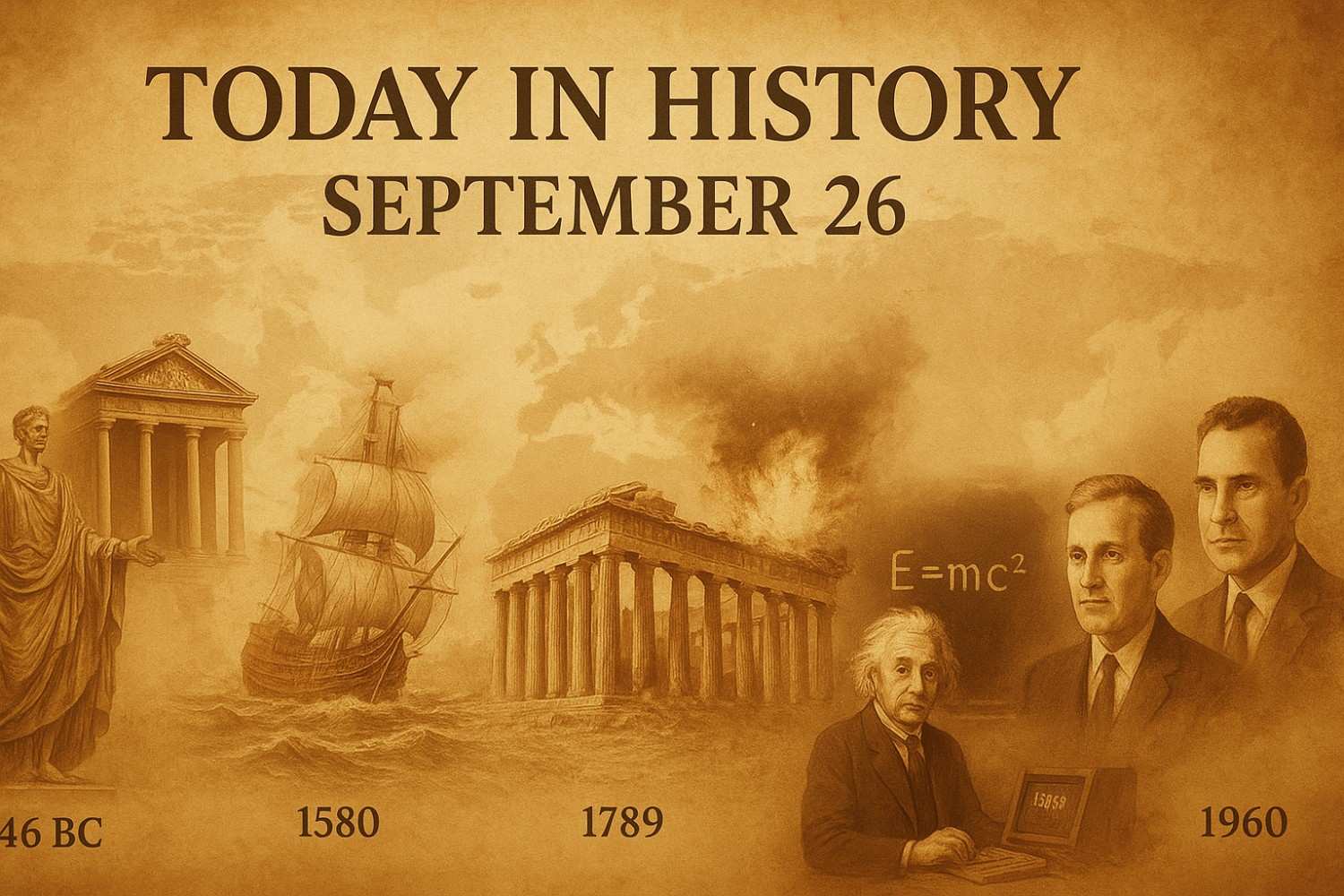
This date stitches together foundational laws, dramatic battles, exploration firsts, and modern catastrophes. Today in History September 26 highlights temple dedications and circumnavigations, battlefield upsets and seismic shocks, media-first debates and close calls that changed political and scientific practice.
Major Events on September 26
46 BC — Julius Caesar Dedicates a Temple to Venus Genetrix
Julius Caesar fulfilled a vow made at Pharsalus by dedicating a temple to Venus Genetrix, publicly linking his family and political program to Rome’s mythic ancestry. The dedication was both devotional and deliberately propagandistic: it reinforced Caesar’s claim to divine favor and signaled continuity after civil war. Monumental religion like this served as a stage for elite legitimacy in late Republican Rome.
The temple and its cult became part of the Julio-Claudian symbolic toolkit used by successors to assert authority.
715 — Battle of Compiègne: Ragenfrid Defeats Theudoald
In 715, Ragenfrid routed Theudoald at Compiègne during a volatile phase of Merovingian politics, a clash that helped shape the transition toward Carolingian dominance. The victory strengthened regional aristocratic power and weakened competing claimants, accelerating processes that would elevate figures like Charles Martel.
These struggles over the mayoralty of the palace and royal authority remade the political map of early medieval Francia. They also illustrate how local military successes translated into long-term dynastic change.
1087 — William II Crowned King of England (William Rufus)
William II was crowned in 1087 following William the Conqueror’s death, inheriting a kingdom still consolidating Norman rule and feudal governance. His reign balanced revenue extraction, hunting-centered royal culture, and recurring tensions with church leaders and magnates.
William Rufus’s policies tested the reach of central authority across England and Normandy and provoked aristocratic friction. His unexpected death in 1100 opened another chapter of contested succession in Norman England.
1212 — Golden Bull of Sicily Confirms Přemyslid Royal Title in Bohemia
The Golden Bull of Sicily formalized a hereditary royal title for the Přemyslid dynasty in Bohemia, clarifying dynastic and imperial relationships in Central Europe. The charter regulated succession and privileges, strengthening Bohemian sovereignty within the patchwork of Holy Roman imperial politics.
Legal instruments like this shaped how medieval polities negotiated autonomy and imperial overlordship. The bull helped anchor Bohemia’s political identity for later centuries.
1345 — Battle of Warns: Frisians Defeat Holland
The Battle of Warns saw Frisian forces beat Hollandic troops, a regional victory that checked Hollandic encroachment on Frisian autonomy. Local maritime communities used terrain, naval skill, and guerrilla-style tactics to resist expansion by larger princedoms.
Warns endures in Frisian memory as a symbol of independence and local resilience. The clash influenced coastal politics in the Low Countries during a fractious late-medieval period.
1371 — Battle of Maritsa: Ottoman Forces Rout Serbian Army
At Maritsa Ottoman forces won a decisive victory over a Serbian army in 1371, accelerating Ottoman expansion into the Balkans and undermining coordinated regional resistance. The rout fragmented local lordships and opened new routes for Ottoman incursions across southeastern Europe.
Maritsa’s strategic consequences reshaped alliance networks and paved the way for later conquests. The battle marks an important inflection in the region’s shift toward Ottoman dominance.
1423 — Battle of La Brossinière: French Defeat the English
In 1423 French forces defeated the English at La Brossinière during the Hundred Years’ War, a local victory that helped blunt English operations in western France. The engagement illustrated the increasing competence of French regional armies and the difficulties the English faced in holding extended lines.
Accumulated local reverses like La Brossinière contributed to the longer-term French reconquest under Charles VII. The battle is one of many that altered the war’s momentum in the 15th century.
1493 — Papal Bull Dudum siquidem Extends Spanish Grants in the New World
Pope Alexander VI issued Dudum siquidem, widening the territorial grants earlier given to Spain by Inter caetera and further delineating Iberian spheres across the Atlantic. Such papal bulls supplied religious legitimation for colonial claims and helped ordain early imperial boundaries—often to the frustration of rival powers.
The document shaped diplomatic rivalries and navigational ambitions in the Age of Discovery. Its effects are woven into the legal and moral debates over colonization that followed.
1513 — Vasco Núñez de Balboa Sights the Pacific Ocean
Vasco Núñez de Balboa climbed a Darién peak and became the first European to see the ocean later named the Pacific, a momentous geographic revelation that redirected European maritime ambitions. Balboa’s sighting suggested a transoceanic world that transformed maps, trade goals and imperial strategy.
The discovery inaugurated Spain’s broader interest in trans-Pacific routes and influenced later colonizing projects. This “first glimpse” remains a signature event of early exploration.
1580 — Francis Drake Completes His Circumnavigation of the Globe
Sir Francis Drake returned to Plymouth in 1580 after completing a circumnavigation, a voyage that mixed exploration, privateering, and imperial audacity. Drake’s expedition brought naval intelligence, wealth, and prestige, helping erode Iberian sea dominance and strengthening English maritime confidence.
His voyage became part of Elizabethan naval lore and helped legitimize future English seafaring enterprises. Drake’s return marked a shift in the balance of Atlantic power.
1687 — Parthenon Damaged During the Siege of the Acropolis (Morean War)
The Parthenon suffered catastrophic damage in 1687 when Venetian bombardment ignited an Ottoman gunpowder magazine stored in the temple, shattering sculptures and architecture. The explosion transformed an iconic classical monument into a ruin and intensified European antiquarian interest and later debates about preservation and cultural patrimony.
The event crystallized early modern anxieties about war’s impact on cultural heritage and fed collecting and conservation movements. The loss reshaped the Parthenon’s symbolic status across Europe.
1688 — Amsterdam Backs William of Orange’s Invasion, Enabling the Glorious Revolution
Amsterdam’s city council voted to support William of Orange in 1688, lending naval and financial backing that proved decisive for the Glorious Revolution in England. Dutch municipal and merchant interests aligned against James II’s policies, helping secure William’s landing and the subsequent constitutional settlement that limited royal prerogative.
The revolution reoriented Anglo-Dutch relations and strengthened parliamentary governance in Britain. Amsterdam’s political choice underscores municipal influence on international affairs.
1777 — British Troops Occupy Philadelphia (American Revolution)
British forces captured Philadelphia in 1777, occupying the American capital and seizing symbolic and administrative centers of the Continental Congress. The occupation disrupted Patriot governance and inflamed both civilian suffering and military countermeasures.
Though tactically significant, holding Philadelphia proved logistically demanding and did not secure decisive strategic advantage for the British. The episode remains a high point in the Revolutionary War’s middle phase.
1789 — Washington Appoints Thomas Jefferson as First U.S. Secretary of State
George Washington named Thomas Jefferson the first Secretary of State in 1789, a foundational step in shaping the new federal government’s cabinet system. Jefferson’s appointment set the tone for early executive-advisory arrangements and for the ideological balancing that would characterize the republic’s first decades.
As Secretary of State, Jefferson influenced foreign policy and institutional precedence under the Constitution. The role helped formalize the separation of executive functions and diplomatic practice.
1799 — Collapse of Suvorov’s Campaign After Franco-Austro-Russian Clashes (War of the Second Coalition)
In 1799 French forces defeated Austro-Russian elements, leading to the collapse of General Suvorov’s campaign and reshaping coalition dynamics in the War of the Second Coalition. The setbacks forced strategic reassessment among anti-French powers and illustrated the fluid fortunes of Napoleonic-era warfare.
Shifting battlefronts and leadership changes during this period influenced later campaigns and diplomatic settlements. The episode exemplifies the era’s volatile coalition politics.
1810 — Bernadotte Becomes Heir to Sweden’s Throne; New Act of Succession Adopted
A Riksdag act of succession in 1810 named Jean Baptiste Bernadotte heir to the Swedish throne, an extraordinary choice that turned a French marshal into a Scandinavian dynasty founder. Bernadotte’s selection reflected geopolitical disruption after Napoleonic upheavals and Sweden’s search for a capable ruler with continental ties.
The dynastic decision reconfigured Swedish foreign policy and monarchical lineage for generations. Bernadotte’s accession inaugurated a ruling house that persists today.
1905 — Einstein Publishes Special Theory of Relativity Paper (Annus Mirabilis)
Albert Einstein’s 1905 paper on special relativity revolutionized physics by redefining simultaneity, time dilation and the relationship between mass and energy at high speeds. The paper challenged Newtonian absolutes and laid essential groundwork for 20th-century theoretical and applied physics.
Its consequences extend into modern technologies—from particle accelerators to GPS systems—and into philosophical debates about space and time. Einstein’s Annus Mirabilis transformed the scientific method and public imagination about physics.
1907 — New Zealand and Newfoundland Promoted to Dominions (Imperial Conference Aftermath)
In 1907, following the Imperial Conference, New Zealand and Newfoundland were elevated from colonies to dominions within the British Empire, signifying a step toward greater self-government and a redefinition of imperial relationships. Dominion status acknowledged political maturity and legislative autonomy while retaining symbolic ties to the Crown.
The change reflected wider constitutional evolution across the Empire in the early 20th century. Dominion recognition shaped subsequent decolonization trajectories.
1914 — The United States Establishes the Federal Trade Commission (FTC)
Congress created the Federal Trade Commission in 1914 to police unfair business practices and protect consumers, institutionalizing Progressive Era regulatory priorities. The FTC became central to antitrust enforcement, advertising oversight and consumer protection, shaping modern U.S. market governance.
Its establishment signaled a new federal willingness to intervene against monopolistic and deceptive commercial behavior. The agency’s jurisprudence continues to influence corporate conduct and policy.
1917 — World War I: Battle of Polygon Wood Begins
The Battle of Polygon Wood (1917) formed part of the Third Battle of Ypres; it was an Allied operation aimed at seizing German defensive positions and improving tactical depth. The fighting demonstrated evolving combined-arms techniques and the brutal attritional costs of trench warfare.
Gains were often measured in yards at great human expense, shaping military doctrine and interwar reflection. Polygon Wood is remembered for tactical lessons and the heavy toll on combatants.
1918 — Meuse-Argonne Offensive Begins (Major Allied Push)
The Meuse-Argonne Offensive, beginning in 1918, was a massive Allied operation that contributed to the final collapse of German resistance on the Western Front. The offensive involved the American Expeditionary Forces in their largest engagement and imposed heavy casualties while breaking entrenched defenses.
Its success helped hasten the Armistice and re-drew postwar diplomatic possibilities. Meuse-Argonne remains central to U.S. military history and World War I commemoration.
1923 — Germany Ends Passive Resistance to the Ruhr Occupation
In 1923, the German government halted passive resistance to French and Belgian occupation of the Ruhr, a policy shift that acknowledged the economic and political cost of continued noncooperation. Ending passive resistance allowed for economic stabilization steps but provoked domestic controversy and long-term political consequences in Weimar Germany.
The episode is a key moment in postwar economic diplomacy and the fragile stabilization processes of the 1920s. It contributed to the period’s complex interplay of reparations, inflation and national politics.
1933 — Machine Gun Kelly Surrenders; “G-Men” Enters Popular Vocabulary
When gangster George “Machine Gun” Kelly surrendered to the FBI in 1933, his dramatic “Don’t shoot, G-Men!” exclamation galvanized media narratives and popularized the “G-Men” nickname for federal agents. The moment symbolized the FBI’s ascendancy in high-profile criminal prosecution during the Depression-era crackdown on organized crime.
Sensational reporting of such surrenders enhanced public perceptions of federal law enforcement capability. The phrase became part of American crime-fighting folklore.
1936 — Spanish Civil War: Lluis Companys Broadens Catalan Government Coalitions
In 1936 Catalan president Lluis Companys broadened the Generalitat government to include the Marxist POUM and anarcho-syndicalist CNT, reflecting the Spanish Republic’s volatile political alliances during the Civil War. The reshuffle aimed to consolidate anti-fascist unity but also exposed deep ideological fissures that complicated military and political coordination.
Catalonia became a crucible for revolutionary experiment, social mobilization and violent repression. The episode exemplifies the complex, multi-sided struggle within Republican Spain.
1942 — Holocaust Memorandum: August Frank’s Instructions on “Evacuation” of Jews
Senior SS official August Frank issued a 1942 memorandum detailing administrative procedures for the “evacuation” of Jews—a euphemism for deportation to extermination camps—formalizing logistics for the Holocaust. The memo illuminates the bureaucratic mechanisms and cold administrative language that underpinned mass murder.
Documents like Frank’s are crucial to understanding the systematic, organized nature of genocide under Nazi rule. The memorandum remains a grim archival testament to industrialized atrocity.
1950 — United Nations Forces Recapture Seoul in the Korean War
UN and allied forces retook Seoul from North Korean control in 1950 during a major phase of the Korean War, a pivotal moment in the conflict’s ebb and flow across the peninsula. The recapture illustrated both the intensity of conventional fighting and the geopolitical stakes of Cold War confrontation in East Asia.
Control of capital cities carried symbolic and operational weight in the war’s shifting front lines. Seoul’s capture and subsequent battles shaped the stalemate that would later define the peninsula.
1953 — Sugar Rationing Ends in the United Kingdom
Rationing of sugar in the United Kingdom officially ended in 1953, a milestone in Britain’s postwar recovery and normalization of civilian life following wartime austerity. The end of food rationing reflected improving supply chains and economic stabilization during the early 1950s.
Symbolic measures like ending rationing had significant morale and cultural resonance for populations still recovering from conflict. It marked a return toward peacetime consumer patterns.
1954 — Tōya Maru Ferry Sinks During Typhoon (Japan)
The Japanese rail ferry Tōya Maru foundered in the Tsugaru Strait during a typhoon in 1954, killing 1,172 people—one of the deadliest maritime disasters in Japanese history. The sinking underscored vulnerabilities of ferry operations in severe weather and pushed for stricter maritime safety and weather-warning measures.
The disaster’s human toll prompted national mourning and policy attention to transport resilience. Tōya Maru remains a somber reference point in Japan’s disaster history.
1959 — Typhoon Vera Devastates Ise Bay Region (Japan)
Typhoon Vera struck in 1959 with catastrophic intensity, killing thousands, injuring tens of thousands and leaving over a million homeless—one of Japan’s worst natural disasters. Vera’s devastation accelerated investment in levees, flood-control infrastructure and disaster preparedness systems nationwide.
The storm reshaped coastal urban planning and emergency response doctrine. Its legacy persists in Japan’s sophisticated disaster management architecture.
1960 — First Televised U.S. Presidential Debate: Nixon vs. Kennedy
The 1960 televised debate between Richard Nixon and John F. Kennedy transformed political communication by foregrounding image as well as argument; television’s reach made visual presentation decisive for many viewers. Observers linked Kennedy’s telegenic performance to shifts in public perception and momentum in the campaign.
The debate inaugurated television’s central role in electoral politics, where appearance, pacing and camera savvy matter alongside policy. The event reshaped campaigning techniques and media strategy worldwide.
1978 — Air Caribbean Flight 309 Crashes in San Juan, Puerto Rico
Air Caribbean Flight 309 crashed in Residencial Las Casas, San Juan in 1978, killing six people and spotlighting aviation safety and urban risk where aircraft operate near populated areas. The accident prompted investigations into flight operations and regulatory oversight in regional aviation.
Such crashes underscore the ongoing need for stringent air-traffic controls and airport-area safety planning. The event remains a tragic note in Puerto Rican aviation history.
1980 — Oktoberfest Bombing in Munich Kills 13, Wounds Many
A bombing at Munich’s Oktoberfest in 1980 killed 13 people and injured hundreds, an act of terrorism that shocked a nation and prompted deep security and criminal investigations. The attack had reverberations for German public policy on counterterrorism and for civic perceptions of public-space vulnerability.
The bombing’s casualties and forensic aftermath influenced criminal justice responses and victim-support systems. Its memory remains part of Germany’s modern security history.
1983 — Stanislav Petrov’s Judgment Averts Possible Nuclear Escalation; Soyuz Pad Explosion Also Occurs
In 1983 Soviet officer Stanislav Petrov identified a computer alert as a false warning of incoming missiles and elected not to report it up the chain, a decision credited with averting catastrophic escalation. Petrov’s judgment highlighted human discretion as a crucial safeguard amid automated systems.
On the same year a Soyuz 7K-ST rocket exploded on the pad; the launch escape system successfully saved the crew before the rocket blew up, illustrating both the perils of spaceflight and the life-saving value of abort technologies. Together these incidents emphasize how human judgment and engineered safety interact in high-risk systems.
1984 — United Kingdom and China Agree to Transfer Sovereignty over Hong Kong (1997)
The UK and China reached a 1984 agreement outlining the 1997 transfer of Hong Kong sovereignty, establishing the “one country, two systems” framework that aimed to preserve Hong Kong’s economic and legal structures post-handover. The accord set terms for autonomy, rights and governance that would dominate international and regional politics for decades.
Its negotiation reflected shifting imperial legacies, global finance, and complex legal arrangements. The 1984 agreement’s long tail continues to shape debates about sovereignty and civil liberties.
1992 — Nigerian Air Force C-130 Crash Kills 158 (Ejigbo, Lagos)
A Nigerian Air Force Lockheed C-130 Hercules crashed in Ejigbo, Lagos in 1992, killing 158 people in one of the country’s deadliest air disasters. The crash prompted scrutiny of military flight safety, maintenance standards and aviation oversight in Nigeria.
Such incidents exposed gaps in regulation and emergency response capabilities, prompting calls for reform. The tragedy remains a pivotal moment in Nigerian civil-military aviation history.
1994 — Yakovlev Yak-40 Crash Near Vanavara Kills 24
A Yakovlev Yak-40 crashed into a river near Vanavara in 1994, killing 24 people and underlining the hazards of regional aviation in remote Russian areas. Investigations focused on approach procedures, weather, and infrastructure challenges in Siberian air operations.
The crash highlighted how geographic remoteness compounds risk and complicates rescue and accountability. Lessons from such accidents informed later Russian aviation safety measures.
1997 — Garuda Indonesia Airbus A300 Crashes near Medan; Umbria–Marche Earthquake Damages Assisi Basilica
In 1997 a Garuda Indonesia A300 crashed near Medan airport, killing 234 people and triggering international scrutiny of airline operations and pilot training. The same year an earthquake struck Umbria and the Marche in Italy, partially collapsing sections of the Basilica of St. Francis at Assisi and damaging priceless medieval art and architecture.
These twin tragedies—a modern aviation disaster and cultural-heritage loss—illustrate different kinds of sudden vulnerability: to technology and to natural forces. Each event spurred review and response in safety, heritage protection and emergency preparedness.
2000 — IMF/World Bank Protests Turn Violent in Prague; MS Express Samina Sinks Off Paros
Anti-globalization demonstrations in Prague during the IMF and World Bank summits in 2000 drew tens of thousands and turned violent in places, marking heightened global contestation over economic policy. The same year the MS Express Samina sank off Paros in the Aegean Sea, killing 80 passengers and raising questions about ferry safety and emergency response in Greek waters.
Together, these events captured a turn-of-the-century mix of political protest and transportation disaster demanding policy attention.
2002 — MV Le Joola Capsizes, Over 1,000 Dead (Senegal)
The Senegalese ferry Le Joola capsized in 2002 after severe overloading and poor seamanship, causing one of the deadliest peacetime maritime disasters with more than 1,000 fatalities. The catastrophe exposed systemic regulatory failure, corruption and inadequate rescue infrastructure in the region. It galvanized national grief, legal scrutiny and demands for maritime reform in West Africa. Le Joola remains a tragic benchmark of governance failures in transport safety.
2009 — Typhoon Ketsana (Ondoy) Floods Large Parts of Southeast Asia
Typhoon Ketsana (2009) dumped record rains across the Philippines and parts of Southeast Asia, causing massive floods, hundreds of deaths and catastrophic urban damage in Manila and beyond. The storm exposed weaknesses in drainage, urban planning and early-warning systems in rapidly urbanizing regions.
International relief and recovery efforts followed, and Ketsana fed policy dialogues on climate resilience and disaster risk reduction. Its aftermath remains a case study in urban flood vulnerability.
2010 — Philippine Bar Exam Bombing Injures Dozens in Manila
A bombing near De La Salle University during the 2010 Philippine Bar exam injured 47 people and drew urgent attention to public security at mass events. The attack targeted an examination center, raising concerns about safety at civic and professional gatherings.
The incident spurred local investigations, heightened security protocols and public debate on prevention. It remains part of Manila’s recent security history.
2014 — Mass Kidnapping in Iguala, Mexico, Sparks National Outrage
In Iguala, Mexico, the disappearance and apparent murder of dozens of student teachers in 2014 provoked nationwide protests and international condemnation, exposing collusion between local officials and organized crime. The case became a symbol of impunity, corruption and human-rights violations in Mexico, fueling sustained civic mobilization and demands for judicial accountability. Families’ long struggle for truth and justice kept the issue in public view for years. Iguala remains a watershed moment in contemporary Mexican social movements.
2019 — Ambon Earthquake (Maluku) and Ongoing Ukraine/US Headlines
A 6.5-magnitude earthquake struck Ambon in Indonesia in 2019, causing fatalities, injuries and damage across the Maluku Islands, and highlighting the region’s seismic risk. Around the same time, major international headlines included the ongoing Ukraine-related investigations and high-profile political stories, showing how natural disasters and geopolitical crises can coincide on the news agenda.
Both types of events emphasize the range of immediate humanitarian and diplomatic priorities that can converge on a single date.
2020–2024 — High-Profile Political, Security and Climate Events
Between 2020 and 2024 this date cluster saw major headlines: Amy Coney Barrett’s Supreme Court nomination (2020) and the public mourning for Justice Ruth Bader Ginsburg; an Amtrak derailment and the German federal election (2021); a mass shooting in Izhevsk and Italy’s pivotal election (2022); continued war-related reporting from Ukraine and clashes in Syria (2023); and in 2024 Hurricane Helene’s devastating U.S.
landfall and intensified Israel–Lebanon exchange—illustrating how natural disasters, elections and war dominate contemporary historical rhythms. These items show the calendar’s persistence as a repository for widely varying historic moments.
Quick Sections
Earlier History
- 46 BC — Caesar’s temple: political religion and public memory in Rome.
- 1580 — Drake’s return: English rise in global seafaring.
- 1687 — Parthenon damaged: turning point in classical heritage loss.
Exploration & Colonial Foundations
- 1493 — Papal bull Dudum siquidem: shaping early colonial claims.
- 1513 — Balboa sights Pacific: opens the Pacific world to Europeans.
Wars & Politics
- 1371 — Maritsa: Ottoman penetration into the Balkans.
- 1777 — British occupy Philadelphia: Revolutionary War operations.
- 1918 — Meuse-Argonne: decisive Allied final offensive.
Arts & Culture
- 1933 — “G-Men” popularized: media, crime and public perception.
- 1969 — The Brady Bunch premiere and Abbey Road references (noted in supplied timeline items).
Science, Technology & Media
- 1905 — Einstein’s special relativity: scientific paradigm shift.
- 1960 — First televised presidential debate: reshaped political campaigning.
- 1933/1983 — communications & control: early media influence and later early-warning system near-miss.
Disasters & Human Rights
- 1954 — Tōya Maru sinking and 1959 — Typhoon Vera: catastrophic Japanese disasters.
- 2002 — Le Joola and 2014 — Iguala: governance failure and human-rights crises.
- 2009 — Typhoon Ketsana: urban flood vulnerability in Southeast Asia.
Notable Births On September 26
- 932 — Al-Mu’izz li-Din Allah — Fatimid caliph.
- 1406 — Thomas de Ros — English soldier and politician.
- 1711 — Richard Grenville-Temple — British statesman, 1st Earl Temple.
- 1729 — Moses Mendelssohn — Philosopher of the Enlightenment.
- 1754 — Joseph-Louis Proust — Chemist (law of definite proportions).
- 1790 — Nassau William Senior — British economist.
- 1867 — Winsor McCay — Animator and cartoonist (Gertie the Dinosaur).
- 1909 — Bill France, Sr. — Founder of NASCAR.
- 1932 — Vladimir Voinovich — Russian novelist and dissident.
- 1981 — Serena Williams — Tennis icon and multiple Grand Slam champion.
Notable Deaths On September 26
- 1328 – Ibn Taymiya, Islamic scholar and philosopher of Harran
- 1241 — Fujiwara no Teika (Sadaie) — Japan’s leading medieval poet and critic.
- 1626 — Lancelot Andrewes — Influential English theologian and preacher.
- 1945 — Béla Bartók — Composer and ethnomusicologist.
- 2008 — Paul Newman — Actor, director, racer, and philanthropist.
- 2019 — Jacques Chirac — Former President of France.
- 2023 — Brooks Robinson — Hall-of-Fame baseball third baseman.
Holidays & observances — September 26
- Day of the National Flag (Ecuador).
- Dominion Day (New Zealand) — commemorates dominion status.
- European Day of Languages (European Union) — celebrates linguistic diversity.
- International Day for the Total Elimination of Nuclear Weapons.
- Petrov Day — commemorating Stanislav Petrov’s 1983 decision.
- Revolution Day (Yemen) — national observance tied to 1962 events.
Final Thoughts on Today in History September 26
September 26 gathers human extremes: civic ritual and dynastic law, daring voyages and destructive storms, media moments and near-misses that averted catastrophe.
The date’s entries trace how technology, politics and culture collide—sometimes with creative outcomes, sometimes with tragic loss—and remind editors that a single calendar date can hold centuries of significance.
Read Here September 25 Facts &Events
Frequently Asked Questions
Why is the 1687 Parthenon explosion so significant?
The 1687 explosion, caused when Venetian bombardment ignited Ottoman gunpowder stored in the Parthenon, permanently damaged one of antiquity’s most important monuments and changed European attitudes toward preservation and classical heritage.
Did Einstein really publish special relativity in 1905?
Yes—Einstein’s 1905 paper on special relativity redefined concepts of space and time, influencing physics, technology and philosophical debates and serving as a cornerstone of modern theoretical physics.
Who was Stanislav Petrov and why is he remembered?
Stanislav Petrov was a Soviet officer who, in 1983, judged a computer early-warning alert to be false and did not report it as an incoming strike—an action credited with helping prevent a potential nuclear escalation.
What lessons came from the Le Joola ferry disaster?
The Le Joola sinking revealed systemic failures—overloading, regulatory lapses and inadequate rescue capacity—leading to demands for maritime reform and stronger passenger-safety enforcement across the region.