Today in history — September 3 collects crowning moments, desperate flights to freedom, decisive battles, scientific landings, and small technical shifts that rippled into much larger change. From Westminster Abbey to the banks of the Hudson, from battlefields in England to the surface of Mars, this date threads together stories of power, escape, invention, and national beginnings.
Major Events on September 3
1189 — Richard I was crowned King of England
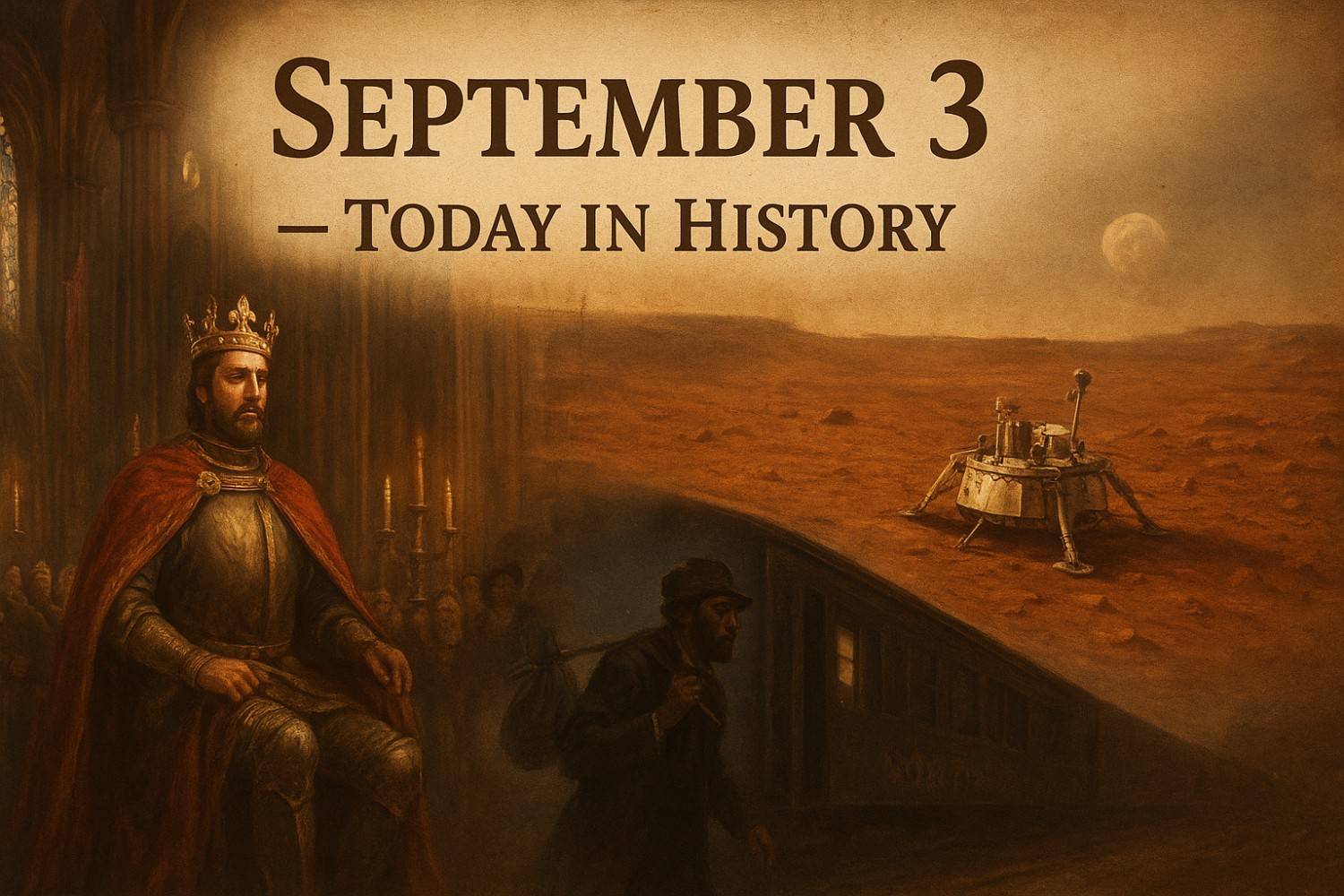
Richard I, later called Richard the Lionheart, was crowned at Westminster Abbey on September 3, 1189. His reputation for courage and military skill was forged on the Crusader battlefield, and his name became synonymous with martial glory in later chronicles. Although he spent relatively little time governing England directly—much of his reign was abroad—his coronation marked the start of a rule that would shape medieval politics and English legend. Richard’s reign highlighted the era’s tensions between feudal obligations at home and grand ambitions overseas.
1609 — Henry Hudson sails into New York Harbor
On September 3, 1609, Henry Hudson steered the Halve Maen (Half Moon) into the great estuary that now bears his name, beginning European exploration of the river and surrounding coast. Acting for the Dutch East India Company, Hudson’s voyage opened the way for Dutch trade and later settlement in what became New Amsterdam. The river he charted would become a vital artery for commerce, immigration, and cultural exchange in North America. Hudson’s entry into the harbor is both a moment of discovery and the seed of centuries of geopolitical and economic change.
1651 — Battle of Worcester (final major battle of the English Civil War)
The Battle of Worcester on September 3, 1651, was the last major engagement of the English Civil Wars. Oliver Cromwell’s Parliamentarian forces routed the Royalist army led by Charles II, forcing the king into exile and effectively ending large-scale Royalist resistance. The defeat consolidated parliamentary control and paved the way for the Commonwealth and Cromwell’s increasing power. Worcester’s outcome reshaped the British political order and left a legacy of contested memory about authority, legitimacy, and revolution.
1783 — Treaty of Paris signed, ending the American Revolutionary War
On September 3, 1783 representatives from Great Britain and the United States signed the Treaty of Paris, formally recognizing American independence. The treaty set boundaries, arranged fishing rights, and launched the fledgling United States into a complex diplomatic and economic future. It was the legal moment the revolution achieved its primary aim: sovereignty. The agreement also began decades of negotiation over borders, merchants’ rights, and the return of property, shaping early U.S. diplomacy.
1838 — Frederick Douglass escapes slavery (a turning point in his life of activism)
Frederick Douglass made his dramatic escape from slavery on September 3, 1838, boarding a northbound train from Baltimore and traveling to freedom in the North. Disguised as a sailor and carrying borrowed papers, Douglass’s flight began the “free life” he later described and launched a career as a writer, orator, and leading abolitionist voice. His experience became a powerful testimony against slavery and a key source for later accounts that shaped American understanding of bondage and resistance. Douglass’s escape on this date is a personal milestone and a chapter in the larger movement to end human bondage.
1894 — Labor Day becomes a national holiday in the United States
In 1894, Congress made the first Monday in September a federal holiday, a decision shaped by years of local observance and by political reaction to labor unrest earlier that year. The law recognized organized labor’s place in public life and gave workers a nationally recognized day for parades, rest, and public demonstration. Federalizing Labor Day reflected both grassroots activism and political calculations aimed at easing social tensions. The holiday endures as a marker of work, reform, and the seasonal rhythm of American life.
1939 — Britain and France declare war on Germany (World War II in Europe)
On September 3, 1939, two days after Germany invaded Poland, Britain and France declared war on Germany—an act that transformed a regional act of aggression into the wider catastrophe of World War II. The declarations marked the collapse of diplomatic efforts to contain aggression and initiated a global conflict with enormous human and political costs. For many nations the date became a turning point from uneasy peace to declared global war. The long shadow of 1939 reshaped borders, ideologies, and international institutions for decades.
1967 — Dagen H: Sweden switches from left- to right-hand driving
On September 3, 1967, Sweden carried out “Dagen H,” a carefully planned national switch from driving on the left to driving on the right. The logistical operation required changing hundreds of thousands of road signs, reconfiguring intersections, and a massive public information campaign to prepare citizens for the shift. Though feared to cause chaos, the transition was largely successful and brought Sweden in line with its continental neighbors, easing cross-border traffic and commerce. Dagen H remains a striking example of large-scale social engineering carried out with intense planning and public coordination.
1976 — Viking 2 lands on Mars
NASA’s Viking 2 lander touched down on Mars on September 3, 1976, becoming the second spacecraft to make a successful soft landing and to return high-resolution images and soil analyses. Viking 2’s instruments collected meteorological and geological data and helped establish methods for future planetary science missions. The mission expanded scientific understanding of Mars’ surface and atmosphere and set performance expectations for decades of robotic exploration. Viking 2’s success turned questions about life and climate on Mars into sustained, data-driven scientific inquiry.
Early September 1995 — eBay (AuctionWeb) launched
Pierre Omidyar launched a simple person-to-person auction site in early September 1995—what he called AuctionWeb during Labor Day weekend—a project that would grow into eBay. What began as a hobby project quickly tapped into a new form of online trust and commerce, connecting buyers and sellers across borders. eBay’s model helped normalize online payments and peer-to-peer marketplaces, shifting retail and collectibles markets worldwide. The site’s quiet launch on a holiday weekend eventually became a landmark in internet business history.
2012 — Griselda Blanco assassinated in Medellín
On September 3, 2012, notorious drug trafficker Griselda Blanco—often called the “Godmother of Cocaine”—was shot dead outside a butcher shop in Medellín. Her violent life and dramatic end punctuated a career linked to trafficking networks, extreme violence, and transnational criminal markets. Blanco’s death closed a brutal chapter in narco-history while prompting reflection on the human and social costs of a decades-long drug war. The assassination also pointed to the continuing violent fallout connected to cartels and their networks.
Notable Births on September 3
Ferdinand Porsche (1875) — Engineer and founder of Porsche AG; his designs shaped early automotive engineering and the Volkswagen project.
Frank Macfarlane Burnet (1899) — Australian virologist and Nobel laureate noted for his work on immunology and acquired immune tolerance.
Whitey Bulger (1929) — Notorious American organized-crime boss whose life and crimes became part of Boston’s criminal history.
Percy Chapman (1900) — English cricketer and captain whose era shaped early 20th-century cricketing history.
Pauline Collins (1940) — English actress best known for Shirley Valentine and Upstairs, Downstairs.
Charlie Sheen (1965) — American actor who moved from film into major television stardom.
Notable Deaths on September 3
Oliver Cromwell (1658) — English military leader and Lord Protector; his death closed a controversial and revolutionary chapter in British history.
Vince Lombardi (1970) — Legendary American football coach whose leadership at the Green Bay Packers became a national symbol of will and excellence.
Frank Capra (1991) — Italian-American filmmaker whose movies like It’s a Wonderful Life helped define American cinema’s optimism.
William Rehnquist (2005) — Chief Justice of the United States whose tenure shaped late 20th-century Supreme Court decisions.
Pauline Kael (2001) — Influential film critic whose sharp, provocative reviews changed how movies were discussed in the U.S.
E. E. Cummings (1962) — Poet and painter known for unconventional punctuation and a distinct modernist voice.
Sir Edward Coke (1634) — Foundational English jurist whose defense of common law influenced constitutional development.
Observances & Institutional Dates
Treaty of Paris (1783) — The legal end of the American Revolutionary War and recognition of U.S. independence.
Labor Day (U.S.) — federalized in 1894 — The first Monday of September was made a national holiday by Congress.
Dagen H (Sweden) — 1967 — Sweden’s national switch from left- to right-hand driving.
Check Also Other Days:
Facts and evants happened on September 2
Facts and evants happened on September 1
Final Thoughts on Today in History: September 3
September 3 mixes coronations and treaties, decisive battles and quiet escapes, national holidays and scientific landings. The date reminds us that calendars are more than countable days — they are compact archives that bundle human choices, crises, inventions, and moments of daring into memorable clusters. Reading a single date’s events offers a compact view of how varied and consequential human lives can be across time and place.
FAQs About September 3
Why does September 3 appear often in history lists?
Mostly coincidence and collective memory — when several high-impact events fall on one date, that date gets retold and remembered in “Today in History” lists.
Did Richard I’s coronation really happen on September 3, 1189?
Yes — Richard I (the Lionheart) was crowned at Westminster Abbey on September 3, 1189.
When did Frederick Douglass escape slavery?
Frederick Douglass escaped on September 3, 1838, disguising himself and boarding a northbound train to freedom.
Did Viking 2 land on Mars on September 3, 1976?
Yes — Viking 2’s lander touched down on Mars on September 3, 1976 and returned images and soil data.