Introduction
Today in History — September 4 gathers imperial endings, civic foundings, technological firsts, and moments of public drama. On this date you’ll find everything from the fall of a Western emperor to the humble pueblo that became Los Angeles, from early electric power grids to modern internet giants. These entries show how a single calendar day can hold political collapse and technical invention, cultural turning points, and sudden loss.
Major Events on September 4
476 — Romulus Augustulus deposed; Odoacer proclaims himself King of Italy
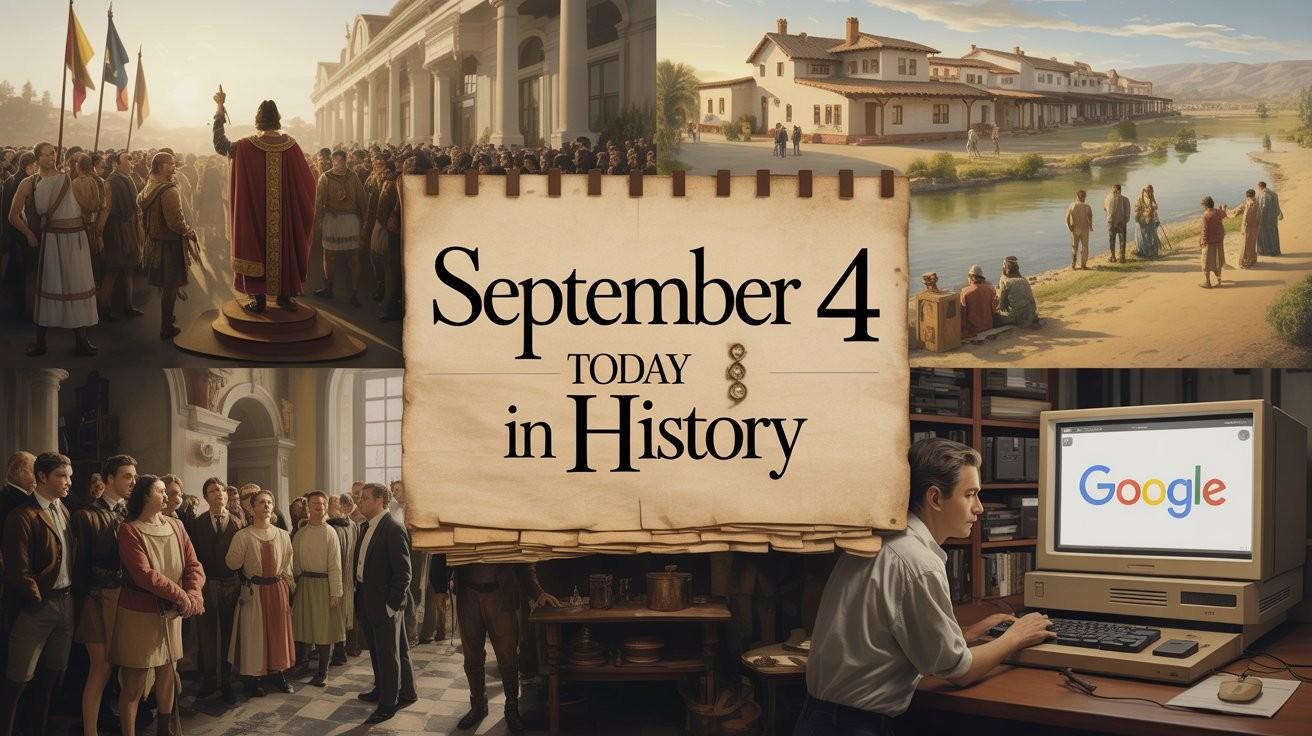
The quiet removal of the teenage Romulus Augustulus on September 4, 476 is often taken as the symbolic end of the Western Roman Empire. A Germanic commander, Odoacer, deposed the boy-emperor and refused to appoint a successor, instead sending the imperial regalia east to Constantinople and assuming rule in Italy himself. The political shift didn’t happen in one thunderclap so much as in administrative reorganization: imperial institutions persisted in altered form while new, localized authorities took practical control. Historians still debate the moment’s symbolic weight, but for many it marks a clear break between ancient imperial structures and the patchwork polities of the early Middle Ages.
925 — Athelstan becomes the first king to rule all England
Athelstan’s consolidation of power in 925 signaled the first clear political unification of several Anglo-Saxon kingdoms under a single crown. His reign blended military action, dynastic marriages, and legal reforms designed to strengthen central authority and royal administration. Athelstan’s court attracted scholars and diplomats and helped standardize practices that subsequent monarchs would refine. Over time his leadership became woven into English identity as the earliest phase of a unified English polity.
1282 — Peter III of Aragon claims the Sicilian crown after the Sicilian Vespers
In the wake of the 1282 Sicilian Vespers uprising, Peter III of Aragon accepted the kingship of Sicily, altering the balance of power in the central Mediterranean. What began as a local rebellion against Angevin rule quickly drew in foreign dynasties and turned the island into a battleground of competing claims. Peter’s intervention shows how regional revolts could trigger broader dynastic involvements and long political realignments. Sicily’s new status under Aragonese influence reshaped maritime politics, trade routes, and seventeenth-century diplomatic networks for years to come.
1781 — Los Angeles founded by Spanish settlers
A small group of Spanish settlers and soldiers laid out a pueblo on September 4, 1781 that would eventually grow into Los Angeles. The original settlement—founded with a handful of families and a central plaza—began as a modest agricultural and ranching community on a fertile plain. Over the next two centuries migration, trade, and industry transformed the pueblo into a sprawling, multicultural metropolis. Remembering the founding is a useful reminder that many global cities began as tiny, pragmatic experiments in settlement and survival.
1870 — Napoleon III deposed; the French Third Republic proclaimed
In the turmoil following France’s military defeat by Prussia, September 4, 1870 became a day of political collapse: Napoleon III was effectively removed and republican leaders declared the Third Republic. The dramatic turn reflected military humiliation at Sedan and a crisis of legitimacy at the heart of French politics. The new republican government faced immediate challenges—securing order, negotiating peace, and dealing with internal dissent—but it also signaled a profound shift in French political life away from imperial rule. The proclamation set France on a republican path that would endure, in various forms, through the 20th century.
1882 — Edison’s Pearl Street Station begins commercial electric service in Manhattan
On September 4, 1882, Thomas Edison’s Pearl Street Station began supplying electric power to parts of lower Manhattan, one of the first commercial electricity systems in the world. The small station powered offices, banks, and a handful of factories, replacing gaslight with a new, safer, and more flexible form of urban illumination. That early grid foreshadowed the vast utility systems that now power modern cities and fundamentally changed how urban life and industry operated after dark. Edison’s experiment on Pearl Street marked a technological turning point that accelerated industrial productivity and reshaped urban design.
1937 — Japanese parliament session funds the China war effort
In early September 1937, Japan’s extraordinary parliamentary session approved funding for expanded military operations in China, formalizing a policy of prolonged conflict. The decision institutionalized a costly commitment that destabilized the region and set the stage for wider wartime devastation. Funding votes like this show how legislative bodies can become engines of escalation once military options take precedence in national strategy. The session’s consequences rippled through East Asia, contributing to a conflict that would merge into the broader violence of the Second World War.
1957 — Little Rock crisis deepens over school integration orders
On September 4, 1957, the crisis at Little Rock Central High School intensified as Arkansas officials obstructed federally ordered school desegregation. The standoff between state authority and federal law became a defining moment in the American civil-rights movement, highlighting the limits of local resistance and the reach of constitutional enforcement. The episode drew national attention, forced federal intervention, and clarified that civil-rights victories won in court required active implementation on the ground. Little Rock’s drama remains a touchstone for how law, politics, and social change collide in moments of moral and legal reckoning.
1972 — Mark Spitz wins a record seven Olympic gold medals
At the Munich Olympics, Mark Spitz completed a stunning run that ended on September 4 with his seventh gold medal—a single-Games record at the time. His performance exemplified the new possibilities of elite training, sports science, and global television exposure. Spitz became an instant international symbol of athletic mastery and helped shift public attention toward individual Olympic superstars. The achievement also underscored how media and sport combined to create modern celebrity and commercial opportunity around athletic success.
1972 — The Price Is Right revival becomes a TV staple (Bob Barker)
On September 4, 1972, the revived game show The Price Is Right premiered with Bob Barker as host, launching one of television’s longest-running daytime series. The show’s format—audience participation, simple spectacle, and everyday prizes—connected with a broad mass audience and redefined daytime TV entertainment. Its success demonstrated how light, reliable programming could become a cultural mainstay and a lucrative platform for advertisers. Over decades the program became a fixture of American television culture and a template for audience-driven game shows worldwide.
1986 — Devastating typhoon hits Vietnam’s northern coast
A powerful typhoon struck Vietnam’s northern coast on September 4, 1986, destroying rice fields, sinking boats, and causing severe loss of life and property. The storm exposed vulnerabilities in coastal agricultural communities and forced national relief and rebuilding efforts under difficult conditions. Such disasters highlight the recurring tension between human settlement in fertile but hazard-prone areas and the need for resilient planning. The typhoon’s aftermath prompted renewed attention to forecasting, evacuation, and long-term coastal safety measures.
1998 — Google incorporated as a private company in California
On September 4, 1998, Larry Page and Sergey Brin formally incorporated Google, turning a Stanford research project into a company that would transform how information is organized and accessed online. Google’s early focus on search quality, ranking, and scalable infrastructure made it a keystone of the emerging web economy. Over the following decades, the company’s products and platforms reshaped advertising, media, and the economics of attention on a global scale. The incorporation date stands as a convenient marker for the start of the modern search and information era.
2000 — Israel moves to end Bezeq’s monopoly on telecom services
Around early September 2000, Israel took steps to open domestic telephone and internet services to competition by curbing the monopoly previously held by Bezeq. Liberalization expanded consumer choice, encouraged investment, and accelerated internet penetration across the country. The change is an example of late-20th-century telecom deregulation that rewired national communications policy and market structures. Such reforms quietly reshape economic opportunity, innovation, and everyday connectivity.
2012 — Griselda Blanco assassinated in Medellín
On September 4, 2012, notorious drug figure Griselda Blanco—often called the “Godmother of Cocaine”—was gunned down in Medellín, ending a violent life tied to transnational trafficking networks. Blanco’s death closed a chapter in the brutal narco-era that had reshaped parts of Latin America and U.S. urban centers through drug trade violence. Her story illustrates how criminal entrepreneurship, state weakness, and demand combine to create long-term social harm. The assassination prompted renewed reflection on trafficking’s human costs and the difficult work of recovery and law enforcement.
Notable Births on September 4
- Alexander III (1241) — King of Scotland who consolidated royal authority and defended Scottish independence.
- Anton Bruckner (1824) — Austrian composer known for monumental symphonies and sacred choral works.
- 1825 — Dadabhai Naoroji, Indian nationalist and critic of British economic policy in India.
- John McCarthy (1927) — American computer scientist who coined the term “artificial intelligence” and helped pioneer early computing theory.
- Dawn Fraser (1937) — Australian swimmer and Olympic champion, a national sporting icon.
- Beyoncé Knowles (1981) — Global pop star, producer, and cultural entrepreneur.
- Wanli (1563) — Ming dynasty emperor whose long reign saw cultural achievement and administrative strain.
- Constantijn Huygens (1596) — Dutch diplomat, poet and polymath of the Golden Age.
- 1853 — Hermann von Wissmann, German explorer whose expeditions aided colonial mapping of Africa.
- Paul Harvey (1918) — Influential American radio broadcaster known for his signature delivery.
- Tom Watson (1949) — American golfer and major champion of the 1970s–80s.
- Kia Stevens (1977) — Professional wrestler and performer (Awesome Kong).
- Shinya Yamanaka (1962) — Japanese physician-scientist and Nobel laureate for cellular reprogramming.
Check Also: Today in History – September 3
Notable Deaths on September 4
- Saint Boniface I (422) — Pope during a turbulent period of church politics.
- John Hunt Morgan (1864) — Confederate cavalry leader killed in action.
- Edvard Grieg (1907) — Norwegian composer central to Scandinavian musical identity.
- E. F. Schumacher (1977) — Economist and author of Small Is Beautiful.
- Hank Greenberg (1986) — Baseball star and two-time AL MVP.
- Steve Irwin (2006) — Australian wildlife conservationist and TV personality who died filming a documentary.
- Joan Rivers (2014) — Comedian and television host known for sharp wit and a long career.
- Pauline Kael (2001) — Influential and provocative American film critic.
- Keith Waterhouse (2009) — English novelist and satirist.
- Cyrus Mistry (2022) — Indian businessman, former chairman of the Tata Group.
- Ferid Murad (2023) — American pharmacologist and Nobel laureate for nitric oxide research.
Observances & Institutional Dates
- Los Angeles founding (1781) — Anniversary of the Spanish pueblo that grew into Los Angeles.
- Labor & media milestones — Several cultural anniversaries and broadcast history events fall near this date.
- Telecom liberalization (Israel, 2000) — Noted as a regulatory step opening domestic internet and phone markets.
Final Thoughts on Today in History: September 4
September 4 ties together endings and beginnings: emperors fall, republics are proclaimed, small towns are planted that will one day become global cities, and technical experiments quietly remake daily life. The day mixes public drama and private risk, from courtroom and parliamentary halls to the laboratory and ocean-crossing ships. Reading these events together offers a compact lens on how societies reorganize, remember, and reinvent across centuries.
FAQs About September 4
Why does September 4 appear often in history lists?
Mostly coincidence and collective memory — when several high-impact events fall on one date, that date gets retold and remembered in “Today in History” lists.
Did Romulus Augustulus actually get deposed on September 4, 476?
Yes — the young western emperor was removed and Odoacer assumed control in Italy, an event commonly used to mark the end of the Western Roman Empire.
Was Los Angeles founded on September 4, 1781?
Yes — Spanish settlers established the pueblo that later became Los Angeles on that date.
Did Google start in September 1998?
Yes — Larry Page and Sergey Brin incorporated Google in early September 1998, launching a company that would reshape the internet.