September 5 stitches together quick political decisions and slow cultural shifts: from tsars changing how a society looked to delegates gathering to argue the fate of an empire, from first editions that changed literature to rockets that left the solar system. In Today in History — September 5, you’ll find moments of statecraft and spectacle, scientific firsts and quietly consequential votes — days that, together, show how small acts and big launches shape what comes next.
Major Events on September 5
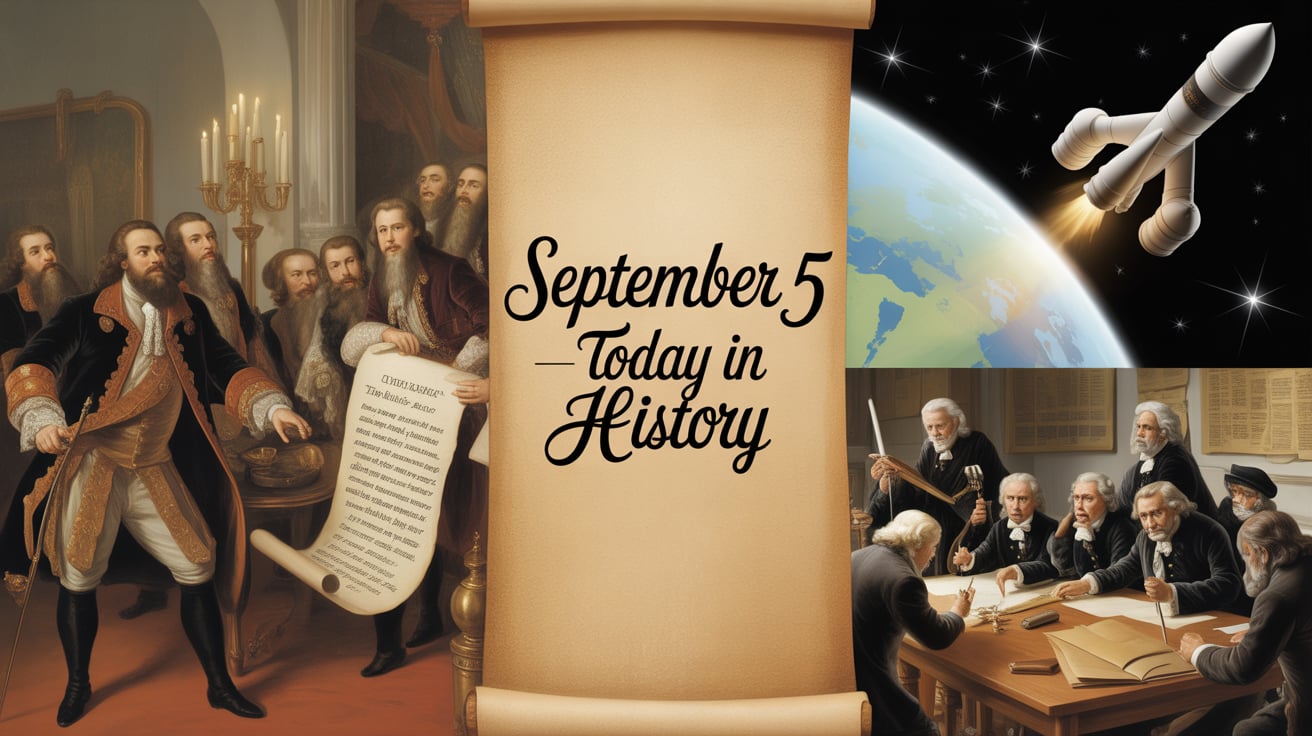
1698 — Peter the Great’s beard decree (Russia’s cultural makeover)
Peter I moved bluntly to modernize Russia by targeting the most visible symbol of traditional life: facial hair. His 1698 policy penalized beards and encouraged Western dress among the nobility and officials, using fines and public shaming to force conformity.
The measure was more than vanity — it signaled a state-driven cultural reorientation toward Europe and away from some Russian Orthodox customs. Long after the fines stopped, the episode remained a vivid example of how rulers try to remake social identity from the top down.
1774 — First Continental Congress convenes in Philadelphia
Delegates from the colonies gathered at Carpenter’s Hall, launching a formal, coordinated response to British policies and setting the stage for united colonial action. The Congress gave voice to growing colonial insistence on rights and representation, drafting petitions and preparing to coordinate economic pressure that would test imperial control.
That meeting transformed local protests into a national strategy and built networks of leaders who would steer events toward revolution. The Philadelphia sessions, therefore, mark a turning point where discord across many colonies met coordinated political organization.
1793 — “Terror is the order of the day” (France’s Revolutionary escalation)
In early September 1793, the National Convention accepted demands from Parisian radicals to make “terror” an instrument of state policy — a hard, defensive answer to internal revolt and foreign invasion. What followed was a sustained campaign of revolutionary courts, purges, and extraordinary measures that reshaped French politics and civic life, producing both rapid military mobilization and widespread repression.
The episode shows how revolutionary governments sometimes answer crisis with centralized, coercive power — with consequences that outlast the emergencies that produced them. Historians often date the Reign of Terror to this moment in 1793, when a revolutionary state consciously turned to punitive instruments of governance.
1836 — Sam Houston elected president of the Republic of Texas
After military victory and an independent declaration, Texans looked for civilian order and elected Sam Houston as their chief executive. Houston’s presidency focused on stabilizing a fledgling republic: negotiating foreign recognition, managing finances, and handling fraught relations with Mexico and indigenous nations.
His election moved Texas from battlefield leadership toward institutional governance, a necessary step for any nation hoping to survive politically and economically. Houston’s presidency also set long-term patterns for Texas politics as the republic later negotiated annexation into the United States.
1939 — The United States proclaims neutrality at the outbreak of the European war
With war already raging after Germany’s invasion of Poland, President Franklin D. Roosevelt issued a proclamation of neutrality that sought to keep the U.S. out of a European conflagration while balancing growing domestic and international pressures. The proclamation framed U.S. policy for months to come: limited material support to some allies but no formal entry into combat, a stance that shifted as global events deepened.
The decision revealed how geography, public opinion, and the legacy of World War I shaped American foreign policy choices at a fraught moment. That formal neutrality was a diplomatic hinge between isolationist sentiment and the eventual full mobilization that followed years later.
1957 — Jack Kerouac’s On the Road hits the bookshelves (Beat literature mainstreamed)
Kerouac’s novel captured a restlessness and search for freedom that came to define the Beat generation and influenced writers, musicians, and filmmakers for decades. Published to mixed reviews, the book nonetheless found a broad readership among people attracted to its speed, music, and ethical looseness — a road-map of rebellion and longing in postwar America.
Its language and structure opened the door for new literary experiments and set the tone for later countercultural movements. On the Road is therefore less a single cultural moment than a long, shifting conversation about American identity and mobility.
1960 — Cassius Clay (Muhammad Ali) wins Olympic light-heavyweight gold (Rome)
An 18-year-old Cassius Clay stunned audiences in Rome, taking gold and beginning a public career that would make him one of the century’s most consequential athletes. The win showcased his speed and style and immediately put him on the international map — a sign of how athletic triumphs can launch broader cultural influence.
Clay’s Olympic success paved the way for his pro career, his public conversions of belief and name, and a lifetime of political and social visibility. The match in Rome was a small ring moment with outsized historical reverberations.
1977 — Voyager 1 launches on a journey beyond the planets
NASA’s Voyager 1 lifted off and began a mission that would yield the first close views of the outer planets and, decades later, cross into interstellar space. Designed for a Grand Tour of the giant planets, the probe returned revolutionary data on Jupiter and Saturn, discovered new moons and rings, and carried a Golden Record meant as a human calling card for the cosmos.
Voyager’s longevity and scientific harvest transformed planetary science and public imagination about humanity’s place in the solar system. Even now, as the farthest human-made object, Voyager 1 stands as an emblem of sustained curiosity and engineering audacity.
2000 — Tuvalu becomes the 189th UN member state
The tiny Pacific nation of Tuvalu formally joined the United Nations, reminding the world that global institutions include states both large and very small. Admission to the UN gave Tuvalu a platform to raise existential concerns—most notably sea-level rise and climate policy—amplifying the voices of vulnerable island nations.
The day was symbolic: a microstate stepping onto a global stage where its survival issues could be heard alongside great-power diplomacy. Tuvalu’s membership underscores how modern international law and forums fold diverse polities into one deliberative space.
2001 — Strong evidence reported for a massive black hole at the Milky Way’s center
Astronomers presented observations of energetic flares and stellar motions that strengthened the case for a supermassive black hole at Sagittarius A*, advancing a theory that had been building for decades. These measurements tied together dynamics, high-energy emissions, and modeling to show that compact, unseen mass best explained the data.
The finding sharpened questions about how galaxies evolve and how black holes influence their environments. In short order, the center of our galaxy moved from theoretical speculation to a testbed for high-precision astrophysics.
Notable Births on September 5
- John Dalton (1766) — English scientist; a founder of modern atomic theory and early researcher into color blindness.
- Caspar David Friedrich (1774) — German Romantic painter, famed for moody landscapes and figures silhouetted against vast skies.
- Nap Lajoie (1874) — American Major League Baseball star and batting great of the early 20th century.
- Mel Sheppard (1884) — American Olympic middle-distance champion and early 20th-century track star.
- Darryl F. Zanuck (1902) — Hollywood producer and studio executive who shaped American cinema’s studio era.
- Bob Newhart (1929) — Comedian and actor known for his deadpan delivery and long-running TV shows.
- Susumu Tonegawa (1939) — Japanese immunologist and Nobel laureate for work on antibody diversity.
- Freddie Mercury (1946) — Tanzanian-born singer-songwriter and charismatic frontman of Queen.
- Werner Herzog (1942) — German filmmaker and essayist known for visionary, often stark cinema.
- Michael Keaton (1951) — American actor who crossed from comedy into major dramatic roles and blockbusters.
- Colt McCoy (1986) — American football quarterback with a notable college and NFL career.
Notable Deaths on September 5
- Mother Teresa (1997) — Catholic nun and humanitarian, Nobel Peace Prize laureate who founded the Missionaries of Charity.
- Phyllis Schlafly (2016) — Conservative activist and organizer influential in U.S. politics and the ERA debate.
- Georg Solti (1997) — Renowned Hungarian-born conductor celebrated for opera and symphonic recordings.
- Gert Fröbe (1988) — German actor best remembered internationally as the cinematic Auric Goldfinger.
- Steve Irwin (2006) — Australian wildlife conservationist and television personality who popularized nature programming.
Observances & Institutional Dates
- First Continental Congress convenes (1774) — early step toward American independence.
- Peter the Great’s westernizing reforms (1698) — symbolized by beard and dress regulations.
- Tuvalu admitted to the United Nations (2000) — a reminder of small-state diplomacy on global issues.
- Cultural milestones such as the publication of On the Road (1957) and Cassius Clay’s Olympic gold (1960) remain widely commemorated in literary and sports histories.
Final Thoughts on Today in History: September 5
September 5 is a compact date for contrasts: law and proclamation meet launches and literary firsts. On the same day you can find rulers remaking society, delegates assembling to imagine a new polity, artists placing new ways of seeing before the public, and engineers sending instruments beyond Neptune.
Those contrasts are exactly what make “Today in History — September 5” a useful lens: it shows how political choices, cultural experiments, and scientific ventures can all ripple outward in different registers of history.
Check Also About September 4 fact and history
FAQs About September 5 in History
Why does September 5 appear often in history lists?
Mostly coincidence plus collective memory — when several high-impact events fall on one date, that date gets retold and remembered in “Today in History” roundups.
Did Romulus Augustulus actually get deposed on September 4, 476?
That deposition is commonly dated to early September 476 (often cited as September 4 or 5) and is used symbolically to mark the end of the Western Roman Empire.
Did the First Continental Congress meet on September 5, 1774?
Yes — delegates assembled in Philadelphia on September 5, 1774, to coordinate colonial responses to British policy.
When did Voyager 1 launch?
Voyager 1 launched on September 5, 1977, beginning a mission that sent back groundbreaking data from the outer planets and beyond.
Is September 5 the date Mother Teresa died?
Yes — Mother Teresa died on September 5, 1997, after decades of religious and humanitarian work.