Today in History — September 6 marks notable voyages completed, significant political ruptures, groundbreaking inventions in warfare and culture, and solemn public moments. Across centuries, this date ties together oceanic returnees, royal inaugurations, acts of violence that reshaped public life, and nation-states stepping onto the global stage.
Major Events on September 6
1522 — Victoria completes the first circumnavigation of the globe
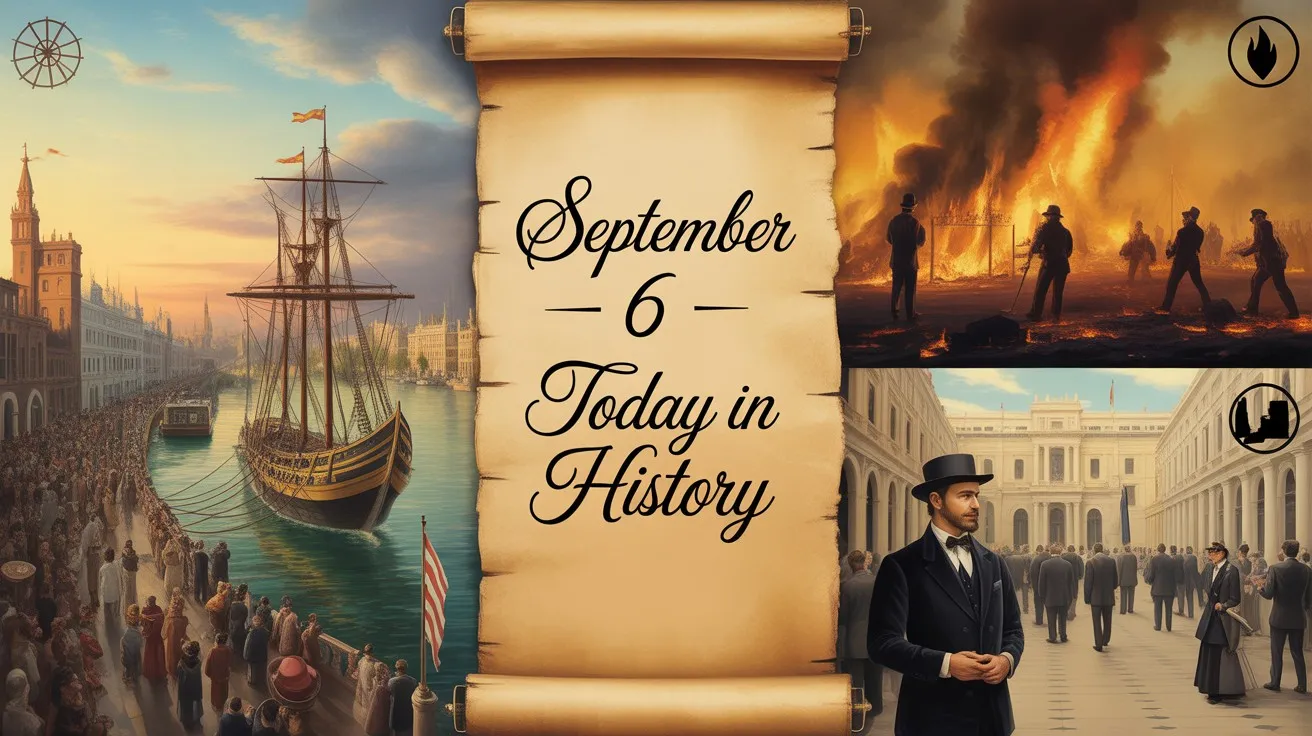
The small Spanish carrack Victoria returned to Spain on September 6, 1522, finishing the expedition that began in 1519 under Ferdinand Magellan. The voyage remapped European understanding of the world: new sea lanes, global wind patterns, and the scale of the oceans forced cartographers and merchants to rethink trade and empire.
The human cost was enormous—only 18 of the original crew survived, and Magellan himself died before the voyage’s end—but the technical and navigational lessons were decisive. The return of Victoria marks the moment when Atlantic Europe truly entered a global maritime age.
1620 — The Mayflower departs for the New World
In early September 1620, the Mayflower set sail from Plymouth carrying Pilgrims bound for North America; Old Style records sometimes show the date as September 6. The crossing was perilous and prolonged, and the passengers later framed their compact and settlement as experiments in self-government.
The voyage and the political arrangements that followed—above all the Mayflower Compact—became foundational symbols in later accounts of American origins. The Mayflower’s departure remains a focal point in stories about migration, colonization, and contested memory.
1666 — London’s Great Fire was controlled after days of destruction
By September 6, 1666, the massive fire that began in Pudding Lane had finally been brought under control after tearing through medieval London for several days. The blaze consumed vast numbers of timber houses and churches, leaving large parts of the city in ruins and forcing a re-evaluation of urban construction and firefighting.
Rebuilding led to significant changes in materials, street layouts, and regulations—and also to the early development of insurance markets and municipal planning. The Great Fire is remembered both for its immediate devastation and for the long-term transformations it imposed on urban life.
1792 — Georges Danton elected deputy to the National Convention
On September 6, 1792 Georges Danton won election to the National Convention, becoming one of the prominent voices in revolutionary Paris. Danton’s combination of blunt rhetoric and practical politics helped shape early revolutionary measures and mobilizations.
His influence was linked to the escalating tempo of revolutionary action that included radical committees and, later, the Terror. Danton’s role underscores how revolutionary leadership could shift from street agitation to institutional authority with rapid and often dangerous consequences.
1847 — Henry David Thoreau leaves Walden Pond
On September 6, 1847, Henry David Thoreau departed his two-year retreat at Walden Pond and resumed life in community with friends and family. The experiment in deliberate simplicity produced writings that later became central texts for American literature and environmental thought.
Walden treats solitude, self-reliance, and careful observation of nature as modes of moral and civic reflection. Thoreau’s exit from the pond marks the transition from solitary experiment back into public life—where his ideas would quietly seed debates about nature and conscience.
1870 — Louisa Ann Swain casts a pioneering vote in Wyoming
On September 6, 1870, Louisa Ann Swain voted in Laramie, Wyoming, often cited as the first woman to cast a legal ballot in the United States under laws granting equal suffrage. Wyoming territory had extended voting rights to women in 1869, and Swain’s vote became a small but vivid early instance of women exercising political voice well before national suffrage.
Her action was both practical and symbolic: a demonstration that legal change could be enacted at the local level. Swain’s role is remembered as an opening moment in a long movement for electoral equality.
1901 — President William McKinley shot at the Pan-American Exposition
President William McKinley was shot on September 6, 1901, at the Pan-American Exposition in Buffalo by Leon Czolgosz, an anarchist; McKinley later died of his wounds. The assassination shocked the United States, accelerated security changes around public figures, and brought Vice President Theodore Roosevelt into the presidency.
The event intensified debates over political violence, immigration, and policing at the turn of the century. McKinley’s death marked a stylistic and policy shift in the American executive office.
1944 — Germany uses V-2 rockets against Allied targets
In early September 1944, Germany began launching V-2 ballistic rockets at Allied-held areas, introducing a new class of high-speed, long-range weapons. The V-2 was technologically advanced and terrifying: supersonic, hard to intercept, and able to strike cities without warning. While the weapon did not change the strategic outcome of the war, it had a profound psychological impact on civilian populations and accelerated postwar rocketry research.
The V-2 thus stands at the grim intersection of wartime innovation and later space-age engineering.
1948 — Juliana was inaugurated as Queen of the Netherlands
Queen Juliana formally assumed the Dutch throne on September 6, 1948, following her mother’s abdication, beginning a reign characterized by accessibility and social concern. Her accession came at a time of reconstruction after war and during early decolonization debates affecting the Netherlands. Juliana’s modest, empathetic style helped stabilize the monarchy and maintain public trust through a period of rapid change.
Her inauguration is remembered as both a ceremonial turning point and a signal of postwar social renewal.
1951 — Prince Talal takes the oath as King of Jordan
Prince Talal became king in 1951 after the assassination of King Abdullah I; his brief reign introduced a new constitution and set a tone for constitutional modernization. Although Talal’s time on the throne was short—he abdicated on health grounds—the constitutional reforms he promulgated had lasting institutional effects.
His accession represented continuity of the Hashemite dynasty while also pointing toward political reform and modernization in the region. Talal’s legacy is tied to a fragile balance between monarchy and constitutional governance.
1965 — Indo-Pak War: major fighting and Pakistan’s Defence Day
On September 6, 1965, fighting escalated between India and Pakistan, with significant battles around Lahore and along other fronts; Pakistan observes the date as Defence Day. The conflict had roots in territorial disputes over Kashmir and broader geopolitical rivalries. Beyond battlefield movements, the war shaped national mythologies, military institutions, and subsequent diplomacy in South Asia.
The anniversary remains a focal point for remembrance and military ceremony in Pakistan.
1966 — Hendrik Verwoerd was assassinated in the South African parliament
South African Prime Minister Hendrik Verwoerd, architect of apartheid policy, was fatally stabbed on September 6, 1966, by a parliamentary messenger. Verwoerd’s assassination removed a leading proponent of institutional racial segregation and intensified political turmoil within the apartheid state.
His death exposed the deep tensions and anxieties about a system that provoked both internal resistance and international condemnation. The event is a stark marker in the history of South Africa’s long, painful struggle over race and power.
1968 — Swaziland (Eswatini) gains independence from Britain
On September 6, 1968, Swaziland became an independent sovereign nation, later renamed Eswatini, joining the United Nations and establishing its own national institutions. Independence brought immediate challenges of development, governance, and international positioning, but it also provided a platform for national identity and self-determination.
The anniversary remains a central civic holiday and an occasion for reflection on postcolonial statecraft. Eswatini’s path highlights the complex transitions many small states navigated in the late 20th century.
1991 — Soviet recognition of the Baltic states’ independence
On September 6, 1991, the Soviet leadership acknowledged the independence of Estonia, Latvia, and Lithuania, allowing the Baltic states to move fully onto the international stage. That recognition followed years of sustained independence movements and mass popular mobilizations in the Baltics.
The decision was a moment in the unraveling of Soviet authority and in the broader redrawing of Europe’s political map. The Baltic states’ return to sovereignty reshaped NATO and EU enlargement debates in the years that followed.
1997 — Funeral of Diana, Princess of Wales, watched worldwide
Diana’s funeral on September 6, 1997, was a global television event—viewed by an enormous international audience—and a major moment of public mourning and media ritual. The ceremony blended state pageantry with intense popular grief, raising questions about celebrity, the monarchy, and media culture.
The global response testified to Diana’s extraordinary public reach and to modern forms of shared commemoration. Her funeral remains a reference point for how personal tragedy becomes a global spectacle.
1999 — Suai Church massacre during East Timor violence
On September 6, 1999, militia forces attacked civilians sheltering in Suai church amid the post-referendum violence that followed East Timor’s vote for independence. The massacre left hundreds dead or missing and intensified international demands for intervention and accountability.
The violence underscored the fragile and dangerous transition from occupation to independence. Suai’s tragedy became part of the broader story that led to UN peacekeeping and eventual nation-building efforts.
2003 — Large demonstrations for Taiwanese identity in Taipei
On September 6, 2003 tens of thousands rallied in Taipei calling for recognition of Taiwan’s distinct identity and for use of the name “Taiwan” rather than “Republic of China.” The demonstrations reflected long-running debates about national identity, sovereignty, and relations with mainland China. Activists framed the demand as democratic expression and an assertion of local political agency.
The protests remain one of several flashpoints in Taiwan’s evolving democratic politics.
2007 — Operation Orchard: Israeli strike on a suspected Syrian facility
On September 6, 2007, Israeli aircraft struck and destroyed a suspected nuclear reactor site in Syria’s Deir ez-Zor region, an operation later identified as Operation Orchard. The strike removed a potential proliferation threat and demonstrated the lengths states might go to neutralize perceived nuclear risks.
The operation highlighted the intersection of secrecy, intelligence, and preemptive military action in contemporary security doctrine. Its long-term implications continue to inform nonproliferation debates.
2007 — Luciano Pavarotti dies
On September 6, 2007, the celebrated tenor Luciano Pavarotti died at age 71, closing a career that brought operatic singing to mass audiences worldwide. Pavarotti’s combination of vocal power, warmth of tone, and media presence expanded opera’s cultural reach.
He performed in major houses and on stadium stages, and his recordings remain widely listened to. His death prompted tributes across genres and underscored the global footprint of classical performance.
Check Also Other days
September 5 in history
September 4 in history
September 3 in history
Notable Births on September 6
- 1475 — Sebastiano Serlio: Italian Mannerist architect and influential theorist.
- 1656 — Guillaume Dubois: French cardinal and chief minister during the Regency.
- 1666 — Ivan V: Nominal tsar of Russia, co-reigned in the late 17th century.
- 1766 — John Dalton: British chemist and physicist; pioneer of atomic theory.
- 1781 — Anton Diabelli: Austrian composer and publisher, known for the Diabelli Variations connection.
- 1808 — Abdelkader: Algerian leader who resisted French colonization and later worked for reconciliation.
- 1813 — Isaac Butt: Irish lawyer and founder of the Home Rule movement.
- 1814 — Sir George-Étienne Cartier: Canadian statesman and Father of Confederation.
- 1819 — William S. Rosecrans: Union general and later U.S. politician.
- 1860 — Jane Addams: Social reformer, peace activist, and Nobel Peace Prize laureate.
- 1876 — J. J. R. Macleod: Scottish physiologist and Nobel laureate for insulin research.
- 1877 — Buddy Bolden: Early jazz cornetist credited as a foundational influence.
- 1890 — Claire L. Chennault: U.S. aviator who led the “Flying Tigers” in China.
- 1906 — Luis Federico Leloir: Argentine biochemist and Nobel Prize winner.
- 1928 — Fumihiko Maki: Japanese architect blending modernism with tradition.
- 1929 — Yash Johar: Indian film producer and founder of Dharma Productions.
- 1954 — Carly Fiorina: Business executive and former CEO of Hewlett-Packard.
- 1957 — Michaëlle Jean: Canadian journalist and 27th Governor General of Canada.
- 1962 — Elizabeth Vargas: American television journalist and anchor.
- 1962 — Jennifer Egan: American novelist and Pulitzer Prize winner.
- 1963 — Geert Wilders: Dutch politician known for outspoken positions on immigration and Islam.
- 1978 — Sawa Homare: Japanese footballer and captain of Japan’s women’s national team.
Notable Deaths on September 6
- 1683 — Jean-Baptiste Colbert: French statesman who reformed royal finances under Louis XIV.
- 1719 — Carlo Cignani: Italian Baroque painter of the Bolognese school.
- 1939 — Arthur Rackham: British illustrator famed for children’s book fantasy imagery.
- 1952 — Gertrude Lawrence: English actress and musical theatre star.
- 1956 — Michael Ventris: English architect and cryptographer who deciphered Linear B.
- 1966 — Hendrik Verwoerd: South African prime minister and architect of apartheid (assassinated).
- 1969 — Artur Friedenreich: Brazilian football pioneer and prolific goal scorer.
- 1969 — Gavin Maxwell: Scottish naturalist and author of Ring of Bright Water.
- 1984 — Ernest Tubb: American country music pioneer.
- 1985 — Little Brother Montgomery: Blues and jazz pianist of wide influence.
- 1987 — Quinn Martin: American television producer noted for crime dramas.
- 1994 — James Clavell: Novelist and screenwriter best known for Shōgun.
- 1998 — Kurosawa Akira: Japanese film director of Rashomon and Seven Samurai.
- 2005 — Eugenia Charles: First female prime minister of Dominica and Caribbean statesperson.
- 2007 — Luciano Pavarotti: World-renowned Italian operatic tenor.
- 2007 — Madeleine L’Engle: Author of A Wrinkle in Time and other children’s literature.
- 2017 — Kate Millett: Feminist writer and activist, author of Sexual Politics.
- 2020 — Lou Brock: Baseball Hall of Famer and prolific base-stealer.
- 2021 — Jean-Paul Belmondo: French New Wave film star and cultural icon.
- 2024 — Lucine Amara: American operatic soprano and longtime Metropolitan Opera artist.
Observances & Institutional Dates
- Defence Day (Pakistan) — Commemorates the country’s military response during the 1965 war.
- Independence Day (Eswatini / formerly Swaziland) — Marks national sovereignty from Britain in 1968.
- Maritime anniversary — Return of Victoria (1522) commemorates early global navigation achievements.
- Remembrance dates — Ceremonies and media commemorations tied to Princess Diana’s funeral and the Suai Church massacre.
Final Thoughts on Today in History: September 6
September 6 brings exploration and empire, cultural turning points and sudden grief. The day’s entries remind us that voyages and votes, violent ruptures and quiet departures, all contribute to how communities remember the past. Looking across these events shows how singular days can carry a surprising mix of beginnings, endings, and public reckoning.
FAQs About September 6
Why does September 6 appear often in history lists?
Mostly coincidence and collective memory — when several high-impact events fall on one date, that date is often retold in “Today in History” roundups.
Did the Victoria really finish the first circumnavigation on September 6, 1522?
Yes — Victoria returned to Spain in early September 1522, completing the expedition that began in 1519 and establishing the first recorded circumnavigation.
Was President McKinley shot on September 6, 1901?
Yes — William McKinley was shot on September 6, 1901, by Leon Czolgosz at the Pan-American Exposition and later died of his wounds.
Is Swaziland’s (Eswatini’s) independence celebrated on September 6?
Yes — the country became independent from Britain on September 6, 1968, and the date remains a national holiday.
Did Voyager 1 launch on September 5 or 6?
Voyager 1 launched on September 5, 1977; its long mission reshaped planetary science and public imagination.