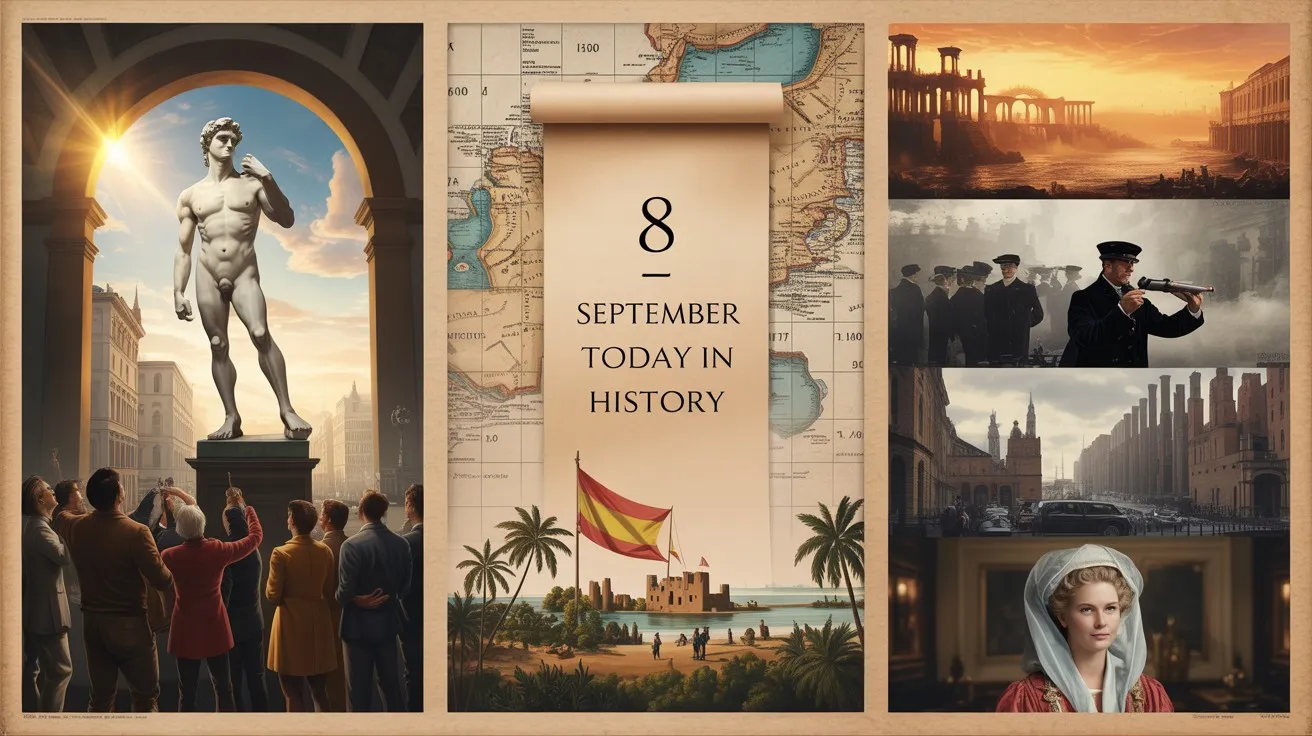
Today in History — September 8 stitches together artistic triumphs, colonial foundations, wartime endurance, and modern media and cultural turning points. Across centuries, the date ties Michelangelo’s marble to catastrophic storms, sieges that tested cities, and broadcast moments that reshaped popular life.
Major Events on September 8
1429 — Joan of Arc’s push on Paris
In September 1429, Joan of Arc attempted to press her advantage toward Paris, seeking to dislodge Burgundian influence and secure the newly crowned Charles VII’s hold on the capital. The assault ultimately failed to take the city, but Joan’s campaign galvanized French morale after years of disarray and helped change the momentum of the Hundred Years’ War.
Her presence fused religious fervor with military leadership in ways that surprised contemporaries and unnerved enemies. The episode is remembered not only for the tactical setback but for the symbolic force Joan brought to the French crown.
1504 — Michelangelo unveils David in Florence
On September 8, 1504 Michelangelo’s David was placed in the Piazza della Signoria, instantly becoming a civic emblem and an icon of Renaissance humanism. Carved from an enormous slab of marble with unprecedented anatomical exactness, the statue combined technical mastery with a poised psychological intensity.
David expressed both republican defiance and the Renaissance celebration of individual human potential, influencing public sculpture across Europe. Its installation transformed Florence’s public space and set a new benchmark for monumental art.
1565 — St. Augustine founded: Spain’s enduring foothold in Florida
Spanish settlers established St. Augustine on September 8, 1565, creating the oldest continuously occupied European-founded town in what is now the continental United States. The settlement functioned as a military outpost, a missionary hub, and a linchpin of Spain’s Atlantic strategy for decades.
St. Augustine’s streets, missions, and fortifications preserve layered stories of colonization, conflict with Indigenous peoples, and cultural exchange. The city’s founding is a reminder of how early maritime empires anchored long-term colonial geographies.
1664 — New Amsterdam surrenders and becomes New York
In September 1664, the Dutch presence in New Amsterdam ended when English ships took control, and the colony was renamed New York. The transfer reshaped legal, commercial, and demographic directions for the port, accelerating Anglo influence in North America.
Under English rule, the harbor city expanded, attracting diverse migrants and evolving into a major Atlantic trading node. This single political handover helped set the long arc from colonial outpost to cosmopolitan metropolis.
1776 — Nathan Hale volunteers as an American spy
On September 8, 1776, Nathan Hale volunteered to gather intelligence behind British lines, an act that quickly made him an emblem of patriotic sacrifice after his capture and execution. His reputed last words—“I only regret that I have but one life to lose for my country”—were repeated in early American civic memory as a touchstone of republican virtue.
Hale’s mission underscores the role of clandestine operations and personal courage in the Revolutionary War’s uncertain early months. His legacy helped shape American narratives about duty and martyrdom.
1781 — Battle of Eutaw Springs: Revolutionary War in the South
On September 8, 1781, American forces under General Nathanael Greene fought British troops at Eutaw Springs in South Carolina, a fierce battle late in the southern campaign. Although tactically inconclusive, the engagement weakened British capacity in the region and contributed to the attritional pressures that preceded Yorktown.
The battle illustrated how protracted, local engagements could have strategic effects far beyond their immediate outcomes. Eutaw Springs is remembered as part of the hard, grinding struggle that ultimately produced American independence.
1900 — Galveston hurricane devastates Texas (deadliest U.S. natural disaster)
A catastrophic hurricane struck Galveston on September 8, 1900, destroying much of the island and killing thousands—the deadliest natural disaster in United States history. The storm exposed profound weaknesses in warning systems, coastal planning, and emergency preparedness at the turn of the century.
In response, city engineers raised large parts of Galveston and built a protective seawall; the disaster also shifted commerce toward mainland ports and reshaped regional infrastructure. The event remains a watershed in American disaster response and coastal engineering.
1930 — Scotch Tape goes to market (3M)
In 1930, 3M began marketing a transparent adhesive tape under the name Scotch tape, a small technological innovation with outsized cultural and commercial effects. The product’s simplicity belied its broad utility—from household mending to industrial uses—helping normalize new forms of everyday convenience.
Scotch tape later became a staple of offices, schools, and workshops worldwide, illustrating how incremental inventions can have lasting social impact. The rollout is a reminder that not all historical turning points are political—many are technological and domestic.
1941 — Siege of Leningrad begins (near-900-day blockade)
By early September 1941, German forces completed the encirclement of Leningrad, launching a siege that would last nearly 900 days and inflict catastrophic civilian suffering. Cut off from supplies, the city endured starvation, bombing, and extreme cold while maintaining industrial output and cultural life under unimaginable strain.
Leningrad’s survival hinged on civic organization, rationing, and sheer resilience, and the siege remains a central story of Soviet wartime endurance. The episode reshaped strategic thinking about sieges and left deep scars in Russian memory.
1943 — Italy announces an armistice with the Allies
On September 8, 1943, Italy publicly announced an armistice with Allied forces, dramatically altering the European theater and precipitating German occupation of much of Italy. The armistice removed a nominal Axis partner and opened new fronts of partisan warfare, civilian displacement, and bitter reprisals.
For Italians, the moment combined the promise of liberation with immediate chaos and hardship as loyalties fractured. Strategically, the armistice forced adjustments in Allied planning and protracted combat across the peninsula.
1945 — First U.S. troops enter southern Korea to accept the Japanese surrender
In early September 1945, U.S. forces moved into the southern Korean peninsula to accept the surrender of Japanese units south of the 38th parallel, setting in motion the peninsula’s postwar division. The arrival of occupying forces and separate Soviet actions in the north produced the political conditions that would harden into the Korean partition.
These events inaugurated a tense, long-term geopolitical contest on the peninsula that reshaped the East Asian postwar order. The episode shows how wartime surrenders can have enduring geopolitical consequences.
1945 — Bess Myerson crowned Miss America (cultural milestone)
Bess Myerson’s crowning as Miss America in 1945 was notable not only as a pageant moment but for its social symbolism—she was the first Jewish Miss America. Her public profile in the postwar years mixed celebrity, civic engagement, and later public service, illustrating the new cultural platforms available to media-era personalities.
Myerson’s coronation reflected shifting American social dynamics in the immediate aftermath of World War II. Her life thereafter complicated notions of fame, identity, and public responsibility.
1957 — Althea Gibson breaks tennis’s color barrier at the U.S. Nationals
Althea Gibson’s victory at the U.S. National Tennis Championship on September 8, 1957, made her the first Black athlete to win the title, breaking a major racial barrier in elite sport. Her success combined top athletic performance with a socially transformative moment, encouraging future diversification of tennis and other sports.
Gibson’s triumph became a touchstone in civil-rights histories and sports narratives alike. The win remains an important milestone in the struggle for inclusion in American athletics.
1960 — Psycho shocks audiences and reshapes film language
Alfred Hitchcock’s Psycho premiered in 1960 and quickly stirred both scandal and admiration, changing expectations about suspense, narrative, and on-screen violence in mainstream cinema. Its editing, score, and the infamous shower sequence became study points for filmmaking craft and audience psychology.
Psycho’s release challenged studio norms and helped open the way for more daring, genre-blurring work in later decades. The film’s long cultural afterlife shows how a single movie can rewrite popular taste.
1966 — Star Trek debuts on American television
The first episode of Star Trek aired in 1966 and introduced a franchise that would blend speculative science, social allegory, and devoted fandom. The series used futuristic settings to probe contemporary issues—race, war, ethics—while popularizing a hopeful vision of multiethnic cooperation.
Star Trek’s cultural reach extended into technology inspiration, fan conventions, and academic study, making it one of TV’s most influential properties. Its debut marks a key moment in television’s rise as a venue for serialized mythmaking.
1974 — President Gerald Ford pardons Richard Nixon
On September 8, 1974, President Gerald Ford announced a full pardon for Richard Nixon, a politically charged gesture meant to close the Watergate chapter. The pardon provoked debate about accountability, the public interest, and the optics of presidential clemency.
While supporters argued it spared the nation protracted legal strife, critics saw it as protective of wrongdoing. The episode reshaped perceptions of the presidency and became a recurring reference point in discussions of political ethics.
1986 — The Oprah Winfrey Show goes national
When Oprah’s show went national on September 8, 1986, it began a cultural run that blended personal storytelling, book promotion, philanthropy, and civic conversation. Oprah’s platform launched authors, shaped charitable priorities, and created a new arc between media influence and social action.
The show’s reach and sincerity turned a daytime program into a cultural institution. Its debut is a clear marker in the history of broadcast influence.
1998 — Mark McGwire’s 62nd home run (record chase)
On September 8, 1998, Mark McGwire hit his 62nd home run of the season, breaking Roger Maris’s single-season record and intensifying public interest in baseball’s power era. McGwire’s chase became a media spectacle that energized attendance, television ratings, and debates about the nature of records in modern sport.
The record run also later fed complex conversations about performance-enhancing substances and how sports history is written. The moment is both a high in baseball lore and part of a later re-evaluation of the game.
2001 — Murder of Tajikistan’s culture minister Abdurahim Rahimov
On September 8, 2001, Tajikistan’s culture minister Abdurahim Rahimov was assassinated in Dushanbe, an episode reflecting the fraught politics and security challenges of post-Soviet Central Asia. The killing underscored how fragile political conditions and factional tensions could endanger public figures in the region.
Rahimov’s death had local reverberations for cultural policy and public trust in order. The event is one of several incidents that marked the instability of the period.
2015 — Stephen Colbert debuts as host of The Late Show
On September 8, 2015 Stephen Colbert took over The Late Show, signaling a generational handoff in late-night television and a new tone of political satire. Colbert’s arrival shifted the show’s comedic approach and demonstrated how hosts can reshape public political conversation. The change reflected broader shifts in audience expectation for satire and media engagement. It’s part of a string of media moments on this date that highlight television’s cultural role.
2023 — Deadly Morocco earthquake near Oukaïmedene
A catastrophic earthquake struck western Morocco on September 8, 2023, causing widespread destruction and a very high death toll across rural and urban communities. The disaster prompted both national and international relief efforts and exposed vulnerabilities in construction practices in mountainous regions.
Recovery has demanded long-term attention to resilience, reconstruction, and humanitarian needs. The quake is a recent reminder of how natural hazards can produce sudden, large-scale human crises.
Notable Births on September 8
- 1157 — Richard I (Richard the Lionheart): King of England, famed crusader and medieval military figure.
- 1157 — Alexander Neckam: English scholar, teacher, and author, influential in medieval learning.
- 1380 — Saint Bernardine of Siena: Franciscan preacher and influential Italian theologian.
- 1442 — John de Vere, 13th Earl of Oxford: Lancastrian leader and soldier in the Wars of the Roses.
- 1474 — Ludovico Ariosto: Italian poet best known for Orlando Furioso.
- 1500 — Peter Martyr Vermigli: Italian Reformer, influential in Protestant theology.
- 1588 — Marin Mersenne: French theologian and mathematician who connected many 17th-century scientists.
- 1621 — Louis II de Bourbon, Prince de Condé: French general and statesman.
- 1633 — Ferdinand IV: King of Bohemia and Hungary, Habsburg heir.
- 1697 — Alexander Monro (primus): Scottish physician and professor of anatomy.
- 1767 — August Wilhelm von Schlegel: German scholar and translator, influential in Romanticism.
- 1774 — Blessed Anna Katharina Emmerick: German nun and mystic whose visions were widely published.
- 1779 — Mustafa IV: Ottoman sultan during the early 19th century.
- 1790 — Edward Law, Earl of Ellenborough: British statesman and colonial administrator.
- 1809 — Manuel Montt: President of Chile, noted for administrative reforms.
- 1814 — Charles-Étienne Brasseur de Bourbourg: French ethnographer and Mesoamerican scholar.
- 1819 — William S. Rosecrans: Union general in the American Civil War and later politician.
- 1828 — Margaret Olivia Slocum Sage: American philanthropist and education benefactor.
- 1848 — Viktor Meyer: German chemist who advanced organic and inorganic chemistry.
- 1863 — Jessie Willcox Smith: American illustrator famous for children’s books and magazines.
- 1925 — Peter Sellers: British actor known for comic range and the Pink Panther films.
- 1941 — Bernie Sanders: U.S. senator and prominent progressive political figure.
- 1946 — Aziz Sancar: Biochemist and Nobel laureate for DNA repair research.
Notable Deaths on September 8
- 0394 — Arbogast: Roman general and power-broker in the late Western Empire.
- c.0701 — Saint Sergius I: Pope noted for liturgical and administrative reforms.
- 0780 — Leo IV: Byzantine emperor who navigated iconoclastic controversies.
- 1100 — Clement (antipope): Rival papal claimant during investiture conflicts.
- 1613 — Carlo Gesualdo: Italian composer known for intensely chromatic madrigals.
- 1627 — Juan Sánchez Cotán: Spanish still-life painter and Baroque precursor.
- 1644 — Francis Quarles: English religious poet known for emblematic verse.
- 1656 — Joseph Hall: English bishop, satirist, and moralist.
- 1709 — Ivan Mazepa: Ukrainian hetman who allied with Sweden against Russia.
- 1784 — Ann Lee: Founder of the Shaker movement and religious leader in America.
- 1811 — Peter Simon Pallas: German naturalist who advanced zoology and geology in Russia.
- 1814 — Maria Carolina: Queen of Naples and influential late-18th-century stateswoman.
- 1869 — William Pitt Fessenden: U.S. senator and key fiscal figure during the Civil War.
- 1894 — Hermann von Helmholtz: German physiologist and physicist with major scientific contributions.
- 1922 — Léon Bonnat: French portrait painter and influential teacher.
- 1947 — Victor Horta: Belgian architect and Art Nouveau pioneer.
- 1949 — Richard Strauss: German composer and conductor of late-Romantic music.
- 1953 — Fred M. Vinson: U.S. Chief Justice and mid-century jurist.
- 1977 — Zero Mostel: American actor and comedian noted for explosive stage roles.
- 2003 — Leni Riefenstahl: Filmmaker known for technical innovation and controversial propaganda films.
- 2022 — Elizabeth II: Queen of the United Kingdom and the Commonwealth, whose seven-decade reign shaped modern monarchy.
Observances & Institutional Dates
- Historical commemorations mark the Siege of Leningrad, the Galveston hurricane, and other civic tragedies or triumphs tied to the date.
- Cultural anniversaries (film premieres, program debuts, sporting milestones) are often observed by institutions and media organizations on or near September 8.
- Brazil’s Independence is celebrated on September 7 (neighboring day) but often appears in regional date roundups covering early September.
Final Thoughts on Today in History: September 8
September 8 brings together moments of creative brilliance, sudden disaster, political rupture, and media reinvention. The day shows how public art and private endurance, scientific and technological increments, and dramatic political choices can share a single date while leaving very different kinds of legacies.
Remembering these entries helps us see how communities rebuild, institutions adapt, and culture keeps changing.
Check also the September 7 facts
FAQs About September 8
What is the history today about?
September 8 is a mix of artistic premieres, colonial foundations, wartime turning points, and media milestones—from Michelangelo’s David and St. Augustine’s founding to the Siege of Leningrad and modern broadcast debuts.
Was Michelangelo’s David unveiled on September 8, 1504?
Yes — Michelangelo’s David was installed in Florence in 1504 and quickly became an emblem of Renaissance art and civic pride.
Did Italy announce its surrender in early September 1943?
Yes — Italy publicly announced an armistice with the Allies in early September 1943, precipitating major strategic shifts in Europe.
Was the Galveston hurricane on September 8, 1900 really that deadly?
Yes — the hurricane killed thousands and remains the deadliest natural disaster in U.S. history, prompting major changes in coastal planning and engineering.
Did Queen Elizabeth II die on September 8, 2022?
Yes — Queen Elizabeth II passed on September 8, 2022; her death marked the end of a seven-decade reign and led to the accession of King Charles III.