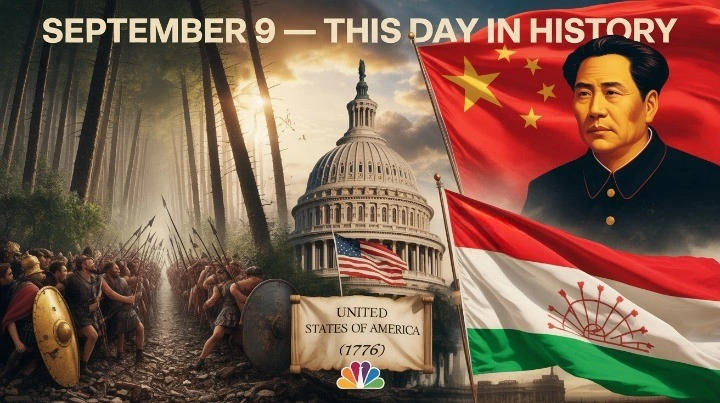
Today in History — September 9 links battlefield shock, nation-building choices, cultural breakthroughs, and media moments. From imperial setbacks and dynastic changes to the founding of states, the rise of broadcast networks, and seismic modern events, this date collects turning points that echo across politics, culture, and technology.
Earlier History
9 AD — Battle of the Teutoburg Forest
The ambush in the Teutoburg Forest shattered three Roman legions and stopped Rome’s push deeper into Germania. The scale of the Roman defeat forced imperial planners to rethink frontier strategy and helped fix the Rhine as a hard boundary. Politically it weakened Rome’s aura of invincibility in the north and strengthened Germanic resistance for generations.
The battle remains a landmark event showing how one military disaster can reframe a region’s historical trajectory.
1087 — Death of William the Conqueror
William’s death in Rouen closed the life of the Norman who remade England after 1066, grafting Norman structures onto Anglo-Saxon society. His reign established feudal administration, castle-building, and fiscal surveys that changed governance across the realm.
Succession tensions after his death affected Anglo-Norman politics for decades. The Norman legacy—law, language, landholding—shaped medieval England’s institutions long after William himself was gone.
1488 — Anne becomes Sovereign Duchess of Brittany
Anne’s accession as Duchess of Brittany placed her at the center of French dynastic politics and regional autonomy debates. Brittany’s strategic position and her marriages would shape French royal consolidation for the next century.
Her rule illustrates how personal unions, female succession, and local identity interacted in late medieval Europe. Brittany’s later absorption into France underscores the slow centralization of modern states.
1513 — Battle of Flodden
Flodden was a catastrophic defeat for Scotland in which King James IV died on the field—the last British monarch killed in battle. The rout weakened Scotland’s military capacity and precipitated political instability and regency struggles.
For England, the victory secured a dangerous northern border and influenced Tudor diplomacy. Flodden’s human cost and national trauma echo in Scottish historical memory.
🌍 Exploration & Colonial Foundations
1565 — Founding of St. Augustine (Spanish Florida)
Spanish settlers established St. Augustine as a fortified foothold and missionary center, creating the oldest continuously occupied European town on the U.S. mainland. The settlement anchored Spain’s maritime routes into the Gulf and Caribbean and served as a bulwark against rival European claims. St.
Augustine’s layered architecture and archives preserve a long story of colonial contact, conflict, and cultural blending. Its founding shows how imperial outposts became enduring urban nodes.
1791 — Washington, D.C., was named (early federal planning)
Decisions made in 1791 about the capital’s location and plan laid the groundwork for a purpose-built national center. The city’s design blended symbolic axial planning with practical compromises among regional interests.
Over time, Washington would perform ceremonial, legislative, and bureaucratic functions that shaped national identity. The early federal choices in 1791 set precedents for how a democratic republic constructs its public face.
1850 — California admitted as the 31st state
California’s admission reshaped the Union: its rapid population growth after the Gold Rush forced urgent political accommodation and touched off sectional bargaining. Statehood accelerated western economic integration—ports, mining, and railroads—and refocused national politics on the balance between free and slave states.
California’s entry altered migration patterns and boosted the United States’ Pacific orientation. The moment shows how economic booms can quickly remake political maps.
Wars & Politics
1776 — Continental Congress adopts “United States of America”
On September 9, 1776 the Continental Congress began using the formal name “United States of America,” a linguistic step that underlined a claim to collective sovereignty. Naming helped present the revolution to foreign courts and publics as the act of a nation, not a loose confederation of colonies.
This semantic decision strengthened diplomatic signaling at a crucial moment of war. Small governmental choices like naming often have outsized nation-building effects.
1926 — NBC founded: the rise of national broadcasting
The National Broadcasting Company’s establishment created the first major U.S. radio network, reshaping news distribution and entertainment. NBC’s network model standardized programming across time zones and built a national culture of shared broadcasts.
The institutionalization of radio foreshadowed television’s later reach and changed how politics, advertising, and popular culture circulated. Broadcasting’s rise marked a structural shift in public life and information flows.
1948 — Democratic People’s Republic of Korea proclaimed
The formal creation of North Korea in 1948 entrenched the peninsula’s division and set the stage for a multi-decade Cold War standoff in East Asia. The new state, under Kim Il Sung, became a central actor in regional security calculations and ideological confrontations.
The partition’s political and human consequences—separation of families, militarization, and recurring crises—remain unresolved legacies of wartime occupation. September 9 thus marks a foundational date in contemporary geopolitics.
1991 — Tajikistan declares independence
As the Soviet Union fractured, Tajikistan declared independence on September 9, 1991—an event that inaugurated state-building under difficult economic and political conditions. Independence opened possibilities for self-rule but also exposed the country to factional conflict and regional instability.
Tajikistan’s subsequent years illustrate the complexities of post-Soviet transitions: institutional creation, resource constraints, and social reconciliation. The date is part of the wider story of the USSR’s dissolution and its messy aftermath.
🎭 Arts & Culture
1956 — Elvis Presley’s Ed Sullivan appearance takes off
Elvis’s September 9, 1956 performance on The Ed Sullivan Show brought rock ’n’ roll to a mass television audience and crystallized youth culture’s growing cultural clout. The broadcast polarized opinion—viewers saw both musical innovation and challenges to conservative norms—but undeniably accelerated Elvis’s national superstardom.
Television here acted as a cultural amplifier, turning regional rhythms into national phenomena. The moment illustrates how mass media can rapidly transform artistic and social landscapes.
1998 — Mark McGwire’s record chase and baseball spectacle
The late-season home run chase in 1998—peaking with McGwire breaking a longstanding record—became a spectacle that reignited fan interest in baseball and dominated sports pages. The chase boosted attendance and TV ratings, but later debates about performance-enhancing substances complicated how the achievements were remembered.
The episode highlights sport’s capacity to capture public imagination while also showing how historical interpretation can change with new evidence. Sports moments, therefore, carry both immediate gloss and lasting reassessment.
2015 — Queen Elizabeth II becomes Britain’s longest-reigning monarch (cultural milestone)
When Queen Elizabeth II surpassed Queen Victoria on September 9, 2015, the milestone prompted reflection on continuity, ceremony, and the monarchy’s modern role. The anniversary highlighted how ceremonial leadership can provide symbolic stability across rapid social change. Public responses ranged from celebration to critical reassessment, revealing the monarchy’s complex cultural standing.
The date is both personal—honoring a long reign—and institutional, prompting questions about national ritual and identity.
🌐 Science, Technology & Media
1855 — End of the Siege of Sevastopol (Crimean War aftermath)
The 1855 fall of Sevastopol marked the end of the Crimean War’s central campaign and showcased changing military technologies and logistics. The siege revealed the brutal human cost of protracted siege warfare and stimulated military and medical reforms in Britain, France, and Russia.
Innovations in battlefield medicine and communications after Crimea changed later conflict management. The siege’s end reworked European diplomatic alignments and prefigured later modernization in military practice.
1926 — NBC again (technology meets culture)
NBC’s founding belongs here as much as in politics: it was a technical and organizational innovation that scaled broadcasting across a continent and established a template for mass media economies. From radio waves to national television networks, the company’s model shaped advertising, program formats, and the rhythms of daily life.
The network era created shared cultural moments—from serials to presidential addresses—that altered civic conversation. Media infrastructure thus moved into the heart of public life.
1956 — The Ed Sullivan broadcast and television’s cultural reach
Television’s power to create instant national events—whether music, politics, or sports—was nowhere more visible than in Elvis’s mass-audience performance. TV transformed cultural transmission, accelerating fame cycles and changing how citizens experienced events together.
Technological shifts in broadcasting, therefore, had direct cultural consequences, shaping taste and public debate. The Ed Sullivan moment is a case study in technology-enabled cultural diffusion.
Check Also: September 8 Facts and Events
Births
- 0384 — Honorius: Western Roman emperor during a turbulent era.
- 1629 — Cornelis Tromp: Dutch admiral and naval commander.
- 1711 — Thomas Hutchinson: Colonial governor of Massachusetts.
- 1721 — Edmund Pendleton: Virginia patriot and legal leader.
- 1737 — Luigi Galvani: Pioneer of bioelectricity research.
- 1747 — Thomas Coke: First Methodist bishop and missionary organizer.
- 1754 — William Bligh: Naval officer, captain of HMS Bounty.
- 1769 — Ivan Kotlyarevsky: Founder of modern Ukrainian literature.
- 1778 — Clemens Brentano: German Romantic poet and novelist.
- 1789 — William Cranch Bond: Astronomer important in early observational work.
- 1822 — Napoléon-Joseph Bonaparte: Member of the Bonaparte family.
- 1823 — Joseph Leidy: Zoologist and paleontologist.
- 1837 — Joaquin Miller: Poet of the American West.
- 1842 — Elliott Coues: Ornithologist and naturalist.
- 1850 — Harishchandra: Indian writer, dramatist in Hindi literature.
- 1852 — John Henry Poynting: Physicist known for the Poynting vector.
- 1855 — Houston Stewart Chamberlain: Writer influential in pan-German thought.
- 1868 — Mary Austin: Novelist and chronicler of the American West.
- 1871 — Ralph Hodgson: British lyric poet.
- 1873 — Max Reinhardt: Theatrical director who reshaped stagecraft.
- 1877 — James Agate: Theatre critic and writer.
- 1878 — Sergio Osmeña: President of the Philippines (1944–46).
- 1878 — Willie Heston: Collegiate football star under Fielding Yost.
- 1887 — Alf Landon: 1936 Republican presidential nominee.
- 1890 — Kurt Lewin: Foundational social psychologist.
- 1894 — Arthur Freed: Hollywood producer and studio force.
- 1896 — Howard Dietz: Songwriter and studio executive.
- 1898 — Frank Frisch: Baseball player and manager.
- 1898 — Styles Bridges: U.S. senator from New Hampshire.
- 1899 — Brassaï: Photographer famed for Paris night imagery.
- 1900 — James Hilton: Novelist (Lost Horizon).
- 1901 — Granville Hicks: Literary critic and commentator.
- 1903 — Phyllis A. Whitney: Prolific author of juvenile and romantic mysteries.
- 1907 — Horst Wessel: Controversial Nazi youth figure.
- 1907 — Leon Edel: Biographer and Henry James authority.
- 1908 — Cesare Pavese: Italian novelist and poet.
- 1911 — John Gorton: Australian prime minister (1968–71).
- 1918 — Oscar Luigi Scalfaro: President of Italy (1992–99).
- 1922 — Hans Georg Dehmelt: Physicist and Nobel laureate.
- 1923 — Cliff Robertson: Academy Award-winning actor.
- 1923 — D. Carleton Gajdusek: Physician and Nobel laureate.
- 1927 — Elvin Jones: Jazz drummer with John Coltrane.
- 1928 — Sol LeWitt: Conceptual and Minimalist artist.
- 1933 — Michael Novak: Theologian and public intellectual.
- 1934 — Sonia Sanchez: Poet of the Black Arts movement.
- 1934 — Nicholas Liverpool: President of Dominica (2003–12).
- 1949 — John Curry: Olympic figure-skating champion.
- 1951 — Alexander Downer: Australian statesman and diplomat.
- 1963 — Chris Coons: U.S. senator from Delaware.
- 1964 — Aleksandar Hemon: Writer on exile and memory.
- 1969 — Natasha Stott Despoja: Australian politician and advocate.
Deaths
- 0276 — Florian: Brief reign as Roman emperor during crisis.
- 1513 — James IV of Scotland: Killed at Flodden; last British monarch to die in battle.
- 1515 — Saint Joseph of Volokolamsk: Influential Russian monastic reformer.
- 1545 — Charles, duc d’Orléans: French noble and military figure.
- 1625 — Gaspare Aselli: Discovered the lacteal vessels.
- 1645 — William Strode: Parliamentary leader and political figure.
- 1680 — Henry Marten: Regicide and English jurist.
- 1691 — Kumazawa Banzan: Neo-Confucian thinker in Japan.
- 1730 — Charles Fitzroy, 1st Duke of Southampton: English noble.
- 1770 — Bernard Siegfried Albinus: Anatomist who advanced human anatomy.
- 1806 — William Paterson: U.S. Supreme Court justice and statesman.
- 1815 — John Singleton Copley: Colonial-era portrait painter.
- 1834 — James Weddell: Antarctic explorer, namesake of the Weddell Sea.
- 1841 — Augustin Pyramus de Candolle: Botany pioneer and taxonomist.
- 1868 — Mzilikazi: Founder and king of the Ndebele (Matabele) kingdom.
- 1890 — Henry Parry Liddon: Influential Anglican priest.
- 1894 — Heinrich Karl Brugsch: Egyptologist and demotic scholar.
- 1898 — Stéphane Mallarmé: Symbolist poet central to modern verse.
- 1909 — Edward H. Harriman: Railroad magnate and financier.
- 1911 — Francis Andrew March: Scholar and lexicographer.
- 1915 — A.G. Spalding: Athlete and sporting-goods pioneer.
- 1931 — Lujo Brentano: Economist of the historical school.
- 1934 — Roger Fry: Art critic and Post-Impressionism advocate.
- 1945 — Zinaida Gippius: Russian Symbolist poet and critic.
- 1947 — Ananda K. Coomaraswamy: Scholar of Indian art and culture.
- 1947 — Ellen Beach Yaw: Operatic soprano noted for exceptional range.
- 1960 — Jussi Björling: Celebrated Swedish tenor.
- 1965 — Julián Carrillo: Composer and microtonal innovator.
- 1978 — Hugh MacDiarmid: Key Scottish poet of the 20th century.
- 1978 — Jack Warner: Film executive and studio pioneer.
- 1980 — Harold Clurman: Influential American theatre director and critic.
- 1990 — Samuel K. Doe: Liberian leader whose rule ended violently.
- 1999 — Catfish Hunter: Hall-of-Fame pitcher and World Series star.
- 2019 — Robert Frank: Photographer who transformed documentary vision.
- 2023 — Mangosuthu Buthelezi: Zulu chief and South African political leader.
Final Thoughts on Today in History: September 9
September 9 shows how dates gather different strands of human action—battles that redirect empires, administrative choices that name nations, and media moments that reshape culture.
These entries reveal patterns of continuity and rupture: political orders formed and broken, technologies that amplified voices, and cultural flashes that shifted public taste. Remembering them sharpens how we see the present as woven from many past decisions.
FAQs About September 9
What is the history today about?
September 9 brings military turning points, state-building moments, and cultural breakthroughs—from the Teutoburg defeat and Flodden to the naming of the United States, NBC’s founding, and landmark pop-culture broadcasts.
Did the Battle of the Teutoburg Forest happen on September 9, 9 AD?
Yes — the battle in early September of 9 AD destroyed three Roman legions and halted Rome’s advance into Germania.
Was California admitted as the 31st state on September 9, 1850?
Yes — California joined the Union in 1850, reshaping national politics and accelerating western development.
Did Tajikistan declare independence on September 9, 1991?
Yes — Tajikistan declared independence during the Soviet collapse, beginning a challenging post-Soviet transition.