
Imagine a world without a screen in your pocket. A world where the phrase “I’m bored” couldn’t be solved by a streaming service, a social media feed, or a video game. For most of human history, this was the reality. The silence wasn’t empty; it was filled with the sounds of conversation, music, and communal celebration. The question, “What did people do for fun before modern technology?” isn’t just a historical curiosity—it’s a key to understanding a fundamentally different way of human connection.
Fun was not a product to be consumed but an experience to be created, often with your own hands and voice, and almost always in the company of others. It was a tapestry woven from social class, seasonal rhythms, and raw human ingenuity. This journey through time will explore how our ancestors carved out joy, from the muddy fields of the Middle Ages to the dawn of the radio age, revealing that the human need for play and connection is a constant, even as its expression transforms through the ages.
🏰 A Time of Feasts and Faith: Fun in Medieval Times
Life in the Medieval period was brutal, short, and defined by backbreaking labor. For the peasant class, leisure wasn’t a scheduled pastime; it was a rare and sanctioned release, a vital pressure valve built into the liturgical and agricultural calendar. Their fun was raw, public, and visceral.
The most spectacular events were the tournaments. While we imagine chivalrous jousts, early tournaments were chaotic, violent melees—a “mock war” where knights could capture rivals for ransom. For the nobility, it was a sport, a training ground, and a potent display of power. For the common folk, it was a breathtaking spectacle, a chance to witness pageantry and prowess, accompanied by great feasts that echoed with music and storytelling from traveling minstrels.
For the average person, fun was found in the village green and the churchyard. Religious feast days—the original “holidays”—were the cornerstone of social life. These were not solemn affairs but vibrant, community-wide festivals. Mystery and morality plays, performed by trade guilds on rolling stages, brought Bible stories to life with a mix of devotion and crude comedy.
Afterwards, the community might engage in a rowdy game of “folk football,” a violent, often boundary-less match between rival villages with a blown-up pig’s bladder, with few rules and much celebratory chaos. In the dark of their cottages, the simple act of storytelling by the hearth was paramount. These tales of heroes, ghosts, and local lore were the Netflix of the era, a living library of culture and imagination passed down through generations.
The contrast was stark: the aristocracy enjoyed curated, expensive spectacles to display their status, while the peasantry found joy in communal, often boisterous, celebrations that provided a necessary escape from their harsh reality.
Explore the history of jousts, feasts, and games in medieval times.
📜 The Dawn of Modernity: Fun in the 1700s and 1800s
As society moved away from feudal structures and urbanization increased, new forms of leisure emerged, reflecting changing social and intellectual landscapes. The concept of “free time” began to crystallize, especially for a growing middle class.
The Enlightenment Era (1700s): Coffeehouses and Concerts
The 18th century, known as the Age of Enlightenment, placed a high value on reason, intellect, and social discourse. Fun, for the educated and affluent, became intertwined with self-improvement and sophisticated socializing. The coffeehouse became the epicenter of this new public sphere. For the price of a coffee, men (as it was predominantly a male domain) could gather to read pamphlets and newspapers, debate politics and philosophy, and discuss the latest scientific discoveries. It was a hub of information and connection, a physical prototype of an internet forum.
Music and theater also flourished. Attending a concert, such as those performed by a young Mozart, or an opera became a mark of status and cultural refinement. For those who could afford it, holding a “salon” in one’s home was the pinnacle of entertainment. Hosted by influential women, these gatherings brought together leading thinkers, artists, and writers for an evening of stimulating conversation. Meanwhile, the lower classes still enjoyed public executions as grim spectacles, frequented taverns for drinking, games, and gossip, and enjoyed traveling fairs and circuses, which grew in popularity.
The Victorian Era (1800s): The Birth of Mass Leisure
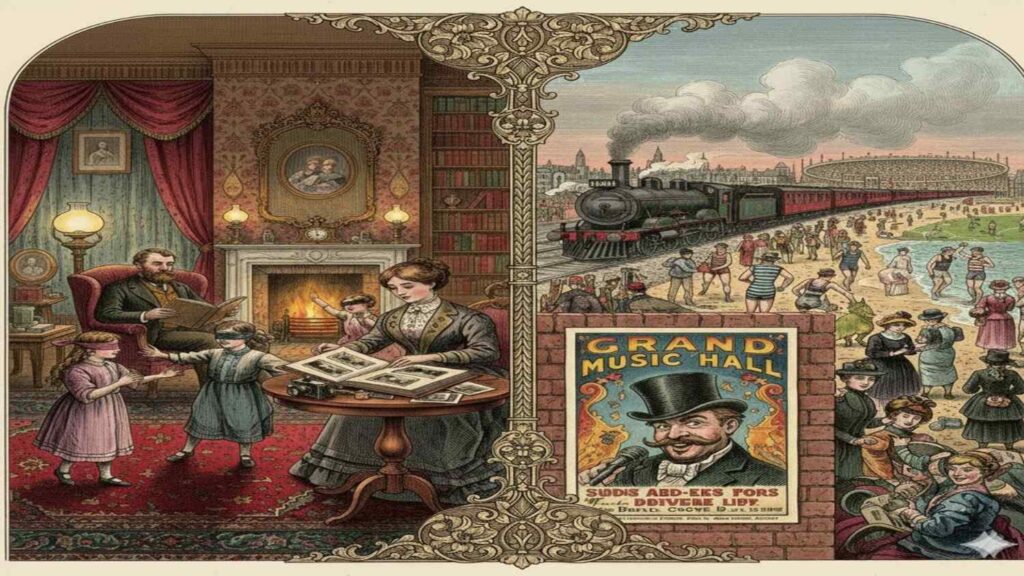
The Industrial Revolution didn’t just change how people worked; it revolutionized how they played. The Victorian middle class, with its strict morals and newfound wealth, turned the home into a sanctuary of respectable amusement. The parlor became the stage for fun.
Here, families engaged in parlor games—Charades, Blind Man’s Bluff, and card games like Whist. This was also the golden age of reading aloud. As literacy rates rose and printing technology advanced, families would gather in the evening to listen to the latest serialized chapter of a Dickens novel or a spine-tingling Gothic tale. The invention of photography introduced a new, albeit expensive, hobby, freezing moments in time for the first time in history.
Beyond the home, leisure went public and commercial. Music halls offered a raucous, working-class alternative to the staid parlor, with a mix of singing, comedy, and acrobatics. The establishment of the weekend and bank holidays created mass tourism, with railways carrying city-dwellers to the newly invented “seaside holiday.” Furthermore, organized sports like soccer and rugby were codified, moving from informal pastimes to professional spectacles that drew tens of thousands of fans.
🎷 The Rise of Mass Media: Fun in the Early 20th Century (1900-1940s)
The 20th century marked the most significant shift in entertainment since the invention of the printing press. Leisure began to move from the home and local community into the realm of mass-produced, commercialized experiences. The defining feature of this period was the ability for millions of people to share the same cultural moment simultaneously.
The single biggest revolution was the cinema. Moving pictures evolved from silent, black-and-white novelties in nickelodeons to “talkies” with full sound by the late 1920s. Going to the movies became a weekly ritual for millions. It was a glamorous escape, offering a window to a world far beyond one’s own, especially during the bleak years of the Great Depression.
Simultaneously, the radio brought the world into the living room. For the first time in history, families could gather to hear live news broadcasts, President Roosevelt’s “Fireside Chats,” dramatic serials (the precursors to modern soap operas), comedy shows, and big band performances. Radio created a shared national culture. This was the Jazz Age, and the new music—energetic, syncopated, and rebellious—defined a generation.
Dance halls were packed with young people doing the Charleston and the Lindy Hop, embodying a new sense of freedom and modernity. Other popular pastimes included attending sporting events in massive new stadiums, reading pulp fiction magazines, and, for the wealthy, listening to music on the gramophone.
This era created the template for the 20th century: a move towards in-home, technologically-delivered entertainment that was professionally produced and mass-consumed.
Life’s Necessities: The Entertainment of Invention
To truly understand historical leisure, we must look at how people transformed the necessities of daily life into opportunities for connection and enjoyment. The “how” of their daily existence directly shaped the “what” of their fun.
The Joy of Illumination
The day did not end at sunset. Before electric light, the darkness presented a challenge that people met with creativity and social spirit. The flickering light of a candle, oil lamp, or hearth fire became the focal point for evening activities. This intimate, low light was perfect for quiet conversation, sewing, whittling, or storytelling.The effort required to maintain light meant that people often congregated in a single room, making the evening an inherently communal time.
The quality of this light shaped the atmosphere of fun—it was softer, more intimate, and left more to the imagination than the harsh glare of a modern LED. Understanding the technologies of light, from tallow candles to gas lamps, is key to picturing these scenes.
The Great Conversation
In an era without instant messaging or email, the act of written correspondence was not just a utility; it was an art form and a primary source of intellectual and emotional connection. People spent hours crafting letters to friends, family, and lovers, sharing news, philosophical ideas, and personal feelings. For the literate, letter-writing was a form of delayed, but deeply thoughtful, conversation.
The arrival of the post was a daily highlight, an event that could bring joy, comfort, or dramatic news. This “great conversation” across distances required patience and deliberation, making the connection feel more earned and the messages more precious than today’s rapid-fire digital exchanges.
Music and Sound
Before recording technology, music was a live, participatory event. If you wanted to hear music, you had to make it yourself or be present where it was being played. Nearly every educated home in the 18th and 19th centuries had a piano, and families would gather around it to sing popular songs or ballads. Playing an instrument like the flute or violin was a common social skill. In communities, group singing was a standard form of entertainment at pubs, in churches, and at public gatherings.
The invention of the phonograph in the late 1800s was a seismic event. It began the transition of music from a participatory activity to a consumed product, allowing people to hear a professional performance on demand for the first time, forever changing our relationship with sound.
From Simple Pleasures to Societal Shifts: A Conclusion
Our journey through the history of pre-technology fun reveals a clear and powerful pattern: for most of human history, entertainment was fundamentally social, active, and community-oriented. Whether it was a village gathered for a mystery play, a family listening to a novel in a parlor, or neighbors dancing to a live radio broadcast, fun was something you did with others.
It relied on imagination, physical skill, and direct human interaction. The shift from these communal experiences to the individualized, on-demand digital entertainment of today represents one of the most profound cultural transformations in human history.
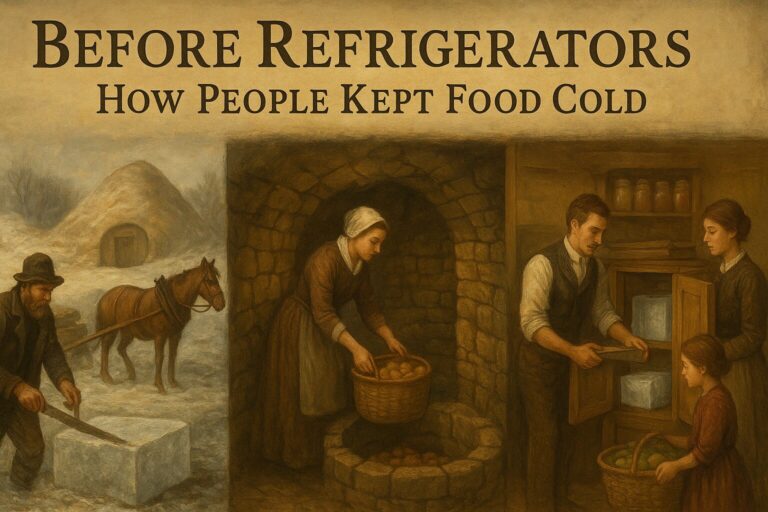
Read Also: How People Kept Food Cold Before Refrigerators
The pastimes of our ancestors were not merely ways to “kill time”; they were the glue that bound communities, the vehicle for cultural transmission, and a vibrant expression of the human spirit’s need for connection, story, and play. They remind us that fun doesn’t require a high-speed connection or the latest gadget—it often just requires presence, creativity, and someone to share the moment with.
To dive deeper into any of these specific periods and discover more about the fascinating ways our ancestors lived, laughed, and played, click on the links throughout this article. Which era of fun will you explore first?
Frequently Asked Questions
What did people do for fun before modern technology?
People entertained themselves with festivals, theater, music, storytelling, games, parlor activities, sports, reading aloud, craft gatherings, and seasonal fairs — activities that varied by class and location.
How did people socialize before phones and the internet?
Socializing happened in person: markets, churches, salons, coffeehouses, guild meetings, fairs, and family gatherings. Letters and the printed press also connected people across distance.
What were common indoor pastimes in the Victorian era?
Indoor pastimes included parlor games, reading serialized novels, playing sheet music, amateur drama, and early photography sessions.
How did the invention of radio change leisure?
Radio created shared national experiences, brought entertainment into private homes, and made serialized storytelling and live music accessible to mass audiences.
How do we have fun without technology?
We can have fun without technology by spending time outdoors, playing board games, reading, cooking, creating art, talking with friends, or learning new skills that don’t require screens.
How did people have fun in the past?
People in the past enjoyed festivals, storytelling, music, dancing, playing games, reading, writing letters, and gathering for community events or outdoor activities.
How did people deal with boredom before technology?
Before technology, people stayed busy through hobbies, crafts, social visits, singing, playing instruments, or simply walking and exploring nature.
What is the 777 rule for kids?
The 777 rule suggests kids should spend 7 hours of sleep, 7 minutes talking with parents, and 7 hours of outdoor activity each week, promoting a balanced lifestyle.
What do people do 144 times a day?
Studies suggest people check their phones about 144 times a day, often without realizing it — showing how deeply technology is tied to daily habits.