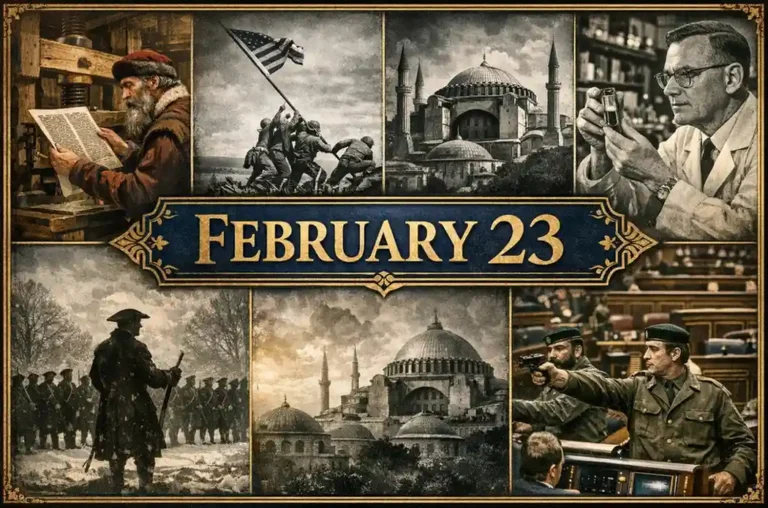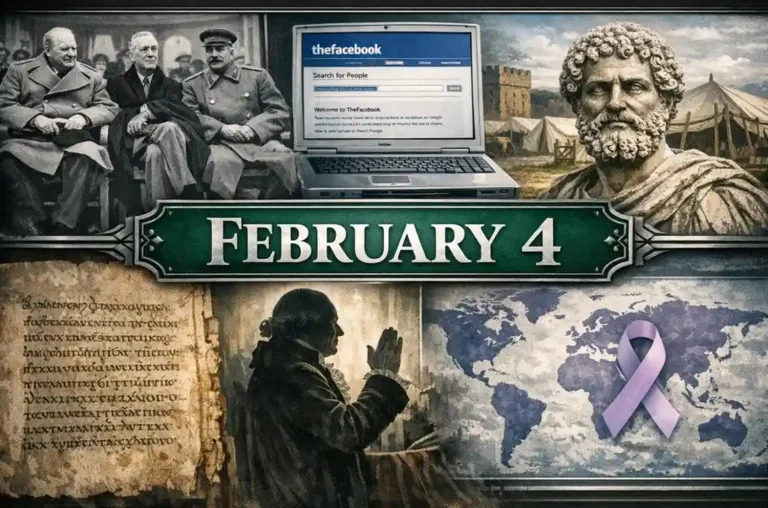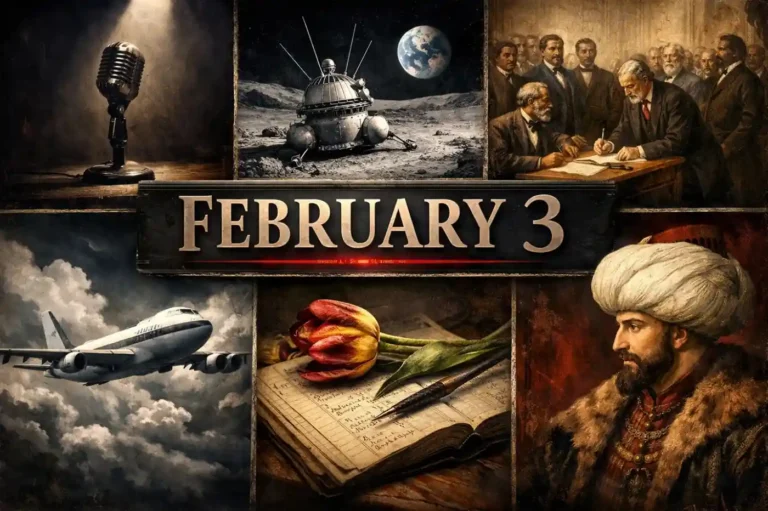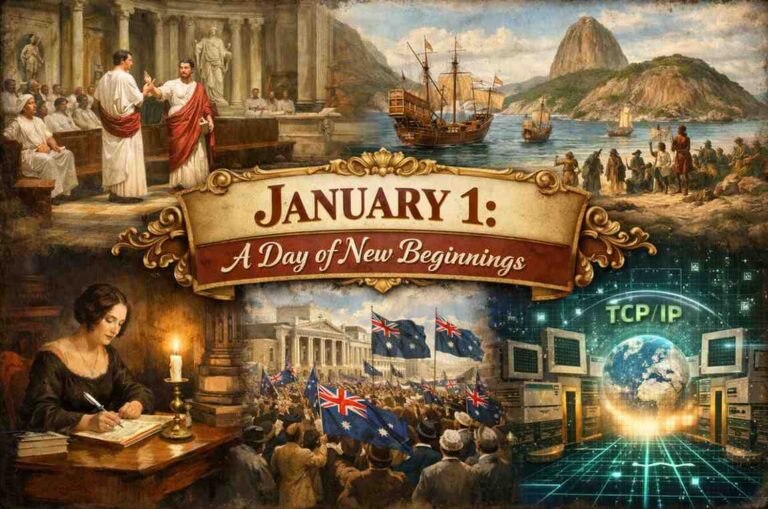
A day that stretches from the trembling of ancient domes to the silent void of space, December 14 holds stories of human vulnerability and audacious triumph. When we trace what happened on this day in history December 14, we follow a path from natural disasters that reshaped coasts and cities to the determined reach of explorers racing to the ends of the Earth.
Important Events That Happened On December 14 In History
557 – Earthquake Damages Constantinople
A powerful earthquake struck Constantinople, severely damaging the city and causing a deep crack in the majestic dome of the Hagia Sophia. This event weakened the architectural marvel and symbolized the fragility of even the greatest human achievements in the face of nature’s power.
835 – The Foiled Sweet Dew Incident
In a bold attempt to reclaim imperial authority, Emperor Wenzong of China’s Tang Dynasty conspired to eliminate the court’s overpowering eunuch faction. The plot, known as the Sweet Dew Incident, was discovered and brutally suppressed, cementing the eunuchs’ control and revealing the emperor’s tragic powerlessness within his own palace.
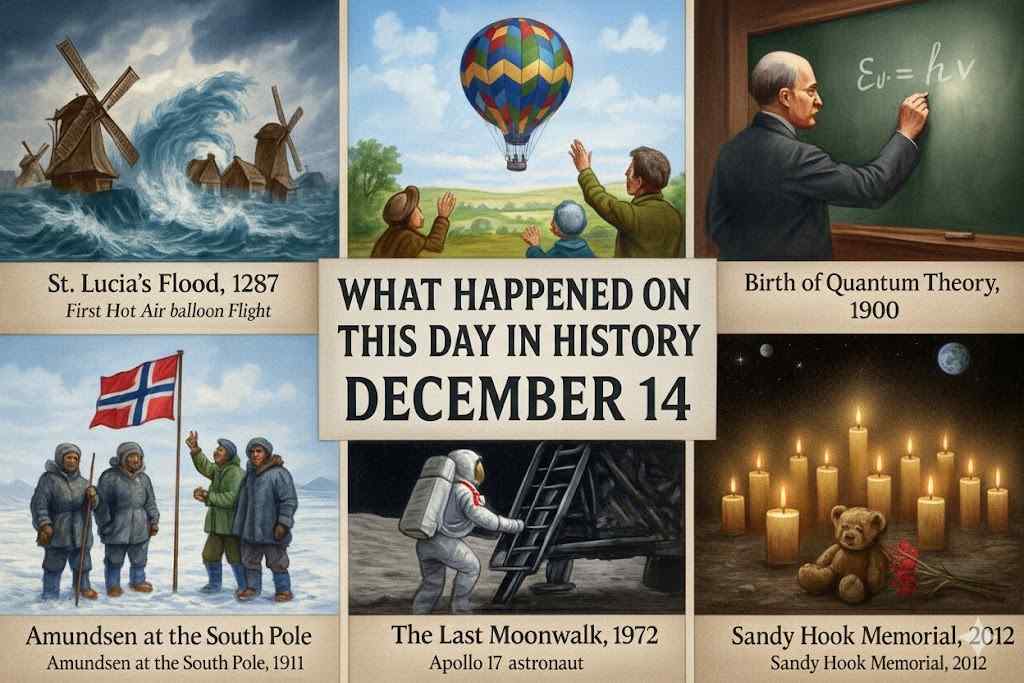
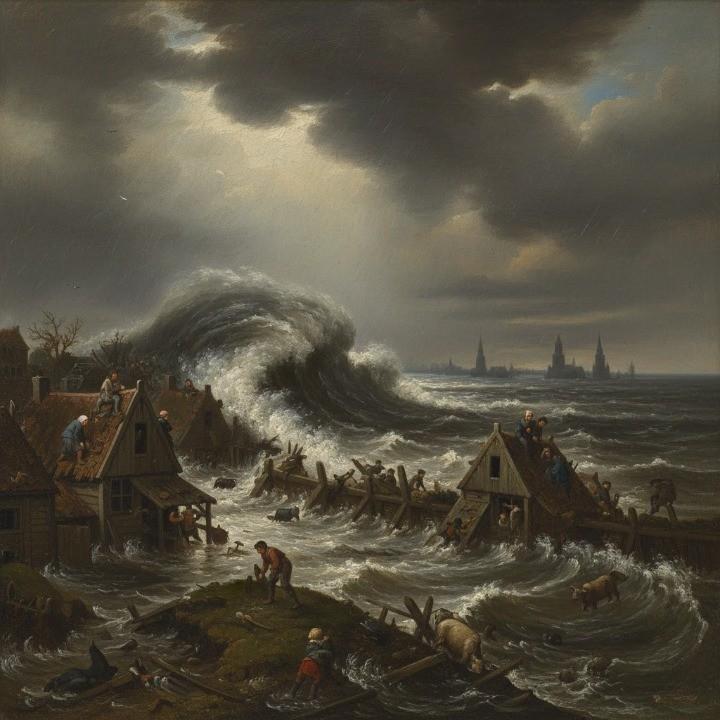
1287 – St. Lucia’s Flood Devastates the Netherlands
In a catastrophic disaster known as St. Lucia’s Flood, the sea wall containing the Zuiderzee collapsed. The resulting flood inundated the Netherlands, killing an estimated 50,000 people and permanently altering the map, highlighting the eternal battle between the Dutch people and the sea.
1542 – The Week-Old Queen of Scots
Upon the death of her father, James V, the one-week-old infant Mary Stuart ascended to the Scottish throne. This precarious beginning for the future Mary, Queen of Scots, set in motion a lifetime of political turmoil and dynastic drama that would echo across the British Isles.
1751 – Foundation of the Theresian Military Academy
Empress Maria Theresa of Austria established the Theresian Military Academy in Wiener Neustadt. Founded as an elite school for training army officers, it became one of the world’s oldest military academies, shaping the professional corps of the Austrian and later Austro-Hungarian armies for centuries.
1780 – Alexander Hamilton Weds Elizabeth Schuyler
Founding Father Alexander Hamilton married Elizabeth Schuyler at her family’s mansion in Albany, New York. The union connected the ambitious immigrant to a powerful colonial family and began a profound personal and political partnership that would endure through revolution and scandal.
1782 – First Unmanned Hot Air Balloon Flight
The Montgolfier brothers achieved a milestone in human aspiration with the first successful test flight of an unmanned hot air balloon in Annonay, France. The balloon traveled nearly 2.5 kilometers, lifting humanity’s dream of flight from pure fantasy into tangible reality.
1812 – The End of Napoleon’s Russian Campaign
The last shattered remnants of Napoleon’s Grande Armée were finally expelled from Russian territory. This ignominious end to the disastrous invasion marked a decisive turning point in the Napoleonic Wars, breaking the French emperor’s aura of invincibility.
1819 – Alabama Joins the Union
Alabama was admitted to the United States as the 22nd state. Its entry underscored the nation’s westward and southern expansion, a growth deeply entangled with the politics of slavery that would soon lead to crisis.
1900 – Planck Presents Quantum Theory
At a meeting of the German Physical Society in Berlin, Max Planck presented his law of black-body radiation, introducing the revolutionary concept of quantized energy. This moment is widely considered the birth of quantum mechanics, fundamentally altering our understanding of the physical universe.
1902 – First Pacific Telegraph Cable Laid
The Commercial Pacific Cable Company finished laying the first direct telegraph cable across the Pacific Ocean, connecting San Francisco to Honolulu. This engineering triumph shrank communication times from weeks by ship to minutes by wire, integrating the Pacific islands more closely with the American mainland.
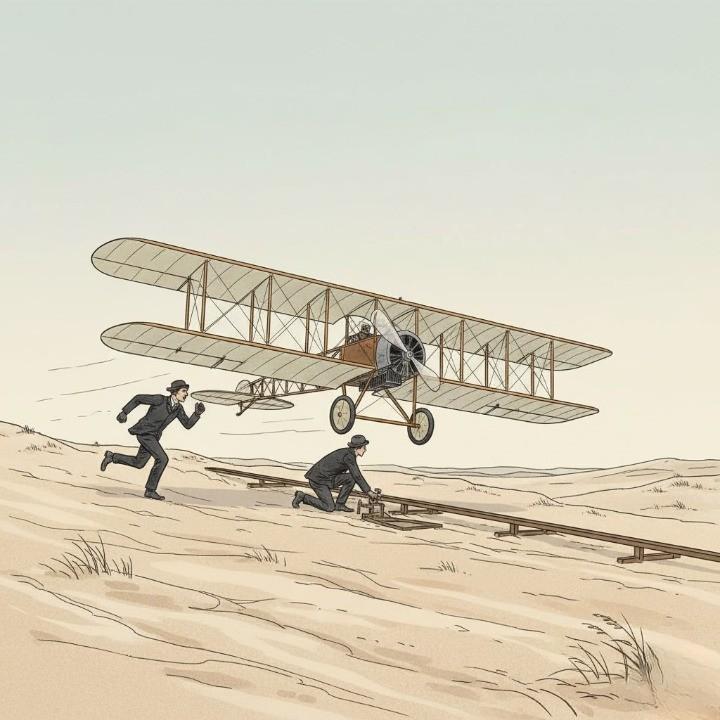
1903 – The Wright Brothers’ First Attempt
At Kitty Hawk, North Carolina, Wilbur and Orville Wright made their first attempted powered flight with the Wright Flyer. Though the try was unsuccessful, it set the stage for their historic success just days later, launching humanity into the age of aviation.
1907 – The Wreck of the Thomas W. Lawson
The Thomas W. Lawson, the largest schooner ever built and the only seven-masted sailing vessel, foundered in a fierce gale near the Isles of Scilly. The massive, engine-less ship was lost, taking the lives of her pilot and fifteen crew members in a dramatic end to the age of commercial sail.
1909 – Creating the Australian Capital Territory
New South Wales Premier Charles Wade signed the act that formally surrendered territory to the federal government, finalizing the creation of the Australian Capital Territory. This transfer provided the land for the purpose-built capital city, Canberra, resolving a long-standing rivalry between Sydney and Melbourne.
1911 – Amundsen Reaches the South Pole
The Norwegian expedition led by Roald Amundsen achieved one of history’s great feats of exploration. Amundsen and his team—Olav Bjaaland, Helmer Hanssen, Sverre Hassel, and Oscar Wisting—became the first humans to stand at the geographic South Pole, planting the Norwegian flag on the frozen plateau.
1913 – Launch of the Battleship Haruna
The Japanese battleship Haruna, the last of the Kongō-class battlecruisers, was launched. She would later be rebuilt into a fast battleship and serve through both World Wars, surviving to become one of the Imperial Japanese Navy’s most utilized and resilient capital ships.
1914 – A Progressive Party Forms in Argentina
Led by Lisandro de la Torre, a group of reformers founded the Democratic Progressive Party at the Hotel Savoy in Buenos Aires. The party emerged to represent liberal, agrarian interests, seeking to challenge the political status quo in early 20th-century Argentina.
1918 – A German Prince Renounces the Finnish Throne
With Germany’s defeat in World War I, Prince Friedrich Karl of Hessen wisely renounced the throne of Finland, to which he had been elected months earlier. His decision closed a brief, unusual chapter where Finland considered a German monarch and solidified the country’s path to a republican future.
1918 – Premiere of Puccini’s Gianni Schicchi
Giacomo Puccini’s one-act comic opera Gianni Schicchi premiered at the Metropolitan Opera in New York. The work, part of his Il Trittico, became an instant favorite for its vibrant score and clever story of greed and impersonation in medieval Florence.
1918 – A Landmark Election in the UK
The United Kingdom held its first general election where women were permitted to vote, and where some women could stand as candidates. In a seismic political shift in Ireland, the republican party Sinn Féin won a landslide victory, fundamentally altering the course of Irish history.
1918 – Assassination of Portuguese President Sidónio Pais
Portuguese President Sidónio Pais, the “President-King” who ruled as a quasi-dictator, was assassinated at Lisbon’s Rossio Railway Station. His death plunged Portugal into renewed political instability, ending his authoritarian “New Republic” experiment.
1939 – Soviet Union Expelled from the League of Nations
Following its unprovoked invasion of Finland, the Soviet Union was expelled from the League of Nations. This act of censure did little to halt the aggression but starkly illustrated the international body’s inability to enforce collective security in the face of determined militarism.
1940 – Plutonium is First Isolated
At the University of California, Berkeley, chemist Glenn T. Seaborg and his team first isolated the radioactive element plutonium. This groundbreaking discovery, achieved by bombarding uranium with deuterons, would soon become crucial to the development of nuclear weapons and energy.
1942 – Aeroflot ANT-20 Crash
An Aeroflot Tupolev ANT-20, a large propaganda aircraft, crashed near Tashkent, killing all 36 people on board. The tragedy claimed the lives of many aviation professionals and marked a significant loss during a critical period of World War II.
1948 – Patent for the First Electronic Game
Thomas T. Goldsmith Jr. and Estle Ray Mann were granted a patent for their “Cathode-Ray Tube Amusement Device.” This invention, which simulated firing a missile at a target on the screen, is recognized as the earliest known patent for an interactive electronic game, a primitive ancestor of the modern video game industry.
1955 – Sixteen Nations Join the United Nations
In a major expansion of the world body, the UN admitted 16 new countries from across Europe, Asia, and Africa, including Austria, Finland, Ireland, Italy, Spain, and several others. This wave of admissions reflected the post-war realignment and decolonization taking shape globally.
1958 – Reaching the Pole of Inaccessibility
The 3rd Soviet Antarctic Expedition successfully arrived at the Southern Pole of Inaccessibility—the point on the Antarctic continent farthest from all oceans. They established a temporary station there, claiming a symbolic victory in the era’s intense polar exploration rivalry.
1960 – UNESCO Adopts Education Convention
UNESCO adopted the Convention against Discrimination in Education, a foundational international treaty affirming the right to non-discriminatory education for all. It established key principles for equality in educational access and opportunity globally.
1962 – Mariner 2 Flies By Venus
NASA’s Mariner 2 spacecraft made a successful flyby of Venus, becoming the first human-made object to conduct a scientific encounter of another planet. The mission returned valuable data about Venus’s extreme surface temperature and atmosphere, heralding a new era of planetary exploration.
1971 – Martyred Intellectuals Day in Bangladesh
During the Bangladesh Liberation War, over 200 of East Pakistan’s most prominent intellectuals—including professors, doctors, and writers—were systematically executed by Pakistani forces and allied militias. This brutal attempt to cripple the nascent nation’s soul is commemorated annually as Martyred Intellectuals Day.
1972 – The Last Human Steps on the Moon
Apollo 17 Commander Eugene Cernan re-entered the lunar module Challenger after the mission’s final moonwalk. His actions made him, to this day, the last human to have walked on the surface of the Moon, closing an epoch of direct human exploration.
1981 – Israel Applies Law to Golan Heights
Israel’s Knesset passed the Golan Heights Law, formally applying Israeli civil law to the territory captured from Syria in 1967. The move was widely condemned internationally as a de facto annexation, solidifying Israeli control and complicating future peace negotiations.
1985 – Wilma Mankiller Leads the Cherokee Nation
Wilma Mankiller was sworn in as Principal Chief of the Cherokee Nation, becoming the first woman ever elected to lead a major Native American tribe. Her leadership marked a historic step for both the Cherokee people and for Indigenous women across North America.
1986 – The Qasba Aligarh Massacre
In Karachi, Pakistan, a violent episode of ethnic conflict erupted. Following a police raid on a drug operation in Sohrab Goth, retaliatory mob violence targeted the Qasba Aligarh neighborhood, leading to the deaths of over 400 Muhajir residents in a brutal cycle of retaliation.
1992 – Tragedy Over Abkhazia
During the War in Abkhazia, a helicopter evacuating refugees from the besieged town of Tkvarcheli was shot down. The crash killed at least 52 people, including 25 children, an atrocity that galvanized further Russian military involvement in the conflict on the Abkhaz side.
1994 – Groundbreaking for the Three Gorges Dam
Construction officially began on China’s Three Gorges Dam, the world’s largest power station by installed capacity. This monumental engineering project on the Yangtze River aimed to control floods and generate clean power but came with immense social and environmental costs.
1995 – The Dayton Agreement is Signed
In Paris, the leaders of Bosnia and Herzegovina, Croatia, and Serbia signed the General Framework Agreement for Peace in Bosnia and Herzegovina, commonly known as the Dayton Agreement. This treaty ended the Bosnian War, the deadliest conflict in Europe since World War II.
1998 – Ambush in Kosovo
During the Yugoslav Wars, the Yugoslav Army ambushed a unit of the Kosovo Liberation Army (KLA) near the Albanian border as they attempted to smuggle weapons into Kosovo. The clash resulted in the deaths of 36 KLA fighters, intensifying the pre-war tensions in the region.
1999 – Venezuela’s Vargas Tragedy
Torrential rains triggered catastrophic flash floods and debris flows in the state of Vargas, Venezuela. The disaster killed tens of thousands of people, erased entire towns from the map, and caused a near-total collapse of the region’s infrastructure in one of the worst natural disasters in Venezuelan history.
2003 – Musharraf Survives Assassination Attempt
Pakistani President Pervez Musharraf narrowly escaped an assassination attempt when a powerful bomb detonated minutes after his convoy crossed a bridge in Rawalpindi. The attack underscored the severe threats he faced from militant groups after aligning Pakistan with the U.S. “War on Terror.”
2004 – Inauguration of the Millau Viaduct
France officially opened the Millau Viaduct, a breathtaking cable-stayed bridge spanning the Tarn River valley. Soaring taller than the Eiffel Tower, it became the world’s tallest bridge and a masterpiece of engineering, gracefully solving a major traffic bottleneck.
2012 – Sandy Hook Elementary School Shooting
A gunman opened fire at Sandy Hook Elementary School in Newtown, Connecticut, killing 20 children and six adult staff members before taking his own life. The tragedy sparked intense, ongoing national debates in the United States on gun control, mental health, and school safety.
2013 – Coup Attempt in South Sudan
Violent clashes erupted in South Sudan’s capital, Juba, stemming from a reported coup attempt against President Salva Kiir. The fighting quickly escalated along ethnic lines, triggering the devastating civil war that would engulf the world’s youngest nation for years.
2017 – Disney Announces Acquisition of 21st Century Fox
The Walt Disney Company announced a historic agreement to acquire key assets of 21st Century Fox for $52.4 billion. The deal, which included the legendary 20th Century Fox film studio, marked a seismic consolidation in the entertainment industry, reshaping the media landscape for the streaming era.
2020 – A Total Solar Eclipse Crosses the South
A total solar eclipse swept across parts of the South Pacific Ocean, southern Chile and Argentina, and the South Atlantic Ocean. This celestial event provided a moment of global wonder and scientific observation, a reminder of our place in a vast solar system.
Read Here December 13 Stories:
Famous People Born On December 14
| Name | Role / Short Description | Dates |
|---|---|---|
| James H. Doolittle | U.S. aviator & general | December 14, 1896 – September 27, 1993 |
| Spike Jones | American bandleader (novelty) | December 14, 1911 – May 1, 1965 |
| Helle Thorning-Schmidt | Prime minister of Denmark | December 14, 1966 – |
| Shyam Benegal | Indian film director | December 14, 1934 – December 23, 2024 |
| Paul Éluard | French poet (Surrealist) | December 14, 1895 – November 18, 1952 |
| John J. Mearsheimer | American IR scholar | December 14, 1947 – |
| Sergey Bubka | Ukrainian pole-vaulter | December 14, 1963 – |
| Michael Ovitz | American talent manager (CAA) | December 14, 1946 – |
| Thomas Cochrane, 10th Earl of Dundonald | British admiral & politician | December 14, 1775 – October 31, 1860 |
| Pierre-Samuel du Pont | French economist & industrialist | December 14, 1739 – August 6, 1817 |
| Roger Fry | British art critic & painter | December 14, 1866 – September 9, 1934 |
| Kurt von Schuschnigg | Chancellor of Austria | December 14, 1897 – November 18, 1977 |
| Don S. Hewitt | TV producer (created 60 Minutes) | December 14, 1922 – August 19, 2009 |
| Nikolay Basov | Soviet physicist (Nobel) | December 14, 1922 – July 1, 2001 |
| Henri Cochet | French tennis player | December 14, 1901 – April 1, 1987 |
| Gerard Reve | Dutch author | December 14, 1923 – April 8, 2006 |
| Hanni Wenzel | Liechtenstein Olympic skier | December 14, 1956 – |
| Edward L. Tatum | American biochemist (Nobel) | December 14, 1909 – November 5, 1975 |
| Errico Malatesta | Italian anarchist & agitator | December 14, 1853 – July 22, 1932 |
| Pierre Puvis de Chavannes | French mural painter | December 14, 1824 – October 24, 1898 |
| Karl Renner | President of Austria | December 14, 1870 – December 31, 1950 |
| Hans J. P. von Ohain | Designer of first operational jet engine | December 14, 1911 – March 13, 1998 |
| Daniel De Leon | American socialist leader | December 14, 1852 – May 11, 1914 |
| Karl Carstens | President of West Germany | December 14, 1914 – May 30, 1992 |
| Charles John Canning, Earl Canning | Governor-General / 1st Viceroy of India | December 14, 1812 – June 17, 1862 |
| James Bruce | Scottish explorer (Blue Nile) | December 14, 1730 – April 27, 1794 |
| Arsenio Martínez Campos | Spanish general & PM | December 14, 1831 – September 23, 1900 |
| Philander Chase | American clergyman & educator | December 14, 1775 – September 20, 1852 |
| John B. Jervis | American civil engineer | December 14, 1795 – January 12, 1885 |
| Justus Möser | German political essayist | December 14, 1720 – January 8, 1794 |
Famous People Died On December 14
| Name | Role / Short Description | Dates |
|---|---|---|
| James V | King of Scotland | April 10, 1512 – December 14, 1542 |
| Andrey Sakharov | Soviet physicist & dissident | May 21, 1921 – December 14, 1989 |
| St. John of the Cross | Spanish mystic & poet | June 24, 1542 – December 14, 1591 |
| Charles III | King of Spain (enlightened despot) | January 20, 1716 – December 14, 1788 |
| Stanley Baldwin | Prime minister of the UK | August 3, 1867 – December 14, 1947 |
| Roger Maris | American baseball player | September 10, 1934 – December 14, 1985 |
| Walter Lippmann | American journalist & commentator | September 23, 1889 – December 14, 1974 |
| Carl Philipp Emanuel Bach | German composer | March 8, 1714 – December 14, 1788 |
| Orval Faubus | Governor of Arkansas | January 7, 1910 – December 14, 1994 |
| W. G. Sebald | German-English author | May 18, 1944 – December 14, 2001 |
| Louis Agassiz | Swiss-American naturalist | May 28, 1807 – December 14, 1873 |
| William Slim, 1st Viscount Slim | British field marshal | August 6, 1891 – December 14, 1970 |
| George Gipp | American football legend (Notre Dame) | February 18, 1895 – December 14, 1920 |
| Julia Grant | First Lady of the United States | January 26, 1826 – December 14, 1902 |
| Sir Stanley Spencer | English painter | June 30, 1891 – December 14, 1959 |
| Marjorie Kinnan Rawlings | American author | August 8, 1896 – December 14, 1953 |
| Juho Kusti Paasikivi | President of Finland | November 27, 1870 – December 14, 1956 |
| Aldfrith | King of Northumbria | — December 14, 704 |
| Charles E. Mitchell | American banker | October 6, 1877 – December 14, 1955 |
| John Breckinridge | American politician | December 2, 1760 – December 14, 1806 |
| John R. Firth | British linguist | June 17, 1890 – December 14, 1960 |
| John Frederick Kensett | American landscape painter | March 22, 1816 – December 14, 1872 |
| Agnes of Poitou | Empress consort & regent | c.1024 – December 14, 1077 |
| Gregory Ratoff | Actor & director | April 20, 1897 – December 14, 1960 |
| George Hudson | British financier (“Railway King”) | March 1800 – December 14, 1871 |
| Roy William Neill | Film director (Sherlock Holmes series) | September 4, 1887 – December 14, 1946 |
| Pierre Dupuy | French historian & librarian | November 27, 1582 – December 14, 1651 |
| Anton Korošec | Slovene political leader | May 12, 1872 – December 14, 1940 |
| Sir Henry Bradwardine Jackson | British naval officer (radio telegraphy) | January 21, 1855 – December 14, 1929 |
| Herman Haupt | American civil engineer & inventor | March 26, 1817 – December 14, 1905 |
Observances & Institutional Dates – December 14
Martyred Intellectuals Day (Bangladesh): A national day of mourning to honor the intellectuals systematically killed by Pakistani forces on December 14, 1971, during the Bangladesh Liberation War.
Alabama Day (Alabama, USA): Commemorates the admission of Alabama as the 22nd state of the Union in 1819.
Forty-seven Ronin Remembrance Day (Sengaku-ji, Tokyo): Observed at the graves of the 47 Ronin (masterless samurai) to mark the anniversary of their raid to avenge their lord’s death, a foundational story in Japanese culture.
Monkey Day: An international, informal holiday celebrating primates and raising awareness about animal welfare and conservation issues.
Frequently Asked Questions
What major explorations are linked to December 14?
The date is monumental in exploration history. It marks Roald Amundsen’s team reaching the South Pole (1911) and NASA’s Mariner 2 completing the first successful planetary flyby at Venus (1962). It also saw the end of Napoleon’s failed invasion of Russia (1812), itself a kind of disastrous exploration.
Why is December 14 significant for science and innovation?
It is a cornerstone date for scientific revolution, from Max Planck’s presentation of quantum theory (1900) that changed physics, to the first unmanned hot-air balloon flight (1782), the patent for the first electronic game (1948), and the inaugural flight of a cable across the Pacific (1902).
How does December 14 reflect social and political change?
The day captures pivotal shifts: the first UK election with women voters (1918), the swearing-in of Wilma Mankiller as Cherokee Chief (1985), a landmark US civil rights Supreme Court ruling (1964), and the signing of the peace deal that ended the Bosnian War (1995). It also encompasses profound tragedies like the Martyred Intellectuals killings (1971) and the Sandy Hook shooting (2012).