
A date where the fate of empires and the fabric of societies can be decided by a single battle, a new law, or a bold declaration. The question of what happened on this day in history December 15 reveals a timeline where military disaster sits beside artistic triumph, and where the fight for rights and recognition finds powerful expression.
Important Events That Happened On December 15 In History
533 – Belisarius Crushes the Vandals
Byzantine general Belisarius secured a decisive victory over the Vandal Kingdom at the Battle of Tricamarum in North Africa. Following up his prior success, this defeat of King Gelimer effectively shattered Vandal power, paving the way for the Byzantine reconquest of the region under Emperor Justinian I.
687 – A Compromise Pope is Elected
Ending a bitter schism, Sergius I was elected Pope as a peaceful compromise candidate between two rival factions in Rome. His election restored unity and began a long papacy notable for introducing the Agnus Dei to the Mass and resisting imperial interference in church doctrine.
1025 – Constantine VIII’s Solo Reign Begins
After 63 years serving as co-emperor—first with his father and then his brother—Constantine VIII became the sole ruler of the Byzantine Empire. His long-awaited solo reign, however, was marked by indifference to governance and a focus on pleasure, weakening the state.
1161 – A Jin Emperor Falls to Assassins
Following a major military defeat at the Battle of Caishi against the Song dynasty, Jin Emperor Wanyan Liang faced a fatal conspiracy. His own military officers, enraged by the costly failure and his tyrannical rule, stormed his camp and assassinated him, triggering a power struggle within the Jin dynasty.
1256 – The Assassins’ Stronghold Falls
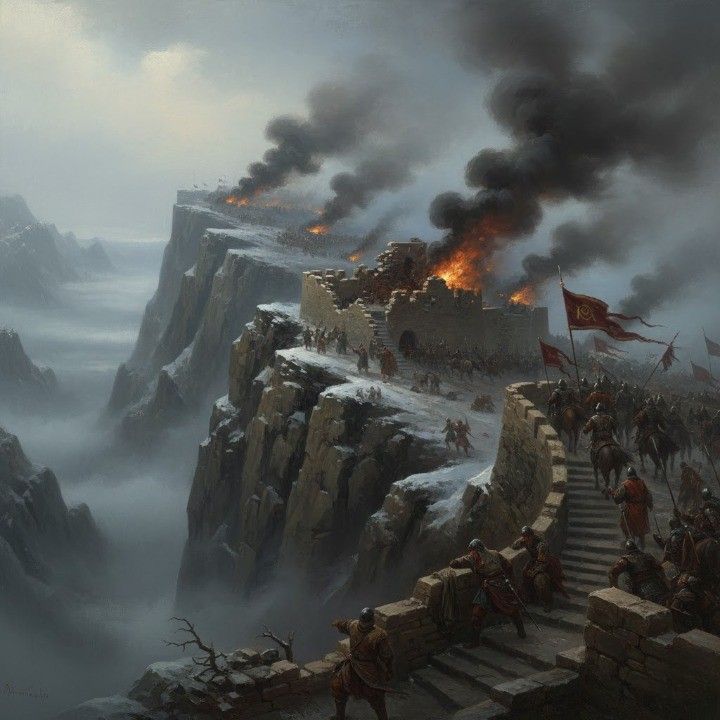
Hulagu led his forces into the legendary fortress of Alamut, the heart of the Nizari Ismaili (Assassin) order. The capture and systematic dismantling of this mountain stronghold marked the definitive end of the Assassins’ political power in Persia, a key objective in the Mongol sweep across Southwest Asia.
1467 – Stephen of Moldavia Triumphs at Baia
Stephen III of Moldavia secured a significant victory against a much larger Hungarian army led by King Matthias Corvinus at the Battle of Baia. Corvinus was wounded three times in the fierce combat, and the defeat halted Hungarian ambitions in the region, bolstering Moldavian autonomy.
1546 – Founding of Ekenäs
King Gustav Vasa of Sweden signed the charter founding the town of Ekenäs (Finnish: Tammisaari) on the southern coast of modern-day Finland. This strategic move strengthened Swedish royal administration and economic influence in the Gulf of Finland.
1651 – Castle Cornet Surrenders
After a grueling eight-year siege during the English Civil War, the Royalist garrison of Castle Cornet in Guernsey, the final holdout for the Crown, surrendered to Parliamentarian forces. Its fall brought the Channel Islands entirely under Parliamentary control.
1778 – Naval Clash at the Battle of St. Lucia
In a pivotal engagement of the American Revolutionary War, a British fleet under Admiral Samuel Barrington repelled an attack by a larger French squadron under Comte d’Estaing off the island of St. Lucia. This victory allowed the British to successfully land troops and capture the island, securing a key Caribbean base.
1791 – The Bill of Rights is Ratified
The United States Bill of Rights, the first ten amendments to the U.S. Constitution, became law following ratification by the Virginia General Assembly. This foundational charter of personal liberties and legal protections completed the revolutionary framework of American governance.
1836 – The U.S. Patent Office Burns
A devastating fire consumed the U.S. Patent Office building in Washington, D.C., destroying all 9,957 patents issued to that date along with thousands of related models. This catastrophic loss prompted a complete overhaul of the patent record-keeping system.
1862 – The Costly Defeat at Fredericksburg Concludes
Union General Ambrose Burnside called a halt to the futile assaults on Marye’s Heights and ordered the Army of the Potomac to withdraw across the Rappahannock River. The Battle of Fredericksburg ended as a crushing and demoralizing defeat for the North, with terrible Union casualties.
1864 – The Battle of Nashville Commences
The Union Army of the Cumberland under General George H. Thomas launched a massive attack on Confederate forces under General John Bell Hood outside Nashville. This two-day battle would utterly destroy the Confederate Army of Tennessee as an effective fighting force in the West.
1869 – The Short-Lived Republic of Ezo
Following the Boshin War, former Tokugawa shogunate loyalists proclaimed the Republic of Ezo on Japan’s northern island of Hokkaido. It was the first attempt to establish a government based on democratic election in Japanese history, though it would survive for only five months before surrendering to Imperial forces.
1871 – A Telegraphic First from Arizona
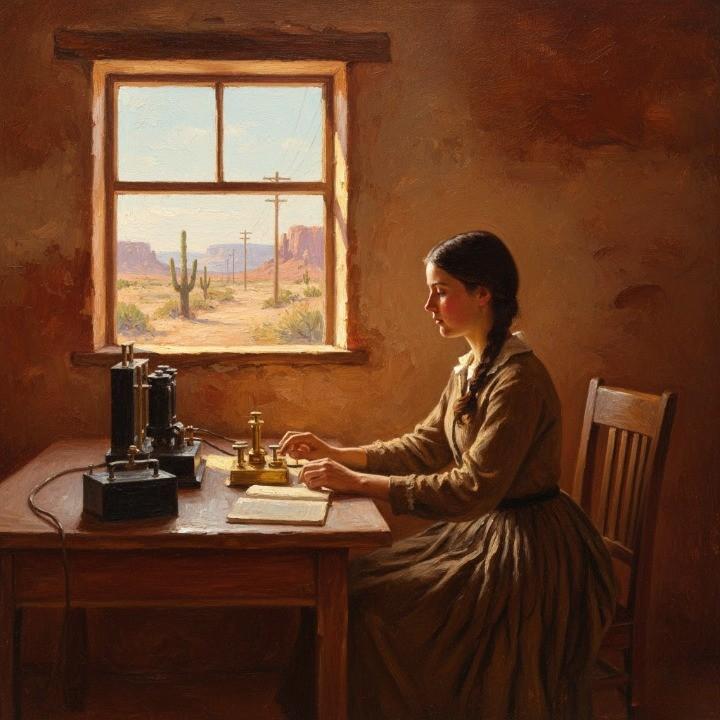
At the Pipe Spring outpost, sixteen-year-old operator Ella Stewart keyed and sent the first telegraphed message from Arizona Territory via the Deseret Telegraph line. This connection integrated the remote territory into the rapidly growing network of instant communication.
1890 – Sitting Bull is Killed
On the Standing Rock Indian Reservation, Hunkpapa Lakota leader Sitting Bull was killed during a botched arrest attempt by tribal police. His death, meant to quell the growing Ghost Dance movement, instead inflamed tensions, leading directly to the Wounded Knee Massacre two weeks later.
1893 – Dvořák’s “New World” Symphony Premieres
Antonín Dvořák’s Symphony No. 9, “From the New World,” had its first public performance at Carnegie Hall in New York. The rehearsal premiere captivated the audience, introducing a masterpiece that beautifully synthesized American spiritual and folk motifs with European symphonic tradition.
1899 – A Black Week Defeat at Colenso
British forces suffered a severe defeat at the Battle of Colenso in Natal, South Africa, the third and final loss during the “Black Week” of the Second Boer War. Poor tactics and strong Boer defensive positions led to heavy British casualties, shocking the empire.
1903 – Patent for the Ice Cream Cone Machine
Italian immigrant Italo Marchiony received a U.S. patent for a device that molded warm dough into edible ice cream cups. While others claimed the cone’s invention, his patent solidified the mechanized production of what would become a classic American treat.
1905 – The Pushkin House is Established
In Saint Petersburg, Russia, the Pushkin House was founded as a national institute of literature. Dedicated to preserving the legacy of Alexander Pushkin, it became the central archive for the study of Russian literary history.
1906 – A New Underground Line Opens
London’s Great Northern, Piccadilly and Brompton Railway (now part of the Piccadilly line) opened to the public, connecting Hammersmith to Finsbury Park. This major expansion of the London Underground provided vital new links across the city.
1914 – Mitsubishi Hōjō Mine Disaster
A massive coal dust explosion ripped through the Mitsubishi Hōjō colliery in Kyushu, Japan. The disaster killed 687 miners, making it one of the deadliest mining accidents in Japanese history and exposing the dire safety conditions of the era.
1914 – Serbia Retakes Belgrade
In a bold counteroffensive during World War I, the Serbian Army successfully recaptured its capital, Belgrade, from the occupying Austro-Hungarian forces. This victory provided a vital morale boost, though the kingdom would later be forced into a tragic retreat across the mountains.
1917 – An Armistice on the Eastern Front
World War I: Following the Bolshevik Revolution, the new Russian government signed an armistice with the Central Powers (Germany, Austria-Hungary, Bulgaria, and the Ottoman Empire) at Brest-Litovsk, halting fighting on the Eastern Front and allowing Russia to exit the war.
1933 – Anarchist Insurrection in Zaragoza
A major anarchist-led insurrection against the Spanish government was suppressed in the city of Zaragoza. The uprising, part of a nationwide period of radical unrest, was put down by the Civil Guard and army after several days of street fighting.
1939 – Premiere of Gone with the Wind
The epic film Gone with the Wind, based on Margaret Mitchell’s novel, premiered at Loew’s Grand Theatre in Atlanta, Georgia. The event was a cultural sensation, launching the film into legendary status and setting records for attendance and awards.
1941 – The Drobytsky Yar Massacre
Nazi German troops began a systematic massacre at Drobytsky Yar, a ravine near Kharkiv, Ukraine. Over two days, they murdered more than 15,000 Jews, one of the largest single Holocaust atrocities on Soviet territory.
1942 – The Battle of Mount Austen Begins
On Guadalcanal, U.S. forces launched an offensive against entrenched Japanese positions on Mount Austen, beginning a brutal, month-long struggle for a series of ridges codenamed the “Galloping Horse” and “Sea Horse.” The fighting was some of the toughest of the entire campaign.
1943 – Battle of Arawe Begins
As part of the New Britain campaign, Allied forces made an amphibious landing at Arawe to establish a diversionary foothold and block Japanese reinforcements. The operation drew Japanese forces away from the main landing site at Cape Gloucester.
1944 – Bandleader Glenn Miller Disappears
A single-engine UC-64 Norseman aircraft carrying famed American bandleader Major Glenn Miller disappeared over the English Channel en route to Paris. Neither the plane nor his body was ever found, creating an enduring mystery and silencing the voice of the wartime generation’s defining music.
1961 – Eichmann Sentenced to Death
An Israeli court pronounced the death sentence on Nazi war criminal Adolf Eichmann. Found guilty of crimes against the Jewish people and humanity for his central role in organizing the Holocaust, he was executed the following year.
1945 – The Shinto Directive
U.S. General Douglas MacArthur, as Supreme Commander for the Allied Powers, issued the “Shinto Directive,” ordering the abolition of State Shinto as Japan’s official state religion. This aimed to dismantle the ideological apparatus that had fueled Japanese militarism and ultranationalism.
1960 – Plots and Power Grabs
Two stark events unfolded: In the U.S., Richard Pavlick was arrested for plotting to assassinate President-Elect John F. Kennedy. Meanwhile, in Nepal, King Mahendra suspended the constitution, dissolved parliament, dismissed the cabinet, and imposed direct royal rule, ending the country’s first experiment with democracy.
1965 – First Space Rendezvous Achieved
NASA’s Gemini 6A spacecraft, with astronauts Wally Schirra and Thomas Stafford, was launched. They successfully maneuvered to within feet of the already-orbiting Gemini 7, achieving the world’s first controlled rendezvous of two manned spacecraft, a critical step toward the Moon landings.
1970 – First Soft Landing on Another Planet
The Soviet Union’s Venera 7 spacecraft survived the immense pressure and heat of the Venusian atmosphere to make a successful soft landing on the planet’s surface. It became the first human-made object to transmit data from the surface of another planet, revealing a hellish landscape.
1973 – Homosexuality Declassified as a Mental Disorder
The American Psychiatric Association’s Board of Trustees voted unanimously to remove homosexuality from its official manual of mental disorders. This landmark decision was a pivotal moment in the long struggle for LGBTQ+ rights and dignity, shifting the issue from pathology to identity.
1973 – Getty Kidnapping Ends
After five months in captivity, the kidnapped 16-year-old John Paul Getty III was found alive near Naples, Italy, following payment of a reduced ransom. The ordeal, which included the grisly delivery of his ear to a newspaper, highlighted the brutal intersection of crime, family, and vast wealth.
1978 – U.S. Shifts Recognition to China
President Jimmy Carter announced the United States would formally recognize the communist People’s Republic of China as the sole government of China and sever diplomatic ties with the Republic of China on Taiwan, fundamentally reshaping the geopolitical landscape of East Asia.
1981 – First Modern Suicide Bombing in Beirut
A suicide bomber driving a car loaded with explosives destroyed the Iraqi embassy in Beirut, Lebanon, killing 61 people, including Iraq’s ambassador. The attack, linked to the Iraqi Islamic opposition, is widely considered a prototype for the modern tactic of vehicular suicide bombing.
1989 – U.N. Protocol Against the Death Penalty
The United Nations adopted the Second Optional Protocol to the International Covenant on Civil and Political Rights, aiming at the abolition of the death penalty. This treaty marked a significant global commitment to ending capital punishment as a tool of state justice.
1993 – The Downing Street Declaration
British Prime Minister John Major and Irish Taoiseach Albert Reynolds jointly issued the Downing Street Declaration. This framework for peace established the principle that any change to Northern Ireland’s status required the consent of a majority of its people, paving a political path forward.
1997 – Tajikistan Airlines Crash
Tajikistan Airlines Flight 3183, a chartered Yak-40, crashed in the desert near Sharjah, United Arab Emirates, shortly after takeoff. The accident, which killed all 85 people on board, was attributed to crew error and overloading.
1997 – First Elected Female President in South America
Janet Jagan, a U.S.-born socialist, was elected President of Guyana. Her victory made her the first elected female head of state in South America and the first white president of the predominantly Black nation, a historic moment for the continent.
2001 – The Leaning Tower of Pisa Reopens
After an 11-year, $27 million stabilization effort that reduced its famous lean by 18 inches, the Leaning Tower of Pisa reopened to the public. The engineering feat corrected centuries of subsidence without eliminating the iconic tilt that made it a world wonder.
2005 – The F-22 Raptor Enters Service
The U.S. Air Force officially introduced the Lockheed Martin F-22 Raptor into active combat service. This fifth-generation stealth air superiority fighter, representing a monumental leap in technology, became the world’s most advanced operational fighter jet.
2010 – Christmas Island Boat Tragedy
A wooden boat carrying about 90 asylum seekers, mostly from Iran and Iraq, crashed against the rocky cliffs of Christmas Island, Australia, during stormy weather. Forty-eight people died in the sight of horrified residents, igniting a fierce national debate on immigration policy.
2013 – South Sudanese Civil War Erupts
Political tensions within the ruling party exploded into violence in Juba. Opposition leaders Riek Machar and others were accused of instigating a coup attempt, triggering brutal ethnically charged fighting that marked the beginning of a devastating civil war in the world’s newest nation.
2014 – The Sydney Siege Begins
Gunman Man Haron Monis took 18 hostages inside a café in Sydney’s Martin Place, beginning a 16-hour siege that paralyzed the city’s center. The standoff ended in a violent police raid the next morning, leaving Monis and two hostages dead.
2017 – Earthquake Strikes Java
A magnitude 6.5 earthquake shook the Indonesian island of Java near the city of Tasikmalaya. The tremor killed four people, injured dozens, and damaged hundreds of buildings, another reminder of the region’s acute seismic vulnerability.
2018 – A Rulebook for the Planet is Forged
The United Nations Climate Change Conference concluded in Katowice, Poland, with nearly 200 countries agreeing on a detailed set of rules to implement the landmark 2015 Paris Agreement. This “rulebook” provided a critical framework for how nations would track and report their emissions cuts, representing a major, if technical, step forward in global cooperative efforts to address the climate crisis.
Famous People Born On — December 15
| Name | Role / short description | Dates |
|---|---|---|
| Freeman Dyson | Physicist & mathematician | December 15, 1923 – February 28, 2020 |
| Henri Becquerel | Physicist (discovered radioactivity) | December 15, 1852 – August 25, 1908 |
| Julie Taymor | Stage & film director / designer | December 15, 1952 – |
| Maurice Wilkins | Biophysicist (DNA X-ray studies) | December 15, 1916 – October 6, 2004 |
| L. L. Zamenhof | Creator of Esperanto; linguist | December 15, 1859 – April 14, 1917 |
| Chico Mendes | Brazilian labor leader & conservationist | December 15, 1944 – December 22, 1988 |
| Harold Abrahams | Olympic sprinter (100 m gold, 1924) | December 15, 1899 – January 14, 1978 |
| Hwang Woo-Suk | Biologist (stem-cell controversy) | December 15, 1953 – |
| Stan Kenton | Jazz bandleader & pianist | December 15, 1911 – August 25, 1979 |
| Edna O’Brien | Novelist & short-story writer | December 15, 1930 – July 27, 2024 |
| John Hammond | Record producer & talent scout | December 15, 1910 – July 10, 1987 |
| George Romney | Portrait painter | December 15, 1734 – November 15, 1802 |
| Josef Hoffmann | Architect & designer | December 15, 1870 – May 7, 1956 |
| Rudolf Laban | Dance theorist / choreographer | December 15, 1879 – July 1, 1958 |
| Uziel Gal | Inventor (Uzi submachine gun) | December 15, 1923 – September 7, 2002 |
| Barry Harris | Jazz pianist & educator | December 15, 1929 – December 8, 2021 |
| Maxwell Anderson | Playwright & poet | December 15, 1888 – February 28, 1959 |
| János Bolyai | Mathematician (non-Euclidean geometry) | December 15, 1802 – January 27, 1860 |
| Muriel Rukeyser | Poet & activist | December 15, 1913 – February 12, 1980 |
| Niels Ryberg Finsen | Physician (phototherapy, Nobel) | December 15, 1860 – September 24, 1904 |
| Albert Memmi | Novelist & essayist | December 15, 1920 – May 22, 2020 |
| Pehr Evind Svinhufvud | President of Finland | December 15, 1861 – February 29, 1944 |
| Michel-Richard Delalande | Composer (French Baroque) | December 15, 1657 – June 18, 1726 |
| Sir Peter Buck (Te Rangi Hīroa) | Māori anthropologist & statesman | December 15, 1880 – December 1, 1951 |
| Kaare Klint | Architect & furniture designer | December 15, 1888 – March 28, 1954 |
| Kermit Bloomgarden | Theatrical producer | December 15, 1904 – September 20, 1976 |
| Charles Augustus Young | Astronomer (solar spectroscopy) | December 15, 1834 – January 3, 1908 |
| Joseph Barrell | Geologist | December 15, 1869 – May 4, 1919 |
| John Caird | Theologian & preacher | December 15, 1820 – July 30, 1898 |
| Yvonne Jacquette | Painter (aerial urban landscapes) | December 15, 1934 – |
Famous People Died On — December 15
| Name | Role / short description | Dates |
|---|---|---|
| Joan Fontaine | Actress | October 22, 1917 – December 15, 2013 |
| Anthony Wayne | U.S. general (Revolutionary War) | January 1, 1745 – December 15, 1796 |
| Afonso de Albuquerque | Portuguese conqueror & governor | 1453 – December 15, 1515 |
| Arthur Machen | Writer (Gothic & supernatural) | March 3, 1863 – December 15, 1947 |
| Carlos P. Romulo | Diplomat, soldier & UN statesman | January 14, 1899 – December 15, 1985 |
| Bob Feller | Baseball pitcher (Cleveland Indians) | November 3, 1918 – December 15, 2010 |
| Jess Willard | Heavyweight boxing champion | December 29, 1881 – December 15, 1968 |
| Kamehameha III | King of Hawaii | March 7, 1814 – December 15, 1854 |
| Izaak Walton | Biographer & angling author | August 9, 1593 – December 15, 1683 |
| Anatole Litvak | Film director & producer | May 10, 1902 – December 15, 1974 |
| Ferdinand II | King consort of Portugal | October 29, 1816 – December 15, 1885 |
| Robert A. Toombs | U.S. politician & Confederate leader | July 2, 1810 – December 15, 1885 |
| Pavel Florensky | Theologian, philosopher & mathematician | January 21, 1882 – December 15, 1943 |
| Whitelaw Reid | Journalist, diplomat & politician | October 27, 1837 – December 15, 1912 |
| Otakar I | King of Bohemia | c.1155 – December 15, 1230 |
| Maggie Lena Draper Walker | Entrepreneur & bank founder | July 15, 1867 – December 15, 1934 |
| Septima Poinsette Clark | Educator & civil-rights activist | May 3, 1898 – December 15, 1987 |
| Zakir Hussain | Tabla virtuoso & composer | March 9, 1951 – December 15, 2024 |
| bell hooks | Scholar & cultural critic | September 25, 1952 – December 15, 2021 |
| Christopher Hitchens | Writer & polemicist | April 13, 1949 – December 15, 2011 |
| Blake Edwards | Film director & screenwriter | July 26, 1922 – December 15, 2010 |
| Oral Roberts | Evangelist & televangelist | January 24, 1918 – December 15, 2009 |
| Serge Lifar | Dancer & choreographer | April 2, 1905 – December 15, 1986 |
| Charles Stanhope, 3rd Earl Stanhope | Scientist & politician | August 3, 1753 – December 15, 1816 |
| Carlo Maratta | Italian painter (Baroque classicism) | May 15, 1625 – December 15, 1713 |
| Georg Friedrich Grotefend | Decipherer of cuneiform inscriptions | June 9, 1775 – December 15, 1853 |
| Adriaen de Vries | Mannerist sculptor | 1545/1546 – December 15, 1626 |
| Pierre-Marie-Alexis Millardet | Botanist (Bordeaux mixture) | December 13, 1838 – December 15, 1902 |
| Numa Droz | Swiss statesman | January 27, 1844 – December 15, 1899 |
| Sven Delblanc | Swedish novelist | May 26, 1931 – December 15, 1992 |
Observances & Institutional Dates – December 15
Bill of Rights Day (United States): Commemorates the ratification of the first ten amendments to the U.S. Constitution on December 15, 1791, celebrating the cornerstone of American civil liberties.
Homecoming Day (Alderney): A celebration in the Channel Island of Alderney, marking the return of islanders after evacuation during World War II.
Kingdom Day / Koninkrijksdag (Netherlands): Celebrates the signing of the Charter for the Kingdom of the Netherlands in 1954, which established the constitutional relationship between the Netherlands and its Caribbean countries.
Zamenhof Day (International Esperanto Community): Honors the birthday of L. L. Zamenhof, the creator of the Esperanto language, promoting linguistic internationalism.
World Turkic Language Family Day (UNESCO): Recognizes the cultural and historical importance of the Turkic language family.
Frequently Asked Questions
What major legal and social milestones occurred on December 15?
The day is foundational for rights: the U.S. Bill of Rights was ratified (1791). It also marks the U.N. abolition of the death penalty protocol (1989) and the declassification of homosexuality as a mental disorder by the APA (1973)—all landmark steps for human dignity and law.
How is December 15 significant in space exploration history?
It marks two giant leaps: the first soft landing on another planet (Venera 7 on Venus, 1970) and the first manned space rendezvous (Gemini 6A and 7, 1965). These achievements were critical in proving the techniques needed for interplanetary travel and lunar missions.
Why is December 15 a pivotal date in wartime history?
The day has seen decisive battles that ended conflicts or destroyed armies: Belisarius’s victory over the Vandals (533), the destruction of the Confederate Army of Tennessee at Nashville (1864), and the Serbian recapture of Belgrade (1914). It also marks the beginning of the end for the Assassins’ order (1256).