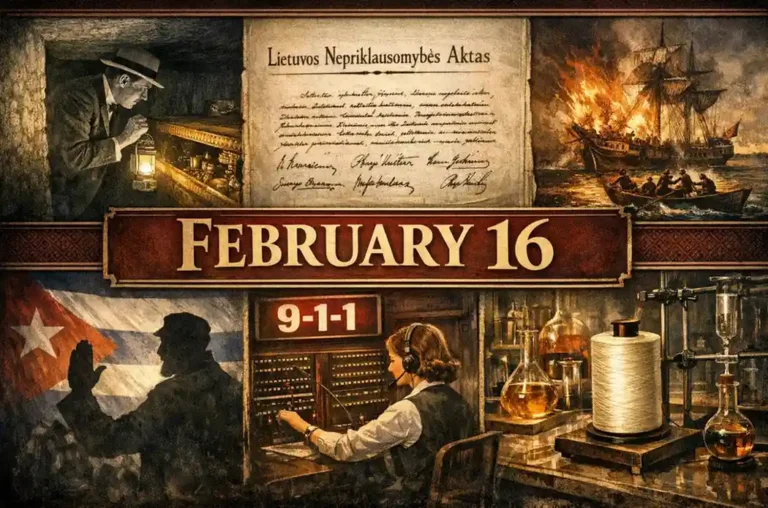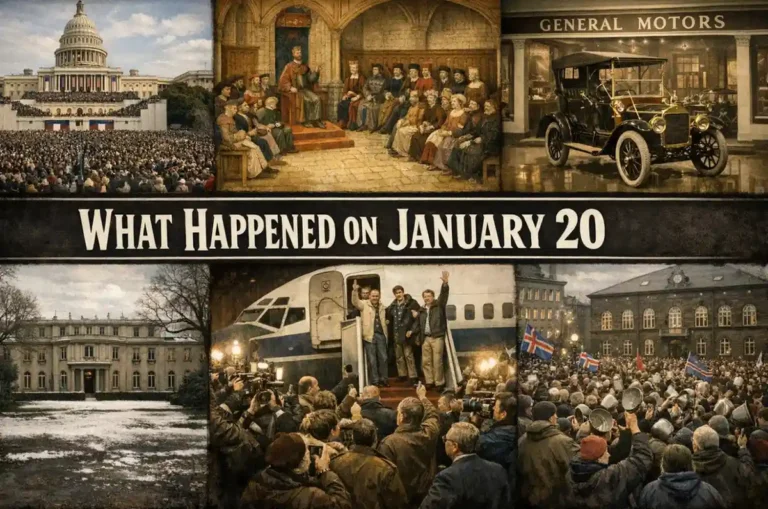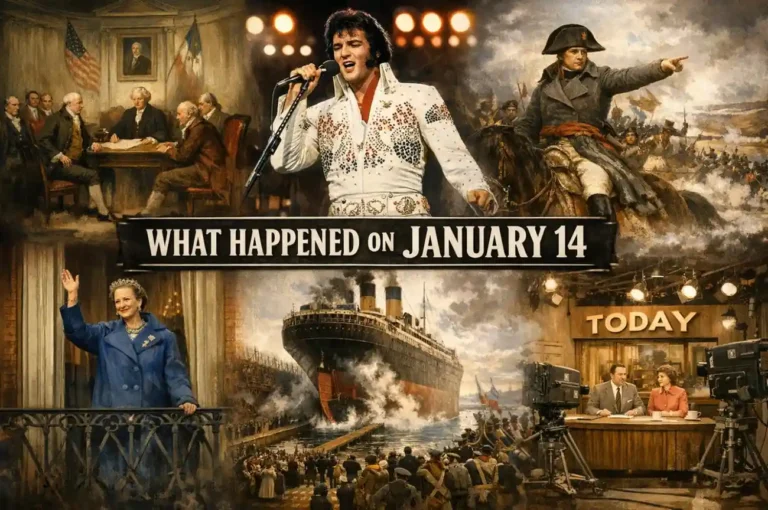

A day of conquests, constitutions, and culture, December 18 charts the deliberate acts that reshape the world. From seizing cities and forging dynasties to proclaiming freedoms and debuting timeless art, the story of what happened on this day in history December 18 is one of profound and lasting transformation.
Important Events That Happened On December 18 In History
1118 – Aragon Takes Zaragoza
King Alfonso I of Aragon, known as “the Battler,” conquered the strategic city of Zaragoza from the Almoravid dynasty. This victory was a pivotal moment in the Spanish Reconquista, permanently securing the Ebro Valley for Christian Aragon and drastically weakening Muslim power in northeastern Spain.
1271 – The Yuan Dynasty is Proclaimed
The great Mongol ruler Kublai Khan formally declared the establishment of the Yuan dynasty, giving his empire a Chinese name and administrative identity. This act marked the official start of Mongol rule over a united China, with Kublai as Emperor, blending steppe tradition with Chinese statecraft.
1499 – Rebellion in the Alpujarras
In response to forced conversions and intense pressure from the Spanish Inquisition, the Muslim population (Moriscos) of the Alpujarras mountains rose in rebellion. This violent revolt against the Crown of Castile was a desperate struggle to preserve religious identity in the face of eradication.
1622 – A Battle for Angola
Portuguese forces clashed with the army of the Kingdom of Kongo at the Battle of Mbumbi. The Portuguese victory was a severe blow to Kongo’s independence, accelerating European colonial encroachment and the expansion of the transatlantic slave trade from central Africa.
1655 – Jews Cleared to Return to England
The Whitehall Conference concluded with the landmark determination that no law prevented Jews from resettling in England. This opened the door for their formal readmission under Oliver Cromwell, ending their exile enacted by King Edward I’s Edict of Expulsion in 1290.
1777 – America’s First National Thanksgiving
The United States celebrated its first national day of Thanksgiving, decreed by the Continental Congress to honor the crucial victory at the Battle of Saratoga. This celebration of General Burgoyne’s surrender marked a high point of hope and unity for the revolutionary cause.
1787 – New Jersey Ratifies the Constitution
New Jersey became the third state to ratify the U.S. Constitution, voting unanimously in its favor. As a small state, its quick approval was vital for momentum, helping to validate the new federal framework and its promise of equal representation in the Senate.
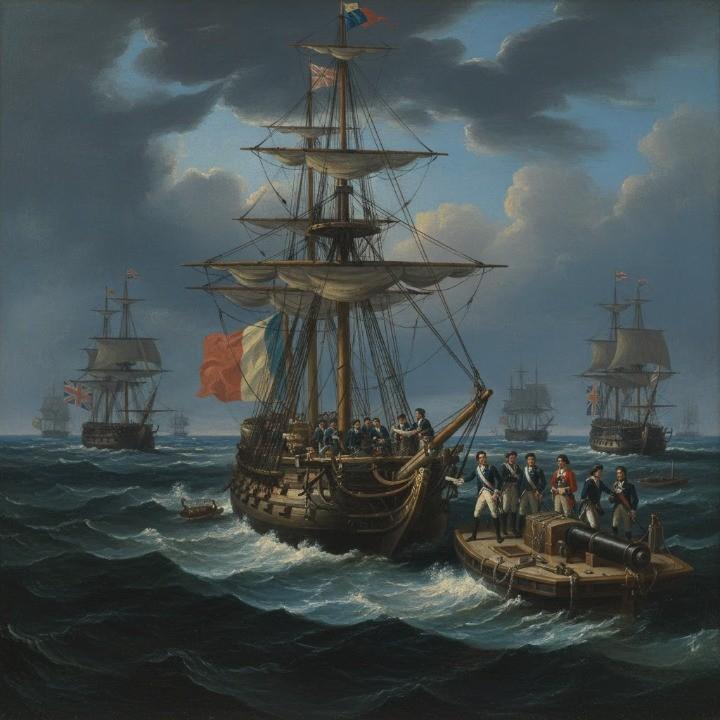
1793 – The Surrender of the Lutine
The French frigate Lutine, captured by Royalist forces, was surrendered to British Admiral Lord Samuel Hood. Taken into Royal Navy service as HMS Lutine, she would later sink to become one of history’s most famous treasure wrecks, her bell later serving at Lloyd’s of London.
1833 – A New Anthem for the Russian Empire
The imperial anthem “God Save the Tsar!” with music by Alexei Lvov was performed publicly for the first time. Its solemn melody replaced the earlier tune, becoming a powerful symbol of Tsarist authority and Russian nationalism throughout the 19th century.
1854 – The End of the Seigneurial System in Canada
The Legislative Assembly of the Province of Canada passed legislation abolishing the last remnants of the seigneurial system of land distribution in Lower Canada. This feudal holdover, inherited from French rule, was finally replaced with freehold tenure, modernizing land ownership.
1865 – Slavery Abolished in the United States
Secretary of State William H. Seward officially proclaimed the adoption of the Thirteenth Amendment to the U.S. Constitution. Its ratification permanently abolished slavery and involuntary servitude throughout the nation, fulfilling the emancipation begun by the Civil War.
1867 – A Devastating Taiwan Earthquake and Tsunami
A powerful magnitude 7.0 earthquake struck off the coast of Taiwan, generating a catastrophic tsunami. The twin disaster devastated coastal communities, killing at least 580 people and highlighting the region’s acute vulnerability to seismic activity.
1878 – The Al Thani Dynasty Assumes Rule in Qatar
Sheikh Jassim bin Mohammed Al Thani formally assumed leadership, consolidating Qatari tribes and securing independence from Ottoman influence. This marked the effective founding of modern Qatar under the Al Thani dynasty, which continues to rule today.
1892 – Premiere of The Nutcracker
Pyotr Ilyich Tchaikovsky’s ballet The Nutcracker premiered at the Mariinsky Theatre in Saint Petersburg. While initial reviews were mixed, the enchanting score and fantastical story would eventually become a beloved cornerstone of holiday tradition worldwide.
1898 – The First Land Speed Record
French nobleman Gaston de Chasseloup-Laubat drove a Jeantaud electric car to a speed of 63.159 km/h (39.245 mph), setting the first officially recognized land speed record. This event ignited a century of competitive pursuit for automotive speed supremacy.
1916 – The Battle of Verdun Ends
After ten months of unimaginable carnage, the Battle of Verdun effectively concluded. A final French push reclaimed lost ground, forcing German forces to cease offensive operations. The battle had become a symbol of patriotic sacrifice and the horrific futility of trench warfare.
1917 – Prohibition is Passed by Congress
The U.S. Congress passed the resolution containing the language of the Eighteenth Amendment, which would establish the prohibition of alcohol. Sent to the states for ratification, it set the stage for a transformative—and tumultuous—era in American social history.
1932 – The First NFL Playoff Game
The Chicago Bears defeated the Portsmouth Spartans 9–0 in a specially scheduled indoor game at Chicago Stadium. This contest, necessitated by a tied regular-season record, was the first playoff game in NFL history and cemented the league’s championship format.
1935 – Founding of the Lanka Sama Samaja Party
The Lanka Sama Samaja Party (LSSP), Ceylon’s (now Sri Lanka) first major Marxist political party, was founded. It became a leading force in the island’s independence movement and early labor organizing, shaping the nation’s leftist political tradition.
1939 – First Major Air Battle of WWII
The Royal Air Force launched an attack on German shipping in the Heligoland Bight, resulting in the first major aerial confrontation of World War II. The Battle of the Heligoland Bight saw significant losses for British bombers, revealing the perils of unescorted daylight raids.
1944 – Korematsu v. United States Decided
The U.S. Supreme Court issued its decision in Korematsu v. United States, ruling that the internment of Japanese Americans during World War II was a “military necessity” and therefore constitutional. The 6–3 ruling remains one of the court’s most criticized civil liberties decisions.
1944 – The Hankow Fire Raid
In response to Japan’s Operation Ichi-Go offensive in China, the U.S. XX Bomber Command launched a massive raid on the supply base at Hankow (modern Wuhan). The attack dropped 500 tons of incendiary bombs, causing a devastating firestorm to cripple Japanese logistics.
1957 – The Sunfield Tornado
A violent F5 tornado completely obliterated the small community of Sunfield, Illinois. The tornado, part of a deadly outbreak, left nothing standing where the town had been, a stark demonstration of nature’s most destructive power.
1958 – Launch of Project SCORE
The United States launched Project SCORE (Signal Communications by Orbiting Relay Equipment), the world’s first communications satellite. From orbit, it broadcast a Christmas message from President Eisenhower, demonstrating the potential of space for global communication.
1966 – Discovery of Saturn’s Moon Epimetheus
Astronomer Richard Walker discovered Epimetheus, a small, irregularly shaped moon of Saturn. Intriguingly, it shares a very close orbit with the moon Janus, the two engaging in a gravitational “dance” where they swap orbits every four years.
1972 – Operation Linebacker II Announced
President Richard Nixon announced the commencement of Operation Linebacker II, an intense bombing campaign against North Vietnam. After peace talks stalled, these “Christmas Bombings” sought to force concessions, unleashing the heaviest aerial bombardment of the war.
1973 – Soyuz 13 Launches
The Soviet Union launched Soyuz 13, crewed by cosmonauts Valentin Lebedev and Pyotr Klimuk. Unlike previous missions, it was dedicated primarily to astronomical observations, carrying the Orion 2 space telescope, and marked a shift toward specialized scientific missions.
1977 – United Airlines Flight 2860 Crashes
A United Airlines cargo flight, a Douglas DC-8, crashed into a mountainside near Kaysville, Utah, while on approach to Salt Lake City during a snowstorm. The impact killed all three crew members aboard.
1977 – SA de Transport Aérien Flight 730 Crashes
A chartered Portuguese Boeing 727 crashed near Funchal Airport on Madeira, Portugal. The aircraft struck the ocean and broke apart, killing 36 of the 164 people on board, in an accident attributed to pilot error during a difficult visual approach.
1981 – First Flight of the Tu-160 “Blackjack”
The Tupolev Tu-160, the largest and most powerful supersonic combat aircraft ever built, took its maiden flight. This variable-sweep wing strategic bomber, nicknamed “Blackjack” by NATO, became a cornerstone of Russian long-range aviation.
1995 – Lockheed Electra Crash in Angola
A chartered Lockheed L-188 Electra, transporting military personnel, crashed shortly after takeoff from Jamba, Angola. The accident killed 141 of the 144 people on board, one of the deadliest aviation disasters in African history.
1995 – The Kellingley Colliery Closes
Kellingley Colliery in North Yorkshire, the last deep coal mine in Great Britain, closed its gates. Its shutdown marked the symbolic end of an industry that had fueled the nation’s Industrial Revolution and defined communities for centuries.
1999 – NASA Launches the Terra Satellite
NASA launched the Terra satellite, a flagship Earth observatory carrying five sophisticated instruments. It began a new era of coordinated, simultaneous measurements of Earth’s atmosphere, land, and oceans, vastly improving our understanding of climate change.
2002 – California’s Budget Deficit Announcement
Governor Gray Davis of California announced the state faced a record budget deficit of $35 billion, nearly double the figure discussed during his recent re-election campaign. This revelation fueled a recall movement that would eventually remove him from office.
2005 – Start of the Chadian Civil War
Rebel groups, believed to be backed by neighboring Sudan, launched a major attack on the city of Adré. This assault marked the beginning of the fourth phase of the Chadian Civil War, a protracted conflict that drew in regional and international powers.
2006 – Major Flooding Begins in Malaysia
The first of a series of severe floods struck Malaysia, particularly impacting the southern state of Johor. The disaster, which would displace over 400,000 people and kill at least 118, became one of the worst flood events in the country’s history.
2006 – First UAE Federal Elections
The United Arab Emirates held its first-ever limited elections for half the seats of its federal advisory body, the Federal National Council. While a modest step, it marked the beginning of a carefully managed political opening in the Gulf federation.
2017 – Amtrak Cascades Derailment
Amtrak Cascades passenger train 501 derailed at high speed onto a highway near DuPont, Washington, on its inaugural run along a new bypass route. The crash killed three passengers and injured dozens, raising urgent questions about rail safety and crew training.
2018 – A Meteor Explodes Over the Bering Sea
A meteor, estimated to be 10 meters in diameter, exploded in the atmosphere over the Bering Sea with an energy impact roughly ten times greater than the Hiroshima atomic bomb. The event, largely unnoticed at the time, was a stark reminder of Earth’s vulnerability to celestial objects.
2019 – First Impeachment of Donald Trump
The U.S. House of Representatives impeached President Donald Trump on charges of abuse of power and obstruction of Congress. This made him the third president in American history to be impeached, triggering a Senate trial.
2022 – Argentina Wins the World Cup
In one of the most dramatic finals in football history, Argentina defeated defending champions France 4–2 in a penalty shootout after a 3–3 draw in extra time. The victory in Qatar gave Argentina its third World Cup title and cemented Lionel Messi’s legendary status.

Explore key events from December 17
Famous People Born On December 18
| Name | Role / short description | Dates |
|---|---|---|
| Betty Grable | American actress & dancer | December 18, 1916 – July 2, 1973 |
| Saki | Scottish writer | December 18, 1870 – November 14, 1916 |
| Pierre Nkurunziza | President of Burundi | December 18, 1963 – June 8, 2020 |
| Ossie Davis | American actor & playwright | December 18, 1917 – February 4, 2005 |
| Charles Wesley | English clergyman & hymnwriter | December 18, 1707 – March 29, 1788 |
| Alejandro Sanz | Spanish singer-songwriter | December 18, 1968 – |
| Dame Gladys Cooper | British actress | December 18, 1888 – November 17, 1971 |
| Edwin H. Armstrong | American inventor (radio) | December 18, 1890 – January 31 or February 1, 1954 |
| Fletcher Henderson | American bandleader & arranger | December 18, 1897 – December 29, 1952 |
| Alfred Bester | American science-fiction author | December 18, 1913 – October 20, 1987 |
| Edward MacDowell | American composer | December 18, 1860 – January 23, 1908 |
| Alvin E. Roth | American economist (market design) | December 18, 1951 – |
| Harold Varmus | American scientist (Nobel laureate) | December 18, 1939 – |
| David Chipperfield | British architect | December 18, 1953 – |
| Gillian Armstrong | Australian film director | December 18, 1950 – |
| Christopher Fry | British playwright | December 18, 1907 – June 30, 2005 |
| Francis Thompson | British poet | December 18, 1859 – November 13, 1907 |
| Ray Meyer | American basketball coach | December 18, 1913 – March 17, 2006 |
| A. M. Homes | American novelist | December 18, 1961 – |
| Walter Dorwin Teague | American industrial designer | December 18, 1883 – December 5, 1960 |
| Duro Ladipo | Nigerian dramatist & composer | December 18, 1931 – March 11, 1978 |
| Josephine S. W. Griffing | American abolitionist & suffragist | December 18, 1814 – February 18, 1872 |
| Theodor von Sickel | Austrian historian | December 18, 1826 – April 21, 1908 |
| Willis Conover | American radio broadcaster | December 18, 1920 – May 17, 1996 |
| Isaac T. Hecker | American priest (Paulist founder) | December 18, 1819 – December 22, 1888 |
| Lujo Brentano | German economist | December 18, 1844 – September 9, 1931 |
| Phoebe Worrall Palmer | American evangelist & writer | December 18, 1807 – November 2, 1874 |
| Lyman Abbott | American minister & writer | December 18, 1835 – October 22, 1922 |
| Daniel Mazia | American cell biologist | December 18, 1912 – June 9, 1996 |
| Billie Eilish | American singer & songwriter | December 18, 2001 – |
Famous People Died On December 18
| Name | Role / short description | Dates |
|---|---|---|
| Konrad Zuse | German engineer (early computers) | June 22, 1910 – December 18, 1995 |
| Ronnie Biggs | British criminal (Great Train Robbery) | August 8, 1929 – December 18, 2013 |
| Bobby Jones | American golfer (amateur legend) | March 17, 1902 – December 18, 1971 |
| Richard Rogers | British architect | July 23, 1933 – December 18, 2021 |
| Robert Bresson | French film director | September 25, 1901 – December 18, 1999 |
| Johann G. von Herder | German philosopher & critic | August 25, 1744 – December 18, 1803 |
| Aleksey N. Kosygin | Premier of the Soviet Union | February 20, 1904 – December 18, 1980 |
| Mark Goodson | American TV & radio producer | January 24, 1915 – December 18, 1992 |
| Mary Parker Follett | American sociologist & management thinker | September 3, 1868 – December 18, 1933 |
| Eduard Bernstein | German political theorist | January 6, 1850 – December 18, 1932 |
| Theodosius Dobzhansky | Geneticist & evolutionary biologist | January 25, 1900 – December 18, 1975 |
| Louis M. Gottschalk | American composer & pianist | May 8, 1829 – December 18, 1869 |
| Bernhard Bolzano | Bohemian mathematician & theologian | October 5, 1781 – December 18, 1848 |
| Pierre Cauchon | French bishop (Joan of Arc trial) | 1371 – December 18, 1442 |
| Andrija Mohorovičić | Croatian geophysicist | January 23, 1857 – December 18, 1936 |
| Leonardo Torres Quevedo | Spanish engineer & inventor | December 28, 1852 – December 18, 1936 |
| Al-Ghazālī | Muslim jurist, theologian, mystic | 1058 – December 18, 1111 |
| Warne Marsh | American jazz saxophonist | October 26, 1927 – December 18, 1987 |
| Michel Chasles | French mathematician | November 15, 1793 – December 18, 1880 |
| Father Joseph | French mystic & reformer (Cardinal Richelieu’s ally) | November 4, 1577 – December 18, 1638 |
| Zsa Zsa Gabor | Hungarian-American actress & socialite | February 6, 1917 – December 18, 2016 |
| Václav Havel | Playwright & president of Czech Republic | October 5, 1936 – December 18, 2011 |
| Conor Cruise O’Brien | Irish diplomat & writer | November 3, 1917 – December 18, 2008 |
| Mark Felt | U.S. government official (“Deep Throat”) | August 17, 1913 – December 18, 2008 |
| Paul Weyrich | American conservative activist | October 7, 1942 – December 18, 2008 |
| Joseph Barbera | American animator (Hanna-Barbera) | March 24, 1911 – December 18, 2006 |
| Chris Farley | American actor & comedian | February 15, 1964 – December 18, 1997 |
| David Wagoner | American poet & novelist | June 5, 1926 – December 18, 2021 |
| Kilian Ignaz Dientzenhofer | Bohemian architect | September 1, 1689 – December 18, 1751 |
| Louise Blanchard Bethune | American architect (first professional woman architect in US) | July 21, 1856 – December 18, 1913 |
Observances & Institutional Dates – December 18
International Migrants Day (UN): A day to recognize the contributions, rights, and challenges of migrants around the world, promoting a dialogue on safe and orderly migration.
National Day (Qatar): Commemorates the assumption of power by Sheikh Jassim bin Mohammed Al Thani in 1878, the founder of the modern State of Qatar, and celebrates the country’s unity and heritage.
Republic Day (Niger): Marks the anniversary of the founding of the Republic and the creation of the Presidency in 1958, while still a member of the French Community.
UN Arabic Language Day: Celebrates the Arabic language and its cultural and historical contributions to humanity, coinciding with the day in 1973 when it became an official UN language.
Frequently Asked Questions
What pivotal political and legal events happened on December 18?
The date is monumental for governance: New Jersey ratified the U.S. Constitution (1787), the Thirteenth Amendment abolishing slavery was proclaimed (1865), and the U.S. House impeached President Trump (2019). It also saw the end of Jewish exile from England (1655) and the oppressive Korematsu Supreme Court ruling (1944).
How is December 18 significant in cultural history?
It marks the premiere of Tchaikovsky’s The Nutcracker ballet (1892), a cultural touchstone. It also saw the first land speed record (1898), the launch of the first communications satellite (1958), and Argentina’s epic 2022 World Cup victory—all events that captured global imagination.
What moments of conflict and technological shift define this day?
The day encompasses the end of the brutal Battle of Verdun (1916), the first major WWII air battle (1939), and the announcement of the Vietnam War’s “Christmas Bombings” (1972). Technologically, it ranges from the first land speed record to the launch of Project SCORE.