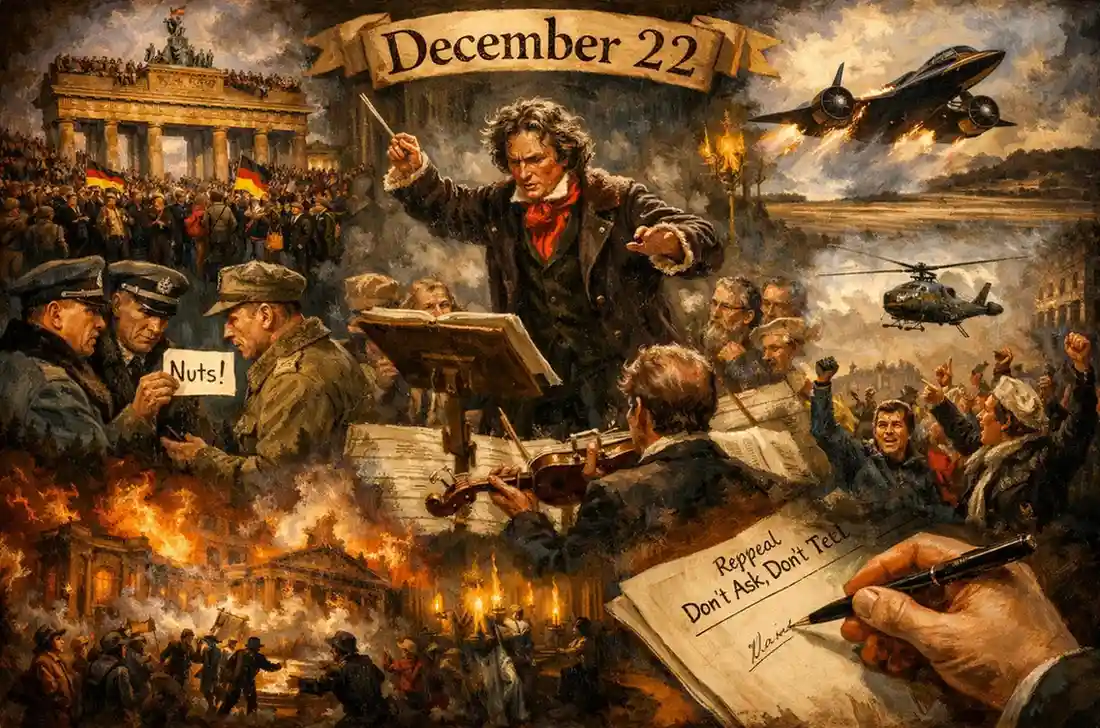
December 22 stands as a day of dramatic shifts, ranging from the overthrow of dictators to the premiere of some of the world’s most iconic music. When we look at what happened on this day in history December 22, we see a tapestry of revolutionary fervor, scientific progress, and cultural milestones that continue to resonate across the globe.
Important Events That Happened On December 22 In History
AD 69 – Vespasian Rises Amidst Roman Chaos
The “Year of the Four Emperors” reached its bloody conclusion as Vespasian was officially proclaimed the Emperor of Rome. His predecessor, Vitellius, had attempted to abdicate his power but was captured by his rivals and killed at the Gemonian stairs. This transition marked the beginning of the Flavian dynasty, bringing a period of much-needed stability to a fractured empire.
401 – The Election of Pope Innocent I
In a rare instance for the early Church, Pope Innocent I was elected to the papacy, succeeding his father, Pope Anastasius I. His reign was significant for his efforts to assert the primacy of the Roman See over the entire Western Church. He also notably dealt with the fallout of the Siege of Rome by the Visigoths during a very turbulent era.
856 – The Catastrophic Damghan Earthquake
A massive earthquake struck the Persian city of Damghan, resulting in the deaths of an estimated 200,000 people. This disaster remains the sixth deadliest earthquake in recorded history, highlighting the extreme geological risks of the region. The sheer scale of the loss of life devastated the local population and the Abbasid Caliphate’s infrastructure.
880 – Rebel Forces Capture the Tang Capital of Luoyang
During the reign of Emperor Xizong, the rebel leader Huang Chao led his forces to capture Luoyang, the eastern capital of the Tang dynasty. This victory was a major blow to the central authority of the Tang government, which was already struggling with internal decay. The rebellion eventually contributed to the final collapse of one of China’s most famous dynasties.
1135 – Stephen of Blois Claims the English Throne
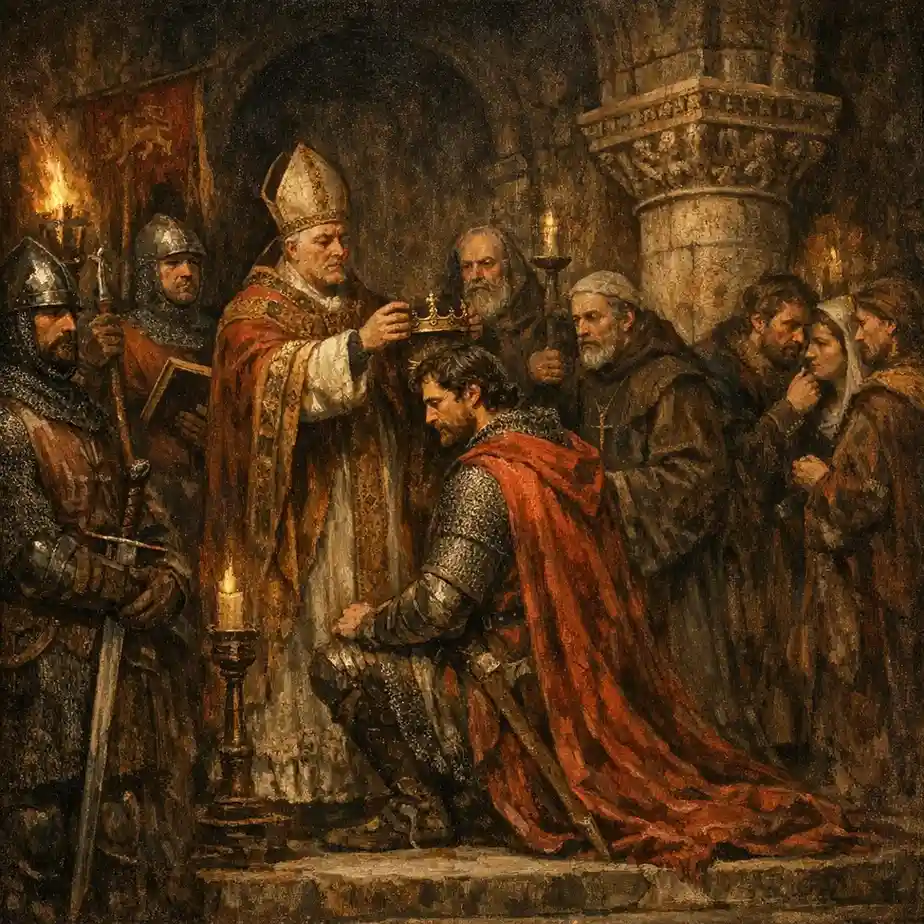
Following the death of King Henry I, Stephen of Blois moved quickly to seize the English throne and was privately crowned in London. This act bypassed Henry’s chosen heir, his daughter Empress Matilda, and ignited a long, civil war known as The Anarchy. The conflict would tear England apart for nearly two decades as the two sides fought for legitimacy.
1216 – Pope Honorius III Confirms the Dominican Order
The Dominican Order received official papal approval through the bull Religiosam vitam, issued by Pope Honorius III. This confirmation allowed St. Dominic and his followers to establish a religious order dedicated to preaching and scholarship. The Dominicans would go on to become one of the most influential intellectual and missionary forces in the Catholic Church.
1489 – The Catholic Monarchs Take Control of Almería
As the Reconquista neared its end, the forces of King Ferdinand and Queen Isabella successfully took control of Almería from the Nasrid ruler, Muhammad XIII. This was a strategic victory that further isolated the Emirate of Granada, the last Muslim stronghold in the Iberian Peninsula. The fall of Almería signaled that the total unification of Spain under Christian rule was imminent.
1769 – The End of the Sino-Burmese War
The Sino-Burmese War concluded with the Qing dynasty withdrawing its forces from Burma permanently. Despite multiple invasions by the powerful Qing Empire, the Burmese Konbaung dynasty successfully defended its territory. This victory preserved Burma’s independence and marked the end of Chinese attempts to expand their influence in the region via military force.
1788 – Nguyễn Huệ Proclaims Himself Emperor Quang Trung
In Vietnam, the rebel leader Nguyễn Huệ officially proclaimed himself Emperor Quang Trung, effectively ending the long-standing Lê dynasty. He led a series of brilliant military campaigns that defeated both internal rivals and external Qing invaders. His reign is remembered as a period of significant military reform and national unification in Vietnamese history.
1790 – Russian Forces Storm the Fortress of Izmail
The Russian army, led by the legendary General Alexander Suvorov, successfully stormed and captured the Turkish fortress of Izmail. This victory during the Russo-Turkish War was considered a military masterpiece due to the fortress’s reputation for being impregnable. The fall of Izmail significantly weakened Ottoman control over the northern Black Sea region.
1807 – The United States Passes the Embargo Act
At the strong urging of President Thomas Jefferson, the U.S. Congress passed the Embargo Act, which forbade all trade with foreign countries. The policy was intended to punish Britain and France for their interference with American shipping during the Napoleonic Wars. However, the act proved to be economically disastrous for American merchants and was widely unpopular.
1808 – Beethoven Conducts His Legendary 1808 Concert
In one of the most famous concerts in music history, Ludwig van Beethoven conducted a massive four-hour performance at the Theater an der Wien. The evening featured the world premieres of his Fifth and Sixth Symphonies, the Fourth Piano Concerto, and the Choral Fantasy. Despite the freezing cold and an exhausted orchestra, the concert introduced some of the most iconic works of Western classical music.
1851 – India Operates Its First Freight Train
India’s first freight train began its journey in Roorkee, carrying materials for the construction of the ambitious Ganges Canal. This was a landmark event in the history of Indian infrastructure, proving the utility of rail transport for large-scale engineering projects. It laid the groundwork for the massive railway network that would eventually span the entire subcontinent.
1851 – Fire Devastates the Library of Congress
A catastrophic fire broke out in the Library of Congress in Washington, D.C., destroying approximately 35,000 volumes. Among the losses were many books from Thomas Jefferson’s original collection, which had been purchased to restart the library after the War of 1812. The disaster led to major improvements in library fire safety and collection management in the years that followed.
1864 – Sherman Presents Savannah as a Christmas Gift
During the American Civil War, the city of Savannah, Georgia, fell to General William Tecumseh Sherman’s Union forces. In a famous telegram to President Abraham Lincoln, Sherman wrote: “I beg to present you as a Christmas gift the city of Savannah.” This victory marked the successful conclusion of Sherman’s “March to the Sea,” which crippled the Confederate war effort.
1885 – Itō Hirobumi Becomes Japan’s First Prime Minister
Itō Hirobumi, a prominent samurai and statesman, was appointed as the first Prime Minister of Japan under the new cabinet system. He was a central figure in the Meiji Restoration and played a key role in drafting the Meiji Constitution. His leadership was instrumental in transforming Japan from a feudal society into a modern, industrialized world power.
1888 – The Christmas Meeting of 1888 in the Faroe Islands
The Christmas Meeting, or Jólafundurin, was held in Tórshavn and is considered the official birth of the Faroese independence movement. Activists gathered to demand the preservation of the Faroese language and more cultural autonomy from Denmark. This event sparked a national awakening that eventually led to the modern self-governing status of the islands.
1890 – Cornwallis Valley Railway Begins Operations
The Cornwallis Valley Railway officially opened for business, connecting Kentville and Kingsport in Nova Scotia. This rail line was vital for the local agricultural industry, particularly for transporting apples from the fertile Annapolis Valley to international markets. It played a major role in the economic development of rural Nova Scotia during the late 19th century.
1891 – Photography Discovers Its First Asteroid
Asteroid 323 Brucia made history as the first asteroid ever discovered through the use of photography. Max Wolf, a German astronomer, used long-exposure photographic plates to identify the moving light in the sky, a technique that revolutionized how astronomers searched for celestial bodies. This discovery opened the door for thousands of subsequent asteroid identifications.
1894 – The Injustice of the Dreyfus Affair Begins
In a moment that would divide France for years, Alfred Dreyfus, a Jewish officer in the French army, was wrongly convicted of treason. The case was fueled by rampant antisemitism and a military cover-up, leading to Dreyfus being sentenced to life in prison on Devil’s Island. The eventual fight for his exoneration became a landmark struggle for justice and human rights.
1906 – A Deadly Earthquake Strikes Xinjiang, China
A powerful 7.9 magnitude earthquake hit the Xinjiang region of China, resulting in the deaths of at least 280 people and massive property damage. The remote location made rescue efforts incredibly difficult for the survivors in the frigid winter conditions. This seismic event is one of many that have historically affected this mountainous and geologically active area.
1920 – The Soviet GOELRO Plan is Adopted
The 8th Congress of Soviets adopted the GOELRO plan, the first Soviet project for national economic recovery and development through electrification. Vladimir Lenin championed the plan, famously stating that “Communism is Soviet power plus the electrification of the whole country.” This initiative laid the industrial foundation for the future Soviet superpower.
1921 – Visva-Bharati College is Founded in India
Nobel laureate Rabindranath Tagore officially opened Visva-Bharati College in Santiniketan, India. Tagore envisioned the school as a “world university” where the best of Western and Eastern cultures could meet and learn from one another. Today, Visva-Bharati University remains a prestigious institution known for its unique educational philosophy and artistic heritage.
1937 – The Lincoln Tunnel Opens to Traffic
The first tube of the Lincoln Tunnel, connecting New York City to Weehawken, New Jersey, was officially opened to motor vehicles. This engineering marvel provided a vital new link for commuters and commerce between the two states. Over the decades, additional tubes were added to accommodate the massive volume of traffic that defines the New York metropolitan area.
1939 – Indian Muslims Observe the “Day of Deliverance”
The All-India Muslim League observed a “Day of Deliverance” to celebrate the resignation of the Indian National Congress government members. The resignations occurred because the British government had involved India in World War II without consulting Indian leaders. This event highlighted the deep political and religious divisions within the Indian independence movement at the time.
1940 – Greek Forces Capture Himara from Italy
During the Greco-Italian War, the Greek army successfully captured the strategic town of Himara from Italian occupying forces. This victory was part of a broader Greek counter-offensive that pushed the Italian military back into Albania. The success of the Greek forces was a major morale boost for the Allied powers during the early years of World War II.
1942 – Hitler Signs the Order for V-2 Rocket Development
Adolf Hitler signed the official order to proceed with the development of the V-2 rocket as a “vengeance weapon” during World War II. This liquid-propellant rocket was the world’s first long-range guided ballistic missile and represented a terrifying leap in military technology. While it caused significant destruction in cities like London, it could not change the ultimate outcome of the war.
1944 – General McAuliffe Gives His Famous “Nuts!” Reply
During the Battle of the Bulge, German forces surrounded the American 101st Airborne Division at Bastogne and demanded their surrender. General Anthony McAuliffe famously gave a one-word written response: “Nuts!” This act of defiance inspired his troops to hold the line until they could be relieved, becoming one of the most legendary stories of the U.S. Army.
1944 – The People’s Army of Vietnam is Formed
Under the leadership of Vo Nguyen Giap and Ho Chi Minh, the first unit of what would become the People’s Army of Vietnam was formed. This military force was created to resist the Japanese and French colonial occupations of Indochina. It would eventually grow into a formidable army that fought for Vietnamese independence throughout the mid-20th century.
1945 – President Truman Issues Refugee Visa Order
U.S. President Harry S. Truman issued an executive order that gave priority to World War II refugees in visa applications under existing immigration quotas. This move was intended to help the millions of displaced persons in Europe who were left homeless and stateless by the war. It was a significant early step in addressing the post-war humanitarian crisis.
1948 – The Emergency Government of Indonesia is Established
Following the capture of the Indonesian republican capital by the Dutch, Sjafruddin Prawiranegara established the Emergency Government of the Republic of Indonesia (PDRI) in West Sumatra. This ensured that the Indonesian independence movement continued to have a formal governing body while its top leaders were in captivity. It was a crucial move for maintaining the legitimacy of the young republic.
1963 – The Cruise Ship Lakonia Burns at Sea
A fire broke out on the Greek cruise ship TSMS Lakonia while it was traveling north of Madeira, Portugal, leading to the deaths of 128 people. The disaster was marked by chaos during the evacuation and inadequate safety equipment, prompting a major international outcry. The tragedy led to significantly stricter global regulations for fire safety on passenger vessels.
1964 – First Test Flight of the SR-71 Blackbird
The SR-71 Blackbird, the world’s fastest and highest-flying operational manned aircraft, took its first test flight in Palmdale, California. Designed by Lockheed’s Skunk Works, the SR-71 was a masterpiece of Cold War engineering, capable of flying at speeds over Mach 3. It served as a vital reconnaissance tool for the United States for over two decades.
1965 – The UK Imposes a 70 MPH Speed Limit
For the first time, the United Kingdom applied a 70 miles per hour speed limit to all rural roads and motorways. Before this regulation, there was no national speed limit on many of these roads, leading to dangerous high-speed driving. The move was part of a broader effort to reduce the rising number of fatal accidents on Britain’s expanding road network.
1968 – Mao Zedong Orders Intellectual Youth to the Countryside
The People’s Daily published Chairman Mao’s instructions that “The intellectual youth must go to the country” to be re-educated by poor peasants. This launched the “Down to the Countryside Movement” during the Cultural Revolution, which saw millions of urban students relocated to rural areas. The policy profoundly disrupted the lives and educations of an entire generation of Chinese youth.
1971 – Doctors Without Borders is Founded
The international humanitarian organization Médecins Sans Frontières (Doctors Without Borders) was founded in Paris by a group of doctors and journalists. They sought to create an organization that could provide emergency medical aid regardless of race, religion, or political affiliation. Today, it is one of the world’s most respected NGOs, working in conflict zones and disaster areas globally.
1973 – A Royal Air Maroc Caravelle Crashes in Tangier
A Sud Aviation Caravelle operated by Royal Air Maroc crashed into a mountain while approaching Tangier-Boukhalef Airport in Morocco. All 106 people on board were killed in the accident. The crash was attributed to the pilot making an unauthorized turn during a difficult approach, resulting in one of the deadliest aviation disasters in Moroccan history.
1974 – Comoros Votes for Independence from France
In a historic referendum, the islands of Grande Comore, Anjouan, and Mohéli voted overwhelmingly to become the independent nation of Comoros. However, the island of Mayotte voted to remain under French administration, creating a political division that persists to this day. This event was a major step in the decolonization of the Indian Ocean region.
1974 – IRA Attacks the Home of Former PM Edward Heath
Members of the Provisional IRA carried out an attack on the home of former British Prime Minister Edward Heath in London. A bomb was thrown at the house, but fortunately, Heath was not at home at the time and no injuries were reported. The attack was part of a campaign of violence targeting high-profile British political figures during the Troubles.
1975 – The Strategic Petroleum Reserve is Created
In response to the energy crisis of the early 1970s, U.S. President Gerald Ford signed legislation creating the Strategic Petroleum Reserve. This vast underground storage system for crude oil was designed to protect the United States from future energy supply disruptions. It remains the largest emergency petroleum supply in the world.
1978 – The Third Plenum Launches China’s Economic Reform
The Third Plenum of the 11th National Congress of the Chinese Communist Party was held in Beijing, marking a historic turning point. Deng Xiaoping successfully reversed Mao-era policies and initiated the “Reform and Opening Up” program. This shift moved China toward a market-oriented economy and began its transformation into a global economic powerhouse.
1984 – The “Subway Vigilante” Bernhard Goetz Shoots Four
Bernhard Goetz became a sensation and a source of national debate after he shot four young men on a New York City subway train. Goetz claimed he was acting in self-defense against a perceived mugging, while critics argued it was an act of racially motivated vigilantism. The case highlighted the high crime rates and public frustration in New York during the 1980s.
1987 – ZANU and ZAPU Reach a Peace Agreement in Zimbabwe
In a major step toward national reconciliation, the two largest political parties in Zimbabwe, ZANU and ZAPU, signed a unity accord. This agreement ended years of ethnic and political violence in the Matabeleland region known as the Gukurahundi. While it brought peace, it also solidified Robert Mugabe’s control over the country by merging the two parties.
1989 – Nicolae Ceaușescu is Overthrown in Romania
Following days of bloody protests and confrontations, the communist dictator of Romania, Nicolae Ceaușescu, was overthrown. He and his wife Elena fled the capital by helicopter while protesters cheered in the streets of Bucharest. Their capture and subsequent execution just days later marked the end of decades of repressive communist rule in Romania.
1989 – The Brandenburg Gate Re-opens in Berlin
In a powerful symbol of German reunification, Berlin’s Brandenburg Gate was officially re-opened after being closed for nearly 30 years. Thousands of people from both East and West Germany gathered to celebrate the moment, which signaled the effective end of the division of Berlin. It was one of the most emotional milestones of the Cold War’s conclusion.
1990 – Lech Wałęsa is Elected President of Poland
Lech Wałęsa, the leader of the Solidarity movement and a Nobel Peace Prize winner, was elected as the first non-communist President of Poland. His victory was a crowning achievement for the labor movement that had challenged Soviet authority for over a decade. Wałęsa’s transition from a shipyard electrician to the presidency symbolized the triumph of democracy in Eastern Europe.
1990 – Final Independence for Marshall Islands and Micronesia
The United Nations formally terminated the trusteeship status of the Marshall Islands and the Federated States of Micronesia. This act granted these Pacific nations their final and full independence from the United States-led administration. Both countries entered into a Compact of Free Association with the U.S., ensuring a continued close relationship in defense and economic aid.
1992 – Mid-air Collision over Tripoli Kills 157
Libyan Arab Airlines Flight 1103, a Boeing 727, collided in mid-air with a Libyan Air Force MiG-23 during its approach to Tripoli International Airport. All 157 people on the passenger plane were killed in the disaster. Investigations into the crash were hampered by political tensions, leading to various theories about the cause of the tragic collision.
1996 – Airborne Express Flight 827 Crashes in Virginia
All six people on board an Airborne Express DC-8 were killed when the aircraft crashed into a mountain in Narrows, Virginia, during a post-maintenance test flight. The investigation determined that the crew lost control of the aircraft while performing stalls at high altitudes. The tragedy highlighted the risks involved in specialized aircraft testing and maintenance flights.
1997 – The Brutal Acteal Massacre in Mexico
In the village of Acteal in Chiapas, Mexico, 45 indigenous people attending a prayer meeting were massacred by a paramilitary group. The victims were members of a pacifist group that supported indigenous rights but remained neutral in the Zapatista conflict. The massacre shocked the world and drew intense scrutiny to the Mexican government’s role in the regional violence.
1997 – Hussein Farrah Aidid Relinquishes the Somali Presidency
In a significant step toward ending the Somali Civil War, faction leader Hussein Farrah Aidid signed the Cairo Declaration. By doing so, he relinquished his disputed claim to the presidency, paving the way for reconciliation between rival groups. While it did not end the conflict immediately, it was a vital early diplomatic breakthrough for the war-torn nation.
1999 – Korean Air Cargo Flight 8509 Crashes in England
A Korean Air Cargo Boeing 747 crashed into Hatfield Forest shortly after taking off from London Stansted Airport, killing all four crew members. The crash was caused by a combination of a faulty instrument and pilot error, as the captain failed to respond correctly to the plane’s banking. It remains one of the more notable cargo aviation accidents in UK history.
2001 – Rabbani Hands Power to Hamid Karzai in Afghanistan
Burhanuddin Rabbani, the political leader of the Northern Alliance, officially handed over power to an interim government led by President Hamid Karzai. This transfer took place in Kabul following the fall of the Taliban regime. It marked the beginning of a new, internationally recognized political era for Afghanistan after decades of constant warfare.
2001 – Richard Reid Attempts the “Shoe Bomb” Attack
Richard Reid, a British citizen and Al-Qaeda operative, attempted to destroy American Airlines Flight 63 by igniting explosives hidden in his shoes. Passengers and crew successfully subdued Reid before he could light the fuse, and the plane landed safely in Boston. This incident led to the permanent requirement for air travelers to remove their shoes during security screenings.
2008 – The Massive TVA Coal Ash Spill in Tennessee
A dike ruptured at a Tennessee Valley Authority coal plant in Roane County, releasing over 1.1 billion gallons of coal fly ash slurry. This industrial spill was the largest of its kind in U.S. history, burying homes and contaminating local waterways with toxic heavy metals. The disaster led to major changes in how coal ash waste is regulated and stored nationwide.
2010 – President Obama Signs the Repeal of “Don’t Ask, Don’t Tell”
U.S. President Barack Obama officially signed the law to repeal the “Don’t Ask, Don’t Tell” policy, which had banned gay and lesbian individuals from serving openly in the military for 17 years. The repeal allowed thousands of service members to serve with honesty and integrity for the first time. It was hailed as a historic victory for civil rights within the American armed forces.
2012 – Bashir Ahmad Bilour Killed in Peshawar Suicide Attack
Bashir Ahmad Bilour, a prominent leader of the Awami National Party in Pakistan, was killed along with eight others in a Taliban suicide bombing. The attack took place in a busy market area near Qissa Khwani Bazaar in Peshawar. Bilour was a vocal opponent of extremism, and his assassination was a major blow to the secular political movement in the region.
2016 – A Proven Ebola Vaccine is Announced
A major medical study confirmed that the VSV-EBOV vaccine was between 70% and 100% effective against the Ebola virus. This made it the first proven and effective vaccine against the deadly disease, which had caused a massive outbreak in West Africa years earlier. The breakthrough was a monumental achievement for global health and pandemic preparedness.
2017 – UN Security Council Approves Resolution 2397
The United Nations Security Council unanimously approved Resolution 2397, imposing harsh new sanctions against North Korea in response to its continued ballistic missile testing. The sanctions aimed to further restrict North Korea’s oil imports and overseas labor revenue. The unanimous vote included support from China and Russia, reflecting global concern over the regime’s nuclear program.
2017 – Trump Signs the Tax Cuts and Jobs Act
President Donald Trump signed the Tax Cuts and Jobs Act of 2017, the most significant overhaul of the U.S. tax code in over 30 years. The law drastically lowered the corporate tax rate and provided temporary tax cuts for individuals. It remains one of the most consequential and debated pieces of domestic legislation from the Trump administration.
2018 – Anak Krakatau Tsunami Hits Indonesia
A sudden tsunami, triggered by a flank collapse of the Anak Krakatau volcano, struck the coastal regions of the Sunda Strait in Indonesia. Without an earthquake to provide a warning, the waves killed at least 430 people and injured nearly a thousand more. The disaster highlighted the dangers of volcanic-triggered tsunamis and the need for better detection systems.
2018 – The Longest U.S. Federal Government Shutdown Begins
The 2018–2019 United States federal government shutdown began following a deadlock over funding for a wall on the U.S.-Mexico border. Lasting for 35 days, it became the longest shutdown in the history of the U.S. federal government. The closure affected hundreds of thousands of federal workers and disrupted various government services across the country.
Check Here December 21 Stories
Famous People Born On December 22
| Name | Role / short description | Dates |
|---|---|---|
| Paul Wolfowitz | U.S. government official; deputy secretary of defense | December 22, 1943 – |
| Edgard Varèse | Composer; avant-garde sound innovator | December 22, 1883 – November 6, 1965 |
| James C. Wright, Jr. | U.S. politician; Speaker of the House | December 22, 1922 – May 6, 2015 |
| Peggy Ashcroft | British stage & film actress | December 22, 1907 – June 14, 1991 |
| Filippo T. Marinetti | Writer; founder of Futurism | December 22, 1876 – December 2, 1944 |
| James Edward Oglethorpe | British army officer; founder of Georgia (colony) | December 22, 1696 – June 30/July 1, 1785 |
| Connie Mack | Baseball manager & executive | December 22, 1862/23, 1862 – February 8, 1956 |
| Roger II | King of Sicily | December 22, 1095 – February 26, 1154 |
| Sarada Devi | Hindu religious teacher | December 22, 1853 – July 21, 1920 |
| Max Bill | Swiss artist, designer & architect | December 22, 1908 – December 9, 1994 |
| Edwin Arlington Robinson | American poet | December 22, 1869 – April 6, 1935 |
| Frank B. Kellogg | U.S. statesman; Nobel Peace Prize (Kellogg–Briand) | December 22, 1856 – December 21, 1937 |
| Kenneth Rexroth | American poet, essayist & translator | December 22, 1905 – June 6, 1982 |
| Thomas C. Südhof | Neuroscientist; Nobel laureate (synaptic biology) | December 22, 1955 – |
| Thomas Wentworth Higginson | Abolitionist, clergyman & reformer | December 22, 1823 – May 9, 1911 |
| Jean Henri Fabre | French entomologist & writer | December 22, 1823 – October 11, 1915 |
| Levi Woodbury | U.S. Supreme Court Justice & statesman | December 22, 1789 – September 4, 1851 |
| Marc Allégret | French film director | December 22, 1900 – November 4, 1973 |
| Teresa Carreño | Venezuelan pianist & composer | December 22, 1853 – June 12, 1917 |
| Grote Reber | Radio astronomer; built first radio telescope | December 22, 1911 – December 20, 2002 |
| Johann Jakob Bachofen | Swiss jurist & early anthropologist | December 22, 1815 – November 25, 1887 |
| Pierre Brasseur | French actor (stage & film) | December 22, 1905 – August 14, 1972 |
| Ulrich v. Wilamowitz-Moellendorff | German classical scholar | December 22, 1848 – September 25, 1931 |
| Demetrius A. Gallitzin | Roman Catholic missionary in U.S. | December 22, 1770 – May 6, 1840 |
| Johan S. C. Welhaven | Norwegian poet & critic | December 22, 1807 – October 21, 1873 |
| Jean Hardouin | French scholar & editor | December 22, 1646 – September 3, 1729 |
| Christian Rohlfs | German painter & printmaker (Expressionism) | December 22, 1849 – January 8, 1938 |
| Vladimir V. Markovnikov | Russian organic chemist (Markovnikov rule) | December 22, 1838 – February 1904 |
| Dmitri Bilozerchev | Russian gymnast (champion) | December 22, 1966 – |
| Meyer Prinstein | U.S. Olympic jumper | December 22, 1878 – March 10, 1925 |
Famous People Died On December 22
| Name | Role / short description | Dates |
|---|---|---|
| Franz Boas | German-American anthropologist; cultural relativism founder | July 9, 1858 – December 22, 1942 |
| Mehmed III | Ottoman sultan (r. 1595–1603) | 1566 – December 22, 1603 |
| Darryl F. Zanuck | Hollywood producer & studio executive | September 5, 1902 – December 22, 1979 |
| Rachel Jackson | Wife of Andrew Jackson (U.S. president-elect) | June 15, 1767 – December 22, 1828 |
| Lucy Burns | American suffragist & activist | July 28, 1879 – December 22, 1966 |
| Dwight L. Moody | Evangelist & publisher | February 5, 1837 – December 22, 1899 |
| Chico Mendes | Brazilian rubber-tapper, activist & conservationist | December 15, 1944 – December 22, 1988 |
| Josef von Sternberg | Film director (Austrian-American) | May 29, 1894 – December 22, 1969 |
| José María Morelos | Mexican priest & revolutionary leader | September 30, 1765 – December 22, 1815 |
| Nathanael West | American novelist & screenwriter | October 17, 1903 – December 22, 1940 |
| Richard von Krafft-Ebing | Psychiatrist; pioneer in sexual psychopathology | August 14, 1840 – December 22, 1902 |
| Richard Dimbleby | British pioneering broadcast journalist | May 25, 1913 – December 22, 1965 |
| Otto Neurath | Austrian philosopher & sociologist | December 10, 1882 – December 22, 1945 |
| Gustavo A. Bécquer | Spanish Romantic poet & author | February 17, 1836 – December 22, 1870 |
| Il Guercino | Italian Baroque painter | February 8, 1591 – December 22, 1666 |
| William Hyde Wollaston | Chemist; discovered palladium & rhodium | August 6, 1766 – December 22, 1828 |
| James E. Meade | British economist; Nobel laureate | June 23, 1907 – December 22, 1995 |
| Jean Bourgain | Belgian mathematician; Fields Medalist | February 28, 1954 – December 22, 2018 |
| Sir Percivall Pott | English surgeon; occupational cancer pioneer | January 6, 1714 – December 22, 1788 |
| Maximilien de Béthune, duc de Sully | French statesman & minister to Henry IV | December 13, 1560 – December 22, 1641 |
| Walter Damrosch | Conductor & promoter of classical music in U.S. | January 30, 1862 – December 22, 1950 |
| Irna Phillips | Creator of the modern soap opera (radio/TV writer) | July 1, 1901 – December 22, 1973 |
| Carlos Mérida | Guatemalan painter & muralist | December 2, 1891 – December 22, 1984 |
| James Mooney | American ethnographer & Native American scholar | February 10, 1861 – December 22, 1921 |
| Edmund M. Clarke | Computer scientist; model-checking pioneer | July 27, 1945 – December 22, 2020 |
| Petro Mohyla | Orthodox theologian & metropolitan of Kiev | December 21, 1596 – December 22, 1646 |
| Thomas Kinsella | Irish poet & translator | May 4, 1928 – December 22, 2021 |
| Wallace H. Thurman | Harlem Renaissance writer & editor | August 16, 1902 – December 22, 1934 |
| Frank A. Munsey | Publisher and magazine consolidator | August 21, 1854 – December 22, 1925 |
| Leonhard, count von Blumenthal | Prussian field marshal | July 30, 1810 – December 22, 1900 |
Observances & Institutional Dates
- Mother’s Day (Indonesia): Established in 1953 to celebrate the spirit of Indonesian women and their contribution to the nation’s independence and development.
- National Mathematics Day (India): Commemorates the birth anniversary of the legendary Indian mathematician Srinivasa Ramanujan, celebrating his extraordinary contributions to number theory.
- Teachers’ Day (Cuba): A day dedicated to honoring educators across the nation, commemorating the day in 1961 when Cuba declared itself free of illiteracy.
- Unity Day (Zimbabwe): This public holiday marks the 1987 signing of the Unity Accord, which ended years of civil conflict and merged the nation’s two main political parties.
Frequently Asked Questions
Which famous symphonies premiered on December 22?
Ludwig van Beethoven premiered both his Fifth Symphony and Sixth Symphony (Pastoral) during a massive concert in Vienna on December 22, 1808.
What was the significance of the 1989 events in Romania and Germany?
December 22, 1989, saw the overthrow of Romanian dictator Nicolae Ceaușescu and the symbolic re-opening of the Brandenburg Gate in Berlin, marking the end of communist rule in Romania and the division of Germany.
When did the longest U.S. government shutdown start?
The record-breaking 35-day U.S. federal government shutdown began on December 22, 2018, due to a budget dispute over border wall funding.