From the birth of the American central bank to the miraculous rescue of survivors in the Andes, the events of this date have left an indelible mark on the world. By examining what happened on this day in history December 23, we can see how moments of individual desperation and national transformation have shaped the course of modern human life.
Important Events That Happened On December 23 In History
484 – The Vandals Ease Religious Persecution
In a significant shift for the North African region, the Arian Vandal Kingdom officially ceased its systematic persecution of Nicene Christianity. This move provided a rare moment of peace for the Catholic community, which had faced decades of hardship under Vandal rule. It represented a brief period of religious cooling in a century otherwise defined by intense theological conflict and social upheaval.
558 – The Crowning of Chlothar I
Chlothar I was officially crowned King of the Franks, effectively reuniting the kingdom that his father, Clovis I, had established. His reign was marked by the consolidation of power through both diplomacy and ruthless military action against his own brothers. By the end of his rule, he had successfully brought the disparate Frankish territories under a single crown for the first time in years.
583 – A Maya Queen Ascends the Throne
In the ancient city-state of Palenque, the Maya queen Yohl Ik’nal was crowned as the ruler, a rare occurrence of female leadership in the Classic Maya period. Her reign was notable for its longevity and her ability to navigate the complex geopolitical landscape of the Yucatan Peninsula. She successfully maintained the prestige of her lineage despite facing significant military pressure from rival city-states.
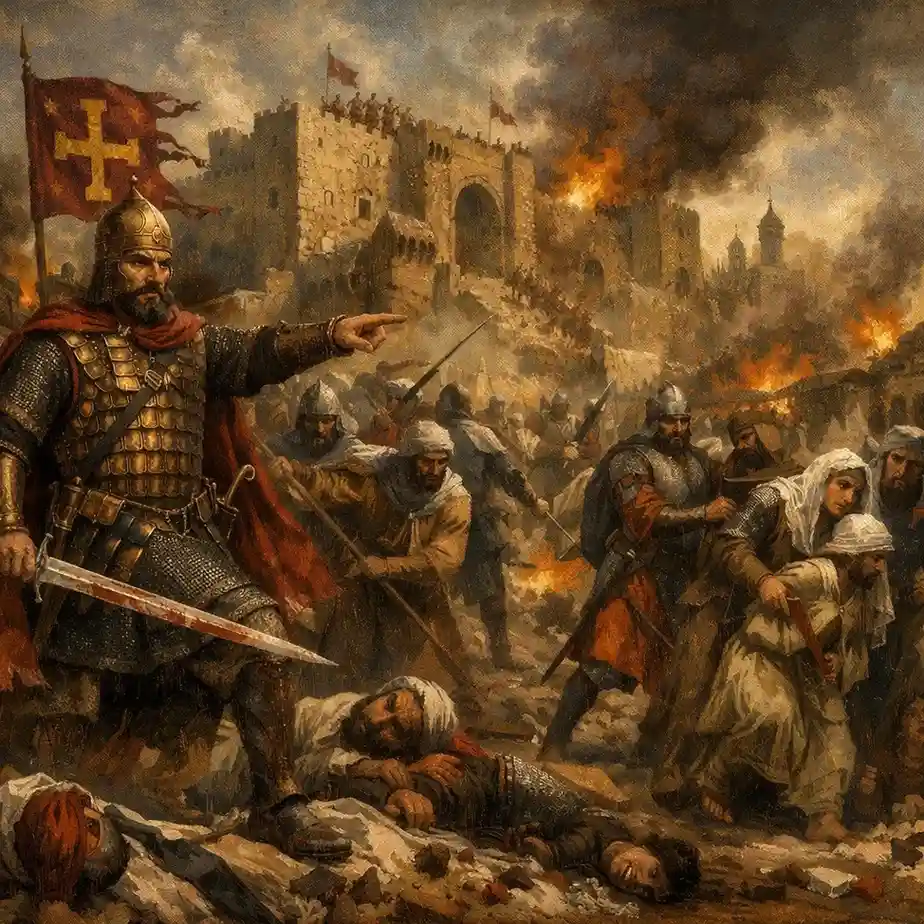
962 – The Byzantine Sack of Aleppo
During the height of the Arab–Byzantine wars, Byzantine troops under the future Emperor Nicephorus Phocas successfully stormed and sacked the city of Aleppo. This victory was a major turning point, as it severely weakened the Hamdanid Dynasty and re-established Byzantine influence in Northern Syria. The conquest was brutal, leaving much of the city in ruins and significantly altering the regional balance of power.
1299 – The Ilkhanate Victory at Homs
The Mongol ruler Ghazan led the Ilkhanate army to a decisive victory over a Mamluk force at the Battle of Wadi al-Khaznadar near Homs. This triumph allowed the Mongols to briefly occupy parts of Syria, marking one of the final major Mongol incursions into the Levant. However, despite the victory, the Ilkhanate forces were unable to maintain a long-term presence due to logistical challenges and internal pressures.
1598 – The Death of Governor Óñez de Loyola
During the fierce Arauco War in Chile, the Spanish Governor Martín García Óñez de Loyola was killed in the Battle of Curalaba by Mapuche warriors. Led by the cacique Pelentaru, the Mapuche forces utilized the dense terrain to ambush the Spanish expedition, resulting in a total defeat for the colonizers. This event sparked a massive uprising that forced the Spanish to withdraw from much of southern Chile for decades.
1688 – King James II Flees to France
As the Glorious Revolution reached its climax, King James II of England fled London for Paris after being abandoned by his military and political allies. His departure paved the way for his daughter Mary and her husband, William of Orange, to take the throne as joint monarchs. This bloodless transition of power fundamentally changed the British monarchy, establishing the principle of parliamentary sovereignty.
1773 – Foundation of the Moscow Ballet School
Under the imperial patronage of Catherine the Great, the Moscow State Academy of Choreography was officially founded to train the nation’s elite dancers. It was the second major ballet school established in Russia and eventually became the home of the world-renowned Bolshoi Ballet. The academy has since produced some of the most celebrated dancers in history, cementing Russia’s reputation as a global leader in dance.
1783 – George Washington Resigns His Commission
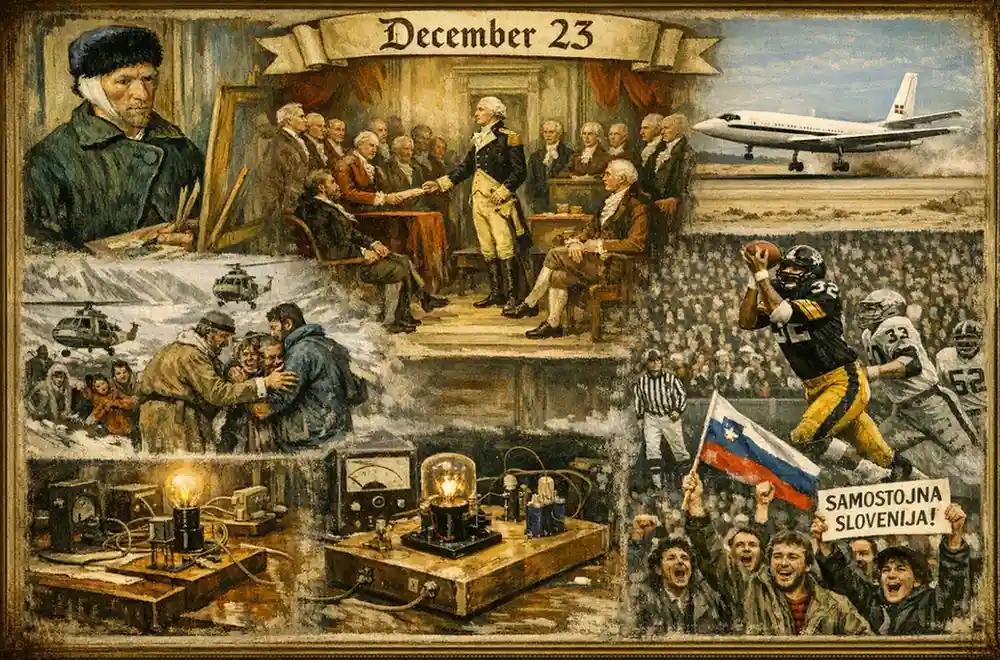
In a profound act of civic virtue, George Washington resigned as commander-in-chief of the Continental Army at the Maryland State House. By voluntarily relinquishing military power to the Continental Congress, he established a vital precedent for civilian control of the military in the new United States. This selfless gesture was hailed globally as a rare example of a victorious general refusing to become a dictator.
1793 – The Royalist Defeat at the Battle of Savenay
During the chaotic years of the French Revolution, the republican forces secured a crushing victory over the royalist counter-revolutionaries in the War in the Vendée. The Battle of Savenay effectively destroyed the Grand Catholic and Royal Army, bringing a brutal end to the largest organized internal threat to the Republic. The aftermath was marked by extreme violence as the revolutionary government sought to pacify the rebellious region.
1815 – Jane Austen’s Emma is Published
The novel Emma, one of Jane Austen’s most beloved works, was first published in London, though it was originally dedicated to the Prince Regent. Featuring the “handsome, clever, and rich” Emma Woodhouse, the book explored themes of social status, marriage, and the pitfalls of meddling in others’ lives. It remains a masterpiece of English literature, celebrated for its wit and psychological depth.
1876 – The First Ottoman Constitution Takes Effect
The Ottoman Empire took a significant step toward modernization by enacting its first comprehensive constitution, which granted the sultan full executive power. This period, known as the First Constitutional Era, aimed to revitalize the empire and satisfy internal demands for reform. However, the newfound democracy was short-lived, as the sultan suspended the constitution only two years later.
1888 – Vincent van Gogh Cuts Off His Ear
In one of the most famous mental health crises in history, Vincent van Gogh severed part of his left ear following a violent argument with fellow artist Paul Gauguin. The two had been living and painting together in the “Yellow House” in Arles, but their relationship had grown increasingly strained. Van Gogh’s act of self-mutilation remains a haunting symbol of his psychological struggles and intense artistic passion.
1893 – Premiere of the Opera Hansel and Gretel
Engelbert Humperdinck’s enchanting opera Hansel and Gretel was performed for the first time in Weimar, conducted by none other than Richard Strauss. Based on the classic Brothers Grimm fairy tale, the opera was an immediate success and became a staple of holiday performances worldwide. Its lush orchestration and folk-inspired melodies captivated audiences, making it one of the most popular operas in the German repertoire.
1905 – The First Meeting of Lenin and Stalin
During a secret Bolshevik conference in Tampere, Finland, Vladimir Lenin and Joseph Stalin met in person for the first time. This encounter laid the foundation for a political partnership that would eventually lead to the Russian Revolution and the creation of the Soviet Union. Though they had very different personalities, their collaboration during this meeting solidified their shared revolutionary goals.
1913 – The Federal Reserve Act is Signed
President Woodrow Wilson signed the Federal Reserve Act into law, creating the modern central banking system of the United States. The act was designed to provide the nation with a stable and flexible monetary system after a series of devastating financial panics. It established twelve regional banks and a central board, forever changing the way the American economy is managed.
1914 – AU and NZ Troops Arrive in Cairo
During the opening months of World War I, the first contingents of the Australian and New Zealand Army Corps (ANZAC) arrived in Cairo, Egypt. They were originally sent there for training before being deployed to the front lines, but their presence in Egypt became a vital part of the Allied strategy in the Middle East. This arrival marked the beginning of a storied and often tragic military legacy for both nations during the Great War.
1914 – Ottoman Friendly Fire at Sarikamish
During the brutal winter Battle of Sarikamish in World War I, Ottoman forces mistakenly engaged their own troops in a massive friendly fire incident. Confused by the blinding snow and identical uniforms, the soldiers killed roughly 2,000 of their own comrades before the error was realized. This tragedy was a precursor to the even greater losses the Ottoman army would suffer from the freezing cold and Russian attacks.
1916 – The Battle of Magdhaba
Allied forces secured a vital victory against Ottoman troops in the Sinai Peninsula during the Battle of Magdhaba. The engagement was a key part of the Sinai and Palestine Campaign, aimed at securing the Suez Canal and pushing Turkish forces back. The success of the Allied cavalry and camelry units during this desert battle helped clear the way for the eventual advance into Palestine.
1919 – UK Removes Sex-Based Job Barriers
The Sex Disqualification (Removal) Act became law in the United Kingdom, making it illegal to bar women from most professions based on their gender. This landmark legislation allowed women to serve as lawyers, magistrates, and high-ranking civil servants for the first time. It was a major victory for the women’s suffrage movement and a significant step toward gender equality in the British workforce.
1936 – Colombia Signs the Buenos Aires Copyright Treaty
In a major step for international intellectual property rights, Colombia officially became a signatory to the Buenos Aires Convention. This treaty was designed to provide mutual recognition of copyrights between nations in the Americas, ensuring that authors and creators were protected across borders. It represented an important moment of legal and cultural cooperation within the Western Hemisphere.
1936 – Legalization of the Regional Defence Council of Aragon
During the height of the Spanish Civil War, the Republican government officially recognized the Regional Defence Council of Aragon. This body was largely controlled by anarchist and socialist collectives that had implemented radical social and economic reforms in the region. The legalization was a strategic move by the central government to maintain an uneasy alliance with the revolutionary factions fighting against Franco.
1941 – The Fall of Wake Island
After a heroic 15-day defense, the small American garrison on Wake Island was forced to surrender to the Imperial Japanese Army. The defenders had managed to repel the initial invasion attempt, becoming a symbol of American resilience in the early days of the Pacific War. Despite their capture, the “Alamo of the Pacific” remained a potent rallying cry for U.S. forces throughout the conflict.
1947 – The First Demonstration of the Transistor
Scientists at Bell Laboratories successfully demonstrated the first working transistor, a tiny device that would revolutionize the world of electronics. By replacing bulky and unreliable vacuum tubes, the transistor allowed for the miniaturization of computers and the birth of modern digital technology. This invention is widely considered one of the most important technological breakthroughs of the 20th century.
1948 – Execution of Japanese War Criminals
Seven high-ranking Japanese military and political leaders, including former Prime Minister Hideki Tojo, were executed at Sugamo Prison in Tokyo. They had been convicted of “Class A” war crimes by the International Military Tribunal for the Far East following World War II. The executions marked the conclusion of the legal process intended to hold Japan’s leadership accountable for the atrocities committed during the war.
1950 – The Death of General Walton Walker
Tragedy struck the United States military in Korea when General Walton Walker, commander of the Eighth Army, was killed in a jeep accident. His sudden death occurred during a critical phase of the war as UN forces were retreating in the face of Chinese intervention. He was quickly replaced by General Matthew Ridgway, whose leadership would eventually stabilize the front and turn the tide for the Eighth Army.
1954 – The First Successful Kidney Transplant
Medical history was made when surgeons J. Hartwell Harrison and Joseph Murray performed the first successful human kidney transplant in Boston. The transplant involved identical twins Ronald and Richard Herrick, which eliminated the risk of organ rejection through genetic compatibility. This pioneering procedure paved the way for the entire field of modern organ transplantation.
1955 – Premiere of The Unknown Soldier in Finland
The first film adaptation of Väinö Linna’s iconic novel, The Unknown Soldier, premiered in Finland under the direction of Edvin Laine. The movie, which depicts the struggles of a Finnish machine gun platoon during the Continuation War, became a massive cultural phenomenon. It remains one of the most significant and frequently watched films in Finnish history, often aired on Independence Day.
1960 – The “Oven Homicide” in Finland
The quiet town of Kokemäki, Finland, was shocked by the brutal murder of Hilkka Saarinen, a case that would become known as the “oven homicide.” Hilkka disappeared shortly before Christmas, and her body was not discovered until years later, hidden inside a large baking oven in her own home. The case remains one of Finland’s most chilling and widely discussed historical true-crime mysteries.
1968 – Release of the USS Pueblo Sailors
After eleven harrowing months of captivity and torture in North Korea, the 82 surviving sailors of the USS Pueblo were finally released. The ship had been seized by North Korean forces in international waters, sparking a major Cold War diplomatic crisis. The sailors crossed the “Bridge of No Return” into South Korea just in time for the Christmas holiday.
1970 – Topping Out the WTC North Tower
The North Tower of the original World Trade Center reached its full height of 1,368 feet, officially becoming the tallest building in the world at that time. Located in Lower Manhattan, the “Twin Towers” became an iconic part of the New York City skyline and a symbol of global commerce. The completion of the North Tower was a major milestone in urban engineering and architecture.
1970 – The DRC Becomes a One-Party State
Under the leadership of Mobutu Sese Seko, the Democratic Republic of the Congo officially transitioned into a one-party state. This move solidified Mobutu’s authoritarian control over the nation and paved the way for decades of centralized rule under his “Mobutism” ideology. The shift silenced political opposition and fundamentally altered the country’s political landscape for a generation.
1972 – The “Immaculate Reception” Wins the Game
In one of the most famous plays in NFL history, Franco Harris caught a deflected pass just inches from the ground to score a game-winning touchdown for the Pittsburgh Steelers. This improbable play, dubbed the “Immaculate Reception,” gave the Steelers their first-ever playoff victory against the Oakland Raiders. It remains a legendary moment that transformed the Steelers into a football powerhouse.
1972 – The Devastating Managua Earthquake
A powerful 6.5 magnitude earthquake struck the capital of Nicaragua, Managua, in the early hours of the morning. The disaster claimed the lives of more than 10,000 people and left hundreds of thousands homeless as much of the city’s infrastructure collapsed. The earthquake had long-lasting political consequences, as the government’s mishandling of relief funds fueled the growing revolutionary movement.
1972 – The “Miracle of the Andes” Rescue
After 73 days stranded in the freezing mountains following a plane crash, the 16 survivors of Uruguayan Flight 571 were finally rescued. Their survival had required incredible mental strength and the desperate decision to consume the remains of their deceased companions to avoid starvation. Their story of human endurance against all odds continues to captivate and haunt the world.
1978 – Alitalia Flight 4128 Crashes into the Sea
Tragedy occurred off the coast of Sicily when Alitalia Flight 4128 crashed into the Tyrrhenian Sea while attempting to land at Palermo Airport. Out of the 129 people on board, 108 lost their lives in the accident, which was later attributed to pilot error during a premature descent. The crash remains one of the deadliest aviation incidents in Italian history and led to a review of landing procedures at the airport.
1979 – Soviet Forces Occupy Kabul
In a move that escalated the Cold War, Soviet Union forces invaded Afghanistan and occupied the capital city of Kabul. This action was intended to support the local communist government but instead sparked a brutal decade-long insurgency supported by the West. The invasion led to massive international condemnation and had a lasting impact on global geopolitics.
1984 – Aeroflot Flight 3519 Emergency Landing Crash
Shortly after taking off from Krasnoyarsk in the Soviet Union, an Aeroflot Tu-154 suffered a catastrophic engine fire. The crew attempted to return to the airport for an emergency landing, but the aircraft crashed, killing 110 of the 111 people on board. It was a devastating loss of life that highlighted the critical importance of engine safety and emergency response training in commercial aviation.
1986 – Voyager Completes Non-Stop Global Flight
Pilots Dick Rutan and Jeana Yeager landed the Voyager aircraft in California, completing the first-ever non-stop, unrefueled flight around the world. The journey took nine days and tested the limits of both the experimental aircraft and the endurance of the pilots. This feat remains a historic milestone in aviation history, proving that global travel without stopping was possible.
1990 – Slovenia Votes for Independence
In a historic referendum, an overwhelming 88.5% of the Slovenian electorate voted in favor of gaining independence from Yugoslavia. This decisive result was a major milestone in the dissolution of the Yugoslav federation and led to Slovenia’s formal declaration of sovereignty. The vote reflected a powerful national desire for self-determination and paved the way for Slovenia’s entry into the European community.
2002 – First Drone vs. Conventional Aircraft Combat
A historic moment in modern warfare occurred when a U.S. MQ-1 Predator drone was shot down by an Iraqi MiG-25. This was the first time in history that a remotely piloted drone engaged in direct combat with a conventional, manned fighter jet. Although the drone was lost, the encounter proved that unmanned aerial vehicles would play a central role in the future of air-to-air engagements.
2003 – The PetroChina Gas Field Explosion
A massive gas explosion at the Chuandongbei natural gas field in Chongqing, China, resulted in the deaths of at least 234 people. The blast released a toxic cloud of hydrogen sulfide, which spread through the surrounding villages and poisoned thousands of residents in their sleep. It remains one of the worst industrial disasters in China’s history, leading to significant changes in safety regulations for the energy sector.
2005 – Azerbaijan Airlines Flight 217 Crash
An Antonov An-140 operated by Azerbaijan Airlines crashed into the Caspian Sea shortly after taking off from Baku. All 23 people on board were killed in the accident, which investigators later linked to a failure of the aircraft’s gyroscopes. The crash led to the grounding of the An-140 fleet in Azerbaijan and raised serious questions about the maintenance of older Soviet-designed aircraft.
2007 – Nepal Agrees to Become a Republic
The Kingdom of Nepal reached a historic agreement to abolish its 240-year-old monarchy and transform into a federal democratic republic. This decision followed a decade-long civil war and a massive pro-democracy movement that stripped the king of his absolute power. The transition marked the beginning of a new political era for the Himalayan nation as it sought to draft a new constitution.
2008 – A Coup d’état Occurs in Guinea
Only hours after the death of President Lansana Conté, who had ruled Guinea for 24 years, a military junta seized control of the government. The coup leaders suspended the constitution and dissolved the country’s political institutions, claiming they wanted to end corruption. This sudden seizure of power plunged the West African nation into a period of political instability and international isolation.
2015 – Bombing at Istanbul’s Sabiha Gökçen Airport
An explosion rocked the apron of Istanbul’s Sabiha Gökçen Airport, resulting in the death of one airport cleaner and injuring another. The Kurdistan Freedom Hawks (TAK) later claimed responsibility for the attack, stating it was a response to Turkish military operations. The incident heightened security concerns across Turkey’s major transportation hubs during a time of increased regional tension.
2023 – The Plateau State Massacres in Nigeria
A series of horrific massacres unfolded in Nigeria’s Plateau State, where armed groups targeted Berom civilian communities. The coordinated attacks left over 200 people dead and hundreds more injured, causing a massive humanitarian crisis in the region. The tragedy underscored the persistent ethnic and land-use tensions in central Nigeria and the ongoing challenges of ensuring rural security.
Famous People Born On December 23
| Name | Role / short description | Dates |
|---|---|---|
| Joseph Dunford | United States general; Chairman, Joint Chiefs of Staff | December 23, 1955 – |
| Donna Tartt | American novelist; Pulitzer Prize winner | December 23, 1963 – |
| Silvia | Queen consort of Sweden | December 23, 1943 – |
| Yousuf Karsh | Armenian-Canadian portrait photographer | December 23, 1908 – July 13, 2002 |
| Sir Richard Arkwright | British industrialist & inventor (textile machinery) | December 23, 1732 – August 3, 1792 |
| Robert Kahn | American electrical engineer; Internet pioneer (with Cerf) | December 23, 1938 – |
| Jean-François Champollion | French linguist; deciphered Egyptian hieroglyphs | December 23, 1790 – March 4, 1832 |
| Victoriano Huerta | President of Mexico (dictatorial regime) | December 23, 1854 – January 13, 1916 |
| James Buchanan Duke | American tobacco magnate & philanthropist | December 23, 1856 – October 10, 1925 |
| Samuel Smiles | Scottish author; Self-Help (Victorian moralist) | December 23, 1812 – April 16, 1904 |
| Quentin Bryce | Australian lawyer; Governor-General of Australia | December 23, 1942 – |
| Robert Bly | American poet, translator & essayist | December 23, 1926 – November 21, 2021 |
| Henri Pirenne | Belgian historian (medieval studies) | December 23, 1862 – October 24, 1935 |
| Mikhail Gromov | Mathematician (geometry); Abel Prize laureate | December 23, 1943 – |
| Frederick Augustus I | King of Saxony (first king) | December 23, 1750 – May 5, 1827 |
| Giuseppe Tomasi di Lampedusa | Italian author (The Leopard) | December 23, 1896 – July 23, 1957 |
| Pierre Bérégovoy | French prime minister | December 23, 1925 – May 1, 1993 |
| James Gibbs | Scottish architect (18th-century church & pattern books) | December 23, 1682 – August 5, 1754 |
| Dick Weber | American professional bowler (PBA pioneer) | December 23, 1929 – February 13, 2005 |
| Charles-Augustin Sainte-Beuve | French literary critic & historian | December 23, 1804 – October 13, 1869 |
| John Marin | American modernist painter & printmaker | December 23, 1870 – October 1, 1953 |
| Niels K. Jerne | Danish immunologist; Nobel laureate | December 23, 1911 – October 7, 1994 |
| Joseph Bodin de Boismortier | French Baroque composer | December 23, 1689 – October 28, 1755 |
| William Moody | U.S. Supreme Court Justice; statesman | December 23, 1853 – July 2, 1917 |
| Richard Lepsius | German Egyptologist & archaeologist | December 23, 1810 – July 10, 1884 |
| Prafulla Kumar Mahanta | Indian politician (Assam regional leader) | December 23, 1952 – |
| Harriet Monroe | American poet; founder/editor of Poetry magazine | December 23, 1860 – September 26, 1936 |
| Joseph Smith | Founder, Latter-day Saint movement (religious leader) | December 23, 1805 – June 27, 1844 |
| Alexander I | Emperor of Russia (Napoleonic era) | December 23, 1777 – December 1, 1825 |
| Wael Ghonim | Egyptian activist & internet engineer (2011) | December 23, 1980 – |
Famous People Died On December 23
| Name | Role / short description | Dates |
|---|---|---|
| Peggy Guggenheim | American art collector & patron (modern art) | August 26, 1898 – December 23, 1979 |
| Oscar Peterson | Canadian jazz pianist & composer | August 15, 1925 – December 23, 2007 |
| Victor Borge | Danish-American pianist & comedian | January 3, 1909 – December 23, 2000 |
| George Catlin | American painter & author (Native American scenes) | July 26, 1796 – December 23, 1872 |
| Abraham Joshua Heschel | Jewish theologian & thinker | 1907 – December 23, 1972 |
| Alfred G. Gilman | American pharmacologist; Nobel laureate | July 1, 1941 – December 23, 2015 |
| Walton H. Walker | U.S. Army general (Korean War commander) | December 3, 1889 – December 23, 1950 |
| Sir Henry Clinton | British general (American Revolutionary War) | April 16, 1730? – December 23, 1795 |
| Henry Woodfin Grady | American journalist & orator (New South booster) | May 24, 1850 – December 23, 1889 |
| Dagobert II | Merovingian king of Austrasia | c.650 – December 23, 679 |
| Anthony Fokker | Dutch aircraft manufacturer & designer | April 6, 1890 – December 23, 1939 |
| Ronnie Scott | British jazz tenor saxophonist & club founder | January 28, 1927 – December 23, 1996 |
| Charles Dana Gibson | American illustrator (the “Gibson Girl”) | September 14, 1867 – December 23, 1944 |
| G. P. Kuiper | Gerard P. Kuiper — Dutch-American astronomer | December 7, 1905 – December 23, 1973 |
| Lavrenty Beria | Soviet security chief (NKVD); politician | March 29, 1899 – December 23, 1953 |
| Tōjō Hideki | Prime minister of Japan (WWII); wartime leader | December 30, 1884 – December 23, 1948 |
| Edward F. L. Wood, 1st Earl of Halifax | British statesman & diplomat | April 16, 1881 – December 23, 1959 |
| Andrey N. Tupolev | Soviet aircraft designer (Tupolev bureau) | November 10, 1888 – December 23, 1972 |
| Laurence Oliphant | British author, traveller & mystic | 1829 – December 23, 1888 |
| Jane Cunningham Croly | Journalist & clubwoman (American social reformer) | December 19, 1829 – December 23, 1901 |
| Joan Didion | American essayist and novelist | December 5, 1934 – December 23, 2021 |
| P. V. Narasimha Rao | Prime minister of India (1991–96) | June 28, 1921 – December 23, 2004 |
| Sir Reginald Myles Ansett | Australian airline founder & businessman | February 13, 1909 – December 23, 1981 |
| Ambrose Reeves | Anglican bishop; anti-apartheid activist | December 6, 1899 – December 23, 1980 |
| Sarah Grimké | American abolitionist & early feminist | November 26, 1792 – December 23, 1873 |
| Sir William Hay Macnaghten, Bt. | British diplomat (Afghanistan) | August 1793 – December 23, 1841 |
| James Cowles Prichard | British physician & ethnologist | February 11, 1786 – December 23, 1848 |
| Ernest B. Schoedsack | American film director (e.g., King Kong) | June 8, 1893 – December 23, 1979 |
| John Cotton | New England Puritan leader & minister | December 4, 1585 – December 23, 1652 |
| Pierre Janssen | French astronomer; discovered helium in sun | February 22, 1824 – December 23, 1907 |
Observances & Institutional Dates
- Festivus (International): A secular holiday created as an alternative to the commercialism of Christmas, featuring the “Airing of Grievances” and “Feats of Strength.”
- Kisan Diwas (India): Also known as National Farmers’ Day, it honors the birth anniversary of Chaudhary Charan Singh and celebrates the vital role of farmers in India.
- Night of the Radishes (Mexico): A traditional folk art festival in Oaxaca where artisans carve oversized radishes into intricate scenes of history and religion.
- HumanLight (United States): A secular humanist holiday focused on the “light” of human reason, compassion, and hope for a positive future.
- Children’s Day (Sudan & South Sudan): A day dedicated to promoting the welfare of children and celebrating their importance within the national community.
- Tom Bawcock’s Eve (Cornwall): A traditional festival in the village of Mousehole commemorating a legendary fisherman who saved the town from starvation.
Frequently Asked Questions
What was the “Immaculate Reception” on December 23?
The “Immaculate Reception” refers to a legendary 1972 NFL playoff play where Franco Harris made a miraculous catch to win the game for the Pittsburgh Steelers.
Why is December 23 significant for aviation history?
In 1986, the Voyager aircraft completed the first non-stop flight around the world without refueling, landing after a nine-day journey.
Who was the artist that cut off his ear on this day?
Vincent van Gogh cut off a portion of his left ear on December 23, 1888, following an intense mental health breakdown and a fight with Paul Gauguin.