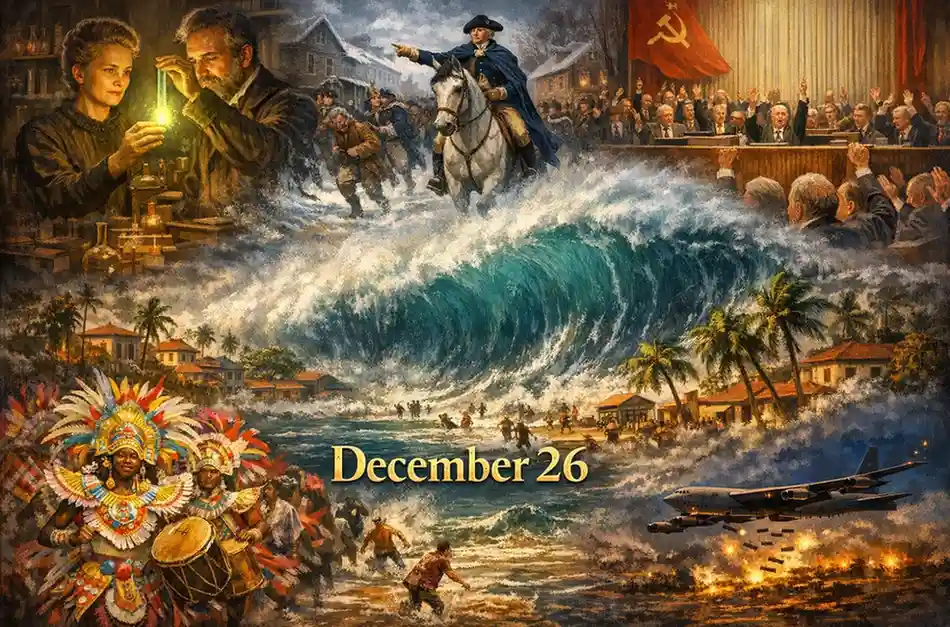
While the world often pauses for a day of rest after Christmas, history tells a story of intense movement and profound change on this date. By looking at what happened on this day in history December 26, we reveal a narrative where Marie Curie isolated radium, empires collapsed in the cold of winter, and the earth itself shifted with the power of a world-altering tsunami.
Important Events That Happened On December 26 In History
795 – The Election of Pope Leo III
In the wake of the death of Adrian I, the Roman clergy quickly elected Leo III to the papacy. His reign was marked by intense political friction within Rome, which eventually led him to seek the protection of Charlemagne. This alliance famously resulted in the restoration of the Western Imperial title, fundamentally changing the relationship between the Church and European monarchies.
887 – Berengar I and the Iron Crown
Berengar I was elected as the King of Italy by the lords of Lombardy, seeking to fill the power vacuum left by the declining Carolingian Empire. He was officially crowned with the legendary Iron Crown of Lombardy at Pavia. His reign began a long and tumultuous period of struggle for control over the Italian peninsula, as he fought off various rivals and invaders to maintain his throne.
1481 – The Battle of Westbroek
A massive army of up to 5,000 soldiers, raised by the Bishop of Utrecht, David of Burgundy, engaged in a fierce conflict against an armed mob from the city of Utrecht. The citizens were attempting to take revenge for a previous massacre of the inhabitants of Westbroek. The battle was a bloody chapter in the ongoing regional power struggles between the bishopric and the defiant urban centers of the Netherlands.
1704 – The Second Battle of Anandpur
During the Second Battle of Anandpur, the forces of the Mughal Emperor Aurangzeb committed a tragic act that remains a somber memory in Sikh history. Generals Wazir Khan and Zaberdast Khan captured the two youngest children of Guru Gobind Singh, Zorawar Singh and Fateh Singh. Despite their ages of only eight and five, the children were executed by being buried alive within a brick wall after refusing to renounce their faith.
1709 – The Premiere of Agrippina
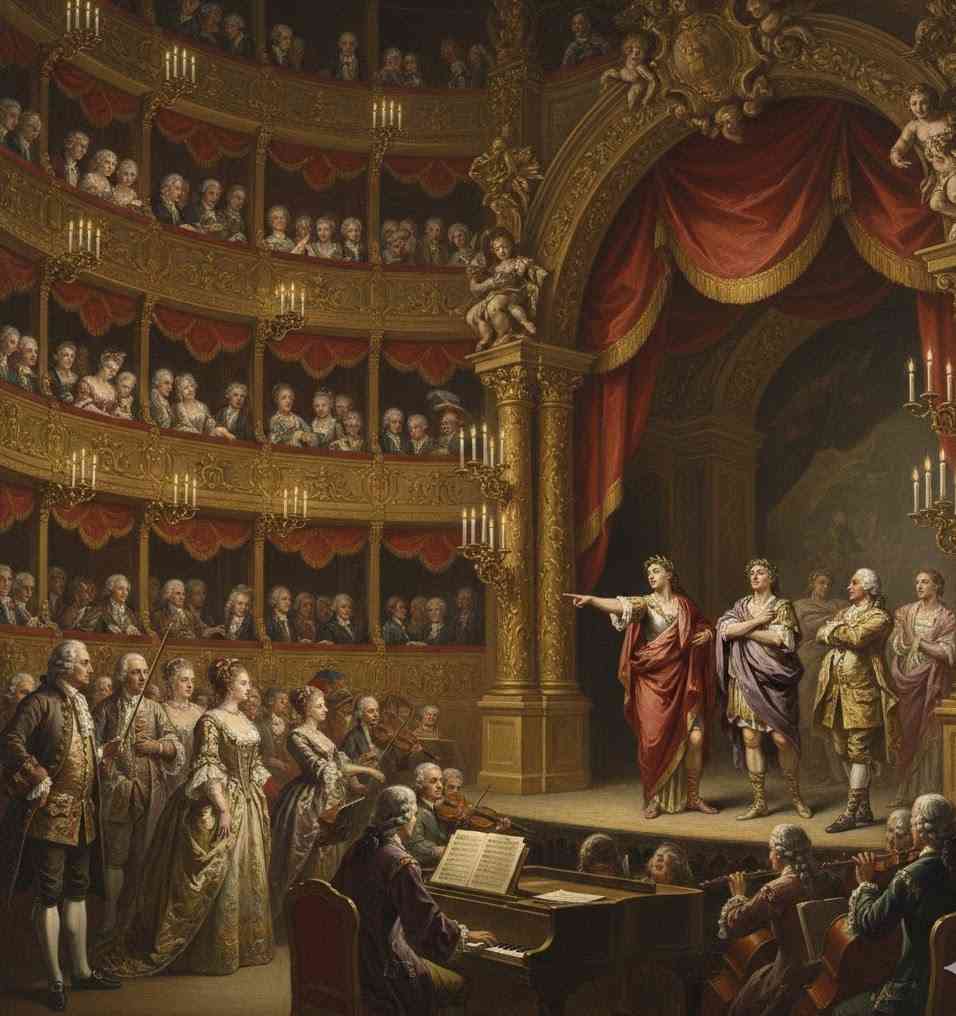
George Frideric Handel’s opera Agrippina made its triumphant debut in Venice, marking one of the earliest major successes of the legendary composer’s career. The opera, a satire on Roman political intrigue, ran for an unprecedented 27 performances and established Handel as a master of the Italian style. Its success in Venice paved the way for his later international fame in London.
1723 – Bach’s First Leipzig Christmas Cantata
In a milestone for Baroque music, Johann Sebastian Bach led the first performance of Darzu ist erschienen der Sohn Gottes (BWV 40). This was his very first Christmas cantata composed specifically for his new position in Leipzig. The work showcased Bach’s ability to weave complex theological themes into intricate musical structures, setting a high standard for the liturgical music that would follow during his tenure.
1776 – Washington’s Victory at Trenton
Following a perilous night crossing of the icy Delaware River, George Washington led the Continental Army in a daring surprise attack against a Hessian garrison. The Battle of Trenton was a stunning American victory that resulted in the capture of nearly 1,000 enemy troops with almost no American lives lost. This triumph provided a desperate boost to the morale of the Revolution, proving that the British forces were not invincible.
1790 – Louis XVI Assents to the Clergy Constitution
Amidst the escalating tension of the French Revolution, King Louis XVI gave his reluctant public assent to the Civil Constitution of the Clergy. This law effectively placed the Catholic Church under the control of the French government, requiring priests to swear an oath of loyalty to the state. The move caused a deep religious schism in France and further alienated the monarchy from traditionalist sectors of society.
1793 – The Second Battle of Wissembourg
In a significant military engagement of the French Revolutionary Wars, the French Republican forces achieved a decisive victory over the Austrian army. By retaking the lines of Wissembourg, the French managed to secure their eastern borders and push the Coalition forces back across the Rhine. The victory was a testament to the growing tactical proficiency and fervor of the new French revolutionary armies.
1799 – A Eulogy for George Washington
In a moving tribute delivered to Congress, Henry Lee III famously honored the recently deceased George Washington. He described the former president as being “first in war, first in peace, and first in the hearts of his countrymen.” This phrase became the definitive summary of Washington’s legacy, cementing his status as the indispensable figure of the early United States.
1805 – The Treaty of Pressburg
Following Napoleon’s crushing victory at Austerlitz, Austria and France signed the Treaty of Pressburg. The agreement forced Austria to cede vast territories in Italy and Germany, effectively ending its influence in those regions for years to come. The treaty also marked the beginning of the end for the Holy Roman Empire, as Napoleon began to reshape the map of Europe to his liking.
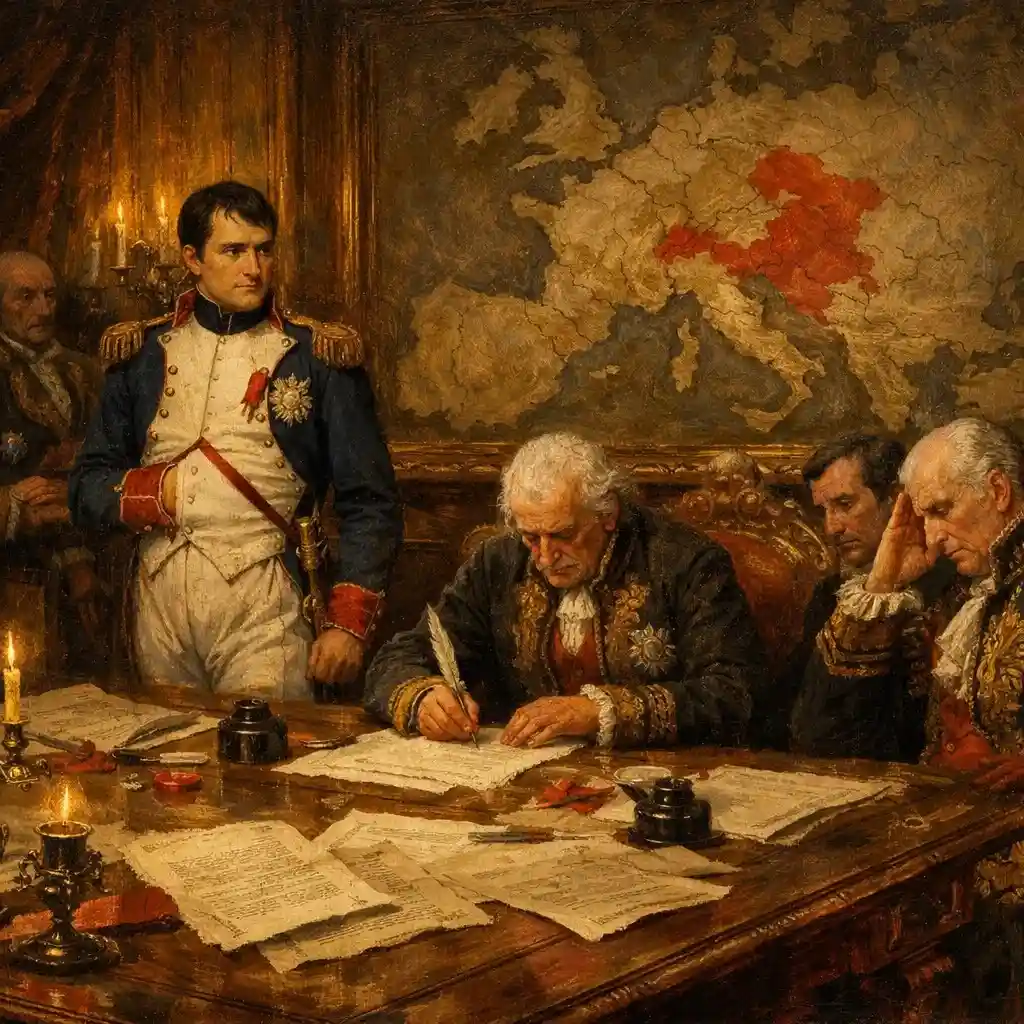
1806 – Battles of Pultusk and Golymin
During the War of the Fourth Coalition, Russian forces successfully held their ground against Napoleon’s French army in two separate engagements. Although the battles were tactically inconclusive, the Russian resilience prevented Napoleon from achieving the decisive victory he sought in the winter mud of Poland. These encounters highlighted the immense difficulty of conducting large-scale warfare in the harsh Eastern European climate.
1811 – The Richmond Theater Fire
A devastating fire broke out during a performance at a theater in Richmond, Virginia, claiming the lives of 72 people. Among the victims were the Governor of Virginia, George William Smith, and prominent bank president Abraham B. Venable. The tragedy led to a period of deep mourning in the state and prompted significant changes to building safety codes for public gathering spaces.
1825 – The Decembrist Revolt
A group of liberal-minded military officers in Russia led an uprising in St. Petersburg against the accession of Czar Nicholas I. Known as the Decembrists, these rebels sought to implement a constitutional government and abolish serfdom. However, the revolt was poorly organized and was quickly suppressed by loyalist troops, leading to the execution or exile of its leaders and a period of increased censorship.
1843 – The Discovery of Octonions
Mathematician John T. Graves announced the discovery of octonions, a new system of numbers, in a letter to his friend William Rowan Hamilton. Graves represented these eight-dimensional numbers with a boldface O, extending the work Hamilton had done with quaternions. Octonions would eventually find a unique place in modern physics, particularly in string theory and the study of particle interactions.
1860 – The First Rules Derby
The world’s oldest football fixture was born when Sheffield F.C. and Hallam F.C. met for the first ever “Rules derby.” This match was played under the Sheffield Rules, which predated the standardized laws of the modern game. This historic encounter at Sandygate Road laid the foundation for the organized competitive football culture that would eventually sweep across the globe.
1861 – The Easing of the Trent Affair
The United States government released Confederate envoys James Murray Mason and John Slidell, who had been seized from a British mail steamer. This move successfully de-escalated the Trent Affair, which had brought the U.S. and the United Kingdom dangerously close to war. By freeing the diplomats, President Lincoln avoided a second conflict while the American Civil War was still raging.
1862 – The Battle of Chickasaw Bayou Begins
Union General William T. Sherman began landing his troops in a major attempt to advance on the Confederate stronghold of Vicksburg, Mississippi. This signaled the start of the Battle of Chickasaw Bayou, as the Union sought to gain control of the vital Mississippi River. The terrain proved extremely difficult, leading to a challenging campaign against well-entrenched Confederate defenders.
1862 – The Mankato Mass Hanging
In the largest mass execution in U.S. history, 38 Native American men were hanged in Mankato, Minnesota, following the Dakota War of 1862. The executions were the result of military trials that have since been heavily criticized for their lack of due process. The event remains a deeply painful chapter in the history of the relationship between the U.S. government and Indigenous peoples.
1871 – The Debut of Thespis
The legendary partnership of Gilbert and Sullivan officially began with the debut of their first collaboration, Thespis. While the original music for the operetta was largely lost over time, the production was a success and proved that the duo had a unique chemistry for musical theater. This initial project paved the way for the “Savoy Operas” that would later define British light opera.
1898 – The Isolation of Radium
In a monumental moment for science, Marie and Pierre Curie announced to the French Academy of Sciences that they had successfully isolated a new radioactive element called radium. Working in a makeshift laboratory with painstaking effort, the Curies extracted the element from pitchblende. This discovery fundamentally changed the understanding of atomic physics and opened new doors for medical treatments.
1919 – The Sale of Babe Ruth
Red Sox owner Harry Frazee sold superstar Babe Ruth to the New York Yankees for $125,000, allegedly to finance a Broadway play. This transaction changed the course of baseball history, transforming the Yankees into a perennial powerhouse while the Red Sox entered an 86-year championship drought. The move gave birth to the “Curse of the Bambino,” one of the most famous superstitions in sports.
1926 – Premiere of Tapiola
The world premiere of Jean Sibelius’s tone poem Tapiola took place, representing one of the final major orchestral works from the legendary Finnish composer. The piece evokes the vast, mysterious forests of Finland and the ancient forest god Tapio. Its cold, haunting beauty captured the essence of the Nordic landscape and solidified Sibelius’s reputation as a master of atmosphere and tone.
1941 – Thanksgiving and Churchill’s Address
In a busy day for American politics, President Franklin D. Roosevelt signed a bill formally establishing the fourth Thursday of November as Thanksgiving Day. On the same day, British Prime Minister Winston Churchill delivered a defiant and powerful address to a joint meeting of the U.S. Congress. Churchill spoke of the resolve of the Allied powers, strengthening the bond between the two nations during the height of World War II.
1943 – The Sinking of the Scharnhorst
The German battleship Scharnhorst was sunk off Norway’s North Cape during the Battle of the North Cape. A superior force of the British Royal Navy, including the battleship HMS Duke of York, cornered and destroyed the German vessel after a long pursuit in the dark arctic waters. The sinking removed one of the greatest threats to Allied convoys traveling to the Soviet Union.
1944 – Patton Breaks the Encirclement
General George S. Patton’s Third Army successfully broke through German lines to reach the surrounded U.S. forces at Bastogne, Belgium. The breakthrough was a turning point in the Battle of the Bulge, relieving the 101st Airborne Division that had been holding the town against overwhelming odds. Patton’s swift armored advance remains one of the most celebrated military maneuvers of the Second World War.
1948 – The Arrest of Cardinal Mindszenty
In a move that shocked the Catholic world, Cardinal József Mindszenty was arrested by the communist government in Hungary. He was accused of treason and conspiracy against the state, primarily due to his outspoken opposition to communist policies and the secularization of Catholic schools. His imprisonment became a global symbol of the struggle for religious freedom under iron curtain regimes.
1948 – Soviet Withdrawal from North Korea
The Soviet Union announced the total withdrawal of its troops from North Korea, fulfilling an earlier agreement to leave the peninsula. This departure left the newly established Democratic People’s Republic of Korea under the leadership of Kim Il-sung to govern independently. The withdrawal intensified the political divide on the peninsula, as U.S. forces remained in the south, setting the stage for the Korean War.
1963 – The US Release of “I Want to Hold Your Hand”
Capitol Records released the Beatles’ singles “I Want to Hold Your Hand” and “I Saw Her Standing There” in the United States, ahead of the band’s scheduled arrival. The records were an instant sensation, selling hundreds of thousands of copies within days and igniting Beatlemania on an international scale. This release marked the beginning of the “British Invasion” that would dominate the American music charts for years.
1966 – The First Kwanzaa Celebration
Maulana Karenga, a professor of Black Studies, organized the first ever Kwanzaa celebration in California. The holiday was created to honor African heritage in African-American culture and is defined by seven core principles, including unity and self-determination. Over the decades, Kwanzaa has grown into a widely recognized cultural festival celebrated by millions between December 26 and January 1.
1968 – Founding of the Communist Party of the Philippines
Jose Maria Sison led a breakaway group from the old Partido Komunista ng Pilipinas to establish the modern Communist Party of the Philippines (CPP). Based on Maoist ideology, the party sought to overthrow the government through a protracted people’s war. The CPP and its armed wing, the New People’s Army, would become one of the longest-running communist insurgencies in the world.
1972 – Operation Linebacker II: The Hanoi Raid
In the largest single combat launch in the history of the Strategic Air Command, 120 American B-52 bombers attacked targets in Hanoi. This massive air strike was part of Operation Linebacker II, intended to pressure North Vietnam into serious peace negotiations. The raid involved bombers launched from both Guam and Thailand, representing a final, intense escalation of U.S. involvement in the Vietnam War.
1975 – The Tu-144 Enters Service
The Soviet-built Tupolev Tu-144, the world’s first commercial supersonic aircraft, officially entered service by carrying mail between Moscow and Alma-Ata. Capable of surpassing Mach 2, the Tu-144 beat the European Concorde into regular service by several weeks. Though its commercial career was plagued by technical issues and high costs, it remains a marvel of 20th-century aviation engineering.
1798 – The First Paris-Dakar Rally
The inaugural Paris-Dakar Rally began as 182 vehicles departed from Paris on a grueling 10,000-kilometer journey toward the capital of Senegal. Founded by Thierry Sabine, the race was designed to test the absolute limits of human endurance and mechanical reliability across the Sahara Desert. The rally quickly became a legendary event in the world of motorsports, known for its extreme danger and adventure.
1980 – The Rendlesham Forest Incident
Military personnel at RAF Woodbridge in England reported the first in a series of sightings of unexplained lights and a strange metallic craft in Rendlesham Forest. The incident is often referred to as “Britain’s Roswell” because of the high number of credible witnesses, including a deputy base commander. It remains one of the most famous and well-documented UFO sightings in history, sparking decades of investigation.
1989 – United Express Flight 2415 Crash
Tragedy struck the Pacific Northwest when United Express Flight 2415 crashed on its final approach to Tri-Cities Airport in Washington. All six people on board were killed when the plane stalled and plummeted into the ground during poor weather conditions. The investigation later highlighted issues with icing on the aircraft’s wings, leading to improved de-icing procedures for regional turboprop flights.
1991 – The Dissolution of the Soviet Union
The Supreme Soviet of the USSR held its final meeting and formally voted the Soviet Union out of existence. This legal decree acknowledged the independence of the 15 former Soviet republics and officially ended the Cold War. The dissolution transformed the global political landscape overnight, leaving the United States as the world’s sole superpower and ending a nearly 70-year experiment in communist rule.
1994 – The Hijacking of Air France Flight 8969
Four members of the Armed Islamic Group seized control of Air France Flight 8969 in Algiers, eventually forcing the plane to fly to Marseille. In a dramatic televised rescue operation, a French Gendarmerie assault team (GIGN) stormed the aircraft, killing all four hijackers and saving the passengers. The incident led to a massive overhaul of aviation security and a temporary suspension of flights between France and Algeria.
1998 – Iraq Defies the No-Fly Zones
Iraq officially announced its intention to fire upon U.S. and British warplanes that were patrolling the northern and southern “no-fly zones.” This defiance led to a series of skirmishes and airstrikes as Western forces attempted to enforce the restrictions designed to protect minority populations. The rising tensions were a precursor to the larger conflicts that would define the region in the coming decade.
1999 – The Devastation of Storm Lothar
A powerful windstorm named Lothar swept across Central Europe, bringing hurricane-force winds that caused widespread destruction in France, Germany, and Switzerland. The storm killed 137 people and caused over $1.3 billion in property damage, making it one of the costliest weather events in European history. Millions were left without power, and the storm’s intensity led to significant improvements in regional early-warning systems.
2003 – The Bam Earthquake
A magnitude 6.6 earthquake struck the historic city of Bam in southeastern Iran, causing catastrophic damage to the ancient mud-brick city and its 2,000-year-old citadel. More than 26,000 people lost their lives, and the local healthcare infrastructure was completely overwhelmed. The international community responded with a massive aid effort to help survivors in the freezing winter conditions.
2004 – The Indian Ocean Tsunami
One of the deadliest natural disasters in history began when a 9.1 magnitude earthquake struck off the coast of northern Sumatra. The resulting tsunami traveled across the Indian Ocean, striking the coasts of 14 countries and claiming the lives of an estimated 227,898 people. The sheer scale of the tragedy led to a global effort to install a comprehensive tsunami warning system for the entire Indian Ocean region.
2004 – The Orange Revolution: Final Run-off
Ukraine held a repeat of its presidential run-off election under intense international scrutiny following widespread allegations of fraud in the previous vote. Known as the Orange Revolution, the peaceful protests led to this historic re-vote, which saw Viktor Yushchenko defeat Viktor Yanukovych. The victory was seen as a major win for democratic movements in the former Soviet space.
2006 – The Hengchun Earthquakes
Two powerful earthquakes, measuring 7.0 and 6.9, struck off the coast of Hengchun, Taiwan, within minutes of each other. While the loss of life was fortunately low, the quakes caused massive damage to undersea fiber-optic cables. This resulted in a massive disruption of internet and telecommunications services across much of East and Southeast Asia, highlighting the vulnerability of global digital infrastructure.
2012 – World’s Longest High-Speed Rail Opens
China officially opened the world’s longest high-speed rail route, a 1,428-mile line connecting Beijing in the north to Guangzhou in the south. The new line cut the travel time between the two major economic hubs from 22 hours to just eight. The project was a showcase for China’s massive investment in modern infrastructure and its dominance in the field of high-speed rail technology.
2015 – The Garland EF-4 Tornado
A violent EF-4 tornado struck the city of Garland, Texas, during a rare winter storm sequence. The tornado packed winds of up to 180 mph, killing nine people and injuring nearly 500 others while destroying hundreds of homes and businesses. The event was part of a broader outbreak of severe weather across the Southern United States, prompting a massive local and federal recovery response.
2021 – The Texaco Store Shooting
A tragic incident occurred in Garland, Texas, when a 14-year-old opened fire at a Texaco convenience store, killing three people. The shooting shocked the community and reignited national debates regarding juvenile justice and firearm access. The suspect’s age and the senseless nature of the violence led to an intensive investigation and widespread calls for increased community safety measures.
Read Also: What Happened on This Day in History December 25: Crowns & Cosmic Firsts
Famous People Born On December 26
| Name | Role / short description | Dates |
|---|---|---|
| Toomas Hendrik Ilves | President of Estonia | December 26, 1953 – |
| George Dewey | United States naval commander | December 26, 1837 – January 16, 1917 |
| Aksel Lund Svindal | Norwegian alpine skier | December 26, 1982 – |
| Elton Mayo | Psychologist / industrial sociologist | December 26, 1880 – September 7, 1949 |
| Thomas Gray | English poet | December 26, 1716 – July 30, 1771 |
| José Ramos-Horta | President of East Timor; Nobel laureate | December 26, 1949 – |
| Carlton Fisk | American baseball player (catcher) | December 26, 1947 – |
| Maurice Utrillo | French painter | December 26, 1883 – November 5, 1955 |
| Jean Toomer | American writer & poet | December 26, 1894 – March 30, 1967 |
| Alejo Carpentier | Cuban novelist & musicologist | December 26, 1904 – April 24, 1980 |
| Gnassingbé Eyadéma | President of Togo | December 26, 1935 – February 5, 2005 |
| Leonel Fernández Reyna | President of the Dominican Republic | December 26, 1953 – |
| Earle Brown | Composer (avant-garde) | December 26, 1926 – July 2, 2002 |
| Ernst Moritz Arndt | German writer & patriot | December 26, 1769 – January 29, 1860 |
| Sir Norman Angell | British economist & peace campaigner (Nobel Peace Prize) | December 26, 1873 – October 7, 1967 |
| Julien Benda | French philosopher & author | December 26, 1867 – June 7, 1956 |
| Susan Butcher | Champion sled-dog racer (Iditarod) | December 26, 1954 – August 5, 2006 |
| Joseph Sifakis | Computer scientist; Turing Award co-winner | December 26, 1946 – |
| Ernst Felix Hoppe-Seyler | Physician / biochemist | December 26, 1825 – August 10, 1895 |
| John Bradfield | Engineer (Sydney Harbour Bridge) | December 26, 1867 – September 23, 1943 |
| F. Reinhold Kreutzwald | Estonian folklorist & poet | December 26, 1803 – August 25, 1882 |
| Clemens Alexander Winkler | Chemist (discovered germanium) | December 26, 1838 – October 8, 1904 |
| Isaiah Bowman | Geographer & educator | December 26, 1878 – January 6, 1950 |
| Wilhelm Dörpfeld | Archaeologist (Mycenaean sites) | December 26, 1853 – April 25, 1940 |
| Emma Southworth | Popular American novelist | December 26, 1819 – June 30, 1899 |
| Lonne Elder III | Playwright & actor | December 26, 1931 – June 11, 1996 |
| René Bazin | French novelist | December 26, 1853 – July 20, 1932 |
| Leopold Mannes | Musician & co-developer of Kodachrome | December 26, 1899 – August 11, 1964 |
| John Elliott Cairnes | Economist | December 26, 1823 – July 8, 1875 |
| Charles Jean Seghers | Bishop & missionary (Alaska) | December 26, 1839 – November 28, 1886 |
Famous People Died On December 26
| Name | Role / short description | Dates |
|---|---|---|
| Nigel Hawthorne | British actor (Yes, Minister) | April 5, 1929 – December 26, 2001 |
| E.O. Wilson | Biologist; authority on ants & sociobiology | June 10, 1929 – December 26, 2021 |
| Howard Hawks | American film director | May 30, 1896 – December 26, 1977 |
| Weegee | Photojournalist / street photographer | June 12, 1899 – December 26, 1968 |
| Frederic Remington | Painter & sculptor of the American West | October 4, 1861 – December 26, 1909 |
| Shankar Dayal Sharma | President of India | August 19, 1918 – December 26, 1999 |
| Roy J. Glauber | Physicist; Nobel laureate (optics) | September 1, 1925 – December 26, 2018 |
| Melvil Dewey | Librarian; Dewey Decimal Classification | December 10, 1851 – December 26, 1931 |
| Publius Septimius Geta | Roman emperor | March 7, 189 – December 26, 211 |
| George Blake | Diplomat & Cold War Soviet spy | November 11, 1922 – December 26, 2020 |
| Jerry Herman | Broadway songwriter | July 10, 1931 – December 26, 2019 |
| Sister Wendy Beckett | Nun & art critic / TV presenter | February 25, 1930 – December 26, 2018 |
| John A. Logan | U.S. general & politician (Memorial Day proponent) | February 9, 1826 – December 26, 1886 |
| Lawrence Roberts | Computer scientist (ARPANET) | December 21, 1937 – December 26, 2018 |
| St. Dionysius | Pope | – December 26, 268 |
| Henry Louis Vivian Derozio | Poet & educator (India) | April 18, 1809 – December 26, 1831 |
| Richard Parsons | Businessman & attorney | April 4, 1948 – December 26, 2024 |
| Claude-Adrien Helvétius | Enlightenment philosopher | January 26, 1715 – December 26, 1771 |
| Tony Smith | Architect & sculptor (Minimalism) | September 23, 1912 – December 26, 1980 |
| Stephen Girard | Financier & philanthropist | May 20, 1750 – December 26, 1831 |
| Simon Marius | Astronomer (named Jupiter’s moons) | January 10, 1573 – December 26, 1624 |
| H. W. Fowler | Lexicographer & style guide author | March 10, 1858 – December 26, 1933 |
| Emil Heinrich Du Bois-Reymond | Physiologist (electrophysiology) | November 7, 1818 – December 26, 1896 |
| Rudolph Fisher | Writer & physician (Harlem Renaissance) | May 9, 1897 – December 26, 1934 |
| John Kemeny | Mathematician & computer scientist (BASIC) | May 31, 1926 – December 26, 1992 |
| Jean-Louis-Marie Poiseuille | Physician (fluid dynamics / Poiseuille’s law) | April 22, 1797 – December 26, 1869 |
| James Gadsden | Diplomat & businessman (Gadsden Purchase) | May 15, 1788 – December 26, 1858 |
| Giuseppe Mario Bellanca | Aircraft designer | March 19, 1886 – December 26, 1960 |
| Giuseppe Zanardelli | Prime minister of Italy | October 29, 1826 – December 26, 1903 |
| Manmohan Singh | Prime minister of India | September 26, 1932 – December 26, 2024 |
Observances & Institutional Dates
- Boxing Day (Commonwealth): A traditional holiday in many former British colonies where gifts are given to the poor or tradespeople; it is now primarily a day for shopping and sports.
- Kwanzaa (First Day): The start of a seven-day festival honoring African-American culture and community, beginning with the lighting of the first candle for “Umoja” (Unity).
- Saint Stephen’s Day (Europe): A public holiday in many European countries commemorating the first Christian martyr; it often involves local folk traditions and religious services.
- Junkanoo (The Bahamas): A vibrant and colorful street parade featuring music, dance, and elaborate costumes that takes place in the early morning hours of December 26.
- Wren Day (Ireland): An ancient tradition where “Wrenboys” dress in straw suits and parade through towns, commemorating a mix of Celtic and Christian folklore.
- Independence and Unity Day (Slovenia): A national holiday celebrating the 1990 referendum in which Slovenians voted overwhelmingly for independence from Yugoslavia.
Frequently Asked Questions
What was the result of the Battle of Trenton?
On December 26, 1776, George Washington’s surprise attack resulted in a decisive victory that captured nearly 1,000 Hessians and saved the American Revolution from collapse.
Why is the 2004 Indian Ocean Tsunami historically significant?
It was one of the deadliest natural disasters in history, claiming over 227,000 lives and leading to the creation of a global tsunami warning system.
Who discovered Radium on this day?
Marie and Pierre Curie announced the isolation of radium on December 26, 1898, a discovery that earned Marie Curie her second Nobel Prize and revolutionized physics.