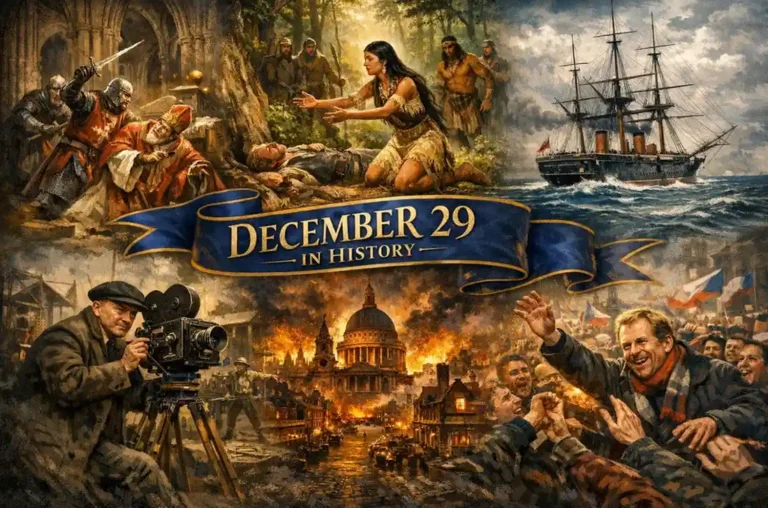
December 28 is a date marked by monumental architectural achievements, the birth of modern entertainment, and pivotal political shifts. From the halls of Westminster to the early screens of Paris, we explore what happened on this day in history December 28—a journey through centuries of human progress and tragedy.
Important Events That Happened On December 28 In History
418: A Papal Election and the Ascent of Pope Boniface I
Following the death of Pope Zosimus, a contentious papal election began in Rome. The process eventually led to the installment of Pope Boniface I, whose reign was marked by efforts to maintain ecclesiastical discipline and restore the rights of the papacy.
457: Majorian Rises as the Western Roman Emperor
In a period of significant instability for Rome, Majorian was acclaimed as the Western Roman Emperor. He would become one of the last emperors to make a concerted effort to restore the fading glory of the empire through military campaigns and legal reforms.
484: The Accession of Alaric II to the Visigoth Throne
Alaric II succeeded his father, Euric, as the King of the Visigoths. Upon taking power, he established his seat of government at Aire-sur-l’Adour in Southern Gaul, governing a kingdom that spanned much of modern-day France and Spain.
893: The Devastating Earthquake of Dvin, Armenia
The ancient Armenian capital of Dvin was struck by a catastrophic earthquake. The disaster resulted in massive loss of life and the near-total destruction of the city’s infrastructure, leaving a lasting scar on the region’s medieval history.
1065: The Consecration of the Original Westminster Abbey
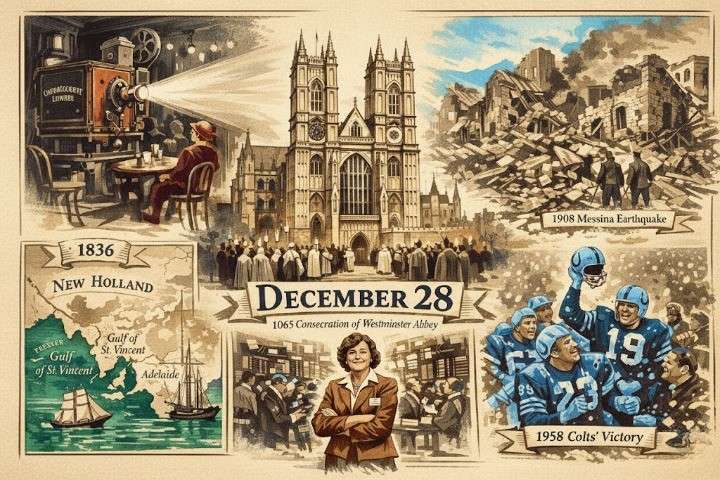
A landmark moment for English architecture and religion occurred as Edward the Confessor’s Romanesque monastic church at Westminster Abbey was officially consecrated. Though Edward was too ill to attend, the abbey would become the site of every British coronation thereafter.
1308: Emperor Hanazono Ascends the Japanese Throne
Emperor Hanazono began his reign during a period of intense rivalry between the Jimyōin-tō and Daikakuji-tō imperial lines. Although real political power rested with the Kamakura shogunate, his reign is remembered for cultural refinement, Buddhist devotion, and contributions to classical Japanese poetry.

1659: The Battle of Kolhapur and the Maratha Triumph
In a significant military clash, the Maratha forces led by Chhatrapati Shivaji Maharaj defeated the Adilshahi troops. This victory at the Battle of Kolhapur further solidified Maratha’s rising influence in the Indian subcontinent.
1768: The Coronation of King Taksin and the New Capital of Thonburi
After reclaiming Thai territory from Burmese occupation, King Taksin the Great was crowned. He moved the capital to Thonburi, establishing a new era for the Siamese kingdom and laying the foundations for modern Thailand.
1795: Laying the Foundation for Toronto’s Yonge Street
In Upper Canada, construction began on Yonge Street. Originally designed as a military route, it was famously recognized for many years as the longest street in the world, serving as a vital artery for the growth of Toronto.
1832: John C. Calhoun’s Historic Resignation from the Vice Presidency
John C. Calhoun became the first Vice President of the United States to resign from office. His departure followed his election to the Senate, where he intended to champion South Carolina’s interests during the Nullification Crisis.
1835: Osceola Ignites the Second Seminole War
Fierce resistance against U.S. expansion began in Florida as the Seminole leader Osceola led his warriors into battle. This marked the start of the Second Seminole War, a long and costly conflict over land and sovereignty.
1836: The Birth of South Australia and Adelaide
The British colony of South Australia was officially proclaimed, and the city of Adelaide was founded. Unlike other Australian colonies, it was established as a planned colony for free settlers rather than a penal settlement.
1836: Spain Grants Sovereignty to Independent Mexico
More than a decade after the fighting ended, Spain finally recognized the independence of Mexico. The formal recognition was solidified through the signing of the Santa María–Calatrava Treaty.
1846: Iowa Joins the Union as the 29th State
Iowa was officially admitted to the United States. Entering as a free state, it played a key role in the shifting political balance of the mid-19th century American frontier.

1879: The Tragic Collapse of the Tay Rail Bridge
Disaster struck in Dundee, Scotland, when the central section of the Tay Rail Bridge collapsed during a violent storm while a train was crossing. The accident resulted in the deaths of all 75 people on board and remains a cautionary tale in civil engineering.
1885: The Founding of the Indian National Congress
In Bombay, a group of 72 delegates met to form the Indian National Congress. This pivotal organization would eventually lead the movement for India’s independence from British rule.
1895: The Dawn of Cinema with the Lumière Brothers
In the basement of the Grand Café in Paris, Auguste and Louis Lumière held the first public demonstration of their Cinématographe. This historic screening of short films marks the official birth of the motion-picture industry.
1895: Wilhelm Röntgen Unveils the Mystery of X-Rays
Science changed forever when Wilhelm Röntgen published his paper detailing the discovery of “X-rays.” His work on this new type of radiation would revolutionize medicine and earn him the first Nobel Prize in Physics.
1902: The Birth of Professional Indoor Football
In a unique sporting milestone, the Syracuse Athletic Club defeated the New York Philadelphians 5–0. The match, held at New York’s Madison Square Garden, was the first professional indoor football game ever played.
1908: The Great Messina Earthquake Devastates Italy
One of the deadliest natural disasters in European history occurred as a 7.1 magnitude earthquake struck Southern Italy. The quake and subsequent tsunami killed approximately 80,000 people and leveled the city of Messina.
1912: San Francisco Launches Its First Municipal Streetcars
San Francisco took a major step in urban transit by debuting its first municipally owned streetcars. This move paved the way for the city’s iconic public transportation network.
1918: Constance Markievicz Makes History in the British Parliament
While imprisoned in Holloway, Irish revolutionary Constance Markievicz became the first woman elected to the British House of Commons. In line with Sinn Féin policy, she did not take her seat, but her election was a landmark for women’s suffrage.
1941: The Commencement of Operation Anthropoid
During the height of World War II, the secret mission to assassinate the high-ranking Nazi official Reinhard Heydrich began. Czechoslovak paratroopers were dropped into occupied territory to carry out the daring plot.
1943: The Forced Deportation of the Kalmyk People
Soviet authorities initiated Operation Ulussy, a brutal ethnic cleansing campaign that saw the mass deportation of the Kalmyk nation to Siberia and Central Asia. Thousands died during the journey and the subsequent exile.
1943: Victory at the Brutal Battle of Ortona
After eight days of intense, house-to-house urban warfare, the 1st Canadian Infantry Division captured the Italian town of Ortona. The hard-fought victory over elite German paratroopers earned the battle the nickname “Little Stalingrad.”
1944: Maurice Richard’s Unprecedented Eight-Point Night
“Rocket” Richard set a stunning NHL record by scoring five goals and three assists in a single game for the Montreal Canadiens. His eight-point performance remains one of the most legendary feats in hockey history.
1948: The Unsolved Disappearance of DC-3 NC16002
A Douglas DC-3 aircraft carrying 32 people vanished without a trace while flying from San Juan, Puerto Rico, to Miami. Despite extensive searches, no wreckage was ever found, adding to the lore of the Bermuda Triangle.
1956: The Baling Talks Seek Peace in Malaya
In an attempt to end the Malayan Emergency, leaders David Marshall and Tunku Abdul Rahman met with communist leader Chin Peng. Although the talks failed to reach a resolution, they were a critical step toward Malayan independence.
1958: The “Greatest Game Ever Played” in NFL History
The Baltimore Colts defeated the New York Giants in a thrilling sudden-death overtime game at Yankee Stadium. This NFL Championship match is credited with skyrocketing the popularity of professional football in the United States.
1967: Muriel Siebert Shatters the Glass Ceiling at the NYSE
Muriel Siebert became the first woman to own a seat on the New York Stock Exchange. Known as the “First Lady of Wall Street,” she overcame immense gender bias to pave the way for women in finance.
1972: The Unintended End of the U.S. Military Draft
Due to a national day of mourning for the late President Harry S. Truman, draft offices were closed on what was supposed to be the final day of induction. Because the draft was not renewed in 1973, those scheduled for induction that day were never drafted.
1973: The Endangered Species Act Becomes Law
In a landmark win for environmental conservation, President Richard Nixon signed the Endangered Species Act into law. The legislation provided a framework for protecting at-risk plants and animals and their habitats in the United States.
1978: The Tragedy of United Airlines Flight 173
A United Airlines flight ran out of fuel and crashed into a Portland neighborhood while the crew was distracted by a landing gear issue. The accident led to revolutionary changes in cockpit communication known as Crew Resource Management.
1989: Newcastle, Australia Struck by a Rare Earthquake
The city of Newcastle in New South Wales was hit by a magnitude 5.6 earthquake. It was one of Australia’s deadliest natural disasters, claiming 13 lives and causing widespread structural damage.
2006: The Capture of Mogadishu by Somali and Ethiopian Forces
The Transitional Federal Government of Somalia, backed by Ethiopian troops, moved into the capital city of Mogadishu unopposed. This marked a major shift in the War in Somalia against the Islamic Courts Union.
2009: Tragedy at Ashura as a Suicide Bomb Hits Karachi
A suicide bomber targeted a Shia Muslim procession during the Day of Ashura in Karachi, Pakistan. The attack killed 43 people and triggered several days of unrest in the city.
2014: The Fatal Plunge of Indonesia AirAsia Flight 8501
En route from Surabaya to Singapore, an AirAsia flight crashed into the Karimata Strait during bad weather. All 162 passengers and crew on board perished in the disaster.
2014: Fire Breaks Out on the MS Norman Atlantic
A fire erupted on the MS Norman Atlantic ferry in the Adriatic Sea. Amidst stormy conditions, a complex rescue operation ensued, but nine people lost their lives and many others went missing.
2019: A Heartbreaking Terror Attack in Mogadishu
A massive truck bomb exploded at a busy security checkpoint in Mogadishu, Somalia. The attack, claimed by Al-Shabaab, killed at least 85 people and injured over 100, marking one of the city’s deadliest incidents.
Read Also: What Happened On This Day In History December 27: Sacred Wonder & Galactic Pulses
Observances & Institutional Dates
- Proclamation Day (South Australia): Commemorating the establishment of the government in 1836.
- King Taksin Memorial Day (Thailand): A day of remembrance for the great king who unified the nation.
- Republic Day (South Sudan): A national holiday celebrating the sovereign state.
- The Fourth Day of Christmas: Part of the traditional Western Christian Twelve Days of Christmas.
Frequently Asked Questions
Who was the first woman to own a seat on the NYSE?
Muriel Siebert became the first woman to own a seat on the New York Stock Exchange on December 28, 1967.
When was the Indian National Congress founded?
It was founded on December 28, 1885, in Bombay (now Mumbai).
What was the “Greatest Game Ever Played”?
It refers to the 1958 NFL Championship game between the Baltimore Colts and the New York Giants, which was the first to use sudden-death overtime.
When did Iowa become a state?
Iowa was admitted to the Union as the 29th state on December 28, 1846.
What was the “Greatest Game Ever Played” on this day?
On December 28, 1958, the Baltimore Colts and New York Giants played the first NFL game to go into sudden-death overtime, changing the future of professional football and sports broadcasting.
Why is December 28 important in the history of cinema?
On December 28, 1895, the Lumière brothers held the first public screening of motion pictures in Paris, marking the birth of the commercial film industry.
What is the history of the Endangered Species Act?
The Endangered Species Act was signed into law by President Richard Nixon on December 28, 1973. It is one of the strongest environmental laws ever created to protect plants and animals from extinction.