Across eras, this date reflects turning points shaped by conflict, leadership, and bold decisions. In tracing what happened on this day in history December 5, each moment shows how societies responded to upheaval and change, leaving a path of ideas, risks, and outcomes that still echo today.
Important Events That Happened On December 5 In History
63 BC — Cicero delivers the fourth Catiline Oration
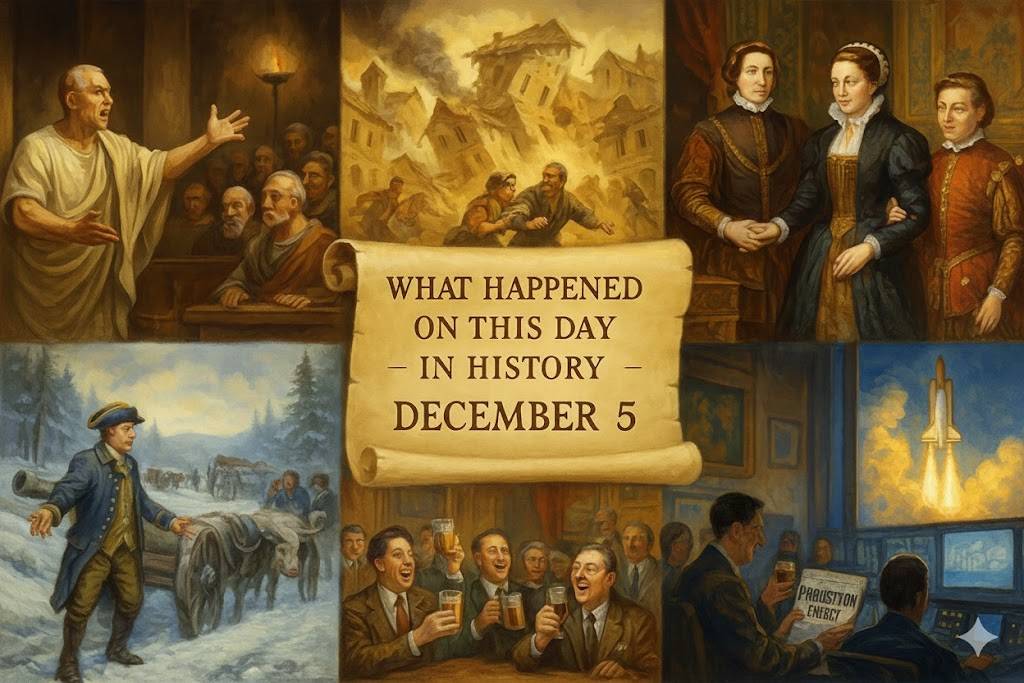
Cicero’s speeches in the Roman Senate exposed the conspiracy of Catiline and rallied senators and public opinion against an alleged plot to overthrow the Republic. The orations helped secure Cicero’s reputation as a defender of the state, but also deepened political divisions that marked the late Republic. These speeches remain central to studies of Roman rhetoric and crisis politics.
633 — Fourth Council of Toledo opens
Presided over by Isidore of Seville, this council was part of a series of Visigothic church synods shaping religious and legal life in Iberia. The Toledo councils reinforced ecclesiastical discipline and codified aspects of church-state relations in the Visigothic kingdom. Isidore’s influence helped transmit classical learning into medieval Spain.
1033 — Jordan Rift Valley earthquake
A major seismic event devastated cities across the Levant and generated tsunamis that compounded the destruction, with large numbers of casualties reported in contemporary sources. The quake had long-lasting social and economic consequences for affected communities. It is one of the larger recorded medieval earthquakes in the eastern Mediterranean.
1082 — Assassination of Ramon Berenguer II, Count of Barcelona
Ramon Berenguer II was killed in circumstances widely believed to involve his brother, Berenguer Ramon II, reshaping succession and regional politics in Catalonia. The murder intensified dynastic rivalry and influenced the region’s feudal alignments for decades. It remains a notorious episode in Catalan medieval history.
1408 — Emir Edigu reaches Moscow (fails to take the city)
Edigu of the Golden Horde invaded to reassert control over Muscovy, burning areas around Moscow but failing to capture the city itself. The raid underlined the vulnerability and resilience of Moscow at the time and shaped later Muscovite military and diplomatic strategies. It was part of the broader contest between Rus’ principalities and steppe powers.
1456 — Major earthquakes in Italy (first of two)
A severe Mw ~7.2 quake struck parts of Italy, causing extreme destruction and an enormous death toll in contemporary records. The disaster deeply affected urban life and prompted long rebuilding efforts and social dislocation in the affected regions. Medieval and early-modern chroniclers treated the event as catastrophic for central Italy.
1484 — Papal bull Summis desiderantes affectibus issued
Pope Innocent VIII authorized inquisitorial action against alleged witchcraft in parts of Germany, empowering Heinrich Kramer and Jacob Sprenger. The bull contributed to intensifying witch-hunting activity in late medieval Europe and fed a literature of demonology and persecution. Its legal and cultural legacy fed later trials and manuals.
1496 — Decree ordering the expulsion of Jews from Portugal
King Manuel I issued an edict ordering the expulsion (or forced conversion) of Jewish communities, part of a broader Iberian pattern of religious homogenization after the Reconquista. The measure disrupted established communities, economies, and cultural life and prompted migrations and conversions with long-term effects across the Atlantic world. It is a painful episode in Iberian religious history.
1560 — Charles IX becomes King of France (aged ten)
At only ten years old Charles IX ascended the French throne, with his mother Catherine de’ Medici acting as regent and guiding policy in a turbulent religious and political environment. His minority intensified factional court politics and the pressures that would contribute to the French Wars of Religion. The accession illustrates dynastic succession and regency politics in early-modern Europe.
1578 — Sir Francis Drake raids Valparaíso after sailing the Strait of Magellan
Returning from the Pacific, Drake struck Spanish shipping and ports such as Valparaíso, disrupting Spain’s Pacific interests and asserting English privateering reach. These raids were part of maritime rivalry that helped shape early global seafaring competition and imperial expansion. Drake’s voyage consolidated his reputation as a bold seafarer and thorn in Spanish imperial plans.
1649 — Foundation of Raahe (Brahestad) in Finland
Count Per Brahe the Younger formally established the town of Raahe during Swedish rule, reflecting northern European patterns of urban founding and mercantile expansion. The town later grew as a local maritime and trading centre on the Bay of Bothnia. Its foundation is part of broader state-driven urban development in the early modern period.
1757 — Battle of Leuthen (Seven Years’ War)
Frederick II (the Great) achieved a decisive victory over Austrian forces, demonstrating Prussian tactical skill and contributing to Prussia’s military prestige. Leuthen forced a rethinking of Austrian strategy and helped secure Prussia’s continued role among European great powers. The battle is often cited for Frederick’s use of oblique order and maneuver.
1766 — First sale by auctioneer James Christie in London
James Christie held his inaugural sale, founding what would become a major international auction house. The event marks a turning point in the commercialization and institutionalization of the art market in Britain. Christie’s sales shaped collecting practices and the professional art trade in the centuries that followed.
1770 — Verdicts in the aftermath of the Boston Massacre
Privates Hugh Montgomery and Matthew Kilroy were found guilty of manslaughter for the deaths of Crispus Attucks and Samuel Gray, underscoring colonial tensions with British troops. The trials and verdicts intensified colonial political debate and fed revolutionary sentiment in the years before American independence. The Boston Massacre remained a powerful symbol in Patriot propaganda.
1775 — Henry Knox begins hauling artillery from Fort Ticonderoga
Knox’s transport of captured cannons to Cambridge was a logistical feat that supplied the Continental Army with heavy guns for the Siege of Boston. The operation highlighted colonial resourcefulness and contributed materially to later American successes during the revolution. It became a celebrated example of early American military improvisation.
1776 — Phi Beta Kappa holds its first meeting
Founded at the College of William & Mary, Phi Beta Kappa established a model for academic honor societies in the United States, promoting scholarship and liberal learning. Its foundation reflects the emergence of collegiate institutions and intellectual networks in the young republic. The society later became a marker of academic distinction.
1831 — John Quincy Adams takes his seat in the House of Representatives
The former president returned to public service as a congressman, using his seat to speak forcefully on issues including slavery and civil liberties. Adams became a prominent anti-slavery voice in the House, illustrating a rare post-presidential political career. His presence there shaped antebellum debates on moral and constitutional questions.
1847 — Jefferson Davis elected to the U.S. Senate
Jefferson Davis’s entry into the Senate marked his growing prominence in American national politics before he later became the Confederacy’s president. His legislative career reflected antebellum sectional tensions and the politics of southern leadership. Davis’s Senate tenure helped build his reputation among Southern elites.
1848 — U.S. President James K. Polk confirms discovery of California gold
Polk’s message to Congress acknowledged large gold finds in California, accelerating migration and economic transformation as the Gold Rush took off. The announcement reshaped westward expansion, labor flows, and the U.S. economy in the 1850s. It also intensified political debates over slavery’s extension into new territories.
1865 — Peru allies with Chile against Spain (Chincha Islands War)
Peru’s alignment with Chile represented regional opposition to Spanish expeditions and a defense of newly independent states’ sovereignty. The conflict reflected lingering imperial ambitions and 19th-century Latin American realignments. It had naval and diplomatic consequences for the Pacific coast nations.
1895 — First concert of the New Haven Symphony Orchestra
The orchestra’s debut added to the growth of organized, institutional music culture in late-19th-century America. Local symphonies played a role in civic identity, cultural life, and professionalizing music in U.S. cities. New Haven’s ensemble later became a sustained presence in Connecticut’s musical scene.
1914 — Imperial Trans-Antarctic Expedition begins
Sir Ernest Shackleton’s ambitious plan to cross Antarctica by land set out, initiating one of the most dramatic survival sagas of early 20th-century exploration. Though the expedition’s ship, Endurance, later became trapped and crushed in sea ice, the voyage transformed narratives of leadership and endurance in polar exploration. The undertaking remains central to exploration history.
1919 — Suppression of the Polonsky conspiracy (Ukrainian War of Independence)
The conspiracy’s suppression reflects the chaotic, multi-sided conflicts that marked the post-World War I period in Eastern Europe. Such actions illustrate the violent reordering of authority during revolutionary and counter-revolutionary struggles. The episode is part of the broader, tragic story of state-building and factional warfare in the region.
1921 — FA bans women’s football in England from league grounds
The Football Association’s decision sidelined women’s football for decades, reflecting gendered assumptions about sport and public space. The ban had long-term effects on the development of the women’s game in England, only being reversed half a century later. It remains a landmark instance of institutional exclusion in sport history.
1933 — Twenty-first Amendment ratified (repeal of U.S. Prohibition)
The repeal ended the national experiment of Prohibition, reshaping American social life, law enforcement, and the economy. Repeal acknowledged the policy’s failures and allowed states to regulate alcohol anew. It marked a potent example of large-scale policy reversal in U.S. history.
1934 — Wal Wal attack (Abyssinia Crisis)
Italian forces attacked the Ethiopian outpost at Wal Wal, escalating tensions that fed Mussolini’s expansionist aims and contributed to the 1935 Italian invasion of Ethiopia. The incident exposed weaknesses in the League of Nations and European diplomacy between the world wars. It was a prelude to wider aggression in East Africa.
1935 — Mary McLeod Bethune founds the National Council of Negro Women
Bethune’s organization promoted leadership, advocacy, and social welfare for African American women, becoming an important civil-rights and community institution. The council linked grassroots activism with national politics and helped cultivate Black female leadership through the 20th century. Its founding is a landmark in U.S. social history.
1936 — Soviet constitution adopted; Kirghiz SSR elevated
The new constitution reorganized Soviet federal arrangements and recognized the Kirghiz SSR as a full Union Republic, part of the USSR’s nationality policy. These changes were both administrative and symbolic, affecting governance and identity in Soviet Central Asia. They reflect the Soviet project of nation-state formation under communist rule.
1941 — Battle of Moscow: Zhukov launches Soviet counter-attack
Georgy Zhukov’s counter-offensive halted the German advance and marked a turning point on the Eastern Front in World War II. The defense and counter-attack preserved Moscow and shifted German operational momentum, shaping the war’s larger trajectory. Moscow’s survival bolstered Soviet morale and international perceptions.
1941 — Great Britain declares war on Finland, Hungary and Romania
Following alignment with Axis aggression, Britain extended formal declarations, reflecting the widening diplomatic and military rifts of World War II. These declarations underscored global diplomatic realignments and the deepening reach of wartime enmities. They were part of a complex matrix of alliances and declarations.
1943 — Allied Operation Crossbow begins attacks on secret weapons sites
Allied air forces targeted V-weapon development facilities (V-1 and V-2 infrastructure) in occupied Europe to disrupt Germany’s strategic rocket program. The campaign combined intelligence, bombing, and deception to limit civilian and military damage from the new weapons. Crossbow foreshadowed strategic efforts to counter emerging technologies.
1945 — Flight 19 disappears in the Bermuda Triangle
A training flight of TBF Avengers vanished over the Atlantic with all crew lost, spawning enduring mystery and popular myths about the so-called Bermuda Triangle. The episode stimulated aviation inquiries into navigation, weather, and training protocols, while also entering popular culture. Official investigations emphasized navigational error and conditions rather than supernatural causes.
1952 — Great Smog of London begins
A cold fog combined with heavy coal smoke to create lethal smog that immobilized the city for days and was later estimated to have caused thousands of premature deaths. The disaster accelerated public awareness of air pollution and led to the Clean Air Act in the UK. It remains a key case in environmental health and urban policy.
1955 — AFL and CIO merge to form the AFL–CIO
The unification of the two major American labour federations created a single, more powerful voice for organized labour and reshaped mid-20th-century labour politics in the United States. The merger consolidated resources, coordinated bargaining and political lobbying, and symbolized a new phase in union influence. It affected labour’s role in postwar policy debates.
1955 — Montgomery Bus Boycott led by E. D. Nixon and Rosa Parks
Rosa Parks’ arrest and the ensuing boycott, organized by civic leaders including E. D. Nixon, became a landmark moment in the U.S. Civil Rights Movement. The sustained boycott applied economic and moral pressure that ultimately led to desegregation of Montgomery’s buses and energized national activism. It showcased grassroots organizing and legal strategy in civil-rights campaigns.
1958 — Subscriber Trunk Dialling (STD) inaugurated in the UK
Queen Elizabeth II made a ceremonial call inaugurating direct long-distance telephone dialing between cities, modernizing telecommunications and reducing reliance on operators. STD revolutionized public communication and helped accelerate business and personal connectivity across Britain. It was a milestone in postwar technological modernization.
1958 — Preston By-pass opens (first UK motorway stretch)
The opening of the Preston By-pass marked the start of Britain’s motorway era, altering transport patterns, commerce, and the built environment. The roadway would become part of the M6 and M55, reflecting postwar investment in road infrastructure and mobility. Motorways reshaped regional economies and travel habits.
1964 — Captain Roger Donlon awarded first Vietnam War Medal of Honor
Roger Donlon received the first Medal of Honor of the conflict for heroic actions, symbolizing early U.S. ground involvement and valor narratives in Vietnam. The award highlighted individual sacrifice amid mounting political controversy about the war. It exemplified military recognition during a protracted and divisive conflict.
1964 — Lloyd J. Old links MHC and disease (mouse leukemia)
Old’s discovery opened the path to understanding how major histocompatibility complex (MHC) genes influence immune response and disease susceptibility. This work became foundational for transplant biology, immunology, and cancer research. The finding helped frame decades of biomedical advances around genetic control of immunity.
1971 — Battle of Gazipur (Bangladesh Liberation War)
Pakistani forces suffered defeat as Indian and allied Bangladeshi units advanced, contributing to the collapse of Pakistani positions in the region. The wider campaign led to Bangladesh’s independence and major geopolitical reconfiguration in South Asia. The fighting at Gazipur reflected broader liberation struggles and regional intervention.
1977 — Egypt severs diplomatic relations with several Arab states
President Anwar el-Sadat’s outreach to Israel and independent diplomacy prompted Syria, Libya, Algeria, Iraq and South Yemen to break ties, reflecting sharp intra-Arab divisions over peace negotiations. The rupture highlighted shifting regional alliances and the political costs of bilateral peacemaking. It foreshadowed the diplomatic realignments of the Camp David era.
1983 — Dissolution of Argentina’s Military Junta
After years of authoritarian rule and economic crisis, the military regime disintegrated as Argentina transitioned back toward civilian democratic governance. The junta’s fall followed military defeat, human-rights scandals, and popular pressure, reshaping national politics. The transition began a fraught process of truth-seeking and institutional reform.
1991 — Leonid Kravchuk elected first President of independent Ukraine
Kravchuk’s election marked Ukraine’s move from Soviet republic toward sovereign statehood amid the USSR’s dissolution. The vote set in motion a new national trajectory, with complex economic and political transitions ahead. His presidency embodied early post-Soviet leadership challenges.
1994 — Budapest Memorandum signed (security assurances for Ukraine)
The memorandum provided security assurances to Ukraine in exchange for relinquishing nuclear weapons, a major diplomatic settlement after the Soviet collapse. The agreement involved the U.S., UK, and Russia and framed non-proliferation and sovereignty commitments that later became politically contested. It remains a reference point in debates about security guarantees.
1995 — Sri Lankan government announces conquest of Jaffna
Government forces’ retaking of Jaffna represented a major military and symbolic moment in the island’s civil war, affecting civilian life and the insurgency’s trajectory. The operation reshaped conflict dynamics and humanitarian conditions in the region. Jaffna’s fall had long repercussions for reconciliation and displacement.
1995 — Azerbaijan Airlines Flight A-56 crash near Nakhchivan
A serious aviation accident killed 52 people near Nakhchivan, underscoring ongoing safety and operational challenges in regional air travel. The crash prompted investigations and discussions on airline oversight and flight safety standards in the post-Soviet space. It remains one of Azerbaijan’s aviation tragedies.
2001 — Space Shuttle Endeavour launches STS-108 to the ISS
The mission carried Expedition 4 crew and supplies, supporting ongoing assembly and operation of the International Space Station. STS-108 exemplified international cooperation in low-Earth orbit and routine logistics that sustain long-duration missions. The flight was part of NASA’s sustained shuttle support for the ISS.
2005 — Civil Partnership Act takes effect in the UK
The Act allowed same-sex couples to register civil partnerships, granting legal recognition and many rights of marriage and marking a major advance in LGBT legal equality in Britain. The first registrations that day established new civil status options and influenced later debates and reforms on marriage equality. It was a landmark in social and legal change.
2005 — Lake Tanganyika earthquake (6.8 Mw)
A powerful quake shook the eastern DRC provinces, causing fatalities and severe local damage with high Mercalli intensities reported. The event highlighted tectonic activity in the African Rift system and challenged regional emergency response capacities. It added to ongoing concerns about seismic risk in the region.
2006 — Commodore Frank Bainimarama overthrows Fiji’s government
Bainimarama’s coup ousted the elected government, reflecting long-running tensions over ethnicity, governance and military intervention in Fiji. The coup produced international condemnation and prompted a period of political instability and eventual constitutional change. It illustrates persistent strains in post-colonial governance arrangements.
2007 — Westroads Mall shooting in Omaha, Nebraska
A gunman killed nine people and then himself at a department store, producing shock and local mourning while raising questions about gun access, workplace violence, and prevention. The attack prompted changes in mall security practices and community responses to mass shootings. It remains a painful moment in Omaha’s recent history.
2013 — Attack on Defense Ministry compound in Sana’a, Yemen
Militants struck a major government facility, killing scores and injuring many, as Yemen grappled with insurgency, political fragmentation, and regional spillovers. The attack deepened security crises and complicated diplomatic and humanitarian responses in an already fragile state. It forms part of Yemen’s ongoing instability since 2011.
2014 — Orion Exploration Flight Test-1 launches (EFT-1)
NASA’s Orion capsule successfully undertook its first flight test, assessing heat-shield performance and re-entry systems for future deep-space missions. EFT-1 marked a technical milestone for human exploration beyond low-Earth orbit and validated critical spacecraft systems. The test advanced plans for crewed lunar and deep-space missions.
2017 — IOC bans Russia from 2018 Winter Olympics (doping scandal)
Following investigations into state-sponsored doping, the International Olympic Committee barred the Russian team from competing under its flag while allowing certain athletes to compete as neutrals. The decision aimed to uphold anti-doping standards and penalize institutional violations, provoking debate about collective punishments and athlete rights. It had major sporting and diplomatic repercussions.
See what happened on December 4
Famous People Born On December 5
| Name | Role / Short Description | Dates |
|---|---|---|
| Otto Preminger | Filmmaker/director | Dec 5, 1905 – Apr 23, 1986 |
| Christina Rossetti | English poet | Dec 5, 1830 – Dec 29, 1894 |
| José Carreras | Operatic tenor | Dec 5, 1946 – |
| Lin Biao | Chinese military leader | Dec 5, 1907 – Sep 13, 1971? |
| Sheikh Muhammad Abdullah | Kashmiri political leader | Dec 5, 1905 – Sep 8, 1982 |
| Anastasio Somoza Debayle | President of Nicaragua | Dec 5, 1925 – Sep 17, 1980 |
| Arnold Sommerfeld | Physicist | Dec 5, 1868 – Apr 26, 1951 |
| Sir Arthur W. Currie | Canadian general | Dec 5, 1875 – Nov 30, 1933 |
| Aleksandr Rodchenko | Russian artist (Constructivist) | Dec 5, 1891 – Dec 3, 1956 |
| John R. Jellicoe, 1st Earl Jellicoe | British admiral | Dec 5, 1859 – Nov 20, 1935 |
| Anjali Bhagwat | Indian rifle shooter | Dec 5, 1969 – |
| Sheldon Glashow | Theoretical physicist (Nobel) | Dec 5, 1932 – |
| Jianwen (Ming emperor) | Emperor of Ming dynasty | Dec 5, 1377 – Jul 13, 1402? |
| Bill Pickett | Rodeo cowboy (bulldogging) | Dec 5, 1870? – Apr 2, 1932 |
| Emeric Pressburger | Screenwriter & producer | Dec 5, 1902 – Feb 5, 1988 |
| Robert Sobukwe | South African nationalist leader | Dec 5, 1924 – Feb 27, 1978 |
| Lina Bo Bardi | Architect & designer | Dec 5, 1914 – Mar 29, 1992 |
| Grace Moore | Singer & actress | Dec 5, 1898 – Jan 26, 1947 |
| Henri Oreiller | Olympic skier / racer | Dec 5, 1925 – Oct 7, 1962 |
| Clyde V. Cessna | Aviator & aircraft manufacturer | Dec 5, 1879 – Nov 20, 1954 |
| Paul Painlevé | Mathematician & prime minister | Dec 5, 1863 – Oct 29, 1933 |
| Jugderdemidiin Gurragcha | Mongolian cosmonaut | Dec 5, 1947 – |
| Faustus Socinus | Theologian (Socinian) | Dec 5, 1539 – Mar 3, 1604 |
| Vítězslav Novák | Czech composer | Dec 5, 1870 – Jul 18, 1949 |
| Nunnally Johnson | Screenwriter & producer | Dec 5, 1897 – Mar 25, 1977 |
| C. F. Powell | Physicist (Nobel) | Dec 5, 1903 – Aug 9, 1969 |
| Marcus Daly | Industrialist (“Copper King”) | Dec 5, 1841 – Nov 12, 1900 |
| Alice Brown | Novelist & short-story writer | Dec 5, 1856 – Jun 21, 1948 |
| Jack Conroy | American author (proletarian lit.) | Dec 5, 1899 – Feb 28, 1990 |
| Luc Jacquet | Documentary filmmaker | Dec 5, 1967 – |
Famous People Died On December 5
| Name | Role / Short Description | Dates |
|---|---|---|
| Alexandre Dumas, père | French author | Jul 24, 1802 – Dec 5, 1870 |
| Nicolaus Steno | Geologist & anatomist | Jan 11, 1638 – Dec 5, 1686 |
| Amrita Sher-Gil | Painter (Indian modernist) | Jan 30, 1913 – Dec 5, 1941 |
| Robert Aldrich | Film director | Aug 9, 1918 – Dec 5, 1983 |
| Sonia Delaunay | Painter & textile designer | Nov 14, 1885 – Dec 5, 1979 |
| Colin Wilson | English author & philosopher | Jun 26, 1931 – Dec 5, 2013 |
| U Ne Win | Burmese general & dictator | May 24, 1911 – Dec 5, 2002 |
| Sir R. A. Watson-Watt | Physicist (radar pioneer) | Apr 13, 1892 – Dec 5, 1973 |
| Kenny Dorham | Jazz trumpeter | Aug 30, 1924 – Dec 5, 1972 |
| Cosmo Gordon Lang | Archbishop of Canterbury | Oct 31, 1864 – Dec 5, 1945 |
| Aleksey II | Patriarch of Moscow | Feb 23, 1929 – Dec 5, 2008 |
| Vachel Lindsay | American poet | Nov 10, 1879 – Dec 5, 1931 |
| Władysław Reymont | Polish novelist (Nobel) | May 7, 1867 – Dec 5, 1925 |
| Maurice Barrès | French author & politician | Aug 19, 1862 – Dec 5, 1923 |
| Pierre Gaultier de Varennes, La Vérendrye | Explorer | Nov 17, 1685 – Dec 5, 1749 |
| Hāshim al-ʿAtāsī | President of Syria | 1875 – Dec 5, 1960 |
| Giovanni B. Morgagni | Anatomist & pathologist | Feb 25, 1682 – Dec 5, 1771 |
| Ramon Berenguer II | Count of Barcelona | c.1053 – Dec 5, 1082 |
| Gaspard Bauhin | Botanist & physician | Jan 17, 1560 – Dec 5, 1624 |
| Joseph Erlanger | Physiologist (Nobel) | Jan 5, 1874 – Dec 5, 1965 |
| Walter Dorwin Teague | Industrial designer | Dec 18, 1883 – Dec 5, 1960 |
| Sir Roy Welensky | Rhodesian statesman | Jan 20, 1907 – Dec 5, 1991 |
| Hans Richter | Conductor | Apr 4, 1843 – Dec 5, 1916 |
| Friedrich Dahlmann | Historian & politician | May 13, 1785 – Dec 5, 1860 |
| Thomas Pringle | Poet & abolitionist | Jan 5, 1789 – Dec 5, 1834 |
| Marie-Anne de la Trémoille | French noble & courtier | 1642 – Dec 5, 1722 |
| Seymour Lipton | Sculptor | Nov 6, 1903 – Dec 5, 1986 |
| Emil W. Haury | Archaeologist & anthropologist | May 2, 1904 – Dec 5, 1992 |
| Teodor Parnicki | Polish novelist | Mar 5, 1908 – Dec 5, 1988 |
| Alexandre Trauner | Set designer | Aug 3, 1906 – Dec 5, 1993 |
Observances & Institutional Dates — December 5
Klozum (Schiermonnikoog, Netherlands)
A local festival on the island of Schiermonnikoog, Klozum involves masquerade, music and community gatherings marking winter traditions and island identity. It is an example of regional folk customs that sustain local culture.
Children’s Day (Suriname)
A national observance focusing on children’s welfare, education and rights, often marked with school activities and public events to highlight youth issues. It reflects state and civic attention to childhood development.
International Volunteer Day for Economic and Social Development
A United Nations day recognising volunteer contributions to development goals, encouraging governments and organisations to support volunteer activity and civic engagement. Events worldwide showcase volunteer achievements and mobilise resources.
The King Bhumibol Adulyadej Memorial Birthday (Thailand)
A commemorative day honoring the late King Bhumibol, observed with memorial services, national reflection and ceremonial events remembering his long reign and public service. It functions as a moment of national remembrance.
Discovery Day (Haiti and Dominican Republic)
A shared commemoration of Christopher Columbus’s 1492 arrival in Hispaniola, observed differently across the two nations and often reframed in modern discussion about colonial legacies. The day prompts historical reflection and varied public rituals.
Krampusnacht (Austria)
A traditional Alpine festival night where the folkloric figure Krampus appears in processions to scare misbehaving children, mixing pagan and Christian seasonal customs and lively public spectacle. It remains a popular cultural event in parts of Central Europe.
World Soil Day
A UN observance promoting soil health, sustainable land use and awareness of soils’ role in food security and climate resilience. The day highlights scientific, policy and community action to protect vulnerable soils.
Day of Military Honour — Battle of Moscow (Russia)
A commemorative observance remembering the defense of Moscow in 1941 and honoring veterans and the military sacrifices that repelled the German advance. It forms part of national memory rituals connected to the Great Patriotic War.
Frequently Asked Questions
What were the Catiline Orations and why do they matter?
Cicero’s Catiline Orations were a series of Senate speeches exposing a conspiracy against the Roman Republic; they shaped Republican politics and remain key texts for rhetoric and crisis governance.
How did the Great Smog change public policy?
The 1952 smog produced thousands of deaths and pushed the UK to enact the Clean Air Act, transforming regulation of urban air pollution and heating practices.
Why is Flight 19 still talked about?
Flight 19 vanished during a routine training flight in 1945; its unexplained loss, coupled with later wreckage and mismatched evidence, fed myths about the Bermuda Triangle even as official explanations favor navigational and environmental factors.
What is the significance of the Civil Partnership Act (UK, 2005)?
The Act legally recognised same-sex partnerships, granting many rights of marriage and marking a major step in British LGBT equality—preceding later legalization of same-sex marriage.
Which space missions on December 4 helped exploration?
Notable launches linked to this date include Shuttle and Orion test flights and routine ISS missions—each advancing human and robotic capabilities in orbit and beyond.