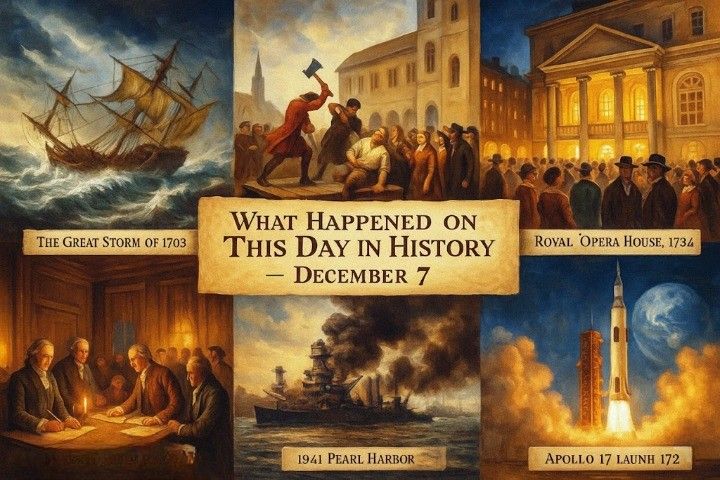
December 7 gathers moments of conflict, power shifts, and human resolve across centuries. What happened on this day in history December 7 sits within stories of assassinations, imperial transitions, and regional struggles that shaped how leaders ruled and how societies endured change.
Important Events That Happened On December 7 In History
43 BC — Assassination of Cicero
Marcus Tullius Cicero, one of Rome’s most influential orators and statesmen, is killed near Formia on the orders of Marcus Antonius. His death marks a decisive moment in the bitter power struggle that followed Julius Caesar’s assassination. Cicero’s attempts to defend the Republic and challenge Antony made him a direct target. His execution became a symbol of the Republic’s final collapse.
574 — Justin II Adopts Tiberius as Caesar
Facing recurring bouts of mental instability, Byzantine Emperor Justin II formally adopts his trusted general Tiberius. By naming him Caesar, Justin II effectively transfers imperial authority to ensure continuity of rule. The move stabilizes the empire during a period of internal pressure and external threats. It also prepares the way for Tiberius’s later reign as emperor.
927 — Defeat of Yusuf ibn Abi’l-Saj Near Kufa
Yusuf ibn Abi’l-Saj, the Sajid emir of Adharbayjan, is defeated and captured by Qarmatian forces near Kufa. His capture weakens Sajid power in the region and strengthens Qarmatian influence across parts of Iraq. The confrontation reflects the shifting alliances and rivalries shaping the eastern Islamic world at the time. It also marks a turning point in regional control and political authority.
1703 — The Great Storm of 1703
The fiercest windstorm recorded in southern Great Britain batters coasts and countryside, with gusts reported up to 120 mph. Shipping losses, collapsed buildings and flooded towns leave enormous destruction in its wake. Contemporary accounts estimate thousands of lives lost and widespread economic ruin; the storm became a landmark catastrophe in British climate history.
1724 — Tumult of Thorn: executions after religious unrest
Religious tensions in Thorn (Toruń) erupt into violence and a harsh official response. After disturbances between Catholic authorities and Protestant townspeople, nine Protestant citizens and the mayor are executed. The incident deepened confessional divisions in the region and is remembered as a grim episode of early-modern sectarian repression.
1732 — Royal Opera House opens at Covent Garden
The new theatre at Covent Garden begins life as a centre for music, dance and drama in London. Its opening marks a durable addition to Britain’s cultural institutions and the growth of public performance in the 18th century. Over time the house becomes home to opera companies, ballet companies and countless premieres.
1776 — Lafayette enters American service as major general
The young French aristocrat Gilbert du Motier, Marquis de Lafayette, volunteers to join the American revolutionary cause and receives a commission as major general. His arrival brings both military enthusiasm and important diplomatic ties between France and the American rebels. Lafayette’s subsequent role as a bridge between the two revolutions preserved his reputation as a symbol of liberal internationalism.
1787 — Delaware ratifies the U.S. Constitution (first state)
Delaware’s legislature becomes the first to ratify the newly drafted Constitution, setting a precedent for other states. That act seals Delaware’s place in the founding sequence and provides momentum toward the Constitution’s wider adoption. The quick ratification highlights the urgency among smaller states to secure representation under the new federal compact.
1837 — Battle of Montgomery’s Tavern (Upper Canada Rebellion)
Rebels who challenged colonial rule in Upper Canada are routed at Montgomery’s Tavern near Toronto by government forces. The defeat effectively ends the short-lived uprising but the underlying grievances about land, power and representation remain influential. In the longer term the rebellion feeds into debates that lead to constitutional reform in British North America.
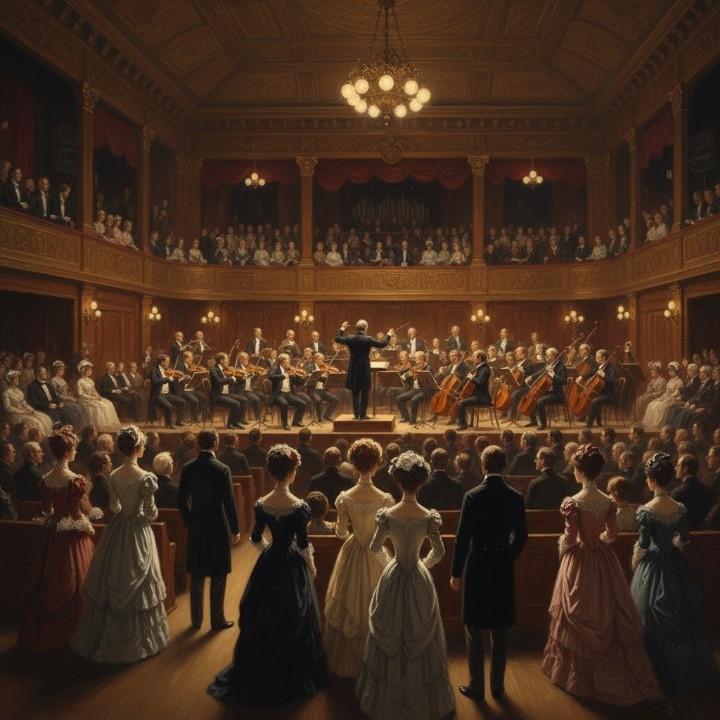
1842 — First concert of the New York Philharmonic
A new civic orchestra gives its inaugural public concert, founding what will become one of America’s leading symphonic institutions. The ensemble’s birth reflects New York’s growing cultural ambitions in the antebellum era. Over the following decades the Philharmonic helps professionalize orchestral life in the United States.
1904 — HMS Spiteful vs HMS Peterel fuel trials
Trials comparing oil-fired and coal-fired warships begin; HMS Spiteful operates solely on fuel oil, marking a major shift in naval engineering. Results hasten the Royal Navy’s transition away from coal and reshape global naval logistics and strategy. The tests presage the rapid modernization of twentieth-century fleets.
1917 — United States declares war on Austria-Hungary
In the wider sweep of World War I diplomacy and warfare, the U.S. extends its state of belligerency by declaring war on Austria-Hungary. This formal step aligns American policy with the Entente powers and further integrates U.S. forces and resources into the European conflict. The declaration underscores how the war’s diplomatic map was reshaped during 1917–18.
1922 — Northern Ireland votes to remain part of the United Kingdom
The Parliament of Northern Ireland affirms its decision not to join the newly independent Southern Ireland. That vote cements partition as the political reality on the island and frames decades of contested governance and identity. The outcome shapes the constitutional status of Northern Ireland for generations.
1930 — First U.S. television telecast (W1XAV Boston) and first TV ad
A Boston telecast transmits the CBS radio orchestra’s program to early television viewers and includes what is recorded as the first U.S. television advertisement. The broadcast represents an important technical and commercial milestone in the emergence of television as a mass medium. It foreshadows the medium’s rapid cultural and economic expansion.
1932 — Albert Einstein granted an American visa
Einstein, already an eminent physicist and public intellectual, receives permission to enter the United States. His arrival strengthens transatlantic scientific ties and contributes to the intellectual migration of European thinkers in the 1930s. Einstein’s presence also amplifies public discussion about science, politics and pacifism.
1936 — Jack Fingleton scores centuries in four consecutive Tests
Australian cricketer Jack Fingleton achieves a rare batting feat by scoring centuries in four straight Test innings. The string of performances cements his reputation as one of Australia’s leading batsmen of the era. It remains a noteworthy statistical landmark in cricket history.
1941 — Japanese attack on Pearl Harbor; U.S. enters World War II
A surprise aerial assault on the U.S. Pacific Fleet at Pearl Harbor, Oahu, kills thousands and destroys ships and aircraft, precipitating America’s formal entry into WWII. The strike transforms global strategy, mobilizes U.S. industry and alters the course of the conflict across the Pacific and Europe. December 7 becomes both a date of national mourning and a turning point in twentieth-century history.
1941 — Night and Fog Decree issued by Adolf Hitler
The regime issues a secret order authorizing detention and disappearance of persons deemed threats to German security. The decree institutionalizes terror tactics used against resistance and occupied populations and presages darker phases of repression. Its secretive nature and brutal consequences are characteristic of the escalating wartime crimes.
1942 — Operation Frankton: British commando raid on Bordeaux shipping
Royal Marines and canoe teams carry out a daring raid against German cargo ships in Bordeaux harbour, aiming to disrupt supply lines to U-boats. Though costly, the raid demonstrates bold special-operations tactics and becomes legendary for its courage. Operation Frankton helps shape later commando doctrine.
1944 — Wakayama earthquake and tsunami in Japan
A coastal earthquake off Wakayama Prefecture generates a tsunami that kills more than a thousand people and devastates communities. The disaster highlights seismic risks for Japan’s coastal settlements and the recurring human cost of tsunamis. Post-event relief and reconstruction underscore long-term resilience challenges.
1946 — Winecoff Hotel fire in Atlanta, Georgia
A catastrophic hotel blaze kills 119 people and becomes the deadliest single-structure hotel fire in U.S. history. The scale of the tragedy prompts changes in fire codes, emergency procedures and building safety standards. Memories of the victims spur reforms intended to prevent similar losses.
1949 — ROC government relocates from Nanjing to Taipei, Taiwan
Following military defeat on the mainland, the Republic of China government transfers its seat to Taipei, reorganizing its institutions and political life in exile. The move lays the foundation for Taiwan’s separate political development and the long-running cross-strait dispute. It also marks a major episode in the Chinese Civil War’s aftermath.
1962 — Monaco constitutional revision under Prince Rainier III
Prince Rainier III revises Monaco’s constitution, transferring some authority to representative bodies and modernizing governance. The reform rebalances monarchic authority and consultative institutions in the tiny principality. It reflects broader twentieth-century trends toward constitutional modernization in microstates.
1963 — Instant replay debuts at the Army–Navy game
Television broadcasters introduce instant replay during the annual Army–Navy football game, changing how viewers experience live sport. The innovation reshapes sports broadcasting, officiating and fan discussion by enabling immediate review and repeated viewing of key plays. Instant replay soon becomes a ubiquitous feature of televised sport.
1965 — Revocation of mutual excommunications between Rome and Constantinople
Pope Paul VI and Ecumenical Patriarch Athenagoras I lift the mutual excommunications that had existed since the Great Schism of 1054. The joint act marks a symbolic step toward reconciliation between the Roman Catholic and Eastern Orthodox churches. While doctrinal divisions remain, the gesture opens channels for sustained ecumenical dialogue.
1971 — Battle of Sylhet (Indo-Pakistani War)
Indian forces engage Pakistani troops at Sylhet during the 1971 war that leads to Bangladesh’s independence. The battle is one among several that reshape South Asian geopolitics and accelerate the collapse of Pakistani control in the eastern theatre. Military outcomes on the ground have enduring regional consequences.
1971 — Pakistan’s coalition government formed under Yahya Khan
In a fraught political environment following the 1970 elections and rising unrest, President Yahya Khan announces a coalition government with Nurul Amin and Zulfikar Ali Bhutto in leadership roles. The arrangement aims to manage political fragmentation but cannot halt the escalating crisis in East Pakistan. The episode precedes the catastrophic breakup of Pakistan later that year.
1972 — Apollo 17 launches, final Apollo Moon mission (Blue Marble photo)
Apollo 17 lifts off on the last crewed mission to the Moon; its crew returns iconic photography of Earth, including the famous “Blue Marble.” The mission concludes NASA’s Apollo era of lunar exploration and leaves a lasting visual legacy of Earth as a fragile, whole planet. Apollo 17 also gathers geological samples that broaden lunar science.
1982 — First U.S. lethal injection execution (Charles Brooks Jr.)
Texas carries out the nation’s first execution by lethal injection, inaugurating a method that will be adopted by many U.S. states. The case sparks legal and ethical debates about methods of capital punishment and their humaneness. Subsequent years see continuing controversy over death-penalty practices.
1982 — Senior Road Tower collapse (industrial accident)
A tower collapse kills five workers and injures others in a sudden structural failure. The incident raises attention to workplace safety standards and emergency response planning. Investigations focus on construction practices and the enforcement of occupational safeguards.
1983 — Madrid runway collision kills 93
Taxiing aircraft in dense fog collide at Madrid–Barajas Airport, producing a deadly runway accident. The crash highlights hazards of low-visibility operations and prompts renewed emphasis on ground control procedures and safety protocols. Aviation authorities review training and equipment to reduce similar risks.
1987 — Pacific Southwest Airlines Flight 1771 suicide-attack crash
After a passenger shoots both pilots and takes control of the aircraft, the plane crashes, killing all on board. The atrocity intensifies concern about airline security and the protection of flight decks. The tragedy leads to strengthened passenger screening and cockpit-locking measures.
1988 — Armenian earthquake (6.8 Ms)
A powerful earthquake devastates northern Armenia, producing tens of thousands of casualties and widespread destruction. The disaster reveals vulnerabilities in building stock and emergency preparedness across the region. International and domestic rescue efforts follow, and reconstruction becomes a long-term challenge.
1993 — Long Island Rail Road shooting by Colin Ferguson
A gunman opens fire on a commuter train, killing six and wounding many more in a shocking act of mass violence. The attack provokes debate over gun control, mental-health services and security on public transport. Survivors’ stories and legal proceedings keep the incident in public memory.
1995 — Galileo arrives at Jupiter
NASA’s Galileo spacecraft reaches Jupiter after a long interplanetary voyage, beginning an extended study of the planet and its moons. The mission yields highly significant data about Jovian atmospheres, magnetospheres and satellite geology. Galileo’s findings reshape understanding of gas-giant systems.
1995 — Khabarovsk United Air Group Flight 3949 crash
A passenger aircraft crashes into mountainous terrain, killing 98 people and prompting investigations into flight operations and safety oversight. The accident underscores the risks of regional aviation in difficult topography and weather. Responses focus on improving navigation aids and crew training.
1995 — Air Saint Martin crash near Belle Anse, Haiti
A commuter aircraft crashes, killing twenty people and adding to global concerns about regional air safety and maintenance standards. The disaster highlights the precarious safety environment for small carriers in developing regions. Authorities pursue inquiries into aircraft condition and operational procedures.
2003 — Conservative Party of Canada officially registered
Following a merger of two parties, a consolidated Conservative Party is created and registered, reshaping Canadian political alignment on the centre-right. The reorganization alters party competition and contributes to subsequent electoral realignments. The new party becomes a major actor in federal politics.
2005 — Rigoberto Alpizar shot by federal air marshals at Miami airport
After allegedly claiming to have a bomb, a passenger is fatally shot by an air marshal team during a security response at Miami International Airport. The incident stimulates debate over threat assessment, rules of engagement and the use of lethal force in aviation security. It remains a contested case in post-9/11 security policy.
2015 — JAXA’s Akatsuki enters orbit around Venus successfully
Japan’s Akatsuki probe achieves orbit insertion at Venus after a five-year odyssey, marking a major technical and scientific success for JAXA. The mission studies Venusian climate, atmospheric dynamics and cloud chemistry, filling gaps in comparative planetology. Akatsuki’s recovery from earlier failure is celebrated as an engineering triumph.
2016 — Pakistan International Airlines Flight 661 crashes near Havelian
A domestic ATR-42 flight crashes in northern Pakistan, killing all 47 aboard and triggering investigations into maintenance, operations and crash causes. The loss is felt widely and renews scrutiny of regional airline safety practices. Authorities and industry partners examine record-keeping and regulatory oversight.
2017 — Aztec High School shooting
A former student carries out a shooting at his old high school, killing two people and prompting renewed grief and calls for improved school safety measures. The tragedy echoes broader patterns of school violence and the policy debates surrounding prevention, mental health and security. Communities rally to support victims and families.
2024 — Battle of Damascus (2024): opposition forces advance near capital
Reports indicate Syrian opposition formations push into the Rif Dimashq Governorate, approaching within 20 km of Damascus. The development represents a dramatic escalation in the long Syrian conflict and risks major humanitarian and security consequences. Observers watch for wider regional and international responses to a potential change in the war’s dynamics.
Missed the earlier dates? See what happened on December 6
Famous People Born On December 7
| Name | Role / Short Description | Dates |
|---|---|---|
| Gian Lorenzo Bernini | Italian sculptor & architect | Dec 7, 1598 – Nov 28, 1680 |
| Theodor Schwann | German physiologist (cell theory) | Dec 7, 1810 – Jan 11, 1882 |
| Leopold Kronecker | German mathematician | Dec 7, 1823 – Dec 29, 1891 |
| Willa Cather | American novelist | Dec 7, 1873 – Apr 24, 1947 |
| Pietro Mascagni | Italian composer (opera) | Dec 7, 1863 – Aug 2, 1945 |
| Rudolf Friml | Composer (operetta & film) | Dec 7, 1879 – Nov 12, 1972 |
| Gerard P. Kuiper | Dutch-American astronomer | Dec 7, 1905 – Dec 23, 1973 |
| Joyce Cary | British novelist | Dec 7, 1888 – Mar 29, 1957 |
| Stuart Davis | American modernist painter | Dec 7, 1894 – Jun 24, 1964 |
| Eli Wallach | American actor | Dec 7, 1915 – Jun 24, 2014 |
| Louis Prima | American musician & bandleader | Dec 7, 1910 – Aug 24, 1978 |
| Mário Soares | President & statesman (Portugal) | Dec 7, 1924 – Jan 7, 2017 |
| Noam Chomsky | American linguist & intellectual | Dec 7, 1928 – |
| Larry Bird | American basketball player & coach | Dec 7, 1956 – |
| Tom Waits | American singer-songwriter & actor | Dec 7, 1949 – |
| Sara Bareilles | American singer-songwriter | Dec 7, 1979 – |
| Jeffrey Wright | American actor | Dec 7, 1965 – |
| Johnny Bench | American baseball Hall-of-Famer | Dec 7, 1947 – |
| Hanyu Yuzuru | Japanese figure skater | Dec 7, 1994 – |
| Pete Alonso | American baseball player | Dec 7, 1994 – |
| Nathan Adrian | American Olympic swimmer | Dec 7, 1988 – |
| Peretz Markish | Yiddish poet & writer | Dec 7, 1895 – Aug 12, 1952 |
| Joseph Cook | Prime Minister of Australia | Dec 7, 1860 – Jul 30, 1947 |
| Allan Cunningham | Scottish poet & antiquarian | Dec 7, 1784 – Oct 30, 1842 |
| Nicodemus Tessin, the Elder | Swedish architect | Dec 7, 1615 – May 24, 1681 |
| Abigail Hopper Gibbons | Social reformer (prison reform) | Dec 7, 1801 – Jan 16, 1893 |
| Henry Stewart, Lord Darnley | Scottish noble (Mary, Queen of Scots’ husband) | Dec 7, 1545 – Feb 9/10, 1567 |
| Gian Lorenzo Bernini | Italian sculptor & architect (duplicate) | Dec 7, 1598 – Nov 28, 1680 |
| Leopold Kronecker | German mathematician (duplicate) | Dec 7, 1823 – Dec 29, 1891 |
| Peretz Markish | Yiddish poet & writer (duplicate) | Dec 7, 1895 – Aug 12, 1952 |
Famous People Died On December 7
| Name | Role / Short Description | Dates |
|---|---|---|
| Rube Goldberg | American cartoonist & satirist | Jul 4, 1883 – Dec 7, 1970 |
| William Bligh | English naval officer (HMS Bounty) | Sep 9, 1754 – Dec 7, 1817 |
| Thornton Wilder | American playwright & novelist | Apr 17, 1897 – Dec 7, 1975 |
| Elizabeth Edwards | American attorney & author | Jul 3, 1949 – Dec 7, 2010 |
| Joan Bennett | American actress | Feb 27, 1910 – Dec 7, 1990 |
| Potter Stewart | U.S. Supreme Court Justice | Jan 23, 1915 – Dec 7, 1985 |
| Ferdinand de Lesseps | French diplomat & Suez Canal builder | Nov 19, 1805 – Dec 7, 1894 |
| Pope Innocent IV | Pope (Avignon/medieval) | – Dec 7, 1254 |
| Jeane Kirkpatrick | Political scientist & diplomat | Nov 19, 1926 – Dec 7, 2006 |
| Otto II | Holy Roman Emperor | 955 – Dec 7, 983 |
| Mathilde Kschessinska | Russian prima ballerina | Aug 31, 1872 – Dec 7, 1971 |
| Nicholas Murray Butler | Educator & Nobel laureate (Peace) | Apr 2, 1862 – Dec 7, 1947 |
| Sir George Darwin | Astronomer & scientist | Jul 9, 1845 – Dec 7, 1912 |
| Sir Peter Lely | Dutch-born English portrait painter | Sep 14, 1618 – Dec 7, 1680 |
| Kirsten Flagstad | Norwegian soprano (Wagnerian) | Jul 12, 1895 – Dec 7, 1962 |
| Meindert Hobbema | Dutch landscape painter | Oct 31, 1638 – Dec 7, 1709 |
| Saint Eutychian | Pope (early church) | – Dec 7, 283 |
| Félix Candela | Spanish-Mexican architect (thin shell concrete) | Jan 27, 1910 – Dec 7, 1997 |
| Laurette Taylor | American stage actress | Apr 1, 1884 – Dec 7, 1946 |
| Martin Rodbell | Biochemist (Nobel Prize) | Dec 1, 1925 – Dec 7, 1998 |
| Alexander Wetmore | American ornithologist | Jun 18, 1886 – Dec 7, 1978 |
| José Donoso | Chilean novelist | Oct 5, 1924 – Dec 7, 1996 |
| Chuck Yeager | American test pilot | Feb 13, 1923 – Dec 7, 2020 |
| Greg Lake | British musician (ELP, King Crimson) | Nov 10, 1947 – Dec 7, 2016 |
| Harry Morgan | American actor | Apr 10, 1915 – Dec 7, 2011 |
| Robert Graves | British poet & novelist | Jul 24, 1895 – Dec 7, 1985 |
| Cecilia Payne-Gaposchkin | Astronomer (stellar composition) | May 10, 1900 – Dec 7, 1979 |
| Félix Houphouët-Boigny | President of Côte d’Ivoire | Oct 18, 1905? – Dec 7, 1993 |
| Reinaldo Arenas | Cuban novelist & poet | Jul 16, 1943 – Dec 7, 1990 |
| Michel Ney | Marshal of France (Napoleonic) | Jan 10, 1769 – Dec 7, 1815 |
Observances & Institutional Dates – December 7
Royal Opera House anniversary (Covent Garden)
The 1732 opening of the Royal Opera House marks the start of a long-lived cultural institution in London; each anniversary recalls its role in opera, ballet and theatre history.
Pearl Harbor Remembrance Day (United States)
Tied to the December 7, 1941 attack on Pearl Harbor, the day is observed to honor those who died and to remember the event that drew the U.S. into World War II.
Frequently Asked Questions
What was the Great Storm of 1703 and why does it matter?
A catastrophic windstorm across southern Britain with very high gusts and thousands of deaths; it reshaped shipping, coastal defense and public memory of natural disaster in Britain.
Why is December 7 so significant in modern history?
Because the 1941 attack on Pearl Harbor transformed World War II by bringing the United States fully into the conflict and altering global strategy and mobilization.
What was Operation Frankton?
A daring British commando canoe raid in 1942 against German shipping in Bordeaux harbour, notable for its courage and influence on later special-operations tactics.
What scientific or space milestones fall on this date?
Notable milestones include Apollo 17’s 1972 launch (the last crewed Moon mission) and JAXA’s Akatsuki probe achieving Venus orbit in 2015, both important advances in space exploration.