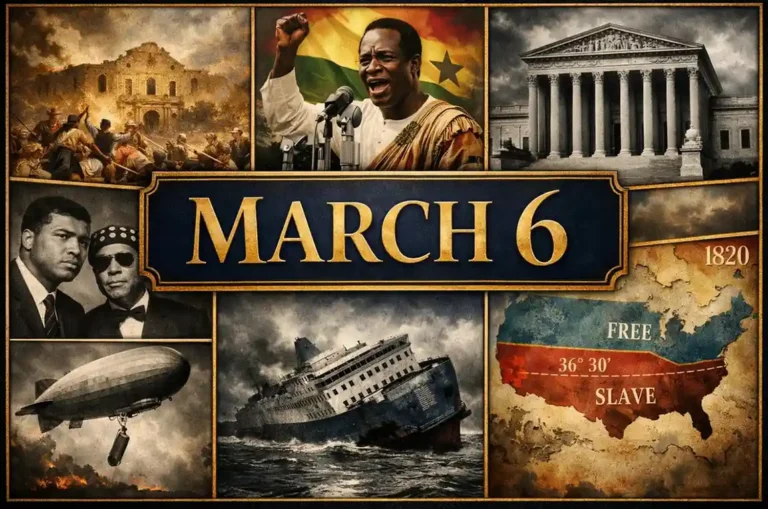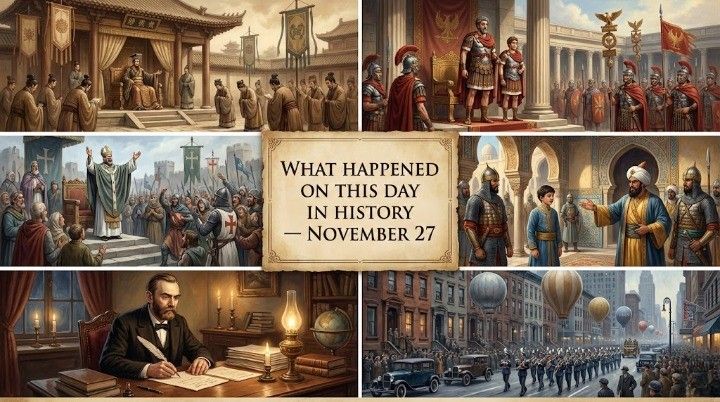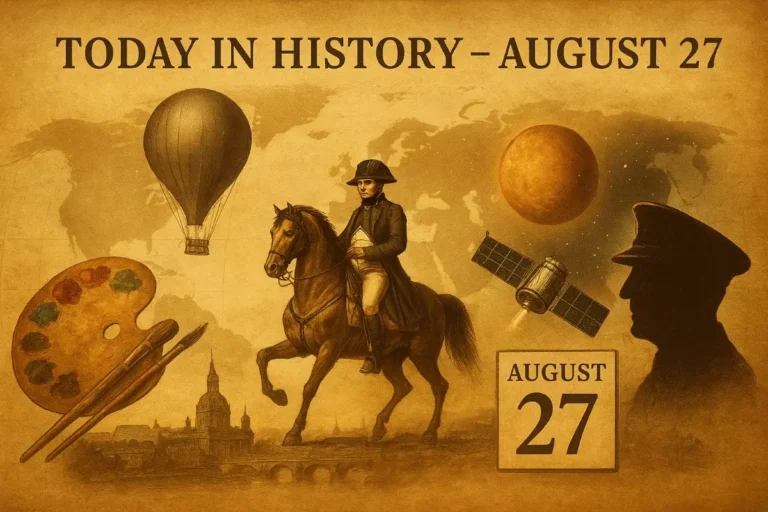
Today offers a chance to look back at what happened on this day in history December 8 and trace how battles, ideas, upheavals, and breakthroughs shaped different eras. From ancient dynasties rising and falling to cultural firsts that changed public life, the date carries stories of conflict, creativity, and global turning points.
Important Events That Happened On December 8 In History
395 — Later Yan defeated at the Battle of Canhe Slope
Northern Wei routs the Later Yan army at Canhe Slope, toppling the military strength of a once-dominant court. The defeat accelerates political fragmentation in northern China and reshapes the region’s balance of power.
757 — Du Fu returns to Chang’an
After the turmoil of the An Lushan Rebellion, the poet Du Fu makes his way back into Chang’an and takes a place at the imperial court. His later poems from this period blend private grief with sharp observations about war, displacement and civic life.
877 — Louis the Stammerer crowned king of West Francia
Louis II is anointed at Compiègne, inheriting a realm still marked by Carolingian decline and local power-brokering. His reign continues the slow transformation from a united empire toward regional principalities.
1504 — Oran fatwa by Ahmad ibn Abi Jum’ah
In response to forced conversions in Spain, Ahmad ibn Abi Jum’ah issues guidance that relaxes certain ritual obligations for coerced Muslims. The fatwa becomes an important historical example of religious law adapting to extreme circumstances.
1660 — First recorded woman performs on the English stage
Either Margaret Hughes or Anne Marshall appears publicly as Desdemona in Othello, breaking the long convention of male actors playing female roles. This small step opens the stage to professional women and alters the face of English theatre.
1851 — Battle of Loncomilla ends the Chilean 1851 Revolution
Government forces centered in Santiago defeat rebel contingents at Loncomilla, bringing the uprising to a close. The victory consolidates conservative rule and shapes Chile’s political order in the mid-19th century.
1854 — Immaculate Conception proclaimed by Pope Pius IX
Pope Pius IX formally defines the Immaculate Conception in Ineffabilis Deus, teaching that Mary was conceived without original sin. The pronouncement has lasting theological and devotional implications across Catholic communities.
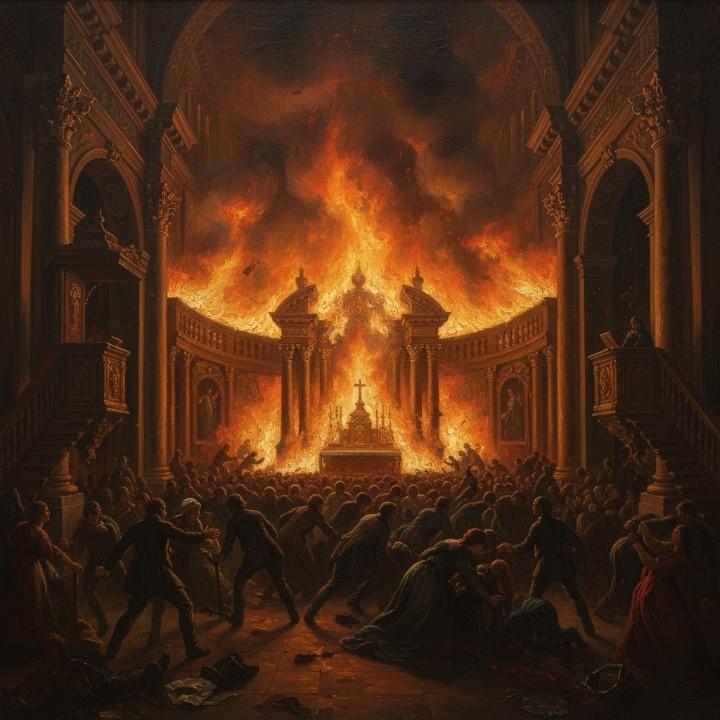
1863 — Church of the Company fire in Santiago, Chile
A catastrophic blaze during Mass kills an estimated two to three thousand worshippers, making it one of modern history’s deadliest single-building fires. The disaster shocks Chile and prompts long-term changes in public-safety thinking.
1864 — Quanta cura and the Syllabus of Errors issued
Pope Pius IX publishes an encyclical and a list condemning modern liberal doctrines and reaffirming papal authority. The documents crystallize a conservative response to 19th-century social and political change.
1907 — Gustaf V becomes King of Sweden
Gustaf V accedes to the throne, beginning a long reign that will carry the Swedish monarchy through constitutional change and two world wars. His tenure embodies continuity amid rapid 20th-century transformation.
1912 — German Imperial War Council considers the risk of general war
Germany’s leaders convene to discuss the growing possibility of a broad European conflict, reflecting strategic anxieties of the era. The council’s deliberations are part of the tense prelude to the Great War.
1914 — Battle of the Falkland Islands
A Royal Navy squadron defeats the Imperial German East Asia Squadron, reversing an earlier German naval victory and reasserting British control at sea. The action demonstrates the global reach of World War I’s naval contests.
1922 — Irish Free State executes four IRA leaders
Soon after the Free State’s foundation, four republican leaders are executed, deepening the wounds of civil conflict. The executions harden divisions and echo through Irish politics for years to come.
1933 — Anarchist insurrection in Zaragoza, Spain
Violent unrest erupts in Zaragoza as part of Spain’s fractious politics in the 1930s. Such local uprisings foreshadow the broader polarization that leads to civil war later in the decade.
1941 — FDR’s “a date which will live in infamy” after Pearl Harbor
President Franklin D. Roosevelt addresses Congress following Japan’s attack on Pearl Harbor, a speech that mobilizes U.S. public opinion and brings America fully into World War II. The phrase endures as a defining memory of that shock.
1941 — Wide Japanese offensive across Asia-Pacific
On the same day as Pearl Harbor, Japanese forces launch coordinated invasions across East and Southeast Asia — from Shanghai and Hong Kong to the Philippines and the Dutch East Indies — dramatically expanding the war’s frontiers.
1943 — Mega Spilaio monastery destroyed; 22 killed
The German 117th Jäger Division razes Mega Spilaio and executes monks and visitors in reprisal operations, part of the brutal occupation policies in Greece. The atrocity becomes one among many wartime tragedies in the region.
1953 — Eisenhower’s “Atoms for Peace” speech
President Eisenhower proposes sharing nuclear technology for peaceful purposes, seeding international programs for civilian atomic research. The speech reframes nuclear power as both perilous and potentially beneficial.
1955 — Flag of Europe adopted by the Council of Europe
A twelve-star emblem is chosen as a symbol for European unity and cooperation; over time it becomes widely associated with pan-European institutions and identity.
1962 — Long newspaper strike in New York City
Workers at multiple New York papers strike for 114 days, disrupting publication and highlighting labor tensions in the media industry. The walkout reshapes distribution and labor relations in the city’s press.
1963 — Pan Am Flight 214 struck by lightning and crashes
A Boeing 707 is hit by lightning and crashes near Elkton, Maryland, killing all aboard; the disaster spurs changes in understanding weather-related aviation risks and safety protocols.
1966 — Sinking of SS Heraklion in the Aegean
The ferry Heraklion founders during a severe storm, costing more than two hundred lives and exposing vulnerabilities in maritime safety during extreme weather.
1969 — Olympic Airways Flight 954 crashes near Keratea
A Douglas DC-6 strikes terrain outside Keratea, Greece, killing 90 people; it remains among the deadliest DC-6 accidents and prompts renewed attention to navigational and procedural safety.
1971 — Indian Navy strikes Karachi in the Indo-Pakistani War
Naval operations against Karachi demonstrate India’s maritime reach and contribute to strategic pressure during the 1971 conflict, which ultimately reshapes South Asian geopolitics.
1972 — United Airlines Flight 553 crashes (first 737 loss)
After aborting a landing at Chicago Midway, the aircraft crashes and causes significant loss of life; investigators focus on approach procedures and cockpit safety, as it is the first fatal Boeing 737 accident.
1974 — Greece abolishes the monarchy by plebiscite
A national vote ends the monarchy and establishes a republic, closing a turbulent chapter in modern Greek constitutional history and securing a new republican order.
1980 — Murder of John Lennon in New York City
John Lennon is shot and killed outside his home at The Dakota, a killing that provokes worldwide mourning and a long cultural reflection on fame, violence and grief.
1985 — SAARC founded for South Asian cooperation
The South Asian Association for Regional Cooperation is established to foster dialogue and collaboration among neighboring states, aiming to address shared economic and social challenges.
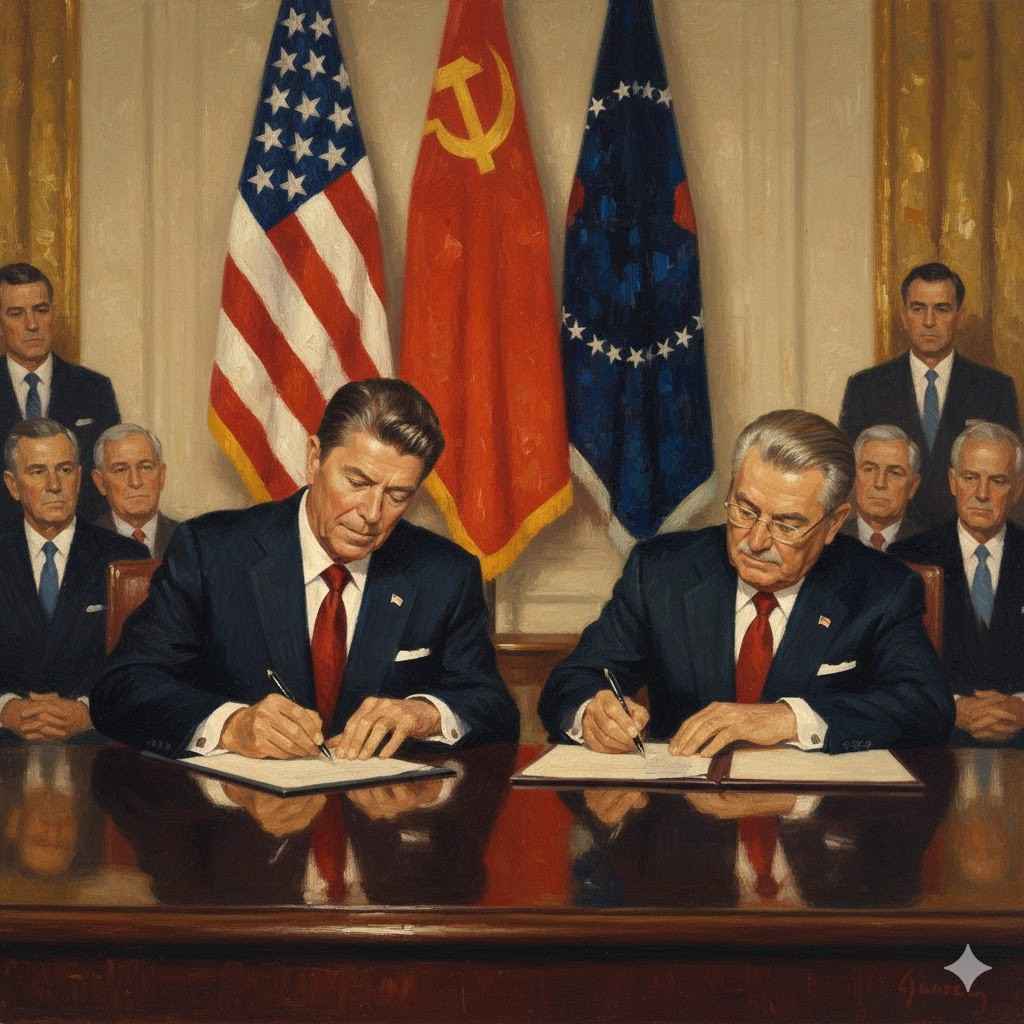
1987 — INF Treaty signed by Reagan and Gorbachev
The United States and the Soviet Union agree to eliminate an entire class of intermediate-range missiles in Europe, a landmark step in Cold War arms control and détente.
1987 — Erez Crossing accident cited among triggers of the First Intifada
A traffic collision involving an Israeli army vehicle and Palestinian refugees at Erez Crossing helps feed sharp local grievances that contribute to the broader uprising known as the First Intifada.
1988 — A-10 crash into Remscheid apartment blocks
A U.S. Air Force jet crashes into civilian housing in Remscheid, Germany, killing and injuring residents; the incident raises questions about military flight safety near populated areas.
1990 — Galileo spacecraft’s first Earth flyby
NASA’s Galileo performs a gravity-assist flyby of Earth, a crucial maneuver that helps send the probe onward to study Jupiter and its moons.
1991 — Leaders sign agreement dissolving the Soviet Union
Russia, Belarus and Ukraine conclude accords that formally end the USSR and lead to the creation of the Commonwealth of Independent States — a momentous geopolitical rupture.
1992 — Galileo’s second Earth flyby
A second gravity assist further tweaks Galileo’s trajectory toward Jupiter, underscoring the careful planning behind long-range planetary missions.
1998 — Armed groups kill 81 people in Algeria
A brutal attack claims dozens of lives during a period of intense internal violence, reflecting the wider cycle of terror and counterinsurgency in 1990s Algeria.
2001 — Singapore thwarts Jemaah Islamiyah embassy-attack plot
A decisive ISD raid foils a plan to bomb foreign embassies, highlighting effective regional intelligence cooperation against transnational terror networks.
2004 — Cusco Declaration establishes South American Community of Nations
Leaders sign a declaration aimed at deeper regional integration and cooperation, a diplomatic step toward new multilateral institutional ties in South America.
2004 — Columbus nightclub shooting shocks the music world
A gunman opens fire at the Alrosa Villa, killing guitarist Dimebag Darrell and others before being stopped — an episode that reverberates through the rock community and public-safety debates.
2009 — Baghdad bombings kill 127 and wound 448
A wave of coordinated attacks in Iraq’s capital inflicts heavy civilian casualties and underscores the fragile security environment in the country’s post-invasion years.
2010 — SpaceX’s Falcon 9 and Dragon achieve a private orbital milestone
With the successful launch and recovery of Dragon, SpaceX becomes the first private company to orbit and return a spacecraft — a turning point for commercial spaceflight.
2010 — Japanese solar-sail IKAROS passes Venus
The IKAROS probe completes a close flyby of Venus while testing solar-sail propulsion, demonstrating Japan’s growing role in innovative planetary exploration.
2013 — Little India riots after a fatal accident in Singapore
A traffic fatality sparks rare and serious rioting, prompting official reflection on policing, crowd control and community relations in a tightly regulated city-state.
2013 — Metallica performs in Antarctica, completing seven-continent tour
The band plays a concert on all seven continents — a cultural oddity that also showcases the logistical possibility of staging events in extreme locations.
2019 — First confirmed COVID-19 case reported in China
Health authorities identify an initial case that will later be linked to a global pandemic, starting months of intense scientific, political and social upheaval worldwide.
2024 — Reports of Damascus falling to rebels as government withdraws
News accounts indicate government forces pull back and rebel groups enter Damascus, a dramatic development that reshapes the immediate battlefield and regional responses.
Read Also: What Happened On This Day In History December 7: Unforgettable Stories
Famous People Born On December 8
| Name | Role / Short Description | Dates |
|---|---|---|
| Francis I | Holy Roman emperor | December 8, 1708 – August 18, 1765 |
| James Thurber | American writer & cartoonist | December 8, 1894 – November 2, 1961 |
| Parkash Singh Badal | Indian politician | December 8, 1927 – April 25, 2023 |
| Jimmy Smith | American jazz organist | December 8, 1928 – February 8, 2005 |
| William Crapo Durant | Founder, General Motors | December 8, 1861 – March 18, 1947 |
| Wifredo Lam | Cuban painter | December 8, 1902 – September 11, 1982 |
| Elzie Segar | Cartoonist, creator of Popeye | December 8, 1894 – October 13, 1938 |
| Adolf von Menzel | German painter & printmaker | December 8, 1815 – February 9, 1905 |
| Bohuslav Martinů | Czech composer | December 8, 1890 – August 28, 1959 |
| Bjørnstjerne Martinius Bjørnson | Norwegian writer, Nobel laureate | December 8, 1832 – April 26, 1910 |
| Uday Shankar | Indian dancer & choreographer | December 8, 1900 – September 26, 1977 |
| Delmore Schwartz | American poet & critic | December 8, 1913 – July 11, 1966 |
| Aristide Maillol | French sculptor & painter | December 8, 1861 – September 27, 1944 |
| Jacques-Salomon Hadamard | French mathematician | December 8, 1865 – October 17, 1963 |
| Jean Ritchie | American folk musician & folklorist | December 8, 1922 – June 1, 2015 |
| August Belmont | American banker & diplomat | December 8, 1816 – November 24, 1890 |
| Oswald Jacoby | Bridge & games expert | December 8, 1902 – June 27, 1984 |
| Henry Timrod | American poet | December 8, 1828 – October 6, 1867 |
| Sir Thomas Edward Thorpe | British chemist | December 8, 1845 – February 23, 1925 |
| József Hild | Hungarian architect | December 8, 1789 – March 6, 1867 |
| Pierre Etchebaster | French real tennis champion | December 8, 1893 – March 24, 1980 |
| Louis Ducos du Hauron | French inventor (color photography) | December 8, 1837 – August 31, 1920 |
| Josephine Bell | British physician & novelist | December 8, 1897 – April 24, 1987 |
| Liang Shiqiu | Chinese author & translator | December 8, 1902 – November 3, 1987 |
| Marie Mattingly Meloney | American journalist & editor | December 8, 1878 – June 23, 1943 |
| Horace Everett Hooper | Publisher (Encyclopædia Britannica) | December 8, 1859 – June 13, 1922 |
| Nakae Chōmin | Japanese writer & political thinker | December 8, 1847 – December 13, 1901 |
| Johann von Charpentier | Swiss geologist | December 8, 1786 – December 12, 1855 |
| Tokutomi Roka | Japanese novelist | December 8, 1868 – September 18, 1927 |
| Adolf Fischhof | Austrian political theorist | December 8, 1816 – March 23, 1893 |
Famous People Died On December 8
| Name | Role / Short Description | Dates |
|---|---|---|
| George Boole | British mathematician (Boolean algebra) | November 2, 1815 – December 8, 1864 |
| Antônio Carlos Jobim | Brazilian composer & bossa nova pioneer | January 25, 1927 – December 8, 1994 |
| Jeanne Bécu, Countess du Barry | Mistress of Louis XV | August 19, 1743 – December 8, 1793 |
| William Henry Vanderbilt | American railroad magnate & philanthropist | May 8, 1821 – December 8, 1885 |
| Thomas De Quincey | English essayist (Confessions of an English Opium-Eater) | August 15, 1785 – December 8, 1859 |
| Hermann Weyl | German-American mathematician & physicist | November 9, 1885 – December 8, 1955 |
| Sir George Cayley | Pioneer of aeronautical engineering | December 27, 1773 – December 8, 1854 |
| Pafnuty Lvovich Chebyshev | Russian mathematician | May 16, 1821 – December 8, 1894 |
| Albert Kahn | American industrial architect | March 21, 1869 – December 8, 1942 |
| Henry Laurens | American statesman (Continental Congress) | March 6, 1724 – December 8, 1792 |
| Richard Baxter | English Puritan minister & author | November 12, 1615 – December 8, 1691 |
| James Hoban | Architect of the White House | c.1762 – December 8, 1831 |
| Maximilian, Graf von Spee | German admiral (WWI) | June 22, 1861 – December 8, 1914 |
| Arnulf | Holy Roman emperor / King of Germany | (d.) December 8, 899 |
| Tris Speaker | American baseball Hall of Famer | April 4, 1888 – December 8, 1958 |
| Benjamin Constant | Franco-Swiss writer & politician | October 25, 1767 – December 8, 1830 |
| Gertrude Jekyll | English garden designer & writer | November 29, 1843 – December 8, 1932 |
| Martin Ritt | American film director | March 2, 1914 – December 8, 1990 |
| Viktor Shklovsky | Russian literary critic & writer | January 24, 1893 – December 8, 1984 |
| Sir John Cornforth | Chemist, Nobel Prize winner | September 7, 1917 – December 8, 2013 |
| Juice WRLD | American rapper | December 2, 1998 – December 8, 2019 |
| Pierre André de Suffren | French admiral | July 13, 1729 – December 8, 1788 |
| Jackson Mac Low | American poet & performance artist | September 12, 1922 – December 8, 2004 |
| William Shawn | Editor of The New Yorker | August 31, 1907 – December 8, 1992 |
| Dom Joseph Pothier | Scholar & restorer of Gregorian chant | December 7, 1835 – December 8, 1923 |
| George D. Widener | American financier & racehorse owner | March 11, 1889 – December 8, 1971 |
| Raffaele Pettazzoni | Italian historian of religions | February 3, 1883 – December 8, 1959 |
| Johan Gottlieb Gahn | Swedish mineralogist (discovered manganese) | August 19, 1745 – December 8, 1818 |
| Vladimir Nikolayevich Chelomey | Soviet aerospace designer | June 30, 1914 – December 8, 1984 |
| Theobald Mathew | Irish priest, “Apostle of Temperance” | October 10, 1790 – December 8, 1856 |
Observances & Institutional Dates – December 8
- Bodhi Day (Japan) — Commemorates the Buddha’s attainment of enlightenment; practiced with meditation, study and offerings in many Japanese Buddhist communities.
- Battle Day (Falkland Islands) — Marks the 1982 conflict and remembers those who fought and fell; a day of local remembrance and reflection.
- Constitution Day (Romania & Uzbekistan) — National holidays marking key constitutional milestones and civic identity; often observed with official ceremonies.
- National Youth Day (Albania) — A day recognizing youth contributions and encouraging civic engagement and cultural programs.
- Hari-Kuyō (Kansai, Japan) — A quiet observance honoring broken needles and tools, giving thanks and reflecting on craft traditions.
- Day of Finnish Music (Finland) — Celebrates Finland’s musical culture with concerts and educational events.
- National Tree Planting Day (Malawi, second Monday in December) — Encourages reforestation and environmental stewardship across communities.
- Nations, Nationalities and Peoples’ Day (Ethiopia) — Celebrates Ethiopia’s diversity with cultural programs and official statements of unity.
- CARICOM–Cuba Day (CARICOM & Cuba) — Marks regional ties and cooperation between the Caribbean Community and Cuba.
Frequently Asked Questions
How did the INF Treaty change European security?
Signed in 1987, it eliminated an entire class of intermediate-range missiles from Europe and eased superpower tensions, becoming a landmark in arms-control diplomacy.
What was the significance of SpaceX’s 2010 mission?
SpaceX’s Falcon 9 and Dragon accomplishments marked the first time a private company launched, orbited and recovered a spacecraft—opening the era of commercial orbital missions.
Why does December 8 include so many air and sea disasters?
Historical coincidence and seasonal weather, combined with the date’s wartime and commercial activity, have produced several high-profile aviation and maritime tragedies recorded on this day.