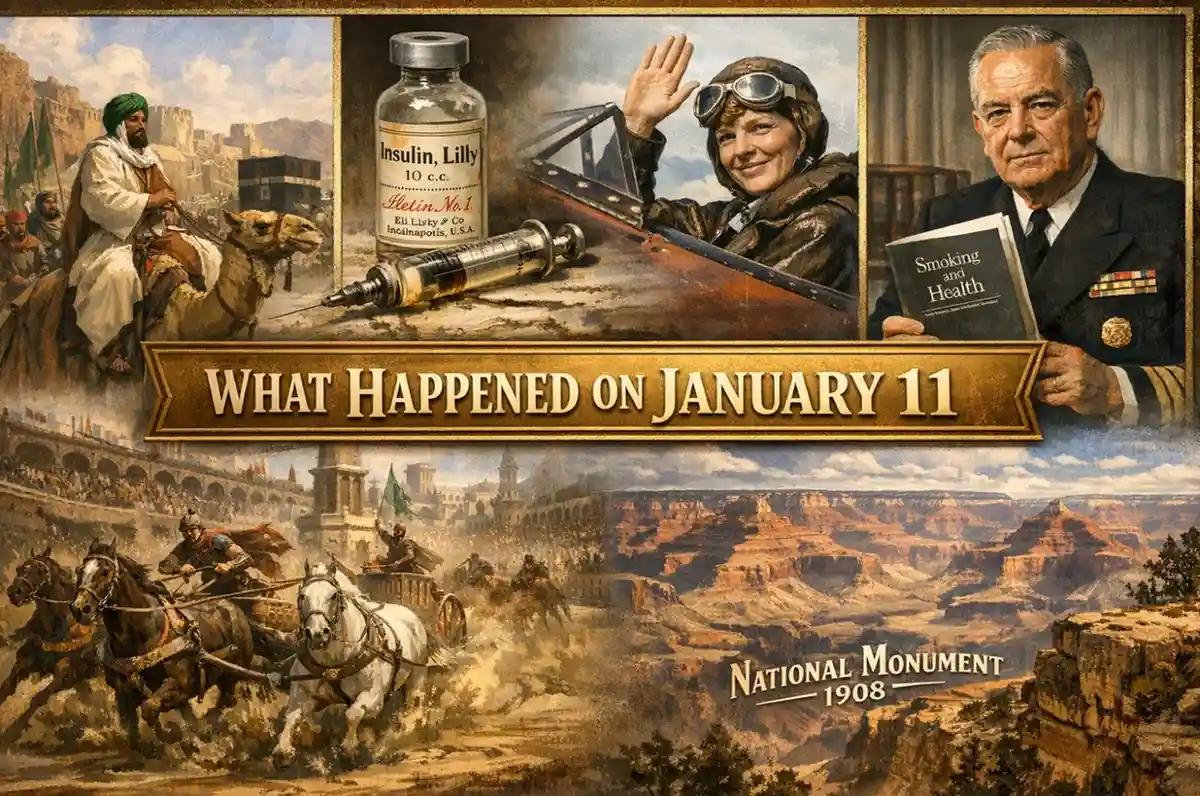
The history of January 11 is defined by dramatic shifts in power, the birth of modern healthcare, and the courage of pioneers who defied the odds. To truly understand what happened on this day in history January 11, we must look at the religious conquest of Mecca, the first life-saving injection of insulin, and the official report that changed the world’s perspective on public health forever.
Important Events That Happened On January 11 In History
532: The Nika Riots Begin
In Constantinople, a standard day of chariot racing at the Hippodrome spiraled into the deadliest civil unrest in the city’s history. A quarrel between the rival “Blues” and “Greens” factions escalated into a full-scale revolt against Emperor Justinian I, nearly toppling the Byzantine throne. The resulting violence destroyed half the city and left tens of thousands dead before order was finally restored.
630: The Conquest of Mecca
The Prophet Muhammad led a massive force of followers toward Mecca, resulting in a nearly bloodless conquest of the holy city. The Quraysh leaders, realizing they were vastly outnumbered, surrendered the city and accepted the new Islamic leadership. This pivotal moment marked the end of years of conflict and established Mecca as the spiritual center of the Islamic world.
930: Sack of Mecca by the Qarmatians
In a shocking act of religious desecration, the Qarmatians—an Ismaili Shia sect—raided Mecca during the Hajj pilgrimage. They slaughtered thousands of pilgrims and infamously stole the Black Stone from the Kaaba, taking it back to their base in Eastern Arabia. The stone remained in their possession for over twenty years before it was eventually returned to its rightful place.
1055: Theodora Crowned Empress
Theodora Porphyrogenita was officially crowned as the reigning Empress of the Byzantine Empire following the death of Constantine IX. As one of the few women to rule the empire in her own right, her brief but firm administration was marked by the dismissal of corrupt officials and a strong grip on the imperial bureaucracy. Her death a year later marked the end of the illustrious Macedonian dynasty.
1158: Vladislaus II Becomes King of Bohemia
The Duke of Bohemia, Vladislaus II, was elevated to the rank of King by the Holy Roman Emperor Frederick Barbarossa. This promotion was a reward for his military support during the Emperor’s campaigns in Italy. While the title was initially not hereditary, it significantly raised the prestige of the Bohemian state within the European political hierarchy.
1569: The First English Lottery
England’s first recorded state lottery was held at the West Door of St. Paul’s Cathedral in London. Queen Elizabeth I authorized the draw to raise funds for “reparation of the havens and strength of the Realme,” offering prizes that included silver plate and tapestries. This early venture into public fundraising set the precedent for modern lotteries used to support national infrastructure.
1654: Defeat of the Spanish at Bueno River
During the long-running Arauco War in Chile, a Spanish colonial army suffered a major defeat at the hands of the Mapuche-Huilliche people. The Spanish were attempting to cross the Bueno River to expand their territory when they were ambushed by the local indigenous forces. This victory forced the Spanish to retreat and successfully halted their southern expansion for decades.
1759: First American Life Insurance Company
The first life insurance company in the American colonies was incorporated in Philadelphia under a long and descriptive name focused on helping Presbyterian ministers and their families. Now known as part of the Unum Group, its creation marked the beginning of the organized insurance industry in North America. It provided a vital safety net for the widows and orphans of clergy members during the colonial era.
1787: Herschel Discovers Moons of Uranus
Astronomer William Herschel expanded our knowledge of the solar system by discovering Titania and Oberon, the two largest moons orbiting Uranus. Having discovered the planet itself just six years earlier, Herschel’s continued observations revealed these distant natural satellites. These moons were eventually named after characters from Shakespeare’s A Midsummer Night’s Dream.
1805: Creation of the Michigan Territory
The United States Congress passed an act creating the Michigan Territory, carving it out of the larger Indiana Territory. Detroit was named as the initial capital, and the new administrative boundary set the stage for the region’s rapid development and eventual statehood. This move helped the federal government better manage the growing population and resources of the Great Lakes region.
1820: The Great Savannah Fire
A devastating fire tore through the heart of Savannah, Georgia, destroying over 400 buildings and leaving much of the city in ruins. The blaze was fueled by heavy winds and the many wooden structures that made up the busy port town. In the aftermath, the city implemented stricter building codes and reorganized its fire department to prevent such a catastrophe from recurring.
1851: Proclamation of the Taiping Heavenly Kingdom
Hong Xiuquan, a self-proclaimed prophet, officially declared the establishment of the Taiping Heavenly Kingdom, sparking the Jintian Uprising against the Qing Dynasty. This event marked the start of the Taiping Rebellion, one of the bloodiest civil wars in human history, which lasted for over a decade. The movement sought to radically transform Chinese society through a unique blend of religious and social reforms.
1861: Alabama Secedes from the Union
Alabama became the fourth state to withdraw from the United States, following the election of Abraham Lincoln. The state’s secession convention voted 61 to 39 in favor of leaving the Union, as leaders sought to protect the institution of slavery and the doctrine of states’ rights. Shortly after, Alabama invited other seceding states to meet in Montgomery to form a new southern confederacy.
1863: The Battle of Arkansas Post
Union forces under General John McClernand and Admiral David Dixon Porter captured Fort Hindman, bringing the three-day Battle of Arkansas Post to a close. The victory eliminated a major Confederate stronghold that had been harassing Union shipping on the Mississippi River. By securing the Arkansas River, the Union significantly improved its strategic position in the Western Theater of the Civil War.
1863: Sinking of the USS Hatteras
In a rare open-sea engagement off the coast of Galveston, the Confederate commerce raider CSS Alabama encountered and sank the USS Hatteras. The battle lasted only twenty minutes, but it highlighted the effectiveness of the Alabama’s superior speed and firepower. This victory allowed the Confederate ship to continue its highly successful campaign against Northern merchant shipping.
1879: The Anglo-Zulu War Begins
British forces crossed the Buffalo River into Zululand, officially starting the Anglo-Zulu War. The invasion was launched by British colonial officials without the authorization of the home government, aimed at neutralizing the Zulu Kingdom as a perceived threat to confederation in Southern Africa. The conflict would become famous for the epic battles of Isandlwana and Rorke’s Drift.
1908: Grand Canyon National Monument Created
President Theodore Roosevelt utilized the Antiquities Act to declare the Grand Canyon a National Monument, protecting it from private development and mining. Roosevelt famously stated that the canyon was a natural wonder that every American should see, and his action ensured its preservation for future generations. This designation was a critical step toward it becoming a full National Park eleven years later.
1912: The Lawrence Textile Strike
Immigrant textile workers in Lawrence, Massachusetts, walked off the job in what became known as the “Bread and Roses” strike. The protest was triggered by a reduction in wages that followed a new law shortening the work week for women and children. The strike drew national attention to the poor working conditions and low pay faced by industrial laborers in the United States.
1914: Sinking of the Karluk
The Karluk, the flagship of the Canadian Arctic Expedition, was crushed by ice and sank in the Arctic Ocean. The crew was forced to abandon ship and set up a camp on the ice, beginning a harrowing struggle for survival in sub-zero temperatures. Their subsequent journey across the ice to reach land remains one of the most famous tales of Arctic endurance and tragedy.
1917: Kingsland Munitions Factory Explosion
A massive fire and series of explosions destroyed the Kingsland munitions factory in New Jersey, which was producing shells for the Russian army during World War I. The blast was so powerful it was felt for miles and destroyed millions of dollars worth of military supplies. Later investigations suggested the event was an act of sabotage carried out by German agents.
1922: First Use of Insulin on a Human
Fourteen-year-old Leonard Thompson became the first person in history to be injected with insulin to treat diabetes. Before this medical breakthrough at the University of Toronto, a diagnosis of Type 1 diabetes was essentially a death sentence. The treatment was a miraculous success, rapidly lowering Thompson’s dangerously high blood sugar and launching a new era in modern medicine.
1923: Occupation of the Ruhr
Troops from France and Belgium moved into the Ruhr Valley, Germany’s industrial heartland, after Germany failed to keep up with its World War I reparation payments. The occupation was met with “passive resistance” from German workers and led to a hyperinflation crisis that crippled the German economy. This event further strained international relations and fueled the rise of extremist political movements in Germany.
1927: Creation of the Academy of Motion Picture Arts and Sciences
Louis B. Mayer, the head of MGM, announced the formation of the Academy of Motion Picture Arts and Sciences during a banquet in Los Angeles. The organization was created to improve the image of the film industry and handle labor disputes, but it eventually became most famous for establishing the Academy Awards. This move solidified Hollywood’s status as a professional and influential global institution.
1935: Earhart’s Solo Flight from Hawaii
Amelia Earhart made history by becoming the first person to fly solo from Honolulu, Hawaii, to Oakland, California. The grueling 18-hour flight across the Pacific was a major feat of navigation and endurance, proving that long-distance air travel was becoming more reliable. Her success further cemented her status as a global icon of aviation and female empowerment.
1942: Fall of Kuala Lumpur
During the early stages of World War II in the Pacific, Japanese forces successfully captured Kuala Lumpur, the capital of the Federated Malay States. The British and Allied forces were forced into a rapid retreat south toward Singapore as the Japanese advanced down the Malay Peninsula. This victory provided the Japanese with a vital administrative and logistical hub for their occupation of Southeast Asia.
1942: Battle of Tarakan Begins
Japanese forces launched an amphibious assault on the island of Tarakan in the Netherlands East Indies, marking the start of a fierce battle for the region’s oil fields. The Dutch garrison attempted to destroy the oil installations before they could be captured, but the Japanese quickly secured the island. This was a strategic move by Japan to secure the energy resources needed to fuel its war machine.
1943: Sino-British and Sino-American New Equal Treaties
The Republic of China signed historic treaties with both Great Britain and the United States, officially ending the era of extraterritoriality and unequal treaties. These agreements restored Chinese sovereignty over its own legal and judicial systems, which had been compromised by Western powers for nearly a century. This was a major diplomatic victory for China during its struggle in World War II.
1943: Assassination of Carlo Tresca
The prominent Italian-American anarchist and labor leader Carlo Tresca was gunned down in Manhattan. Tresca was a fierce opponent of both fascism and Stalinism, making him many powerful enemies in the political and criminal underworld. His murder remains one of New York City’s most famous unsolved political assassinations, with theories ranging from Mafia involvement to Soviet agents.
1946: Proclamation of the People’s Republic of Albania
Enver Hoxha, the leader of the Communist Party of Albania, officially declared the country a People’s Republic and named himself as the head of state. This move solidified communist control over Albania following the withdrawal of Axis forces at the end of World War II. Hoxha would go on to rule the country with an iron fist for the next four decades, leading it into deep isolation.
1949: First Networked Television Broadcast
The first “networked” television broadcast took place as KDKA-TV in Pittsburgh began operations, effectively linking the East Coast and Midwest programming via coaxial cable. This technological milestone allowed viewers in different regions to watch the same live broadcast simultaneously for the first time. It marked the beginning of television’s transformation into a truly national medium of information and entertainment.
1957: Founding of the African Convention
Political leaders gathered in Dakar, Senegal, to found the African Convention (Convention Africaine), a political party aimed at uniting French West African territories. The organization sought to advocate for greater autonomy and eventually independence from French colonial rule. It was a significant step in the growing pan-African movement that would reshape the continent over the following years.
1959: Lufthansa Flight 502 Crash
A Lufthansa Super Constellation crashed while attempting to land at Rio de Janeiro/Galeão International Airport, resulting in 36 fatalities. The aircraft hit the water just short of the runway during a rainy approach, though three crew members miraculously survived. An investigation into the disaster suggested that pilot error and fatigue played a significant role in the tragic accident.
1961: Opening of the Throgs Neck Bridge
New York City’s infrastructure was expanded with the official opening of the Throgs Neck Bridge, connecting the Bronx and Queens. Designed to relieve traffic congestion on the nearby Whitestone Bridge, the suspension bridge became a vital artery for the city’s growing automotive traffic. Its completion was a major achievement in the post-war era of large-scale urban engineering projects.
1962: Destruction of Soviet Submarine B-37
While docked at its pier in Polyarny, the Soviet submarine B-37 was destroyed when a fire in its torpedo compartment caused a massive explosion. The blast was so powerful that it also damaged a nearby submarine and several pier installations, resulting in numerous casualties among the crew and dockworkers. The incident was a significant blow to the Soviet Northern Fleet during the height of the Cold War.
1962: The Huascarán Avalanche
A massive avalanche triggered by a collapsing glacier on Mount Huascarán in Peru buried several villages under millions of tons of ice and debris. The disaster claimed an estimated 4,000 lives, making it one of the deadliest avalanches in recorded history. The sheer speed and volume of the slide left the residents of the valley with almost no time to escape.
1964: Surgeon General’s Report on Smoking
Dr. Luther Terry, the U.S. Surgeon General, released the landmark report Smoking and Health, which officially linked cigarette smoking to lung cancer and heart disease. This was the first time the federal government took a definitive stand against the tobacco industry, sparking a massive shift in public perception. The report laid the foundation for decades of anti-smoking legislation and public health campaigns.
1966: Opening of the Tbilisi Metro
The capital of Georgia, then part of the Soviet Union, celebrated the opening of the Tbilisi Metro, the fourth underground transit system built in the USSR. The initial line served the city’s main industrial and residential districts, providing a modern and efficient solution to urban transport. Its unique architecture and deep-level stations remain a hallmark of Soviet engineering.
1972: East Pakistan Becomes Bangladesh
In the aftermath of the war of liberation, East Pakistan officially changed its name to Bangladesh, signaling its total independence from Pakistan. This transition was the culmination of years of political struggle and a bloody conflict that drew in regional powers. The name change represented the birth of a new nation and the start of a long journey toward reconstruction and sovereignty.
1973: Adoption of the Designated Hitter
Major League Baseball owners voted to allow the American League to adopt the designated hitter (DH) position on a trial basis. The rule allowed a team to use a specialized batter to hit in place of the pitcher, aimed at increasing offensive scoring and fan engagement. This decision created a fundamental difference between the American and National Leagues that lasted for nearly fifty years.
1977: Premiere of Pikku Kakkonen
The first episode of the beloved Finnish children’s television show Pikku Kakkonen (“Little Number Two”) aired on Yle TV2. The program was designed to educate and entertain young children through a variety of segments, including animation and puppet shows. It has since become a cultural institution in Finland, remaining on the air for over four decades.
1983: United Airlines Flight 2885 Crash
A United Airlines cargo flight crashed shortly after takeoff from Detroit Metropolitan Airport when the aircraft’s cargo shifted, causing it to stall. All three crew members on board were killed as the plane plummeted into a nearby field. The accident led to stricter regulations regarding the securing of heavy cargo and the training of ground handling crews for freight operations.
1986: Opening of the Gateway Bridge
The Gateway Bridge in Brisbane, Australia, was officially opened, providing a vital new link over the Brisbane River. At the time of its completion, it was the largest concrete cantilever bridge in the world, reflecting the city’s rapid growth and modernization. The bridge significantly improved local transport efficiency and became an iconic part of the Brisbane skyline.
1994: Ending the Irish Broadcasting Ban
The Irish Government announced the end of a controversial 15-year ban that prevented members of the IRA and Sinn Féin from being interviewed on television and radio. The move was a significant step in the Northern Ireland peace process, allowing for more open political dialogue during a sensitive time of negotiations. It signaled a shift toward engagement rather than censorship in the effort to end “The Troubles.”
1995: Plane Crash in María La Baja
A regional flight crashed in a swampy area near María La Baja, Colombia, after experiencing a mechanical failure during its approach. The disaster resulted in the deaths of 51 people, though one young girl was found alive in the wreckage, becoming the sole survivor. The accident prompted a review of the safety standards and maintenance procedures for Colombia’s domestic airline industry.
1996: Launch of STS-72
The Space Shuttle Endeavour launched from the Kennedy Space Center on mission STS-72, marking the tenth flight for the orbiter. During the nine-day mission, the crew successfully retrieved a Japanese research satellite and conducted two spacewalks to test tools for the upcoming assembly of the International Space Station. This mission highlighted the growing international cooperation in space exploration.
1998: The Sidi-Hamed Massacre
During the Algerian Civil War, a group of armed militants launched a brutal attack on the village of Sidi-Hamed during the month of Ramadan. Over 100 civilians were killed in the massacre, which was one of the many horrific acts of violence that characterized the “Black Decade” in Algeria. The event drew international condemnation and highlighted the extreme danger faced by rural populations during the conflict.
2003: Illinois Death Row Commutations
Governor George Ryan of Illinois made the historic decision to commute the death sentences of all 167 prisoners on the state’s death row to life imprisonment. His decision was based on deep concerns regarding the integrity of the state’s justice system following the Jon Burge police torture scandal. This mass commutation remains one of the most significant moments in the modern American debate over the death penalty.
2013: Failed Rescue Attempt in Bulo Marer
A French commando raid in Bulo Marer, Somalia, failed to rescue a French intelligence agent being held hostage by militants. The operation resulted in a fierce firefight that left one French soldier and 17 militants dead, while the hostage was also believed to have been killed during the assault. The event highlighted the extreme risks involved in special forces operations against extremist groups.
2020: First Recorded COVID-19 Death
Health officials in Wuhan, China, announced the first death from a mysterious new respiratory virus, later identified as COVID-19. The victim was a 61-year-old man who had been a frequent customer at the Huanan Seafood Market. This announcement was a grim milestone marking the beginning of a global pandemic that would eventually change the course of modern history.
See what happened on January 10
Famous People Born On January 11
| Name | Role / Short Note | Dates |
|---|---|---|
| Nicolaus Steno | Danish geologist, founder of stratigraphy | Jan 11, 1638 – Dec 5, 1686 |
| Aldo Leopold | American environmentalist, A Sand County Almanac | Jan 11, 1887 – Apr 21, 1948 |
| Tony Hoare | British computer scientist, Turing Award | Jan 11, 1934 – |
| Ezra Cornell | Founder of Cornell University | Jan 11, 1807 – Dec 9, 1874 |
| Eva Hesse | American sculptor, postminimalism | Jan 11, 1936 – May 29, 1970 |
| Alan Paton | South African author, anti-apartheid voice | Jan 11, 1903 – Apr 12, 1988 |
| Pierre Mendès-France | Prime Minister of France | Jan 11, 1907 – Oct 18, 1982 |
| William Stephenson | Allied intelligence chief (WWII) | Jan 11, 1896 – Jan 31, 1989 |
| Reinhold Glière | Soviet composer | Jan 11, 1875 – Jun 23, 1956 |
| Oswald de Andrade | Brazilian modernist writer | Jan 11, 1890 – Oct 22, 1954 |
| Laurens Hammond | Inventor of the Hammond organ | Jan 11, 1895 – Jul 1, 1973 |
| Cai Yuanpei | Chinese educator, Peking University | Jan 11, 1863 – Mar 5, 1940 |
| Trygve Bratteli | Prime Minister of Norway | Jan 11, 1910 – Nov 20, 1984 |
| Suzuki Zenkō | Prime Minister of Japan | Jan 11, 1911 – Jul 19, 2004 |
| Roger Guillemin | Nobel Prize–winning physiologist | Jan 11, 1924 – Feb 21, 2024 |
| Christian Marclay | Multimedia artist & composer | Jan 11, 1955 – |
| David Wolper | TV producer (Roots) | Jan 11, 1928 – Aug 10, 2010 |
| Edward B. Titchener | Experimental psychologist | Jan 11, 1867 – Aug 3, 1927 |
| Bernard De Voto | American historian & writer | Jan 11, 1897 – Nov 13, 1955 |
| Sir James Paget | British surgeon & pathologist | Jan 11, 1814 – Dec 30, 1899 |
| Bayard Taylor | American travel writer | Jan 11, 1825 – Dec 19, 1878 |
| Dwight W. Morrow | U.S. diplomat & statesman | Jan 11, 1873 – Oct 5, 1931 |
| Juanita Morris Kreps | First female U.S. Commerce Secretary | Jan 11, 1921 – Jul 5, 2010 |
| Tracy Caulkins | Olympic champion swimmer | Jan 11, 1963 – |
| Calvin Bridges | Geneticist, heredity research | Jan 11, 1889 – Dec 27, 1938 |
| François-Marie de Broglie | French marshal | Jan 11, 1671 – May 22, 1745 |
| Barbara Heinemann | Religious community leader (Amana) | Jan 11, 1795 – May 21, 1883 |
| Antoine-Alexandre Barbier | French librarian & bibliographer | Jan 11, 1765 – Dec 5, 1825 |
| Alexander Hall | Hollywood film director | Jan 11, 1894 – Jul 30, 1968 |
| Francis Xavier Ford | Catholic missionary & martyr | Jan 11, 1892 – Feb 21, 1952 |
Famous People Died On January 11
| Name | Role / Short Note | Dates |
|---|---|---|
| Alberto Giacometti | Swiss sculptor, existential modernism | Oct 10, 1901 – Jan 11, 1966 |
| Emanuel Lasker | World chess champion | Dec 24, 1868 – Jan 11, 1941 |
| Éric Rohmer | French New Wave filmmaker | Apr 4, 1920 – Jan 11, 2010 |
| Sir Michael Atiyah | Mathematician, Fields Medal | Apr 22, 1929 – Jan 11, 2019 |
| Isidor Isaac Rabi | Physicist, Nobel Prize | Jul 29, 1898 – Jan 11, 1988 |
| Ariel Sharon | Prime Minister of Israel | Feb 26, 1928 – Jan 11, 2014 |
| Sheldon Adelson | Casino magnate & publisher | Aug 4, 1933 – Jan 11, 2021 |
| Anita Ekberg | Actress (La Dolce Vita) | Sep 29, 1931 – Jan 11, 2015 |
| Georges-Eugène Haussmann | Architect of modern Paris | Mar 27, 1809 – Jan 11, 1891 |
| Galeazzo Ciano | Italian Fascist diplomat | Mar 18, 1903 – Jan 11, 1944 |
| Jean de Lattre de Tassigny | French marshal (WWII) | Feb 2, 1889 – Jan 11, 1952 |
| François-Joseph de Grasse | French admiral, American Revolution | Sep 13, 1722 – Jan 11, 1788 |
| Barbara Pym | English novelist | Jun 2, 1913 – Jan 11, 1980 |
| Carl David Anderson | Physicist, discovered positron | Sep 3, 1905 – Jan 11, 1991 |
| Domenico Cimarosa | Italian opera composer | Dec 17, 1749 – Jan 11, 1801 |
| Constantine IX Monomachus | Byzantine emperor | c.980 – Jan 11, 1055 |
| Minh Mạng | Emperor of Vietnam | May 24, 1792 – Jan 11, 1841 |
| Nathan Straus | Philanthropist, Macy’s owner | Jan 31, 1848 – Jan 11, 1931 |
| Gail Borden | Inventor of condensed milk | Nov 9, 1801 – Jan 11, 1874 |
| Oscar Straus | Austrian operetta composer | Mar 6, 1870 – Jan 11, 1954 |
| Marcella Sembrich | Polish opera soprano | Feb 15, 1858 – Jan 11, 1935 |
| Louis-François Roubiliac | Baroque sculptor | Aug 31, 1702 – Jan 11, 1762 |
| James Martineau | English philosopher & theologian | Apr 21, 1805 – Jan 11, 1900 |
| Clyde Bellecourt | Native American rights activist | May 8, 1936 – Jan 11, 2022 |
| João de Deus | Portuguese poet | Mar 8, 1830 – Jan 11, 1896 |
| Sid Chaplin | British novelist | Sep 20, 1916 – Jan 11, 1986 |
| Daniel-Henry Kahnweiler | Cubism art dealer | Jun 25, 1884 – Jan 11, 1979 |
| Hannes Kolehmainen | Olympic distance runner | Dec 9, 1889 – Jan 11, 1966 |
| Benjamin F. Butler | U.S. Civil War general | Nov 5, 1818 – Jan 11, 1893 |
| François Gérard | Neoclassical painter | May 4, 1770 – Jan 11, 1837 |
Observances & Institutional Dates
- National Human Trafficking Awareness Day (USA): A day dedicated to raising public awareness about the global issue of human trafficking and supporting victims.
- Republic Day (Albania): Commemorating the 1946 proclamation of the People’s Republic of Albania.
- Kagami biraki (Japan): A traditional Japanese ceremony of “opening the mirror,” marking the first time the decorative New Year’s mochi is broken and eaten.
- Prithvi Jayanti (Nepal): A day celebrating the birth of King Prithvi Narayan Shah, the unifier of modern Nepal.
Frequently Asked Questions
What major medical first happened on January 11?
In 1922, Leonard Thompson became the first person to receive an insulin injection to treat diabetes, a breakthrough that has since saved millions of lives.
Which famous report on health was released on January 11, 1964?
The U.S. Surgeon General released the first official report linking cigarette smoking to lung cancer, sparking worldwide anti-smoking efforts.
What was the “Bread and Roses” strike of January 11, 1912?
It was a major textile strike in Lawrence, Massachusetts, where immigrant workers protested for better pay and working conditions.