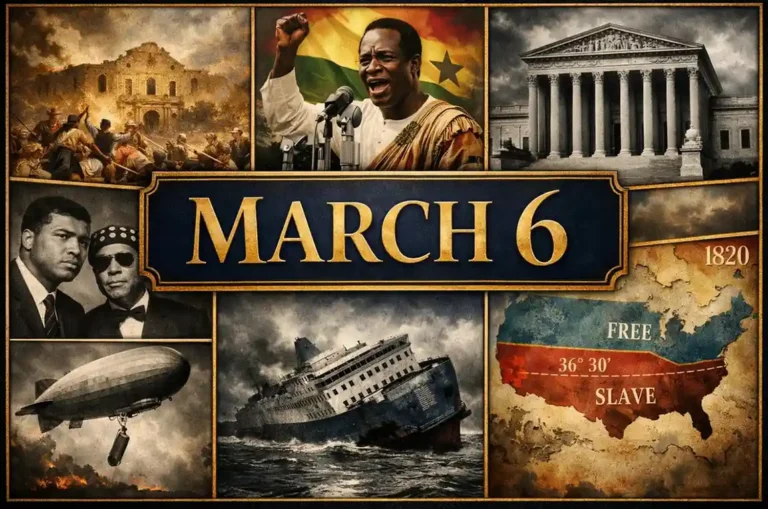
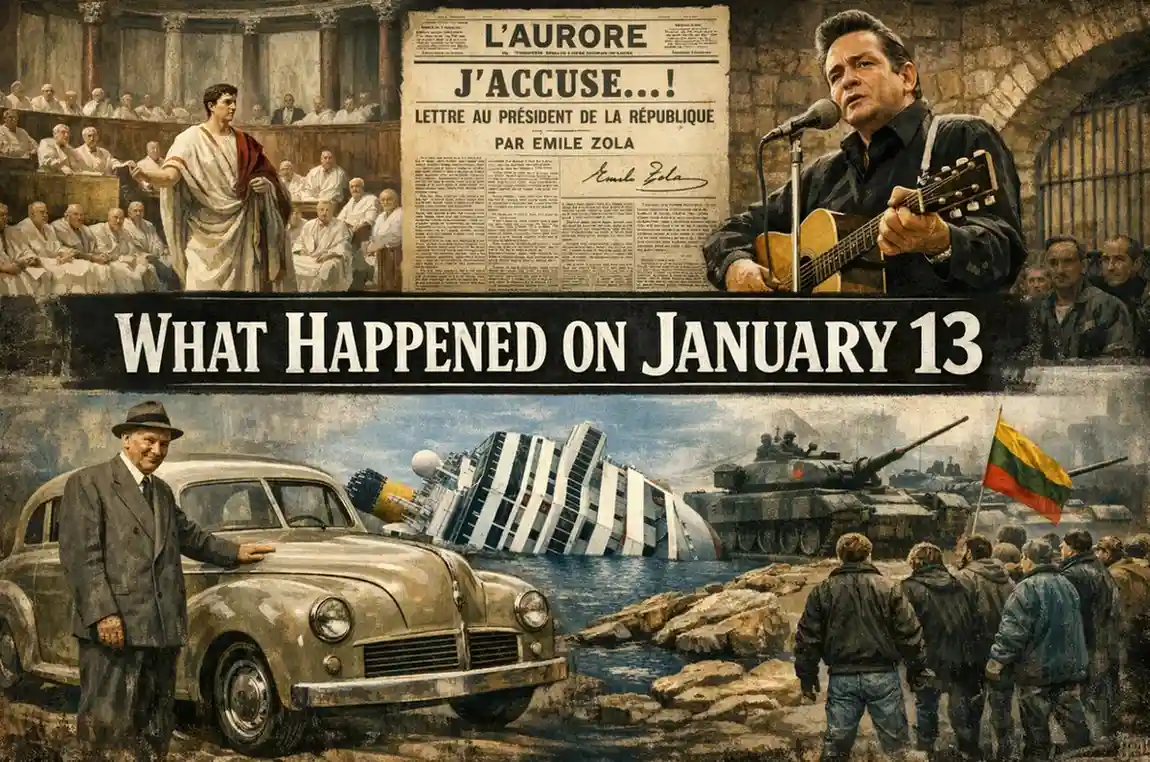
The history of January 13 is a tapestry of bold political maneuvers, devastating natural disasters, and cultural milestones. To understand what happened on this day in history January 13, we look back at Octavian’s calculated move to secure Roman dominance, the first African American cabinet appointment, and a digital-age false alarm that gripped the islands of Hawaii in terror.
Important Events That Happened On January 13 In History
27 BC: Octavian and the Roman Senate
In a masterstroke of political theater, Octavian transferred the state back to the Roman Senate and the people, officially ending the era of the triumvirate. In return, he was granted control over the vast provinces of Spain, Gaul, and Syria for ten years, effectively securing the military power needed to rule. This day is often cited as a critical step in the birth of the Roman Empire.
532: The Outbreak of the Nika Riots
Tensions in Constantinople boiled over during the chariot racing season at the Hippodrome, as fans of the Blue and Green teams united against the heavy-handed rule of Emperor Justinian I. What began as a sporting quarrel quickly turned into a city-wide revolt that threatened the imperial throne and left the city in flames. The resulting “Nika!” (Victory!) cries marked the start of one of the deadliest riots in ancient history.
1435: Promulgation of Sicut Dudum
Pope Eugene IV issued the papal bull Sicut Dudum, an early and significant stance against the exploitation of indigenous people. The decree forbade the Spanish from enslaving the Guanche natives of the Canary Islands who had converted to, or were in the process of converting to, Christianity. It demanded that all such captives be restored to their liberty within fifteen days under the pain of excommunication.
1547: Sentencing of the Earl of Surrey
Henry Howard, the Earl of Surrey and a renowned poet, was sentenced to death for high treason against King Henry VIII. The specific charge involved his use of the royal coat of arms in his own family’s heraldry, which the paranoid King viewed as a claim to the throne. This execution was one of the final acts of violence in Henry VIII’s long and turbulent reign.
1793: The Lynching of Nicolas de Bassville
Nicolas Jean Hugon de Bassville, a representative of the French Revolutionary government, was lynched by a pro-papal mob in the streets of Rome. The crowd was incited by his visible display of revolutionary symbols, which were seen as a direct insult to the authority of the Pope. His death further poisoned the already volatile relationship between Revolutionary France and the Vatican.
1797: Battle of the Droits de l’Homme
A fierce naval engagement during the French Revolutionary Wars saw two British frigates take on the massive French ship of the line, Droits de l’Homme. The battle took place in heavy seas off the coast of Brittany, eventually forcing the French vessel onto the rocks. The shipwreck was a catastrophe, resulting in the deaths of over 900 men who were either killed in battle or drowned in the surf.
1815: The Capture of Fort Peter
In the final months of the War of 1812, British troops successfully captured Fort Peter in St. Marys, Georgia. This engagement remains significant as the only land battle of the war to take place within the borders of the state of Georgia. The British occupation of the fort and the nearby town lasted until the news of the peace treaty finally reached the southern coast.
1822: Adoption of the Greek Flag
The First National Assembly at Epidaurus officially adopted the design of the Greek flag as the national emblem of the Greek people. Featuring the white cross on a blue field, the design symbolized the “wisdom of God” and the purity of the cause for independence. This moment provided a unified identity for the Greek revolutionaries fighting to liberate their land from Ottoman rule.
1833: Andrew Jackson and the Nullification Crisis
President Andrew Jackson wrote a firm letter to Vice President-elect Martin Van Buren, doubling down on his opposition to South Carolina’s defiance of federal law. Jackson made it clear that “nullification” was an act of treason and that the Union must be preserved at all costs. This exchange highlighted the escalating tensions between federal authority and states’ rights in the pre-Civil War era.
1840: Sinking of the Steamship Lexington
The steamship Lexington was destroyed by a fire while sailing through Long Island Sound, leading to the loss of 139 lives. The fire spread rapidly due to the ship’s cargo of cotton, and the freezing winter waters left almost no chance for survivors. Only four individuals managed to survive the ordeal, making it one of the most tragic maritime disasters in American history.
1842: Dr. William Brydon’s Lone Survival
In a stunning and grim conclusion to the British retreat from Kabul, Dr. William Brydon arrived at the gates of Jalalabad. He was famously hailed as the sole survivor of an entire army of 4,500 soldiers and 12,000 followers who had been decimated by Afghan tribesmen and the bitter cold. His arrival became a powerful symbol of the disastrous British experience in the First Anglo-Afghan War.
1847: The Treaty of Cahuenga
The Mexican–American War in California came to a de facto end with the signing of the Treaty of Cahuenga. Negotiated between John C. Frémont and Andrés Pico, the agreement called for the surrender of the Californio forces and provided for the peaceful coexistence of the local residents. This pact effectively secured California for the United States, even before the official war-ending treaty was signed in Mexico.
1849: Colony of Vancouver Island Established
The British government officially established the Colony of Vancouver Island to secure its interests in the Pacific Northwest. The territory was granted to the Hudson’s Bay Company for a nominal fee, on the condition that they promote settlement and agriculture. This move was a critical step in the development of Western Canada and the eventual formation of British Columbia.
1849: The Battle of Chillianwala
The Second Anglo-Sikh War saw a bloody and indecisive encounter at Chillianwala, where British forces suffered heavy casualties and were forced into a retreat. The Sikh army utilized the dense jungle terrain to launch fierce counterattacks, shattering several British regiments. While the British eventually claimed victory in the war, this battle was a significant blow to their military prestige in India.
1888: National Geographic Society Founded
Thirty-three explorers and scientists met at the Cosmos Club in Washington, D.C., to found the National Geographic Society. Their goal was to create an organization dedicated to the “increase and diffusion of geographic knowledge.” This meeting birthed what would become one of the world’s largest non-profit scientific and educational institutions, famous for its iconic yellow-bordered magazine.
1893: First Meeting of the Independent Labour Party
Keir Hardie presided over the first national meeting of the Independent Labour Party (ILP) in Bradford, United Kingdom. The party was formed to give the working class a political voice independent of the Liberal and Conservative establishment. This gathering was a foundational moment for the modern British Labour movement and the eventual creation of the Labour Party.
1893: U.S. Marines Land in Hawaii
Troops from the USS Boston landed in Honolulu to support the Committee of Safety in their efforts to overthrow Queen Liliʻuokalani. The landing was intended to prevent the Queen from abrogating the “Bayonet Constitution” and protect American business interests on the islands. This military intervention directly led to the collapse of the Hawaiian Monarchy and the eventual annexation of the islands by the U.S.
1895: The Battle of Coatit
The opening engagement of the First Italo-Ethiopian War took place at Coatit, resulting in a victory for the Italian colonial forces. Italian troops managed to repel an attack by the forces of Ras Mengesha Yohannes, a regional ruler under the Ethiopian Emperor. While a tactical success for Italy, it was merely the beginning of a conflict that would eventually lead to their decisive defeat at Adwa.
1898: Émile Zola Publishes J’accuse…!
In a monumental act of journalistic courage, Émile Zola published his open letter J’accuse…! on the front page of the newspaper L’Aurore. The letter exposed the systemic anti-semitism and cover-ups within the French military regarding the wrongful conviction of Alfred Dreyfus. This publication ignited the Dreyfus Affair, a political scandal that divided France for years and reshaped modern European politics.
1900: German Decreed as Military Language
Emperor Franz Joseph I of Austria-Hungary issued a decree making German the sole language of command for the Empire’s diverse armed forces. This move was intended to streamline communication and maintain central control, but it deeply offended the many ethnic groups within the military, particularly Czech nationalists. The decree added to the growing internal tensions that would eventually fracture the empire.
1908: The Rhoads Opera House Fire
A tragic fire broke out during a church-sponsored play in Boyertown, Pennsylvania, claiming the lives of 171 people. The disaster was exacerbated by overcrowded exits and doors that opened inward, trapping victims inside the burning building. In the wake of the tragedy, Pennsylvania enacted some of the strictest fire safety laws in the nation, which served as a model for the rest of the country.
1915: The Avezzano Earthquake
A catastrophic 6.7 magnitude earthquake struck the province of L’Aquila in central Italy, completely leveling the town of Avezzano. The tremors were felt as far away as Rome and resulted in a death toll estimated between 30,000 and 32,000 people. It remains one of the deadliest natural disasters in Italian history, occurring at a time when the nation was already preparing for the onset of World War I.
1920: The Reichstag Bloodbath
The bloodiest demonstration in German history occurred when security forces fired upon thousands of protesters outside the Reichstag building in Berlin. The crowd was protesting the Works Councils Act, which they believed undermined workers’ rights in the new Weimar Republic. The violence left dozens dead and hundreds wounded, highlighting the extreme political instability of post-war Germany.
1935: The Saarland Plebiscite
Residents of the Saarland region voted overwhelmingly in a plebiscite to rejoin Germany after fifteen years of governance by the United Kingdom and France under a League of Nations mandate. Over 90% of the voters chose to return to German sovereignty, a result that was hailed as a major diplomatic victory for Adolf Hitler’s Nazi government. The vote marked the first territorial expansion of the Third Reich.
1939: Black Friday Bushfires
Searing heat and high winds fueled a series of catastrophic bushfires across Victoria, Australia, burning through approximately 20,000 square kilometers of land. The fires destroyed entire townships and claimed the lives of 71 people, making it one of the worst environmental disasters in Australian history. The tragedy led to a royal commission that revolutionized fire management and forest policy in the country.
1942: Henry Ford Patents the Soybean Car
Innovator Henry Ford received a patent for a car with a plastic body constructed from a formula that included soybean fibers. Ford believed that “grown” materials could be 30% lighter and more durable than steel, while also providing a boost to the American farming industry. Although the car never reached mass production due to the onset of the war, it showcased Ford’s early interest in sustainable materials.
1942: First Use of an Aircraft Ejection Seat
A German test pilot made history by becoming the first person to successfully use an ejection seat during an emergency. While flying a Heinkel He 280 jet fighter, the pilot experienced a control failure and was forced to eject at a high altitude. This successful test proved that pilots could safely exit high-speed aircraft, a technology that would soon become standard in all modern military jets.
1950: Collision of HMS Truculent
The British submarine HMS Truculent collided with a Swedish oil tanker in the Thames Estuary during a routine surface transit. The submarine sank rapidly, and while many men escaped the vessel, they were swept away by a fast-moving tide in the dark. A total of 64 men lost their lives, leading to significant changes in British submarine safety procedures and escape equipment.
1950: Finland and China Establish Relations
Finland became one of the first Western nations to officially recognize and establish diplomatic relations with the newly formed People’s Republic of China. This move was part of Finland’s post-war “Paasikivi-Kekkonen” policy of maintaining neutral relations with both the Eastern and Western blocs. It laid the foundation for decades of strong economic and diplomatic ties between the two countries.
1951: The Battle of Vĩnh Yên
The First Indochina War escalated as the Battle of Vĩnh Yên began between French colonial forces and the Viet Minh. Led by General Võ Nguyên Giáp, the Viet Minh attempted a large-scale assault on the French perimeter surrounding Hanoi. The battle marked the first time the Viet Minh used massed infantry tactics against the French, though they eventually suffered heavy losses from French airpower and artillery.
1953: The “Doctors’ Plot” Accusation
The Soviet state newspaper Pravda published a sensational article accusing several prominent doctors, many of whom were Jewish, of a conspiracy to murder Soviet leaders. The article claimed the doctors were working for Western intelligence agencies to poison the Kremlin’s top military and political officials. This fabricated “Doctors’ Plot” signaled a new wave of anti-semitic purges in the final months of Joseph Stalin’s life.
1958: The Battle of Edchera
During the Ifni War, the Moroccan Army of Liberation launched a surprise ambush against a Spanish Foreign Legion patrol near the town of Edchera. The fierce close-quarters combat resulted in significant casualties on both sides and highlighted the intensity of the anti-colonial struggle in the Sahara. Two Spanish soldiers were posthumously awarded the Cross of San Fernando for their bravery during the engagement.
1963: Assassination of Sylvanus Olympio
The first president of independent Togo, Sylvanus Olympio, was assassinated during a military coup d’état led by disgruntled veterans of the French colonial army. Olympio was gunned down outside the U.S. Embassy while trying to seek asylum, marking the first time a president was killed during a coup in post-colonial West Africa. The event set a precedent for decades of political instability in the region.
1964: Anti-Muslim Riots in Calcutta
Widespread communal violence erupted in Calcutta, India, as anti-Muslim riots broke out in response to anti-Hindu violence across the border in East Pakistan. The riots resulted in the deaths of approximately one hundred people and the displacement of thousands more as neighborhoods were burned. The tragedy underscored the persistent religious tensions that remained in the region following the 1947 partition.
1964: The Murder of Pamela Mason
Fourteen-year-old Pamela Mason was tragically murdered in Manchester, New Hampshire, a crime that would eventually lead to a major Supreme Court decision. Edward Coolidge was convicted of the murder, but his conviction was later overturned in the landmark 1971 case Coolidge v. New Hampshire. The court ruled that the search warrants used in the case were invalid, setting a vital precedent for Fourth Amendment protections.
1966: First African American Cabinet Member
Robert C. Weaver made history when he was appointed by President Lyndon B. Johnson as the first United States Secretary of Housing and Urban Development. This appointment made Weaver the first African American ever to serve in the U.S. Cabinet. A Harvard-educated economist, Weaver used his position to advocate for fair housing laws and the revitalization of American cities.
1968: Johnny Cash at Folsom Prison
Country music legend Johnny Cash performed a legendary live concert for the inmates at Folsom State Prison in California. The recording of the show, At Folsom Prison, became one of the most famous albums of his career and revitalized his public image. Cash’s empathetic connection with the prisoners and his performance of “Folsom Prison Blues” solidified his status as an icon of American music.
1972: Military Coup in Ghana
Prime Minister Kofi Abrefa Busia was ousted in a bloodless military coup led by Colonel Ignatius Kutu Acheampong while Busia was away in London for medical treatment. The military criticized the government’s economic policies and the devaluation of the national currency. The coup ended Ghana’s Second Republic and brought the National Redemption Council to power, marking another shift in the country’s turbulent political history.
1977: JAL Cargo Flight 1045 Crash
A Japan Air Lines Cargo jet crashed shortly after takeoff from Anchorage, Alaska, killing all five people on board. The investigation revealed that the pilot was intoxicated, which led to a stall and the subsequent crash onto the runway. The disaster remains a chilling reminder of the critical importance of pilot sobriety and the strict enforcement of safety regulations in commercial aviation.
1978: New FDA Blood Labeling Rules
The United States Food and Drug Administration implemented a new regulation requiring all donated blood to be clearly labeled as coming from either a “paid” or “volunteer” donor. The rule was designed to increase the safety of the blood supply, as studies had shown that blood from paid donors carried a significantly higher risk of hepatitis. This move helped transition the U.S. to a primarily volunteer-based blood donation system.
1982: The Crash of Air Florida Flight 90
In a tragedy that unfolded on live television, Air Florida Flight 90 crashed into the 14th Street Bridge in Washington, D.C., and plunged into the Potomac River during a heavy snowstorm. The crash killed 78 people, including four motorists on the bridge, and was attributed to ice buildup on the wings and pilot error. The heroic rescue of five survivors from the icy water by bystanders and a park police helicopter captivated the nation.
1985: Ethiopia’s Awash Rail Disaster
A passenger train plunged into a deep ravine near the town of Awash in Ethiopia, resulting in the deaths of 428 people. The disaster occurred when the train derailed while crossing a bridge at high speed, making it the deadliest railroad accident in African history. The tragedy highlighted the aging infrastructure and the challenges of railway safety in the region during a time of famine and conflict.
1986: Civil War in South Yemen
A month-long, violent power struggle erupted in Aden between rival factions of the ruling Socialist Party in South Yemen. The conflict between supporters of President Ali Nasir Muhammad and former President Abdul Fattah Ismail resulted in thousands of casualties and the destruction of much of the capital city. The civil war led to a significant shift in the country’s leadership and eventually paved the way for Yemeni unification.
1988: Lee Teng-hui Becomes President
Following the death of Chiang Ching-kuo, Lee Teng-hui was sworn in as the first native-born Taiwanese President of the Republic of China. Lee’s presidency was a major turning point in Taiwan’s history, as he led the country through a transition from authoritarian rule to a thriving multi-party democracy. He is often referred to as “Mr. Democracy” for his role in Taiwan’s political liberalization.
1990: Douglas Wilder Takes Office
Douglas Wilder was inaugurated in Richmond as the Governor of Virginia, becoming the first elected African American governor in United States history. A grandson of slaves, Wilder’s victory was a historic milestone in American politics, particularly in the South. His term was characterized by fiscal conservatism and efforts to bridge racial divides within the state.
1991: Soviet Attack on Vilnius
Soviet paratroopers and tanks launched a violent assault on independence supporters at the television tower in Vilnius, Lithuania. The attack killed 14 people and wounded hundreds more who had gathered to protect the symbols of their newly declared independence. The “January Events” drew worldwide condemnation and served to strengthen the resolve of the Baltic states to break away from the Soviet Union.
1993: Launch of STS-54
The Space Shuttle Endeavour lifted off from the Kennedy Space Center on mission STS-54, its third flight into space. The primary goal of the six-day mission was to deploy a Tracking and Data Relay Satellite (TDRS) to improve communication between Earth and orbiting spacecraft. The crew also conducted several scientific experiments and a spacewalk to test tools for future station assembly.
1993: Chemical Weapons Convention Signed
Representatives from over 130 nations gathered in Paris to sign the Chemical Weapons Convention (CWC), a landmark arms control treaty. The agreement prohibited the development, production, stockpiling, and use of chemical weapons, and mandated the destruction of all existing stockpiles. It was the first disarmament treaty to provide for the global elimination of an entire category of weapons of mass destruction.
1993: Operation Southern Watch Airstrikes
U.S. and Allied aircraft launched a series of airstrikes against anti-aircraft and surface-to-air missile sites in Southern Iraq. The strikes were a response to Iraqi violations of the “no-fly zone” and provocations against Allied pilots monitoring the region. This military action was part of the ongoing effort to contain Saddam Hussein’s regime following the conclusion of the Gulf War.
1998: Protest in St. Peter’s Square
Alfredo Ormando, a Sicilian writer, tragically set himself on fire in the middle of St. Peter’s Square in the Vatican. His self-immolation was a desperate protest against the Roman Catholic Church’s stance on homosexuality and the homophobia he experienced in society. His death a few days later became a rallying point for international LGBTQ+ rights activists seeking change within the Church.
2000: Sirte Oil Company Plane Crash
A Short 360 aircraft, chartered by the Sirte Oil Company, crashed into the Mediterranean Sea shortly after taking off from Brega, Libya. The accident resulted in the deaths of 21 people, many of whom were oil workers of various nationalities. The investigation pointed to engine failure caused by a lack of proper de-icing as the aircraft climbed into colder air.
2001: The El Salvador Earthquake
A powerful 7.6 magnitude earthquake struck off the coast of El Salvador, triggering massive landslides that buried entire neighborhoods. The disaster killed more than 800 people and left hundreds of thousands homeless across the country. The town of Santa Tecla was particularly hard hit, where a single landslide swallowed hundreds of homes in the Las Colinas community.
2003: Discovery of 208996 Achlys
Astronomers Chad Trujillo and Michael E. Brown discovered the minor planet 208996 Achlys using the Palomar Observatory. This distant object, located in the outer solar system beyond Neptune, was part of a series of discoveries that helped redefine our understanding of the Kuiper Belt. The discovery added to the growing list of small, icy bodies that inhabit the fringes of our planetary system.
2012: Sinking of the Costa Concordia
The luxury cruise ship Costa Concordia ran aground and partially sank off the coast of Isola del Giglio, Italy, after the captain diverted from the planned course. The disaster resulted in 32 deaths and a chaotic evacuation of the 4,200 passengers and crew. Captain Francesco Schettino was later convicted of manslaughter and abandoning ship, having left the vessel while hundreds were still on board.
2018: Hawaii False Missile Alert
A false emergency alert was sent to cell phones and broadcast stations across Hawaii, warning of an impending ballistic missile strike. The message, which ended with “THIS IS NOT A DRILL,” caused 38 minutes of widespread panic as residents sought shelter in bathtubs and storm drains. The error was later attributed to a miscommunication during a shift change at the state’s emergency management agency.
2020: First COVID-19 Case Outside China
The Thai Ministry of Public Health confirmed the first recorded case of COVID-19 outside of China, involving a traveler who had recently arrived from Wuhan. This announcement was a pivotal moment in the early stages of the pandemic, proving that the virus was capable of international spread. It signaled to the world that the outbreak was no longer a localized health crisis.
2021: Second Impeachment of Donald Trump
The United States House of Representatives voted to impeach President Donald Trump for a second time, a historic first for any U.S. president. The charge was “incitement of insurrection” following the attack on the U.S. Capitol on January 6. The impeachment took place just one week before the end of his term, highlighting the unprecedented political turmoil of the period.
Take a Look At January !2 Stories:
Famous People Born On January 12
| Name | Role / Short Note | Dates |
|---|---|---|
| John Singer Sargent | American painter, master of portraiture | Jan 12, 1856 – Apr 15, 1925 |
| Joseph-Jacques-Césaire Joffre | French general, “Victor of the Marne” | Jan 12, 1852 – Jan 3, 1931 |
| Johann Heinrich Pestalozzi | Swiss educational reformer | Jan 12, 1746 – Feb 17, 1827 |
| Luise Rainer | Actress, first double Oscar winner | Jan 12, 1910 – Dec 30, 2014 |
| P. W. Botha | State president of South Africa | Jan 12, 1916 – Oct 31, 2006 |
| Ruth Brown | R&B singer, “Miss Rhythm” | Jan 12, 1928 – Nov 17, 2006 |
| David Wechsler | Psychologist, IQ test pioneer | Jan 12, 1896 – May 2, 1981 |
| Igor Kurchatov | Soviet nuclear physicist | Jan 12, 1903 – Feb 7, 1960 |
| Étienne Lenoir | Inventor, internal-combustion engine | Jan 12, 1822 – Aug 4, 1900 |
| Morton Feldman | Avant-garde American composer | Jan 12, 1926 – Sep 3, 1987 |
| Walter Mosley | American crime novelist | Jan 12, 1952 – |
| Texas Guinan | Actress & Prohibition-era icon | Jan 12, 1884 – Nov 5, 1933 |
| Ferdinand II | King of the Two Sicilies | Jan 12, 1810 – May 22, 1859 |
| Max Eastman | Writer & political activist | Jan 12, 1883 – Mar 25, 1969 |
| Charles Emmanuel I | Duke of Savoy | Jan 12, 1562 – Jul 26, 1630 |
| José Limón | Modern dancer & choreographer | Jan 12, 1908 – Dec 2, 1972 |
| James Mark Baldwin | Philosopher & psychologist | Jan 12, 1861 – Nov 8, 1934 |
| Émile Lahoud | President of Lebanon | Jan 12, 1936 – |
| Georges Carpentier | World boxing champion | Jan 12, 1894 – Oct 27, 1975 |
| Ferenc Molnár | Hungarian playwright | Jan 12, 1878 – Apr 1, 1952 |
| Paul Hermann Müller | Chemist, Nobel laureate (DDT) | Jan 12, 1899 – Oct 12, 1965 |
| Philip Speakman Webb | Arts & Crafts architect | Jan 12, 1831 – Apr 17, 1915 |
| Spyridon Louis | Olympic marathon gold medalist | Jan 12, 1873 – Mar 26, 1940 |
| Zhang Binglin | Chinese scholar & revolutionary | Jan 12, 1869 – Jun 14, 1936 |
| Pierre Brossolette | French Resistance leader | Jan 12, 1903 – Mar 22, 1944 |
| Kurt Jooss | German dance innovator | Jan 12, 1901 – May 22, 1979 |
| Gregorio Ricci-Curbastro | Mathematician, tensor calculus | Jan 12, 1853 – Aug 6, 1925 |
| Fevzi Çakmak | Turkish marshal & statesman | Jan 12, 1876 – Apr 10, 1950 |
| Bolesław Leśmian | Polish modernist poet | Jan 12, 1877/78 – Nov 5, 1937 |
| Sandro Penna | Italian lyric poet | Jan 12, 1906 – Jan 21, 1977 |
Famous People Died On January 12
| Name | Role / Short Note | Dates |
|---|---|---|
| Pierre de Fermat | Mathematician, number theory pioneer | Aug 17, 1601 – Jan 12, 1665 |
| Hermann Minkowski | Mathematician, relativity geometry | Jun 22, 1864 – Jan 12, 1909 |
| William Hewlett | HP co-founder, engineer | May 20, 1913 – Jan 12, 2001 |
| Marie-Antoine Carême | Founder of haute cuisine | Jun 8, 1784 – Jan 12, 1833 |
| Cyrus Vance | U.S. Secretary of State | Mar 27, 1917 – Jan 12, 2002 |
| Tongzhi | Qing dynasty emperor | Apr 27, 1856 – Jan 12, 1875 |
| Nevil Shute | Novelist (On the Beach) | Jan 17, 1899 – Jan 12, 1960 |
| Friedrich von Schlegel | German Romantic writer | Mar 10, 1772 – Jan 12, 1829 |
| Laurence J. Peter | Author, Peter Principle | Sep 16, 1919 – Jan 12, 1990 |
| William Wyndham Grenville | British prime minister | Oct 25, 1759 – Jan 12, 1834 |
| Nikolay Podgorny | Soviet head of state | Feb 18, 1903 – Jan 12, 1983 |
| Saint Aelred of Rievaulx | Medieval theologian & abbot | c.1110 – Jan 12, 1167 |
| Georg Forster | Explorer & scientist | Nov 26, 1754 – Jan 12, 1794 |
| Sharad Yadav | Indian politician | Jul 1, 1947 – Jan 12, 2023 |
| Sir Isaac Pitman | Shorthand system inventor | Jan 4, 1813 – Jan 12, 1897 |
| Giacomo Carissimi | Baroque composer | Apr 18, 1605 – Jan 12, 1674 |
| Saint Benedict Biscop | English monastic founder | c.628 – Jan 12, 689/690 |
| Ellen Arthur | Wife of U.S. President Chester A. Arthur | Aug 30, 1837 – Jan 12, 1880 |
| Georg Jellinek | Legal & political philosopher | Jun 16, 1851 – Jan 12, 1911 |
| Charles B. Huggins | Nobel Prize–winning cancer researcher | Sep 22, 1901 – Jan 12, 1997 |
| John M. Stahl | Hollywood film director | Jan 21, 1886 – Jan 12, 1950 |
| Bob Kaufman | Beat poet | Apr 18, 1925 – Jan 12, 1986 |
| Sir Stafford Northcote | British Conservative leader | Oct 27, 1818 – Jan 12, 1887 |
| Ramón Gómez de la Serna | Spanish avant-garde writer | Jul 3, 1888 – Jan 12, 1963 |
| Joshua Humphreys | Naval architect (USS Constitution) | Jun 17, 1751 – Jan 12, 1838 |
| Gösta Ekman | Swedish stage & film actor | Dec 28, 1890 – Jan 12, 1938 |
| Richard Challoner | English Catholic Bible editor | Sep 29, 1691 – Jan 12, 1781 |
| Macarius of Moscow | Russian Orthodox metropolitan | c.1482 – Jan 12, 1564 |
| Vasco Pratolini | Italian novelist | Oct 19, 1913 – Jan 12, 1991 |
| Peter Rochegune Munch | Danish foreign minister | Jul 25, 1870 – Jan 12, 1948 |
bservances & Institutional Dates
- Lohri: A popular winter folk festival celebrated primarily in the Punjab region of India and Pakistan, marking the end of the winter solstice.
- Constitution Day (Mongolia): Commemorating the 1992 adoption of the current democratic constitution of Mongolia.
- Democracy Day (Cape Verde): Celebrating the first multi-party elections held in the country in 1991.
- National Gluten-Free Diet Day: A day to raise awareness about Celiac disease and the benefits of a gluten-free lifestyle.
Frequently Asked Questions
Which U.S. President was impeached for the second time on January 13?
Donald Trump was impeached by the House of Representatives for the second time on January 13, 2021, on the charge of incitement of insurrection.
What was the “J’accuse” letter published on January 13, 1898?
It was an open letter by Émile Zola that exposed the wrongful conviction of Alfred Dreyfus, sparking a major political scandal in France.
Which famous singer performed at Folsom Prison on this day?
Johnny Cash performed his legendary live concert for the inmates of Folsom State Prison on January 13, 1968.