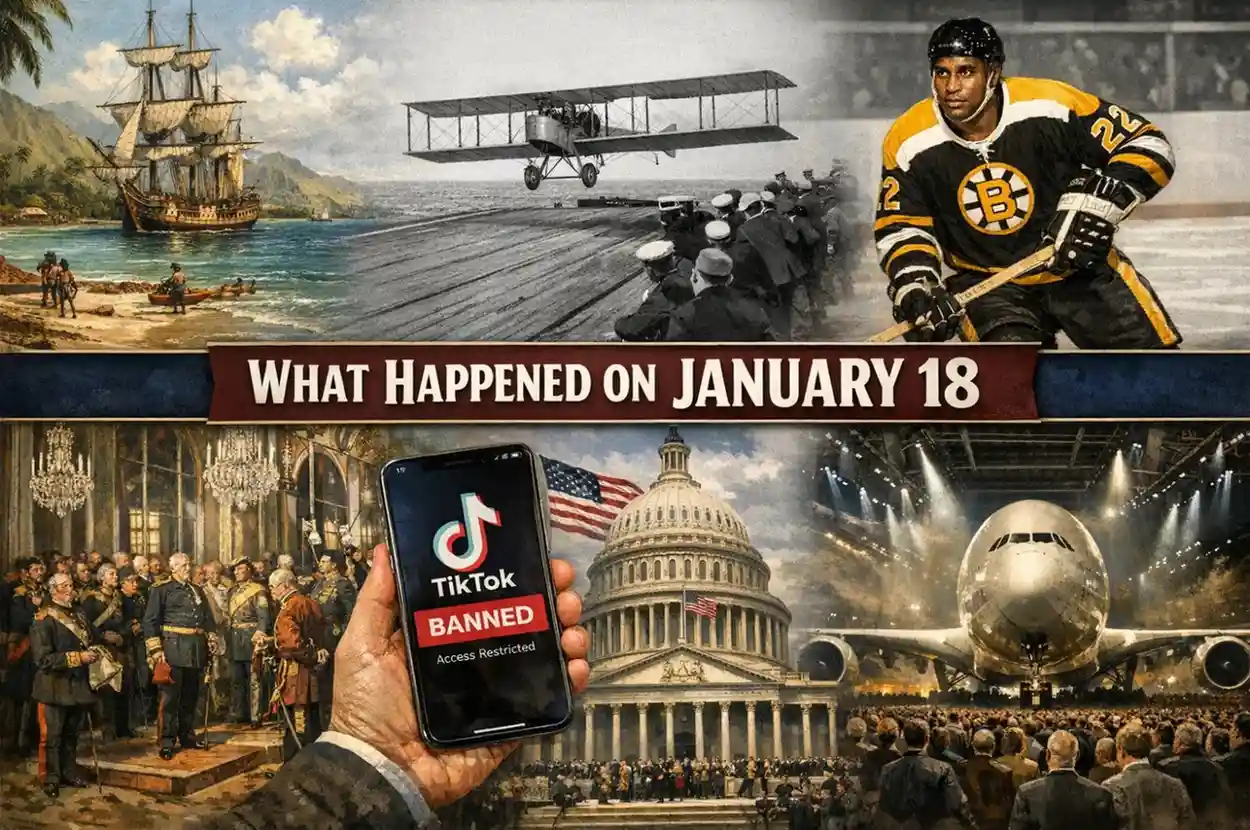
From the birth of the German Empire to the arrival of the First Fleet in Australia, this date marks moments where nations were forged and technology redefined human limits. Today, we look at what happened on this day in history January 18, exploring everything from the discovery of Hawaii to the modern digital shift of a major social media ban.
Important Events That Happened On January 18 In History
350: Magnentius Proclaimed Emperor
Dissatisfied with the rule of Emperor Constans, Roman aristocrats and military leaders threw their support behind General Magnentius. He was proclaimed emperor at Autun, forcing Constans to flee toward the Pyrenees where he was eventually killed. This power grab triggered a period of civil war within the Roman Empire as Magnentius sought to solidify his legitimacy against the remaining Constantinian dynasty.
474: Seven-Year-Old Leo II Ascends
Following the death of his maternal grandfather, Leo I, the young Leo II became the Byzantine Emperor. Because of his age, his father, Zeno, acted as co-emperor to manage the state’s affairs. His reign was tragically short, lasting only ten months before he died of an illness, leaving the throne entirely to his father and sparking a period of political instability in Constantinople.
532: Failure of the Nika Riots
The Nika riots, which had nearly toppled Emperor Justinian I, came to a bloody end in the Hippodrome of Constantinople. Imperial troops led by generals Belisarius and Mundus trapped the rioters inside and executed an estimated 30,000 people. The failure of the revolt solidified Justinian’s absolute power and allowed him to proceed with his ambitious rebuilding of the city, including the Hagia Sophia.
1126: Abdication of Emperor Huizong
Facing an imminent invasion by the Jurchen Jin forces, Emperor Huizong of the Song dynasty abdicated his throne in favor of his son, Qinzong. Huizong was a celebrated patron of the arts but was seen as a weak military leader. His attempt to pass responsibility to his son did little to save the dynasty; both were eventually captured and taken into captivity in the north.
1486: Marriage of Henry VII and Elizabeth of York
King Henry VII married Elizabeth of York at Westminster Abbey, a union specifically designed to end the Wars of the Roses. By marrying the daughter of Edward IV, Henry symbolically united the House of Lancaster and the House of York. This marriage gave birth to the Tudor dynasty and brought a long-awaited period of internal peace to the English throne.
1562: Final Session of the Council of Trent
Pope Pius IV officially reopened the Council of Trent for its third and final session. This council was the cornerstone of the Catholic Counter-Reformation, addressing the challenges posed by the Protestant Reformation. Over the following year, it clarified Catholic doctrine on the sacraments and the Bible while introducing necessary reforms to church administration and discipline.
1586: The Tenshō Earthquake Strikes Japan
A massive magnitude 7.9 earthquake struck the Chūbu region of Honshu, Japan, causing widespread devastation. The quake destroyed several castles and villages, killing an estimated 8,000 people. It also triggered a tsunami along the coast and massive landslides, one of which completely buried the town of Kaerigumo, leaving few survivors.
1670: Henry Morgan Captures Panama
Famous privateer Henry Morgan led a force of over 1,000 men to capture Panama City, one of the wealthiest Spanish ports in the Americas. After a difficult trek across the isthmus, Morgan’s men defeated the Spanish defenders and looted the city of its gold and silver. During the occupation, a fire broke out that burned the city to the ground, leading to its relocation.
1701: Frederick I Crowns Himself
In a grand ceremony at Königsberg, Frederick III, the Elector of Brandenburg, crowned himself Frederick I, “King in Prussia.” He had gained the Emperor’s permission for this title in exchange for military support. This act elevated the status of the Hohenzollern dynasty and laid the foundation for the future rise of the Prussian state as a major European power.
1778: James Cook Discovers Hawaii
During his third voyage to the Pacific, Captain James Cook became the first known European to reach the Hawaiian Islands. He initially made landfall at Kauai and named the chain the “Sandwich Islands” in honor of the Earl of Sandwich. This encounter opened the islands to Western contact, which would rapidly and permanently change Hawaiian society and politics.
1788: First Fleet Arrives at Botany Bay
The first ships of the “First Fleet,” led by Arthur Phillip, arrived at Botany Bay to establish a penal colony in Australia. The fleet carried 736 convicts from Great Britain along with marines and supplies. Finding Botany Bay unsuitable for settlement, Phillip soon moved the fleet to Port Jackson, where he established the site that would become the city of Sydney.
1806: Cape Colony Surrenders to the British
Dutch General Jan Willem Janssens officially surrendered the Cape Colony to British forces following the Battle of Blaauwberg. The British seized the territory to prevent it from falling under the control of Napoleonic France. This transition of power began over a century of British colonial rule in South Africa, deeply impacting the region’s demographic and political future.
1866: Wesley College Established
Wesley College was founded in Melbourne, Australia, as a prestigious educational institution associated with the Methodist Church. Since its opening, it has grown to become one of the most prominent schools in the country, known for its academic and sporting traditions. The college has educated many influential figures in Australian public life, including prime ministers and judges.
1871: Proclamation of the German Empire
In a move intended to humiliate France, Wilhelm I was proclaimed German Emperor (Kaiser) in the Hall of Mirrors at the Palace of Versailles. This event marked the formal unification of Germany following the North German Confederation’s victory in the Franco-Prussian War. The new empire, dominated by Prussia, shifted the entire balance of power in continental Europe.
1886: Modern Field Hockey is Born
The Hockey Association was formed in England, establishing the first standardized set of rules for field hockey. Prior to this, various versions of the game were played with differing regulations. The formation of the association allowed for organized competition and eventually led to the game’s spread throughout the British Empire and its inclusion in the Olympic Games.
1896: First Exhibition of an X-ray Machine
H. L. Smith exhibited an X-ray generating machine for the first time, demonstrating the revolutionary technology discovered by Wilhelm Röntgen. The public was fascinated by the ability to see the internal structure of the human body without surgery. This demonstration was a critical step in moving X-ray technology from a laboratory curiosity to a vital tool in medical diagnostics.
1911: First Aircraft Landing on a Ship
Eugene B. Ely made aviation history by successfully landing his Curtiss pusher airplane on a specially built platform on the deck of the USS Pennsylvania. The ship was anchored in San Francisco Bay, and Ely used a primitive system of hooks and ropes to catch the aircraft. This feat proved that ships could serve as mobile airfields, giving birth to the concept of the aircraft carrier.
1913: Naval Battle of Lemnos
During the First Balkan War, a Greek flotilla commanded by Admiral Pavlos Kountouriotis defeated the Ottoman Navy off the island of Lemnos. The Greek victory forced the Ottoman fleet to retreat to the safety of the Dardanelles and secured Greek control over the islands of the Northern Aegean. This dominance was crucial in preventing Ottoman reinforcements from reaching the front lines.
1915: Japan’s Twenty-One Demands
The Japanese government issued a secret list of “Twenty-One Demands” to the Republic of China, aiming to vastly increase Japanese influence over Chinese affairs. The demands included greater control over Manchuria, Shandong, and the Chinese economy. The move sparked widespread anti-Japanese sentiment in China and drew concern from Western powers over Japanese expansionism.
1919: Paris Peace Conference Opens
World leaders gathered at the Palace of Versailles for the opening of the Paris Peace Conference to negotiate the end of World War I. The “Big Four”—representing the US, UK, France, and Italy—led the discussions to redraw the map of Europe and the Middle East. The conference eventually produced the Treaty of Versailles, which imposed heavy reparations and territorial losses on Germany.
1919: Paderewski Becomes Polish Prime Minister
Ignacy Jan Paderewski, a world-famous pianist and composer, was appointed the first Prime Minister of the newly independent Republic of Poland. His international fame helped win diplomatic recognition for the young nation. Paderewski represented Poland at the Paris Peace Conference, working to secure the country’s borders and its place in the post-war international order.
1932: Alt Llobregat Insurrection
A revolutionary strike and insurrection broke out in the mining region of Alt Llobregat in Catalonia, Spain. Led by anarcho-syndicalists, the workers seized control of several towns and proclaimed “libertarian communism.” The Spanish government responded by sending in the military, which suppressed the uprising within a few days, leading to numerous arrests and deportations.
1941: British Counter-Offensive in East Africa
British and Commonwealth forces launched a major general counter-offensive against Italian positions in East Africa. The campaign targeted Italian-occupied Ethiopia, Eritrea, and Somaliland. Through a series of coordinated strikes, the British forces began to dismantle the Italian African empire, eventually leading to the restoration of Emperor Haile Selassie to his throne.
1943: First Warsaw Ghetto Uprising
Jewish resistance fighters in the Warsaw Ghetto launched their first armed insurrection against German forces during a wave of deportations to extermination camps. Using smuggled weapons and homemade grenades, they surprised the German troops, forcing them to temporarily halt the “action.” While small in scale, this initial resistance inspired the larger and more famous uprising that occurred months later.
1945: Liberation of Kraków
The Soviet Red Army entered and liberated the city of Kraków, Poland, during the Vistula–Oder Offensive. Unlike many other Polish cities, Kraków escaped total destruction during the German retreat, leaving much of its historic architecture intact. The liberation was a major strategic gain for the Soviets as they continued their rapid advance toward the German heartland.
1958: Willie O’Ree’s NHL Debut
Willie O’Ree became the first Black player in National Hockey League history when he suited up for the Boston Bruins in a game against the Montreal Canadiens. Despite facing racial taunts and having lost 95% of his vision in one eye from a previous injury, O’Ree played a strong game. His debut broke the color barrier in professional hockey, paving the way for future generations of Black athletes.
1960: Crash of Capital Airlines Flight 20
A Vickers Viscount operated by Capital Airlines crashed into a farm in Charles City County, Virginia, during a flight from Washington D.C. to Norfolk. All 50 people on board were killed when the plane’s engines failed due to icing, leading to a loss of control. It was the third fatal crash for the airline in as many years, leading to increased scrutiny of its safety protocols.
1967: Conviction of the “Boston Strangler”
Albert DeSalvo was convicted on several counts of sexual assault and robbery and sentenced to life in prison. While he had confessed to being the “Boston Strangler”—responsible for the murders of 13 women—he was never actually tried for those killings due to a lack of physical evidence at the time. His case remains one of the most famous and debated in American criminal history.
1969: United Airlines Flight 266 Crash
Just minutes after taking off from Los Angeles International Airport, United Airlines Flight 266 crashed into Santa Monica Bay. All 38 people on board were killed when the Boeing 727 suffered an engine fire followed by a total loss of electrical power. The investigation led to improved fire detection systems and cockpit instrumentation for the 727 fleet.
1972: Mukti Bahini Lay Down Arms
A month after the end of the Bangladesh Liberation War, members of the Mukti Bahini (freedom fighters) formally laid down their arms in a ceremony at Dhaka. This transition from a revolutionary militia to a civilian status was a critical step in the stabilization of the newly independent nation. It signaled the beginning of the reconstruction phase under the leadership of Sheikh Mujibur Rahman.
1974: Israeli-Egyptian Disengagement
Following the Yom Kippur War, Israel and Egypt signed a Disengagement of Forces agreement mediated by US Secretary of State Henry Kissinger. The deal established a buffer zone in the Sinai Peninsula and led to a partial withdrawal of Israeli troops. This “shuttle diplomacy” success was the first major step toward the eventual peace treaty between the two nations years later.
1976: Karantina Massacre in Beirut
During the early stages of the Lebanese Civil War, Christian militias attacked and overran the Karantina district of Beirut, a largely Palestinian and Muslim slum. At least 1,000 people were killed in the assault, and the area was burned to the ground. The massacre triggered a brutal retaliatory attack on the town of Damour, deepening the sectarian violence that ravaged Lebanon for years.
1977: Discovery of the Legionnaires’ Bacterium
Scientists at the CDC announced they had finally identified a previously unknown bacterium, named Legionella pneumophila, as the cause of the mysterious illness that struck an American Legion convention. The discovery ended months of speculation and fear following the deaths of 29 attendees. This breakthrough allowed for the development of targeted treatments and improved ventilation safety standards.
1977: Granville Rail Disaster
Australia’s worst rail disaster occurred in Sydney when a crowded commuter train derailed and struck the supports of a heavy concrete road bridge. The bridge collapsed onto the carriages, crushing many passengers instantly and killing 83 people. The tragedy led to a massive overhaul of railway safety, bridge design, and emergency response procedures across Australia.
1977: Death of Džemal Bijedić
The Prime Minister of Yugoslavia, Džemal Bijedić, was killed along with his wife and six others when their plane crashed into a mountainside in Bosnia and Herzegovina. The crash occurred during a blizzard as the aircraft was attempting to land at Sarajevo. Bijedić was a close ally of President Josip Broz Tito, and his sudden death was a significant loss to the Yugoslav political leadership.
1978: ECHR Ruling on Northern Ireland
The European Court of Human Rights issued a landmark ruling regarding the treatment of detainees by British authorities in Northern Ireland. The court found the UK government guilty of “inhuman and degrading treatment”—specifically through the use of the “five techniques” of sensory deprivation—but stopped short of a “torture” conviction. The ruling forced a change in British interrogation policies.
1981: First “Grand Slam” of BASE Jumping
Phil Smith and Phil Mayfield became the first people to complete BASE jumps from all four required categories: Buildings, Antennae, Spans (bridges), and Earth (cliffs). Their final jump was from a Houston skyscraper, marking the official birth of BASE jumping as a recognized extreme sport. The acronym B.A.S.E. was coined to celebrate these four specific types of exit points.
1983: Jim Thorpe’s Medals Restored
The International Olympic Committee (IOC) officially restored the Olympic gold medals won by Jim Thorpe in the 1912 pentathlon and decathlon. Thorpe had been stripped of his medals in 1913 because he had previously played professional baseball, violating the era’s strict amateurism rules. After decades of campaigning by his family, the IOC recognized him as the sole winner of both events.
1886: Guatemala Plane Crash
An Aerovías Sud Aviation Caravelle crashed into the jungle while on approach to Mundo Maya International Airport in Flores, Petén. All 94 people on board were killed in what remains the deadliest aviation accident in Guatemalan history. The investigation cited poor visibility and pilot error during the approach as the primary causes of the disaster.
1988: China Southwest Airlines Flight 4146
During a flight from Ganzhou to Chongqing, a China Southwest Airlines Ilyushin Il-18 crashed after an engine caught fire. All 108 people on board were killed when the crew lost control of the aircraft during the emergency. The crash led to the immediate grounding of the airline’s remaining Il-18 fleet and a review of maintenance procedures for older Soviet-built aircraft.
1990: Arrest of Mayor Marion Barry
In a high-profile FBI sting operation, Washington, D.C., Mayor Marion Barry was arrested for drug possession at the Vista International Hotel. The arrest was captured on video, showing the mayor smoking crack cocaine. Despite the scandal and a subsequent prison sentence, Barry remained a popular and influential figure, eventually being re-elected to the mayor’s office years later.
1993: MLK Day Observed in All 50 States
For the first time since the holiday was established in 1986, Martin Luther King, Jr. Day was officially observed by all 50 US states. Arizona and New Hampshire were among the last states to recognize the holiday at the state level. This universal observance marked a milestone in the national recognition of Dr. King’s legacy and the civil rights movement.
2002: Sierra Leone Civil War Declared Over
In a symbolic ceremony, President Ahmad Tejan Kabbah declared the decade-long Sierra Leone Civil War to be officially over. The conflict, known for its extreme brutality and the use of “blood diamonds” to fund rebel forces, had claimed tens of thousands of lives. The declaration followed a successful UN-led disarmament process and paved the way for national elections and reconstruction.
2003: Canberra Bushfires
A series of massive bushfires fueled by extreme heat and high winds swept through the suburbs of Canberra, Australia’s capital city. The fires killed four people and destroyed over 500 homes, including the historic Mount Stromlo Observatory. The disaster led to a major inquiry into land management and fire preparedness in the Australian Capital Territory.
2005: Unveiling of the Airbus A380
The world’s largest commercial jet, the Airbus A380, was officially unveiled at a grand ceremony in Toulouse, France. Heads of state from across Europe attended the event to celebrate the double-decker aircraft, which was designed to carry over 500 passengers. The A380 represented a massive technological gamble by Airbus to dominate the future of long-haul air travel.
2007: Cyclone Kyrill Hits Europe
One of the most powerful storms in decades, Cyclone Kyrill, tore across Western Europe, causing widespread destruction and at least 44 deaths. In the UK, it was the strongest storm in 17 years, while Germany experienced its worst weather since 1999. The storm caused massive power outages, grounded thousands of flights, and forced the closure of major rail networks.
2008: Return of the Euphronios Krater
The Euphronios Krater, an ancient Greek vase considered one of the finest examples of red-figure pottery, was unveiled in Rome after being returned by the Metropolitan Museum of Art. The vase had been looted from an Etruscan tomb in the 1970s and sold to the Met. Its return was a major victory for Italy in its effort to reclaim stolen cultural heritage from international museums.
2012: Global SOPA/PIPA Protest
In one of the largest coordinated online protests in history, over 115,000 websites—including Wikipedia, Reddit, and Google—engaged in a “blackout” or displayed protest banners. The action targeted the proposed US Stop Online Piracy Act (SOPA) and the Protect IP Act (PIPA). Critics argued the laws would lead to internet censorship, and the protest successfully led to the bills being shelved.
2018: Kazakhstan Bus Fire
A passenger bus traveling on a remote road in the Yrgyz District of Kazakhstan caught fire, killing 52 people. Most of the victims were Uzbek citizens traveling to Russia for work. Only five people, including the drivers, managed to escape the blaze. The tragedy was attributed to the use of an open-flame heater inside the bus to combat the extreme winter cold.
2019: Tlahuelilpan Pipeline Explosion
A massive explosion occurred at an illegally tapped fuel pipeline in Tlahuelilpan, Mexico, while hundreds of people were gathering to collect leaking gasoline. The blast killed 137 people and injured dozens more. The disaster highlighted the dangers of fuel theft in Mexico and led to a government crackdown on the criminal gangs involved in “huachicoleo.”
2023: Ukraine Helicopter Crash
A State Emergency Service helicopter crashed in a residential area of Brovary, near Kyiv, killing 14 people including the Ukrainian Interior Minister, Denys Monastyrsky. The crash damaged a kindergarten and several apartment buildings, causing civilian casualties on the ground. The loss of top leadership was a significant blow to the Ukrainian government during the ongoing conflict with Russia.
2025: TikTok Banned in the United States
Following the expiration of a deadline set by the Protecting Americans from Foreign Adversary Controlled Applications Act (PAFACA), the social media app TikTok was officially banned in the United States. The law required the app’s parent company, ByteDance, to divest its US operations or face a nationwide block. The ban sparked intense legal battles and a major shift in the American social media landscape.
2026: Adamuz Train Collision
In what became the worst railway disaster in Spain in over a decade, two trains collided near the town of Adamuz in the province of Córdoba. At least 42 people were killed and nearly 300 others were injured in the high-impact crash. Emergency services from across the region were deployed to the site as investigators began looking into signaling failures as a potential cause of the tragedy.
Read Also: What Happened On This Day In History January 17
Famous People Born On January 18
| Name | Role / Short Note | Dates |
|---|---|---|
| Veerappan | Indian bandit and poacher | 1952 – 2004 |
| N.T. Rama Rao | Indian actor & politician | 1923 – 1996 |
| John Boorman | British director | 1933 – |
| Henri Giraud | French military officer | 1879 – 1949 |
| Anthony Giddens | British sociologist | 1938 – |
| Philippe Starck | French designer | 1949 – |
| Paul Keating | Australian prime minister | 1944 – |
| Yoichiro Nambu | American physicist | 1921 – 2015 |
| Rubén Darío | Nicaraguan poet | 1867 – 1916 |
| Curt Flood | American baseball player | 1938 – 1997 |
| Jacob Bronowski | British mathematician & scientist | 1908 – 1974 |
| Kiki Smith | American artist | 1954 – |
| John Hume | Irish leader | 1937 – 2020 |
| Arthur Ransome | English author | 1884 – 1967 |
| Mahadev Govind Ranade | Indian reformer & judge | 1842 – 1901 |
| Sir Edmund Barton | Australian statesman | 1849 – 1920 |
| Paul Ehrenfest | Austrian physicist | 1880 – 1933 |
| César Cui | Russian composer | 1835 – 1918 |
| Emmanuel Chabrier | French composer | 1841 – 1894 |
| Peter Mark Roget | English physician & lexicographer | 1779 – 1869 |
| Francesco Caracciolo | Italian admiral | 1752 – 1799 |
| Charles Gavan Power | Canadian politician | 1888 – 1968 |
| Gaston Gallimard | French publisher | 1881 – 1975 |
| William Sansom | British writer | 1912 – 1976 |
| Sir Thomas Octave Murdoch Sopwith | British aircraft designer | 1888 – 1989 |
| Seth Low | American educator | 1850 – 1916 |
| Arno Schmidt | German author | 1914 – 1979 |
| José María Arguedas | Peruvian author | 1911 – 1969 |
| Sir Edward Frankland | British chemist | 1825 – 1899 |
| Antoine Pevsner | French sculptor | 1886 – 1962 |
Famous People Died On January 18
| Name | Role / Short Note | Dates |
|---|---|---|
| Michel Tournier | French novelist | 1924 – 2016 |
| Laurent Kabila | President of DRC | 1939 – 2001 |
| Sir Cecil Beaton | British photographer & designer | 1904 – 1980 |
| Jan van Riebeeck | Dutch colonial administrator | 1619 – 1677 |
| Bruce Chatwin | British author | 1940 – 1989 |
| Edward Bulwer-Lytton | British novelist | 1803 – 1873 |
| Amadeus | King of Spain | 1845 – 1890 |
| Hugh Gaitskell | British politician | 1906 – 1963 |
| Alfred Lewis Vail | American scientist | 1807 – 1859 |
| Juliette Gordon Low | Founder of Girl Scouts | 1860 – 1927 |
| Pietro Bembo | Italian cardinal & writer | 1470 – 1547 |
| David O. McKay | American religious leader | 1873 – 1970 |
| Konstantin Päts | President of Estonia | 1874 – 1956 |
| Adolf Butenandt | German biochemist | 1903 – 1995 |
| John George | Elector of Brandenburg | 1525 – 1598 |
| Bartolomé Mitre | Argentine president | 1821 – 1906 |
| Sa’id Pasha | Ottoman viceroy of Egypt | 1822 – 1863 |
| Thomas Anthony Dooley | American physician | 1927 – 1961 |
| O.G. Rejlander | Swedish photographer | 1813 – 1875 |
| Leonor Fini | Argentine-born artist | 1907 – 1996 |
| Henry Howard Kessler | American surgeon | 1896 – 1978 |
| André Leon Talley | American fashion editor | 1948 – 2022 |
| Glenn Frey | American musician | 1948 – 2016 |
| R. Sargent Shriver | American politician & diplomat | 1915 – 2011 |
| Charles Lanrezac | French general | 1852 – 1925 |
| Abram Stevens Hewitt | NYC mayor | 1822 – 1903 |
| Victor Alexander Bruce | British viceroy of India | 1849 – 1917 |
| Carl Zuckmayer | German playwright | 1896 – 1977 |
| Peter Abrahams | South African author | 1919 – 2017 |
Observances & Institutional Dates
- Royal Thai Armed Forces Day (Thailand): A day of parades and ceremonies to honor the service and history of Thailand’s military branches.
- Martin Luther King, Jr. Day (USA): Often falling on or near January 18, this day commemorates the life and civil rights work of Dr. King.
Frequently Asked Questions
Which US city saw its mayor arrested in a drug sting on January 18, 1890?
Washington, D.C. Mayor Marion Barry was arrested by the FBI at the Vista International Hotel.
When was the first aircraft landing on a ship achieved?
Eugene B. Ely landed on the USS Pennsylvania on January 18, 1911, marking a major milestone for naval aviation.
Which historic peace conference began on this day in 1919?
The Paris Peace Conference opened at Versailles to negotiate the treaties ending World War I.