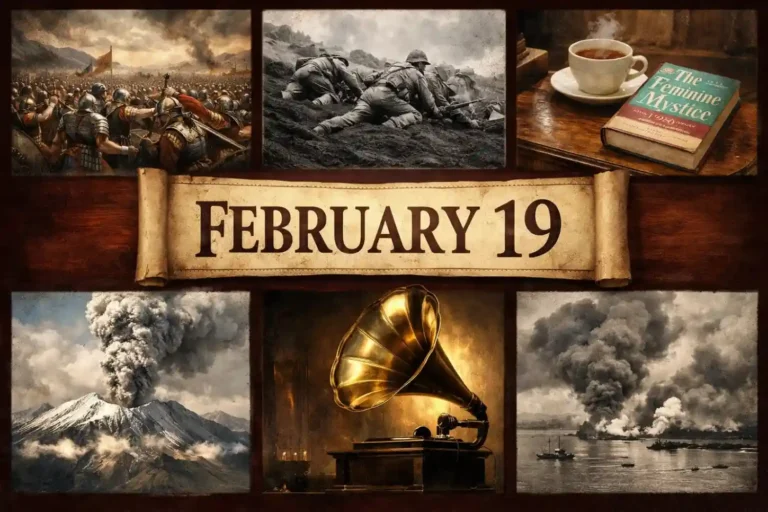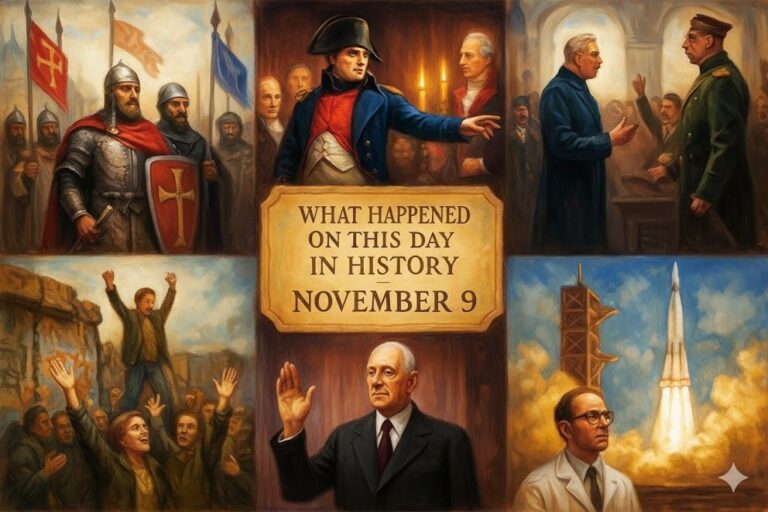

History is often written through the lens of bold defiance and sky-high ambitions, and January 4 is a testament to both. To truly grasp what happened on this day in history January 4, we must look toward the fall of Sputnik, the liberation of Sofia, and the opening of the world’s tallest skyscraper in the heart of Dubai.
Important Events That Happened On January 4 In History
46 BC: The Battle of Ruspina
In the North African desert, Julius Caesar found himself in a precarious position during the Battle of Ruspina. Facing his former lieutenant, Titus Labienus, Caesar was forced to navigate a tactical challenge against a superior force of Numidian cavalry. This engagement was a critical moment in the Roman Civil War, highlighting Caesar’s resilience under extreme pressure.
871: The Battle of Reading
The Great Heathen Army of Danish invaders dealt a heavy blow to the Anglo-Saxons during the Battle of Reading. King Æthelred of Wessex and his younger brother, Alfred the Great, led their forces in an attempt to dislodge the Vikings from their fortified camp. Despite their bravery, the English brothers were forced into a retreat, setting the stage for more bloody conflicts to follow.
1642: King Charles I Fails to Arrest Parliamentarians
In a move that accelerated the onset of the English Civil War, King Charles I entered the House of Commons with 400 soldiers. He intended to arrest five members of Parliament for treason, but the men had already fled after receiving a secret tip-off. Seeing the empty benches, the King famously remarked, “I see the birds have flown,” forever damaging his relationship with the legislature.
1649: The Rump Parliament Votes to Trial the King
The English Civil War reached a point of no return as the Rump Parliament passed an ordinance to put King Charles I on trial. This radical decision marked the first time a reigning monarch was legally challenged by their own government for high crimes. It was a staggering blow to the “Divine Right of Kings” and led directly to the establishment of a republic.
1717: The Formation of the Triple Alliance
The Netherlands, Great Britain, and France came together to sign the Triple Alliance, a treaty designed to maintain European peace. By joining forces, these three nations sought to uphold the terms of the Treaty of Utrecht and check the territorial ambitions of Spain. This diplomatic union reshaped the balance of power in the early 18th century.
1762: Britain Enters the Seven Years’ War Against Spain
Tensions between global empires reached a boiling point when Great Britain officially declared war on Spain. This move drew Spain into the existing Seven Years’ War, expanding the conflict into a truly worldwide struggle for colonial dominance. The declaration paved the way for British naval expeditions against Spanish territories in the Caribbean and the Philippines.
1798: Prince Constantine Hangerli Arrives in Bucharest
Wallachia received a new ruler as Constantine Hangerli arrived in Bucharest to begin his reign as Prince. Invested by the Ottoman Empire, Hangerli’s tenure was marked by the complexities of ruling a territory under the shadow of the Sultan. His arrival signaled another chapter in the intricate political dance between the Balkan principalities and the Sublime Porte.
1844: The Founding of the Saima Newspaper
J. V. Snellman, a champion of Finnish culture and language, published the first issue of the Saima newspaper in Kuopio. Writing primarily in Swedish but advocating for Finnish identity, Snellman used the platform to stir national consciousness and social reform. The paper became a vital voice for the intellectual growth of Finland during the 19th century.
1853: Solomon Northup Regains His Freedom
After twelve agonizing years of being kidnapped and held in illegal bondage, Solomon Northup finally regained his freedom in a courtroom in Louisiana. A free Black man from New York, Northup’s rescue became a sensation and a powerful tool for the abolitionist movement. His subsequent memoir, Twelve Years a Slave, remains one of the most significant accounts of the American slave trade.
1854: The Discovery of the McDonald Islands
Captain William McDonald, sailing aboard the Samarang, sighted a remote and desolate group of islands in the Southern Ocean. These sub-antarctic landmasses, now known as the McDonald Islands, were a rare discovery in the late era of maritime exploration. They remain an important site for geological study due to their active volcanic nature.
1863: Establishment of the New Apostolic Church
In the city of Hamburg, Germany, the New Apostolic Church was officially established as a distinct Christian denomination. Emerging from the Catholic Apostolic movement, the church emphasized the restoration of the office of the Apostle. Its chiliastic teachings focused on the preparation of believers for the imminent second coming of Christ.
1878: The Liberation of Sofia
During the Russo-Turkish War, Russian forces entered Sofia, ending five centuries of Ottoman rule over the city. The liberation was met with jubilation by the local Bulgarian population and became a cornerstone of modern Bulgarian history. Sofia was soon designated as the capital of the newly reborn Bulgarian state.
1884: The Fabian Society is Founded
A group of intellectuals in London founded the Fabian Society with the goal of advancing the principles of democratic socialism. Unlike more radical groups, the Fabians advocated for gradual, reformist change rather than violent revolution. Their influence would eventually play a foundational role in the creation of the British Labour Party.

1885: The Battle of Núi Bop
French troops under General Oscar de Négrier achieved a tactical victory against the Qing Dynasty forces in northern Vietnam. Despite being outnumbered, the French utilized superior discipline and firepower to secure their position during the Sino-French War. The engagement was part of a broader struggle for French colonial control over the Tonkin region.
1896: Utah Becomes the 45th State
After decades of tension and multiple petitions for statehood, Utah was finally admitted as the 45th state in the Union. The path to statehood required the territory to address federal concerns regarding the practice of polygamy and religious governance. Its admission marked a significant milestone in the westward expansion and stabilization of the United States.
1903: The Electrocution of Topsy the Elephant
In a grim spectacle at Coney Island’s Luna Park, an elephant named Topsy was put to death via high-voltage electricity. The event was filmed by the Edison Manufacturing Company and has often been incorrectly cited as a demonstration by Thomas Edison against alternating current. Topsy’s death remains a dark example of animal cruelty in early 20th-century entertainment.
1909: Aeneas Mackintosh’s Narrow Escape
During the Imperial Trans-Antarctic Expedition, explorer Aeneas Mackintosh faced a life-threatening situation on the frozen southern continent. While attempting to traverse unstable ice floes, he narrowly avoided a fatal fall into the frigid waters. His survival allowed him to continue his vital work in support of the expedition’s broader goals.
1912: Incorporation of the Scout Association
The Scout Association was formally incorporated across the British Empire through the granting of a royal charter. This move provided official recognition and a unified structure for the scouting movement founded by Robert Baden-Powell. It solidified the organization’s mission to develop character and citizenship among young people worldwide.
1918: International Recognition of Finnish Independence
Following its declaration of independence from Russia, the young nation of Finland received critical diplomatic recognition from several world powers. Russia, Sweden, Germany, and France all formally acknowledged Finland as a sovereign state on this day. This wave of recognition was essential for the survival and legitimacy of the Finnish Republic.
1944: Operation Carpetbagger Begins
The United States Army Air Forces launched Operation Carpetbagger, a secret mission to drop supplies and agents behind enemy lines in occupied Europe. Flying modified B-24 Liberators painted black for night operations, crews delivered weapons to resistance fighters in France, Italy, and the Low Countries. The operation was instrumental in weakening Nazi control from within.
1946: A Deadly Tornado Outbreak
A “disastrous” three-day tornado outbreak began across the south-central United States, leaving a trail of ruin in its wake. Over the course of the event, 41 people were killed as powerful twisters leveled homes and businesses. The scale of the destruction highlighted the urgent need for better storm warning systems in the mid-20th century.
1948: Burma Gains Independence
The nation of Burma (now Myanmar) officially ended more than sixty years of British colonial rule, becoming an independent republic. Unlike many other former British colonies, Burma chose not to join the Commonwealth of Nations. Sao Shwe Thaik was inaugurated as the first president, marking the start of a new era of self-rule.
1951: The Fall of Seoul During the Korean War
For the second time in the conflict, Chinese and North Korean forces captured the city of Seoul. The South Korean capital was abandoned by UN forces as they retreated southward to establish a new defensive line. The city changed hands four times during the war, suffering immense damage and displacement of its civilian population.
1956: Formation of the National Radical Union
In Greece, politician Konstantinos Karamanlis founded the National Radical Union (ERE), a conservative political party. The party was established to provide a stable governing platform during a period of reconstruction and economic growth. Karamanlis would go on to serve multiple terms as Prime Minister, leaving a lasting impact on Greek politics.
1958: Sputnik 1 Falls to Earth
The world’s first artificial satellite, Sputnik 1, met its end as it re-entered Earth’s atmosphere and burned up. Launched by the Soviet Union in October 1957, the small sphere had spent three months in orbit, signaling the start of the Space Race. Its final descent marked the conclusion of a mission that forever changed human technology.
1959: Luna 1 Reaches the Moon’s Vicinity
The Soviet Union’s Luna 1 spacecraft achieved a historic milestone by becoming the first man-made object to reach the vicinity of the Moon. While it did not impact the lunar surface as planned, it flew within 6,000 kilometers of it before entering a solar orbit. The mission provided the first direct measurements of the solar wind.
1965: Aeroflot Flight 101/X-20 Disaster
A tragic aviation accident occurred in Kazakhstan as an Aeroflot Ilyushin Il-18 crashed while attempting to land at Alma-Ata Airport. Low visibility and poor weather conditions contributed to the disaster, which claimed the lives of 64 people on board. It was one of several major accidents that led to increased safety scrutiny for the Soviet airline.
1972: Rose Heilbron’s Historic Appointment
Rose Heilbron became the first female judge to preside over cases at the Old Bailey, London’s Central Criminal Court. Already a pioneer as one of the first women to be appointed King’s Counsel, her presence on the bench was a landmark for gender equality in the British legal system. She was known for her brilliant mind and formidable presence in the courtroom.
1975: The TOPS-10 Date Overflow Bug
Decades before the famous Y2K scare, computer systems running the TOPS-10 operating system faced a “date overflow” crisis. The 12-bit field used for tracking dates reached its limit, causing numerous system crashes and malfunctions. Engineers had to scramble to develop an alternative format to keep critical systems operational.
1976: Violence Flares in Northern Ireland
The Troubles saw a horrific surge in violence as members of the Ulster Volunteer Force shot and killed six Irish Catholic civilians in County Armagh. The massacre triggered a cycle of retaliation, with ten Protestant civilians being killed the very next day. This dark period underscored the deep-seated sectarian tensions that plagued the region for decades.
1987: The Maryland Train Collision
In one of the deadliest accidents in Amtrak’s history, a passenger train en route to Boston collided with Conrail freight engines in Chase, Maryland. The impact resulted in 16 deaths and over 160 injuries. Investigators discovered that the Conrail crew had bypassed safety signals and had traces of marijuana in their systems, leading to major federal safety reforms.
1989: The Second Gulf of Sidra Incident
Tensions between the United States and Libya turned into a combat engagement over the Mediterranean Sea. A pair of US Navy F-14 Tomcats from the USS John F. Kennedy shot down two Libyan MiG-23s after the Libyan jets made aggressive maneuvers. The incident highlighted the volatile relationship between the two nations during the Reagan era.
1990: Pakistan’s Deadliest Train Disaster
A horrific collision occurred in Sangi, Pakistan, when an overloaded passenger train smashed into a stationary empty freight train. The accident resulted in 307 deaths and hundreds of injuries, making it the worst rail disaster in the country’s history. Overcrowding and a failure in signal switching were cited as the primary causes of the tragedy.
1998: The Great North American Ice Storm
A massive and persistent ice storm began to batter eastern Canada and the northeastern United States. The freezing rain caused widespread power outages, collapsed transmission towers, and led to the deaths of dozens of people. It remains one of the most expensive and destructive natural disasters in the history of the region.
1999: Jesse Ventura Sworn In as Governor
In a political upset that stunned the nation, former professional wrestler and actor Jesse “The Body” Ventura was sworn in as the 38th Governor of Minnesota. Running as a member of the Reform Party, Ventura’s victory signaled a wave of voter frustration with the traditional two-party system. His tenure was marked by a unique, plain-spoken approach to governance.
2000: The Åsta Train Accident
Norway experienced a tragic railway disaster when two passenger trains collided head-on in the municipality of Åmot. The accident killed 19 people and injured dozens more, leading to a fire that complicated rescue efforts. Subsequent investigations focused on the lack of automatic train control systems on that specific stretch of track.
2004: NASA’s Spirit Rover Lands on Mars
The robotic explorer Spirit successfully touched down on the Martian surface, initiating a mission that would far outlast its original 90-day life expectancy. Landing in Gusev Crater, the rover began searching for evidence of past water activity. Its success, along with its twin Opportunity, revolutionized our understanding of the Red Planet.
2004: Mikheil Saakashvili Wins Georgian Presidency
Following the peaceful “Rose Revolution” that ousted the previous government, Mikheil Saakashvili was overwhelmingly elected as the President of Georgia. His rise to power was seen as a major victory for pro-Western and anti-corruption movements in the Caucasus. He promised to modernize the nation and seek closer ties with NATO and the European Union.
2006: Ehud Olmert Becomes Acting PM of Israel
Ehud Olmert assumed the role of acting Prime Minister of Israel after Ariel Sharon suffered a massive and debilitating stroke. Olmert stepped in during a period of significant regional instability and political transition. He would eventually lead his party to victory in the subsequent general election, becoming the permanent Prime Minister.
2007: Nancy Pelosi Becomes the First Female Speaker
The 110th United States Congress made history by electing Nancy Pelosi as the Speaker of the House. As the first woman to hold the position, she became the highest-ranking female politician in American history at that time. Her election was a milestone for female representation in the halls of government.
2008: Plane Crash in the Los Roques Archipelago
A Let L-410 Turbolet carrying 14 people disappeared while flying from Caracas to the Los Roques islands in Venezuela. The aircraft crashed into the Caribbean Sea, resulting in no survivors. The wreckage was not located until years later, leaving the families of the victims in a long state of uncertainty.
2010: The Grand Opening of the Burj Khalifa
Dubai officially inaugurated the Burj Khalifa, the tallest building ever constructed by mankind. Standing at a staggering height of 828 meters, the needle-like skyscraper became a global icon of architecture and engineering. The opening ceremony featured a massive fireworks display and solidified Dubai’s status as a world-class city.
2013: The Kawit Rampage
A tragic mass shooting occurred in the town of Kawit in the Philippines when a gunman went on a house-to-house rampage. Eight people were killed, including children, before the perpetrator was fatally shot by responding police officers. The incident led to renewed national debates regarding gun control and public safety in the Philippines.
2018: The Hennenman–Kroonstad Train Crash
In South Africa’s Free State province, a passenger train collided with a truck that had failed to stop at a level crossing. The impact caused several carriages to derail and catch fire, resulting in 20 deaths and hundreds of injuries. The tragedy was one of the worst rail accidents in South Africa’s modern history.
2019: The Koszalin Escape Room Fire
A birthday celebration turned into a tragedy in Koszalin, Poland, when a fire broke out in an “escape room” entertainment venue. Five teenage girls died from carbon monoxide poisoning because the room lacked a proper emergency exit. The incident prompted a nationwide crackdown and safety inspection of similar venues across Europe.
Check Also: What Happened On This Day In History January 3: Powerful Tails
Famous People Born On January 4
| Name | Role / Short Note | Dates |
|---|---|---|
| John McLaughlin | British jazz-rock guitarist & bandleader | January 4, 1942 – |
| Floyd Patterson | American boxer, two-time heavyweight champion | January 4, 1935 – May 11, 2006 |
| Jacob Ludwig Carl Grimm | German folklorist, Brothers Grimm | January 4, 1785 – September 20, 1863 |
| Doris Kearns Goodwin | American historian & author | January 4, 1943 – |
| Benjamin Rush | American statesman, Founding Father | January 4, 1746 – April 19, 1813 |
| General Tom Thumb | American showman, Barnum star | January 4, 1838 – July 15, 1883 |
| Giovanni Battista Pergolesi | Italian composer (La serva padrona) | January 4, 1710 – March 16, 1736 |
| Everett McKinley Dirksen | U.S. senator, Republican leader | January 4, 1896 – September 7, 1969 |
| Gao Xingjian | Chinese-French writer, Nobel laureate | January 4, 1940 – |
| James Ussher | Anglican archbishop & chronologist | January 4, 1581 – March 21, 1656 |
| Carlos Saura | Spanish film director | January 4, 1932 – February 10, 2023 |
| C. L. R. James | Caribbean writer & political theorist | January 4, 1901 – May 31, 1989 |
| Augustus John | Welsh painter & portraitist | January 4, 1878 – October 31, 1961 |
| Marsden Hartley | American modernist painter | January 4, 1877 – September 2, 1943 |
| Brian D. Josephson | British physicist, Nobel laureate | January 4, 1940 – |
| André Masson | French Surrealist artist | January 4, 1896 – October 28, 1987 |
| Helmut Jahn | German-American architect | January 4, 1940 – May 8, 2021 |
| Carter Glass | U.S. senator, Glass-Steagall Act | January 4, 1858 – May 28, 1946 |
| Sir Isaac Pitman | Inventor of Pitman shorthand | January 4, 1813 – January 12, 1897 |
| Richard R. Schrock | American chemist, Nobel laureate | January 4, 1945 – |
| Katsura Tarō | Prime minister of Japan | January 4, 1848 – October 10, 1913 |
| Leroy Randle Grumman | Founder of Grumman Aircraft | January 4, 1895 – October 4, 1982 |
| Wilhelm Lehmbruck | German Expressionist sculptor | January 4, 1881 – March 25, 1919 |
| Armin Zöggeler | Italian Olympic luger | January 4, 1974 – |
| Dominique Vivant Denon | French artist & Louvre founder | January 4, 1747 – April 27, 1825 |
| Nūbār Pasha | Prime minister of Egypt | January 4, 1825 – January 14, 1899 |
| Louis-Lucien Bonaparte | French linguist & politician | January 4, 1813 – November 3, 1891 |
| Karl Humann | Archaeologist of Pergamon | January 4, 1839 – April 12, 1896 |
| Benjamin Lundy | American abolitionist | January 4, 1789 – August 22, 1839 |
| Wilhelm Beer | German astronomer, lunar mapping | January 4, 1797 – March 27, 1850 |
Famous People Died On January 4
| Name | Role / Short Note | Dates |
|---|---|---|
| Christopher Isherwood | British-American novelist | August 26, 1904 – January 4, 1986 |
| Moses Mendelssohn | Jewish Enlightenment philosopher | September 26, 1729 – January 4, 1786 |
| Donald Malcolm Campbell | British speed-record pioneer | March 23, 1921 – January 4, 1967 |
| Ferdinand I | King of the Two Sicilies | 1751 – January 4, 1825 |
| Martinus J. G. Veltman | Dutch physicist, Nobel laureate | June 27, 1931 – January 4, 2021 |
| Harold Edgerton | Engineer, high-speed photography | April 6, 1903 – January 4, 1990 |
| Alfred von Schlieffen | German general, Schlieffen Plan | February 28, 1833 – January 4, 1913 |
| Fay Weldon | British novelist & playwright | September 22, 1931 – January 4, 2023 |
| Charles d’Orléans | French poet & duke | November 24, 1394 – January 4, 1465 |
| Joan Aiken | British fantasy author | September 4, 1924 – January 4, 2004 |
| Benito Pérez Galdós | Spanish novelist | May 10, 1843 – January 4, 1920 |
| Irving Layton | Canadian poet | March 12, 1912 – January 4, 2006 |
| Mary Mahoney | First Black professional nurse | May 7, 1845 – January 4, 1926 |
| Stephen Hales | English scientist & physiologist | 1677 – January 4, 1761 |
| Aharon Appelfeld | Israeli Holocaust novelist | February 16, 1932 – January 4, 2018 |
| Kaj Munk | Danish playwright & resistance figure | January 13, 1898 – January 4, 1944 |
| Constant Permeke | Belgian Expressionist artist | July 31, 1886 – January 4, 1952 |
| Louis-Léopold Boilly | French genre painter | July 5, 1761 – January 4, 1845 |
| Sir Alliott Verdon Roe | British aviation pioneer | April 26, 1877 – January 4, 1958 |
| Theodor Körner | President of Austria | April 24, 1873 – January 4, 1957 |
| Rosi Mittermaier | German Olympic skier | August 5, 1950 – January 4, 2023 |
| Pierre-Jean David d’Angers | French sculptor | March 12, 1789 – January 4, 1856 |
| Sancho II | King of Portugal | 1207 – January 4, 1248 |
| Muzio Attendolo Sforza | Italian condottiere | May 8, 1369 – January 4, 1424 |
| Clarence Edward Dutton | American geologist | May 15, 1841 – January 4, 1912 |
| Sol Tax | American anthropologist | October 30, 1907 – January 4, 1995 |
| Thomas Rickman | Gothic Revival architect | June 8, 1776 – January 4, 1841 |
| Carl Shipp Marvel | Polymer chemist | September 11, 1894 – January 4, 1988 |
| William Conyngham Plunket | Irish lawyer & statesman | July 1, 1764 – January 4, 1854 |
| Charlotte E. Ray | First Black woman lawyer (U.S.) | January 13, 1850 – January 4, 1911 |
Observances & Institutional Dates
- World Braille Day: Celebrating the birth of Louis Braille and the importance of the reading system for the visually impaired.
- Independence Day (Myanmar): Commemorating the nation’s formal break from British rule in 1948.
- Day of the Martyrs (DR Congo): Honoring those who died in the struggle for independence.
- Tokyo Dome Show: The massive “Wrestle Kingdom” event that draws thousands of wrestling fans to Japan every year.
Frequently Asked Questions
Which US state was admitted to the Union on January 4?
Utah became the 45th state of the United States on January 4, 1896.
When did the Burj Khalifa officially open?
The Burj Khalifa, the world’s tallest building, opened with a grand ceremony on January 4, 2010.
What is World Braille Day?
It is a global observance held on January 4 to raise awareness of the importance of Braille as a means of communication for the blind.