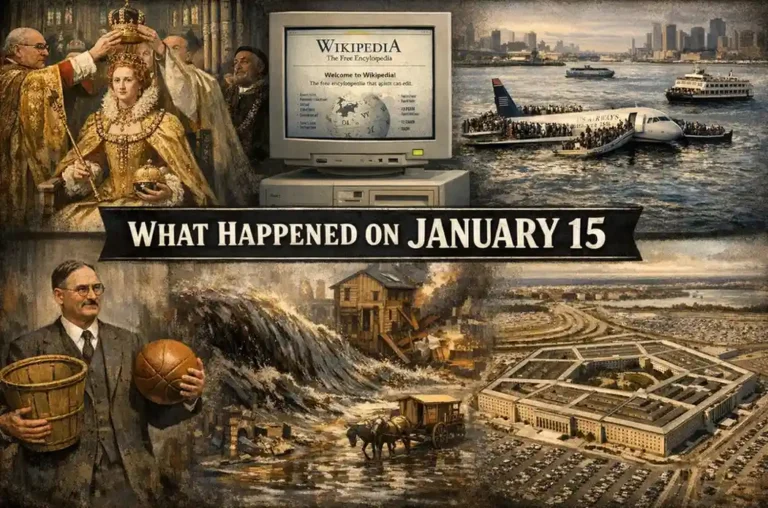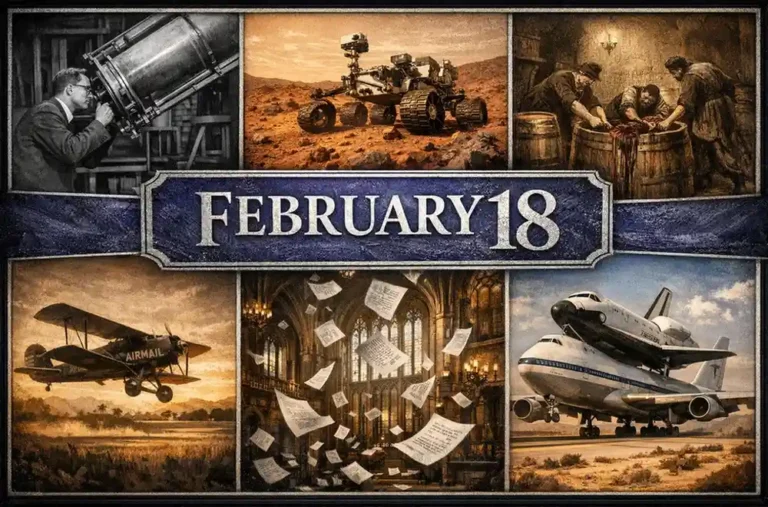

From the ancient halls of Westminster to the steps of the modern-day Capitol, this date is etched into the records of political power and radical change. To truly understand what happened on this day in history January 6, we must look at the crowning of kings, the birth of scientific theories, and the dramatic shifts in global leadership.
Important Events That Happened On January 6 In History
1066: The Coronation of Harold Godwinson
Following the death of Edward the Confessor, the Witan met to confirm Harold Godwinson as the new King of England. His coronation took place the very same day, but his claim was immediately contested by rivals across the sea. This rapid ascent to the throne sparked a massive succession crisis that ultimately led to the Norman Conquest at the Battle of Hastings.
1322: The Double Coronation of Stephen Uroš III
In a grand ceremony of Serbian royalty, Stephen Uroš III was crowned King after defeating his half-brother in a bitter struggle for the throne. Notably, his son was also crowned “young king” during the same ritual, a move intended to secure the family bloodline. This event solidified his authority and established a clear path for the future of the Serbian monarchy.
1355: Charles IV Becomes King of Italy
Charles IV of Bohemia reached a major milestone in his imperial ambitions when he was crowned King of Italy in Milan. He was adorned with the legendary Iron Crown of Lombardy, a symbol of immense historical and religious prestige. This coronation was a vital step toward his eventual goal of being recognized as the Holy Roman Emperor.
1449: Constantine XI Crowned Byzantine Emperor
In the Peloponnese city of Mystras, Constantine XI Palaiologos was crowned the last Byzantine Emperor. Taking the throne at a time of great peril, he faced the nearly impossible task of defending Constantinople against the rising Ottoman power. His reign would ultimately end in a heroic but tragic last stand during the fall of the city.
1492: The Fall of Granada
In a moment that defined the end of the Reconquista, the Catholic Monarchs Ferdinand and Isabella made their triumphal entry into Granada. The surrender of the city by Boabdil marked the final collapse of Moorish rule in the Iberian Peninsula. This event unified Spain under Christian rule and cleared the way for the monarchs to fund Christopher Columbus’s voyage later that year.
1536: The Americas’ First Higher Learning School
A landmark in Western education occurred with the founding of the Colegio de Santa Cruz de Tlatelolco in Mexico City. Established by Viceroy Antonio de Mendoza, it was the first school of higher learning in the Americas, specifically designed for the sons of Indigenous nobility. It served as a unique center for blending European academic traditions with Nahuatl culture.
1540: King Henry VIII Marries Anne of Cleves
The Tudor king entered into his fourth marriage, wedded to the German noblewoman Anne of Cleves in a politically motivated union. Henry had been won over by a portrait of Anne, but upon meeting her in person, he was famously disappointed and sought an annulment almost immediately. Though the marriage lasted only six months, Anne survived the ordeal with her head intact and a generous settlement as the “King’s Sister.”
1579: The Union of Arras
Seeking to preserve their interests under Spanish rule, several southern provinces in the Netherlands formed the Union of Arras. They declared their loyalty to King Philip II of Spain and the Catholic faith, setting themselves apart from the northern Protestant rebels. This diplomatic alliance was a turning point in the Eighty Years’ War, effectively splitting the Netherlands into two distinct regions.
1661: The Fifth Monarchist Revolt in London
In the wake of the English Restoration, a radical religious group known as the Fifth Monarchists attempted a daring coup to seize control of London. Believing that the reign of Jesus was imminent, they fought pitched battles against local militias for several days. The revolt was ultimately suppressed, leading to the execution of their leaders and a crackdown on dissenting religious sects.
1721: The South Sea Bubble Fraud Revealed
The Committee of Inquiry published its explosive findings regarding the “South Sea Bubble,” exposing a web of massive financial fraud. The report revealed that company directors and corrupt politicians had manipulated stock prices for personal gain, leading to a devastating market crash. This scandal forced the British government to overhaul its financial regulations to prevent future systemic collapses.
1781: The Battle of Jersey
French forces made their final attempt to invade the island of Jersey in the Channel Islands, but they were met with fierce British resistance. The Battle of Jersey ended in a decisive British victory, effectively ending French ambitions to use the island as a strategic stepping stone. The conflict is remembered for the heroism of Major Francis Peirson, who died leading the final charge.
1838: The First Demonstration of the Telegraph
Alfred Vail and his colleagues successfully showcased a telegraph system that used a series of dots and dashes to transmit messages across a wire. This breakthrough served as the functional forerunner to the Morse code, which would soon revolutionize global communication. The demonstration proved that information could travel faster than any horse or ship, shrinking the world forever.
1839: Ireland’s “Night of the Big Wind”
One of the most terrifying natural disasters in Irish history occurred when an exceptionally violent windstorm swept across the island. Known as the “Night of the Big Wind,” the storm destroyed thousands of homes and caused widespread devastation to the landscape. In Dublin alone, over 20% of the housing was damaged, and the event remained a benchmark for catastrophic weather for generations.
1912: New Mexico Becomes the 47th State
After sixty years as a territory and multiple failed attempts at statehood, New Mexico was officially admitted to the Union. President William Howard Taft signed the proclamation, making the “Land of Enchantment” the 47th state. Its admission brought a unique blend of Native American, Spanish, and Anglo cultures into the United States’ political fold.
1912: Alfred Wegener Proposes Continental Drift
During a lecture at the Senckenberg Museum, German geophysicist Alfred Wegener first presented his revolutionary theory of continental drift. He argued that the earth’s continents were once joined in a single landmass called “Pangea” before drifting apart over millions of years. Though initially met with skepticism, his work laid the essential foundation for the modern science of plate tectonics.
1929: Mother Teresa Arrives in India
A young nun named Sister Teresa arrived by sea in Calcutta, beginning a journey that would change the lives of millions. Originally sent to teach at a local school, she would eventually feel a “call within a call” to serve the poorest of the poor in the city’s slums. Her arrival on this day marked the start of a lifelong mission of compassion and the founding of the Missionaries of Charity.
1941: FDR Delivers the “Four Freedoms” Speech
In his State of the Union address, President Franklin D. Roosevelt proposed four fundamental freedoms that people “everywhere in the world” ought to enjoy. He spoke of the freedom of speech, freedom of worship, freedom from want, and freedom from fear. The speech provided a moral justification for American involvement in World War II and became a cornerstone of human rights doctrine.
1947: The First Round-the-World Ticket
Pan American Airlines made aviation history by becoming the first commercial carrier to offer a scheduled round-the-world flight ticket. This service made global travel a reality for civilians, connecting disparate parts of the globe with unprecedented speed. It signaled the dawn of the jet age and the beginning of modern international tourism.
1951: The Ganghwa Massacre Begins
During the height of the Korean War, a tragic mass killing known as the Ganghwa massacre began in South Korea. Over the course of several days, an estimated several hundred people suspected of being communist sympathizers were executed by local police and militias. This dark chapter remains a somber reminder of the ideological brutality that defined the conflict on the peninsula.
1960: The Bombing of National Airlines Flight 2511
A flight traveling from New York to Miami met a violent end when a bomb exploded in mid-air over North Carolina. All 34 people on board were killed, and the subsequent investigation pointed to a passenger who had allegedly committed suicide for insurance money. This tragedy forced the aviation industry to implement stricter security measures and bag-checking protocols.
1974: Early Daylight Saving in Response to Oil Crisis
In a desperate attempt to conserve energy during the 1973 oil crisis, the United States moved to daylight saving time nearly four months early. The “Emergency Daylight Saving Time Energy Conservation Act” was intended to reduce electrical demand during the dark winter months. While the move was initially popular, it was eventually shortened due to concerns about children walking to school in the dark.
1994: The Attack on Nancy Kerrigan
The world of figure skating was rocked by a brutal assault on Nancy Kerrigan during a practice session for the U.S. Figure Skating Championships. An assailant struck Kerrigan’s knee with a metal baton, an attack later linked to the associates of her rival, Tonya Harding. The “whack heard ’round the world” became a media sensation and a dark chapter in the history of professional sports.
1995: Discovery of “Project Bojinka”
A chemical fire in a Manila apartment led Philippine police to stumble upon one of the most ambitious terrorist plots in history. “Project Bojinka” was a three-phased plan to assassinate Pope John Paul II and blow up twelve commercial airliners over the Pacific. The accidental discovery saved thousands of lives and exposed the global reach of burgeoning extremist networks.
2019: The First Abdication in Malaysian History
In an unprecedented move, Muhammad V of Kelantan resigned as the Yang di-Pertuan Agong, the King of Malaysia. He became the first monarch in the nation’s history to step down before the end of his five-year term since independence in 1957. His resignation followed a period of leave and intense public speculation, leading to a historic shift in the country’s unique rotational monarchy.
2021: The Storming of the United States Capitol
A mob of protesters stormed the U.S. Capitol Building in Washington, D.C., in an attempt to disrupt the certification of the 2020 presidential election. The breach led to the evacuation of Congress, several deaths, and widespread damage to the historic site. The event was viewed globally as a significant assault on American democratic institutions and resulted in major federal investigations.
2025: Justin Trudeau Announces Resignation
In a major shift for Canadian politics, Prime Minister Justin Trudeau announced his resignation as the leader of the Liberal Party. After nine years in office, he signaled his departure from the role of Prime Minister, sparking a leadership race to find his successor. His resignation marked the end of a significant era in Canada’s domestic and international policy.
Read Also: What Happened On This Day In History January 5: Breakthroughs & Golden Gate
Famous People Born On January 6
| Name | Role / Short Note | Dates |
|---|---|---|
| Charles Sumner | U.S. statesman, abolitionist | January 6, 1811 – March 11, 1874 |
| Gustave Doré | French illustrator & printmaker | January 6, 1832 – January 23, 1883 |
| Sun Myung Moon | Korean religious leader (Unification Church) | January 6, 1920 – September 3, 2012 |
| Aleksandr Scriabin | Russian composer & pianist | January 6, 1872 – April 27, 1915 |
| Jakob Bernoulli | Swiss mathematician (Bernoulli numbers) | January 6, 1655 – August 16, 1705 |
| Sam Rayburn | U.S. politician, long-time Speaker of the House | January 6, 1882 – November 16, 1961 |
| E.L. Doctorow | American novelist | January 6, 1931 – July 21, 2015 |
| Justin Welby | Archbishop of Canterbury | January 6, 1956 – |
| Tom Mix | Silent-era American Western film star | January 6, 1880 – October 12, 1940 |
| Babrak Karmal | President of Afghanistan (1979–86) | January 6, 1929 – December 3, 1996 |
| Jacques Ellul | French philosopher & social critic | January 6, 1912 – May 19, 1994 |
| Eduard Bernstein | German political theorist (revisionist socialism) | January 6, 1850 – December 18, 1932 |
| Victor, Baron Horta | Belgian Art Nouveau architect | January 6, 1861 – September 8, 1947 |
| Barry Lopez | American nature writer | January 6, 1945 – December 25, 2020 |
| Kid Chocolate | Cuban boxer, world champion | January 6, 1910 – August 8, 1988 |
| José G. R. de Francia | Dictator of Paraguay | January 6, 1766 – September 20, 1840 |
| Khristo Botev | Bulgarian poet & revolutionary | January 6, 1849 – June 1, 1876 |
| Anselme Payen | French chemist (discovered cellulose) | January 6, 1795 – May 12, 1871 |
| George Ledyard Stebbins, Jr. | Evolutionary botanist | January 6, 1906 – January 19, 2000 |
| Clarence King | American geologist, first USGS director | January 6, 1842 – December 24, 1901 |
| Norman Eric Kirk | Prime Minister of New Zealand | January 6, 1923 – August 31, 1974 |
| Gustav Bauer | Chancellor of Germany (Weimar era) | January 6, 1870 – September 16, 1944 |
| Sir Percivall Pott | English surgeon (occupational cancer link) | January 6, 1714 – December 22, 1788 |
| João Cabral de Melo Neto | Brazilian poet & diplomat | January 6, 1920 – October 9, 1999 |
| Murray Rose | Australian Olympic swimmer | January 6, 1939 – April 15, 2012 |
| Olaus Petri | Swedish Reformation church leader | January 6, 1493? – April 19, 1552 |
| Dame Adeline Genée | British dancer & teacher | January 6, 1878 – April 23, 1970 |
| John Durang | Early American dancer (hornpipe) | January 6, 1768 – 1822 |
| Martin Agricola | German composer & music theorist | January 6, 1486 – June 10, 1556 |
| Louis Harris | American pollster & journalist | January 6, 1921 – December 17, 2016 |
Famous People Died On January 6
| Name | Role / Short Note | Dates |
|---|---|---|
| Victor Fleming | American film director (Gone with the Wind, Wizard of Oz) | February 23, 1889 – January 6, 1949 |
| David Alfaro Siqueiros | Mexican muralist & painter | December 29, 1896 – January 6, 1974 |
| Tyagaraja | Indian Carnatic composer | May 4, 1767 – January 6, 1847 |
| Ida Tarbell | American investigative journalist (muckraker) | November 5, 1857 – January 6, 1944 |
| Tina Modotti | Photographer & activist | August 16, 1896 – January 6, 1942 |
| Julius Rosenwald | American philanthropist & businessman | August 12, 1862 – January 6, 1932 |
| Duane Hanson | American hyper-realist sculptor | January 17, 1925 – January 6, 1996 |
| Ian Charleson | Scottish actor | August 11, 1949 – January 6, 1990 |
| Vladimir I. Vernadsky | Russian geochemist & biogeochemist | March 12, 1863 – January 6, 1945 |
| Pavel A. Cherenkov | Soviet physicist, Nobel laureate | July 28, 1904 – January 6, 1990 |
| Ricardo Piglia | Argentine novelist & critic | November 24, 1941 – January 6, 2017 |
| Marko Marulić | Croatian humanist & poet | August 18, 1450 – January 6, 1524 |
| Chikamatsu Monzaemon | Japanese dramatist (jōruri plays) | 1653 – January 6, 1725 |
| Philip Danforth Armour | American meat-packing industrialist | May 16, 1832 – January 6, 1901 |
| William Gropper | American cartoonist & painter | December 3, 1897 – January 6, 1977 |
| Alvin Kraenzlein | Olympian track athlete (hurdling technique) | December 12, 1876 – January 6, 1928 |
| Josef Dobrovský | Czech philologist & scholar | August 17, 1753 – January 6, 1829 |
| Isaiah Bowman | American geographer & educator | December 26, 1878 – January 6, 1950 |
| Jean-Henri Riesener | French royal cabinetmaker | July 4, 1734 – January 6, 1806 |
| Tex Rickard | Boxing promoter & entrepreneur | January 2, 1870 or January 2, 1871 – January 6, 1929 |
| Rodolphe Kreutzer | French violinist & composer | November 16, 1766 – January 6, 1831 |
| Uzun Ḥasan | Turkmen ruler (Ak Koyunlu) | 1423 – January 6, 1478 |
| A. Lawrence Lowell | President of Harvard University | December 13, 1856 – January 6, 1943 |
| Chen Yi | Chinese military leader & politician | August 26, 1901 – January 6, 1972 |
| Jean Lurçat | French painter & tapestry designer | July 1, 1892 – January 6, 1966 |
| Emma Calvé | French operatic soprano | August 15, 1858 – January 6, 1942 |
| Hartley Coleridge | British poet | September 19, 1796 – January 6, 1849 |
| Philip Henslowe | Elizabethan theatre manager | c.1550 – January 6, 1616 |
| Walter Cunliffe, 1st Baron Cunliffe | English banker | December 4, 1855 – January 6, 1920 |
| John Bernard Flannagan | American sculptor | April 7, 1895 – January 6, 1942 |
Observances & Institutional Dates
- Epiphany: A major Christian feast day celebrating the revelation of God incarnate as Jesus Christ and the visit of the Magi.
- Little Christmas (Ireland): Also known as Nollaig na mBan, a tradition where women have the day off and men take over the household chores.
- Þrettándinn (Iceland): The “Thirteenth Day,” marked by bonfires and elfin celebrations as Icelanders bid farewell to the holiday season.
- National Bean Day (US): A day to appreciate the nutritional value and variety of beans in global cuisine.
Frequently Asked Questions
Why is January 6 called Little Christmas in Ireland?
Known as Nollaig na mBan, it is a day where gender roles traditionally reversed, allowing women to rest while men handled domestic duties after the busy holiday season.
Who was the first Malaysian King to resign?
Muhammad V of Kelantan made history on January 6, 2019, by becoming the first Yang di-Pertuan Agong to abdicate the throne.
What theory did Alfred Wegener propose on this day?
He proposed the theory of “Continental Drift,” suggesting that the Earth’s continents move and were once part of a single supercontinent.