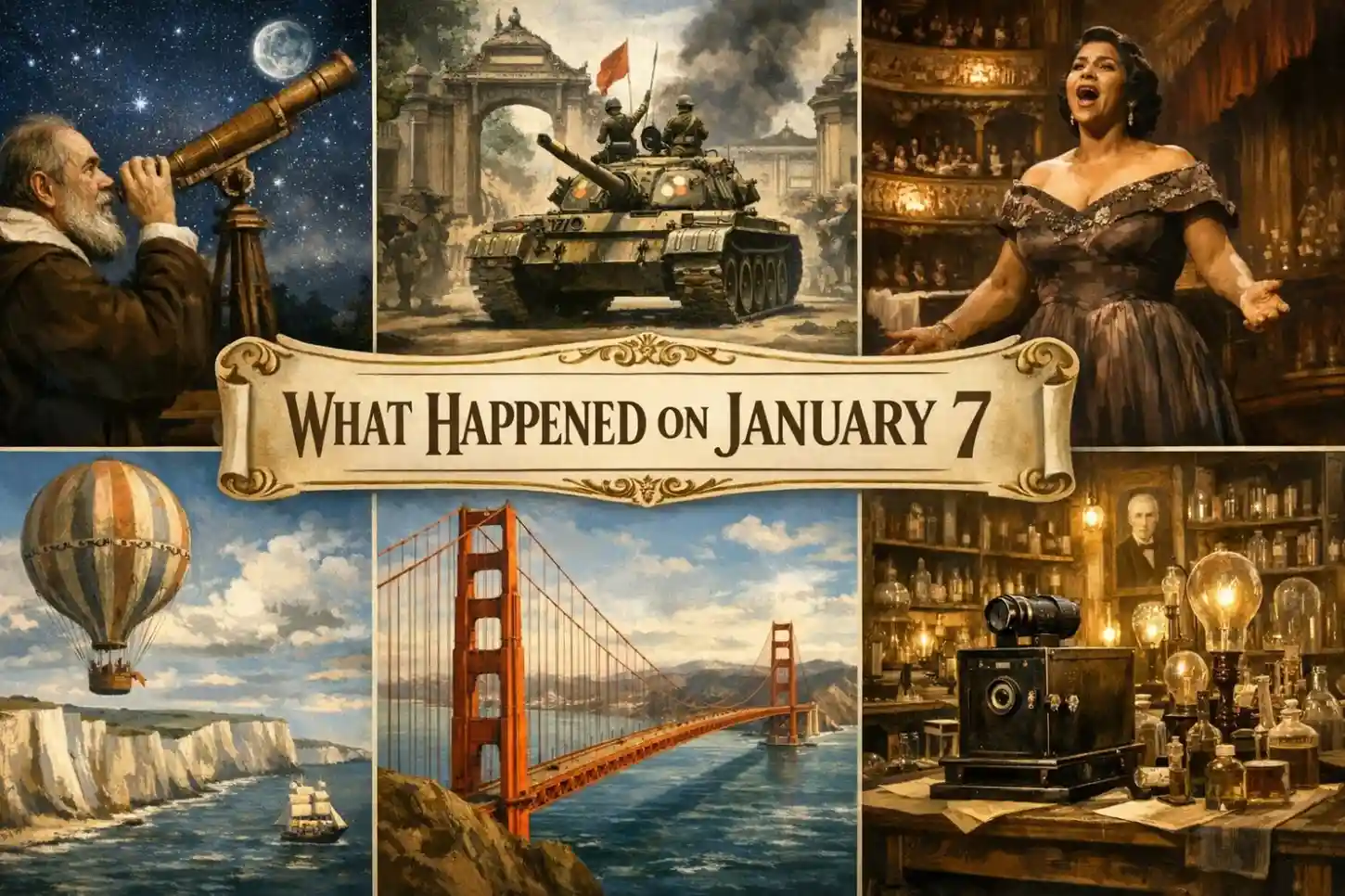
The narrative of human history is woven with threads of scientific discovery, political upheaval, and cultural milestones. To understand what happened on this day in history January 7, one must look toward the heavens with Galileo, witness the fall of regimes in Cambodia, and reflect on the persistent march of civil rights and technological innovation across the centuries.
Important Events That Happened On January 7 In History
49 BC: Julius Caesar Named Public Enemy
The Roman Senate issued a stern ultimatum to Julius Caesar, demanding he disband his veteran army or be declared an official enemy of the state. This high-stakes political move forced Caesar’s supporters, the tribunes, to flee Rome and seek refuge with him in Ravenna. This direct confrontation was the final spark that led Caesar to cross the Rubicon, effectively ending the Roman Republic.
1078: The Revolt in Constantinople
Discontent reached a boiling point in the Byzantine capital as the people of Constantinople rose up in a violent revolt. The mob lynched the deeply unpopular imperial official Nikephoritzes, whose economic policies had caused widespread suffering. In the chaos, Nikephoros Botaneiates was proclaimed the new emperor, signaling a swift and bloody transition of power.
1325: Afonso IV Ascends the Portuguese Throne
Following the death of his father, King Denis, Afonso IV officially became the King of Portugal. His reign was characterized by a focus on the internal development of the kingdom and the strengthening of the Portuguese navy. Known as “Afonso the Brave,” he played a crucial role in the Battle of Río Salado, defending the peninsula against Moorish invasion.
1558: France Reclaims Calais from England
The Duke of Guise led French forces in a decisive siege that resulted in the capture of Calais, the last English possession on mainland Europe. This loss was a devastating blow to Mary I of England, who famously said that the name “Calais” would be found engraved on her heart. The victory restored the city to French control after more than two centuries of English rule.
1608: The Great Fire of Jamestown
A catastrophic fire tore through the fledgling settlement of Jamestown, Virginia, destroying nearly all of its wooden structures and vital supplies. The blaze left the struggling colonists vulnerable to winter weather and famine, testing the resilience of the first permanent English colony in America. Only through the leadership of John Smith and help from local tribes did the colony manage to rebuild.
1610: Galileo Observes the Galilean Moons
Using his improved telescope, Galileo Galilei turned his gaze toward Jupiter and discovered what appeared to be three small stars near the planet. These were actually the moons Ganymede, Callisto, and Io, with Europa becoming distinguishable the following evening. This discovery provided visual proof that not everything in the universe revolved around the Earth, revolutionizing our understanding of the cosmos.
1708: The Battle of Zlatoust
During the Bashkir rebellion, a fierce engagement known as the Battle of Zlatoust took place between government troops of the Russian Tsardom and Bashkir and Tatar rebels. The rebels were fighting against the heavy taxation and religious impositions of the Russian state. This battle remains a significant moment in the struggle of the regional nomadic tribes for autonomy and cultural preservation.
1708: Bashkir Rebels Besiege Yelabuga
Simultaneous with broader uprisings against the Russian state, Bashkir rebels laid a heavy siege to the town of Yelabuga. The attack was part of a coordinated effort to disrupt Russian control over the Volga region and reclaim ancestral lands. While the siege was eventually broken, it demonstrated the scale and organization of the resistance against Peter the Great’s expansionist policies.
1738: The Peace Treaty of Bhopal
Following a decisive Maratha victory at the Battle of Bhopal, a peace treaty was signed between Peshwa Bajirao and Jai Singh II. The agreement saw the Mughals ceding the entire Malwa region and a significant indemnity to the Marathas. This victory solidified Maratha dominance in central India and signaled the accelerating decline of the Mughal Empire’s territorial control.
1782: Bank of North America Opens
The United States witnessed a financial milestone as the Bank of North America officially opened its doors in Philadelphia. As the first commercial bank in the country, it was established to help stabilize the currency and fund the final stages of the Revolutionary War. Its creation marked the beginning of a formal banking system that would drive American economic growth for centuries.
1785: First Aerial Crossing of the English Channel
Jean-Pierre Blanchard and John Jeffries achieved a historic feat by traveling from Dover, England, to Calais, France, in a gas-filled balloon. The journey was perilous, at one point requiring the pair to throw nearly everything overboard to stay aloft. Their successful landing in France proved that international aerial travel was possible, captivating the imagination of the world.
1835: The HMS Beagle Anchors at Chonos Archipelago
The HMS Beagle, carrying a young naturalist named Charles Darwin, dropped anchor off the rugged Chonos Archipelago in Chile. Darwin spent his time exploring the unique geology and diverse wildlife of the islands, collecting specimens that would later inform his theories on evolution. This stop was a vital link in the voyage that changed the course of biological science.
1867: The Kingstree Jail Fire
In a tragic event during the Reconstruction era, a fire broke out at the jail in Kingstree, South Carolina. The blaze claimed the lives of 22 freedmen who were locked in their cells and unable to escape the suffocating smoke and heat. This disaster highlighted the precarious safety and lack of protection for newly freed African Americans in the post-Civil War South.
1894: Edison’s Kinetoscopic Sneeze
Thomas Edison’s laboratory produced one of the world’s first films, a short clip featuring an employee, Fred Ott, performing a sneeze. On the same day, William Kennedy Dickson received a patent for motion picture film, cementing the technology’s future. This five-second clip, while simple, was a monumental step in the birth of the global film industry.
1904: Introduction of the “CQD” Signal
The Marconi International Marine Communication Company established “CQD” as the standard distress signal for ships at sea. Contrary to popular belief, it stood for “Seek You” (CQ) and “Distress” (D), rather than a specific acronym. It served as the primary call for help until it was replaced two years later by the more easily recognizable “SOS.”
1919: The Christmas Uprising in Montenegro
Montenegrin guerrilla fighters launched a rebellion against the planned annexation of their country by the Kingdom of Serbia. Known as the Christmas Uprising, the rebels sought to maintain Montenegrin independence and restore their king to the throne. The revolt ultimately failed, leading to a period of guerrilla warfare and the eventual integration of Montenegro into Yugoslavia.
1920: Socialist Assemblymen Barred in New York
In a moment of intense political tension, the New York State Assembly refused to seat five duly elected members of the Socialist Party. The move was fueled by the “Red Scare” and fears of radicalism following the Russian Revolution. This suspension of elected officials sparked a major debate regarding the rights of political minorities in a democratic society.
1922: Dáil Éireann Ratifies Anglo-Irish Treaty
After weeks of fierce debate, the Irish parliament (Dáil Éireann) voted 64–57 to ratify the Anglo-Irish Treaty. The agreement established the Irish Free State as a self-governing dominion within the British Empire, rather than a fully independent republic. This narrow victory ended the War of Independence but laid the groundwork for the tragic Irish Civil War.
1927: First Transatlantic Telephone Service
Commercial communication reached a new frontier with the launch of the first transatlantic telephone service between New York and London. The service used radio waves to transmit voices across the ocean, with the first call made by the president of AT&T to the head of the British General Post Office. Although it cost a fortune, it successfully bridged the gap between the two continents.
1928: Disastrous Thames Flood
Riverside London suffered extensive damage when the River Thames burst its banks during a storm surge. The flood claimed 14 lives and left thousands of people homeless, particularly in the poorer districts of Westminster and Lambeth. This disaster eventually led to the development of better flood defenses, including the eventual construction of the Thames Barrier.
1931: First Solo Trans-Tasman Flight
Guy Menzies made history by completing the first solo non-stop flight from Australia to New Zealand. Flying a Southern Cross Junior, he completed the crossing in 11 hours and 45 minutes before crash-landing in a swamp on New Zealand’s west coast. His daring journey proved the viability of trans-Tasman aviation, even if the landing was less than perfect.
1935: The Franco-Italian Agreement
In Rome, Benito Mussolini and French Foreign Minister Pierre Laval signed a series of agreements intended to settle colonial disputes. The pact was designed to create a unified front against the rising power of Nazi Germany. However, the agreement was short-lived, as the geopolitical landscape shifted dramatically following Italy’s invasion of Ethiopia.
1940: Finnish Victory at Raate Road
During the Winter War, the Finnish 9th Division achieved a stunning victory over the numerically superior Soviet 44th Rifle Division. Utilizing “motti” tactics, the Finns cut the Soviet column into isolated pieces and destroyed them in the deep snow. The Battle of Raate Road became a symbol of Finnish courage and tactical ingenuity against a massive invader.
1948: The Thomas Mantell UFO Incident
Kentucky Air National Guard pilot Thomas Mantell died when his P-51 Mustang crashed while he was pursuing a mysterious, unidentified flying object. Mantell had reported seeing a “metallic object of tremendous size” before blacking out due to oxygen deprivation at high altitude. The incident remains one of the most famous and debated cases in the history of UFO sightings.
1950: Sverdlovsk Air Disaster
A tragic plane crash near Sverdlovsk claimed the lives of all 19 people on board, including almost the entire VVS Moscow ice hockey team. The team, which belonged to the Soviet Air Force, was traveling to a game in Chelyabinsk when their Li-2 crashed in a snowstorm. The Soviet government kept the accident a secret for years to avoid national embarrassment.
1954: The Georgetown–IBM Experiment
IBM and Georgetown University held the first public demonstration of machine translation, showing a computer translating Russian sentences into English. Using a basic vocabulary and primitive rules, the “IBM 701” computer successfully processed the text. This experiment sparked immense optimism about the future of artificial intelligence and automated language translation.
1955: Marian Anderson Debuts at the Met
In a landmark moment for civil rights in the arts, contralto Marian Anderson became the first person of color to perform at the Metropolitan Opera. She took the stage as Ulrica in Verdi’s Un ballo in maschera, receiving a standing ovation before she even sang a note. Her debut shattered a long-standing racial barrier in the world of classical music.
1959: US Recognizes Castro’s Government
The United States government officially recognized the new Cuban government led by Fidel Castro, just days after the fall of the Batista regime. At the time, Washington hoped to maintain stable relations with the revolutionary leaders. However, the relationship quickly soured, leading to decades of Cold War hostility and economic embargoes.
1968: Launch of Surveyor 7
NASA launched Surveyor 7, the final spacecraft in the Surveyor series designed to explore the lunar surface. It successfully touched down near the Tycho crater, sending back thousands of high-quality images and analyzing the chemical composition of the moon’s soil. The mission was a critical success in preparing the way for the manned Apollo landings.
1972: Iberia Flight 602 Crash
A tragic aviation accident occurred when an Iberia Sud Aviation Caravelle crashed into a mountain while on approach to Ibiza Airport. All 104 people on board were killed in the disaster, which remains one of the deadliest in Spanish aviation history. Investigators concluded that the pilot had failed to maintain the correct altitude during the descent.
1972: Discovery of the First Black Hole
Scientists Louise Webster and Paul Murdin announced the first confirmed evidence of a black hole, Cygnus X-1. By analyzing X-ray energy and the motion of a nearby star, they proved the existence of an invisible, incredibly dense object. This discovery moved black holes from the realm of theoretical physics into observable reality.
1973: The Howard Johnson’s Shooting
In a violent rampage in New Orleans, Mark Essex fatally shot seven people, including three police officers, at the Howard Johnson’s Hotel. Essex, a former Navy sailor, took a stand on the hotel roof, leading to a hours-long standoff with law enforcement. He was eventually shot and killed by police marksmen firing from a helicopter.
1979: The Fall of Phnom Penh
Vietnamese forces captured the Cambodian capital of Phnom Penh, effectively ending the brutal four-year reign of Pol Pot and the Khmer Rouge. The Vietnamese invasion followed years of border clashes and the horrific atrocities committed during the Cambodian Genocide. While the fall of the city brought relief, it also triggered a decade of civil war and occupation.
1980: Chrysler Bailout Authorized
President Jimmy Carter signed legislation providing $1.5 billion in federal loan guarantees to rescue the Chrysler Corporation from bankruptcy. At the time, it was the largest government bailout of a private company in American history. The loan, which was repaid ahead of schedule, saved hundreds of thousands of jobs and transformed the American auto industry.
1984: Brunei Joins ASEAN
The Sultanate of Brunei officially became the sixth member of the Association of Southeast Asian Nations (ASEAN). Having gained its full independence from the United Kingdom just days earlier, Brunei’s entry into the regional bloc was a major step in its diplomatic integration. This move helped secure its political and economic standing in Southeast Asia.
1985: Japan Launches Sakigake
Japan’s aerospace agency launched Sakigake, the nation’s first interplanetary spacecraft. It was designed to fly past Halley’s Comet, making Japan only the third country, after the US and the USSR, to launch a deep-space probe. The mission was a source of national pride and demonstrated Japan’s growing capabilities in space exploration.
1989: Sutton United’s FA Cup Upset
In a historic sports moment, fifth-tier Sutton United defeated top-tier Coventry City in the third round of the FA Cup. This 2–1 victory remains one of the most famous “giant-killings” in the history of English football. It was the first time in over a decade that a non-league team had beaten a team from the highest division.
1991: Roger Lafontant’s Failed Coup
In Haiti, Roger Lafontant, a former leader of the dreaded Tonton Macoute, attempted a coup d’état against the newly elected president. He seized the National Palace and forced the provisional president to resign on television. However, the military remained loyal to the democratic process, quickly arresting Lafontant and restoring order.
1993: Jerry Rawlings Inaugurated in Ghana
The Fourth Republic of Ghana was officially inaugurated with Jerry Rawlings being sworn in as president. This marked the transition from a decade of military rule to a multi-party democratic system. Rawlings’ inauguration set Ghana on a path of relative political stability that has made it a model for democracy in West Africa.
1993: The Kravica Attack
During the Bosnian War, the Bosnian Army launched a surprise attack on the village of Kravica in eastern Bosnia. The engagement resulted in the deaths of dozens of Bosnian Serbs and the destruction of the village. This event remains a highly sensitive and contested moment in the history of the ethnic conflicts that tore Yugoslavia apart.
1994: United Express Flight 6291 Crash
A United Express Jetstream 41 crashed on approach to Port Columbus International Airport in Ohio. The accident claimed the lives of five people on board, including the three crew members. Federal investigators determined that the crash was caused by the flight crew’s failure to properly manage the aircraft’s speed and descent during a low-visibility approach.
1999: Impeachment Trial of Bill Clinton Begins
The United States Senate officially opened the impeachment trial of President Bill Clinton. Presided over by Chief Justice William Rehnquist, the trial addressed charges of perjury and obstruction of justice stemming from the Monica Lewinsky scandal. It was only the second time in American history that a president had faced a Senate impeachment trial.
2012: Carterton Hot Air Balloon Crash
Tragedy struck the North Island of New Zealand when a hot air balloon collided with power lines and caught fire. All 11 people on board, including the pilot and five couples, were killed in the accident. It was the deadliest aviation disaster in New Zealand since 1979 and led to stricter safety regulations for the ballooning industry.
2015: The Charlie Hebdo Massacre
Two gunmen forced their way into the offices of the satirical newspaper Charlie Hebdo in Paris, killing twelve people, including several prominent cartoonists. The attack, claimed by Al-Qaeda, was motivated by the newspaper’s depictions of the Prophet Muhammad. The tragedy sparked a global defense of free speech under the slogan “Je suis Charlie.”
2015: Sanaa Police College Bombing
A powerful car bomb exploded outside a police academy in the Yemeni capital of Sanaa, killing at least 38 people. The blast targeted students who were queuing to register for classes, leaving dozens more wounded. The attack underscored the deepening security crisis and the violent power struggle between Houthi rebels and extremist groups in Yemen.
2020: Puerto Rico Earthquakes
A 6.4 magnitude earthquake struck the southern coast of Puerto Rico, part of a devastating seismic sequence that lasted several weeks. The quake killed four people and caused widespread damage to homes, schools, and the island’s power grid. It left thousands of residents sleeping outdoors in makeshift camps due to the constant fear of aftershocks.
2023: Kevin McCarthy Elected House Speaker
After a historic four-day stalemate and 15 rounds of voting, Kevin McCarthy was finally elected as the 55th Speaker of the U.S. House of Representatives. It was the longest speaker election since the Civil War era, requiring extensive negotiations with a group of conservative holdouts. The gridlock highlighted deep divisions within the Republican Party.
2025: Greater Los Angeles Wildfires
A series of unprecedented wildfires swept through the Greater Los Angeles area, fueled by extreme drought and high winds. The blazes claimed at least 16 lives and destroyed over 13,000 structures, including entire residential neighborhoods. The disaster prompted a massive federal emergency response and renewed focus on climate resilience in California.
Take a Look At: January 6 Stories
Famous People Born On January 7
| Name | Role / Short Note | Dates |
|---|---|---|
| Lewis Hamilton | Formula One world champion driver | January 7, 1985 – |
| Nick Clegg | British politician, UK Deputy PM (2010–15) | January 7, 1967 – |
| Joseph Bonaparte | King of Spain & Naples; Napoleon’s brother | January 7, 1768 – July 28, 1844 |
| Francis Poulenc | French composer (Les Six) | January 7, 1899 – January 30, 1963 |
| Albert Bierstadt | American landscape painter | January 7, 1830 – February 19, 1902 |
| Charles Addams | Cartoonist, creator of The Addams Family | January 7, 1912 – September 29, 1988 |
| Paul Keres | Estonian chess grandmaster | January 7, 1916 – June 5, 1975 |
| Adolph Zukor | Film producer, Paramount founder | January 7, 1873 – June 10, 1976 |
| Myron S. Scholes | Economist, Nobel laureate (Black–Scholes) | January 7, 1941 – |
| John Thune | U.S. Senator, Senate Majority Leader | January 7, 1961 – |
| St. Bernadette of Lourdes | Catholic saint, Lourdes visions | January 7, 1844 – April 16, 1879 |
| Andrew Browne Cunningham | British admiral, WWII commander | January 7, 1883 – June 12, 1963 |
| Johann Philipp Reis | Physicist, telephone pioneer | January 7, 1834 – January 14, 1874 |
| Vasily Ivanovich Alekseyev | Soviet Olympic weightlifter | January 7, 1942 – November 25, 2011 |
| Sir Sandford Fleming | Engineer, inventor of standard time | January 7, 1827 – July 22, 1915 |
| Jean-Pierre Rampal | French flutist | January 7, 1922 – May 20, 2000 |
| Charles Péguy | French poet & philosopher | January 7, 1873 – September 5, 1914 |
| Émile Borel | French mathematician | January 7, 1871 – February 3, 1956 |
| John Walker | Chemist, Nobel laureate (ATP synthesis) | January 7, 1941 – |
| Robert Duncan | American poet (Black Mountain) | January 7, 1919 – February 3, 1988 |
| Johann Christian Fabricius | Entomologist, taxonomy pioneer | January 7, 1745 – March 3, 1808 |
| James Harrington | Political philosopher (Oceana) | January 7, 1611 – September 11, 1677 |
| Henry Allen | Jazz trumpeter | January 7, 1908 – April 17, 1967 |
| Tassos Papadopoulos | President of Cyprus | January 7, 1934 – December 12, 2008 |
| Valery Kubasov | Soviet cosmonaut | January 7, 1935 – February 19, 2014 |
| Ulysses Kay | American composer | January 7, 1917 – May 20, 1995 |
| Lamar Jackson | NFL quarterback | January 7, 1997 – |
| Yuto Horigome | Olympic skateboarder | January 7, 1999 – |
| Carolyn Bessette Kennedy | Fashion publicist | January 7, 1966 – July 16, 1999 |
| Orval Eugene Faubus | Governor of Arkansas | January 7, 1910 – December 14, 1994 |
Famous People Died On January 7
| Name | Role / Short Note | Dates |
|---|---|---|
| Franz Beckenbauer | Legendary German footballer | September 11, 1945 – January 7, 2024 |
| Jean-Marie Le Pen | French far-right politician | June 20, 1928 – January 7, 2025 |
| Hirohito | Emperor of Japan | April 29, 1901 – January 7, 1989 |
| Tommy Lasorda | Baseball manager (LA Dodgers) | September 22, 1927 – January 7, 2021 |
| John Berryman | American poet | October 25, 1914 – January 7, 1972 |
| Juan Rulfo | Mexican novelist | May 16, 1917 – January 7, 1986 |
| Sir Edmund Barton | First Prime Minister of Australia | January 18, 1849 – January 7, 1920 |
| Innocent X | Pope (1644–1655) | May 7, 1574 – January 7, 1655 |
| Charles I of Naples | King of Naples & Sicily | March 1226 – January 7, 1285 |
| Lou Hoover | First Lady of the United States | March 29, 1874 – January 7, 1944 |
| François Fénelon | French theologian & writer | August 6, 1651 – January 7, 1715 |
| Mário Soares | President of Portugal | December 7, 1924 – January 7, 2017 |
| Dinis | King of Portugal | October 9, 1261 – January 7, 1325 |
| Andrey Bely | Russian symbolist poet | October 26, 1880 – January 7, 1934 |
| Vladimir Prelog | Chemist, Nobel laureate | July 23, 1906 – January 7, 1998 |
| Inês de Castro | Portuguese historical figure | 1323? – January 7, 1355 |
| Alfred Kastler | Physicist, Nobel laureate | May 3, 1902 – January 7, 1984 |
| Ada Louise Huxtable | Architecture critic | March 14, 1921 – January 7, 2013 |
| Allan Ramsay | Scottish poet | October 15, 1686 – January 7, 1758 |
| André Maginot | French statesman (Maginot Line) | February 17, 1877 – January 7, 1932 |
| Josef Stefan | Physicist (Stefan–Boltzmann law) | March 24, 1835 – January 7, 1893 |
| Sir Arthur Keith | Anthropologist | February 5, 1866 – January 7, 1955 |
| Tenji | Emperor of Japan | 625/626 – January 7, 672 |
| Richard Hamming | Mathematician (Hamming code) | February 11, 1915 – January 7, 1998 |
| Rod Taylor | Film actor | January 11, 1930 – January 7, 2015 |
| Heinrich Harrer | Explorer & author | July 6, 1912 – January 7, 2006 |
| Rosemary Kennedy | Member of Kennedy family | September 13, 1918 – January 7, 2005 |
| Nancy Hanks | Chair, National Endowment for the Arts | December 31, 1927 – January 7, 1983 |
| Tadeusz Konwicki | Polish writer & filmmaker | June 22, 1926 – January 7, 2015 |
| Saint Lucian of Antioch | Christian theologian & martyr | c.240 – January 7, 312 |
Observances & Institutional Dates
- Distaff Day: A traditional European holiday marking the day women returned to their spinning and domestic work after the Christmas season.
- Tricolour Day (Italy): The national day celebrating the adoption of the Italian flag, the il Tricolore, in 1797.
- Pioneer’s Day (Liberia): Commemorating the arrival of the first free African American settlers in 1822.
- Victory from Genocide Day (Cambodia): Honoring the end of the Khmer Rouge regime in 1979.
Frequently Asked Questions
Which US president faced an impeachment trial on January 7?
The Senate trial for the impeachment of President Bill Clinton began on January 7, 1999.
When did Galileo first observe the moons of Jupiter?
Galileo made his first observations of the four largest Jovian moons on January 7, 1610.
What was the significance of the 1979 fall of Phnom Penh?
The capture of the city by Vietnamese troops marked the official end of the Khmer Rouge regime and the Cambodian Genocide.