History on this day is a striking mix of hard-won military victories, the birth of modern political parties, and the somber memory of aviation tragedies. To understand what happened on this day in history January 8, we must look at the defiance of Andrew Jackson, the vision of Woodrow Wilson, and the technological leaps that allowed humans to live in space for over a year.
Important Events That Happened On January 8 In History
307: Sima Chi Becomes Emperor of Jin
In a transition marked by dynastic friction, Sima Chi ascended to the throne of the Jin dynasty, succeeding his brother Sima Zhong. His path to power was not easily won, as he faced a significant challenge from another brother, Sima Ying. This period of succession struggle highlighted the internal instability that frequently plagued the imperial court during this era.
871: The Battle of Ashdown
Æthelred I and his younger brother, Alfred the Great, led a West Saxon army in a fierce attempt to repel an invading force of Danelaw Vikings. The Saxons managed to secure a vital victory on the ridge of Ashdown, halting the Viking advance through Wessex. This early triumph served as a defining moment for Alfred, establishing his reputation as a defender of the English people.
1297: François Grimaldi Captures Monaco
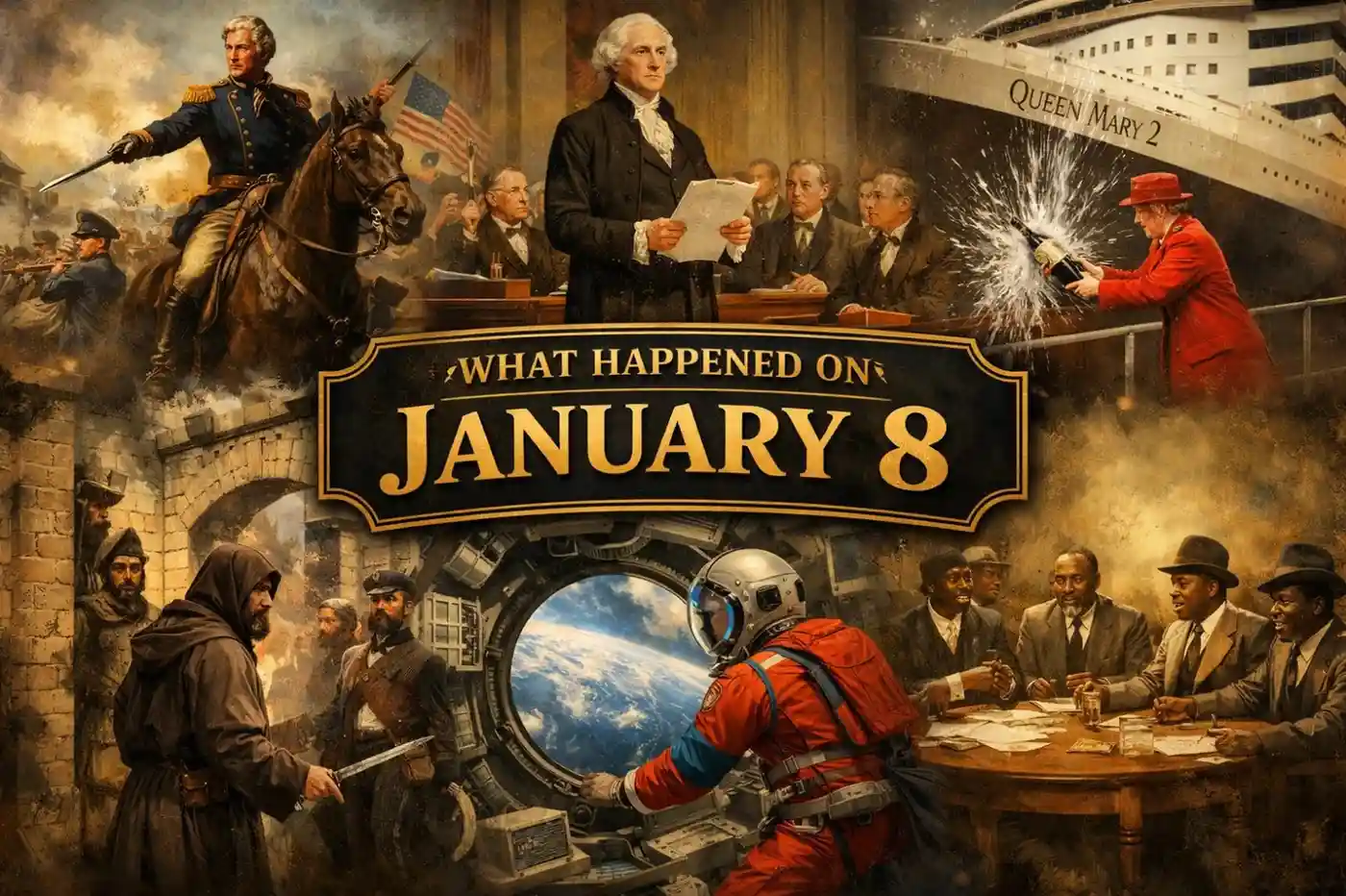
Utilizing a daring ruse, François Grimaldi disguised himself as a monk to gain entry into the fortress protecting the Rock of Monaco. Once inside with his men, he successfully seized the stronghold, effectively establishing the Grimaldi family as the rulers of the territory. This act of cunning began a sovereign legacy that has endured for over 700 years.
1454: The Papal Bull Romanus Pontifex
Pope Nicholas V issued the papal bull Romanus Pontifex, which granted the Kingdom of Portugal exclusive rights to trade and colonization across Africa south of Cape Bojador. This decree essentially provided a religious and legal framework for the Portuguese to claim newly discovered lands and control the maritime routes. It was a foundational document that fueled the early stages of the Age of Discovery.
1499: Marriage of Louis XII and Anne of Brittany
King Louis XII of France wed Anne of Brittany in a union mandated by a law established by his predecessor, Charles VIII. The marriage was a strategic move to ensure that the Duchy of Brittany remained tied to the French crown rather than regaining its independence. Through this alliance, the geographical and political unity of modern France was significantly strengthened.
1547: First Lithuanian-Language Book Published
The first book ever printed in the Lithuanian language, the Catechism of Martynas Mažvydas, was published in Königsberg. This historic publication provided a foundational text for Lithuanian literacy and religious instruction during the Reformation. It remains one of the most important artifacts in the history of the Baltic languages and national identity.
1735: Premiere of Handel’s Ariodante
The Royal Opera House at Covent Garden hosted the world premiere of George Frideric Handel’s operatic masterpiece, Ariodante. This production was one of Handel’s most successful ventures in London, featuring intricate melodies and a compelling narrative of love and betrayal. Its debut solidified the theater’s reputation as a premier destination for high-quality musical drama.
1746: Bonnie Prince Charlie Occupies Stirling
During the Second Jacobite Rising, Charles Edward Stuart, better known as Bonnie Prince Charlie, successfully occupied the town of Stirling. While his forces took control of the town, the castle itself remained in government hands, leading to a prolonged and difficult siege. This occupation represented one of the final significant maneuvers of the Jacobite attempt to reclaim the British throne.
1790: Washington’s First State of the Union
George Washington delivered the first-ever State of the Union address to a joint session of Congress in New York City. In this inaugural speech, he laid out his vision for the country, emphasizing the need for national defense and a unified currency. This event established the constitutional tradition of the President reporting on the nation’s condition to the legislative branch.
1806: The British Take the Cape Colony
Following their victory at the Battle of Blaauwberg, British forces took formal control of the Dutch Cape Colony in southern Africa. This strategic acquisition ensured British dominance over the vital sea route to the East Indies. The transition marked the beginning of a long period of British colonial influence that would fundamentally reshape the region’s social and political landscape.
1811: The German Coast Uprising
Charles Deslondes led a major, though ultimately unsuccessful, slave revolt in the settlements of St. Charles and St. James, Louisiana. Hundreds of enslaved people rose up in a desperate bid for freedom, marching toward New Orleans before being crushed by a local militia. The revolt remains one of the most significant acts of resistance against the institution of slavery in American history.
1815: The Battle of New Orleans
In a lopsided victory during the War of 1812, Andrew Jackson led American forces to a decisive win over the British army. Interestingly, the battle occurred after a peace treaty had already been signed in Europe, but the news had not yet reached the Americas. The victory catapulted Jackson to national fame and boosted American morale and sense of independence.
1828: Formation of the Democratic Party
The modern Democratic Party was officially organized on this day to support the political movement and presidential ambitions of Andrew Jackson. Branching off from the original Democratic-Republican Party, it focused on representing the interests of the “common man” and expanding suffrage. This organizational shift created one of the most enduring political institutions in the world.
1835: US National Debt Hits Zero
President Andrew Jackson announced a celebratory dinner to mark a feat never repeated in American history: the total elimination of the national debt. Through aggressive land sales and a strict veto of spending bills, Jackson’s administration managed to pay off every cent the country owed. The debt-free status was a source of great pride for Jackson, though it lasted only a brief time.
1863: The Second Battle of Springfield
During the American Civil War, Confederate forces led by John S. Marmaduke launched an attack on the strategic hub of Springfield, Missouri. Union defenders, despite being outnumbered and largely composed of convalescents and local militia, successfully repelled the assault. The victory ensured that the Union maintained control over this vital supply depot for the duration of the conflict.
1867: Black Suffrage in Washington, D.C.
The United States Congress passed a landmark bill granting African American men the right to vote within the District of Columbia. This move was a significant step toward racial equality during the Reconstruction era, as the federal government asserted its authority over local voting laws. It served as a powerful signal of the changing political landscape in post-war America.
1877: The Battle of Wolf Mountain
In the frozen landscape of the Montana Territory, Crazy Horse and his warriors fought their final major battle against the United States Cavalry. Facing extreme cold and superior military technology, the Native American forces were eventually forced to retreat. This engagement marked the end of large-scale armed resistance for the Lakota and Cheyenne in the Great Sioux War.
1889: Hollerith Patents the Punched Card Calculator
Herman Hollerith was granted a patent for his “Art of Applying Statistics,” a machine that used punched cards to tabulate data. This revolutionary invention was designed to automate the massive task of processing the 1890 U.S. Census, completing it in record time. Hollerith’s company eventually became the foundation for the global tech giant IBM.
1900: Alaska Placed Under Military Rule
President William McKinley issued an executive order placing the territory of Alaska under military rule to maintain order during the chaos of the gold rush. With thousands of prospectors flooding the region, the existing civil infrastructure was unable to keep up with the demand for law enforcement. The military presence was intended to prevent claim jumping and general lawlessness in the frontier towns.
1912: Founding of the African National Congress
The South African Native National Congress, which would later become the African National Congress (ANC), was founded to advocate for the rights of Black South Africans. Established in Bloemfontein, the organization sought to unite the people against the discriminatory policies of the colonial government. It eventually grew into the primary movement that led the fight to dismantle apartheid.
1912: The San Diego Free Speech Fight
The city of San Diego passed a restrictive ordinance banning public speaking in the downtown area, sparking a violent confrontation with labor activists. Members of the Industrial Workers of the World (Wobblies) flocked to the city to defy the law, leading to mass arrests and months of civil unrest. It is remembered as one of the most intense and bloody battles for the right to free speech in U.S. history.
1918: Wilson Announces the “Fourteen Points”
In a speech to Congress, President Woodrow Wilson outlined his “Fourteen Points,” which he proposed as the framework for a peaceful end to World War I. His vision included the creation of a League of Nations, freedom of the seas, and the right to national self-determination. The points became the moral foundation for the armistice and influenced the subsequent peace negotiations in Versailles.
1920: Failure of the 1919 Steel Strike
The massive steel strike that had paralyzed the American industry for months officially came to an end as a failure for the labor unions. The Amalgamated Association of Iron, Steel and Tin Workers was unable to withstand the pressure from steel companies and the lack of public support. This defeat was a major setback for organized labor in the United States during the post-war era.
1926: Coronation of the Last Emperor of Vietnam
Crown Prince Nguyễn Phúc Vĩnh Thuỵ was crowned as Emperor Bảo Đại, marking the beginning of the final reign of the Nguyễn dynasty. As the last monarch of Vietnam, his rule saw the transition from French colonial control through the Japanese occupation and into the early years of the struggle for independence. His eventual abdication in 1945 ended centuries of imperial rule.
1926: Abdul-Aziz ibn Saud Crowned King of Hejaz
Following his successful military campaigns in the Arabian Peninsula, Abdul-Aziz ibn Saud was crowned King of Hejaz in the Grand Mosque of Mecca. This coronation was a pivotal step in the unification of various regions under his control, which would eventually lead to the founding of the Kingdom of Saudi Arabia. It signaled the rise of a new and powerful political entity in the Middle East.
1933: Anarchist Insurrection in Barcelona
A major anarchist-led uprising broke out in Barcelona, as part of a broader cycle of social and political unrest in Spain. The insurrectionists attacked barracks and government buildings in an attempt to spark a social revolution against the Second Spanish Republic. The government responded with force, and the uprising was suppressed after several days of intense street fighting.
1936: The Kashf-e Hijab Decree in Iran
Reza Shah Pahlavi issued and immediately enforced the Kashf-e hijab decree, which prohibited the wearing of Islamic veils in public places across Iran. The law was part of a sweeping modernization and secularization effort intended to bring Iran closer to Western social standards. However, the move was deeply controversial and met with significant resistance from the country’s religious conservative population.
1940: Britain Introduces Food Rationing
With the pressures of World War II mounting, the British government officially introduced food rationing to ensure that essential supplies were distributed fairly. Initially, the system covered staples like bacon, butter, and sugar, requiring citizens to use coupon books for their purchases. Rationing would become a defining feature of daily life in Britain for over a decade.
1945: Philippine Troops Attack Japanese Forces
Philippine Commonwealth troops entered the province of Ilocos Sur in Northern Luzon to launch an attack against occupying Japanese Imperial forces. This operation was part of the broader campaign to liberate the Philippines from Japanese control during the final stages of World War II. The local resistance and commonwealth units played a critical role in clearing the way for Allied advances.
1946: Finnish War Crimes Evidence Submitted
Andrei Zhdanov submitted critical interrogation reports and documents, including Hitler’s “Barbarossa” plan, to the Finnish War Criminal Court. The evidence detailed the secret contacts and collaboration between Finnish and German military personnel prior to the Continuation War. These documents were instrumental in the trials of Finnish political and military leaders following the end of the conflict.
1956: The Fate of Operation Auca
Five American missionaries were killed by members of the Waorani tribe in the Ecuadorian jungle shortly after making their first peaceful contact. The tragedy, which occurred on a riverbank known as “Palm Beach,” became a world-famous story of faith and martyrdom. Despite the violent end to the initial mission, the families of the men later established a peaceful relationship with the same tribe.
1959: Charles de Gaulle Inaugurated as President
Charles de Gaulle was officially proclaimed as the first President of the French Fifth Republic, marking a major restructuring of the French government. Returning to power during the crisis of the Algerian War, de Gaulle oversaw the creation of a new constitution that granted the president significantly more authority. His leadership was foundational to the stability of modern France.
1961: French Referendum on Algeria
In a national referendum, the French people voted overwhelmingly in support of President Charles de Gaulle’s policies regarding self-determination for Algeria. This vote provided de Gaulle with the political mandate needed to negotiate an end to the brutal Algerian War of Independence. It signaled the beginning of the end for French colonial rule in North Africa.
1964: LBJ Declares the “War on Poverty”
During his State of the Union address, President Lyndon B. Johnson launched an ambitious legislative agenda known as the “War on Poverty.” He proposed a series of social programs aimed at eliminating the causes of economic hardship and providing better opportunities for the marginalized. This initiative led to the creation of the Job Corps, Head Start, and other pillars of the Great Society.
1972: Release of Sheikh Mujibur Rahman
Under mounting international pressure, Pakistani President Zulfikar Ali Bhutto released Bengali leader Sheikh Mujibur Rahman from prison. Mujib had been held after declaring the independence of Bangladesh, which led to a devastating war. His release allowed him to return to a newly independent Bangladesh as its founding leader and first president.
1973: Launch of Soviet Space Mission Luna 21
The Soviet Union successfully launched the Luna 21 mission, carrying the Lunokhod 2 rover to the moon’s surface. The mission was designed to explore the lunar landscape, take high-resolution images, and conduct chemical analysis of the soil. The rover successfully landed and operated for several months, providing valuable data on the moon’s physical properties.
1973: Watergate Trial Begins
The trial of the seven men accused of breaking into the Democratic National Committee headquarters at the Watergate complex began in Washington, D.C. The proceedings gradually revealed a massive political scandal involving illegal surveillance and a White House cover-up. This trial was the catalyst for the investigations that eventually led to the resignation of President Richard Nixon.
1975: Ella T. Grasso Becomes Governor
Ella T. Grasso was sworn in as the Governor of Connecticut, making history as the first woman to be elected a U.S. governor in her own right. Unlike previous female governors who had succeeded their husbands, Grasso won her position through a long and independent political career. Her victory was a landmark moment for women’s leadership in American politics.
1977: Triple Bombing in Moscow
A series of three bombs exploded in Moscow within a span of 37 minutes, targeting a subway train and various grocery stores. The attacks killed seven people and injured dozens more, marking a rare and shocking act of domestic terrorism in the Soviet Union. Authorities later attributed the bombings to an Armenian separatist group, leading to several executions.
1981: The Trans-en-Provence UFO Sighting
A local farmer in Trans-en-Provence, France, reported seeing a disc-shaped object land in his field before quickly flying away. This case became famous as one of the most thoroughly documented UFO sightings, as investigators found physical evidence of indentations and chemical changes in the soil. It remains a cornerstone case for those studying unidentified aerial phenomena.
1982: The AT&T Divestiture Agreement
In a massive antitrust settlement, the telecommunications giant AT&T agreed to divest itself of its 22 local telephone subdivisions. This agreement ended the “Bell System” monopoly and led to the creation of several independent regional companies known as “Baby Bells.” The move fundamentally changed the American telecommunications landscape and fostered new competition.
1989: The Kegworth Air Disaster
British Midland Flight 92, a Boeing 737-400, crashed into an embankment on the M1 motorway while attempting an emergency landing at East Midlands Airport. The crash killed 47 people and was caused by the pilots mistakenly shutting down the functioning engine after a mechanical failure in the other. The tragedy led to significant improvements in pilot training and engine monitoring systems.
1994: Valeri Polyakov’s Record Space Stay
Russian cosmonaut Valeri Polyakov launched toward the Mir space station, beginning a mission that would set the record for the longest single human stay in space. He remained in orbit for 437 days to study the long-term physiological effects of weightlessness on the human body. His mission remains a vital piece of data for planning future manned missions to Mars.
1996: The Kinshasa Market Crash
An Antonov An-32 cargo aircraft failed to gain enough lift during takeoff and plowed into a crowded open-air market at the end of the runway in Kinshasa. The disaster killed over 200 people on the ground, making it one of the deadliest aviation accidents in history in terms of ground fatalities. The crash highlighted severe safety issues within the region’s aviation infrastructure.
2002: No Child Left Behind Act Signed
President George W. Bush signed the No Child Left Behind Act into law, introducing sweeping changes to federal education policy. The act required states to implement standardized testing to ensure that all students were meeting basic proficiency levels in reading and math. It aimed to close the achievement gap, though it also became a subject of significant debate over its implementation.
2003: Two Major Aviation Accidents
Tragedy struck twice on this day as both Turkish Airlines Flight 634 and Air Midwest Flight 5481 crashed, resulting in significant loss of life. The Turkish Airlines flight crashed in heavy fog in Diyarbakır, while the Air Midwest flight crashed shortly after takeoff in Charlotte, North Carolina. These accidents led to renewed safety investigations into regional flight operations and weight-and-balance procedures.
2004: Christening of the Queen Mary 2
The RMS Queen Mary 2, the largest and most expensive ocean liner ever built at the time, was officially christened by Queen Elizabeth II. The ship was designed to revive the golden age of transatlantic travel, serving as the flagship for the Cunard Line. It remains the only true ocean liner currently in service, carrying on a century-old maritime tradition.
2005: USS San Francisco Undersea Collision
The nuclear-powered submarine USS San Francisco collided at full speed with an uncharted undersea mountain south of Guam. Despite suffering severe bow damage and one fatality, the crew managed to stabilize the vessel and return to port under their own power. The incident led to a massive overhaul of undersea navigation charts and safety protocols for the Navy.
2009: Costa Rica Earthquake
A powerful 6.1-magnitude earthquake struck northern Costa Rica, causing significant landslides and structural damage in the region. The quake killed 15 people and left dozens injured, with many being trapped in remote areas by falling debris. It was the strongest earthquake to hit the central part of the country in decades, prompting a major emergency response.
2010: Attack on the Togo National Football Team
Gunmen from a separatist group in the Cabinda enclave attacked the bus carrying the Togo national football team to the Africa Cup of Nations. The ambush killed three people and injured several others, leading the team to withdraw from the tournament in mourning. The attack highlighted the ongoing security challenges and political tensions in the region.
2011: Assassination Attempt on Gabby Giffords
U.S. Congresswoman Gabby Giffords was shot in the head at point-blank range during a constituent meeting in Tucson, Arizona. The shooter killed six people, including a federal judge and a nine-year-old girl, and injured 13 others. Giffords survived the attack and became a prominent advocate for gun control and a symbol of national resilience.
2016: Recapture of “El Chapo” Guzmán
Mexican security forces successfully recaptured Joaquín “El Chapo” Guzmán, the leader of the Sinaloa Cartel, after a dramatic shootout in Los Mochis. Guzmán had famously escaped from a maximum-security prison through a tunnel just months earlier. His recapture and subsequent extradition to the United States marked the end of the run for one of the world’s most notorious drug traffickers.
2016: West Air Sweden Flight 294 Crash
A cargo aircraft operating as West Air Sweden Flight 294 crashed in a remote area near the Akkajaure reservoir in northern Sweden. Both pilots were killed when the plane suddenly entered a steep dive due to a malfunction in the spatial orientation system. The investigation led to new safety recommendations regarding instrument display reliability and pilot response to instrument failure.
2020: Shooting Down of Flight 752
Shortly after taking off from Tehran, Ukraine International Airlines Flight 752 was shot down by two Iranian surface-to-air missiles, killing all 176 people on board. Iran later admitted to the “unintentional” shoot-down, citing human error during a time of high military tension with the U.S. The tragedy caused international outrage and devastating loss for families across several nations.
2021: Police “Massacre” in La Vega
In the La Vega neighborhood of Caracas, Venezuela, a police operation resulted in the deaths of 23 people in what human rights groups described as a “massacre.” The government claimed the operation was a crackdown on local gangs, but witnesses and activists reported extrajudicial killings. The event drew international condemnation for the excessive use of force by Venezuelan security units.
2023: Storming of the Brazilian Congress
Supporters of former President Jair Bolsonaro breached and vandalized the Brazilian Congress, Supreme Court, and Presidential Palace in Brasília. The rioters were protesting the results of the 2022 election and calling for military intervention to remove President Lula da Silva. The events were widely condemned as a direct assault on Brazil’s democratic institutions, leading to hundreds of arrests.
Read Also: What Happened On This Day In History January 7: Powerful Stories
Famous People Born On January 8
| Name | Role / Short Note | Dates |
|---|---|---|
| Alfred Russel Wallace | British naturalist, co-discoverer of evolution | January 8, 1823 – November 7, 1913 |
| James Longstreet | Confederate general (American Civil War) | January 8, 1821 – January 2, 1904 |
| Wilkie Collins | British novelist, pioneer of detective fiction | January 8, 1824 – September 23, 1889 |
| Sir Lawrence Alma-Tadema | British painter of classical antiquity | January 8, 1836 – June 25, 1912 |
| Su Shi | Chinese poet, calligrapher, statesman | January 8, 1037 – August 24, 1101 |
| Koizumi Junichiro | Prime Minister of Japan | January 8, 1942 – |
| John Curtin | Prime Minister of Australia (WWII era) | January 8, 1885 – July 5, 1945 |
| Nicholas Biddle | American financier, Second Bank president | January 8, 1786 – February 27, 1844 |
| St. Maximilian Kolbe | Polish Catholic martyr & saint | January 8, 1894 – August 14, 1941 |
| Saeed Jaffrey | Indian-born British film actor | January 8, 1929 – November 14, 2015 |
| Adam Goodes | Australian rules football champion | January 8, 1980 – |
| Hans von Bülow | German conductor & pianist | January 8, 1830 – February 12, 1894 |
| Richard Courant | Mathematician, Courant Institute founder | January 8, 1888 – January 27, 1972 |
| Baltasar Gracián | Spanish philosopher & writer | January 8, 1601 – December 6, 1658 |
| John Carroll | First Roman Catholic bishop in the U.S. | January 8, 1735 – December 3, 1815 |
| Emily Greene Balch | Nobel Peace Prize–winning scholar | January 8, 1867 – January 9, 1961 |
| Galina Ulanova | Soviet prima ballerina assoluta | January 8, 1910 – March 21, 1998 |
| Lowell Mason | American hymn composer & educator | January 8, 1792 – August 11, 1872 |
| S.W.R.D. Bandaranaike | Prime Minister of Sri Lanka | January 8, 1899 – September 26, 1959 |
| Walther Bothe | German physicist, Nobel laureate | January 8, 1891 – February 8, 1957 |
| Thomas J. Watson Jr. | IBM chairman & business leader | January 8, 1914 – December 31, 1993 |
| Bronislava Nijinska | Ballet choreographer & teacher | January 8, 1891 – February 21, 1972 |
| Philip Astley | Founder of the modern circus | January 8, 1742 – 1814 |
| Leonardo Sciascia | Italian writer & intellectual | January 8, 1921 – November 20, 1989 |
| Peter Arno | American cartoonist (The New Yorker) | January 8, 1904 – February 22, 1968 |
| Ivan Gundulić | Croatian poet & dramatist | January 8, 1589 – December 8, 1638 |
| Ellen Churchill Semple | American geographer | January 8, 1863 – May 8, 1932 |
| Jaromír Weinberger | Czech composer (Švanda Dudák) | January 8, 1896 – August 8, 1967 |
| Sir Frank Dyson | British astronomer, eclipse test of relativity | January 8, 1868 – May 25, 1939 |
| Yan Fu | Chinese scholar & translator | January 8, 1854 – October 27, 1921 |
Famous People Died On January 8
| Name | Role / Short Note | Dates |
|---|---|---|
| Joseph Schumpeter | Economist, theory of creative destruction | February 8, 1883 – January 8, 1950 |
| Robert Baden-Powell | Founder of the Scout Movement | February 22, 1857 – January 8, 1941 |
| Paul Verlaine | French Symbolist poet | March 30, 1844 – January 8, 1896 |
| Hashemi Rafsanjani | President of Iran | August 25, 1934 – January 8, 2017 |
| Arcangelo Corelli | Italian Baroque composer | February 17, 1653 – January 8, 1713 |
| Kurt Schwitters | German Dada artist | June 20, 1887 – January 8, 1948 |
| George Wesley Bellows | American realist painter | August 12, 1882 – January 8, 1925 |
| Carlos Monzón | World middleweight boxing champion | August 7, 1942 – January 8, 1995 |
| Sir Michael Tippett | British composer | January 2, 1905 – January 8, 1998 |
| Simon Bolivar Buckner | U.S. Civil War general | April 1, 1823 – January 8, 1914 |
| John Mauchly | Co-inventor of ENIAC computer | August 30, 1907 – January 8, 1980 |
| Diponegoro | Javanese resistance leader | c.1785 – January 8, 1855 |
| Russell Banks | American novelist | March 28, 1940 – January 8, 2023 |
| Celestine III | Pope of the Catholic Church | c.1106 – January 8, 1198 |
| Nikolay Nekrasov | Russian poet & journalist | December 10, 1821 – January 8, 1878 |
| John Baskerville | English typographer | January 28, 1706 – January 8, 1775 |
| Aleksandr Prokhorov | Soviet physicist, Nobel laureate | July 11, 1916 – January 8, 2002 |
| Richard Tucker | American operatic tenor | August 28, 1913 – January 8, 1975 |
| Albert II Alcibiades | German margrave & military leader | March 28, 1522 – January 8, 1557 |
| Kay Sage | American Surrealist painter | June 25, 1898 – January 8, 1963 |
| Kenneth Patchen | American poet & artist | December 13, 1911 – January 8, 1972 |
| Jack Broughton | Boxing pioneer & rule-maker | c.1704 – January 8, 1789 |
| Jean-Marie Collot d’Herbois | French revolutionary | June 19, 1749 – January 8, 1796 |
| Justus Möser | German Enlightenment writer | December 14, 1720 – January 8, 1794 |
| Baldomero Espartero | Spanish general & regent | February 27, 1793 – January 8, 1879 |
| Maud Powell | American virtuoso violinist | August 22, 1868 – January 8, 1920 |
| Christian Rohlfs | German Expressionist painter | December 22, 1849 – January 8, 1938 |
| Ada Rehan | American stage actress | April 22, 1857 – January 8, 1916 |
| John Michael Rysbrack | English sculptor | June 27, 1694 – January 8, 1770 |
| Richard Assheton Cross | British statesman | May 30, 1823 – January 8, 1914 |
Observances & Institutional Dates
- Typing Day: An international observance celebrating the art of fast and accurate typing, often held on this day to honor the 10-key keyboard.
- Commonwealth Day (Northern Mariana Islands): Marking the anniversary of the islands becoming a commonwealth in political union with the US.
- Babinden (Russia & Belarus): A traditional Slavic holiday dedicated to midwives and women who help in childbirth.
- Children’s Day (Thailand): Celebrated on the second Saturday of January to honor the future of the nation.
Frequently Asked Questions
Which US President balanced the national debt on January 8?
Andrew Jackson is the only president to have ever reduced the national debt to zero, an achievement he celebrated on January 8, 1835.
What is the significance of the 1912 founding of the ANC?
The African National Congress was founded on this day to unite African people and spearhead the fight against racial discrimination and apartheid in South Africa.
Who stayed in space for a record 437 days?
Cosmonaut Valeri Polyakov launched on January 8, 1994, and set the world record for the longest single stay in space aboard the Mir space station.