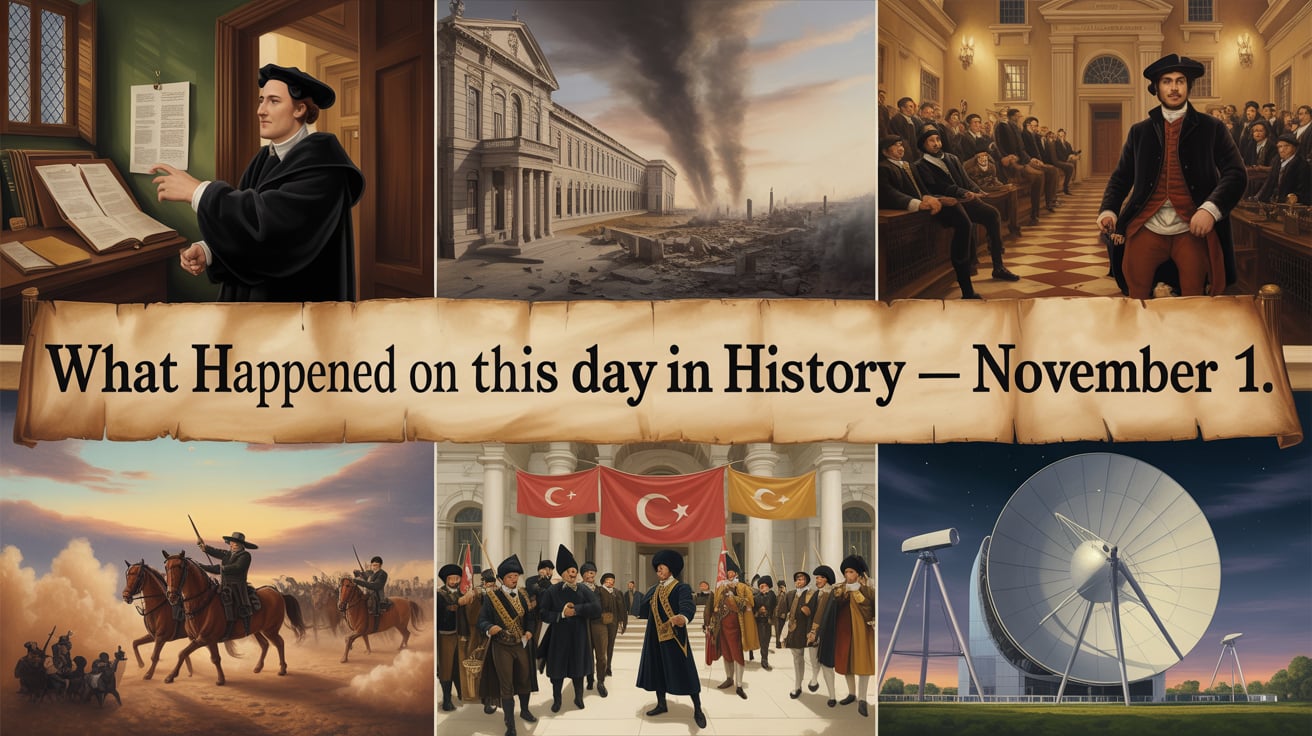
Moments of religious defiance, natural disaster, and human innovation mark November 1 as a date of lasting transformation — where belief, politics, and progress intersect. What happened on this day in history, November 1, ties together Martin Luther’s bold challenge to church power, the Lisbon earthquake’s shattering of Enlightenment faith in order, and later revolutions in science, governance, and daily life that followed in their wake.
Major Events on November 1
365 — Valentinian I learns the Alemanni have crossed the Rhine and invaded Gaul
News that Alemanni forces had crossed the Rhine brought an immediate military and political alarm to Emperor Valentinian I. The crossing threatened Roman frontier stability in Gaul, forcing rapid mobilization and defensive measures to hold vital provinces. The episode illustrates the era’s recurring frontier pressures and the empire’s reliance on swift, reactive command to preserve territorial control.
996 — Oldest recorded use of the name Ostarrîchi (Austria)
Emperor Otto III’s deed to Gottschalk, Bishop of Freising, contains the earliest known written form of Ostarrîchi, a linguistic ancestor of “Austria.” The document is an important milestone for regional identity, demonstrating how medieval charters preserved place-names and administrative claims. Historians view the deed as both a legal act and a cultural marker in the development of Central European polities.
1141 — Empress Matilda’s brief rule ends; Stephen of Blois is restored
After months of civil contest, Stephen of Blois regained the kingship from Empress Matilda, whose ephemeral status as “Lady of the English” ended with shifting loyalties among nobles. The reversal deepened the period known as The Anarchy, revealing how dynastic rivalry and baronial power shaped succession. The episode underlines the instability of medieval kingship and the limits of female rule in a patriarchal political order.
1179 — Philip II crowned King of France
Philip II’s coronation consolidated Capetian authority and inaugurated a reign that would expand royal domains and administrative capacity. Philip’s policies toward royal justice and territorial consolidation set the stage for later French centralization. The crowning marks an important phase in the transformation of medieval monarchy into a more centralized instrument of governance.
1214 — Sinope surrenders to the Seljuq Turks
The fall of the port city of Sinope to Seljuq forces extended Turkish influence along the Black Sea littoral and altered trade and naval balances in the region. Control of the harbor gave the Seljuqs strategic access to maritime routes and defensive depth. Sinope’s capture is an example of how military pressure reshaped regional commerce and coastal politics in the medieval eastern Mediterranean.
1348 — Anti-royalist Union of Valencia attacks Jews at Murviedro
Violent anti-Jewish attacks in Murviedro, instigated by local anti-royalist agitation, reflect the dangerous intersection of political conflict and religious scapegoating in late medieval Spain. Jews were accused of royalist sympathies and attacked on that pretext, suffering dispossession and bodily harm. Such incidents are part of a larger pattern of communal violence that affected minority communities during times of political stress.
1503 — Cardinal Giuliano della Rovere elected Pope Julius II
Elected to the papacy as Julius II, Cardinal della Rovere became a forceful pope who pursued political and military strategies to restore and expand papal territories. His pontificate combined patronage of the arts with energetic statecraft, commissioning major artistic projects while engaging in Italian power struggles. Julius II’s tenure marks a nexus of cultural flourishing and aggressive papal diplomacy.
1512 — Michelangelo’s Sistine Chapel ceiling exhibited to the public for the first time
When Michelangelo’s painted ceiling was revealed, contemporaries encountered a bold integration of biblical narrative, figure study and architectural illusion. The frescoes transformed devotional and artistic expectations, consolidating Michelangelo’s reputation and influencing generations of Renaissance and post-Renaissance artists. The public exhibition marked a cultural moment in which patronage, genius and church space combined to redefine visual religion.
1520 — Ferdinand Magellan navigates the Strait of Magellan
Magellan’s passage through the strait that bears his name linked Atlantic and Pacific waters for European navigators, enabling the first recorded circumnavigation and reshaping global maritime routes.
The navigation demonstrated the strategic and geographic payoff of transoceanic exploration while revealing the hazards of long voyages. The strait’s discovery had profound implications for trade, imperial competition and maritime cartography.
1555 — French Huguenots establish France Antarctique near Rio de Janeiro
A Huguenot colonial experiment near present-day Rio de Janeiro represented a Protestants’ attempt at settlement and escape from European confessional conflict. France Antarctique became a short-lived foothold in South America amid Iberian claims, reflecting how Reformation-era identities extended into colonial projects. The venture underscores the global reach of religious divisions in the sixteenth century.
1570 — All Saints’ Flood devastates the Dutch coast
The catastrophic flood of 1570 submerged vast coastal areas and caused widespread loss of life and property, marking one of the worst marine disasters in Dutch history. It exposed the vulnerability of low-lying lands to storm surges and shaped later Dutch engineering and water-management priorities. The flood’s human and economic toll resonated in subsequent debates about land reclamation and communal resilience.
1611 — Probable first performance of William Shakespeare’s The Tempest
Reports linking The Tempest to a 1611 performance point to one of Shakespeare’s late romances being staged for early seventeenth-century audiences. The play’s themes of power, reconciliation and the strange island world reflect theatrical experimentation at the period’s close. If performed then, the piece contributed to the playwright’s evolving public stature and the era’s dramatic repertoire.
1612 — Polish troops expelled from Moscow’s Kitay-gorod in Time of Troubles
Under Dmitry Pozharsky’s command, Russian forces forced Polish troops to withdraw from Moscow’s fortified Kitay-gorod, a moment in the long Time of Troubles that helped restore Russian political continuity. The expulsion highlighted grassroots mobilization and the reassertion of Russian sovereignty after a period of dynastic crisis. The action contributed to the eventual establishment of the Romanov dynasty.
1683 — New York subdivided into twelve counties under British colonial rule
The division of New York into twelve counties organized colonial administration and property jurisdictions, shaping local governance and legal frameworks in the province. The subdivision reflects the British Crown’s efforts to impose orderly cadastral and judicial systems in North America, establishing units that would later influence local political identities and regional administration.
1688 — William III departs Hellevoetsluis to press his claim in the Glorious Revolution
William of Orange’s departure for England launched a decisive phase of the Glorious Revolution, aiming to displace James II and secure Protestant succession. The operation combined careful diplomacy with military deployment and drew on domestic English opposition to James’s policies. William’s bid altered the constitutional balance in Britain and advanced parliamentary supremacy.
1755 — Lisbon earthquake and tsunami devastate the city
A massive earthquake and consequent tsunami struck Lisbon, producing extraordinary destruction and massive loss of life; contemporary estimates place fatalities in the tens of thousands. The disaster had immediate humanitarian consequences and inspired philosophical and scientific debate about nature, providence and urban planning. Lisbon’s reconstruction involved radical rebuilding and new approaches to earthquake-resistant design.
1765 — The Stamp Act enacted by the British Parliament
Parliament’s Stamp Act imposed direct taxation on printed materials in the Thirteen Colonies to help defray military expenses, provoking fierce colonial opposition. The law catalyzed unified protest, nonimportation agreements and political mobilization that fed the revolutionary ferment. The act is widely seen as a turning point in colonial-British relations, accelerating the path toward independence.
1790 — Edmund Burke publishes Reflections on the Revolution in France
Burke’s critique of the French Revolution articulated a conservative argument skeptical of radical change and the universalist abstractions he associated with Jacobin policies. The essay influenced political thought across Europe, shaping debates about rights, tradition and constitutionalism. Burke’s work remains a foundational text in modern conservative intellectual history.
1800 — John Adams first U.S. president to reside in the Executive Mansion (White House)
When President John Adams moved into the then-new Executive Mansion, he set a precedent for the presidential household and the symbolic center of American executive authority. The shift marked the practical establishment of a federal capital and the material embodiment of republican governance. Adams’s residency inaugurated the White House’s long role as official presidential residence.
1805 — Napoleon invades Austria (War of the Third Coalition)
Napoleon’s campaign into Austrian territory intensified continental conflict and led to decisive battles that reshaped European alliances. The invasion underscored French military dominance and tactical mobility, compelling diplomatic realignments across the coalition system. These operations preluded the 1805 Austerlitz campaign that dramatically reconfigured the continental order.
1814 — Congress of Vienna opens to redraw post-Napoleonic Europe
Diplomats convened to negotiate a stable European order after Napoleon’s defeat, deliberating territorial settlements, dynastic restoration and balance-of-power arrangements. The Congress set principles that governed nineteenth-century diplomacy, seeking to prevent hegemonic domination and preserve monarchical legitimacy. Its decisions shaped maps, alliances and international law for decades.
1848 — Boston Female Medical School opens, first U.S. medical school for women
The foundation of a medical school explicitly for women marked a pioneering step toward professional inclusion, expanding educational access and challenging gendered restrictions in medicine. Its creation signaled the start of institutional pathways that would slowly open medical practice to women and influence public health professions. The school later merged into broader university structures, carrying forward its legacy.
1861 — Lincoln appoints George B. McClellan commander of Union forces
President Abraham Lincoln’s selection of McClellan reflected a search for disciplined military leadership early in the Civil War, though their later differences would shape command politics. McClellan’s organizational talents contrasted with caution in the field, producing contentious debates over strategy and civil-military relations. The appointment was a major early decision with long operational consequences.
1870 — U.S. Weather Bureau issues its first official forecast
The newly organized Weather Bureau (later the National Weather Service) began issuing forecasts as a federal function, institutionalizing meteorological observation and public weather forecasting. This step improved maritime and agricultural planning and reflected growing scientific capacity for atmospheric study. Over time forecasting became integral to commerce, safety and daily life.
1893 — Battle of Bembezi (First Matabele War) yields decisive British victory
At Bembezi British forces routed Matabele resistance, affecting colonial consolidation in what became Rhodesia. The battle exemplified the asymmetries of imperial warfare and the military means by which colonial rule was extended. The outcome had implications for settlement patterns, resource exploitation and indigenous dispossession in southern Africa.
1894 — Nicholas II becomes Tsar of Russia
Nicholas II’s accession inaugurated the last Romanov reign, a period that would experience intense social strains and revolutionary currents. His rule encompassed rapid industrialization, imperial competition and mounting political unrest that culminated in 1917. Nicholas’s reign is central to understanding the collapse of imperial Russia and the revolutionary transformations that followed.
1894 — Edison’s Black Maria films Buffalo Bill and Annie Oakley
Thomas Edison’s studio filmed Buffalo Bill and company, producing early motion pictures that captured popular performers and the variety of turn-of-the-century entertainment. These short films illustrate the infancy of cinema and its role in documenting public figures and spectacle. The Black Maria recordings are milestones in the technological and cultural history of moving images.
1896 — First photograph of a bare-breasted woman appears in National Geographic
The magazine’s publication of an image showing a woman’s bare breasts indicates early editorial choices about ethnographic display and the boundaries of Victorian-era publication norms. The photograph reflected contemporary approaches to non-Western subjects and the magazine’s growing reach, while raising later debates about representation, exoticism and editorial ethics.
1897 — Library of Congress opens its own building to the public
The opening of a dedicated Library of Congress building provided a purpose-built space for the nation’s collections and public research, expanding access to resources and signaling a commitment to national learning infrastructure. The facility strengthened legislative and civic scholarship and helped position the Library as a leading international repository.
1897 — Juventus Sport-Club founded in Turin by students
The establishment of Juventus by a group of schoolboys launched one of football’s most enduring clubs, which would grow into a major force in Italian and European soccer. The club’s founding reflects football’s rapid institutionalization in Europe and the social culture of sport clubs that shaped mass spectator traditions.
1905 — Lahti granted city rights by Tsar Nicholas II (Finland)
Lahti’s formal recognition as a city within the Grand Duchy of Finland reflected urban growth and the administrative practices of the Russian imperial system. City status shaped local governance, infrastructural development and municipal identity during a period of modernization in Finnish society.
1911 — First combat aerial bombing mission (Giulio Gavotti) in Italo-Turkish War
Lieutenant Gavotti’s small aerial bombs marked an early experiment with aircraft as offensive weapons, signaling a transformation from observation to direct attack in military aviation. The mission foreshadowed the profound militarization of air power in the twentieth century and raised questions about the ethics and tactics of bombardment.
1914 — Battle of Coronel: Royal Navy defeat off Chilean coast
The German victory at Coronel inflicted the Royal Navy’s first major loss of World War I, sinking HMS Good Hope and HMS Monmouth and delivering a shock to British naval prestige. The battle revealed the global reach of the conflict and prompted rapid strategic and operational responses in the South Atlantic theatre.
1914 — Australian Imperial Force departs Albany for Egypt
The mass movement of Australian troops toward the Middle Eastern theatre opened a defining chapter in Australia’s wartime experience and national memory. The troop convoy signaled colonial contributions to imperial war efforts and set the stage for later campaigns in Gallipoli and the Western Front that shaped national identity.
1916 — Milyukov’s “stupidity or treason” speech precipitates government collapse in Russia
Pavel Milyukov’s State Duma speech accused government leaders of treachery, fueling political crisis and contributing to the downfall of Boris Stürmer’s cabinet. The episode illustrates mounting wartime discontent and the fragility of Russian wartime governance that preceded the 1917 revolutions.
1918 — Italian Regia Marina sinks SMS Viribus Unitis with a manned torpedo at Pula
A daring Italian torpedo action into the Austro-Hungarian naval base saw the battleship Viribus Unitis damaged and sunk, exemplifying novel naval special-operations techniques. The exploit had both tactical effects and symbolic weight in the closing months of the war as empires crumbled.
1918 — Malbone Street wreck kills at least 102 in Brooklyn subway disaster
The Malbone Street subway crash stands as the deadliest rapid-transit accident in U.S. history, prompting scrutiny of training, equipment and urban transit safety. The catastrophe had long-term effects on municipal transit governance and the professionalization of subway operations.
1918 — Western Ukraine separates from Austria-Hungary
Amid imperial collapse, Western Ukrainian territories declared separation from Austria-Hungary and sought new political arrangements, reflecting the broader fracturing and nation-building that followed World War I. The realignments contributed to contested borders and subsequent conflicts in Eastern Europe.
1922 — Abdication of Mehmed VI; abolition of the Ottoman sultanate
Mehmed VI’s departure and the Grand National Assembly’s decision to abolish the sultanate inaugurated the final phase of Ottoman state dissolution and the rise of Turkish republicanism under Mustafa Kemal Atatürk. This political rupture ended centuries of Ottoman rule and facilitated radical constitutional and social reform in Turkey.
1923 — Aero O/Y (Finnair) founded, first Finnish airline
The creation of Aero O/Y marked the beginnings of Finnish civil aviation, establishing routes and capacities that would later evolve into a national carrier. The airline’s foundation exemplifies post-war modernization and the expanding role of air transport in connecting nations and markets.
1928 — Turkey adopts the Latin alphabet by law
The alphabet reform replaced Ottoman Turkish’s Arabic script with a Latin-based script, dramatically altering literacy, education and public communication in the early Turkish Republic. The change was a centerpiece of Atatürk’s cultural modernization, accelerating mass education and reorienting Turkey toward a Western-style public sphere.
1937 — Execution of Pastor Paul Hamberg and Lutheran community members in Azerbaijan
Stalinist repression in the Soviet periphery included religious persecution and show trials that targeted minority clergy and communities; the execution of Pastor Hamberg and others exemplifies the regime’s reach into faith communities and the brutal methods used to suppress dissenting institutions.
1938 — Seabiscuit defeats War Admiral in a celebrated match race
The unexpected victory by Seabiscuit over a favored champion became a cultural touchstone, symbolizing grit during the late Depression era and gaining mass attention for sport and popular hero narratives. The race captured public imagination and contributed to the lore of American horseracing.
1941 — Ansel Adams photographs Moonrise, Hernandez — iconic image in photography
Adams’ striking composition and mastery of light produced one of the twentieth century’s most celebrated photographic images, blending landscape, tonal precision and contemplative mood. The photograph became emblematic of American fine-art photography and influenced visual aesthetics in nature photography.
1942 — Matanikau Offensive begins in the Guadalcanal campaign (U.S. victory)
American forces launched operations around the Matanikau River that helped secure perimeter control in the bitter Guadalcanal struggle, contributing to a strategic turning point in the Solomon Islands campaign. The operation exemplified island warfare’s intensity and the gradual shift of initiative to Allied forces in the Pacific.
1943 — US 3rd Marine Division secures Bougainville beachhead; naval clash at Empress Augusta Bay
The Bougainville landing and ensuing naval engagement helped establish Allied footholds in the Solomons and reduce Japanese naval presence, aiding broader campaigns of isolation and attrition against Japan’s defensive perimeter. The operation showcased joint amphibious and naval coordination in island operations.
1944 — British Army landings at Walcheren during the Battle of the Scheldt
Allied operations to clear the Scheldt estuary secured access to the port of Antwerp, essential for logistics supporting the northern European campaign. The difficult amphibious and combined-arms action at Walcheren reflected the campaign’s complexity and the strategic importance of supply lines for advancing forces.
1945 — Rodong Sinmun, official North Korean newspaper, first published as Chongro
The debut of what would become North Korea’s principal official newspaper signalled the consolidation of propaganda and state-controlled media in the emerging DPRK, shaping public communication and party messaging in the early post-war era.
1948 — Athenagoras I enthroned as Ecumenical Patriarch of Constantinople
Athenagoras’s installation as patriarch occurred in a period of geopolitical upheaval and church-state realignments; his later ecumenical moves would include rapprochement efforts with other Christian communions. His enthronement marks continuity in a key position of Eastern Orthodox leadership.
1949 — Eastern Air Lines Flight 537 midair collision kills all 55 aboard
A midair collision near Alexandria, Virginia produced a tragic loss and heightened awareness of air-traffic control safety, precipitating investigations into flight procedures and contributing to later improvements in aviation regulation and collision avoidance systems.
1950 — Puerto Rican nationalists attempt to assassinate President Truman at Blair House
The assassination attempt underscored political violence linked to anti-colonial and nationalist grievances and revealed vulnerabilities in presidential security during a high-profile visit. The incident prompted immediate security responses and a reassessment of protective arrangements around the chief executive.
1951 — Operation Buster–Jangle exposes 6,500 U.S. soldiers to atomic blasts for training
Large numbers of service members took part in exercises near atmospheric nuclear tests, raising later ethical and health concerns about informed consent and the human costs of nuclear preparedness. The operation exemplifies Cold War-era civil-military practices and the contested legacy of nuclear testing on personnel.
1952 — Ivy Mike thermonuclear test detonated at Eniwetok Atoll
The successful Ivy Mike test demonstrated the power of thermonuclear devices and accelerated the nuclear arms race, with profound military, environmental and political consequences. The test convinced strategists of the weapons’ strategic potency while prompting debates about testing’s humanitarian and ecological costs.
1954 — First shots of the Algerian War of Independence fired by the FLN
The Front de Libération Nationale’s initial attacks inaugurated a bitter war against French colonial rule that would last for years and reshape Algerian and French politics. The conflict highlighted decolonization’s violent dimensions and led to eventual Algerian independence and deep political consequences in metropolitan France.
1955 — U.S. Military Assistance Advisory Group established in South Vietnam
The creation of MAAG marked an intensification of American advisory involvement in South Vietnam, a step on a path that would later lead to deeper military commitment. The advisory mission reflected Cold War containment logic and growing U.S. entanglement in Southeast Asian conflicts.
1955 — United Airlines Flight 629 bombing kills 44 (DC-6B)
A bombing that destroyed a commercial airliner produced a national shock and intensified efforts to secure civil aviation, leading to criminal prosecutions and adjustments to airline security and baggage-screening practices in subsequent decades.
1956 — Indian states reorganized; Springhill mining disaster kills 39; Hungarian Revolution developments
1956 was a year of dramatic, disparate events: Indian states were reorganized under linguistic and administrative reforms; a mining disaster in Springhill, Nova Scotia cost dozens of lives; and Hungary’s brief revolutionary moment culminated in political upheaval as Imre Nagy announced neutrality and Soviet forces moved to reassert control, foreshadowing a bloody crackdown.
1957 — Mackinac Bridge opens, then the world’s longest suspension bridge between anchorages
The bridge’s opening linked Michigan’s peninsulas, facilitating regional transport and symbolizing mid-century engineering achievement. The structure altered economic flows and became an infrastructural landmark, reflecting postwar investments in large civil works and automotive mobility.
1963 — Arecibo Observatory officially opens in Puerto Rico
With the world’s largest radio telescope at the time, Arecibo became a global center for radio astronomy, atmospheric science and planetary radar research. The facility advanced scientific knowledge, supported asteroid studies and became an iconic instrument in observational astrophysics for decades.
1963 — South Vietnamese coup begins (political upheaval)
The coup in South Vietnam initiated a period of rapid political turnover and instability that complicated U.S. policy and contributed to the growing quagmire of the Vietnam conflict, illustrating how internal political fragility affected allied wartime governance.
1967 — Cool Hand Luke opens, Paul Newman’s emblematic antihero role
The film’s release popularized a gritty, character-driven style of American cinema and solidified Paul Newman’s star persona. The movie’s themes of rebellion and stoic endurance resonated with cultural currents in the late 1960s, becoming a staple of film studies and popular memory.
1968 — MPAA film rating system introduced (G, M, R, X)
The Motion Picture Association of America’s rating system began as a self-regulatory measure that reframed film content classification and shaped distribution, marketing and artistic boundaries. The ratings changed how audiences and filmmakers navigated cinematic content in the decades that followed.
1970 — Club Cinq-Sept fire in Saint-Laurent-du-Pont, France kills 146
A devastating fire at a crowded nightclub claimed many young lives and exposed safety and crowd-control deficiencies. The tragedy led to stricter fire codes and emergency protocols for public venues in France and elsewhere, altering standards for public-safety enforcement.
1973 — Leon Jaworski named Watergate Special Prosecutor
Jaworski’s appointment continued the investigation into presidential wrongdoing and signaled persistence of legal accountability mechanisms during the Watergate crisis. The special prosecutor’s work contributed to the unfolding constitutional and legal outcomes that followed.
1973 — Mysore renamed Karnataka, reflecting regional identity
The renaming reflected linguistic and cultural assertions that sought to better represent the region’s diverse communities and historical identity within India’s federal structure. The change was part of broader post-colonial processes of administrative redefinition in Indian states.
1976 — Bloodless coup in Burundi removes Michel Micombero
Jean-Baptiste Bagaza’s takeover ended Micombero’s rule and inaugurated another period of political reconfiguration in Burundi, illustrating the instability of post-colonial governments and the recurring role of military intervention in political succession.
1979 — Bolivia coup by Colonel Alberto Natusch vs. Wálter Guevara
The violent overthrow reflected South America’s turbulent political landscape in the late twentieth century and underscored the fragility of constitutional governance amid factional pressures and military ambition.
1979 — Griselda Álvarez becomes first female governor in Mexico
Her election as governor marked a breakthrough for women’s political leadership in Mexico, signaling gradual but important changes in gendered access to public office and the expanding role of women in political life.
1981 — Antigua and Barbuda gains independence from the United Kingdom
Independence marked the island’s formal assumption of sovereignty and entry into the community of nations, reflecting the broader decolonization wave in the Caribbean and the political maturation of post-colonial states.
1982 — Honda opens its first U.S. automobile plant in Marysville, Ohio
Honda’s factory inauguration was a landmark in globalization and the internationalization of auto manufacturing, signaling the rise of Asian automakers’ direct production in North America and reshaping regional industrial employment.
1984 — Anti-Sikh riots erupt after Indira Gandhi’s assassination; nationwide violence
The assassination of Prime Minister Indira Gandhi by her Sikh bodyguards sparked mass reprisals that resulted in thousands of deaths, especially in New Delhi, and left enduring wounds in India’s communal and political life. The riots prompted discussions about state response, justice and reconciliation.
1987 — British Rail Class 43 (HST) sets on-board fuel rail speed record (238 km/h)
The high-speed test exemplified advances in rail technology and the drive to improve intercity service performance, reflecting late twentieth-century engineering improvements in rail traction and safety.
1991 — Dzhokhar Dudayev declares Chechnya’s sovereignty from Russia
Dudayev’s declaration marked an escalation in Chechen aspirations for independence and foreshadowed the violent conflicts that would follow in the North Caucasus, raising complex questions about self-determination and federal integrity.
1993 — Maastricht Treaty enters into force, formally establishing the European Union
The treaty created new institutional structures for European integration, introduced a roadmap toward economic and monetary union, and expanded cooperation in foreign policy and justice. Maastricht’s ratification represented a major legal and political step in postwar European integration.
1994 — NASA launches the Wind spacecraft to explore the space environment between Earth and Sun
Wind’s mission to study the solar wind and magnetospheric phenomena contributed to space-weather science and our understanding of heliophysics, enhancing knowledge crucial for satellite operations and space science.
1997 — Titanic premieres publicly at Tokyo festival, launching a global blockbuster career
James Cameron’s film debut signaled the ascent of a massively popular cinematic phenomenon that would break box-office records and shape late-1990s film culture, making its principal stars and creators internationally prominent.
2000 — Chhattisgarh created as India’s 26th state; Serbia and Montenegro join the UN
India’s internal reorganization produced a new state intended to reflect local administrative needs and identity, while Serbia and Montenegro’s UN admission reflected post-Yugoslav diplomatic adjustments and the shifting map of international representation.
2001 — Turkey, Australia and Canada agree to commit troops to the invasion of Afghanistan
Allied troop commitments in the wake of 9/11 signaled the globalization of counterterrorism operations and the extension of coalition military action into Afghanistan, reshaping security and foreign-policy priorities across participating nations.
2009 — Il-76 crash near Mirny kills 11 in Yakutia
The crash of a Russian transport aircraft highlighted persistent aviation risks in remote regions and prompted investigations into flight safety, maintenance and operational conditions in Arctic and sub-Arctic airspace.
2011 — Mario Draghi becomes President of the European Central Bank
Draghi’s accession occurred amid the Eurozone sovereign-debt crises, and his later policy decisions would become pivotal to European monetary stabilization efforts. The leadership change was consequential for ECB strategy and European financial governance.
2012 — Fatal fuel tanker explosion in Riyadh kills 26, injures many
A devastating explosion caused major casualties and prompted scrutiny of tanker safety, hazardous-material transport standards and related emergency response systems in urban settings.
2023 — Texas Rangers win their first World Series (sports milestone)
The franchise’s championship victory became a major sports milestone and local celebration, reflecting franchise investment, long-term team building and a moment of civic pride in American professional sports.
2024 — Concrete canopy collapse at Novi Sad railway station kills 14, injures 3
A recent structural failure at a major transport node produced tragic fatalities and raised urgent questions about infrastructure maintenance, inspection regimes and public-safety oversight at public facilities. The incident prompted immediate investigations and calls for accountability.
Read About October 31 Important Facts
Notable births — November 1
Tim Cook — American business executive, CEO of Apple — born 1960.
L. S. Lowry — British painter (industrial landscapes) — born 1887.
Antonio Canova — Italian Neoclassical sculptor — born 1757.
Hannah Höch — German Dada artist — born 1889.
Rafic al-Hariri — Lebanese businessman & prime minister — born 1944.
Benvenuto Cellini — Florentine sculptor & goldsmith — born 1500.
Spencer Perceval — British prime minister (assassinated in office) — born 1762.
Gustav IV Adolf — King of Sweden (overthrown 1809) — born 1778.
Süleyman Demirel — Turkish statesman — born 1924.
Fernando Valenzuela — Mexican MLB pitcher — born 1960.
Notable deaths — November 1
Phil Silvers — American actor & comedian — died 1985.
King Vidor — American film director — died 1982.
William Styron — American novelist — died 2006.
Pietro Badoglio — Italian general & statesman — died 1956.
René Lévesque — Premier of Quebec — died 1987.
Alfred Jarry — French writer — died 1907.
Jacques Piccard — Swiss ocean engineer & explorer — died 2008.
Severo Ochoa — Spanish-American biochemist, Nobel laureate — died 1993.
Observances & institutional dates — November 1
All Saints’ Day (Christian observance).
Day of the Dead / Day of the Innocents (start in Mexico; related observance).
Anniversary of the Revolution (Algeria).
Chhattisgarh Rajyotsava (Chhattisgarh, India).
Karnataka Rajyotsava (Karnataka, India).
National Brush Day (United States).
World Vegan Day.
Frequently Asked Questions
Why is November 1 linked to Martin Luther and the Reformation?
Martin Luther’s posting of the 95 Theses in 1517 (traditionally dated to this day) challenged church practices and papal authority. The act helped ignite theological debate, print-fueled dissemination of reform ideas, and a movement that ultimately reshaped European religion, politics, and literacy.
What made the 1755 Lisbon earthquake so consequential?
The quake, tsunami and fires destroyed much of Lisbon and killed tens of thousands, exposing the vulnerability of cities to natural disaster. Its social and philosophical aftermath influenced Enlightenment thinkers’ views on providence, prompted early disaster-response thinking and spurred changes in urban planning and building practice.
How did November 1 affect women’s entry into medicine?
On this date in 1848 the Boston Female Medical School opened, one of the first U.S. institutions dedicated to training women as physicians. Its founding advanced professional opportunities for women and paved the way for wider acceptance of women in medical education and practice.
Why does November 1 appear in technological and scientific timelines?
The date hosts several landmark tech and science moments — for example, the opening of the Arecibo Observatory (1963) and the Ivy Mike thermonuclear test (1952) — showing how the day recurs in milestones that expanded observational science and high-energy research, with long-term implications for both civilian and strategic fields.