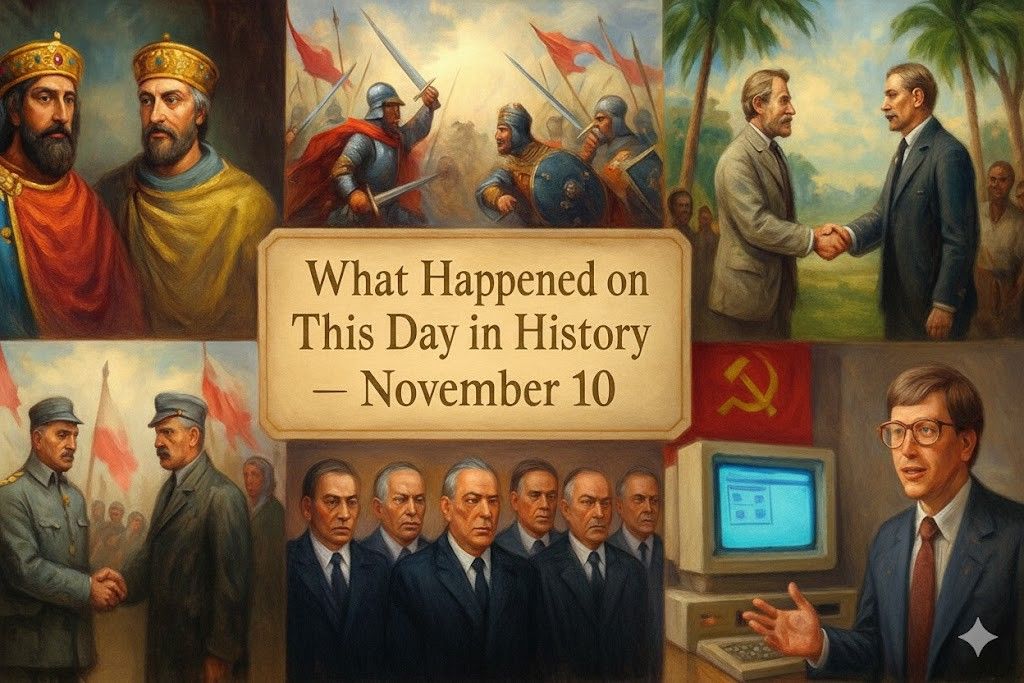
History stages sudden shifts and long echoes on November 10: royal deaths and usurpations, sieges and maritime losses, scientific firsts and modern political ruptures. What happened on this day in history November 10 links medieval dynastic struggles and early-modern power politics with twentieth- and twenty-first-century revolutions, legal changes and technological milestones.
Important Events That Happened on November 10 in History
474 — Emperor Leo II dies; Zeno becomes sole Byzantine ruler
The ten-month reign of infant Emperor Leo II ended with his death, elevating his father Zeno to sole rule. Zeno’s accession unfolded amid palace intrigue and the ongoing challenge of securing imperial authority in a fractious, faction-driven Constantinople. His tenure shaped the empire’s response to internal and external pressures.
911 — Conrad I was elected king of East Francia at Forchheim
Following the death of Louis the Child, Conrad I’s election at Forchheim marked a turning point in East Frankish politics as non-Carolingian magnates asserted authority. His kingship illustrated the decentralizing tendencies of the period, with regional dukes and nobles playing decisive roles in succession and governance.
937 — Li Bian (Xu Zhigao) founds Southern Tang after usurping Wu
Li Bian’s takeover replaced the Wu state and inaugurated Southern Tang rule in southern China. The transition exemplified the fluidity of the Ten Kingdoms era, when regional warlords and court factions remade dynastic lines and reshaped the political map of late medieval China.
1202 — Fourth Crusade begins siege of Zara despite papal ban
Crusaders besieged Zara (Zadar) even after Pope Innocent III forbade attacks on Christian ports, an episode that signalled the crusade’s diversion into European political quarrels. The sack highlighted how crusading energy could be redirected by commercial and dynastic interests, with lasting damage to papal authority and inter-Christian relations.
1293 — Raden Wijaya crowned first monarch of Majapahit (Kertarajasa Jayawardhana)
Raden Wijaya’s coronation established the Majapahit kingdom in Java under the regnal name Kertarajasa Jayawardhana. The new polity would become a major maritime and cultural power in the Indonesian archipelago, shaping regional trade, statecraft and court culture over subsequent centuries.
1444 — Battle of Varna: defeat of crusading forces; the king was killed
Crusading armies under King Władysław III were decisively defeated by Sultan Murad II at Varna, where the Polish-Hungarian monarch fell. The battle ended a major Christian offensive in the Balkans, reinforced Ottoman momentum in Southeast Europe, and had lasting repercussions for regional geopolitics.
1599 — Åbo Bloodbath: executions in Turku for opposition to Duke Charles
Fourteen noblemen opposing Duke Charles were executed in Turku’s Old Great Square during a ruthless political purge. The Åbo Bloodbath illustrates how dynastic conflict and factional rivalry within Scandinavian polities could be settled by public executions and legal terror.
1659 — Shivaji defeats Afzal Khan at the Battle of Pratapgarh
Maratha leader Chhatrapati Shivaji Maharaj killed Afzal Khan in the encounter at Pratapgarh, a tactical triumph that enhanced Shivaji’s stature and the Maratha position in western India. The episode demonstrates the interplay of guerrilla tactics, personal leadership and regional rivalries in early modern subcontinental warfare.
1674 — Treaty of Westminster ends the Third Anglo-Dutch War; New Netherland ceded
Under terms fixed by the Treaty of Westminster, the Dutch ceded New Netherland to England, reshaping colonial claims in North America and setting the stage for English expansion. The treaty exemplified seventeenth-century imperial bargaining, where territorial swaps resolved commercial and naval rivalries.
1702 — English colonists besiege Spanish St. Augustine during Queen Anne’s War
James Moore’s expedition against St. Augustine reflected imperial contestation in colonial North America; the siege formed part of larger Anglo-Spanish rivalry and illustrated how European wars played out in the colonies through raids, sieges and disputed claims.
1766 — William Franklin signs charter founding Queen’s College (Rutgers)
The colonial governor William Franklin signed the charter for Queen’s College, later Rutgers University, creating an institution that would become part of the American higher-education landscape. The foundation shows how colonial civic life and educational initiatives prefigured later national institutions.
1775 — United States Marine Corps founded at Tun Tavern, Philadelphia
Samuel Nicholas and members of the Continental Marines established the U.S. Marine Corps at Tun Tavern, initiating a military corps that would play recurring roles in American naval and expeditionary operations. The founding became a recurring institutional anniversary in U.S. service history.
1793 — French Convention proclaims a Goddess of Reason amid the Revolution
Radical elements of the Convention embraced a secular cult of Reason, replacing traditional worship with civic festivals. The episode captures the revolutionary regime’s experiments in symbolic politics, the politicization of ritual, and the cultural upheavals of the Terror period.
1821 — Rufina Alfaro’s Cry of Independence in La Villa de Los Santos (Panama)
Rufina Alfaro’s uprising sparked a local independence movement that led Panama away from Spanish rule and into union with Gran Colombia. The event forms part of the wider Spanish-American independence era, where local leaders and popular uprisings changed imperial geographies.
1847 — Wreck of the Stephen Whitney spurs Fastnet lighthouse construction
The passenger ship Stephen Whitney was lost in fog off Ireland, killing most aboard and motivating safer navigation measures, notably the Fastnet Rock lighthouse. Maritime disasters like this often prompted investments in coastal safety and the institutionalization of lifesaving infrastructure.
1865 — Major Henry Wirz executed for war crimes at Andersonville
Henry Wirz, superintendent of the Confederate Andersonville prison camp, was hanged after conviction for wartime atrocities; one of the few civil-war era executions for war crimes, his case fed debates about accountability, command responsibility and the treatment of prisoners in wartime.
1871 — Stanley finds David Livingstone at Ujiji: “Dr. Livingstone, I presume?”
Henry Morton Stanley’s meeting with David Livingstone in Ujiji became an iconic moment of nineteenth-century exploration lore. The encounter highlighted European exploration of Africa, missionary networks and the media’s role in shaping public perception of imperial ventures.
1898 — Wilmington massacre: white supremacist coup and massacre of Black citizens
White insurgents overthrew Wilmington’s biracial government in a violent coup, massacring and expelling Black residents and seizing municipal power. The event stands as a stark example of racial terrorism and the rollback of Reconstruction-era gains in the United States.
1910 — San Diego Army and Navy Academy opens (founding date noted)
Thomas A. Davis’s institution began operations on this date (official founding later recorded), reflecting early twentieth-century patterns of private military education and preparatory schooling in the United States.
1918 — Secret message signals armistice; Piłsudski returns to Warsaw to declare independence
A coded message received in Nova Scotia alerted Ottawa and Washington that hostilities would cease on November 11; meanwhile, Józef Piłsudski’s arrival in Warsaw helped declare Polish independence after partition, underscoring how communication and political leadership converged at the end of World War I.
1918 – Poland Regains Its Independence
After more than a century of partition by Russia, Prussia, and Austria, Poland finally reemerged as a sovereign nation. On November 10, 1918, Józef Piłsudski returned to Warsaw, greeted by crowds celebrating freedom. His arrival marked the collapse of foreign control amid World War I’s end. The next day, Poland officially reclaimed its independence, beginning the rebirth of the Polish Republic.
1939 — F. E. Sillanpää awarded the Nobel Prize in Literature
Finnish author Frans Eemil Sillanpää received the Nobel Prize in Literature, marking international recognition of his literary work and contributing to Nordic cultural visibility on the world stage.
1940 — The Vrancea earthquake devastates Romania
A major quake in Romania’s Vrancea region killed roughly a thousand people and injured thousands more, producing widespread destruction. The disaster prompted responses in civil protection and revealed vulnerabilities in interwar and wartime emergency preparedness.
1942 — Germany invades Vichy France after Darlan’s North Africa agreement
German forces occupied Vichy-controlled territories following Admiral François Darlan’s negotiations with the Allies in North Africa, illustrating the fragile sovereignty of Vichy France and the strategic interplay among Axis and Allied moves in wartime diplomacy.
1944 — USS Mount Hood explodes, causing massive casualties at Seeadler Harbour
The ammunition ship USS Mount Hood catastrophically detonated, killing hundreds and wounding many more aboard nearby vessels. The explosion demonstrated the lethal risks of ammunition handling in forward bases and prompted operational reviews of ordnance safety.
1945 — Heavy fighting in Surabaya; Heroes’ Day in Indonesia
Violent clashes between Indonesian nationalists and returning colonial forces in Surabaya became a defining moment in Indonesia’s struggle for independence; the day is commemorated as Heroes’ Day (Hari Pahlawan) for its symbolic and human cost in anti-colonial resistance.
1946 — Devastating 6.9 earthquake in the Peruvian Andes
A powerful earthquake in the Peruvian Andes killed at least 1,400 people and caused major destruction, leading to large-scale humanitarian needs and influencing seismological study and regional reconstruction efforts.
1951 — North American Numbering Plan begins direct coast-to-coast dialing
The rollout of the numbering plan enabled direct-dial long-distance calls across the United States, a major modernization in telecommunications that transformed personal and business communication by simplifying nationwide telephone access.
1954 — Eisenhower dedicates the U.S. Marine Corps War Memorial (Iwo Jima)
President Dwight D. Eisenhower dedicated the iconic Iwo Jima memorial, honoring U.S. Marines’ sacrifices and commemorating World War II’s Pacific theater; the monument became a lasting national symbol of service and remembrance.
1958 — Hope Diamond donated to the Smithsonian
Harry Winston gifted the famed Hope Diamond to the Smithsonian Institution, moving a notable gem into public museum stewardship and enhancing the museum’s natural-history and gem collections for scientific and popular audiences.
1967 — Australian Parliament passes Nauru Independence Act; Nauru to become independent
Australian legislation set independence for Nauru (effective January 1968), ending mandate-era arrangements and creating a new small-state participant in Pacific diplomacy and resource politics.
1969 — Sesame Street debuts on National Educational Television
The children’s program Sesame Street premiered, pioneering educational television for young audiences with a mix of entertainment and pedagogy; its format influenced generations of early-childhood media worldwide.
1970 — Vietnamization milestone: week without U.S. combat fatalities
For the first time in five years, a full week ended with no reported American combat fatalities in Southeast Asia, symbolizing a moment in the gradual U.S. drawdown under Vietnamization policies, though the war’s toll and controversy persisted.
1970 — Luna 17 launches (Soviet uncrewed lunar mission)
The Soviet Union launched its Luna 17 mission, an unmanned lunar probe that later deployed the Lunokhod rover, underscoring ongoing robotic exploration and competition in lunar science during the space age.
1971 — Khmer Rouge attack Phnom Penh; Merpati Viscount crash kills 69
Khmer Rouge forces struck Phnom Penh and its airport in an attack that inflicted casualties and material damage; separately, Merpati Nusantara’s Vickers Viscount crashed into the Indian Ocean near Padang with no survivors, highlighting both conflict-driven violence and aviation risk in the region.
1972 — Southern Airways Flight 49 hijacking threatens Oak Ridge nuclear site
Hijackers of Flight 49 demanded political concessions and at one point threatened to crash the plane into a nuclear facility; after extended negotiations the aircraft was flown to Cuba, where the perpetrators were later imprisoned—an event reflecting the era’s airline-security vulnerabilities.
1975 — SS Edmund Fitzgerald sinks on Lake Superior, all 29 crew lost
The freighter Edmund Fitzgerald foundered in a storm on Lake Superior, becoming one of the Great Lakes’ most famous maritime tragedies. The loss prompted renewed focus on shipping safety, weather forecasting and the hazards of inland seafaring in severe conditions.
1975 — Treaty of Osimo signed between Italy and Yugoslavia
The Treaty of Osimo formalized border arrangements between Italy and Yugoslavia, resolving parts of a longstanding territorial dispute and illustrating how Cold War Europe negotiated bilateral settlements to reduce flashpoint tensions.
1975 — UN General Assembly passes Resolution 3379 (Zionism = racism)
The General Assembly adopted a contentious resolution equating Zionism with racism; the measure reflected Cold War alignments and decolonization-era politics in multilateral fora, later becoming a major diplomatic flashpoint before its revocation in 1991.
1979 — Mississauga train derailment spreads toxic chemicals across suburban Ontario
A 106-car Canadian Pacific freight train derailed near Mississauga, spilling and igniting hazardous materials and prompting the large-scale evacuation of surrounding communities. The accident drove improvements in hazardous-materials transport policy and emergency planning.
1982 — Soviet leader Leonid Brezhnev dies after eighteen years in power
Brezhnev’s death marked the end of an era in Soviet leadership characterized by stability and stagnation; his passing opened a period of rapid leadership turnover and contributed to later political shifts in Moscow.
1983 — Bill Gates introduces Microsoft Windows 1.0
Microsoft announced Windows 1.0, an early graphical extension to MS-DOS that began a long evolution of desktop operating systems and user interfaces, catalyzing the personal-computing revolution and transforming software markets.
1985 — Mid-air collision over Fairview, New Jersey kills six
A Dassault Falcon 50 and a Piper Cherokee collided over Fairview, producing multiple fatalities and renewed attention to air-traffic procedures, radar coverage and small-jet operational safety.
1989 — Todor Zhivkov removed; Germans begin to tear down the Berlin Wall
Bulgaria’s long-time leader Todor Zhivkov was replaced amid political change, and in Germany citizens began dismantling the Berlin Wall—both events emblematic of the sweeping political transformations sweeping Eastern Europe and the collapse of Communist party dominance.
1990 — World premiere of the comedy film Home Alone
John Hughes’s family comedy Home Alone premiered and quickly became a holiday box-office staple, its success spawning sequels and embedding the film in popular seasonal viewing traditions.
1995 — Ken Saro-Wiwa and eight Ogoni activists executed in Nigeria
Playwright and activist Ken Saro-Wiwa and fellow Ogoni leaders were executed following controversial trials, provoking international condemnation and highlighting tensions over environmental exploitation, state repression and human rights in Nigeria.
1997 — WorldCom–MCI merger announced, a then-record US$37 billion deal
The proposed merger of WorldCom and MCI Communications represented the age’s wave of telecom consolidation and signalled both the scale of corporate restructuring and later scrutiny as the telecommunications sector faced governance and accounting controversies.
1999 — World Anti-Doping Agency (WADA) formed in Lausanne
WADA’s establishment created an international institutional framework to coordinate anti-doping rules, testing and sanctions across sports, reflecting growing concern about fairness and the integrity of elite competition.
2001 — China accepted into the WTO after long negotiations (Taiwan approved next day)
After long diplomatic and trade bargaining, China’s accession to the World Trade Organization reshaped global trade patterns, integrating China more fully into the world economy and setting the stage for profound shifts in manufacturing, investment and trade policy.
2002 — Veteran’s Day Weekend Tornado Outbreak strikes large U.S. region
A widespread tornado outbreak from northern Ohio to the Gulf Coast produced extensive damage and underscored the seasonal vulnerability of U.S. communities to severe convective storms, prompting emergency response and rebuilding efforts.
2006 — Assassination of Nadarajah Raviraj and opening of the National Museum of the Marine Corps
Sri Lankan politician Nadarajah Raviraj was killed in Colombo, a politically charged murder that intensified national tensions. In the United States the National Museum of the Marine Corps opened in Quantico, dedicated by President George W. Bush and commemorating Marine service history.
2008 — NASA ends the Phoenix Mars mission after loss of contact
After an extended surface mission on Mars, NASA declared the Phoenix lander mission concluded when communications could no longer be maintained, closing a chapter in polar-landing science and planetary-surface study.
2009 — Naval skirmish off Daecheong Island between North and South Korea
Ships from North and South Korea clashed near Daecheong Island, a reminder of the persistent tensions along the maritime arm of the Korean Demilitarized Zone and the volatility of incidents in contested sea spaces.
2019 — Evo Morales resigns amid protests and military recommendation
Bolivian President Evo Morales resigned after major protests and pressure from the military following disputed elections, leading to a political vacuum and national debate over electoral legitimacy and the role of security forces in political transitions.
2020 — Armenia, Azerbaijan, Russia sign Nagorno-Karabakh armistice
An agreement brokered by Russia ended active hostilities in the Second Nagorno-Karabakh War, reshaping territorial control and introducing Russian peacekeepers into the region—an arrangement with complex political and humanitarian consequences for the South Caucasus.
Read Also: What Happened On This Day In History November 9
Famous People Born On November 10
Patrick Henry Pearse — Irish poet and statesman. (Nov 10, 1879 – May 3, 1916)
William Hogarth — English artist. (Nov 10, 1697 – Oct 26, 1764)
Claude Rains — British actor. (Nov 10, 1889 – May 30, 1967)
Russell Means — Oglala Sioux activist. (Nov 10, 1939 – Oct 22, 2012)
El Lissitzky — Russian artist, typographer and designer. (Nov 10, 1890 – Dec 30, 1941)
Oliver Goldsmith — Anglo-Irish author and dramatist. (Nov 10, 1730 – Apr 4, 1774)
François Couperin — French composer and harpsichordist. (Nov 10, 1668 – Sep 11, 1733)
Henry Van Dyke — American writer and diplomat. (Nov 10, 1852 – Apr 10, 1933)
Zuo Zongtang — Chinese official and military leader. (Nov 10, 1812 – Sep 5, 1885)
Sir Jacob Epstein — British sculptor. (Nov 10, 1880 – Aug 21, 1959)
Vachel Lindsay — American poet and public reader. (Nov 10, 1879 – Dec 5, 1931)
Andrey N. Tupolev — Soviet aircraft designer. (Nov 10, 1888 – Dec 23, 1972)
John Knudsen Northrop — American aeronautical designer. (Nov 10, 1895 – Feb 18, 1981)
Jorge Ubico — President and dictator of Guatemala. (Nov 10, 1878 – Jun 14, 1946)
Granville Sharp — English scholar and abolitionist. (Nov 10, 1735 – Jul 6, 1813)
Michael Ivanovich Rostovtzeff — Archaeologist and historian. (Nov 10, 1870 – Oct 20, 1952)
Karl Shapiro — American poet and critic. (Nov 10, 1913 – May 14, 2000)
Ernst Otto Fischer — German chemist, Nobel laureate. (Nov 10, 1918 – Jul 23, 2007)
José Hernández — Argentine poet and chronicler of the gaucho. (Nov 10, 1834 – Oct 21, 1886)
Lisette Model — Austrian-born photographer and teacher. (Nov 10, 1901 – Mar 30, 1983)
Famous People Died On November 10
Miriam Makeba — South African singer (“Mama Afrika”). (Mar 4, 1932 – Nov 10, 2008)
Shah ʿĀlam II — Mughal emperor (nominal). (Jun 15, 1728 – Nov 10, 1806)
John Trumbull — American painter of Revolutionary scenes. (Jun 6, 1756 – Nov 10, 1843)
Dion O’Bannion — American gangster and bootlegger. (1892 – Nov 10, 1924)
Carmen McRae — American jazz vocalist and pianist. (Apr 8, 1920 – Nov 10, 1994)
Ibrahim Pasha — Egyptian viceroy and military leader. (1789 – Nov 10, 1848)
Władysław III Warneńczyk — King of Poland and Hungary. (Oct 31, 1424 – Nov 10, 1444)
Abel Gance — French film director and pioneer. (Oct 25, 1889 – Nov 10, 1981)
Sir Gordon Richards — English champion jockey. (May 5, 1904 – Nov 10, 1986)
Amadou Toumani Touré — President of Mali. (Nov 4, 1948 – Nov 10, 2020)
Walter Sutton — American geneticist (chromosome theory). (1877 – Nov 10, 1916)
Klaus Friedrich Roth — British mathematician. (Oct 29, 1925 – Nov 10, 2015)
Celestine IV — Pope (brief papacy). (d. Nov 10, 1241)
Thomas Macdonough — U.S. naval officer (War of 1812). (Dec 31, 1783 – Nov 10, 1825)
Joseph-François Dupleix — French colonial governor in India. (1697 – Nov 10, 1763)
Gideon A. Mantell — British paleontologist. (Feb 3, 1790 – Nov 10, 1852)
Elio Petri — Italian film director and screenwriter. (Jan 29, 1929 – Nov 10, 1982)
Xavier Herbert — Australian novelist. (May 15, 1901 – Nov 10, 1984)
David Seymour — Photojournalist (Chim/Eugène Smith era). (Nov 20, 1911 – Nov 10, 1956)
Svetlana Beriosova — Prima ballerina of the Royal Ballet. (Sep 24, 1932 – Nov 10, 1998)
Observances & institutional dates — November 10
- Cry of Independence Day (Panama).
- Day of Remembrance of Atatürk (Turkey).
- Day of the Russian Militsiya (Russia).
- Heroes’ Day (Indonesia) / Hari Pahlawan.
- Martinisingen (Germany).
- United States Marine Corps birthday (United States).
- World Keratoconus Day.
- World Science Day for Peace and Development.
Frequently Asked Questions
Why does November 10 mix royal, military and scientific events?
Calendar dates simply aggregate many separate occurrences over centuries; November 10 happens to feature dynastic successions and battles as well as modern scientific and cultural milestones, showing how public life combines warfare, institution-building and technological advance.
Which November 10 event most changed global communications?
The 1951 North American Numbering Plan rollout enabled nationwide direct dialing, a structural change in telecommunications that transformed how people and businesses connected across long distances.
Are any November 10 anniversaries still actively commemorated?
Yes: Panama’s Cry of Independence Day, Indonesia’s Heroes’ Day, and the U.S. Marine Corps birthday remain regular commemorations; academic and scientific anniversaries (e.g., World Science Day) are also observed each year.